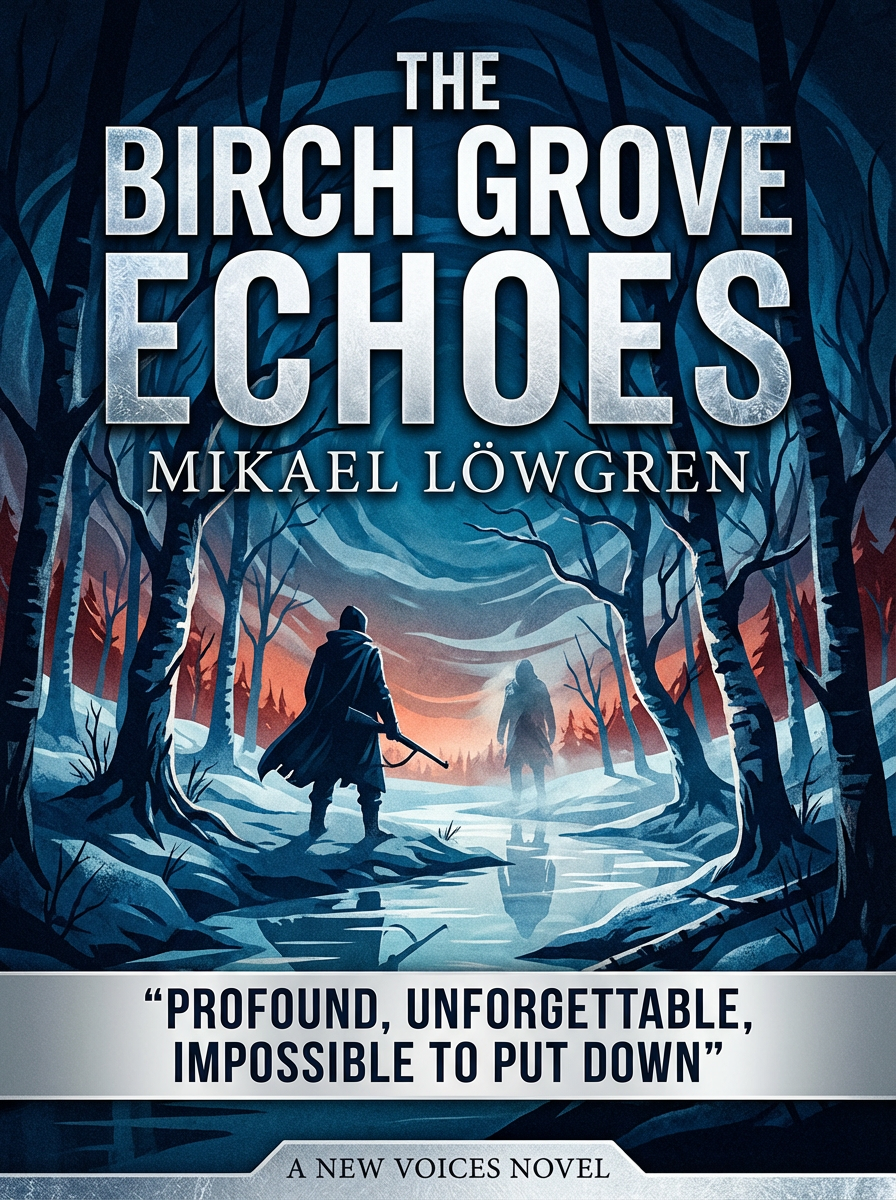
The Birch Grove Echoes
By Mikael Löwgren
Synopsis
Haunted by the ghosts of his past, Simo Häyhä's fragile peace is shattered by an unexpected encounter: Alexei Volkov, the young Soviet soldier he spared, now a broken man seeking answers. Their reluctant reunion forces Simo to confront the true cost of his legend and the enduring scars of war, leadi
Chapter 1: A Glimpse in the Clearing
The ice in Simo’s coffee had long since melted, its diluted warmth doing little to penetrate the persistent chill that seemed to emanate from the very marrow of his bones. Years had passed since the war, since the snow had last tasted of blood and the birch trees whispered secrets of impending death. Now, only the wind spoke in the groves of Rautjärvi, a mournful, indifferent language he understood better than any human tongue. His cabin, a stoic sentinel against the encroaching wilderness, offered scant solace. The scar, a jagged calligraphy across his jaw, throbbed with a phantom ache, a constant, physical reminder of a past that refused to stay buried. He ran a calloused thumb over it, feeling the raised ridge like a secret code embedded in his flesh.
He still hunted, of course. It was a rhythm ingrained deeper than memory, a silent dance with the forest that anchored him to the present, however tenuously. The rifle, an extension of his will, felt familiar in his hands, its cold steel a comfort. Today, the deer were elusive, their scent faint and their tracks hesitant in the damp earth. The air was heavy with the scent of pine needles and decaying leaves, a perfume of solitude. He moved with the quiet grace of a predator, his senses finely tuned, every rustle of leaf, every snap of twig registering in his consciousness as a potential message.
It was in a small clearing, bathed in the diffuse, watery light of a late autumn afternoon, that the silence broke. Not with a sound, but with an image. A flicker, at first, at the periphery of his vision, a disturbance in the otherwise placid tapestry of greens and browns. He froze, rifle instinctively raised, his breath held captive in his lungs.
The figure was slight, stooped, moving with a hesitant, almost jerky gait. He wore clothes that seemed too thin for the biting Finnish air, a frayed coat that hung loosely on his frame. His head was down, as if burdened by an invisible weight, but as he paused, drawing a ragged sleeve across his face, his eyes lifted.
And then, time fractured.
They were eyes Simo knew. Not from a photograph, not from a dream, but from the brutal intimacy of a battlefield. Wide, deep-set, rimmed with a profound exhaustion that spoke of endless nights and unspeakable terrors. Haunted. They held the same bewildered terror, the same raw vulnerability that had arrested his trigger finger all those years ago. The face was older, etched with lines that spoke of hardship and starvation, but the underlying structure, the particular curve of the brow, the set of the jaw – it was unmistakable.
Alexei.
The name, unspoken, reverberated in the hollow chambers of Simo’s mind, a ghost exhumed from the frozen earth. He squeezed his eyes shut for a fraction of a second, a desperate attempt to dispel the apparition. When he opened them again, the clearing was empty. The figure had vanished, swallowed by the indifferent trees.
Simo stood there, rooted to the spot, the rifle now a leaden weight in his hands. The scent of pine and decay seemed to sharpen, to take on the metallic tang of old blood. The wind, which had been a distant murmur, now howled in his ears, carrying with it a faint, insistent echo. Not of the forest, but of a young man’s terrified gasp, a plea for mercy in a language he didn't understand.
His fragile peace, a carefully constructed edifice of solitude and routine, had just been breached. The ghost of Alexei Volkov, it seemed, had found its way through the snow and ice, across the border, and into the very heart of his sanctuary. The forest, which he had once considered an extension of himself, now felt alien, imbued with a sinister, watchful presence. The hunt for deer was forgotten. A different kind of hunt, a far more unsettling one, had just begun.
Chapter 2: Whispers of the Past
The scent of pine needles, usually a balm, now clung to Simo’s senses like a shroud. The rifle felt heavy, a cold, familiar weight against his shoulder, but its presence offered no comfort. He walked, or rather, drifted, back through the deepening twilight, the woods around him no longer a sanctuary but a labyrinth of shadows and half-formed shapes. The figure in the clearing – it had been so undeniably there, a stark silhouette against the fading light, yet as elusive as smoke.
He reached the cabin, a small, sturdy structure he’d built with his own hands, each timber a testament to his desire for solitude. The fire in the hearth had dwindled to embers, a mirror of the warmth that had drained from his own spirit. He stoked it, the crackle of burning birch an unwelcome echo of the grove. He sat, not in his usual armchair, but on the hard wooden bench by the window, staring out into the encroaching darkness.
The face. It had been Volkov’s face, etched with a terror he remembered with visceral clarity. The eyes, wide and pleading, the blood smeared across his cheek – a memory he had meticulously buried beneath layers of snow and silence. For decades, he had believed it to be a ghost, a recurring nightmare born of the battlefield’s trauma. But this was different. This was daylight, albeit fading, and the solid ground beneath his feet. This was not a dream.
He closed his eyes, and the birch grove materialized with terrifying precision. The skeletal trees, stripped bare by winter, stood like silent sentinels. The snow, pristine and unforgiving, swallowed sound, amplifying the frantic rhythm of his own heart. He remembered the cold bite of the rifle stock against his cheek, the slow, controlled breath, the crosshairs settling. And then, the hesitation. A flicker of something, a recognition of shared humanity in the young Soviet soldier’s eyes, a desperate plea that had pierced the hardened shell of the sniper. He had lowered the rifle. A moment of weakness, a breach in the iron discipline that had defined his war, a decision that had haunted him with a quiet persistence for fifty years.
Now, that decision had returned, not as a whisper, but as a tangible presence in the twilight.
Simo ran a hand over his scar, the permanent reminder of the bullet that had nearly claimed his life. It throbbed, a phantom ache mirroring the turmoil within him. He poured himself a cup of strong coffee, the bitter taste grounding him, if only for a moment. He needed to think, to dissect this impossible encounter.
Was he finally losing his mind? The thought, cold and unwelcome, settled in his chest. He had always been a man of precision, of methodical thought. Hallucinations were for those broken by war, those who drowned their past in drink. He had done neither. He had chosen silence, chosen to live with his ghosts, to acknowledge their presence without succumbing to their demands. But what if this was a new kind of haunting, one that defied the boundaries of his carefully constructed reality?
He remembered a story his grandmother used to tell, about the forest spirits, the *metsänväki*, who could take on human forms, testing the resolve of those who ventured too deep into their domain. He dismissed the thought – he was a man of logic, a survivor of a brutal war, not a child afraid of old wives' tales. Yet, the memory lingered, a faint, unsettling echo.
The forest, his lifelong companion, now felt alien, imbued with a new, unsettling energy. He had always found solace in its silent majesty, its predictable rhythms. Now, every rustle of leaves, every snap of a twig, seemed to hold a hidden meaning, a potential revelation. The trees, once comforting sentinels, now seemed to watch him, their gnarled branches reaching like skeletal fingers.
He rose and went to the window again, peering into the inky blackness. The moon, a sliver of silver, cast long, distorted shadows. He tried to rationalize, to find a logical explanation. A hunter, perhaps, lost or simply passing through. But the face… the terror… the unmistakable familiarity. It was not just a face; it was an echo of a specific moment, a specific choice.
He remembered the weight of his guilt, a silent companion throughout the years. He had taken lives, many lives, with a chilling efficiency that had earned him a grim legend. But Volkov… Volkov had been different. He had spared him, a solitary act of mercy in a landscape of brutality. And now, that mercy, or perhaps the memory of it, had returned to confront him.
The silence of the cabin pressed in on him, heavy and suffocating. He needed to move, to do something, anything, to break the spell. He picked up a half-finished wooden carving, a small, intricate fox, its eyes still uncarved. His hands, usually steady and precise, trembled slightly. He set it down.
He walked to his small library, a collection of worn books on history, nature, and philosophy. He picked up a volume of Finnish poetry, its pages brittle with age. He read a few lines, the words blurring, their meaning lost in the clamor of his thoughts. The poetry, usually a source of quiet contemplation, felt hollow, unable to penetrate the thick fog of his unease.
He thought of the logline for his own story, the one the newspapers had sensationalized: "The White Death." He had never sought the notoriety, had never revelled in the grim title. He was simply a man who had done his duty, a man who had survived. But the legend, like a tenacious shadow, had followed him, defining him in ways he had never intended. And now, it seemed, the legend had brought its own consequences, its own reckoning.
He remembered the conversations he’d had with the few people who dared to visit him – a curious journalist, a distant relative. They always asked about the war, about the kills, about the fear. He always gave them the same answers, carefully constructed and devoid of emotion. He had learned to compartmentalize, to separate the man from the legend, the present from the past. But the man in the clearing had ripped open those carefully constructed partitions.
The question gnawed at him: Why now? Why, after all these years, had this specter from his past chosen to reappear? And what did it want? Answers, perhaps? Forgiveness? Or something more sinister?
He pictured Volkov again, the young, frightened soldier. He had been barely more than a boy, thrust into a war he likely didn't understand. Simo had seen the fear, the desperation, the raw humanity in his eyes. It was that flicker of recognition, that shared vulnerability, that had stayed his hand. He had always wondered what had become of him, if he had survived, if he had found peace. He had hoped he had.
Now, the possibility that Volkov had not only survived, but had sought him out, sent a shiver down his spine. The implications were vast, unsettling. It meant his past was not merely a memory, a series of events confined to the pages of history, but a living, breathing entity, capable of reaching out and touching him.
He got up and walked to the small, cold stove in the corner of the cabin. He opened the iron door, the faint scent of ash rising. He remembered the feeling of the frozen earth beneath his boots during the war, the biting wind, the constant threat of death. He had learned to be stone, to feel nothing. But the encounter with the figure had cracked that stone, revealing the raw, vulnerable flesh beneath.
He knew, with a chilling certainty, that he could not simply dismiss this. It was not a hallucination, not a trick of the light, not a ghost of his imagination. It was real. And if it was real, then his carefully constructed peace, his solitary existence, was irrevocably shattered.
The forest, once his steadfast companion, now felt like a stage, meticulously set for a drama he had long believed to be over. The echoes of the past, once confined to the quiet corners of his mind, were now reverberating through the very air he breathed, demanding to be heard, demanding a reckoning. He was no longer just Simo Häyhä, the old man living in the woods. He was Simo Häyhä, the sniper, confronted by the enduring consequences of his most profound choices. The night was long, and sleep, he knew, would be a distant, elusive dream. He would spend it staring into the darkness, listening to the whispers of the past, wondering what the dawn would bring.
Chapter 3: The Uninvited Guest
The week that followed Simo’s unsettling encounter in the birch grove was a strange, viscous thing, stretching and contracting like a disturbed earthworm. The air itself seemed to thicken, laden with unspoken questions. He went through the motions of his solitary life – chopping wood, mending a fishing net, staring at the embers of his evening fire – but each act felt like a pantomime, a poorly rehearsed play where the lead actor had forgotten his lines. The forest, once a vast, comforting silence, now hummed with a low, disquieting frequency, as if a thousand unseen cicadas were preparing for a mournful chorus.
His sleep offered no respite. Dreams, vivid and unsettling, painted themselves across the canvas of his subconscious. He saw Volkov’s face, not as it was in the clearing, but as it had been that winter day, a ghost of terror and a flicker of something unreadable in his eyes. He heard the metallic click of his rifle bolt, the sharp intake of breath as the bullet found its mark, or didn’t. The line between what was and what could have been blurred, a watercolor smudged by rain.
The morning of the eighth day dawned, not with the crisp clarity Simo usually associated with the Finnish winter, but with a sullen, bruised sky that promised snow. He was in the small lean-to beside his cabin, sharpening an axe, the rhythmic rasp of steel against stone a familiar, grounding sound. The air was cold, biting at his exposed hands, but he hardly noticed. His mind was still adrift in the murky waters of his past.
Then came the knock.
It wasn't the tentative tap of a lost hiker, nor the firm rap of a curious neighbor. It was a weak, uncertain thud, as if the knuckles making contact were themselves hesitant, unsure of their right to disturb the stillness. Simo paused, the whetstone frozen mid-stroke. His heart, a steady drum for decades, gave an unfamiliar lurch. He knew, with a certainty that bypassed logic and reason, who would be standing on the other side of that rough-hewn door.
He wiped his hands on his trousers, the scent of woodsmoke and steel clinging to his skin. He walked to the door, each step measured, deliberate. The scar on his jaw tightened, a familiar phantom ache. He reached for the latch, his fingers cold, and pulled it open.
The man standing on his porch was a ghost.
Gaunt, shivering, wrapped in an ill-fitting, threadbare coat that offered little protection against the biting air, he looked less like a human being and more like a scarecrow animated by a desperate, internal wind. His face, etched with lines that spoke of hardship and sleepless nights, was a map of suffering. His eyes, sunken and shadowed, held a quiet desperation that made Simo’s breath catch in his throat. They were the same eyes he had seen in the clearing, the same eyes that had looked up at him from the snow-covered ground all those years ago.
Alexei Volkov.
He stood there, swaying slightly, his breath pluming in the cold air. His lips were chapped, cracked, and when he spoke, the words were a raw, rasping whisper, laced with a thick, unfamiliar accent.
"Simo... Häyhä?"
The Finnish was broken, each syllable a struggle, a testament to a long-held memory or a desperate recent study. Simo simply stared, his mind struggling to reconcile the spectral figure in his memories with the tangible, shivering man before him. He remembered the flicker in Volkov’s eyes, the unspoken plea, the youthful fear. This man carried a different kind of fear, a deeper, more ingrained weariness.
Volkov took a step forward, then winced, a hand going to his ribs. He looked as if a strong gust of wind might shatter him. "You... remember?" he managed, his voice barely audible.
Simo nodded slowly, a single, deliberate movement. The scar pulsed. He stepped aside, opening the door wider. "Come in," he said, his own voice a dry, unused rasp.
Volkov hesitated, as if unsure of his right to enter, then shuffled across the threshold, bringing with him the scent of damp earth, stale smoke, and something else – a faint, metallic tang that Simo couldn’t quite place, but which settled uncomfortably in the back of his throat. He closed the door behind him, plunging the small cabin into a dim, hushed intimacy.
Volkov stood awkwardly in the center of the room, his eyes darting around, taking in the sparse, functional furnishings: the rough-hewn table, the two chairs, the cast-iron stove, the narrow bed covered with a wool blanket. He looked like a man who had forgotten how to be indoors, how to exist in a space that wasn't open sky or cramped hiding place.
"Sit," Simo offered, gesturing to one of the chairs. He moved towards the stove, adding a few more logs, stoking the embers until a cheerful crackle filled the silence. The warmth began to spread, slowly pushing back the chill Volkov had brought with him.
Volkov sank into the chair, his movements stiff, as if his joints were rusted. He held his hands out towards the burgeoning heat, though he didn’t seem to truly feel it, his gaze still fixed on Simo.
"I... survived," Volkov began, his voice gaining a fraction of strength as the warmth seeped into his bones. "After... after you left me. The others... they found me. Thought I was dead. But I wasn't." He paused, a strange, half-smile twisting his lips, a flicker of something ancient and resilient in his eyes. "A miracle, they said. Or a curse. I never knew which."
Simo remained silent, leaning against the rough-hewn wall, his arms crossed. He listened, his gaze steady on Volkov's face, searching for the boy he had spared, finding only the man he had become.
Volkov continued, his story unfolding in broken Finnish, punctuated by Russian words Simo instinctively understood, piecing together a harrowing narrative of survival. He spoke of waking in a makeshift field hospital, of the pain, the slow, agonizing recovery. He spoke of being sent back to the front, of the endless, grinding war, of the cold, the hunger, the constant awareness of death breathing down his neck.
"I tried to forget," he said, his voice dropping to a near whisper. "To forget that day. To forget you. But I couldn't. Your face... it was always there. In the snow. In the smoke. In the eyes of the dying." He shivered, despite the warmth of the stove. "It was a strange thing to be spared. A burden, almost. To live when so many others didn't. To carry that knowledge."
He reached into the inner pocket of his coat, his hand trembling slightly. He pulled out a small, worn leather wallet, its edges soft with age and handling. From it, he extracted a faded, sepia-toned photograph. He held it out to Simo.
Simo took it. It was a picture of a young woman, her smile gentle, a small child perched on her lap, another child, slightly older, standing beside her, holding her hand. Their faces were kind, open, innocent. A family.
"My wife, Anya. My son, Dmitri. My daughter, Lena," Volkov said, his voice thick with a tenderness that cut through the harshness of his previous words. "They were waiting for me. I carried this. Always. It was... my reason."
Simo looked at the photograph, then back at Volkov. The desperation in his eyes deepened, shifting from a general weariness to a specific, focused agony.
"After the war," Volkov continued, his gaze distant, "I went home. To our village, near Smolensk. It was... gone. Not just bombed. Erased. As if it had never existed." He paused, swallowing hard. "I searched. For weeks. Months. I asked everyone. No one knew. No one remembered. It was as if my family, my entire life, had vanished into thin air. Like a forgotten dream."
He took a deep, shuddering breath. "I rebuilt my life. I had to. I worked. I traveled. I tried to forget again. But the question... it always remained. What happened to them? Why was there no trace? No graves? No official records of their disappearance?"
Simo remained silent, the photograph warm in his hand. He understood the void Volkov spoke of. The silence where a life should be. The unanswered questions that gnawed at the soul. He knew what it was like to carry a burden that refused to be shed.
"Then," Volkov said, his voice dropping again, conspiratorial, urgent, "about six months ago, I heard something. A whisper. A name. A place. A story that made no sense, but… it resonated. It spoke of things that vanish. Of people who are… removed. Not by war. By something else."
He looked directly at Simo, his eyes burning with an unsettling intensity. "The whisper said there was a man. A ghost of the war. A man who knew things. Who saw things others didn't. A man who understood what it meant for life to disappear without a trace."
Simo felt a prickle of unease. He knew where this was going.
"It spoke of the White Death," Volkov continued, the words a strange mixture of reverence and fear. "It spoke of a sniper who saw... beyond the battlefield. Who understood the deeper currents. The hidden truths." He leaned forward, his voice a desperate plea. "They said you would know. They said you were the only one who could help me find out what truly happened to my family. To my village."
He held out a hand, palm up, revealing a small, crudely drawn map on a scrap of paper, yellowed with age. It depicted a series of winding lines, a few indistinct symbols, and a single, circled 'X' deep within a vast, unmarked forest.
"This is all I have," Volkov said, his voice raw with emotion. "A rumor. A faded memory. And this map. It points to a place. A place where things are supposedly... remembered. Where answers might be found." He looked at Simo, his eyes pleading. "I have nowhere else to go. No one else to ask. The war... it binds us, Simo Häyhä. You spared my life. Now, I ask you to help me find out what became of it."
The cabin was silent save for the crackle of the fire. Simo looked at the map, then at the photograph, then at Volkov’s gaunt, desperate face. The uninvited guest. A ghost of his past, now returned to demand not a life, but an answer. The forest, he realized, was not just a stage for his unresolved past. It was a crucible, and he, Simo Häyhä, was about to be forged anew. The echoes of the birch grove were not just whispers. They were calls to action, drawing him back into a world he had long sought to escape. The fragile peace he had built around himself, brick by solitary brick, had just been shattered. And he knew, with a chilling certainty, that this was only the beginning.
Chapter 4: A Pact Forged in Silence
Simo watched Volkov, the gaunt man on his doorstep, shiver. The rain had softened to a persistent drizzle, clinging to the branches of the birches outside like silver tears. Volkov’s words, broken Finnish interspersed with a guttural Russian that Simo understood more from context than direct translation, painted a picture of a life unmade. The faded photograph, clutched in a hand that trembled not just from cold but from a deeper tremor, showed a woman with kind eyes and two small children, their smiles frozen in a time before the world had gone mad.
Simo had seen countless such photographs. He’d seen them clutched by fallen soldiers, tucked into pockets of uniforms stained with blood and mud. He’d seen them in the hands of grieving widows, their faces ashen, their eyes hollow. But this photograph, in this man’s hand, felt different. It was a testament not to loss, but to a desperate, almost irrational hope.
Volkov spoke of a labor camp. A place far to the east, shrouded in a fog of official silence. He spoke of whispers, of rumors carried on the wind, of families deemed… inconvenient. He’d spent years searching, years following faint trails of information, years clinging to the thread of a possibility that his wife and children, presumed dead in the chaos of war and subsequent purges, might still be alive. Relocated. Reassigned. Re-educated. The euphemisms of a monstrous bureaucracy, designed to obscure the truth.
Simo listened, his gaze fixed on the steam rising from the mug of tea he’d given Volkov. The younger man’s story was a mosaic of fragmented memories, harrowing escapes, and relentless pursuit. He’d been imprisoned himself, released only through a twist of fate, a clerical error, or perhaps simply because he was no longer deemed a threat. He’d walked across vast stretches of land, worked in mines, toiled in fields, always moving, always asking, always searching. The war had ended for everyone else, but for Volkov, it had simply transformed into a different kind of battle.
“They said… they said they were gone,” Volkov rasped, his voice hoarse. “But then, a man… an old man, he worked at the archives, he told me… he said some families, not all of them, but some… they were moved. To a new… settlement. Far north. Beyond the known maps.”
Simo felt a familiar tightening in his chest. A cold, metallic taste in his mouth. The kind he’d known when he’d sighted an enemy through his scope, when the world narrowed to a single, stark decision. He understood the impulse to search, the relentless pull of an unfinished story. He understood the need for answers, even if those answers were terrible.
He looked at Volkov’s eyes, red-rimmed and bloodshot, but burning with an unshakeable conviction. They were the eyes of a man who had nothing left but this single, desperate quest. And in those eyes, Simo saw an echo of his own past humanity. Not the legendary White Death, the ghost of the battlefield, but the young man who had once believed in something beyond survival.
Volkov needed Simo’s skills. That was the unspoken truth hanging in the air between them, thicker than the woodsmoke from the hearth. Simo was a ghost of the wilderness, a master of stealth and evasion, a man who could navigate the harsh, unforgiving landscapes of the north as if they were an extension of his own body. He knew how to disappear. He knew how to find what was lost. He knew how to survive where others perished.
“The archives man… he gave me a name,” Volkov continued, his voice dropping to a whisper. “A code name. For the settlement. ‘Severnaya Zarya’.” Northern Dawn. A cruel irony, Simo thought.
Simo remained silent. He traced the rim of his mug with a calloused thumb. The silence in the cabin was not empty; it was pregnant with unspoken questions, with the weight of shared history, with the ghost of a shared moment in a birch grove.
Volkov watched him, his gaze unwavering, expectant. He wasn’t asking for help, not directly. He was laying out his burden, his impossible dream, and implicitly, offering Simo a chance to finally close a chapter that had haunted them both.
Simo thought of the birch grove. The snow, pristine and undisturbed. The glint of sun on the rifle barrel. Volkov’s face, young and terrified. The moment of decision. The almost imperceptible shift of his finger away from the trigger. A flicker of something, a recognition of shared humanity in the brutal machinery of war. He had spared Volkov’s life, and in doing so, had inadvertently woven their destinies together with an invisible thread.
Now, that thread was pulling.
He stood up and walked to the window. The birches, skeletal in the persistent drizzle, swayed gently. Beyond them, the forest stretched, dark and ancient, a labyrinth of shadows and secrets. The north. A place of unforgiving beauty, of endless horizons, of hidden depths. A place where things could be lost, and sometimes, found.
“It’s a long way,” Simo said, his voice a low rumble, rusty from disuse.
Volkov nodded, a slow, deliberate movement. “I know.”
“Dangerous.”
“I have nothing left to lose.”
Simo turned from the window, his gaze sweeping over Volkov. The man was a wreck, yes, but there was an inner steel, a core of unyielding resolve that Simo recognized. It was the same fire that had driven him through the long, frozen winters of the war, the same tenacity that had allowed him to survive against impossible odds.
He walked to a worn wooden chest in the corner of the cabin. He rummaged inside, pulling out a faded map, its edges frayed, its surface creased with countless folds. He spread it on the rough-hewn table, smoothing it with his hands. It was a Finnish military map, old but detailed, showing the vast, untamed wilderness stretching eastward.
Volkov leaned closer, his breath catching in his throat. His finger, trembling slightly, traced a path across the map, across the border, into the unknown territories of the Soviet Union.
“Beyond this,” Simo said, pointing to a vast, blank area on the map, “it is uncharted. Or, at least, uncharted by us.”
Volkov’s eyes, however, were fixed on something else. On the margin of the map, Simo had scrawled a few cryptic notes in Finnish, observations from his own forays into the border regions during and after the war. Weather patterns, game trails, hidden waterways. The kind of knowledge that could mean the difference between life and death in the wilderness.
He looked up at Simo, a flicker of understanding in his gaze. He knew, without a word being spoken, that Simo was considering. Not just the journey, but the implications. The danger. The breaking of his own self-imposed exile. The re-engagement with a world he had painstakingly sought to leave behind.
Simo picked up an old, leather-bound journal from the shelf. He flipped through its pages, filled with his terse, economical handwriting. Observations of the forest, the movements of animals, the subtle shifts of the weather. A lifetime of intimacy with the natural world, distilled into ink and paper.
He closed the journal, the soft thump echoing in the quiet cabin. He looked at Volkov again. The man’s face was a roadmap of suffering, but beneath it, there was an insistent, almost childlike hope. A hope that, despite everything, refused to die.
The thought, unbidden, came to Simo: *What if it were me? What if it were my family?* The question, a phantom limb of a past he’d long buried, resonated with an unexpected force. He had no family, not anymore. The war had taken them, or scattered them to the winds of memory. But the primal urge to protect, to search, to reclaim what was lost, was a universal language, one that transcended borders and allegiances.
He knew the risks. He knew the Soviet Union was a vast, unforgiving land, guarded by an omnipresent, invisible hand. To venture into its depths, especially in search of a forbidden settlement, was an act of profound folly, or profound courage.
But then, Simo had always walked the line between those two extremes.
He walked to the hearth, stirring the embers with a long poker. Sparks flew, dancing in the dim light, brief flashes of incandescent life against the encroaching darkness. The air in the cabin was thick with the smell of woodsmoke, damp earth, and the unspoken weight of their shared predicament.
Volkov shifted slightly, his gaze following Simo’s movements. He didn’t press, didn’t plead. He simply waited, a silent testament to his profound desperation. This restraint, this quiet dignity in the face of such overwhelming need, struck Simo more deeply than any impassioned plea could have.
Simo turned from the hearth, his decision made. It wasn’t a verbal declaration, not yet. It was a subtle shift in his posture, a hardening of his gaze, a quiet resolve settling over his features.
He walked back to the table, picked up the faded photograph, and studied it for a long moment. The woman’s smile. The children’s bright, innocent eyes. These faces, these lives, were the anchors of Volkov’s fragile sanity.
He set the photograph down. He looked at the map again, his finger tracing a new, more easterly path. A path through dense forests, across frozen rivers, over snow-laden mountains. A path into the unknown.
“We will need supplies,” Simo said, his voice low, gravelly. “Warm clothes. Food. Ammunition.”
Volkov’s breath hitched. A slow, almost imperceptible nod. A flicker of relief, so profound it was almost painful to witness, passed across his face.
The pact was forged in that silence, in the unspoken understanding that passed between them. It wasn’t a pact of friendship, not yet. It was a pact of necessity, of shared burden, of a silent acknowledgment of the unbreakable thread that bound them.
Simo, the legendary sniper, the ghost of the Finnish snows, was stepping back onto a battlefield, not with a rifle aimed at an enemy, but with a former enemy, in search of a lost family. The irony was not lost on him. The echoes of the birch grove, once a haunting memory, now seemed to propel him forward, into a future he could never have anticipated.
Volkov, the young Soviet soldier spared by a bullet, now a broken man chasing a whisper of hope, had found his unlikely ally. He had found the one man who could navigate the shadows between nations, between past and present, between life and death.
The rain outside had finally stopped. A sliver of pale moonlight pierced through the clouds, illuminating the birches, their white bark gleaming like spectral bones. The forest, once a sanctuary, now beckoned with a new, perilous promise. Simo knew, with a chilling certainty, that the journey would be long, arduous, and fraught with dangers far beyond the bite of the winter wind. But as he looked at Volkov, at the faint glimmer of hope in the man’s haunted eyes, he also knew that some journeys, however impossible, must be undertaken. The echoes of the past, it seemed, demanded their reckoning. And Simo, the quiet man of the woods, had finally answered their call.
Chapter 5: Shadows Across the Border
The biting wind, a relentless sculptor of snow and silence, was their constant companion. Simo, a wraith in the monochrome landscape, led the way, his movements economical, a dance perfected over a lifetime spent in the embrace of the wilderness. Volkov, a shadow in his wake, stumbled occasionally, the unfamiliar terrain a cruel mistress. Days bled into one another, marked only by the shifting light and the gnawing hunger that settled deep in their guts. The Soviet border, a line etched in the snow and in their shared history, remained an abstract concept, a distant hum beneath the frozen earth.
Their interactions were sparse, a language of necessity rather than camaraderie. A pointed finger indicating a safer path, a shared glance acknowledging a particularly treacherous patch of ice. Words, when they came, were clipped, utilitarian. "Rest." "Eat." "North." Each syllable carried the weight of unspoken battles, of lives irrevocably altered. Volkov, his eyes perpetually rimmed with a weariness that went beyond physical exertion, watched Simo with a mixture of apprehension and a nascent, unsettling trust. He remembered the legendary sniper, the White Death, a phantom in the snow, a harbinger of swift, silent demise. Now, that same man, a figure of myth, trudged beside him, a guide to an unknown future. The irony was a bitter taste on his tongue.
The landscape itself was a character in their grim drama, a stark canvas painted in shades of white and grey. Frozen pines, their branches heavy with snow, stood like skeletal sentinels. The air, so cold it burned the lungs, carried the scent of pine needles and something else, something metallic and acrid, an echo of forgotten fires. The silence, profound and pervasive, was occasionally broken by the crack of ice, the rustle of a hidden creature, or the rhythmic crunch of their boots on the packed snow. For Simo, this silence was a familiar comfort, a language he understood intimately. For Volkov, it was a suffocating shroud, amplifying the insistent whispers of his own mind.
One afternoon, as the low winter sun cast long, distorted shadows across the snow, Simo paused. He held up a gloved hand, a silent command. Volkov, accustomed to these sudden halts, stopped instantly, his breath pluming in the frigid air. Simo’s gaze, sharp and unblinking, swept across a rise ahead of them. There, partially obscured by a drift, was a dark, angular shape. A bunker.
It was a stark, concrete scar on the pristine landscape, a brutal intrusion. The entrance, a gaping maw, was choked with snow and ice, but the unmistakable silhouette of a machine-gun nest was still visible. Volkov felt a familiar clenching in his stomach, a cold knot of dread. This was a place where men had died. Where he, too, could have died.
Simo approached cautiously, his rifle held loosely but ready. He peered into the darkness of the bunker, his breath clouding the air. Volkov hesitated at the entrance, a wave of nausea washing over him. The air inside was still and cold, tasting of dust and decay. A broken wooden crate lay overturned, its contents long gone. A faded, torn map was pinned to a crumbling concrete wall, its lines and symbols rendered meaningless by time and neglect.
Volkov’s eyes scanned the interior, his gaze snagging on a small, rusted tin cup lying on the floor. He remembered similar cups, filled with bitter tea, shared in the desperate camaraderie of the trenches. A sudden, vivid image flashed in his mind: a young face, bright with hope, sharing a joke in a similar bunker, before the roar of artillery had ripped him from existence. He felt a tremor run through him. This was not just a bunker; it was a tomb.
Simo, sensing Volkov’s unease, turned. His eyes, usually unreadable, held a flicker of something akin to understanding. He didn’t speak, didn’t offer comfort. There was no need. The silent acknowledgement was enough. They were both intimately familiar with these ghosts.
They continued their journey, the encounter with the bunker leaving a lingering chill that had nothing to do with the weather. The silence between them, already profound, deepened, becoming a shared burden. Volkov found himself replaying fragmented memories of the war, the faces of comrades, the sound of distant gunfire, the smell of gunpowder and blood. He wondered if Simo, too, was wrestling with his own internal demons. Did the White Death ever dream of the men he had killed? Did their faces haunt his quiet nights? The thought was strangely unsettling.
A few days later, they stumbled upon another remnant of the war – an overgrown trench line, snaking across a frozen field like a scar. The earthworks, once meticulously dug, were now softened by snow and time, but their purpose was unmistakable. Here, men had huddled, shivering, waiting for the command to advance, or to retreat. Here, lives had been extinguished with brutal efficiency.
Volkov knelt, brushing away a layer of snow. Beneath it, a piece of rusted barbed wire emerged, its sharp barbs still menacing. He traced the cold metal with a gloved finger, a shiver running down his spine. The air here felt heavy, laden with the echoes of desperate shouts and silent prayers. He could almost hear the wind whispering the names of the fallen.
Simo stood a short distance away, his back to Volkov, his gaze fixed on the horizon. He seemed to be listening to something beyond the wind, something only he could hear. Volkov wondered if Simo felt the weight of these places as acutely as he did, or if the years had dulled the sharp edges of memory. He suspected the latter. Simo, the legendary sniper, had to be a master of detachment, a man who could compartmentalize the horror to survive.
As they moved on, following the undulating line of the trench, Volkov found himself studying Simo more closely. The Finn’s face, weathered by sun and wind, was a roadmap of hardship. His eyes, though often distant, held an intensity that spoke of a mind constantly at work, assessing, calculating. He moved with a grace that belied his age, each step precise, deliberate. There was a quiet strength about him, an almost primal connection to the land.
One evening, as they huddled beside a small, carefully built fire, the flames casting flickering shadows on their faces, Volkov found himself breaking the silence. He had been staring into the embers, the heat a welcome reprieve from the biting cold.
"Do you ever… dream of it?" Volkov asked, his voice low, almost a whisper.
Simo, who had been meticulously cleaning his rifle, paused. He didn't look up immediately. The crackle of the fire filled the void. Finally, he raised his head, his eyes meeting Volkov's across the dancing flames.
"The war?" Simo’s voice was a low rumble, rough with disuse.
Volkov nodded, tracing patterns in the snow with a stick. "The faces. The sounds. The… leaving them behind." He didn't elaborate, but the unspoken words hung heavy in the air. The men he had watched die, the comrades he had been forced to abandon.
Simo returned to his rifle, his movements slow and deliberate. "Dreams are for the living," he said, his voice devoid of emotion. "The dead have their own sleep."
Volkov shivered, though not from the cold. He understood. Simo, the man who had walked through the valley of death and emerged, had perhaps learned to shut off those avenues of pain. Or perhaps, the pain was simply too vast to articulate, too deeply embedded to ever truly escape.
He thought of his own nightmares, the ones that still woke him in a cold sweat, the ones that whispered of his family, lost in the vast, silent machinery of the Soviet state. He wondered if Simo, in his own way, was haunted by a similar emptiness.
A few days later, they encountered another unsettling reminder of the past. A frozen stream, its surface a glassy sheet of ice, wound through a narrow valley. As they approached, Volkov spotted something embedded in the ice, a dark shape beneath the translucent surface.
Simo saw it too. He knelt, his face a mask of grim recognition. It was a helmet, a Soviet helmet, partially submerged, its star emblem dulled by time and water. Beside it, a skeletal hand, encased in ice, reached upwards, a silent plea.
Volkov felt a wave of profound sorrow. This was not a battlefield, not a trench. This was a place where a man had simply… fallen. Lost, perhaps, in the chaos of retreat, or in the unforgiving embrace of the winter. He imagined the soldier, stumbling, disoriented, the cold seeping into his bones, the desperate struggle against the inevitable.
Simo remained silent, his gaze fixed on the frozen hand. There was no pity in his eyes, but a deep, somber understanding. He had seen too many such sights, too many silent farewells. He reached out, his gloved hand hovering inches above the ice, as if to touch the spectral limb. But he didn’t. The gesture was enough. A silent communion between the living and the long-departed.
Volkov watched him, a strange mix of emotions swirling within him. This was the man who had been his enemy, the legendary killer. Yet, in these moments, stripped of the uniforms and the flags, he saw something else: a man who carried the heavy burden of witnessing, a man who understood the profound, brutal finality of war.
As they moved away from the frozen stream, the image of the hand lingered in Volkov’s mind. It was a stark reminder of the fragile line between life and death, a line they were constantly treading as they pushed deeper into the unforgiving wilderness. The border, a physical manifestation of a political divide, seemed to grow closer with each step, but the true border they were crossing was one of memory, of trauma, of the very fabric of their beings.
The journey continued, a relentless march through a landscape that seemed to breathe the ghosts of the past. The days were a blur of white and grey, the nights a struggle against the encroaching cold. Volkov’s initial apprehension of Simo had begun to soften, replaced by a grudging respect, a quiet acknowledgment of their shared humanity in the face of such profound desolation. The legend of the White Death was still there, a chilling undercurrent, but beneath it, Volkov saw a man, weathered and scarred, carrying his own invisible wounds.
And Simo, in his own stoic way, observed Volkov. He saw the haunted eyes, the tremor in his hands when they passed a particularly vivid reminder of the war. He saw the strength beneath the weariness, the unwavering determination that propelled the younger man forward. He saw a reflection of himself, perhaps, in the ghost-ridden landscape of Volkov’s soul. The silence between them was no longer empty, but filled with the unspoken understanding of two men who had walked through hell and emerged, forever changed. The border awaited, a new frontier, but the true journey, they both knew, had begun long ago, in the birch groves and blood-soaked fields of a war that refused to die.
Chapter 6: The Hunter's Instinct Awakens
The air grew thin, carrying the scent of damp earth and pine needles, a familiar perfume that Simo had inhaled countless times. They had crossed the border, a line more psychological than geographical, marked only by a gradual shift in the density of the forest, a subtle change in the undergrowth. Volkov, despite his initial trepidation, moved with a newfound determination, his eyes scanning the tree line, a map of hope and fear unfolding in his mind. Simo, however, felt a different kind of shift within himself. It was a faint tremor at first, like a distant echo in a deep well, then it grew, a low hum beneath his skin.
He saw the first sign near a cluster of ancient birches, their bark peeling like old parchment. A small, almost imperceptible indentation in the moss, a faint scuff mark that only an eye trained for decades in the art of tracking could discern. It wasn't an animal print. It was too regular, too intentional. "Stop," Simo murmured, his voice a low gravelly sound.
Volkov halted, his breath catching in his throat. He looked around, bewildered, seeing nothing but the endless, indifferent trees. "What is it?" he whispered, his hand instinctively going to the worn leather strap of his satchel.
Simo didn't answer immediately. He knelt, his fingers brushing the cool, damp moss. He traced the faint outline, a ghost of a boot print, probably a week or two old, perhaps more. It wasn't a solitary mark. A few feet away, another, then another, leading deeper into the Soviet territory. He stood, his gaze sweeping the surroundings, the familiar landscape now imbued with a new, unsettling layer of meaning.
"Human presence," Simo finally said, his voice flat, devoid of emotion. "Military."
Volkov’s brow furrowed. "But… there shouldn't be. Not here. Not this deep."
Simo simply grunted, a sound that conveyed both agreement and a deep, ingrained skepticism. He pointed to a small, almost hidden thicket of juniper bushes. "Look closer."
Volkov squinted, then his eyes widened slightly. Tucked beneath the tangled branches, partially obscured by fallen leaves, was a small, crumpled piece of paper. Simo retrieved it, his movements fluid and precise. It was a ration wrapper, faded and brittle, with Cyrillic script. "Soviet military field rations," Simo stated, holding it up for Volkov to see. "Not old. A few months, perhaps. Maybe less."
A cold knot tightened in Volkov’s stomach. This wasn't just a stray patrol. This was something more sustained, more deliberate. The border region, he knew, was usually sparsely manned, especially deep within the forest. "But why?" he asked, his voice laced with a tremor of apprehension. "What are they doing here?"
Simo didn't speculate. His mind, long accustomed to the brutal logic of survival, was already piecing together the fragments. The faint tracks, the discarded ration wrapper, the almost imperceptible disturbance in the natural order of the forest. It was a language he understood intimately, a dialect of danger.
As they pressed on, the signs became more frequent, more pronounced. A broken twig, snapped not by the weight of snow, but by a heavy boot. A patch of flattened grass, where men had clearly rested. The ghost of a campfire, long since extinguished, a dark stain on the earth. Each discovery was a subtle vibration in Simo’s consciousness, a reawakening of senses that had lain dormant for decades.
He found himself moving differently, his steps lighter, more deliberate. His eyes, once content to simply observe the beauty of the forest, now darted, scanned, analyzed. He saw the world through a different lens, a lens honed by years of war, a lens that sought out anomalies, disruptions, threats. The soft rustle of leaves was no longer just the wind; it was a potential betrayer of their presence. The distant cry of a bird was no longer just a bird; it was a potential signal.
The old persona, the ‘White Death,’ was stirring. It was a strange, unsettling sensation, like a forgotten limb regaining its feeling, a phantom ache becoming real. He had spent so long trying to bury that part of himself, to let the forest heal the wounds it had inflicted. Now, the forest itself was pulling it back to the surface.
Volkov, walking a few paces behind Simo, noticed the change. Simo’s posture had subtly altered, his shoulders squaring, his head held at a slightly different angle. There was a coiled tension in his movements, a readiness that hadn't been there before. He was no longer just a tracker; he was a hunter.
"You're… different," Volkov ventured, his voice hushed.
Simo didn't break his stride. "The forest changes you," he replied, his voice gruffer than usual. "It demands attention."
But Volkov knew it was more than that. He remembered the stories, the whispered legends of the Finnish sniper, the ghost in the snow. He saw a flicker of that ghost in Simo’s eyes now, a glint of steel that sent a shiver down his spine. It was both terrifying and, in a strange way, reassuring. If anyone could navigate this unseen danger, it was Simo Häyhä.
They came across a more significant discovery near a small, frozen stream. A makeshift lean-to, constructed from branches and tarpaulin, partially hidden by a thicket of spruce. It was abandoned, but recently. A faint smell of woodsmoke still clung to the air. Inside, Simo found a discarded cigarette butt, a brand he recognized as Soviet, and a small, empty tin of preserved meat.
"They were here for a while," Simo observed, his voice devoid of judgment, merely stating a fact. "A patrol. Or a lookout post."
Volkov’s mind raced. He had imagined a quiet journey, a surreptitious infiltration. This was something else entirely. The border region wasn't just active; it seemed to be under a constant, clandestine watch. This complicated everything. His family, if they were indeed in a camp, would be even harder to reach, even more securely guarded.
The blurring lines between past and present became a tangible thing for Simo. He felt the weight of his old rifle, even though it wasn't there. He felt the biting cold of the winter war, even though it was now late spring. The sounds of the forest began to morph, the snap of a twig becoming the crack of a sniper rifle, the rustle of leaves becoming the distant murmur of enemy voices. It was a hallucinatory overlay, a phantom landscape superimposed on the real one.
He paused, leaning against a thick pine trunk, closing his eyes for a moment. The scent of pine resin filled his nostrils, grounding him. He opened his eyes, and the war receded, momentarily. But the hunter remained.
"We need to be more careful," Simo said, his voice low, almost a whisper. "They are not just passing through. They are watching."
Volkov nodded, his face pale. The initial euphoria of finally being on his quest had been replaced by a gnawing anxiety. He had anticipated obstacles, but not this. Not a reawakening of the very conflict that had shaped both their lives.
As they continued, Simo’s observations grew sharper, more detailed. He noticed the way certain branches had been disturbed, not by animals, but by human passage. He saw the faint, almost invisible tracks of a military boot on a patch of exposed earth. He even detected the faint, metallic tang of rifle oil in the air, a scent that had once been as familiar to him as the smell of his own cabin.
He pointed to a cluster of stones arranged in a peculiar pattern near a fallen log. "Signpost," he explained to Volkov. "To mark a path, or a rendezvous point."
Volkov stared at the stones, seeing only random rocks. Simo saw a message, a silent language of military presence. It was unsettling, this ability of Simo to read the unwritten, to see the invisible. It was like walking with a ghost who could interpret the whispers of other ghosts.
The sun began to dip below the horizon, painting the sky in hues of bruised purples and oranges. A chill seeped into the air. They found a sheltered alcove beneath an overhang of rock, a natural hideaway. Simo, with practiced ease, began to prepare a small, smokeless fire, using dry birch bark and twigs. His movements were economical, efficient, honed by years of necessity.
As the small flames flickered, casting dancing shadows on their faces, Volkov watched Simo. The old man’s eyes, usually a calm, reflective grey, now held a glint of something sharper, more alert. The scar on his cheek seemed to deepen in the firelight, a stark reminder of the violence he had endured and inflicted.
"You've been here before, haven't you?" Volkov asked, his voice barely a murmur.
Simo looked up from tending the fire, his gaze meeting Volkov’s. "Many times," he replied, his voice raspy. "During the war. After. Hunting."
"And you see them now, don't you?" Volkov pressed, a strange mix of fear and admiration in his eyes. "The soldiers. The shadows. You see them as if they were still here."
Simo stared into the flames, the orange light reflecting in his pupils. He didn't answer directly. Instead, he spoke in a low, almost poetic tone, as if recalling a half-forgotten dream. "The forest remembers. It holds the echoes of what has passed. The sounds, the movements, the intentions. If you listen closely enough, you can hear them all."
He picked up a small, smooth stone and tossed it into the fire. It hissed softly as the heat touched it. "It's like a song," he continued. "A very old, very dark song. Once you learn the melody, you can't unhear it."
Volkov shivered, despite the warmth of the fire. He understood. Simo wasn't just seeing traces; he was reliving them. The war, for Simo, was not a closed chapter; it was a recurring nightmare, a persistent echo in the birch grove of his mind. And now, this journey, this quest for Volkov's family, was forcing him to confront that nightmare head-on.
The realization settled over Volkov with a heavy weight. He had asked Simo for help, not fully comprehending the cost. He had pulled Simo back into a world he had fought so hard to escape. The 'White Death' was not just a legend; it was a part of Simo, a part that had been dormant, but never truly gone. And now, Volkov had inadvertently awoken it.
He wondered what that meant for their journey, for their chances of success. And more disturbingly, he wondered what it meant for Simo. Could a man truly return to peace once the hunter's instinct had been fully awakened? Or was it an irreversible transformation, a final surrender to the ghost of his past?
The night deepened, the forest growing quiet save for the crackle of their small fire and the distant hoot of an owl. Simo sat, unmoving, his gaze fixed on the darkness beyond their small circle of light. He was listening, not just with his ears, but with every fiber of his being. He was reading the silent language of the forest, deciphering the coded messages of human presence.
The lines between his past and present, between the war and the fragile peace he had built, were not just blurring; they were dissolving. He was no longer just Simo Häyhä, the old man living in the solitude of Rautjärvi. He was Simo Häyhä, the White Death, once again, navigating the treacherous landscape of a world that refused to let go of its ghosts. And in the unsettling silence of the deep forest, he knew, with a chilling certainty, that the hunt had truly begun.
Chapter 7: A Cold Trail
The moon, a sliver of bone in a sky the colour of old bruises, offered little comfort. Simo and Volkov moved like shadows themselves, their breath pluming in the frigid air as they slipped across the border. No grand declaration, no fanfare of trumpets, just the crunch of frozen earth beneath their boots, a silent passage from one world to another. Finland had receded, a memory now, replaced by the vast, indifferent expanse of the Soviet Union.
Here, the forest was different. Not the familiar, welcoming embrace of the birches and pines Simo knew, but a skeletal, watchful presence. The trees stood taller, darker, their branches laced with a thin hoarfrost that shimmered like a million tiny eyes. The air itself felt heavier, laced with the metallic tang of something indefinable, something industrial and cold.
They had crossed at a point Volkov had meticulously scouted, a forgotten stretch of wilderness where the border patrols were said to be less frequent, more lax. But even in this desolate expanse, the feeling of surveillance was palpable. Simo felt it in the way the wind whispered through the dead leaves, in the unnatural silence that descended after a distant, unseen bird called out. The land itself seemed to hum with an unspoken tension, a low thrum beneath the frozen surface.
"This is it," Volkov whispered, his voice thin, almost lost in the vastness. He pointed to a barely discernible track, a faint indentation in the snow, winding deeper into the gloom. "The old logging road. It leads to the checkpoint, eventually."
Simo grunted, his eyes scanning the tree line. His hunter’s instinct, sharpened by the journey and reawakened by the proximity of danger, was a cold, precise instrument. He saw the disturbed snow where a patrol had passed hours ago, the snapped twig that spoke of hurried movement, the faint scent of stale tobacco clinging to the air. This wasn't a forgotten wilderness; it was a carefully managed wilderness, a stage set for a silent, unseen drama.
"We avoid the road," Simo stated, his voice a low growl. "Too open. Too many eyes."
Volkov nodded, a shiver running through him that had nothing to do with the cold. "Yes. I know. But it's the only way to get close to… to where I heard the rumours begin." He paused, his gaze fixed on the endless, dark forest ahead. "They call it the 'Ghost Camp'."
The words hung in the air, a phantom chill. Simo felt a familiar tightening in his gut, a visceral response to the implications of such a name. He had seen enough of war’s atrocities to know that 'ghost' in this context rarely referred to the supernatural, and always to something far more horrifyingly human.
Volkov began to speak, his voice gaining a quiet intensity. "Before I was… before I met you, in the hospital, there were whispers. Among the orderlies, the nurses. Stories they tried to suppress, but could not. Of a place, deep in the forests, far from any official records. A camp. Not for soldiers, not for prisoners of war. For others."
He hesitated, his breath misting. "Political prisoners. Intellectuals. And… and the families of 'traitors'. People who simply disappeared. Vanished. Their names struck from the registers, their existence denied. They said this camp… it operates outside the law. A black hole in the system."
Simo listened, his mind sifting through Volkov’s words, turning them over like smooth, cold stones. The implications were stark. A place of such secrecy, operating with such impunity, meant a level of ruthlessness that transcended even the brutal realities of wartime. It spoke of a system that devoured its own, leaving no trace.
"Why 'Ghost Camp'?" Simo asked, his eyes still sweeping the periphery, his senses alert to every rustle, every shadow.
Volkov shrugged, a weary, defeated gesture. "Because no one ever leaves. And those who are taken there… they become ghosts. Their families never know what happened. Their friends forget their faces. They simply cease to be." He ran a hand through his hair, a gesture of profound weariness. "My family… my father was a professor. My mother, a doctor. My sister… she was still a child. They were deemed 'enemies of the state' after my father spoke out against some… policies. They vanished. I was told they were executed. But then, in the hospital, I heard these whispers. Of a camp where families were held. As leverage. As punishment."
The raw desperation in Volkov's voice was a tangible thing, a cold knot in Simo's stomach. It was the desperation of a man clinging to a sliver of hope, even if that hope led him into the jaws of a monstrous unknown. And Simo, by his own silent pact, was now bound to that journey.
The re-emerging killer within Simo stirred. Not with the bloodlust of battle, not with the adrenaline-fueled clarity of a sniper sighting his target. No, this was a different kind of awakening. A cold, calculating precision. A part of him that understood the mechanics of survival in hostile environments, the brutal logic of elimination, the absolute necessity of ruthlessness. It was the part of him that had allowed him to survive against impossible odds, to become the legend, the ghost in the snow.
He felt the familiar detachment begin to creep in, a subtle shift in his perception. The trees were no longer just trees; they were cover, observation points, potential hiding places. The ground was no longer just ground; it was a map of vulnerabilities, a canvas for traps, a silent teller of stories. The wind was no longer just wind; it was a messenger, carrying scents, sounds, warnings.
This re-emergence was unsettling. For years, he had tried to bury that part of himself, to let the quiet solitude of Rautjärvi smooth over the sharp edges of his wartime persona. He had sought peace, a semblance of normalcy. But peace, like a fragile pane of glass, had been shattered by Volkov's arrival. And now, in this desolate, hostile landscape, the shards of his past were cutting him anew.
He was torn. The promise he had made to Volkov, born of a fleeting moment of shared humanity, a recognition of a common suffering, was a heavy burden. It demanded empathy, protection, a willingness to risk his own life for another. But the re-emerging killer, the 'White Death', demanded something else entirely. It demanded survival at all costs. It demanded efficiency. It demanded a cold, objective assessment of threats and opportunities. It demanded a return to the brutal simplicity of war.
The two forces clashed within him, a silent battle raging beneath his stoic exterior. He was a man divided, walking a tightrope between his conscience and his instincts.
They moved off the logging road, deeper into the tangled undergrowth. The going was slow, arduous. The snow was deeper here, unbroken by human footsteps, muffling their progress. Simo led, his movements fluid and silent, a ghost among the ghostly trees. Volkov followed, his breath ragged, his eyes darting nervously into the oppressive darkness.
Hours passed, marked only by the shifting positions of the stars and the growing fatigue in their limbs. The cold bit deeper, gnawing at their exposed skin. Simo’s mind, however, remained sharp, his senses finely tuned. He noticed the absence of animal tracks, the unnatural quiet that pervaded the forest. Even the nocturnal creatures seemed to shy away from this place, leaving it to the silent, unseen watchers.
He stopped abruptly, holding up a hand. Volkov, stumbling slightly, halted behind him, his breath catching in his throat.
"Hear that?" Simo whispered, his voice barely audible.
Volkov strained his ears, but heard nothing but the pounding of his own heart. "No. What is it?"
"Nothing," Simo replied, his gaze fixed on a cluster of dark, skeletal pines ahead. "That's the problem. Too quiet. Even the wind has stopped whispering."
He dropped to a crouch, his eyes scanning the ground. There, half-buried in the snow, was a cigarette butt. Not a fresh one, but not ancient either. A few days old, perhaps. And beside it, a faint, almost imperceptible indentation in the snow. A boot print, partially melted and refrozen.
"Patrol," Simo stated, his voice devoid of emotion. "Not regular. Not following a fixed route. Searching."
Volkov’s face paled. "Searching for us?"
Simo didn't answer directly. He simply rose, his eyes sweeping the treeline, his senses reaching out into the darkness. The air was still, heavy with an unspoken threat. He felt a prickle at the back of his neck, a familiar sensation that warned him of unseen eyes.
"We need to be more careful," Simo said, his voice low and guttural. "They're closer than you think."
He began to move again, but with a heightened sense of urgency. His pace quickened, his movements even more deliberate, more precise. He was no longer just navigating the wilderness; he was navigating a minefield. Every step was a calculation, every shadow a potential hiding place or a lurking danger.
The killer within him was fully awake now. It was a cold, efficient intelligence, focused solely on survival and the completion of the task. The moral ambiguities, the internal struggles, had receded, replaced by a stark, brutal clarity. Volkov was a burden, yes, but he was also a responsibility, a living testament to a past decision. And Simo, for reasons he didn’t fully understand, felt compelled to see this through.
As they pushed deeper, the landscape began to change subtly. The trees thinned, replaced by a more open, desolate terrain. The air grew colder, and a faint, acrid smell began to permeate the atmosphere – a mix of woodsmoke, damp earth, and something else, something metallic and industrial that Simo couldn’t quite place.
They crested a small rise, and in the distance, through a gap in the trees, Simo saw it. A faint glow against the dark horizon, a dull orange pulse that seemed to beat with a sinister rhythm.
"There," Volkov whispered, his voice hoarse with a mix of fear and desperate hope. "That's the direction of the whispers. The Ghost Camp."
Simo’s eyes narrowed, his gaze fixed on the distant glow. He saw not just the light, but the faint, almost imperceptible plume of smoke rising into the night sky. The smell intensified, a sickly sweet odour now, mixed with the acrid tang.
The re-emerging killer within him assessed the situation with cold, clinical precision. A camp. Likely fortified. Guarded. Filled with desperate people. And the target, Volkov’s family, was likely held within its confines. The odds were stacked against them, overwhelmingly so.
But another part of him, the part that had spared Volkov all those years ago, the part that still carried the weight of his own humanity, stirred. It was a faint, almost imperceptible flicker, but it was there. A sense of obligation, a quiet defiance against the crushing weight of despair.
He looked at Volkov, his face etched with a desperate, fragile hope. Simo saw not just the man he had once targeted, but a reflection of his own past, his own losses, his own yearning for answers that might never come.
"We go slow," Simo finally said, his voice a low rumble. "We observe. We learn."
He knew what lay ahead. Not just a physical challenge, but a deeper, more profound one. He was walking back into the heart of the darkness he had tried so hard to escape. And this time, he was not just fighting for his own survival, but for the ghost of someone else's hope. The cold trail had led them to a place where ghosts were made, and Simo Häyhä, the White Death, was about to confront the true cost of his legend.
Chapter 8: The Watcher in the Woods
The wind, a thin, spectral thing, whispered through the skeletal birches, carrying with it the scent of frozen earth and something else, something metallic and faintly animalistic, like old blood and fear. Simo, his breath a cloud in the frigid air, felt it first—a prickle on the nape of his neck, a subtle dissonance in the otherwise harmonious silence of the forest. It wasn't the wind, not truly. It was a ripple in the fabric of the world, a distortion only he seemed attuned to.
He stopped, a hand raised, a silent signal that Volkov, hunched a few paces behind him, instinctively understood. Volkov froze, a statue carved from anxiety and threadbare winter clothing. The air thickened, the way it does before a storm, or before a predator makes its move. Simo’s gaze, sharpened by decades of solitude and the honed edge of survival, scanned the dense thicket ahead. There was nothing. No snapped twig, no displaced snow, no glint of metal or fabric. Yet, the feeling persisted, a cold, insistent hand on his spine.
“Someone,” Simo murmured, the word barely a breath, “is watching.”
Volkov’s eyes, wide and dark in the dim light, darted around, seeing only the endless, unforgiving expanse of the forest. “Who?” he whispered back, his voice raw with a fear that resonated with Simo’s own unspoken dread.
Simo didn't answer. He didn't need to. The 'who' was less important than the 'that.' The 'that' meant danger, meant a complication they couldn't afford, meant their fragile journey was now under scrutiny. He knelt, his movements fluid and economical, and ran a gloved hand over a patch of undisturbed snow. Not undisturbed, he realized. A faint indentation, almost imperceptible, where a boot had pressed, then been lifted with meticulous care. It was a ghost of a print, a whisper of a presence. Too faint for Volkov to see, too faint for anyone but a man who had lived his life reading the earth like an open book.
“They are good,” Simo said, standing slowly. His voice was devoid of emotion, a flat statement of fact. “Very good.”
A shiver ran through Volkov, despite the biting cold. “How many?”
Simo closed his eyes for a moment, letting the myriad sensations of the forest wash over him – the creak of ice on branches, the distant hoot of an owl, the subtle shift in the air currents. He was listening, not with his ears, but with something deeper, something primal. “At least two. Possibly three. Spread out. Patient.” He opened his eyes, and they held the cold, calculating glint that Volkov had only glimpsed in his nightmares. “They are not hunting animals.”
The implication hung heavy between them. They were the prey.
Simo didn’t hesitate. He turned, not back the way they came, but veering sharply off their current course, plunging into a denser part of the woods where the snow lay deeper, unbroken. “Follow my exact steps,” he instructed, his voice low and urgent. “Do not deviate. Do not make a sound.”
Volkov, despite his fear, felt a strange surge of reassurance. This was Simo’s domain. This was where the legend lived. He moved with an almost comical precision, trying to mimic Simo’s almost supernatural stealth, placing his feet precisely where Simo’s had been, pressing down into the faint indentations in the snow. It was like walking on air, an exercise in controlled weightlessness.
Simo led them in a series of serpentine turns, doubling back on their own trail, then cutting sharply across, weaving through a labyrinth of snow-laden pines and skeletal birches. He wasn’t just moving; he was painting a picture of confusion, a false narrative for their unseen observers. He knew these woods, not just the topography, but the way the light fell, the way the sound carried, the way the wind played tricks. He was using the forest as an extension of himself, a living, breathing shield.
He paused by a thick spruce, its branches heavy with snow, providing a natural camouflage. He pressed his back against its rough bark, melting into its shadow. Volkov, breathing heavily, did the same, his heart hammering against his ribs. The silence of the forest, once a comfort, now felt like a suffocating blanket. Every rustle of leaves, every creak of ice, seemed amplified, a potential harbinger of discovery.
“They are still there,” Simo whispered, his voice barely audible above the faint sigh of the wind. “To our left. Moving slowly. Cautious.” He didn't need to see them. He felt their presence like a low hum beneath the surface of the world, a discordant note in the symphony of the forest.
Volkov strained his ears, his eyes scanning the dense undergrowth, but he saw nothing, heard nothing but the frantic beat of his own blood. Simo, however, was seeing with a different kind of vision, a composite of instinct, experience, and an almost preternatural awareness. He was reading the subtle shifts in the air currents, the almost imperceptible changes in the birdsong, the way the shadows deepened and lightened.
They remained hidden for what felt like an eternity, the cold seeping into their bones, the tension a palpable thing between them. Simo’s eyes, unblinking, never left the direction he’d indicated. He was a statue of vigilance, a predator at rest, but always ready to strike or disappear.
Then, a distant, almost inaudible crunch of snow. Followed by another. Closer this time.
Volkov stiffened, his hand instinctively going to the small, worn knife he carried. It was a pathetic defense, he knew, against trained pursuers, but it was all he had.
Simo, however, remained calm, his expression unreadable. He waited, his breathing shallow and controlled. The crunching sounds grew closer, then stopped. A silence, even more profound than before, descended. It was the silence of anticipation, of hunters holding their breath.
Simo recognized the tactic. They were trying to draw them out, to make them panic and reveal themselves. But Simo was no panicked rabbit. He was a fox, a wolf, a ghost of the snow.
He leaned in close to Volkov, his breath warm against the younger man’s ear. “When I move, you move. Fast. Low. Do not look back.”
Volkov nodded, his throat suddenly dry.
Simo waited for another agonizing minute, letting the silence stretch, letting the pursuers believe they had them cornered, that they were just on the cusp of discovery. Then, with a sudden, explosive burst of movement, he launched himself forward, not deeper into the woods, but diagonally, almost parallel to their supposed position, moving with a speed and agility that belied his age.
Volkov, shocked but spurred by Simo’s urgency, followed, his legs pumping, his breath ragged. They moved through the dense undergrowth, branches whipping at their faces, snow spraying from beneath their feet. Simo was a dark blur ahead, navigating the treacherous terrain with an almost supernatural ease.
They ran like this for several minutes, a silent, desperate dash through the frozen wilderness. Simo didn’t stop until they reached a small, frozen stream, its surface a sheet of treacherous ice. He didn’t hesitate. He stepped onto the ice, testing its strength with a bare minimum of pressure, then began to move across, his boots making almost no sound.
Volkov, less accustomed to such delicate footing, moved more cautiously, his heart in his mouth with every creak and groan of the ice. He kept his eyes fixed on Simo, replicating his movements with meticulous care.
On the other side of the stream, Simo led them into a cluster of ancient, gnarled oaks, their branches bare and twisted like the limbs of old men. He found a hollow beneath the roots of one, a small, sheltered space where the snow hadn’t drifted as deeply.
“In here,” he ordered, his voice still low, but with a hint of strain.
They squeezed into the cramped space, their bodies pressed together for warmth and concealment. The air was thick with the scent of damp earth and old wood. Simo pulled a small, dark cloth from his pocket and draped it over a gap in the roots, further obscuring their hiding place.
They waited, listening. The sounds of the forest slowly returned – the distant calls of birds, the gentle murmur of the wind through the branches. But beneath it all, there was nothing. No crunch of snow, no whispered voices, no rustle of clothing.
Minutes stretched into an hour, then two. The cold gnawed at their extremities, but the fear kept them alert, a taut wire humming in the darkness. Simo, his face a mask of concentration, his eyes half-closed, seemed to be listening to a different frequency, a silent broadcast only he could receive.
Finally, after what felt like an eternity, he stirred. “They are gone,” he said, his voice flat. “They followed our first trail, then lost it at the stream. They won’t cross the ice without knowing it’s safe. And they won’t find our tracks here.”
Volkov let out a long, shaky breath he hadn’t realized he was holding. The tension, which had been a physical weight on his chest, slowly began to dissipate, leaving him feeling weak and drained. “Who… who were they?”
Simo pushed aside the dark cloth, revealing the dim, fading light of late afternoon. He crawled out of the hollow, then helped Volkov out. His gaze swept the surrounding woods, still vigilant, still assessing. “Not border guards. Too disciplined. Too silent. Border guards make noise, leave clear tracks. These were… professionals.”
“KGB?” Volkov whispered, the name a venomous hiss on his tongue.
Simo shrugged, a subtle movement of his broad shoulders. “Perhaps. Or something else. Something… less official. But they are looking for something. Or someone.” His eyes met Volkov’s, and in their depths, Volkov saw a chilling certainty. “They are looking for *us*.”
The realization settled over Volkov like a shroud. This wasn't just a quest for answers; it was a desperate flight for survival. The 'Ghost Camp' was not just a rumor; it was a reality, guarded by unseen forces, and they had stumbled into its periphery.
Simo began to move again, not with the hurried urgency of before, but with a deliberate, almost meditative pace. He was no longer just evading; he was thinking, planning, adapting. The incident had confirmed the dangerous nature of their quest, the hidden forces at play. It had also awakened something deeper within Simo, a primal part of him that thrived in the face of danger, a part that had been dormant for decades. The 'White Death' was not just a ghost of the past; it was a living, breathing shadow, and it was walking the earth once more.
“We need to be more careful,” Simo said, his voice low, almost a whisper, as if speaking to himself. “Much more careful. They know we are here now. The game has changed.”
Volkov nodded, his gaze fixed on Simo’s broad back. He was still afraid, but a new resolve had begun to harden within him. He had sought out Simo, the legendary sniper, for his unique skills in the wilderness. He had found not just a guide, but a protector, a shadow-walker who moved between worlds. And in the face of this new, terrifying threat, Volkov realized, with a chilling clarity, that he was utterly dependent on the man who had once been his enemy, the man who now held the fragile thread of his hope in his calloused hands. The echoes of the birch grove were growing louder, more insistent, and they were leading them into a darkness far deeper than either of them could have imagined.
Chapter 9: Echoes of Betrayal
The air grew heavy, thick with the scent of pine needles and something else – a metallic tang that whispered of decay, of damp earth and rust. Simo, his senses honed by decades of silent observation, felt it before he saw it. The forest, which had for so long been their cloak, now began to feel like a cage. The trees, once a comforting blur of green and brown, now seemed to press in, their branches clawing at the bruised sky.
Volkov, walking a few paces behind Simo, shifted his weight, his breath a ragged whisper in the stillness. Hope, a fragile, dangerous thing, flickered in his eyes, mingling with the ever-present fear. He had spoken little since they crossed the border, his words choked by the grim reality of their quest. Now, though, a tremor of anticipation ran through him, a desperate belief that beyond this dense curtain of conifers, answers awaited.
They moved with the deliberate caution of two men walking a tightrope over an abyss. Each crack of a twig underfoot, each rustle of leaves, was amplified in the oppressive silence. Simo’s eyes, even in the fading light, missed nothing. He noted the subtle indentation in the moss that spoke of a frequent path, the faint glint of metal that suggested a discarded ration tin. The forest was no longer wild; it was a stage, meticulously set, for human drama.
Then, through a break in the trees, Simo saw it. Not the camp itself, not yet, but a subtle shift in the landscape. The orderly chaos of the natural world gave way to something more structured, more unnatural. Trees had been felled with a brutal efficiency, their stumps stark against the twilight. A faint, almost imperceptible line of disturbed earth snaked through the undergrowth – a track, barely visible, leading deeper into the gloom.
Volkov followed Simo’s gaze, and a gasp, half-choked, escaped his lips. His hand instinctively went to the faded photograph tucked into his inner pocket, a gesture Simo had come to recognize as a silent prayer.
They crept closer, moving with the preternatural quietness of shadows. The air grew colder, the metallic smell stronger, laced now with the faint, unsettling odor of woodsmoke and something vaguely chemical. Simo’s heart, usually a steady drum, began to beat with a slow, deliberate rhythm, a primal warning.
Then, the first watchtower appeared. A skeletal structure of rough-hewn timber, its silhouette stark against the bruised sky, like a gallows awaiting its victim. A single, dull light glowed at its peak, casting long, distorted shadows that danced like malevolent spirits.
Volkov stopped dead, his body rigid. Simo put a hand on his shoulder, a silent command to remain still. He scanned the perimeter, his eyes moving like a predator’s, absorbing every detail. The camp was not large, but it exuded an aura of bleak efficiency. A rough fence, made of barbed wire strung between sturdy posts, enclosed a collection of dilapidated barracks. They looked like discarded matchboxes, haphazardly thrown together, their windows dark, like vacant eyes.
Beyond the fence, a small cluster of structures, slightly larger and more imposing, suggested administrative buildings. And further still, a pall of grey smoke curled lazily from a tall, brick chimney, staining the already dismal sky.
"This is it," Volkov whispered, his voice hoarse, barely audible. "This is it, Simo." Hope, now tainted with a chilling dread, flickered in his eyes.
Simo said nothing. He was busy cataloging. The spacing of the watchtowers, the patrols – he saw the faint, worn paths in the snow that indicated regular circuits. The camp was isolated, hidden deep in the forest, but it was not unguarded. It had the grim, methodical precision of a place designed to keep things in, and hope out.
They found a vantage point on a small rise, partially obscured by a thicket of pines, offering a clear if distant view of the camp. Simo settled down, his rifle resting across his knees, its cold metal a familiar comfort. He pulled out his binoculars, their lenses cold against his face, and began to sweep the camp.
The scene that unfolded through the magnified glass was a tableau of quiet despair. Figures moved within the camp, small and indistinct at first, then sharpening into focus. Prisoners. Gaunt, their clothes ragged, their movements slow and heavy. They shuffled through the mud and slush, performing arduous tasks – hauling timber, digging trenches, their faces obscured by shadows and resignation.
A chill, colder than the biting wind, snaked down Simo’s spine. He saw children. Small figures, bundled in inadequate clothing, their movements tentative, their eyes wide with a fear that seemed too old for them. They clung to the tattered skirts of women, their mothers, who themselves moved with the same defeated gait as the men. Families. Volkov’s words echoed in his mind: *“families of ‘traitors’.”*
Volkov, watching beside him with his own, less powerful binoculars, let out a soft moan. He pressed a hand to his mouth, his shoulders shaking. Simo didn’t need to ask what he was seeing. The silent suffering was palpable, even from this distance.
Then, Simo’s breath hitched. A figure emerged from one of the administrative buildings, striding with an arrogant, almost theatrical gait. He was tall, broad-shouldered, his dark uniform immaculate against the drab backdrop of the camp. He carried a heavy stick, which he occasionally swung with casual brutality, striking out at a passing prisoner who stumbled.
Simo adjusted the focus, his jaw tightening. The man’s face, even from this distance, was etched with a familiar arrogance, a cruel satisfaction that Simo had encountered before, in the chaos and blood of war. His heart began to pound, a slow, heavy drum against his ribs.
He knew that face.
It was impossible. The years had blurred the edges of memory, softened the harsh lines of wartime encounters, but some faces, some impressions, were seared into the mind like brands. This man… this officer… Simo had seen him before. Not in a fleeting glimpse, but in a tense, prolonged standoff, a moment of grim reckoning.
A Soviet officer. One who had been part of a patrol Simo had ambushed, years ago, deep in the frozen forests of Karelia. Simo remembered the officer’s sneering defiance even as his men fell around him, his cold, calculating eyes, the way he had leveled his pistol at a wounded Finnish soldier, ready to deliver a coup de grâce before Simo’s own bullet found its mark, not to kill, but to disable, to disarm. Simo had left him for dead, or at least gravely wounded, believing the war had claimed another soul.
But no. Here he was. Older, perhaps, with more lines etched around his cruel eyes, but undeniably the same man.
The realization hit Simo with the force of a physical blow. The world, already a chaotic tapestry of memory and present, suddenly twisted into a grotesque knot. This was no random posting, no chance encounter. This man’s presence here, overseeing a camp of ‘traitors’ and their families, suggested a deeper, more sinister connection to Simo’s own past, to the very fabric of the war itself. It was as if the threads of his legend, the very choices he had made, were being woven into a new, darker pattern.
Volkov, oblivious to Simo’s internal turmoil, let out another strangled cry. Simo tore his gaze from the officer, turning the binoculars back to the general camp activity. A small group of prisoners, including several women and children, were being herded towards a section of the fence, near the main gate. They moved slowly, reluctantly, their heads bowed.
The officer Simo recognized barked an order. Two guards, their rifles held loosely, pushed the prisoners forward. One of the women stumbled, her child, a small boy, crying out as he nearly fell. The officer raised his stick, not in warning, but in a swift, brutal arc.
The crack of the stick against flesh echoed through the binoculars, a sickening sound even at this distance. The woman cried out, clutching her arm, her face contorted in pain. The child, terrified, buried his face in her tattered skirt. The officer merely sneered, a flicker of satisfaction in his eyes, before turning to address the guards, his voice a low growl.
Volkov gasped again, a raw, guttural sound of anguish. Simo felt a familiar coldness spread through his veins, a familiar tightening in his gut. The ‘White Death.’ The hunter. It stirred, a dormant beast, awakened by the scent of injustice, the sight of cruelty.
He lowered the binoculars slowly, his hands trembling almost imperceptibly. He looked at Volkov, whose face was a mask of horror and despair. Tears streamed down Volkov’s cheeks, carving clean paths through the grime.
“My God,” Volkov whispered, his voice raw. “My God, Simo. They are… they are animals.”
Simo said nothing. His mind was reeling, a kaleidoscope of past and present. The officer, the camp, the brutal treatment of families. It was all connected, a dark web stretching back to the war, to the decisions made, the lives taken, the lives spared. His legend, the very thing that had brought Volkov to his door, was now entangled in this new nightmare.
He remembered the officer’s name. Or rather, the name the Finnish intelligence had given him in their briefings: Colonel Viktor Chekhov. A man known for his ruthlessness, his unwavering loyalty to the regime, his particular penchant for ‘interrogation.’ Simo had believed him to be a ghost of the past, a casualty of war. But ghosts, it seemed, had a way of returning, often in the most unexpected and terrifying forms.
“We need to get closer,” Volkov said, his voice laced with a desperate urgency. “I need to see… I need to know if my family is here.”
Simo shook his head, a slow, deliberate movement. “Not like this,” he murmured, his voice a low growl, the sound of a predator assessing its prey. “Not yet.”
He raised the binoculars again, focusing on Chekhov, who was now overseeing the prisoners as they were marched towards a smaller, more isolated building near the perimeter. A chill of recognition, a shiver of dread, ran through Simo. The building, stark and windowless, had the ominous air of a place where secrets were kept, where pain was inflicted.
Chekhov. The name echoed in Simo’s mind, a discordant note in the symphony of the forest. The war had ended, but its echoes, it seemed, were far from silenced. They resonated here, in this desolate camp, in the brutal treatment of the innocent, in the familiar face of a forgotten enemy.
Simo felt the old instincts stir, the cold, calculating precision of the hunter. But this was different. This was not a battlefield, not a clear-cut enemy. This was a place where innocence was brutalized, where families were torn apart. And the ghost of his past, the man he had left for dead, was at the heart of it all.
The weight of his legend, the burden of his past, felt heavier than ever. He had sought peace, a quiet retreat from the horrors he had witnessed, the lives he had taken. But peace, it seemed, was a luxury he could not afford. The birch grove echoes had finally found their way back to him, not in a whisper, but in a chilling scream.
He lowered the binoculars, his gaze fixed on the distant, brutal tableau. The wind picked up, rustling through the pines, a mournful lament. The sun had finally dipped below the horizon, plunging the forest into a deeper, more profound darkness.
Volkov, his face streaked with tears, looked at Simo, his eyes pleading. “What do we do?”
Simo’s eyes, usually as clear and cold as glacial ice, were now clouded with a storm of emotions. Rage, a primal, untamed fury, simmered beneath the surface. But beneath that, a deeper, more unsettling realization was taking root. This was not just about Volkov’s family, not just about a ghost camp. This was about something larger, something that gnawed at the very soul of humanity. And he, Simo Häyhä, the White Death, was inexplicably drawn into its dark embrace.
He looked at the camp, at the watchtowers, at the looming smoke from the chimney. He looked at the face of Colonel Viktor Chekhov, a grim reminder that some battles were never truly over.
“We watch,” Simo said, his voice low and steady, a dangerous calm in its depths. “And then… we act.”
The words hung in the cold night air, a promise, a threat, and a chilling echo of the past. The hunter was awake. And this time, his prey was not just a soldier on a battlefield, but a system, a cruelty, that had festered in the shadows, waiting for its moment to emerge. The cost of his legend, it seemed, was still being tallied. And Simo Häyhä, the quiet man of the forest, was about to pay it in full.
Chapter 10: The White Silence Returns
The air, already brittle with the promise of winter’s final, crushing embrace, splintered into a thousand icy shards. A wind, keen as a surgeon’s scalpel, began to sing its ancient, desolate song through the skeletal birches. Simo, hunched low against the gnarled trunk of a pine, felt it in his bones before he saw it: the deepening hue of the sky, shifting from a bruised violet to a bruised, opaque grey. Then, the first tentative snowflakes began to drift, like forgotten memories, from the heavens.
Volkov, huddled beside him, shivered violently, though whether from cold or dread, Simo couldn’t tell. “It’s coming,” Volkov whispered, his breath pluming white in the deepening gloom. “The *buran*.”
Simo didn’t need the Russian word. He knew this storm, intimately. It was the same white silence that had swallowed entire companies, the same blinding veil that had transformed the frozen landscape into a canvas for death. He felt a familiar tightening in his chest, a sensation both unwelcome and, in a strange, terrible way, comforting. It was the return of an old, unwelcome friend, a phantom limb that throbbed with forgotten purpose.
Within an hour, the world had ceased to exist beyond a few feet. The camp, which had been a stark, brutal silhouette against the twilight sky, dissolved into a swirling vortex of white. The watchtowers, moments before menacing, became spectral suggestions, their lights swallowed by the blizzard’s hungry maw. The wind howled now, a primeval lament, tearing at their meager shelter, pelting them with needles of ice.
“This changes things,” Simo said, his voice flat, almost devoid of inflection. The storm, he knew, was a double-edged sword. It offered concealment, yes, but it also offered an infinite, merciless oblivion.
Volkov nodded, his face a pale, strained mask in the dim light of their small, shielded lantern. He reached into his coat, his movements stiff with cold, and pulled out a crumpled, oil-stained piece of paper. “This… this is from him,” he said, his voice barely audible above the wind’s shriek. “From the informant. A guard, disillusioned. He marked the weak points. Entrances, patrols, shift changes. He said to wait for the worst weather.”
Simo took the map. It was crude, drawn with a shaky hand, but surprisingly detailed. He saw the outlines of barracks, the mess hall, the administration building, and most importantly, the fence lines. Red X’s marked gates, blue arrows indicated patrol routes. A series of small, almost imperceptible dots clustered near one corner of the camp, labeled simply: ‘Families.’
“He said,” Volkov continued, his voice gaining a desperate urgency, “that during a storm like this, visibility drops to nothing. The guards, they huddle. They become complacent. It’s our only chance, Simo. The only chance to get in, to find out for certain.”
Simo studied the map, his mind already calculating angles, wind direction, the depth of the snow. He felt a familiar shift in his perception, a subtle recalibration. The world, once a collection of solid, definable objects, began to transform into a series of probabilities, trajectories, and vulnerabilities. The blizzard, far from obscuring his vision, seemed to sharpen an internal one.
“It’s madness,” he said, not as a question, but as a statement of fact. The violence of the storm was a living thing, a hungry beast that could consume them whole.
Volkov’s eyes, however, held a glint of something Simo hadn’t seen since their first encounter—a spark of the desperate, unyielding hope that had driven him across a continent. “Madness is what we live in, Simo. What choice do we have? To wait? For them to disappear further into this… this ghost camp? My family, Simo. My wife, my daughter. What if they are in there?”
The words hung in the frigid air, heavy with unspoken grief and a terrible, pressing urgency. Simo looked at the map again, then out into the impenetrable white wall that surrounded them. He thought of the other families they had witnessed, the brutal guards, the familiar face of the officer from his past. This wasn't just Volkov's burden anymore. It had become, by some strange, unavoidable confluence of events, his own.
He remembered the feeling of the cold steel against his cheek, the scope pressed against his eye, the world narrowing to a single, precise point. He remembered the stillness, the absolute absence of thought, only instinct. He remembered the ‘White Death,’ a moniker whispered in fear and awe, a legend born in the very conditions that now enveloped them.
He had buried that part of himself, or so he thought. He had meticulously dismantled the machinery of the killer, piece by painful piece, leaving only the quiet, solitary life of a hunter. But the world, it seemed, had other plans. It had dragged him back to the precipice, forcing him to look into the abyss of his past, and in doing so, had rekindled a flicker of the old fire.
“We will need to move like ghosts,” Simo said, his voice low, almost a murmur against the storm’s roar. He folded the map carefully, tucking it into his inner pocket. “The snow will muffle our steps, but it will also obscure our vision. We cannot afford a single mistake.”
Volkov exhaled slowly, a long, shuddering breath. “You… you will go in?”
Simo looked at him, his eyes, usually so distant, now held a strange, focused intensity. “You said it yourself, Alexei. This is madness. And in madness, sometimes, only a madman can navigate.” He paused, then added, his voice barely a whisper, “I know this white silence. I have danced with it before.”
He began to gather their meager gear, his movements deliberate, efficient. He checked the fastenings on his snowshoes, adjusted the straps of his pack. The rifle, which had been a symbol of his past, now felt like an extension of his arm, its cold weight familiar and oddly reassuring. He looked at Volkov, who watched him with a mixture of fear and awe.
“Stay close,” Simo instructed, his voice firm, authoritative. “Do exactly as I say. No questions. No hesitation. Your life, and perhaps theirs, will depend on it.”
Volkov nodded, his jaw set. The desperate hope in his eyes had not diminished, but it was now tempered by a grim determination.
Simo turned, facing the swirling vortex of white. The wind tore at his clothes, biting at his exposed skin, but he felt a strange calm settle over him. It was the calm of a predator, the stillness before the strike. The ‘White Death’ was not a persona he had chosen; it was a state of being, born of necessity and forged in the crucible of unimaginable cold and violence. And now, against his every desire, it was returning.
He took a deep breath, the frigid air burning his lungs, and stepped out into the blizzard, into the heart of the white silence. The world dissolved around him, becoming a canvas of swirling snow and howling wind. But within that chaos, Simo saw patterns, felt currents, perceived weaknesses. He was no longer Simo Häyhä, the quiet farmer, the man seeking peace. He was a shadow, a phantom, moving through a world transformed by the storm, embracing, one last time, the terrible legend that clung to him like frost. The birch grove echoes, indeed. But tonight, it would be the echoes of the white silence that would guide them.
Chapter 11: Infiltration and Revelation
The blizzard was a living thing, a furious white beast that howled and clawed at the world. It whipped snow into blinding curtains, sculpted drifts into treacherous dunes, and swallowed sound whole, leaving only the relentless shriek of the wind. Simo moved through it like a ghost, a darker shadow within the swirling white, his senses sharpened by years of navigating such elemental chaos. Volkov, a less seasoned phantom, stumbled occasionally, his breath catching in ragged gasps, but he kept pace, driven by a desperation that even the arctic tempest couldn’t extinguish.
They had been walking for hours, the cold a blunt, insistent hammer against their bones. The camp, a smudge of flickering, uncertain lights, had materialized through the blizzard’s veil like a mirage. It was a crude affair, hastily constructed, a collection of rough-hewn barracks and tents huddled together, battling the encroaching snow. The air, even from a distance, carried the acrid scent of woodsmoke mingled with something else – a faint, metallic tang that Simo couldn’t quite place, but instinctively disliked.
“This is it,” Volkov rasped, his voice barely audible above the wind’s roar. His eyes, rimmed with ice, were fixed on the distant lights, a raw, naked hope flickering within their depths.
Simo nodded, his gaze sweeping over the camp’s perimeter. There was no fence, no watchtower, nothing to suggest a formal military installation. Only the blizzard itself served as a formidable deterrent. The assumption, Simo surmised, was that no one would be foolish enough to venture out here, let alone attempt an escape. A dangerous assumption, he thought, especially when dealing with the desperate.
They approached from the west, where the snowdrifts were deepest, offering the best cover. Simo moved with a fluid economy of motion, his body a finely tuned instrument. He read the landscape, the way the snow piled against a fallen log, the slight dip in the terrain that offered a momentary reprieve from the wind’s onslaught. Volkov followed, mimicking Simo’s movements imperfectly, but with a surprising tenacity. The thought of his family, Simo knew, was a furnace against the cold, burning away fear and fatigue.
As they drew closer, the faint sounds of the camp began to pierce the blizzard’s roar – the distant barking of a dog, the dull clang of metal, a muffled shout. Simo dropped to a crouch behind a snowdrift, Volkov immediately following suit. He pulled a pair of field glasses from his pack, their lenses already frosted. He wiped them with a gloved hand and peered through the swirling snow.
The camp was a picture of bleak efficiency. Figures moved between the barracks, hunched against the wind, their movements slow and heavy. There were no armed guards visible, but Simo knew better than to assume their absence. This was a place designed to disappear, to exist outside the official gaze. The real guards, he suspected, were the cold, the isolation, and the despair.
“Any sign?” Volkov whispered, his breath pluming white.
Simo shook his head. “Too far. Too much snow.” He lowered the glasses. “We need to get closer. Find a way in.”
The lack of a perimeter fence was both a blessing and a curse. It meant easier access, but also suggested a more casual, less predictable internal layout. Simo considered their options. A direct approach was out of the question. Too many eyes, even in the blizzard. He remembered the faint, metallic smell. Iron. Blood. He shivered, despite the layers of wool and fur.
“We go through the back,” Simo decided, pointing towards a cluster of smaller, more dilapidated tents at the camp’s furthest edge. “Less traffic. Less attention.”
They moved again, hugging the contours of the land, their bodies pressed against the frozen earth. The blizzard, in its fury, was their ally, muffling their footsteps, obscuring their forms. It was a dance between them and the storm, a silent, desperate ballet.
They reached the edge of the camp, a mere stone’s throw from the nearest tent. The air was thick with the smell of unwashed bodies, stale food, and the ever-present woodsmoke. Simo paused, listening. The sounds were clearer now: the low murmur of voices, the occasional cough, a child’s whimper quickly stifled.
“This is it,” Volkov breathed, his voice thick with emotion. He pointed to one of the smaller tents, a makeshift structure patched with canvas and old blankets. “I… I think it might be them.”
Simo followed his gaze. The tent was no different from the others, but there was a faint, almost imperceptible light flickering within, a testament to a desperate attempt at warmth. He felt a familiar tightening in his chest, the old hunter’s instinct, not for prey, but for something more dangerous: human fragility.
He unslung his rifle, a silent, comforting weight in his hands. “Stay low. Wait for my signal.”
Volkov nodded, his eyes wide with a mixture of fear and burgeoning hope.
Simo moved like a shadow, approaching the tent from the rear. He knelt, pressing his ear against the cold canvas. He heard it then, the unmistakable sound of a child’s cough, weak and rattling, followed by a woman’s hushed murmur. And then, a man’s voice, low and weary, but unmistakably Volkov’s father.
He pulled back, a grim understanding settling over him. He looked at Volkov, who was watching him with an agonizing intensity. Simo gave him a slow, deliberate nod.
Volkov’s breath hitched. He closed his eyes for a moment, then opened them, a new resolve hardening his features.
Simo unzipped the tent flap with practiced ease, slipping inside. The air was thick with the scent of sickness and poverty. A small, smoldering fire in a makeshift brazier provided the only light and warmth. Three figures huddled around it, their faces gaunt, their eyes sunken. A woman, her hair streaked with grey, held a small, feverish child in her arms. Beside her, an older man, his once-strong frame now frail, coughed weakly into a rag.
They looked up, startled, their faces etched with fear. Simo raised a hand, a silent gesture of peace.
Then, Volkov was there, pushing past Simo, his voice a choked sob. “Mama! Papa! Anya!”
The woman’s eyes widened, a flicker of disbelief, then recognition. “Alexei?” she whispered, her voice hoarse.
The reunion was a raw, visceral spectacle. Volkov knelt, embracing his mother, his face buried in her hair. His father, tears streaming down his withered cheeks, reached out a trembling hand to touch his son’s face. Anya, the little girl, coughed again, a harsh, dry sound, but her eyes, though glazed with fever, somehow recognized the familiar face, and a weak smile touched her lips.
Simo watched from the shadows, his heart a cold, hard knot in his chest. He saw the truth in their eyes, the gauntness of their faces, the rasping coughs. They were gravely ill. Too ill to travel. The blizzard, which had been their ally in infiltration, was now a cruel, impassable barrier.
Volkov, pulling away from his family, turned to Simo, his face a mask of anguish. “They… they are sick. Very sick. We cannot move them.”
Simo nodded, the grim reality settling over them like a shroud. “We need medicine. And a vehicle.” The words felt hollow, impossible in this desolate place.
He scanned the tent again. There was no sign of food, beyond a few scraps of dry bread. The conditions were appalling. This wasn't merely a labor camp; it was a slow, deliberate death sentence.
“Who is in charge here?” Simo asked, his voice low and steady.
Volkov’s father, his voice a strained whisper, pointed a trembling finger towards a larger, more robust-looking barrack in the center of the camp. “Major Viktor Orlov. He… he is a cruel man.”
Simo’s mind raced. Orlov. A major. This wasn't some backwoods functionary. This was a man with authority, with resources, however limited. This was a man who would have access to medical supplies. And a vehicle.
“I will go,” Simo said, his gaze fixed on the barrack. “You stay here. Keep them warm. Try to give them water.”
Volkov’s eyes were wide with fear. “But… it’s too dangerous. He will have guards.”
“I know,” Simo replied, his voice devoid of emotion. “But we have no other choice.” He looked at Anya, her small body trembling with fever. “They will not survive the night without help.”
He stepped out of the tent, the blizzard immediately clawing at him. He moved towards the central barrack, his senses on high alert. The wind was still howling, but the snow was beginning to ease, a cruel tease of false hope. He could see lights in the barrack windows, hear the muffled sounds of men talking.
He approached the barrack from the side, staying close to the wall, his rifle held ready. He found a window, partially obscured by a tattered curtain. He peered inside.
The room was spartan, but warmer than the rest of the camp. A fire blazed in a pot-bellied stove. Several men sat around a rough-hewn table, playing cards, drinking something from tin mugs. And at the head of the table, a burly man with a thick, dark beard and cold, calculating eyes – Orlov.
Simo’s mind was a whirlwind of strategies. A direct assault was pointless. He needed to create a diversion, a way to get Volkov in and out with supplies without drawing too much attention. And then, the vehicle.
He took a deep breath, the cold air burning his lungs. He felt the familiar stirrings of the White Death, the cold, calculating precision, the ruthless efficiency. It was a part of him he rarely allowed to surface anymore, a ghost he had hoped to bury. But now, it was needed.
He moved to the front entrance, a heavy wooden door. He didn’t try to sneak in. Instead, he kicked the door open with a resounding thud that echoed through the camp, momentarily silencing the blizzard’s roar.
All heads in the barrack snapped towards him. The card players froze, their mugs halfway to their lips. Orlov looked up, his eyes narrowing.
Simo stood framed in the doorway, his silhouette stark against the swirling snow. His rifle was slung across his back, but his hands were visible, empty. He let his gaze sweep over the room, meeting each man’s eyes, a silent, chilling challenge.
Orlov, after a moment of stunned silence, pushed back his chair, a sneer forming on his lips. “Well, well. What have we here? A lost lamb, strayed from the flock?” He rose, his bulk filling the doorway. “You’re a long way from home, comrade. And you look… familiar.”
Simo said nothing, his eyes fixed on Orlov. He let the silence stretch, thick and heavy, punctuated only by the wind’s distant moan. He knew the power of his reputation, the rumors that had spread like wildfire through the Soviet lines during the war. He was gambling on it now.
Orlov took a step closer, his eyes still searching Simo’s face. Then, his gaze fell on the scar, the jagged line that bisected Simo’s left cheek, a permanent reminder of a bullet’s kiss. His eyes widened, a flicker of something akin to fear replacing the sneer.
“No,” Orlov breathed, the word a strangled gasp. “It cannot be.” He backed away, his hand instinctively going to the pistol holstered at his hip. “The White Death.”
The words hung in the air, a chilling pronouncement. The other men in the room exchanged nervous glances, their faces paling. The card game was forgotten. The mugs were set down, untasted. The atmosphere in the barrack shifted, from one of casual camaraderie to one of stark, unadulterated terror.
Simo remained silent, letting the name work its magic. He saw the fear in Orlov’s eyes, the sudden tremor in his hand as he fumbled for his weapon. This was it. The diversion.
“You,” Simo said, his voice a low, gravelly rumble, cutting through the sudden silence. He pointed a finger at Orlov. “You have medical supplies. And a vehicle. My friend needs them. For his family.”
Orlov, still reeling from the shock of recognition, stammered, “What… what friend? What are you talking about?” He pulled his pistol, his hand shaking. “This is Soviet territory! You are trespassing! You will be shot!”
Simo took a slow, deliberate step forward. The men around the table scrambled back, overturning chairs, their faces a mixture of panic and awe.
“I am not here to fight you, Major,” Simo said, his voice still low, but with an underlying steel that brooked no argument. “I am here to ensure that innocent lives are saved. You will give us what we need, and no one else will be harmed.”
Orlov, despite his bluster, was clearly terrified. The legend of the White Death was not just a story; it was a living nightmare for many Soviet soldiers. The man who could disappear in plain sight, who could kill with impossible precision, who was said to be immune to bullets.
“I… I have no medical supplies,” Orlov stammered, his eyes darting around the room, seeking an escape. “This is a labor camp! We have nothing but what we need to survive!”
Simo took another step, his gaze unwavering. “I know what you have, Major. I know everything about this camp. I know about the sick. I know about the conditions. Do you want the world to know? Do you want Moscow to know that you are letting families die in this frozen wasteland?”
Orlov’s face paled further. The threat of exposure, of official scrutiny, was a far greater fear than the prospect of a single sniper. His operation, his little kingdom of cruelty, was built on secrecy.
“What… what do you want?” Orlov finally choked out, his voice barely a whisper.
“A medical kit. Enough for three people. And a vehicle, one that can navigate this snow. Fueled and ready to go in ten minutes.” Simo’s voice was firm, leaving no room for negotiation. “And then, you will forget you ever saw me. You will forget anyone was ever here.”
He watched Orlov, the man’s mind clearly churning, weighing his options. Fear of the White Death on one side, fear of official reprisal on the other. Simo knew which one would win.
“And if I refuse?” Orlov asked, trying to regain some semblance of authority, though his voice still trembled.
Simo’s eyes narrowed, a cold, predatory glint in their depths. “Then you will be the first to die, Major. And then, I will simply take what I need. And your superiors will wonder why a camp full of valuable laborers suddenly went silent.”
The implied threat, the casual brutality of it, sent a shiver through the room. Orlov, defeated, finally slumped back into his chair. “Alright,” he croaked. “Alright. The medical supplies are in the storeroom, behind the kitchen. The vehicle… the snowmobile is in the shed by the west gate. But it’s almost out of fuel.”
“Not anymore,” Simo said, his gaze fixed on Orlov. “It will be full. And ready.” He then turned to the other men, who were still huddled in terror. “One of you will go with my friend. Show him where everything is. You will not try anything. You will not speak. You will simply obey.” He picked out a young, fresh-faced soldier, who looked like he would rather be anywhere else in the world. “You. Come with me.”
He turned and walked out of the barrack, leaving a stunned silence in his wake. As he stepped back into the blizzard, he saw Volkov emerging from the family tent, his face a mixture of hope and trepidation.
“Go to the storeroom,” Simo instructed, keeping his voice low. “The one behind the kitchen. He’ll show you. Get everything you can. Then, the snowmobile shed. Be quick. And be careful.”
Volkov nodded, his eyes shining with a desperate gratitude. He looked at the young soldier Simo had chosen, who was now stumbling out of the barrack, his face pale with fear.
“Wait,” Simo said to the soldier, before he could join Volkov. He leaned in, his voice a chilling whisper. “You try anything, anything at all, and I will find you. And when I find you, you will wish you had frozen to death in this blizzard.”
The soldier gulped, his eyes wide with terror. He nodded frantically, a silent promise of obedience.
Simo watched as Volkov and the panicked soldier disappeared into the swirling snow, heading towards the kitchen. He then turned his attention back to the barrack. He knew Orlov would be watching, waiting for an opportunity. He couldn’t afford to let his guard down.
He found a vantage point behind a stack of firewood, partially obscured by the blizzard. He settled in, his rifle now cradled in his hands, its scope scanning the barrack windows. He was a silent sentinel, a guardian angel of death, ensuring that the fragile hope he had ignited would not be extinguished.
The minutes stretched into an agonizing eternity. The wind continued its mournful song, and the snow, though less intense, still danced in swirling eddies. Simo’s fingers were numb, but his mind was sharp, his senses alert to every subtle shift in the camp’s rhythm.
Then, he saw it. The shed door opened, revealing the dark shape of a snowmobile. Two figures emerged, one of them Volkov, the other the terrified soldier. They worked quickly, efficiently, loading the medical supplies onto the snowmobile. The soldier, under Simo’s watchful eye, checked the fuel, then started the engine. The roar of the snowmobile, though muffled by the blizzard, was a triumphant sound, a harbinger of escape.
Volkov turned, his gaze sweeping the camp, searching for Simo. Simo gave him a subtle nod, a silent signal to proceed. Volkov, his face etched with a grim determination, climbed onto the snowmobile. The soldier, his task complete, retreated back into the shed, his shoulders slumped in relief.
Simo watched as Volkov drove the snowmobile towards the family tent. He saw him help his mother, his father, and the feverish Anya onto the vehicle, wrapping them in blankets. The sight of the little girl, her small face pale against the dark fabric, tightened Simo’s chest further. He had done the right thing.
As Volkov began to pull away, Simo saw a flicker of movement at the central barrack. Orlov, his face a mask of rage and humiliation, stood in the doorway, his pistol raised.
Simo’s rifle snapped to his shoulder in a single, fluid motion. The shot was a whisper in the wind, barely audible over the bluster of the storm. The bullet struck the barrack wall inches above Orlov’s head, kicking up a shower of splintered wood.
Orlov flinched, his eyes wide with renewed terror. He dropped his pistol, his hands flying up in surrender.
Simo lowered his rifle, a silent warning. He held Orlov’s gaze for a long moment, a promise of swift retribution if he dared to interfere. Then, he turned his attention back to the snowmobile, which was now disappearing into the swirling white, a faint red glow from its taillight swallowed by the blizzard.
He watched until the last vestige of the snowmobile was gone, until the camp was once again just a collection of dim lights in the vast, indifferent wilderness. He had honored his pact. He had helped Volkov save his family. But the cost, he knew, was not yet fully paid. The White Death had awakened, and its echo would linger, a cold, dark whisper in the birch grove of his soul. He turned, and melted back into the blizzard, leaving the camp and its terrified inhabitants to their own grim fate, a phantom of the snow, once again disappearing into the silence.
Chapter 12: The Weight of Survival
The blizzard howled its ancient song, a white shroud drawn over the skeletal trees, muting the world into a canvas of shifting grays. Simo moved through it like a whisper, the snow accepting his weight without complaint, a phantom limb of the storm itself. The camp, a cluster of bruised shadows against the white, pulsed with a low, desperate hum. Volkov, his face a mask of gaunt determination, clutched his wife’s hand, her breath a shallow rasp in the frigid air. Their children, hollow-eyed and frail, huddled close, a fragile knot of hope and despair.
Simo had promised. A promise, once given, was a thing of concrete and iron in his world, even if the world itself was made of shifting snow and forgotten memories. He had seen the way the officer’s eyes had widened, a flicker of genuine terror in their depths, when their gazes had locked. The legend, it seemed, still had teeth, even if the man himself was a patchwork of scars and silence. That recognition, that ancient fear, had bought them minutes, perhaps an hour, precious fragments of time to weave an escape.
He’d studied the camp’s perimeter from the edge of the woods, a ghost in the swirling snow. The watchtowers, manned by figures hunched against the cold, were spaced too far apart, their patrols predictable, born of routine rather than genuine vigilance. The blizzard was their ally, a chaotic symphony that masked their movements, blurred their forms, swallowed their whispers.
“The eastern fence,” Simo murmured, his voice a low rumble against the wind. “Weakest point. One guard. He’ll be seeking shelter, not watching.”
Volkov nodded, a silent understanding passing between them. He had seen the guards, too, had cataloged their habits, their weaknesses, during his time as a prisoner. The shared knowledge, born of different perspectives, dovetailed perfectly.
Simo moved first, a dark ripple in the white expanse. He didn’t run, didn’t hurry. Each step was measured, deliberate, a dance perfected in a thousand skirmishes. He was not the killing machine of old, not the ‘White Death’ whose every bullet found a heart or a brain. That Simo was a ghost, too, a memory he’d painstakingly buried. But the instincts, the preternatural awareness of terrain, of wind, of human movement – those remained, honed to a razor’s edge.
He reached the fence, a flimsy thing of rusted wire and splintered wood, without a sound. The guard, a young man with a scarf pulled high over his face, was indeed huddled against the watchtower’s base, stamping his feet against the cold. Simo could have taken him out with a single, precise shot to the head, a flick of his wrist, a whisper of a report lost in the blizzard’s roar. But that wasn’t the purpose now.
He raised his rifle, the cold steel familiar against his cheek, and aimed for the guard’s knee. A disabling shot. It would alert the camp, yes, but it would buy them time, create chaos. The legend, he realized, was not about silence anymore. It was about disruption, about drawing attention, not to kill, but to save.
The shot cracked, sharper than the wind, and the guard screamed, a thin, reedy sound swallowed almost immediately by the storm. He crumpled, clutching his leg, his rifle skittering across the snow. Immediately, a spotlight from another tower swung wildly, painting the swirling snow in stark, ephemeral beams.
“Go!” Simo barked, his voice raw, unpracticed. “Now!”
Volkov, despite his own weakness, moved with surprising speed, urging his family through the breach Simo had created, a jagged tear in the fence. The children, their faces pinched with fear, scrambled through, aided by their parents. Simo watched them, a strange ache in his chest. He had seen so much death, had caused so much of it. To witness this, this desperate scramble for life, was a sensation he hadn’t known he’d missed.
Alarms began to wail, a dissonant chorus against the blizzard’s roar. Figures emerged from the barracks, blurry shapes against the driving snow, their rifles raised. Simo knew they wouldn’t see him clearly, not in this maelstrom, but they would fire. He had to draw them away, create a diversion, a smokescreen of fear and confusion.
He fired again, not at a man, but at a kerosene lamp hanging near a barracks door. The glass shattered, the lamp exploded in a brief, fiery blossom, sending sparks dancing into the snow. The guards, disoriented, turned their attention to the sudden flare, their shouts echoing faintly.
Simo moved, not towards the escape route, but deeper into the camp, a phantom in the snow. He was a ghost, yes, but a ghost that could still cast a long shadow. He fired another shot, this time at the base of a watchtower, ricocheting the bullet off the metal support. The clang resonated, drawing more attention, more shouts.
He felt the old thrill, the cold, calculated precision, but it was different now. It wasn’t about the kill. It was about the dance, the manipulation, the art of being everywhere and nowhere at once. He was a conductor of chaos, orchestrating a symphony of confusion.
A volley of shots ripped through the air, tearing holes in the blizzard around him. He felt the wind of a near miss, a fleeting brush against his ear. He dropped to one knee, melting into a drift, becoming one with the snow. The guards, firing blindly, were wasting their ammunition, their fear clouding their judgment.
He aimed for another lamp, then a stack of empty crates, creating a cacophony of shattering glass and splintering wood. Each sound was a beacon, drawing the guards’ attention further and further away from the eastern fence, where Volkov and his family were now melting into the white expanse beyond the camp.
He had to be careful. He wasn't invincible. The ‘White Death’ was a myth, a legend, but the man beneath the myth was flesh and bone. He had to escape, too. His promise wasn’t just to Volkov, but to himself. He had come this far, broken his solitude, for a reason. And that reason was now disappearing into the blinding snow.
A guttural shout cut through the din. “Simo Häyhä! I know it’s you!”
It was the officer, his voice hoarse with rage, amplified by a megaphone. Simo felt a shiver, not of fear, but of recognition. The officer, a man named Colonel Grigori Volkov (no relation to Alexei, though the irony was not lost on Simo), had been a particularly tenacious adversary during the war, a man whose cunning had almost matched his own. He had been the one who had almost cornered Simo in the birch grove, the one whose face had been etched with a particular blend of frustration and grudging respect.
“You won’t escape this time, ghost!” Grigori’s voice boomed, distorted by the wind. “We have you surrounded!”
Simo smiled, a grim, humorless curve of his lips. Surrounded. It was a word he’d heard before, a hundred times, a thousand times. It meant nothing to a man who could become the snow itself.
He fired two quick shots, not at Grigori, but at the power lines leading to the watchtower from which the colonel was shouting. Sparks flew, a brief, blinding flash, and then the megaphone went dead, the tower plunged into momentary darkness. A ripple of confusion spread through the guards.
This was the game he knew, the one he had mastered. He was not a killer anymore, not in the same way, but he was still a hunter, and these men were now his prey, albeit for a different purpose. He moved with an effortless grace, a dancer in a deadly ballet, drawing fire, evading capture, always moving, always leading them away from the true escape.
He heard the rising crescendo of shouts, the frantic whistles, the increasing intensity of the gunfire. They were closing in, but they were closing in on empty air, on a phantom. He was already a hundred meters away, moving towards the outer perimeter, where the trees offered a deeper, more profound camouflage.
He paused for a moment, hidden behind a thick pine, and looked back at the camp. The searchlights were still sweeping, frantic and desperate, painting fleeting arcs of light in the swirling snow. The alarms continued to wail, a mournful cry in the vast, indifferent wilderness. He saw Grigori, a dark, furious figure, gesturing wildly, organizing his men, his face a contorted mask of frustration.
Simo felt a strange detachment, as if watching a play unfold. He was the protagonist, yes, but also an observer, seeing the legend of the ‘White Death’ take on a new, unexpected role. He had been a symbol of fear, of death, of Finnish resistance. Now, he was a symbol of salvation, a shield for the innocent, a shepherd guiding lost souls to freedom.
He remembered the feel of the sniper scope, the precise alignment of crosshairs, the moment of absolute stillness before the shot. He remembered the faces of the men he had killed, sometimes clear, sometimes blurred by the snow and the smoke of battle. He had carried those faces, those deaths, like stones in his pockets, weighing him down, shaping his silence.
But now, he carried the image of Volkov’s wife, her frail hand clutching her husband’s, her eyes filled with a desperate hope. He carried the images of the children, their small, shivering forms, their lives hanging by a thread. This weight, he realized, was different. It was lighter, yet more profound. It was the weight of survival, of possibility, of a future he had helped to carve out of the unforgiving present.
He had become a ghost again, yes, but a ghost with a purpose, a legend reawakened not for destruction, but for creation. The echoes of the birch grove, the whispers of the past, were still there, but now they were intertwined with new sounds – the faint, desperate cries of the children, the determined steps of a man seeking his family, the silent, resolute tread of Simo Häyhä, the White Death, leading them through the storm.
He turned and melted into the deeper woods, leaving the cacophony of the camp behind him. The blizzard embraced him, a cold, comforting caress. He was home in the snow, a part of its silent majesty. He would follow Volkov’s tracks, a ghost following a ghost, until they were safe, until the promise was fulfilled. The legend had found a new path, a new purpose, etched in the unforgiving canvas of the snow, a testament to the enduring, unexpected power of a single act of mercy. The weight of survival, he mused, was a burden he could carry. It was a burden he chose to carry.
Chapter 13: Beyond the Ice and Smoke
The wind, a ragged breath across the frozen plains, carried the scent of pine and distant woodsmoke, a familiar lullaby to Simo’s aching bones. He moved with the slow, deliberate rhythm of a man navigating a waking dream, each step a carefully measured protest against the icy grip of the earth. The bullet, a hot ember in his shoulder, had been a reminder, sharp and unwelcome, that even legends bled. He had stitched it himself, the crude needle and thread a testament to a resilience forged in colder fires than this.
Volkov and his family were across the border now, a faint, almost imperceptible tremor in the vast, indifferent landscape. Simo had watched them go, a silent sentinel on a ridge overlooking the frozen river. The child, small and bundled, had turned back, a fleeting glimpse of a face obscured by frost-nipped fabric, a hand raised in a gesture he couldn't quite decipher. Perhaps it was a wave, perhaps a plea, perhaps simply the reflex of a small body against the biting wind. He hadn't returned it. His hands, stiff with cold and the memory of the rifle, had remained at his sides.
The journey back to Rautjärvi was a blur of white and grey, of endless forests that whispered secrets he didn’t wish to hear. The landscape, once a sanctuary, now felt like a vast, echoing chamber for his own internal monologue. He saw Volkov’s face in the dappled light filtering through the birch trees, heard the child’s cough in the rustle of dry leaves, tasted the metallic tang of fear in the crisp air. The 'White Death' had returned, not as a phantom of war, but as a reluctant guardian, his legend bent to an unexpected purpose. It was a strange, unsettling metamorphosis. He had always been the hunter, the silent, efficient instrument of destruction. Now, he was something else, something softer, yet no less dangerous.
His cabin, when he finally reached it, was a silent, unblinking eye in the wilderness. The smoke curling from the chimney was his only greeting, a thin, grey plume against the pale sky. He pushed open the door, the familiar creak a comfort after weeks of silence and the hushed urgency of their mission. The air inside was still and cold, carrying the faint, lingering scent of old wood and forgotten meals. He lit the lamp, the sudden bloom of yellow light chasing the shadows into the corners.
He moved through the cabin like a ghost in his own home, his movements precise, economical. He stoked the fire, the crackle and hiss a welcome counterpoint to the ringing silence in his ears. He boiled water, made tea, the ritual a soothing balm to his frayed nerves. He sat at the small wooden table, the steaming mug warming his hands, and stared out the window into the encroaching darkness.
The landscape outside was an etching of stark beauty – skeletal trees against a bruised sky, the ground a blanket of undisturbed snow. It was the same landscape he had known his entire life, yet it felt different now, imbued with a new layer of meaning, a new depth of understanding. The echoes of war were still there, a low thrum beneath the surface, but they were no longer singular, no longer absolute. They were accompanied now by something else, a faint, almost imperceptible melody – a note of redemption, a quiet understanding of shared humanity.
He thought of Volkov, of the desperation in his eyes, the fierce love for his family that had driven him across borders and through the very gates of hell. He thought of the child, small and fragile, a beacon of innocence in a world scarred by adult folly. He thought of the woman, Volkov’s wife, her face etched with suffering, yet holding onto a sliver of hope. And he thought of himself, the man who had once been a symbol of brutal efficiency, now a reluctant participant in a drama of survival and unlikely salvation.
The scar on his jaw throbbed, a constant, physical reminder of the war, of the bullet that had nearly claimed him. But now, another sensation, less tangible but no less profound, settled over him. It was the weight of Volkov’s gratitude, unspoken yet palpable, a warmth that countered the chill in his bones. It was the knowledge that he had chosen a different path, that even in the darkest silence, humanity could find a way to resonate.
He spent the next few days in a quiet rhythm of recovery. His shoulder healed slowly, the pain a dull ache that served as a constant reminder of the recent past. He chopped wood, tended to his traps, and walked the familiar paths of the forest, but always with a heightened awareness, a subtle shift in his perception. The forest, once merely his hunting ground, now felt like a repository of stories, a silent witness to countless struggles, both human and animal.
He saw the world through a new lens, one colored by the unexpected bond he had forged with his former enemy. The lines between friend and foe, once so clearly drawn in the brutal calculus of war, had blurred into an intricate tapestry of shared experience. He had looked into Volkov’s eyes and seen not an enemy, but a man, broken and desperate, yet fiercely determined. And in that reflection, he had seen something of himself, a hidden vulnerability he had long suppressed.
One afternoon, as the sun dipped below the horizon, painting the sky in hues of orange and purple, Simo sat by the window, a book unread in his lap. He wasn't reading. He was listening. Listening to the silence, to the whisper of the wind, to the distant hoot of an owl. And within that silence, he heard it – a faint, almost inaudible echo. It was the sound of a child’s laughter, the murmur of a woman’s voice, the steady, rhythmic beat of a man’s footsteps. It was the sound of life, of hope, of a future unfolding far beyond the icy plains and the smoke-filled skies.
He knew, with a certainty that settled deep in his bones, that his life would never be the same. The legend of the 'White Death' would continue to ripple through the annals of history, a chilling testament to his prowess as a sniper. But for him, Simo Häyhä, the man, the story had taken an unexpected turn. He had walked through fire, through ice, and through the shadows of his own making. And on the other side, he had found something he hadn’t been looking for: a quiet understanding, a fragile hope, and the unexpected resonance of humanity in the most unlikely of places.
He closed his eyes, the faint melody of redemption playing softly in his mind. The echoes of war would never truly fade, but now, they were joined by a new, more profound harmony. It was the sound of a silent pact, a shared burden, and the enduring truth that even in the darkest corners of the human experience, a glimmer of light could always be found. The birch grove, once a symbol of his solitary existence, now seemed to hum with a different kind of life, a quiet testament to the enduring power of connection, even across the chasm of conflict. And in that quiet hum, Simo found a peace he hadn't known he was missing. It was not the peace of forgetting, but the peace of understanding, of accepting, and of moving forward, one slow, deliberate step at a time. The world, beyond the ice and smoke, was still vast and uncertain, but he was no longer alone in its wilderness. He carried the echoes of an unexpected bond, a silent promise, and the faint, persistent melody of a future yet to be written.