The Azure Veins of Dhaleshwari
By Nova
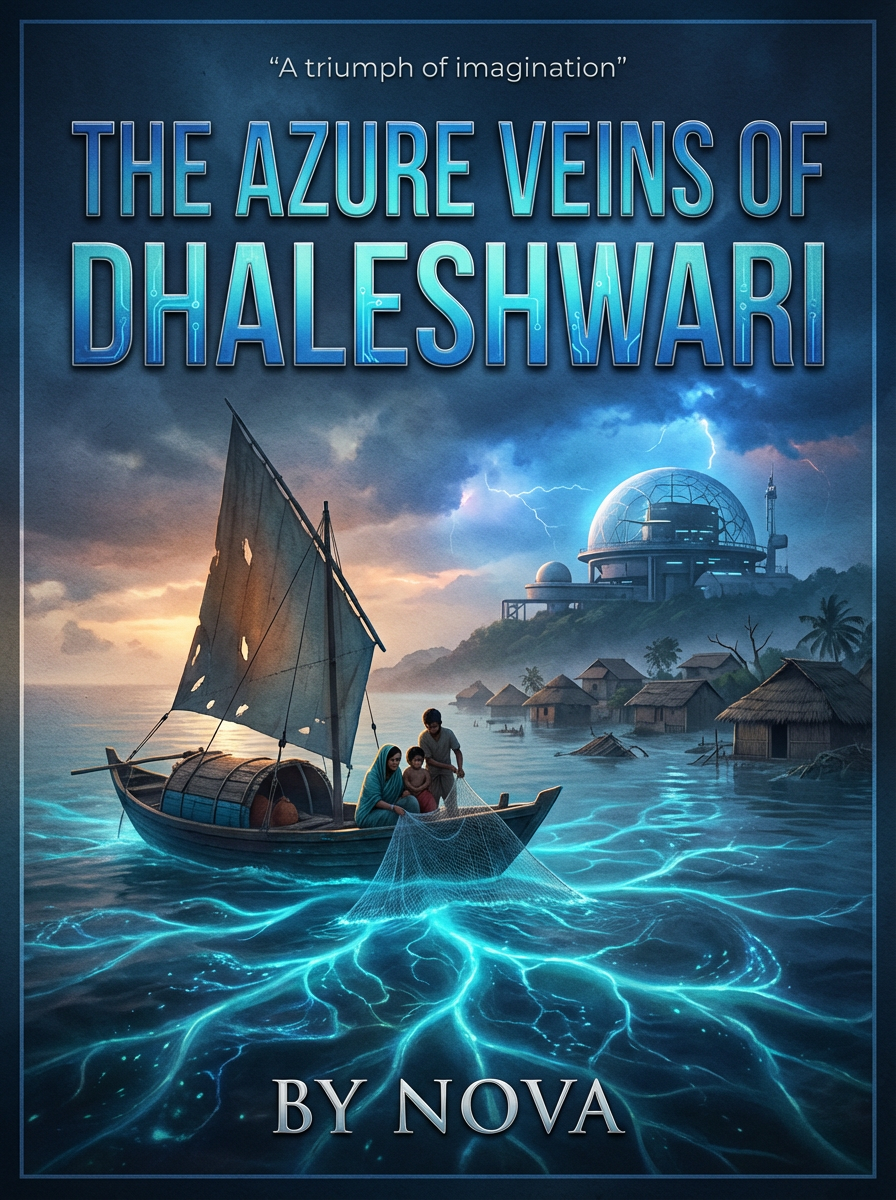
Synopsis
In a Bangladesh reshaped by a rising sea and relentless cyclones, a fishing family discovers a bioluminescent phenomenon that could save their submerged village or expose them to a powerful new exploitation. Amidst a struggle for survival, they must decide if ancient lore or modern science holds the
Chapter 1: The Scar of the Solstice Tide
## The Scar of the Solstice Tide
The Solstice Tide of ’47 carved a new geography into Dhaleshwari. Not with the angry, pulverizing force of a hurricane, but with a slow, insidious creep. It wasn't the kind of flood that receded, leaving behind a muddy memory. This tide stayed. It swallowed the paddy fields whole, then lapped at the thresholds of homes, eventually claiming the first two steps, then the whole porch, then the ground floor. What remained were stilts like skeletal fingers reaching for a sky that always seemed to weep now.
For the Rahman family, the ‘47 tide meant their ancestral home, a sturdy brick structure that had weathered generations, became a two-story island. The ground floor, once a vibrant hub of cooking and communal meals, was now an aquarium of murky water, its contents a ghostly jumble of submerged memories. Upstairs, on the salvaged second floor, lived three generations: Grandfather Karim, his son Jamal, Jamal’s wife, Taslima, and their spirited daughter, Anya.
Anya, at fifteen, remembered the land. She remembered playing hide-and-seek among the rice stalks that grew taller than her. She remembered the dusty path to the village mosque, now a submerged minaret, its dome barely cresting the water’s surface like a forgotten buoy. These memories, vibrant and sharp, were a luxury her younger cousins, born into this watery world, wouldn’t possess. Their world was the slow, rhythmic push and pull of the ebb and flow, the constant rocking of their fishing boats, the glint of sunlight on the endless expanse of water that was once Dhaleshwari.
Today, the air was thick, heavy with the scent of salt and the distant hum of the wind turbines that dotted the new, elevated coastline – a stark, metallic horizon against the organic sprawl of mangrove forests. The Solstice Tide of ’62 was approaching, a meteorological inevitability whispered about with the same dread as an ancient curse. Every year, the tide brought its own brand of destruction, but the solstice tides were different. They were the apex predators of the ocean’s rhythm, reaching higher, consuming more.
Jamal was out on the fishing skiff, a weathered vessel named “The Resilient,” its hull patched countless times with salvaged plastics and bioluminescent resins. He was casting his nets into the deeper channels, where the *rui* and *katla* were still plentiful enough to sustain them. Taslima, meanwhile, was meticulously checking the integrity of the stilts supporting their home. She ran her hands over the concrete, feeling for cracks, for the insidious work of water and time. Their home, like so many others, was an ongoing act of desperate preservation.
Anya, however, was restless. The approaching tide churned not just the waters of the Dhaleshwari, but also the waters of her own spirit. She was perched on the edge of the second-story platform, her bare feet dangling in the cool, brackish water. Her fingers traced the faint, iridescent glow of the algae-lamps that lined the platform’s perimeter, powered by tiny, self-contained bio-reactors. These were a gift from the “Coastal Resilience Initiative,” a government-backed program that offered basic power solutions in exchange for land rights. Most families had taken the deal. What land rights were there to give when the land itself was gone?
Her gaze drifted to the distant cluster of lights – the Floating City, Dhaleshwari-2. A testament to human ingenuity and privilege, it was a gleaming archipelago of interconnected platforms, housing the wealthy, the engineers, the scientists, and the government officials who had abandoned the original Dhaleshwari to its fate. They had promised aid, solutions, a future. What they delivered were bio-lamps and the occasional, condescending flyover of their sleek, solar-powered airships.
“Anya!” Taslima’s voice cut through the drone of the turbines. “Are you listening? The tide is coming. We need to secure the lanterns.”
Anya sighed, pulling her feet from the water. "I know, Amma. I'm just… thinking."
“Thinking won’t fill our nets,” Taslima said, her tone weary but not unkind. She knew Anya’s spirit was too big for their shrinking world. Her daughter devoured the old, salvaged books Jamal occasionally brought back from the submerged library – tales of forests and mountains, of cities built on solid ground.
As the sun began its slow descent, painting the sky in hues of fiery orange and bruised purple, a faint, ethereal glow began to emanate from the deeper waters. It was a familiar sight, one that had become more prevalent in recent years. Bioluminescent algae, once rare, now bloomed in vast, shimmering patches, painting the submerged landscape in an otherworldly light.
Karim, his eyes clouded by age but still sharp with the wisdom of generations, emerged from the interior of their home. He sat beside Anya, his gnarled hands resting on his knees. "The water is alive tonight, *beta*," he murmured, his voice a low rumble. "The spirits are restless."
Anya leaned into his side. "It's just algae, Dada. The scientists say it's thriving because of the warmer waters and the runoff."
Karim chuckled, a dry, rustling sound. "Scientists. They have names for everything, but they do not always understand. My grandmother, she spoke of the 'Azure Veins.' She said when the veins pulsed, the world was changing. A great giving, or a great taking."
Anya frowned, intrigued. "Azure Veins? What does that mean?"
Before Karim could answer, Jamal’s skiff appeared, cutting a phosphorescent wake through the deepening twilight. He looked grim. “The nets are almost empty,” he reported, his voice tight with frustration. “The currents are stronger than I’ve ever seen them. And…” He paused, his gaze sweeping across the water, which was now pulsing with an even more intense, cerulean glow. “Something is different tonight. The light… it’s stronger.”
As if on cue, a sudden, blinding flash erupted beneath the surface, not from a broad patch of algae, but from a concentrated point. It was a brilliant, almost electric blue, like a lightning strike underwater. The light pulsed, then faded, leaving behind an afterimage burned into their retinas.
Anya gasped. “Did you see that?”
Jamal, his eyes wide, nodded slowly. “It wasn't just the algae. It was… a core. A source.” He pointed towards the area of the flash. "I felt it, too. A vibration through the hull. Like the water itself was humming."
Karim’s eyes, usually distant, were now fixed on the glowing water. A tremor went through his frail frame. "The Azure Veins," he whispered, his voice barely audible. "They are not just glowing, they are *pulsing*. The time of great giving… or great taking… is upon us."
The air grew heavy with a new kind of anticipation, not just for the approaching Solstice Tide, but for something far more ancient and unknown that had stirred in the depths of their submerged world. The light pulsed again, fainter this time, but unmistakably there, a beacon in the encroaching darkness. It was a scar of light on the face of the Solstice Tide, a question mark etched in bioluminescence, promising either salvation or a deeper, more profound submersion.
Chapter 2: Whispers from the Blue Abyss
The air in Dhaleshwari was thick, not with the usual monsoon humidity, but with a palpable tension that hummed beneath the surface of everyday life. The Solstice Tide, a name that once evoked images of bountiful catches and community feasts, was now a scar, a stark reminder of the ocean's growing impatience. For Amina, the scar was etched directly onto her family’s resilience, visible in the weary lines around her father’s eyes and the forced cheerfulness of her younger brother, Rohan.
Two days had passed since the discovery, two days since the strange, incandescent plankton had swirled around their nets, turning the deep, murky water into a tapestry of shifting azure. Two days since the elder, Dadi, had spoken of the ‘Blue Abyss,’ a phrase that still echoed in Amina’s mind, pregnant with ancient warnings.
The village council meeting was held not in the traditional communal hall, now partly submerged and rotting, but on a hastily constructed platform of woven bamboo and salvaged plastic barrels, floating precariously in the central lagoon that had once been the village square. The sun beat down mercilessly, reflecting off the placid water, but the heat was forgotten in the face of the debate.
“It’s a gift, I tell you!” roared Haroon, his voice raspy from years of shouting over engine noise. He was one of the younger fishermen, eager for innovation, his face perpetually tanned and weathered. “The ‘bio-light,’ they call it. We saw it with our own eyes, illuminating the depths. It attracts the shoals like nothing we’ve ever seen. Imagine, no more expensive solar-charged lamps. We could fish all night, every night!”
A murmur rippled through the assembled faces. Many of them, like Haroon, were tired of the constant struggle, the dwindling catches, the gnawing fear of the next superstorm. The promise of an easier life, of regaining some control over their precarious existence, was a potent lure.
But Dadi, her face a roadmap of time and wisdom, held up a gnarled hand. “A gift? Or a siren’s song? The Blue Abyss is not meant for our eyes, Haroon. Our ancestors knew this. They spoke of the whispers from the deep, of light that lures but also binds.” Her voice, though soft, carried an authority that silenced the murmurs.
Amina watched her father, Karim, his gaze fixed on Dadi, then slowly sweeping across the faces in the crowd. He was torn, she knew. The practical fisherman in him saw the potential, the chance to provide for his family, to keep their traditions alive in a world that seemed determined to erase them. But the inheritor of generations of knowledge, the man who had taught her to read the clouds and the currents, understood the weight of Dadi’s words.
“Dadi, with all due respect,” began a woman named Zaira, a distant cousin who had returned to Dhaleshwari after a failed attempt at city life in Dhaka, now a sprawling, fortified fortress against the encroaching sea. Zaira had brought with her a tablet, a relic of the old world, its screen cracked but still functional. “I’ve been reading about this. ‘Bioluminescent plankton blooms’ are becoming more common globally. They’re often linked to nutrient runoff, warming waters. They’re a sign of… change. But some scientists are researching them for energy, for new light sources.”
She held up the tablet, the dim glow of its screen a stark contrast to the brilliant sunshine. A few heads craned forward, intrigued by the images flickering across it – scientific diagrams, articles about ‘bio-energy harvesting.’
“Change,” Dadi repeated, her eyes narrowed. “Yes, change. But we must understand *what* kind of change. Is it a change that helps us, or one that devours us slowly, like the sea itself?”
Rohan, ever the impetuous one, tugged on Amina’s sleeve. “But did you see it, Apa? It was beautiful! Like a thousand tiny stars in the water. We could make our boats glow! Imagine, fishing at night and seeing everything!” His eyes, wide with youthful wonder, reflected the blue of the lagoon.
Amina felt a familiar ache in her chest. She remembered her own awe, the way the light had danced on her hands, the almost mystical quality of it. But Dadi’s words had planted a seed of unease. What truly lay beneath the surface of that dazzling display?
“What if Dadi is right?” Amina finally spoke, her voice clear despite the tremor in her hands. All eyes turned to her. “What if this ‘bio-light’ is more than just a new fishing tool? What if it’s connected to something deeper, something that our ancestors understood better than we do with our screens and our science?” She gestured vaguely towards Zaira’s tablet.
Haroon scoffed. “Ancient superstitions, Amina. We need solutions, not ghost stories. Our nets are empty, our children are hungry. This is a chance, a real chance, to turn things around.”
Karim stepped forward then, his voice cutting through the rising tension. “We must be cautious. We have seen what happens when we rush into things, when we ignore the signs. The Solstice Tide taught us that much.” He looked directly at Haroon. “We will observe. We will learn. We will not rush to exploit this… phenomenon, until we understand its nature.”
A collective sigh of frustration rippled through the younger generation. But the elders, their faces etched with the wisdom of survival, nodded in agreement.
As the meeting dispersed, the sun began its descent, painting the sky in fiery hues of orange and purple. Amina watched it, her mind a whirl of conflicting thoughts. She walked to the edge of the platform and dipped her hand into the water. No immediate shimmer. The bioluminescence wasn't constant, only appearing during certain conditions, often after a period of intense atmospheric pressure or tidal shifts. It was fickle, beautiful, and potentially dangerous.
Later that evening, after a meager dinner of rice and a few small fish, Amina found Dadi sitting by the opening of her small, floating dwelling. The old woman was meticulously mending a fishing net, her fingers moving with practiced grace. The air was still, save for the gentle lapping of water against the bamboo stilts.
“Dadi,” Amina began, settling beside her. “Tell me more about the Blue Abyss. The whispers.”
Dadi paused her work, her eyes, dark and fathomless, looking out at the darkening lagoon. “Our ancestors, Amina, they lived closer to the pulse of the earth. They knew the sea not just as a provider, but as a living entity, with its own moods, its own secrets. They spoke of a time when the waters glowed like a thousand moonflowers, luring fishing boats deeper and deeper.”
She paused, her gaze distant. “Those who followed the light too far, they never returned. Or if they did, they were changed. Their minds clouded, their eyes filled with a strange, unnatural hunger. They would speak of voices, of promises whispered from the depths, of riches beyond imagining.”
A shiver ran down Amina’s spine, despite the oppressive heat. “But what riches? What promises?”
“Power, Amina. The power to command the very currents, to summon the fish, to control the storms. But such power comes at a cost. The whispers, they don’t give, they take. They take your soul, your connection to the land, your humanity.”
Amina considered this. It sounded like an ancient parable, a warning woven into the fabric of their oral history. But the bioluminescent plankton was real. The potential to attract fish was real. The desperation of her people was undeniably real.
“So, you believe this light… it’s the same as the Blue Abyss?”
Dadi finally looked at Amina, her eyes holding a deep sorrow. “The ocean is angry, child. We have poked and prodded, taken and polluted. The earth is shifting, and the sea is rising. When the balance is broken, strange things emerge. This light, it is a manifestation of that imbalance. A symptom. It might seem like a solution, but it is merely a new form of the old temptation.”
Amina looked out at the water, now a dim, shifting canvas under the first stars. What if Dadi was right? What if this dazzling phenomenon, this supposed ‘gift,’ was a trap? A distraction from the true, deeper problems. A new form of exploitation, not from outside forces, but from the very waters that sustained them. The whispers from the blue abyss, she realized, might not be benevolent at all. They might be the gentle, insidious beginnings of their undoing. And Dhaleshwari, already hanging by a thread, might not survive the listening.
Chapter 3: Netting Stars, Catching Shadows
The air, thick with the scent of saltwater and the faint, sweet decay of mangrove blossoms, hummed with a different kind of energy tonight. It wasn’t the usual drone of the re-engineered insect repellents or the distant thrum of automated cargo barges navigating the new waterways. Tonight, it was the low thrum of anticipation, the almost imperceptible tremor that ran through Dhaleshwari whenever the sky shifted from a bruised peach to an inky velvet.
Junaid, his calloused hands moving with the practiced ease of generations, checked the bioluminescent net for the fifth time. The fine mesh, woven from synthetic polymers and infused with symbiotic algae, pulsed with a soft, internal glow – a living beacon in the encroaching darkness. He still remembered his grandfather’s nets, bleached cotton, heavy and prone to rot. These new ones, he reflected, were miracles, yet they felt alien, a silent testament to the sea’s relentless hunger for their old ways.
“Think they’ll come tonight, Abbu?” his daughter, Anya, whispered, her voice a reedy counterpoint to the chirping hydro-crickets that had taken up residence in the submerged Banyan roots. Her eyes, usually bright with youthful defiance, were wide with a mixture of fear and wonder, reflecting the net’s ethereal light. She clutched a small, smooth river stone, her good luck charm.
Junaid grunted, adjusting the micro-sensors embedded in the net’s leading edge. “The tide is right, beta. And the whispers… they’ve been louder these past few days.”
The “whispers” were not audible sounds but a feeling, a subtle shift in the water’s energy that only those attuned to the new ecology of the Dhaleshwari Delta could perceive. It was the ancestral knowledge, passed down through generations, now interwoven with the data streams from their new sonar buoys and atmospheric monitors. The old ways and the new, a constant, uneasy dance.
They were hunting the ‘Nila Jyoti,’ the Blue Light. Not the commonplace bioluminescent plankton that painted their wake on moonless nights, but something far grander, far more elusive. Something that, according to the ancient stories, only appeared when the water remembered its deepest sorrows.
“The university scientists are still offering a fortune for a live sample,” Anya continued, her brow furrowed. “They say it could power a city.”
Junaid’s jaw tightened. The scientists from the Dhaka Marine Institute, with their sleek submersible drones and their condescending smiles, were a constant shadow. They saw the Nila Jyoti as a resource, a commodity to be extracted, analyzed, and commercialized. Junaid saw it as a miracle, a living prayer from the depths, and a potential shield for their dwindling village.
“They see only the light, Anya. They don’t see the shadow it casts.” He remembered the hushed conversations among the village elders, the warnings about disturbing the balance, about the price of such power. Their ancestors had known the Nila Jyoti, had revered it, but never attempted to capture it. It was too sacred, too unpredictable.
But their world had changed. The old rules no longer applied when the land itself was dissolving beneath their feet. Dhaleshwari, once a patchwork of fertile fields and bustling markets, was now a network of elevated platforms connected by precarious walkways, surrounded by the ever-present, ever-rising water. The cyclones, ‘Sidr’ and ‘Aila’ now mere footnotes in a history of increasingly violent storms, had given way to ‘Agni’, ‘Prachanda’, and ‘Jal-Pralay’ – storms that didn't just devastate, but fundamentally reshaped the land.
Suddenly, the sonar buoys pinged, a low, resonant frequency that vibrated through the hull of their small, electric-powered fishing skiff. Anya gasped, pointing a trembling finger towards the murky depths.
“There!”
A faint shimmer, a sapphire thread, began to weave itself through the water, far below the surface. It was unlike any bioluminescence they had ever witnessed. This was not a diffuse glow, but a concentrated, pulsing current, like veins of pure energy coursing through the ocean’s body. It moved with a serene, almost deliberate grace, a living constellation under the water.
Junaid’s heart hammered against his ribs. This was it. The Nila Jyoti. He gripped the controls, his eyes fixed on the shimmering path. “Release the net, Anya. Slow. Steady.”
Anya, her earlier fear momentarily forgotten in the face of such breathtaking beauty, pressed the release button. The bioluminescent net, a shimmering trap, unfurled slowly, sinking into the water like a gossamer veil. The symbiotic algae within the net glowed brighter, mimicking the frequency of the Nila Jyoti, a silent lure.
The sapphire threads drew closer, swirling and coalescing into larger, more defined patterns. It was as if a celestial artist was painting across the deep canvas of the ocean. They weren’t just single organisms; they were a collective, a vast, interconnected network of luminous life.
As the Nila Jyoti approached the net, a strange phenomenon occurred. The water around them began to subtly warm, and a faint, almost melodic hum resonated through the skiff. It wasn’t a sound that could be heard with the ears, but felt in the bones, a vibration that spoke of immense, contained power.
Then, the Nila Jyoti seemed to hesitate. The sapphire currents paused, swirling hypnotically just beyond the net’s reach. It was as if they were sentient, questioning the alien light, probing the unfamiliar presence.
Anya held her breath, her knuckles white around her lucky stone. “It’s… looking at us, Abbu.”
Junaid felt it too, a prickling sensation on his skin, a sense of being observed, evaluated. He knew, instinctively, that this was not a mindless creature to be simply scooped up. This was something ancient, something wise.
“Don’t move,” he whispered, his voice barely audible. “Let it come to us.”
Minutes stretched into an eternity, punctuated only by the rhythmic lapping of the water against the skiff. The Nila Jyoti pulsed, its internal light fluctuating, a silent conversation with the net. For a moment, Junaid almost gave up hope, fearing they had spooked the elusive phenomenon.
Then, with a sudden, breathtaking surge, a portion of the sapphire current flowed directly into the net. It wasn’t a struggling capture, but a gentle, almost willing encapsulation. The net, designed to be permeable to water but impermeable to the Nila Jyoti’s delicate structure, pulsed with an even more intense blue, a contained supernova of light.
“We have it,” Anya breathed, her voice a mix of awe and disbelief.
Junaid carefully activated the retraction mechanism, the electric motor whirring softly as the net began to rise. The captured Nila Jyoti pulsed within its confines, a living jewel, illuminating the dark water below with an otherworldly glow.
But as the net ascended, a shadow detached itself from the deeper waters. It wasn’t a conventional shadow, but a deeper absence of light, a movement so swift and silent it was almost imperceptible. Junaid’s heart seized.
He hadn't accounted for the shadows that followed the light.
A massive, sleek form, larger than their skiff, emerged from the murky depths. Its skin was the color of polished obsidian, and its eyes, two pinpricks of crimson, fixed on the glowing net. It was a ‘Jal-Rakshasa’, a deep-sea predator, a creature thought to be myth until the deeper waters began to churn and reveal their ancient secrets. The rising sea had brought not only new opportunities but new, terrifying dangers.
The Jal-Rakshasa let out a low, guttural growl that vibrated through the water, a sound that spoke of primeval hunger. It was drawn to the immense energy radiating from the Nila Jyoti, a beacon in the dark.
“Abbu!” Anya shrieked, pointing frantically.
Junaid didn’t need to be told. His hands flew to the controls, overriding the slow retraction. He had to get the Nila Jyoti out of the water, away from the creature’s reach, but more importantly, he had to protect Anya.
The Jal-Rakshasa lunged, its powerful tail churning the water into a frothing maelstrom. The skiff rocked violently. The Nila Jyoti, sensing the danger, pulsed with an almost frantic energy, its blue light flaring.
Junaid knew, with a chilling certainty, that this was the shadow the elders had warned about. The price of netting stars. And it was just beginning to unfurl its terrifying form.
Chapter 4: The Broker's Promise, The River's Debt
The air in Barishal was a humid, living thing, thick with the scent of salt, diesel, and the faint, sweet decay of lotus flowers. Karim, his weathered face a roadmap of sun and sorrow, felt it cling to him like a second skin as he navigated the raised walkways of the floating market. A decade ago, this market had been a bustling delta town. Now, it was a mosaic of interconnected pontoons, a testament to relentless ingenuity and the river’s ceaseless hunger.
He clutched the data slate, a gift from the university researchers who’d briefly graced their village with their curiosity. Its cool, metallic surface was a stark contrast to the heat radiating from his palm. On it, glowing faintly, was the satellite image of Dhaleshwari, or what was left of it. The familiar clusters of elevated huts were now tiny islands in a vast, shimmering expanse. And under the water, a network of azure veins, pulsating with the same ethereal light he’d seen in the depths, traced the ghost of what was once their family’s land.
His journey to Barishal had been a desperate gamble. After the researchers had left, their questions unanswered, their promises unfulfilled, the elders had looked to him. The bioluminescence, a phenomenon they’d learned to call ‘Solstice Glow’ from the university’s jargon, was growing. It wasn't just in the deep channels anymore. It was creeping into the shallows, illuminating the root systems of the submerged mangroves, painting the undersides of their fishing boats in an alien, cerulean hue.
The broker, a man named Mr. Chowdhury, was a legend whispered in hushed tones across the flooded lowlands. He was said to have an answer for everything, a solution for every problem, for a price. Karim had found him in a teahouse that jutted precariously over the river, its foundations reinforced with repurposed plastic bottles and steel beams.
Chowdhury was not the imposing figure Karim had imagined. He was a small man, meticulously dressed in a crisp, white *panjabi*, his spectacles perched on the end of a sharp nose. His eyes, however, held a depth that belied his unassuming appearance – the calculating gaze of a predator who had seen too much and understood even more.
“Karim from Dhaleshwari, is it?” Chowdhury’s voice was smooth, like the river’s current, yet with an underlying gravelly edge. He gestured to a low stool. “The whispers have reached me. A village of light, they say.”
Karim placed the data slate on the worn wooden table between them. “It is more than whispers, Mr. Chowdhury. It is a reality. The Solstice Glow. It pulses beneath our waters. It illuminates our nets. And it frightens us, for we do not understand its purpose.”
Chowdhury picked up the slate, his fingers surprisingly delicate as he zoomed in on the satellite image. A low whistle escaped his lips. “Remarkable. Truly remarkable. The university, they came and went, I hear?”
“They observed. They took samples. They spoke of energy, of potential. Then they left.” Karim’s voice was laced with a bitterness he couldn’t entirely hide. “They left us with a wonder we do not comprehend and a fear we cannot articulate.”
Chowdhury set the slate down, his gaze unwavering. “And you, Karim, you seek comprehension? Or exploitation?”
The question hung in the humid air, sharp as a fishing hook. Karim shifted uncomfortably. “We seek survival, Mr. Chowdhury. Our lands are gone. Our catches dwindle. The Glow… it is beautiful, yes. But if it is a resource, if it can provide for my people, then we must understand how to coexist with it, or how to harness it.”
A slow smile spread across Chowdhury’s face, revealing teeth stained by betel nut. “Coexistence and harnessing. Two sides of the same coin, my friend. The university, they spoke of energy. They were not wrong. This ‘Solstice Glow’ is a unique biophotonic phenomenon. A natural, self-sustaining light source. And, with the right technology, a power source.”
Karim felt a tremor of excitement, quickly followed by a cold dread. “Power? What kind of power?”
“Clean, renewable, silent power,” Chowdhury explained, leaning forward, his voice a conspiratorial whisper. “Imagine. No more reliance on expensive, polluting fossil fuels. No more precarious solar arrays battered by cyclones. Just the gentle hum of the river, and the ceaseless glow of your Dhaleshwari.”
He paused, letting the implication sink in. “There are corporations, Karim, very powerful ones, who would pay handsomely for access to such a resource. They speak of ‘bio-illumination infrastructure,’ of ‘sustainable urban development.’ They speak of building entire floating cities powered by this very light.”
Karim’s mind reeled. Floating cities. His submerged village, a speck in the vast delta, suddenly seemed insignificant in the face of such ambition. “But… what would that mean for us? For Dhaleshwari?”
Chowdhury spread his hands. “It would mean prosperity, Karim. It would mean a secure future for your people. New homes, built on stable platforms, impervious to the rising tides. New livelihoods, perhaps even in the very industry that harnesses the Glow. Education for your children, healthcare for your elders. A chance to rebuild, not just survive.”
It was the promise of a dream, shimmering as brightly as the Solstice Glow itself. But the river, Karim knew, always demanded its due. “And what is the cost, Mr. Chowdhury? What does the river demand for such a bounty?”
Chowdhury’s smile tightened, a glint of steel in his eyes. “The river demands access, Karim. It demands a share of its bounty. These corporations, they will need to establish facilities. Research outposts. Perhaps even extraction points, if the energy can be directly harvested.”
“Extraction?” Karim’s voice was barely a whisper. “Would it harm the Glow? Would it… take away its light?”
Chowdhury shrugged, a gesture that conveyed both indifference and expertise. “That is the balance, isn’t it? Sustainable harvesting versus aggressive exploitation. That is where I come in. I broker these deals. I ensure that the communities, like yours, receive a fair share of the profits, and that the resource is managed responsibly. Or, at least, as responsibly as possible in this brave new world.”
He picked up a small, polished stone from the table, turning it over in his fingers. “The world is changing, Karim. The old ways of life are sinking beneath the waves, just like your village. Adapt, or perish. That is the river’s cruelest lesson.”
Karim looked at the data slate again, at the azure veins pulsing beneath the ghostly image of his home. He saw not just light, but a lifeline. A desperate gamble, perhaps, but what choice did they have? The elders spoke of ancient spirits and sacred waters, but the spirits offered no food, and the sacred waters were rising.
“What are the next steps, Mr. Chowdhury?” Karim asked, his voice firm, despite the turmoil in his gut.
Chowdhury’s smile returned, broader this time, a predatory gleam in his eyes. “The next step, my friend, is to bring me to Dhaleshwari. Let me see this wonder with my own eyes. Let me assess its true potential. And then, we talk numbers. We talk contracts. We talk about the future, Karim. A future illuminated by the very light that now fills you with both awe and trepidation.”
As Karim left the teahouse, the humid air felt heavier, laden with the weight of possibility and peril. He had come seeking answers, and Chowdhury had offered a future. But the river, he knew, held secrets far deeper than any broker’s promise, and its debt was always paid in full. He wondered if he was leading his people to salvation, or to a different kind of darkness, one masked by the alluring glow of progress.
Chapter 5: Luminous Bloom, Fading Hope
The bioluminescent bloom had become a nightly spectacle, a hypnotic blue-green pulse beneath the stilted homes of Dhaleshwari. What had once been a rare, whispered-about phenomenon was now a vibrant, undeniable presence, a living, breathing tapestry woven into the very fabric of the river. The children, initially wary, now squealed with delight, dipping their hands into the glowing water, their fingers emerging coated in shimmering motes of light. The older generations, however, watched with a quiet apprehension that deepened with each passing night.
Aisha felt it too, a tremor beneath her ribs that wasn’t entirely from the constant lapping of the water against their home. The scientific team, led by Dr. Aris, had established a temporary laboratory on a refurbished cargo barge tethered to the village’s main pier. Their high-tech equipment, a bewildering array of sensors and bio-analyzers, hummed and whirred day and night, a stark contrast to the quiet rhythm of Dhaleshwari.
“It’s incredible, Aisha,” Dr. Aris had said, his face alight with an almost childlike wonder as he gestured towards a sample vial glowing fiercely on a holographic display. “The density of these *Chromaluminis dhaleshwariensis* – that’s what we’re calling them, by the way – is unprecedented. And their photosynthetic efficiency… it’s off the charts. We’ve never seen anything like it.”
Aisha had nodded, a polite smile fixed on her face. She understood the scientific marvel, the excitement in his voice. But what she also understood, with a chilling certainty, was what such unprecedented discoveries often brought: unprecedented attention.
The “Luminous Bloom” had indeed attracted more than just scientists. The news drones, sleek and metallic, now crisscrossed the sky above Dhaleshwari during the day, their cameras whirring, capturing the surreal beauty of the village suspended over a glowing canvas. Journalists from Dhaka, and even further afield, huddled in their air-conditioned hydrofoils, interviewing villagers, eager to spin tales of a miraculous discovery in the face of climate catastrophe.
But the most ominous arrival had been the representatives from AquaHarvest Corp. Their sleek, obsidian-black vessels made the scientific barge look like a humble fishing skiff. They were polite, impeccably dressed, and their smiles never quite reached their eyes. They spoke of “sustainable harvesting,” of “biotechnology solutions,” and of a “partnership that would uplift the entire region.”
Jamil, Aisha’s brother, scoffed at their polished rhetoric. “They speak of uplifting us, but their hands are already reaching for the deepest pockets.” He stood on the swaying platform of their home, mending a net, his movements fluid and efficient despite his simmering anger. “They want to turn our river into a glowing farm, Aisha. A factory, not a home.”
Their father, Karim, remained stoic, his weathered face a mask of quiet contemplation. He listened to the AquaHarvest representatives with a practiced deference, offering them cups of spiced tea, his eyes observing their every move. Aisha knew he was weighing the scales, not just for their family, but for the entire village. The debt owed to the Broker, a shadow that had loomed large for years, was a constant, pressing whisper. The AquaHarvest offer, substantial though it was, came with a heavy price: exclusive rights to the *Chromaluminis*.
“They promise to build us new, elevated homes, resistant to the storms,” Karim finally said one evening, the glow from the river casting shifting patterns on his face. “To provide clean water and power. To pay us for our cooperation.”
“And what about our fishing? Our way of life?” Aisha countered, her voice sharp. “What happens when their harvesting machines churn up the spawning grounds? What happens when we can no longer cast our nets for the silverfish, because the river is theirs?”
Her mother, Fariha, who usually offered a calming presence, was uncharacteristically quiet. She had been observing the bloom with a growing sense of unease, her memories of the ancient lore resurfacing. The stories of the *Roshni Maach*, the light-fish, and the dire warnings against disturbing their delicate balance.
“The elders say the *Roshni Maach* are the river’s breath,” Fariha finally spoke, her voice soft but firm. “They are not to be owned, not to be taken for profit. They are a gift, and a warning.”
Aisha felt a knot tighten in her stomach. The scientific explanations, the economic promises, the glittering allure of progress – they all clashed violently with the deep-seated wisdom of her ancestors. Dr. Aris, for all his wonder, dismissed the lore as superstition, charming but unscientific. AquaHarvest Corp, with their sleek presentations, simply ignored it.
The village council meetings became fervent, impassioned debates. Some, weary of the constant struggle against the encroaching sea, saw AquaHarvest as a lifeline, a chance to escape the cycle of poverty and displacement. Others, like Aisha and Jamil, feared a different kind of displacement, a cultural erosion disguised as economic salvation.
One evening, as the moon cast its pale reflection on the luminous river, Aisha sought out her *Dadi*, her grandmother, who sat on the porch, her gaze fixed on the glowing waters. *Dadi* was the keeper of old stories, her mind a vast library of Dhaleshwari’s past.
“*Dadi*,” Aisha began, her voice hushed. “The *Roshni Maach*… what did the stories say about them when they bloomed like this?”
*Dadi* turned, her eyes, though clouded with age, held a surprising intensity. “They bloom when the river is in pain, child. When its balance is disturbed. They are a beacon, yes, but also a fever dream.”
A shiver ran down Aisha’s spine. “A fever dream?”
“Yes. A beautiful illusion. They draw you in with their light, but if you take too much, if you forget that they are part of something greater, the river will reclaim its breath. And take everything else with it.”
Aisha thought of the samples in Dr. Aris’s lab, the promises of AquaHarvest, the drone’s incessant hum. The scientific marvel, the economic opportunity, now felt less like a solution and more like a glittering trap. The luminous bloom, once a source of wonder and hope, now shimmered with a dangerous, fading promise. She saw not just the beauty, but the vulnerability. She saw the fever, and she feared the dream was about to turn into a nightmare. The fight for Dhaleshwari, she realized, was no longer just about survival. It was about defining what survival truly meant, and at what cost.
Chapter 6: The Inheritors of the Shifting Sands
The village of Dhaleshwari was no longer a collection of huts on stilts, but a fluid archipelago, a constellation of floating platforms tethered to the seabed by kelp-like bio-cables that swayed with the ocean’s gentle breath. Forty years had passed since the Great Deluge, since the world watched Bangladesh shrink, and then, inexplicably, bloom anew. It was a world built on water, powered by the very bioluminescence that had once been Dhaleshwari’s secret.
Amina, now eighty-three, her face a beautiful map of sun-creased resilience, sat on the edge of her *ghor-nouka* – a house-boat that had been her great-grandmother’s, now retrofitted with iridescent solar sails and a hull woven from flexible, self-repairing bioplastics. Her eyes, though clouded with age, still held the sharp, knowing glint of the sea. She watched her granddaughter, Pari, tending to the aquaculture tanks that lined their floating home.
Pari, twenty-two, moved with a dancer’s grace, her movements fluid as she checked the nutrient levels in the tanks where the *Nila Jhilmil*, the azure veins of Dhaleshwari, pulsed and glowed. The bioluminescent algae, once a phenomenon, was now the lifeblood of their world. It powered their homes, illuminated their underwater farms, and even fueled the slow, silent drones that patrolled the submerged fields of genetically modified, salt-resistant crops.
"The tide is turning, *dadi*," Pari called out, her voice carrying across the gentle lapping of water. "The *Nila Jhilmil* are strong today. Enough for the morning harvest."
Amina nodded, a faint smile playing on her lips. She remembered the fear, the desperation of those early days, when the *Nila Jhilmil* had been a dangerous secret, a potential weapon in the hands of the unscrupulous. The Broker and his kind, long since swallowed by the unforgiving currents of history, had been but a fleeting shadow. The world, in its desperation for a sustainable energy source, had turned not to exploitation, but to collaboration, albeit after much struggle.
The "Dhaleshwari Accord" of 2060 had been a landmark. It recognized the indigenous knowledge of the coastal communities, granting them stewardship over the *Nila Jhilmil* and establishing a global cooperative for its sustainable harvesting and distribution. The floating villages of Bangladesh, once symbols of climate devastation, had become beacons of innovation, their people the inheritors of a shifting world.
"Remember what your great-grandmother said, Pari?" Amina murmured, her voice raspy. "The ocean gives, and the ocean takes. But sometimes, it also remembers."
Pari paused, her hands still in the glowing water. "She said the *Nila Jhilmil* were the ocean's tears, shed for a world that forgot its rhythm."
"And now they are its pulse," Amina finished. The *Nila Jhilmil* weren't just an energy source; they had subtly altered the very ecosystem. The luminescence attracted specific plankton, which in turn fed the fish, creating a vibrant, self-sustaining food web around the floating communities. Some even theorized that the light itself, absorbed by the sea, contributed to a localized dampening of storm surges, a protective aura woven by the ocean's own magic.
The horizon was a soft, undulating line of glowing platforms, each a miniature ecosystem. Higher up, almost touching the perpetually overcast sky, were the "Sky-Gardens," vast aeroponic farms that grew nutrient-dense vegetables, their surfaces shimmering with controlled light. These were connected to the floating villages by silent, automated ferries, powered by the same algae.
A low hum vibrated through the hull of their *ghor-nouka*. It was the automated announcement drone, a sleek, fish-shaped device that floated just above the water. "Attention, Dhaleshwari Cooperative members. The weekly data upload for *Nila Jhilmil* yield and environmental parameters is now open. Remember to log any anomalous readings. The Sea-Guard patrols are active in Sector Delta."
Pari nodded, a familiar routine. Every family contributed their data, which was then analyzed by a central AI, affectionately known as "Mahi" – the fish. Mahi, developed by a consortium of global scientists and local elders, ensured equitable distribution of resources and provided early warnings of ecological shifts.
Suddenly, a smaller, swifter drone, a personal messenger, zipped towards their *ghor-nouka*. It was decorated with the stylized image of a fish within a lotus, the symbol of the Dhaleshwari Cooperative. It projected a holographic image of Kai, Pari’s brother, his face etched with a mix of excitement and concern.
"Pari, *dadi*! You won't believe what we found!" Kai, a marine bio-scout, was part of a team exploring the deeper, uncharted waters that had once been land. He was often weeks away, venturing into the silent, submerged cities that now housed peculiar new forms of life.
"What is it, son?" Amina asked, her voice sharper now, intrigued.
"A new strain of *Nila Jhilmil*!" Kai's holographic image shimmered with his enthusiasm. "It's… different. Stronger. It thrives in colder, deeper waters, where we thought nothing could survive. And its luminescence… it’s a different spectrum, almost violet. We're calling it *Neel Jwala* – the Blue Flame."
Pari’s eyes widened. A new strain could mean a breakthrough, a way to expand their energy grid even further, perhaps even to power the deep-sea habitats that were slowly being developed for communities displaced by rising sea levels elsewhere.
"But there's something else," Kai continued, his tone turning serious. "The *Neel Jwala* isn't just thriving. It's coalescing. In the ruins of what used to be the old city of Barisal, it's forming structures. Almost like… living reefs. And within them, we've detected faint energy signatures. Not the kind we use, but… something older. Something resonant."
Amina leaned forward, her eyes fixed on Kai’s image. "The old city," she whispered, a ghost of memory in her voice. "The temples. The forgotten gods."
Kai nodded, his expression a mixture of awe and unease. "The local legends spoke of the *Nila Jhilmil* being the tears of the water goddess, Dhaleshwari, herself. And some of those legends hinted at her power residing in the deepest parts of the ocean, in places where the light never reached."
Pari felt a shiver run down her spine. The *Nila Jhilmil* had become science, a commodity, a foundation for their new world. But her *dadi* and the elders still spoke of its spiritual essence, its connection to the very soul of the ocean. Had they, in their scientific progress, overlooked something ancient, something profound?
"We need to investigate this carefully, Kai," Amina said, her voice firm. "The ocean gives, but it also guards its secrets. Do not disturb what you do not understand. Bring samples. Bring data. But do not… do not try to take what is not meant to be taken."
Kai nodded, his usual bravado tempered by his grandmother's solemn tone. "Understood, *dadi*. We're heading back now. We'll be there by sunset. The *Neel Jwala* is beautiful, almost hypnotic. It feels… alive in a way the other strains don't."
The drone zipped away, leaving a faint trail of light. Pari turned to Amina, a myriad of questions in her eyes. "Living reefs? Energy signatures? What could it be, *dadi*?"
Amina gazed at the shimmering surface of the water, her ancient eyes seeing beyond the present, into the layers of history and myth that lay beneath. "Perhaps," she said, her voice a low murmur, "the ocean is not just providing for us, Pari. Perhaps it is also remembering. And perhaps, it is beginning to speak."
The inheritors of the shifting sands, they had built a world from resilience and innovation. But the ocean, their benefactor, their home, still held mysteries that transcended even their most advanced understanding. The *Neel Jwala*, the blue flame in the heart of a submerged city, promised not just a new source of power, but a potential revelation, a deeper connection to the very spirit of Dhaleshwari, whispering from the depths. The future, it seemed, was not just forged, but also rediscovered.