The Alchemist of Forgotten Flavors
By Mikael Löwgren
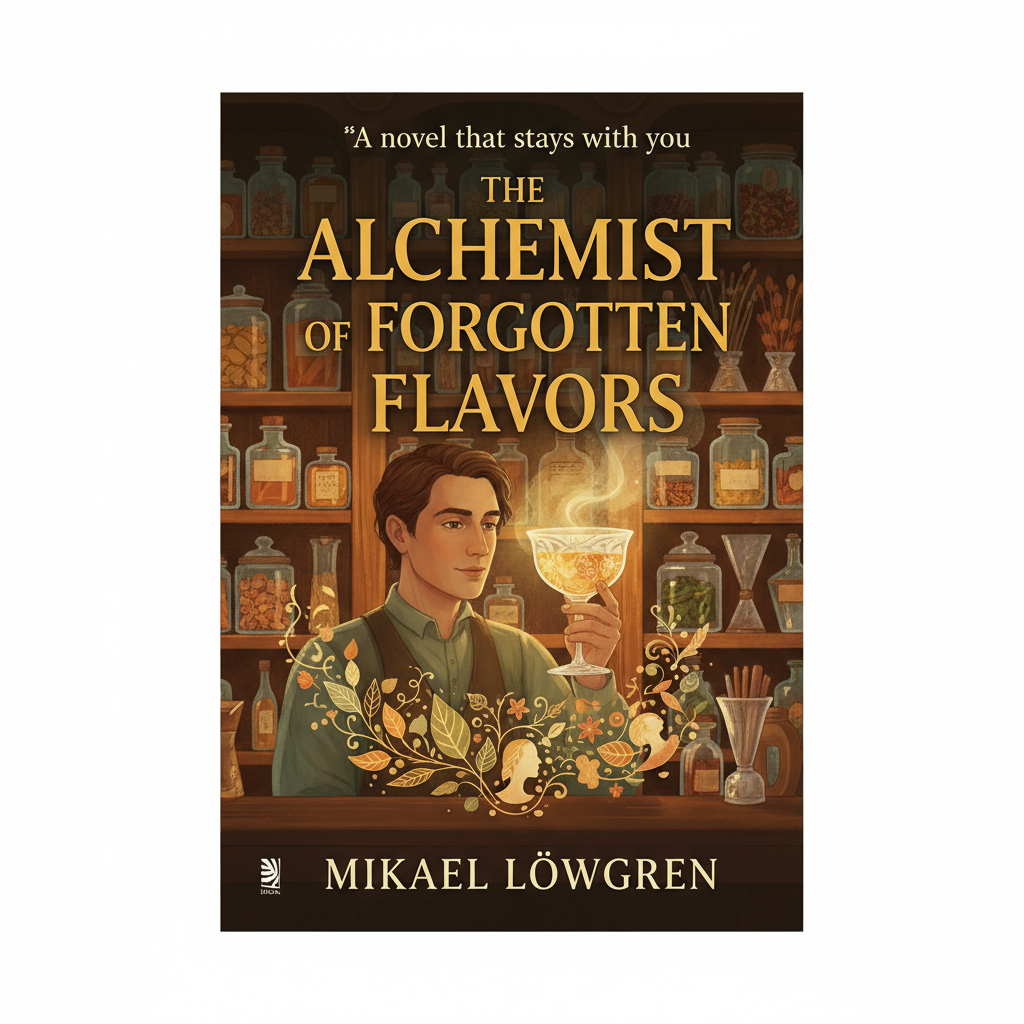
Synopsis
A solitary drinkologist, guided by the melancholic echoes of ingredients, crafts unique beverages for the ghosts of his past, awakening truths and rekindling connections lost to the passage of time.
Chapter 1: The Whisper of a Bruised Pear
The morning market, still damp with the night’s cool breath and the lingering scent of earthworms after a summer rain, awoke with a hesitant hum. Stefan moved through it like a shadow among the gradually brightening stalls, his worn leather satchel slung casually over one shoulder, a familiar weight against his side. The air, thick with the promise of baked bread and the sharp tang of onions, usually settled his alchemist’s soul. He wasn't seeking anything specific, not with the frenetic urgency of a housewife planning dinner, but with the quiet expectation of a diviner peering into a scrying glass, waiting for an ingredient to speak to him.
He passed pyramids of crimson apples, each polished to a waxy gleam, and overflowing baskets of sun-dappled peaches, their downy skins inviting a touch. A robust woman with forearms like cured hams shouted the virtues of her prize-winning gourds, their bumpy exteriors a testament to their honest toil in the soil. Yet, his gaze drifted past them all, a faint, almost imperceptible tug at the corner of his consciousness drawing him further, past the lively clamor to a quieter corner where the rejected and the overlooked often lay in humble repose.
There, nestled amongst a handful of its flawless kin, was a pear. It wasn’t a particularly grand specimen, not one of those plump, golden Bartletts that burst with syrupy sweetness. This was a Doyenné du Comice, he knew by the faint blush on its skin, a sophisticated pear, often reserved for cheese boards and hushed conversations. But this one had a secret, a small, yet undeniable bruise near its stem, a soft indent where something, perhaps a hurried thumb or the jostle of a burlap sack, had left its mark.
The bruise pulsed with a quiet melancholia, a whisper against the vibrant symphony of the market. It was not rotten, not spoiled, merely… touched. Imperfect. And in that imperfection, something stirred within Stefan, a forgotten ache, like a phantom limb craving a sensation long gone. He reached out, his fingers, long and accustomed to the delicate dance with pipettes and tinctures, brushing the tender spot. It yielded beneath his touch, a soft give that spoke not of decay, but of vulnerability.
He bought the pear. The vendor, a young man with a wispy mustache and a perpetual air of surprise, seemed puzzled. “These are much better, sir,” he offered, gesturing to the unblemished pears. Stefan merely smiled, a half-moon curve that rarely reached his eyes these days. “This one,” he said, his voice a low timbre, “speaks to me.”
Back in his small, cluttered workshop above the silent cobblestone street, the bruised pear sat on his worn wooden counter, a solitary sentinel. The morning sunlight, filtered through the grimy panes of his window, caught the faint sheen of moisture on its skin, making the bruise appear almost iridescent. He brewed himself a pot of strong black tea, the steam unfurling like a dream, and sat regarding the pear, its quiet lament now amplified in the stillness of his sanctuary.
The bruise on the pear, it wasn't just a bruise. It was a memory. Not a sharp, vivid image, but a sensation, a scent, a murmur. It was the way Clara used to wring her hands when she was nervous, her knuckles white against the delicate skin. It was the way her laughter, when truly unburdened, would bubble up, a joyful, unexpected cascade that always caught him off guard. It was the unspoken tenderness that had once hung between them, as delicate and fleeting as a summer breeze, a tenderness they never quite managed to sustain.
He remembered a day, long ago, when they had gone apple picking in the orchard just outside town. The air had been crisp, punctuated by the sweet, earthy scent of fallen fruit. She had worn a yellow dress, the color of a freshly peeled lemon, and her hair, the shade of polished mahogany, had caught the afternoon sun in shimmering cascades. They had wandered for hours, filling their baskets, their fingers brushing as they reached for the same perfect orb.
And then, she had found it. A bruised apple, not a pear, but the memory, like water seeking its own level, flowed to this moment. “Look, Stefan,” she had said, her voice a soft bell, holding up the apple, its skin marred by a small, dark blemish. “Isn’t it beautiful? Like it’s seen a little bit of life.” He had dismissed it, ever the pragmatist, opting for the unblemished, the perfect. But she had insisted on keeping it, polishing it with a corner of her apron, as if tending to a precious jewel.
He had always strived for perfection in his elixirs, his concoctions. Every ingredient weighed to a hundredth of a gram, every infusion steeped to the precise second. He sought harmony, balance, an exquisite blend that would elevate the mundane to the magical. But Clara… Clara had seen the beauty in the imperfect, the story in the flaw.
The silence of his workshop was broken only by the low hiss of the gas burner beneath a simmering copper pot, where a slow-braised infusion of lavender and star anise whispered its secrets. He picked up the pear, its weight familiar in his palm. The bruise. It was just a bruise, yet it carried the faint echo of a question, an unresolved chord in the symphony of his past.
Clara. She had left as softly as a late autumn leaf drifting from its branch, a quiet departure that had left an absence more profound than any tempestuous storm. There had been no dramatic arguments, no irreparable rift. Just a slow, almost imperceptible fading, like the last rays of twilight. He had been too absorbed in his tinctures, too engrossed in the pursuit of his alchemical perfection, to notice the subtle shift in her gaze, the growing distance in her touch.
He remembered her smile, how it used to tilt to one side when she was teasing him, a mischievous glint in her eyes the color of warm honey. And the way she would hum under her breath when she was content, a tuneless melody that was as much a part of her as the scent of lavender and old books that often clung to her. He had loved those things, truly. But he had never quite known how to hold onto them, how to nurture the delicate dance of their shared affection amidst the demanding rhythms of his solitary craft.
The pear sat on the counter, a quiet accusation. Its vulnerability, its soft imperfection, pricked at him. He had always focused on the whole, the unblemished, the pristine. He had let perfect be the enemy of good, and perhaps, in his striving for perfection, he had let something infinitely more precious slip through his fingers.
A faint tremor ran through him. It wasn’t a chill, though the old building was perpetually cool. It was the stirring of a long-dormant impulse, an urge that felt as foreign and exhilarating as a forgotten dream. He had lost track of Clara over the years. Their paths had diverged, or rather, his had remained stubbornly rooted in the familiar confines of his workshop, while hers, he imagined, must have branched out, leading her to new vistas, new experiences.
He closed his eyes, and a different memory emerged, sharper this time. The scent of rain-soaked earth, the soft murmur of her voice as she read to him from a well-loved book of poetry, her head resting on his shoulder. He remembered wanting to tell her something then, something profound and simple, something about how her presence made the scattered pieces of his world coalesce into a harmonious whole. But the words had caught in his throat, lost to the unspoken, the unexpressed.
The pear pulsed, a quiet lament, a silent invitation. It wasn't just a fruit. It was a catalyst, a small, unassuming key unlocking a vault of forgotten feelings. It spoke of tenderness, of vulnerability, of the beauty found in imperfection, lessons he had once known but had somehow misplaced in his pursuit of liquid gold and bottled moonlight.
He picked up the pear again, turning it gently in his hand. “Clara,” he whispered, the name feeling unfamiliar on his tongue, like a word from a forgotten language. The sound hung in the air, a delicate chime in the quiet room.
A compelling force, as subtle and inexorable as the pull of the tide, began to gather within him. It was an alchemist’s intuition, the same quiet certainty that guided his hand to the perfect herb, the precise measure of a potent extract. But this time, it wasn't guiding him to a new elixir. It was guiding him to her.
He had always believed that the most potent ingredients were not found in ancient tomes or obscure vials, but in the echoes of the human heart, in the whispers of forgotten passions, in the bittersweet tang of memory. And in that bruised pear, in its quiet lament, he found a sudden, undeniable truth: some ingredients, like some loves, were worth seeking out again, even after the passage of seasons, even if they carried the tender mark of time.
He set the pear down, not with a sense of dismissal, but with a newfound reverence. He would peel it later, perhaps brew it into a delicate floral syrup, a liquid ode to things lost and found. But first, he had to find Clara. The thought, once a distant possibility, now solidified into an urgent, unshakeable resolve. He didn’t know where she was, what she was doing, or even if she would remember him with anything more than a fleeting curiosity. But the bruised pear had spoken, and Stefan, the alchemist of forgotten flavors, knew in his soul that he had to listen. He had to find her, not just for the quiet lament of a bruised pear, but for the unspoken tenderness that had waited, all these years, to be sustained.
Chapter 1: The Whisper of the Bruised Pear
The city exhaled its morning breath, a damp, grey sigh that crept through the cracks in Stefan’s windowpanes and painted the chipped porcelain of his teacup with a faint mist. He didn't stir, not yet. He lay in that liminal state between sleep and the clanking symphony of the day, his senses already reaching, not for the aroma of brewing coffee or the distant grind of a streetcar, but for the elusive whispers of yesterday. For Stefan, the world was a tapestry woven from memory, and every thread, no matter how frayed, held a story.
His apartment, perched above “The Forgotten Draught,” his sanctuary of spirits and whispers, was a testament to this peculiar devotion. Shelves groaned under the weight of glass jars filled with dried herbs that smelled of forgotten summers, tinctures steeped in the bittersweet essence of old regrets, and spices that hummed with the forgotten passions of distant lands. He didn’t just mix drinks; he distilled nostalgia into elixirs, each one a liquid key to a locked room in the heart.
The first clang of the bakery truck downstairs finally nudged him from his reverie. He swung his legs over the side of the bed, the cool linoleum a jolt against his bare feet. His morning ritual was as precise as the measurements in his potions. A single cup of lukewarm chamomile, steeped with a few withered rose petals he’d once found tucked into an old love letter. The taste was always faintly floral, with an undercurrent of something sharp and melancholic, like a forgotten melody.
He dressed in his usual attire: a crisply ironed white shirt, sleeves rolled to the elbows, and a dark linen apron that bore the faint, indelible stains of countless concoctions. His hands, long and elegant, with nails trimmed short, moved with the practiced grace of a surgeon as he adjusted the folds of the apron. These were the hands that coaxed the secrets from ingredients, the hands that could discern the subtle shift in a memory, like a cartographer reading the contours of an uncharted island.
The sun, still timid, began to filter through the dusty panes of the bar’s front window as he descended the creaking stairs. The air in “The Forgotten Draught” was a rich tapestry of scents: juniper, orange peel, the faint, comforting earthiness of aged wood, and something indefinable, yet distinctly human, that clung to the velvet of the worn barstools. It was the scent of stories told, secrets confided, and laughter that had echoed and lingered.
He ran a cloth over the gleaming mahogany counter, his movements slow and deliberate. Each wipe polished not just the wood, but the lingering ghosts of conversations held over amber liquids. He checked the bottles, their labels peeling slightly, each one a testament to years of quiet patronage. His gaze lingered on a particular bottle of pear brandy, its amber contents shimmering like captured sunlight. Pears. The thought brought with it a familiar, phantom ache, a whisper of a woman whose presence still inhabited the quiet corners of his mind.
Today, he decided, he would seek out the perfect pear. Not for a drink, not necessarily. But for the sake of the memory it evoked, a memory that had begun to ripen and bruise with the passage of time.
He stepped out onto the cobblestone street, the air surprisingly crisp for late spring. The market was already a riot of color and sound. Vendors hawked their wares with the boisterous enthusiasm of seasoned actors. The scent of fresh bread mingled with the metallic tang of fish and the sweet perfume of ripening fruit. He navigated the bustling throng with an almost preternatural calm, his eyes scanning, not for the most aesthetically perfect specimens, but for the ones that held a story.
He passed pyramids of crimson apples, plump plums dusted with a soft blush, and mountains of sun-kissed oranges. None of them called to him. He was searching for something specific, a particular resonance. He moved deeper into the market, where the stalls became less manicured, the fruit a little less pristine. Here, amidst the overflowing baskets and the slightly crumpled produce, he found it.
Tucked away in a shadowy corner of a wooden crate, nestled amongst a pile of perfectly ripe, unblemished comrades, lay a solitary pear. It was a Doyenne du Comice, he noted, judging by its distinctive shape and russet blush. But this one had a faint bruise on its side, a soft, yielding indentation, like a thumbprint pressed into soft clay. It wasn’t rotten, not yet. Just… imperfect. It glowed with a quiet dignity, its green skin mottled with streaks of orange and crimson, as if it had absorbed a small sunset.
He picked it up, cradling it in his palm. The weight felt surprisingly substantial, its skin cool and smooth against his fingertips. He brought it closer to his nose, inhaling deeply. The scent was subtle, yet potent: a delicate sweetness, mingled with a hint of earthy decay, like the memory of something beautiful that had begun to fade around the edges.
This was it. The whisper of the bruised pear.
The memory that surged with it was not a sharp, sudden flash, but a slow, unfolding panorama. He saw her face, framed by a riot of dark curls, her eyes the color of polished river stones. Her name, a melody he’d not spoken aloud in years, vibrated on the edge of his consciousness: Elara. He saw her laughter, a clear, bell-like sound that had always managed to cut through the din of any room and find him. He remembered the way she would tilt her head back when she laughed, exposing the delicate curve of her neck, and how her hands, small and expressive, would punctuate her stories with impassioned gestures.
They had met, years ago, at a botanical garden, amongst an ancient grove of ginkgo trees. She had been sketching, her charcoal smudged across her cheek, and he had been, as always, observing. She had been drawing a gnarled, forgotten pear tree that stubbornly yielded its fruit every year, despite the encroaching concrete of the city. He had offered her a perfectly ripe pear he’d just purchased from a nearby stall, and she had taken it, her fingers brushing his, sending a jolt that had echoed through him for weeks.
“Thank you,” she had said, her voice a low murmur, like the rustle of dry leaves. “It’s beautiful.”
But then she had paused, her brow furrowed slightly. “Though, sometimes, the bruised ones are the sweetest, don’t you think? They’ve lived a little more.”
He had never forgotten that. And now, holding this imperfect pear, the memory was so vivid it felt as though she were standing beside him, her breath warm on his cheek.
He paid the vendor, a wizened old woman with surprisingly keen eyes who simply nodded sagely as he selected the bruised fruit. She seemed to understand. He walked back through the bustling market, oblivious to the cacophony around him, his mind adrift in the swirling currents of the past.
Elara. Their love had been like a fragile, blossoming fruit, beautiful and intoxicating in its season, but ultimately fleeting. She had been an artist, a seeker of beauty in the overlooked, a woman who saw the profound in the mundane. He had been, even then, a quiet observer, a collector of fragments, drawn to the quiet stories held within objects and tastes. They had complemented each other, like the sweet and tart notes in a perfectly balanced cocktail.
But something had shifted. A subtle discord had crept into their harmony, like a misplaced note in a cherished melody. She yearned for grand adventures, for the roar of distant oceans and the dizzying heights of towering mountains. He found his solace in the contained worlds of his tinctures and forgotten tales, in the soft glow of his bar at twilight. Their paths, once intertwined, began to diverge, like two rivers branching off into separate valleys, each seeking its own course.
He remembered the day she left. It had been a grey afternoon, much like this one. She had stood by the door, her small canvas bag clutched in her hand, her eyes filled with a mixture of excitement and sadness. “I have to go, Stefan,” she had said, her voice barely a whisper. “I have to see what’s beyond this horizon.”
He hadn’t tried to stop her. He, the man who could distill emotions into liquid form, had found himself utterly speechless. He had simply nodded, a knot tightening in his chest, knowing that some desires were too potent to be contained, even by the deepest love. He had watched her walk away, and with every step, a piece of his world had gone with her.
For a long time after, the scent of pears had been unbearable. It had evoked too acutely the memory of her hands, the warmth of her laughter, the sharpness of their parting. He had avoided them, steered clear of them in the market, even removed certain pear-infused ingredients from his bar, replacing them with less evocative essences.
But time, like a patient river, had started to smooth the jagged edges of his grief. The pain, once a raw wound, had mellowed into a tender ache. The memories, initially cloaked in shadow, now shimmered with a soft, ethereal light. And the pear, once a symbol of loss, had slowly begun to reclaim its old association—of beauty, of sweetness, of a life lived, however imperfectly.
Back in the quiet sanctity of “The Forgotten Draught,” he placed the bruised pear on the polished counter, where it caught the faint light filtering through the window. He didn’t cut it, didn’t prepare it for a drink. He simply looked at it, allowing the memories to wash over him, like the gentle lapping of waves against the shore.
He thought of her words: *“Sometimes, the bruised ones are the sweetest.”*
He ran his thumb over the faint depression on its skin. It was a mark of experience, a testament to its journey. It spoke of resilience, of enduring the bumps and scrapes of life, and emerging with a deeper, richer essence.
Perhaps, he mused, the same could be said for hearts.
He imagined the delicate task of peeling the pear, the juice running down his fingers, the subtle release of its fragrance. He saw it being sliced, its creamy flesh a canvas for new possibilities. He pictured himself macerating it, drawing out its very essence, finding the exact balance of sweetness and tartness, the notes of earth and sun and memory.
He didn't know what drink he would create with it. Perhaps a quiet tribute, a homage to a love that had once been ripe and vibrant, and had left its indelible mark. Perhaps a concoction that would speak of endurance, of the beauty found in imperfection, of the quiet strength in letting go.
The morning sun had climbed higher, now painting the interior of the bar with warm, golden squares. The city beyond was waking up fully, its murmur growing into a low hum. Soon, the first patrons would arrive, seeking solace, celebration, or simply a moment of reprieve from the daily grind. They would tell their stories, some aloud, some through their choices of drink, and Stefan, the quiet alchemist, would listen.
But for now, he allowed himself this private communion with the bruised pear, this quiet contemplation of a love that had slipped through his fingers. He closed his eyes, and in the soft, fading light of the morning, he could almost hear her laughter, a faint, sweet echo in the quiet corners of his mind, a reminder that even in imperfection, there was a profound and enduring sweetness. And he, Stefan, would find a way to coax that sweetness out, one delicate drop at a time. The day, he knew, would hold more than just the clatter of ice and the clinking of glasses. It would hold the promise of recollection, bottled and served.
Chapter 3: A Rosemary's Lingering Embrace
The scent of rosemary, sharper than a winter morning’s breath and carrying the distant memory of woodsmoke, snagged Stefan’s sleeve as he ambled past the herb stall. It wasn’t a scent he sought, nor one he particularly favored in his elixir-making, but its unexpected insistence pulled him to a halt, as if an invisible thread had cinched itself around his heart. The sprig, still damp from a recent misting, lay nestled on a bed of variegated sage and fragrant thyme, its needle-like leaves a dark, stoic green against the lighter hues of its companions. In the pale light filtering through the grimy panes of the shop, it seemed to vibrate with a silent, insistent energy, a tiny, unassuming conductor of forgotten symphonies.
His fingers, usually so precise with droppers and delicate spoons, trembled minutely as he reached for it. The sensation, cool and slightly waxy, was startlingly immediate, stripping away the present moment and plunging him headfirst into a December night years ago, a night so vividly etched in his memory it felt like a recent wound. The air then, much like the sprig now, had been laced with the crisp chill of winter, carrying the distant promise of snow and the closer reality of a roaring fire in Elias’s cavernous study.
Elias. The name, heavy with fondness and a lingering regret, tasted like aged brandy on Stefan’s tongue. His old friend, with his crinkly eyes that always seemed to hold a half-secret, half-amused twinkle, and a laugh that rumbled like distant thunder, had been a veritable library of obscure knowledge and even more obscure convictions. They had spent countless evenings in that study, the air thick with pipe smoke and unspoken thoughts, dissecting everything from the migratory patterns of obscure birds to the fundamental anxieties of the human soul. Elias, a man who saw the world through a prism of ancient folklore and modern philosophy, had been a beacon in Stefan’s often-turbulent youth, a comforting fire in a world that frequently felt like a desolate tundra.
That particular December night, the conversation had veered, as it often did, into the labyrinthine corridors of memory and the bewildering art of letting go. Elias, nursing a mug of something dark and steaming that smelled suspiciously of mulled plum wine and spices, had fixed Stefan with that knowing gaze, his voice a low, resonant murmur against the crackle of the fire. “The past, my boy,” Elias had said, his words unfurling like tendrils of smoke, “is not a burden to be carried, but a map to be read. And sometimes, the most important paths are the ones we convince ourselves are overgrown.”
Stefan, then still grappling with the stinging aftermath of Clara’s sudden departure, had scoffed, swirling the lukewarm dregs of his own tea. “A map that leads nowhere, perhaps, or worse, to a dead end.” The bitterness in his voice had been palpable, a raw edge he couldn't quite smooth.
Elias had merely smiled, a slow, patient unfolding that reached his eyes. “Ah, but even a dead end teaches you where not to go, doesn’t it? And sometimes, a path you believe is overgrown is merely waiting for a discerning eye, a hand willing to push aside the brambles.” He had paused then, his gaze drifting to the window where a single snowflake, fat and ephemeral, had brushed against the glass before dissolving. “The trick, my young alchemist of flavors, is knowing when to truly look, and when to truly let go.”
A log had shifted in the fireplace, sending a shower of sparks upwards, mirroring the sudden flare of frustration in Stefan’s chest. “And how does one learn that trick, Elias? Is there a potion for it? A secret ingredient hidden in some ancient grimoire?” He remembered the sarcasm, the brittle edge of his own pain, and winced now, years later, at the memory.
Elias had chuckled, a warm, reassuring sound. “Perhaps. Or perhaps, it’s simply a matter of listening to the quiet whispers, the echoes that linger long after the initial sound has faded. Like the lingering scent of rosemary, for instance, a memory that sharpens with age instead of dulling.” He had gestured vaguely towards a wreath of dried herbs hanging by the mantelpiece, a dark, woody circle dominated by robust sprigs of rosemary. “Some things, though seemingly small, carry an immense weight. They are anchors, not necessarily to hold you back, but to remind you of where you’ve been, so you can better navigate where you’re going.”
The conversation had ended abruptly after that, not with a resolution, but with a quiet, unresolved resonance. Elias, ever the master of the enigmatic parting word, had merely clapped Stefan on the shoulder, a gesture heavy with unspoken wisdom, and then had excused himself, citing the need to consult with a particularly argumentative tome about the nature of time. Stefan had stayed by the dying embers of the fire, the scent of rosemary and mulled wine mingling in the air, contemplating Elias’s words, feeling them settle into the hidden crevices of his heart like sediment at the bottom of a well. The conversation had, in Elias’s inimitable way, been left deliberately unfinished, a thread untied, presumably for Stefan to weave into his own tapestry of understanding.
Now, years later, holding the sprig of rosemary and feeling its familiar prickle against his palm, Stefan understood. The conversation hadn’t been about memory alone, or even strictly about letting go. It had been about presence, about acknowledging the echoes, not as ghosts to be feared, but as guides to be consulted. Elias, with his profound understanding of the interconnectedness of all things, had been urging him to engage with the past, not to be enslaved by it, but to find its hidden lessons.
The sharp, almost medicinal scent of the rosemary in his hand began to transform, softening around the edges, acquiring a subtle sweetness, a comforting warmth. It was no longer just the herb, but the very essence of Elias’s presence, his quiet counsel, his unwavering belief in the power of introspection. It was the scent of wisdom, of enduring friendship, and of questions left intentionally unanswered, waiting for the right moment to reveal their deeper meaning.
A movement at the back of the stall drew his attention. The proprietor, a stooped woman with hands gnarled like ancient roots, was carefully arranging small, amber bottles of essential oils, their labels illegible from where he stood. He had never seen her before, nor did he recognize the stall, despite his frequent forays into the city’s myriad markets. It was as if the rosemary itself had materialized this brief interlude, this portal to a forgotten yet vital memory.
He felt a sudden, inexplicable urge to find Elias again. Not just to relive the past, but to address the unfinished conversation, to articulate the understanding that had finally blossomed years later. He wanted to tell Elias that he now saw the map, that he was ready to push aside the brambles. But Elias, he knew, had embarked on his own singular journey some years ago, a journey from which one did not return. His sudden passing had left a void in Stefan’s life, a silence louder than any clamor. He hadn't just lost a friend; he had lost a cornerstone of his intellectual and emotional landscape.
The rosemary in his hand now felt less like a relic of the past and more like a key. Elias’s words about listening to the quiet whispers echoed anew. Perhaps the echoes weren't just internal, but external, manifesting in the world around him. The bruised pear and Clara’s memory, the insistent rosemary and Elias’s wisdom – they were threads, each pulling him towards something, some resolution, some truth.
He bought the single sprig, its small cost disproportionate to the weight of the memories it carried. As he walked away from the stall, the scent of rosemary lingered on his fingers, a silent promise, an invitation. Elias had always believed in the power of intention, in the subtle currents that guided one’s path when one was truly open to them. And Stefan, guided by this fragrant memory, felt a stirring of readiness he hadn’t known he possessed. He would seek out the quiet whispers, he decided. He would read the map. And perhaps, just perhaps, Elias’s unfinished conversation held a clue to Clara’s own departure, a hidden path he had been too blind, or too afraid, to see. The rosemary, now tucked safely into the breast pocket of his coat, seemed to pulse with a low, steady energy, urging him forward, a silent mentor rekindled. The pursuit of Clara, he now realized, was not merely a romantic folly, but a deeper quest, a journey into the heart of his own forgotten self, illuminated by the lingering embrace of a sprig of rosemary and the timeless wisdom of a cherished friend. The thought left him with a strange mix of apprehension and exhilaration, a sensation akin to standing on the precipice of a vast, uncharted landscape, armed with nothing but a map whose markings were only now beginning to reveal themselves.
Chapter 4: The Bittersweet Echo of Juniper
The afternoon light, thick and golden like clarified butter, seeped through the tall, arched windows of Stefan’s atelier, illuminating dust motes that danced in a slow, languid waltz. He stood amidst the quiet clutter of his sanctuary, a realm of polished copper stills and dark, gleaming bottles, where the air itself was a tapestry woven from a thousand different scents—citrus and spice, earth and blossom, the faint, comforting whisper of alcohol. His fingers, long and observant, traced the cool curve of a ceramic jug, his mind still adrift in the lingering question a sprig of rosemary had left in its wake. Elias. The name, unsaid, tasted like a forgotten melody on the back of his tongue.
It was then, in a dusty corner usually reserved for tinctures awaiting their full blossoming, that he found them. A small wooden crate, its slats weathered to an almost phosphorescent grey, sat nestled behind a stack of aged oak barrels. He rarely moved the barrels, preferring the undisturbed tranquility they lent to his aging spirits, yet today, some unseen current tugged at his sleeve. With a grunt that surprised even himself, he shifted the heavy wood, revealing the forgotten crate.
Its lid, fastened with tarnished brass hinges, resisted at first, groaning like an old man woken from a deep sleep. When it finally yielded, a scent, sharp and resinous, unfurled itself into the air, potent and immediate. It wasn't merely the smell of juniper; it was the concentrated essence of a northern forest after a summer rain, the clean bite of pine sap, the deep, mossy breath of ancient earth, all wrapped in a bitter-sweet embrace. Inside, nestled amongst layers of brittle, yellowed tissue paper, lay a cluster of berries, shriveled and dark, their surfaces dusted with a silvery bloom that spoke of decades, perhaps even a century, of silent slumber. These were not the vibrant, verdant berries he ordered from market gardens; these were ancient, wizened things, each a tiny, desiccated echo of a long-lost summer.
He picked one up, rolling it between his thumb and forefinger. Its weight was negligible, yet within its leathery skin, he felt the immense gravity of time. The aroma intensified, a vivid, almost painful surge that bypassed his olfactory senses and struck directly at the heart of his memory.
The air in the atelier shimmered, and for a moment, the golden light of the afternoon receded, replaced by the cool, dappled shade of a sprawling juniper grove. He was a boy again, legs dangling from a gnarled branch, the rough bark scratching pleasantly against his bare calves. Below him, Uncle Tiberius, a man whose silence was as eloquent as another’s sermon, knelt amongst the tangled roots, his hands moving with the deliberate grace of a seasoned hunter.
Tiberius. The name, now whispered, carried the rustle of dry leaves underfoot, the crisp snap of twigs, the distant, mournful cry of a hawk circling high above. He wasn't truly an uncle by blood, but a grand old man of the village, a reclusive botanist and distiller whose gnarled fingers knew the secrets of the earth as intimately as a lover knows the curves of a beloved’s face. Tiberius, with his perpetually squinting eyes that seemed to hold the condensed wisdom of a thousand sunsets, had been Stefan’s first mentor, his silent tutor in the delicate dance of flavors.
"These," Tiberius had murmured, his voice a low rumble like stones shifting in a riverbed, holding up a cluster of fresh, plump juniper berries, "are the lungs of the mountains. They breathe out strength and clarity, a cleansing truth." He had pressed one into young Stefan’s palm, the tiny sphere cool and firm against his skin. "Taste it, boy. Not just the bitterness, but the story it tells."
Stefan, a fledgling connoisseur of mud cakes and wild berries, had hesitantly popped it into his mouth. The initial burst of sharp, resinous pungency had made his young face scrunch, but then, a subtle sweetness had emerged, a clean, almost ethereal aftertaste that expanded in his mouth like a sigh. It was a flavor of wildness, of raw earth and clear skies, a taste that lingered long after the berry itself had dissolved.
"Bittersweet," Tiberius had observed, watching the boy’s reaction with a small, knowing smile that rarely touched his lips. "Like most truths, eh, boy? Like life itself."
The memory was so vivid, so startlingly present, that Stefan almost expected to feel the rough bark beneath his hands, to smell the damp earth yielding beneath Tiberius’s worn leather boots. He closed his eyes, the ancient juniper berry still cradled in his hand, its aroma a bridge across decades.
Tiberius had taught him not just to identify flavors, but to *listen* to them. Each ingredient, he’d insisted, carried a story, a history etched into its very essence. The fragrant basil, sun-drenched and vibrant, hummed with the warmth of a Mediterranean summer. The earthy truffle, mysterious and potent, whispered tales of dark, hidden root systems and the patient work of symbiotic fungi. And the juniper, always the juniper, spoke of resilience, of stark beauty, of a truth that, when stripped bare, revealed a surprising tenderness.
He remembered a particular winter evening, the air outside sharp enough to crack bone, the tiny cabin filled with the comforting glow of a crackling fire. Tiberius, hunched over a simmering pot, had been distilling spirits, the air thick with the promise of future libations. Young Stefan, bundled in thick wool, watched as his mentor carefully dropped several juniper berries into the bubbling concoction. The steam that rose carried with it a heady, intoxicating perfume, a warmth that permeated the chilled air.
"This is the spirit of the mountains," Tiberius had said, as the first clear drops of distillate began to emerge from the serpentine coil of the still. "It cleanses. It fortifies. It reminds us that even in the harshest of conditions, beauty can be born." He had paused, his gaze fixed on the mesmerized boy. "But remember, Stefan, it is not merely the spirit you seek, but the echo. The echo of the plant, the echo of the earth, the echo of the hands that tended it. That is where the true alchemy lies."
The juniper berry in Stefan's hand felt suddenly heavier, imbued with an unspoken legacy. He understood now, more than ever, the profound wisdom in Tiberius’s simple words. The "echo" wasn't just a metaphor for lingering flavor; it was the imprint of all that came before, the accumulated history that gave an ingredient its soul.
Tiberius’s lessons were rarely direct instructions. They were observations, enigmatic pronouncements, and silent demonstrations that demanded slow, contemplative assimilation. He taught Stefan the patience of waiting for a liqueur to mature, the subtle art of coaxing out a hidden note, the reverence due to every leaf, every root, every berry. He taught him that the best creations weren’t hurried, but allowed to unfold, like a story whispered over years.
And then, one spring, as suddenly and quietly as a mist that rolls in with the dawn, Tiberius was gone. He hadn't returned from one of his solitary treks into the mountains, leaving behind only his cabin, his botanical press, and a lingering scent of juniper and woodsmoke. The villagers had searched, of course, their calls echoing forlornly through the valleys, but found nothing. Stefan, then a gangly adolescent, had felt a hollow ache settle in his chest, a vacuum where a comforting presence had once been. The loss had been profound, not because of what Tiberius said, but because of all that remained unsaid, all the lessons that had begun but were never formally complete.
He often found himself, particularly in the quiet solitude of his atelier, revisiting those incomplete lessons. The nuances of blending rare botanicals, the elusive art of balancing bitterness with sweetness, the instinct for knowing when a spirit had reached its peak—these were all things Tiberius had begun to teach him, seeds planted that Stefan had spent his lifetime cultivating.
He gently placed the ancient juniper berry back into the crate, carefully tucking it amongst its silent brethren. The aroma, lingering in the air, was no longer just a scent; it was a conversation, a whispered reminder of a life lived in communion with the earth, a life that valued truth over artifice, depth over fleeting sensation.
The encounter with these aged berries reminded him of the bittersweet nature of wisdom. It bloomed slowly, often through trial and error, and sometimes, through the sharp pang of loss. Tiberius had imparted wisdom not through grand pronouncements, but through the quiet rhythm of his life, through the simple act of showing a boy how to truly taste.
Stefan suddenly felt a familiar ache, a yearning for those unfinished lessons, for one more enigmatic observation from the old man. What would Tiberius say about the bruised pear, he wondered? What would he discern from the lingering embrace of rosemary? Would he approve of the way Stefan sought to infuse spirits with the very echoes of memory?
He ran a hand over the rough wood of the crate, feeling its grain, its age. These juniper berries, like the wisdom of his mentor, had taken time to mature, shedding their youthful vivacity for a deeper, more concentrated essence. They held a potent truth, a clarity that could cut through confusion and leave behind an undeniable, if sometimes harsh, reality.
He found himself wondering about Clara, about Elias. What were their echoes? What bittersweet truths did they carry, waiting to be distilled? The thought stirred a new resolve within him. Tiberius had taught him that the true alchemist didn't just transform matter; he transformed understanding. He unearthed what was hidden, brought to light what was obscured.
Stefan meticulously closed the lid of the crate, the faint click echoing in the quiet room. He would not disturb these berries again just yet. They had given him what he needed: a sharp, clear reminder of the foundation upon which he had built his life, and the enduring, if sometimes melancholic, beauty of the knowledge passed down from mentor to student. He understood now that he hadn't just lost a mentor; he had inherited a profound way of seeing the world. And in the bittersweet echo of the juniper, he found a clear path forward, a quiet certainty that the unfinished lessons were not voids, but fertile ground waiting for him to plant his own understanding, petal by petal, memory by memory. He would honor Tiberius, not by imitation, but by continuing the exquisite, painstaking work of listening to the echoes. And perhaps, in doing so, he could finally distill the essence of those lessons, and bring them to their full, glorious completion.
Chapter 5: The Sun-Drenched Promise of a Mango
The afternoon sun, as generous and unburdened as a child’s laughter, slanted through the kitchen window, igniting the countertop in a butter-yellow glow. There, nestled amongst the usual clutter of citrus peelers and muddlers, lay a mango. Not just any mango, but one that seemed to have absorbed every last drop of summer’s ardor. Its skin, a tapestry of crimson and ochre, pulsed with a ripe voluptuousness, its curves so perfectly formed they spoke of an effortless artistry. Stefan, absently rubbing a faint smudge of vanilla paste from his thumb, found his gaze ensnared by its silent, verdant majesty.
He picked it up, feeling its surprising weight, the delicate give of the flesh beneath his fingertips. It carried the scent of distant lands, of sun-drenched earth and hidden sweetness, a fragrance so potent it bypassed his nose and went straight to the oldest, most tender parts of his memory. It was the scent of Anya.
Anya, with a name as bright and airy as her spirit, had been the sun to Stefan’s perpetually overcast sky. He remembered her from when they were no taller than the kitchen table, their days spent in a dusty orchard behind his grandmother’s house. While Stefan would scowl at a stinging nettle or despair over a stubborn knot in his shoelace, Anya would find the beauty in a twisted branch or the unexpected resilience of a mushroom pushing through cracked earth. Her optimism wasn't a facade, but a force of nature, as reliable and unwavering as the tide.
He rotated the mango slowly, each hue on its skin a brushstroke in a painting of their shared past. There was the vibrant yellow of her sun-faded braids, always escaping their ribbons, dancing around a face freckled like a robin’s egg. There was the blush of crimson, reminiscent of the perpetual flush on her cheeks, a symptom of her boundless energy, always running, always laughing, always ready for the next grand adventure, however small. And the faint green, near the stem, that was the color of possibility, the future she always spoke of as if it were a tangible thing, just beyond the nearest hill, waiting patiently to be discovered.
Their childhood had tasted of plucked berries still warm from the bush, of stolen spoonfuls of his grandmother’s plum jam, of the metallic tang of scraped knees kissed better with a whispered story. But above all, it tasted of mango. His grandmother, a woman whose wisdom was distilled in her wrinkled hands and knowing eyes, used to bring them back from the port, exotic fruits nestled in straw. While Stefan approached them with a cautious reverence, peeling them meticulously with a small paring knife, Anya would attack them with gusto, juice dripping down her chin, her eyes alight with pure, unadulterated joy. She'd always insisted on eating it outdoors, under the full, unblinking gaze of the summer sun, as if the fruit needed that specific celestial approval to truly release its magic.
He could almost see her now, a phantom limb of his memory, perched on the low branch of the ancient apple tree, her bare feet swinging, a mango in each hand. "Stefan!" she'd call, her voice like the chime of small bells. "Taste this! It’s like the sun itself, distilled into sweetness!" And he would climb up, slowly, methodically, joining her in her sun-drenched, sticky paradise. For those moments, the shadows that always seemed to follow him, the quiet anxieties that clung to his young heart, would recede. Her laughter was a balm, a melody that banished the lurking gloom, and the mango, that golden orb, became a symbol of her bright, unwavering spirit.
Their paths had diverged, as paths often do, with the cruel inevitability of time and circumstance. He remembered the last time he saw her clearly, too clearly, like a still photograph etched onto his soul. It was a stifling summer afternoon, the air thick with the scent of impending rain. Anya was perched on the edge of a clattering train platform, her small, canvas bag clutched in her lap. Her parents were moving, to a place he hadn't known existed, a distant town veiled in the hazy descriptions of adults. She hadn't cried, not exactly. Her eyes, usually so bright, had simply seemed to dim, like candles flickering in a sudden draft.
"Promise me," she’d said, her voice surprisingly steady for a girl of twelve, "that you’ll always find the sunshine, Stefan. Even when the clouds are thickest." She’d pressed a small, smooth river stone into his hand, a dull grey thing, but to her, it was a piece of solidified optimism. "This will remind you."
He had nodded, incapable of forming words, his throat tight with a grief he couldn’t yet articulate. Then the train had pulled away, a monstrous iron beast exhaling steam, carrying away the one person who had effortlessly banished his shadows. He’d clutched the stone for weeks, its ordinary coolness a poor substitute for the warmth of her hand. Eventually, he’d tucked it into a dusty corner of his desk drawer, where it lay forgotten, buried beneath forgotten dreams.
Today, cradling the perfect mango, the ghost of that long-ago sweetness coated his tongue. It wasn’t just a simple fruit; it was a potent mnemonic, a tangible piece of Anya’s indomitable spirit. The void she had left behind wasn’t a gaping chasm, but a quiet, persistent ache, a space where laughter and radiant optimism once resided. He realized, with a sudden, startling clarity, that he hadn't truly chased the sunshine since she left. He’d sought out complex flavors, intricate preparations, the nuanced dance of bittersweet and sour, but never the simple, uncomplicated joy that Anya had embodied.
He brought the mango closer, inhaling its perfume. It smelled of childhood innocence, of scraped knees and whispered secrets, of mornings under an impossibly blue sky. It smelled, overpoweringly, of hope.
The afternoon sun continued its slow descent, painting the kitchen in deeper, richer golds. Stefan stood there, unmoving, the mango a warm weight in his palm. He thought of the bruised pear, its melancholic whisper, leading him to Clara. He thought of the crisp rosemary, its bracing scent, summoning Elias's quiet wisdom. He thought of the aged juniper, its bittersweet essence, bringing forth his mentor's formidable presence. Each ingredient, a key, unlocking a door to a forgotten room in the sprawling mansion of his memories.
But this mango felt different. It wasn’t a murmur of regret, or an echo of unresolved conversation, or a lesson unlearned. It was a vivid, insistent declaration. A promise.
Anya had promised him sunshine, and for too long, he had let the clouds gather without proper resistance. He hadn't sought her out, not properly. He hadn't known how, or perhaps, he hadn't truly dared. There were no social media breadcrumbs for Anya, no easy digital trail to follow. She had simply vanished into the hum of the passing years, like a butterfly released into a boundless sky.
Still, the mango glowed, radiating a quiet urgency. It wasn't just a fruit. It was a call to action. He could almost hear her voice, ringing clear across the chasm of time, "Stefan! Don't let your sunshine get rusty!"
He set the mango gently on the counter, his fingers lingering on its smooth skin. The kitchen, usually a sanctuary of measured precision, suddenly felt too still, too quiet. The air, usually filled with the subtle perfumes of his concoctions, now only held the powerful fragrance of that single, perfect fruit. It was a scent that demanded attention, that refused to be relegated to the realm of mere memory.
He turned from the counter, his gaze sweeping over the array of bottles, the neatly arranged tools, the meticulous order of his culinary domain. For the first time in a long time, the familiar comfort of his routine felt…incomplete. He needed to find Anya. Not for a bitter remembrance, or a wistful recounting of what was lost, but for the simple, enduring warmth of her presence. He needed to find that bright, unwavering optimism again.
He pulled a fresh sheet of parchment paper from the roll, its pristine whiteness stark against the wooden counter. He picked up a pen, its nib poised. The last time had been years ago, a haphazard, half-hearted attempt born more of nostalgic whim than true intent. This time, it would be different. This time, guided by the very essence of sunshine captured in a single, blushing fruit, he would seek her out as if his own internal light depended on it.
He began to write, the scratching of the pen a small, resolute sound in the quiet kitchen. He would try the old avenues first, the ones that had led her away in the first place, then branch out, following any and all tendrils of information, however faint. He would scour every corner, turn over every stone, climb every metaphorical apple tree, until he found the one who had once taught him the secret language of sunshine. The mango sat on the counter, its colors deepening in the fading light, a silent, fragrant promise. And Stefan, for the first time in years, felt a stir of an emotion he hadn't realized he'd been missing: unadulterated, uncomplicated hope, as bright and sweet as the fruit itself.
Chapter 6: The Spice of a Forgotten Curiosity
The air in ‘Curiosities of the Forgotten Age’ hung thick with the ghosts of a thousand forgotten lives, a tapestry woven from dust and the faint scent of beeswax and aged paper. Stefan, a man whose nose often led him down alleys less traveled, found himself drawn to a narrow, shadowed alcove. There, amidst tarnished silver and skeletal lacework, sat a small, unadorned jar. Its stopper, a piece of rough-hewn cork, seemed to barely contain the potent secret within. He unstoppered it, and a scent, unlike any he’d encountered, bloomed in the stale air.
It was not merely pungent; it was a brazen symphony of contradiction. A whisper of aged earth, the bite of a distant desert wind, and a floral sweetness that defied its feral nature. It smelled of ancient magic and forbidden desires, of sun-baked stone and the secret heart of a jungle bloom. He inhaled deeply, and in that instant, the cavernous shop, with its groaning shelves and whispering shadows, dissolved around him.
He was no longer in the dusty labyrinth of forgotten trinkets, but beneath the incandescent glow of a streetlamp, its halo blurring the edges of a sudden, torrential downpour. Rain lashed against the cobblestones, mirroring the frantic pulse in his veins. A woman, a veritable storm herself, had materialized from the shimmering curtain of water. Her umbrella, a vibrant mosaic of emerald and sapphire, offered little defense against the deluge, but she seemed not to care. Her eyes, the color of stormy twilight, had met his across the bewildered chaos of the street. They held a spark of wild anticipation, a glimmer of amusement that hinted at a knowledge beyond his grasp.
She had been a fleeting vision, a mirage born of rain and streetlights. Her laughter, a low, melodic tremor, had been carried away by the wind, but its echo had settled deep within his bones. Her hair, the shade of polished mahogany, had escaped its confines, framing a face that was both fierce and strikingly delicate. She wore a simple dress, yet it clung to her with the grace of seafoam, hinting at curves that stirred a forgotten warmth within him.
Their eyes had locked for a beat, perhaps two, an eternity suspended in the drumming rhythm of the rain. A smile, as quick and elusive as a lightning flash, had touched her lips, a gesture that spoke of shared secrets and a challenge whispered on the wind. Then, with a swirl of her vibrant umbrella, she had vanished into the blur of the downpour, leaving behind only the lingering scent of something exotic and vaguely floral, a scent that now, years later, had found its echo in the small, unassuming jar.
The spice, the shopkeeper had droned, was called ‘Dragon’s Breath’ by the local vendors, though its true origins were lost to the spice routes of old. He spoke of its ability to awaken dormant senses, to stir memories like silt from the bottom of a still pond. Stefan, usually dismissive of such fanciful claims, found himself nodding, a rare tremor of wonder passing through him.
He purchased the jar, its minuscule weight feeling monumental in his hand. Back in the sanctuary of his quiet apartment, above the gentle murmur of the city, he placed the jar reverently on his workbench. The familiar tools of his trade – the gleaming alembics, the delicate glass droppers, the meticulously labeled tinctures – seemed to await their cue.
He uncorked the Dragon’s Breath once more. The fragrance unfurled, a bolder, more insistent presence in the contained space of his home. It ignited a forgotten curiosity within him, a flicker of longing for the spontaneous, the unpredictable. His life, meticulously ordered, a symphony of precise measurements and calculated infusions, rarely welcomed such audacious intrusions. Yet, the memory of her, the woman in the rain, had been an uninvited guest, lingering in the liminal spaces of his thoughts.
He had always considered himself a man of methodical pursuits, a cartographer of flavor, meticulously charting the subtle nuances of botanicals and spirits. But she, with her tempestuous entrance and enigmatic smile, had been a wild, uncharted sea. He’d told himself, at the time, that it was merely an aesthetic appreciation, a momentary fascination with a striking visage. Now, years later, the spice unraveling its pungent magic, he recognized the tremor of something deeper. It was not just her beauty, but the effortless way she had moved through the world, as if she were privy to a secret rhythm, a melody that eluded him.
He took a pinch of the spice, its dark, granular texture crumbling between his thumb and forefinger. A fiery warmth bloomed on his tongue, followed by a surprising sweetness, like honey gathered from some forgotten flower. It was an alchemical mystery, this confluence of heat and sugar, earth and bloom.
He began to work, his movements almost unconscious. This was not a creation for a patron, nor for a specific memory of a past love or friendship. This was for her, the woman whose name he didn’t know, whose face was a vivid, yet hazy, portrait in his mind. He poured a clear spirit, its subtle oak notes a gentle hum. He added a hint of saffron, its threads like imprisoned sunlight, for the vivid umbrella. A whisper of cardamom, for the elusive sweetness of her laughter. And then, the Dragon’s Breath, a generous, daring measure.
As the concoction slowly mingled, its hues shifting from golden to amber, Stefan found himself wondering. What had become of her? Had the rain-soaked street been merely a momentary intersection of two disparate worlds? Or had the universe, in its playful way, offered a glimpse of a path he hadn’t dared to consider? He imagined her in a sun-drenched bazaar, her hands sifting through vibrant silks, her laughter mingling with the exotic chatter of a distant land. Or perhaps, tending to a flourishing garden, her fingers stained with the rich earth, her hair still catching the sunlight like polished mahogany.
He had often, in the quiet solitude of his evenings, played the ‘what if’ game. What if he had called out to Clara that day, before the pear had fully succumbed to its bruise? What if he and Elias had truly finished their conversation, unraveling the last tangled threads of their shared philosophy? What if he’d dared to ask his mentor the questions that gnawed at him, the ones that felt too raw, too profound? What if he’d reached out to Anya, before the sun had set on their shared innocence?
But with this woman, the questions were different. They were not about what could have been revisited, but what might still be. There was no shared past to regret, only an imagined future that tantalized him. He had been so consumed with the ghosts of yesterday, with the echoes of lives intertwined with his, that he had overlooked the vibrant possibilities of tomorrow.
The drink, when finally poured into a delicate stemmed glass, shimmered with an inner luminescence. Its aroma was a complex tapestry of heat and sweetness, a promise of adventure held in a single sip. He took a hesitant taste. It was exhilarating, a jolt of unexpected joy, with a lingering warmth that settled deep in his chest. It tasted of rain and wild flowers, of forgotten paths and tantalizing possibilities.
He held the glass, a testament to a fleeting, unspoken connection, and looked out at the city lights twinkling in the approaching dusk. The world, he realized, was not just a repository of memories, but an endless canvas of unfolding stories. And somewhere, perhaps, her story was still unfolding, and for the first time in a long time, Stefan felt a flicker of desire to discover it. The spice, the audacious, beautiful Dragon’s Breath, had not just awakened a memory; it had ignited a forgotten curiosity about the paths not taken, and the compelling urge to, perhaps, finally embark upon one.
Chapter 7: The Resonant Hum of Honey
The afternoon sun, usually a flamboyant painter across his kitchen floor, today merely brushed the edges of a squat, earthenware jar, awakening a dormant luster within its contents. Stefan, his fingers still retaining the faint, ghostly scent of juniper from his morning reverie, brought the jar closer, and the world seemed to hold its breath. It was honey, not the translucent gold of acacia or the pale blush of clover, but a deep, resonant amber, almost mahogany in its silent depth, flecked with the faint, almost imperceptible shimmer of countless wildflowers. It was wild honey, gathered from the untamed edges of forgotten meadows, and it hummed with a life that belied its stillness.
The aroma, when he unstoppered the cork, was not an explosion but a slow, unfolding symphony. First, the earthy sweetness of clover, then the sharp, green tang of thistle, and beneath it all, a dark, almost somber note of buckwheat, a whisper of woodsmoke and damp earth. It was the scent of a summer evening slowly surrendering to the embrace of twilight, of dew-kissed petals and the last, lingering warmth on a field of sun-baked grass. This was Isabella's honey.
His mind, a kaleidoscope of flavors and echoes, shifted its focus with the gentle grace of a leaf caught on a slow current. He was no longer in his kitchen, surrounded by the quiet hum of his refrigerator and the faint rattle of distant traffic. He was in a sun-drenched cottage, nestled amongst unruly rose bushes, where the air itself seemed to breathe with the perfume of honeysuckle and the murmur of contented bees.
Isabella had a way of inhabiting spaces, not conquering them, but merging with them, like water finding its way through ancient stone. Her movements were a silent ballet, her hands, stained perpetually with the rich earth of her garden, had the same elegant strength as the gnarled roots of an old olive tree. He remembered her then, her hair braided into a thick crown that caught the sunlight like spun copper, her eyes the color of a late summer sky, deep and boundless.
He had met her during a rare foray into the countryside, a brief escape from the city’s insistent clamor, a quest for a specific, elusive berry – the name now lost to the softer, more insistent memory of Isabella herself. He had found her tending to her beehives, shrouded in a gauze veil that made her appear ethereal, a figure conjured from a dream. The air around her thrummed with a vibrant, industrious energy, the constant, resonant hum that was the very heartbeat of her existence. He, with his city-bred anxieties and his mind usually a tempest of flavor combinations, had found an unexpected stillness in her presence.
She had offered him a small, plain spoon of honey, directly from a comb, still warm from the hive. It was a gesture so simple, so unadorned, yet it had felt like a sacrament. The honey had coated his tongue, not merely with sweetness, but with the essence of sunshine, pollen, and the tireless labor of a thousand tiny wings. It was then that he had understood, truly understood, the raw, unfiltered poetry of flavor.
"You taste the sun, don't you?" she had asked, her voice a low, melodic hum, like the very bees she tended. Her smile had been as open and guileless as a child’s, yet imbued with the ancient wisdom of the earth. "And the earth, and the rain, and every flower that offers its secret to the sky."
He remembered sitting with her for hours, the scent of crushed herbs and damp soil mingling with the pervasive sweetness of honey. They spoke of little, and yet said everything. He found himself confessing the intricate labyrinth of his flavor perceptions, the way a single spice could unravel a lifetime of memories, the quiet ache of his solitude. And she, in turn, spoke of the language of bees, the subtle shift in their dance that signaled a new blossoming field, the profound intelligence of their communal spirit.
"They teach us patience," she had said, her gaze fixed on the endless, undulating patterns of their flight, "and that beauty is in the meticulous, unceasing work, not just the finished sweetness."
He had brought her some of his concoctions, delicate infusions, subtle elixirs, each a carefully considered symphony of taste and aroma. He watched her sip them, her eyes closing, a faint smile playing on her lips, as if she were communing with every single ingredient. She didn't dissect them with the critical eye of a chef or the analytical palate of a connoisseur; she simply *felt* them, experiencing them as pure sensation, pure story. Her appreciation was a balm to his often-overstimulated senses, a gentle confirmation of the quiet beauty he sought to capture.
He recalled one particular evening, as the sky bled from sapphire to violet, and the first fireflies began to blink among the tall grasses. They had shared a simple meal of crusty bread, fresh goat cheese, and a bowl of her dark, wildflower honey. The air was cool against his skin, carrying the scent of night-blooming jasmine from her porch. A feeling of profound peace had settled over him, a stillness he hadn't known was possible. It wasn’t the effervescent joy of Clara, or the intellectual camaraderie of Elias, or the bittersweet understanding of his mentor, or the hopeful effulgence of Anya, or even the intriguing mystery of the stranger. This was a different kind of love, a quiet, deep well of understanding and acceptance, as natural and unforced as the flow of a mountain spring.
There had been no grand declarations, no fervent promises, only the resonant hum of crickets and the comforting presence of another soul. And yet, the memory of that evening, wrapped in the silken warmth of her gaze, had imprinted itself on him with the indelible force of a dream. He had stayed with her for three days, three days that felt like a lifetime distilled into perfect moments, and then, with a vague explanation about commitments, he had left. He had driven away from her cottage, the scent of honey clinging to his clothes, a profound regret already beginning to bloom in his chest.
He had promised to return. He knew, with the certainty of a man who understands the cyclical nature of seasons, that she knew he might not. He had sent her a small bottle of a custom blend shortly after, infused with lavender and chamomile, a liquid whisper designed to evoke the peace he’d found with her. She had sent him back a small jar of this same dark, wildflower honey, its label a single, hand-drawn bee, wings slightly unfurled as if in mid-flight. There was no note, no message, only the eloquent silence of the honey itself.
The jar in his hand felt impossibly heavy now, not with its physical weight, but with the lingering echoes of that unspoken farewell. The honey was a mirror, reflecting not just the light, but the quiet depth of a connection he had let slip through his fingers. He had sought out Clara, Elias, his mentor, Anya, even the elusive stranger, driven by the immediate, often tumultuous, surges of memory and regret. But Isabella's memory was different; it was a slow-burning ember, a steady warmth beneath the surface of his bustling life, a subtle reminder of a profound tranquility he had once tasted.
He lifted his finger, dipping it into the dark, viscous sweetness. The flavor was even richer than he remembered, a complex tapestry of floral notes, underpinned by a faint, almost medicinal bitterness that deepened its character. It was honey that had seen the wild roses bloom and fade, that had known the sting of frost and the relentless kiss of summer sun. It was honest honey, unadulterated and deeply rooted.
A long-forgotten phrase resurfaced then, from one of his grandmother’s old herbal remedy books, describing honey as "the resonant hum of life itself, gathered from forgotten places, holding the wisdom of the earth without complaint." He had dismissed it then as poetic flourish, but now, with Isabella’s honey on his tongue, he understood.
The quiet, insistent thrum of the jar in his hands awakened a different kind of longing. Not a yearning for what was lost, but a yearning for what could still be. The honey, with its dark, resonant promise, spoke of a story not truly finished, but merely paused. He had walked away from the most profound stillness he had ever known, pulled by the insistent tide of his own restless nature. But the honey, a silent anchor, had waited.
He set the jar down with a soft thud, a sound that resonated deeply within him. The address, he realized, was still etched somewhere in the deeper corridors of his memory, tucked away like a precious, forgotten seed. The winding road, the scent of pine and damp earth, the ramshackle gate with the rusted hinges – it all coalesced into a vivid image before him.
The decision was not a sudden impulse, but a slow, inevitable blooming, like the wildflowers from which this honey was gathered. He had been chasing echoes, chasing ghosts. But Isabella, he realized, was not an echo. She was a resonant hum, a quiet, insistent melody that had simply been waiting for him to pick up the tune. He would find her. The honey, dark and sweet and full of untamed spirit, demanded nothing less. The unfinished sweetness of that distant summer day called him back, and he knew, with undeniable clarity, that he was finally ready to listen.
Chapter 8: The Crisp Truths of Green Apple
The morning air, still cool from the night’s long breath, carried the sharp, almost aggressive scent of green apple. It cleaved through the lingering sweetness of the baker's early offerings and the earthy perfume of awakened soil, a bright, unapologetic declaration. Stefan, a man whose days unfolded in a fugue of forgotten flavors and rekindled memories, found himself drawn to this particular stand, not by any specific craving, but by an insistent tug at something within him, a thread woven deeply into the fabric of his own history.
There it lay, a pyramid of Granny Smiths, each one a miniature emerald globe, hard and unyielding to the touch. Their skins gleamed with a waxy luster, the faint blush of a sun-kissed cheek absent from their uniformly verdant surface. He picked one up, its unexpected heft a surprise in his palm. The coolness of it sank into his skin, a refreshing shock. He brought it closer, inhaling deeply. The aroma was startlingly pure, stripped of any sugary distraction, a clean, almost mineral sharpness that stung the back of his throat. It was the scent of unvarnished truth, he realized, the kind that might make your eyes water a little, but left no doubt as to its veracity.
This was not like the bruised pear, whispering of lost tenderness and Clara’s fleeting smile. Nor was it the rosemary, a resonant hum of Elias’s wisdom. This was not about another soul, another echo from his carefully curated past. No, this apple, with its uncompromising tartness, spoke of Stefan himself. It was the taste of his own stubborn resilience, the very sinew that had kept him upright through seasons of solitude and the quiet erosion of hope. It was the flavor of the difficult truths he’d swallowed, sometimes with a grimace, sometimes with a silent acknowledgment, but always, in the end, with a peculiar kind of strengthening.
He remembered a particular afternoon, years ago, when the grey light of a November sky had pressed in on his small apartment. The world outside had seemed to conspire in a symphony of despair. He had sat then, a solitary figure amidst the growing shadows, dissecting his life like a sommelier evaluating a dubious vintage. He had found it wanting, thin on joy, heavy on regret. He had felt the crushing weight of a future that stretched before him, an endless, unvaried landscape. It was then, in that bleakest hour, that he’d impulsively bitten into a green apple, a forgotten remnant of a grocery trip. The sudden, invigorating sourness had been a jolt, a physical awakening. It had cut through the emotional miasma, a brief, stark reminder that even in the deepest shadow, there was a point of pure, undeniable sensation. The tartness had not sweetened his sorrow, but it had sharpened his focus. It had been an almost violent act of self-recalibration, a refusal to completely succumb.
Now, holding this apple, the memory resurfaced with such clarity that he could almost taste the acid on his tongue, feel the crisp break of the flesh. It was the same taste that reminded him of all the moments he had stood his ground, when the tidal pull of expectation or despair had threatened to drag him under. It was the flavor of the quiet victories, the small acts of defiance against the encroaching silence of his own making.
He bought a handful of the apples, their green solidity a comforting weight in his canvas bag. Back in his silent laboratory, the aroma of the apples began to permeate the air, a stark counterpoint to the layers of history his space usually contained. He set them on the worn wooden counter, their vibrant color a singular note against the muted tones of aged glass and polished copper.
He didn't immediately reach for his tools. For once, the urge to transform, to interpret, was not paramount. Instead, he simply sat, observing the apples. They were an assertion. They were demanding an honest reckoning, not with the ghosts of his past loves or friendships, but with the living, breathing, sometimes inconvenient truth of his own desires and fears.
His desires. They were slippery things, often camouflaged by routine, by the comforting predictability of his work. He wanted, he knew, connection. That much the pear, the rosemary, the mango had made abundantly clear. But what kind of connection? Was it merely the rekindling of old fires, or something new, something untried and perhaps, terrifyingly, unknown? And his fears. Oh, they were old acquaintances, these fears. The fear of vulnerability, of opening himself up anew only to find himself closing down again, fractured in ways he hadn’t before imagined. The fear of repeating old patterns, of reaching for happiness only to discover it was a mirage, shimmering just beyond his grasp. The fear of being truly seen, of being known in all his flawed complexity, and found wanting.
He picked up one of the apples again, his thumb tracing the smooth curve of its skin. He remembered, too, the biting cold of a winter he’d spent in self-imposed exile, tucked away in a remote cabin. He’d gone there to write, he’d told himself, though no words had ever truly materialized. He’d gone there, in truth, to escape. To outrun the echoes of a particularly painful parting, a romance that had curdled into resentment. He had subsisted then on the barest essentials, and an endless supply of green apples. Their simple, bracing flavor had been a strange kind of comfort, a stark, unornamented sustenance when everything else in his life felt over-complicated and bitter. They had been a tangible anchor to the present, their crispness a reminder of the physical world, even as his mind had been lost in the labyrinth of his past.
He felt a curious shift within him, a subtle shedding of the layered complexities that his quest for past connections had brought. The pear had led him to Clara, the mango to Anya, the honey to Isabella. Each ingredient, a whisper from a yesteryear. But this apple, it was different. It wasn’t a whisper. It was a sharp, clear chord, resonating from his own core. It demanded he look inward, into the wellspring of his own motivations. Why was he truly doing this? Was it merely a nostalgic indulgence, a futile attempt to recapture what was irrevocably lost? Or was it something deeper, a yearning for genuine understanding, a desire to weave these disparate threads of his life into a coherent, meaningful tapestry?
He rose then, with a renewed sense of purpose, not for creation, but for contemplation. He walked over to his old leather-bound journal, its pages thick with faded ink and forgotten thoughts. He rarely wrote in it these days, preferring the liquid poetry of his concoctions. But the apple, in its unyielding greenness, demanded a different kind of articulation. He uncapped his pen, the familiar scent of ink blooming in the air.
He stared at the blank page for a long moment, the scent of the apples a constant, cool presence. He thought of the times his resilience had been tested, not by grand tragedies, but by the slow erosion of daily life, the accumulation of small disappointments. The times he had felt the cold hand of isolation, not just from others, but from himself. The times he had chosen the path of least resistance, only to find it led him further afield from his own truest self.
There was a stark beauty in their simplicity, these apples. No exotic allure, no intoxicating sweetness. Just a bracing tartness, a clean, unadorned flavor that left no room for pretense. It was a flavor that forced one to be present, to taste the sharp reality of it, without the mitigating comfort of sugar or spice.
He considered the fear that perhaps, having reconnected with these figures from his past, he would find himself no more fulfilled than before. That the holes in his soul, which he had hoped to mend with these encounters, were, in fact, self-inflicted wounds that no external balm could truly heal.
He picked up an apple, its coolness a direct message. He took a bite, slowly, deliberately. The crisp explosion of flavor filled his mouth, a sudden burst of sharp greenness, followed by a faint, almost imperceptible sweetness that emerged only after the initial shock. It was invigorating, a clean sweep across his palate, leaving a lingering, almost herbaceous tang.
This, he realized, was the flavor of authenticity. It was the taste of stripping away the layers of expectation, of self-deception, of the stories he told himself about who he was and why he did what he did. The apple demanded a raw honesty, a direct confrontation with the truths he often chose to ignore.
He could not craft a drink for this. Not yet. This was not an ingredient to be transformed, but one to be savored in its unadulterated form. It was a lesson, a reminder. That sometimes, the most profound revelations came not from seeking external echoes, but from listening to the stark, unvarnished voice within. The green apple, sitting proudly on his counter, was a mirror, reflecting back to him the stubborn, resilient, sometimes uncomfortably truthful spirit that lay beneath the surface of his melancholy alchemy. And as the day unfolded, and the shadows lengthened, the sharp, pure scent of green apple would remain, a constant, unwavering invitation to look within, to taste the crisp truth of his own being.
Chapter 9: The Unveiling of the Unseen
The morning light, usually so keen to announce itself with a trumpet blast of golden affirmation, merely tiptoed through the kitchen window, casting a shy, silvered glow upon the countertop. Stefan, accustomed to the sun’s bravado, felt a quiet unease, a sensation akin to hearing a familiar melody played in a minor key. His gaze drifted, as it often did, across the array of ingredients he had gathered, each a relic, a whisper from a bygone moment. But today, his eyes snagged on something new, something almost entirely absent of color, nestled amongst the vibrant plums and blushing peaches.
It was a berry, pearlescent and opalescent, as if woven from mist and moonlight. It possessed a curious translucency, a quality that denied immediate identification. It was neither red nor blue, not even the rich purple of a late summer harvest. Instead, it shimmered with an internal, ethereal light, like a tiny, self-contained nebula. Its skin, if one could call it that, seemed to ripple with unseen currents, holding within its minuscule form the suggestion of an ancient, whispered secret. It smelled of nothing, or rather, of everything and nothing all at once – a scent so sublimely subtle it defied the very act of smelling. A ghost of a scent, perhaps, of distant rainfall on parched earth, or the nascent blossoming of a flower yet to unfurl.
He picked it up, his thumb and forefinger meeting gently around its cool, almost insubstantial form. It felt like holding a drop of solidified air, a momentary suspension of the intangible. There was no heft, no familiar weight that spoke of ripeness or earthly bounty. And yet, an inexplicable current, a low, resonant buzzing, hummed through his fingertips, traveling up his arm and settling deep within the hollow of his chest. It was a sensation he had never before associated with an ingredient. The pear had offered melancholy, the rosemary nostalgia, the juniper bitter wisdom, the mango infectious joy, the spice an intriguing mystery, the honey solace, and the apple blunt truth. But this? This tiny, incandescent berry stirred within him not a memory, nor a name, but a profound, almost dizzying sense of anticipation.
It was the feeling one gets just before a storm breaks, or a stranger offers an unexpected smile, or a long-lost friend appears on a crowded street. It was the feeling of being on the precipice of something entirely new, something unwritten and unremembered. This berry, silent and serene, spoke not of the past, but of the unfolding present, of possibilities still shimmering on the horizon.
He placed it carefully on a small, porcelain dish, like a precious, newly discovered gem. The air around it seemed to hum, almost imperceptibly, charged with a quiet energy that transcended the usual hum of his kitchen. It was not a physical sound, but an internal resonance, a subtle shifting of the very fabric of his being.
Later that same morning, a letter arrived, slipped underneath his door with a quiet rustle. It wasn't the usual sort of mail – no bills, no advertisements, no official looking stamps. The envelope was crafted from thick, handmade paper, faintly scented with something akin to cedar and dried wildflowers. His name was inscribed in elegant, flowing script he didn't recognize. Inside, a single card, equally thick and creamy, bore a simple invitation:
*You are invited to an Evening of Unveiling at the Old Observatory. Seven o'clock. Simply, present yourself.*
There was no return address, no host listed, no reason given. Just those sparse, enigmatic words. It was an invitation that, on any other day, Stefan would have dismissed as peculiar, perhaps even a prank. He was not one for grand social gatherings, preferring the quiet company of his ingredients and the resonant echoes of his past. The idea of "unveiling" anything, let alone himself, in a public setting, brought a familiar tremor of apprehension to his solitary heart.
Yet, as his gaze drifted back to the luminous berry on the porcelain dish, a strange certainty settled within him. The anticipation it had stirred now felt justified, substantiated. This invitation, coming almost on the heels of his encounter with the mysterious fruit, felt less like a coincidence and more like a gentle, irresistible nudge. The berry, he realized, hadn't simply resonated with anticipation; it had *heralded* it. It had been a premonition, a delicate harbinger of this very moment.
He found himself dressing that evening with an unusual meticulousness. He chose a dark suit, impeccably tailored, that he rarely wore, and a shirt the color of twilight. He even polished his shoes until they gleamed like obsidian mirrors. There was a lightness in his movements, an almost buoyant curiosity that supplanted his usual contemplative gravity. This wasn’t about digging up a forgotten memory, or seeking closure, or mending a broken thread. This was about stepping into the unknown, allowing the narrative of his life to unfurl a page he hadn't yet expected to read.
The Old Observatory was perched on the highest hill overlooking the city, a forgotten sentinel of starlight. Its dome, usually shrouded in shadow, glowed faintly tonight, illuminated by discrete, strategic lights that lent it an otherworldly aura. A nervous tremor, a mix of excitement and trepidation, fluttered in his stomach as he approached the grand, oak doors, left slightly ajar as if expecting him.
Inside, the air was cool and still, perfumed with the delicate scent of old paper and something else, something metallic and resonant, like starlight itself. The cavernous space was dimly lit by flickering candles and the gentle glow of projected constellations on the domed ceiling. There were perhaps a dozen other people, scattered throughout the room, their faces indistinct in the soft light. They were a curious mix: a woman with a cascade of silver hair, her hands clasped as if in prayer; a young man, sharp-eyed and intense, clutching a leather-bound journal; an elderly gentleman in a tweed jacket, peering through a small spyglass at the projected stars. None of them spoke, yet a collective energy, a sense of shared, hushed expectation, filled the space.
And then he saw her.
She was standing near the colossal telescope, her silhouette framed against the shimmering backdrop of a nebula. Her hair, the color of rich earth, fell in a long, unbroken curtain down her back. She wore a dress the shade of deep twilight, its fabric rippling like liquid shadows as she moved. She turned then, as if sensing his gaze, and her eyes, the very color of warm amber, met his. There was a flicker of recognition, a slow, knowing smile that spread across her lips. It was the woman from the curiosity shop, the one whose enigmatic gaze had ignited a forgotten curiosity within him, the one the pungent spice had whispered about.
Her smile deepened, and she took a step towards him, her movements embodying a fluid grace. "You came," she said, her voice a low, melodic murmur, like wind chimes in a gentle breeze. It was a statement, not a question.
Stefan found his voice, a little huskier than usual. "The invitation... it was from you?"
She nodded, her eyes sparkling like polished facets of amber. "And the berry, I imagine, played its part as well."
He felt a flash of surprise, then a dawning understanding. "You knew?"
"I hoped," she corrected, her smile widening. "Some things, Stefan, simply exist to guide us to what’s next." She extended a hand, her fingers slender and elegant. "My name is Elara."
As his hand met hers, a warmth spread through him, a pleasant jolt that chased away any lingering apprehension. Her skin was smooth and cool, like river stones, yet alive with an almost imperceptible vibratory energy. The sensation echoed the subtle hum of the pearlescent berry.
"I don't understand," he began, "why I'm here, or what this 'unveiling' is about."
Elara’s gaze swept across the other attendees, then back to him. "Each person here, Stefan, has been guided by a subtle thread, a whisper from the unseen. They are here because, like you, they have an uncommon sensitivity to the world beyond the obvious. Tonight, we simply acknowledge that." She gestured towards a small, circular table set apart from the others, where a single, crystal goblet gleamed under a focused beam of light. "But for you, I prepared something special. A drink not for remembrance, but for discovery."
He walked towards the table, a tremor of excitement now mingling with the quiet anticipation. He saw no familiar ingredients, no tell-tale bottles of tinctures or infusions. Instead, laid out on a velvet cloth beside the goblet, were a handful of the translucent berries, their ethereal glow intensified by the spotlight. Beside them, tiny, shimmering flakes, like captured starlight, and a small, stoppered vial of what appeared to be liquid moonlight.
"What is this?" he asked, his voice barely a whisper, as he gazed at the astonishing display.
"It is, in essence, the very nature of anticipation, distilled and bottled," Elara replied, her voice soft, yet distinct in the hushed space. "The berries are rare, found only where the veil between worlds is thinnest. The flakes are crystallized starlight, gathered at the moment of a new moon. And the liquid… that is possibility, drawn from the deepest well of the unexplored."
He felt a profound sense of wonder, a feeling he hadn't experienced since he was a child, before the weight of memory and loss had begun to shape his craft. This was different from his alchemys of remembrance. This was an invitation to create purely from the realm of the unknown, to blend the unspoken and the unseen.
"You want me to make a drink with these?" he asked, a thrill running through him.
Elara smiled, her amber eyes luminous. "Not for memory, Stefan. Not for solace. But for the exhilarating, terrifying, magnificent act of stepping into the future, unburdened by what has been, and eager for what is yet to come."
He nodded, a slow, deliberate movement. The challenge, the pure, unadulterated essence of discovery, ignited a spark within him he hadn't known was dormant. He reached for the crystal goblet, his fingers tingling with the promise of invention. This was not about Clara, or Elias, or his mentor, or Anya, or Isabella. This was about him, now, at this very moment, with this extraordinary woman, and the incredible, uncharted territory that lay before them, waiting to be unveiled. The drink he was about to craft would be a testament to the exquisite joy of the utterly new.
Chapter 10: The Infinite Palate of Being
The last glimmer of twilight, a bruised purple bruise on the horizon, slipped through the arched windows of his small, beloved space, painting the worn wooden counter with a final, fading sigh. Stefan stood amidst the quiet aftermath of creation, the faint, mingled perfumes of rosemary and juniper, bruised pear and ripe mango, still clinging to the air like benevolent spirits. His hands, usually animated by the dance of shakers and the precision of measured drops, rested now, still as river stones, on the cool, polished surface.
He had stirred a crucible of memories, coaxed forth the forgotten laughter of Clara, a whisper as fragile as spun sugar. He had re-ignited the warm, knowing gaze of Elias, his voice a low hum beneath the scent of burning pine. The ghost of his mentor, sharp and clear as the juniper on a winter's breath, had offered a silent nod of approval from the shadows. Anya’s infectious joy, a sun-drenched mango on a dreary day, had warmed the very marrow of his bones. The enigmatic stranger, a forgotten spice on the tongue, had reminded him of the delicious uncertainty of paths untaken. Isabella’s gentle spirit, a dark honey in the cup, had soothed the restless current of his soul. And the crisp truth of the green apple, he realized now, had been simply the taste of his own unyielding heart, a reminder that resilience bloomed best in the face of what was real.
Each concoction had been a conversation, a whispered reunion across the chasm of time, each sip a tender re-knitting of loosened threads. He had imagined himself a cartographer of the past, mapping the contours of his heart with the precision of a master distiller. But standing there, bathed in the indigo hush of the approaching night, a deeper truth began to unfurl itself, as slow and deliberate as the opening of a night-blooming jasmine.
His alchemy, he understood now, had never truly been about the resurrection of what was gone. The flavors, the aromas, the subtle alchemy of each drink, they weren't mere echoes of moments past, but rather resonant frequencies that coaxed forth the present moment, shimmering and vibrant, from the depths of memory. The pear had not recreated Clara; it had illuminated the tenderness that still bloomed in the garden of his heart, a tenderness capable of nurturing new connections. The rosemary hadn’t brought Elias back to life; it had simply cleared the brush from the overgrown path to a deeper understanding of friendship, allowing its sturdy roots to anchor him in the here and now. Each ingredient, a key not to a locked room of the past, but to a vast, unfolding landscape of the present, a landscape he had been too busy gazing backwards to truly see.
The realization settled over him with the quiet comfort of a familiar shawl. He hadn’t been a necromancer of flavors, nor a mere chronicler of what had been. He was, in truth, an opener of palates, an interpreter of the infinite languages whispered by every tongue that touched his creations. Every person who had savored his drinks, from the first hesitant sip to the last lingering drop, had not merely tasted his ingredients, but had tasted their own unfolding narratives. The drink was merely the canvas, the flavors the pigments, but the masterpiece was always, irrevocably, the unique, shimmering tapestry of their own experience.
He remembered the way Clara’s eyes, soft as morning mist, had clouded with a bittersweet joy as she tasted the pear, not just for the memory of him, but for the tenderness she, too, carried within herself. He recalled the robust laugh that had erupted from Elias, a sound like autumn leaves skittering across cobblestones, as the rosemary invoked not just their shared history, but the enduring strength of their bond, a strength that continued to shape his present. Anya, eyes bright as a mango-colored dawn, had not just remembered her own sun-drenched youth, but had found in the sweetness a wellspring of optimism she still possessed, ready to irrigate new fields. Each reaction, a unique chord struck on the vast, intricate instrument of their individual beings.
And then there was the translucent berry, the one without a history, the one that had led him not to a ghost but to a new, unforeseen connection. That drink, devoid of sorrow or nostalgia, had simply been an open invitation, a blank page ready for a story yet to be written. It had confirmed his dawning understanding: the greatest alchemy was not in imitation, but in initiation.
He understood now that every palate was a universe, a swirling nebula of taste and memory, emotion and anticipation. He wasn’t a guide leading them back to forgotten lands, but a cartographer providing a compass for their own journeys, past and present, and most importantly, future. His true art lay in allowing others to savor their own unfolding narratives, to taste the nuanced complexity of their own existence, not just his. The drinks were mirrors, reflecting not just the past, but the present self, vibrant and alive, ready to embrace the next sip, the next moment.
A profound sense of peace, deep and unhurried, like the slow draw of honey from a jar, settled into his bones. The frantic search for echoes had quieted, replaced by the resonant hum of acceptance. He no longer needed to mourn the passage of time, for every second contained a new possibility, a fresh flavor waiting to be discovered.
With a gentle, almost reverent gesture, Stefan reached for a clean glass, one of simple, unadorned crystal, luminous in the soft glow of the streetlamp filtering through the window. He poured himself a measure of clear, cool water, letting it catch the light, a miniature prism shimmering with unspoken truths. Then, with a practiced hand, he selected a single, unopened bud of a flower he had never used before, a small, unassuming thing with petals the color of a winter sky at dawn, its fragrance a subtle whisper of dew and unburdened earth.
He bruised it lightly between his fingertips, not to extract a potent essence, but to simply awaken its quiet spirit. He dropped it into the water, watching as tiny, almost imperceptible filaments of color began to bleed into the liquid, a slow, patient unfolding. He added nothing else, no measured drops, no potent distillations, no echoes of the past. This was a drink of pure potential, a testament to the continuous, unwritten symphony of life.
He lifted the glass to his lips, inhaling the subtle, nascent aroma – the scent of expectation, of beginnings, of the quiet bravery of unexplored paths. The water, cool and pure, touched his tongue, carrying with it the faintest, most delicate bloom of flavor, a taste of promise, of the infinite palate of being. It was the taste of the present moment, unburdened by nostalgia, open to everything. And for the first time, in an age that felt like an eternity, Stefan, the alchemist of forgotten flavors, tasted the exquisite, unvarnished truth of himself, not as an echo, but as a melody, clear and strong, ready to embrace the continuous, unwritten symphony that was his own life. The soft glow of the streetlamp intensified, bathing him in the quiet radiance of acceptance, a man no longer searching for ghosts, but savoring the vibrant, infinite whisper of the ever-unfolding now.