Quantum Resonance
By @charliemoore
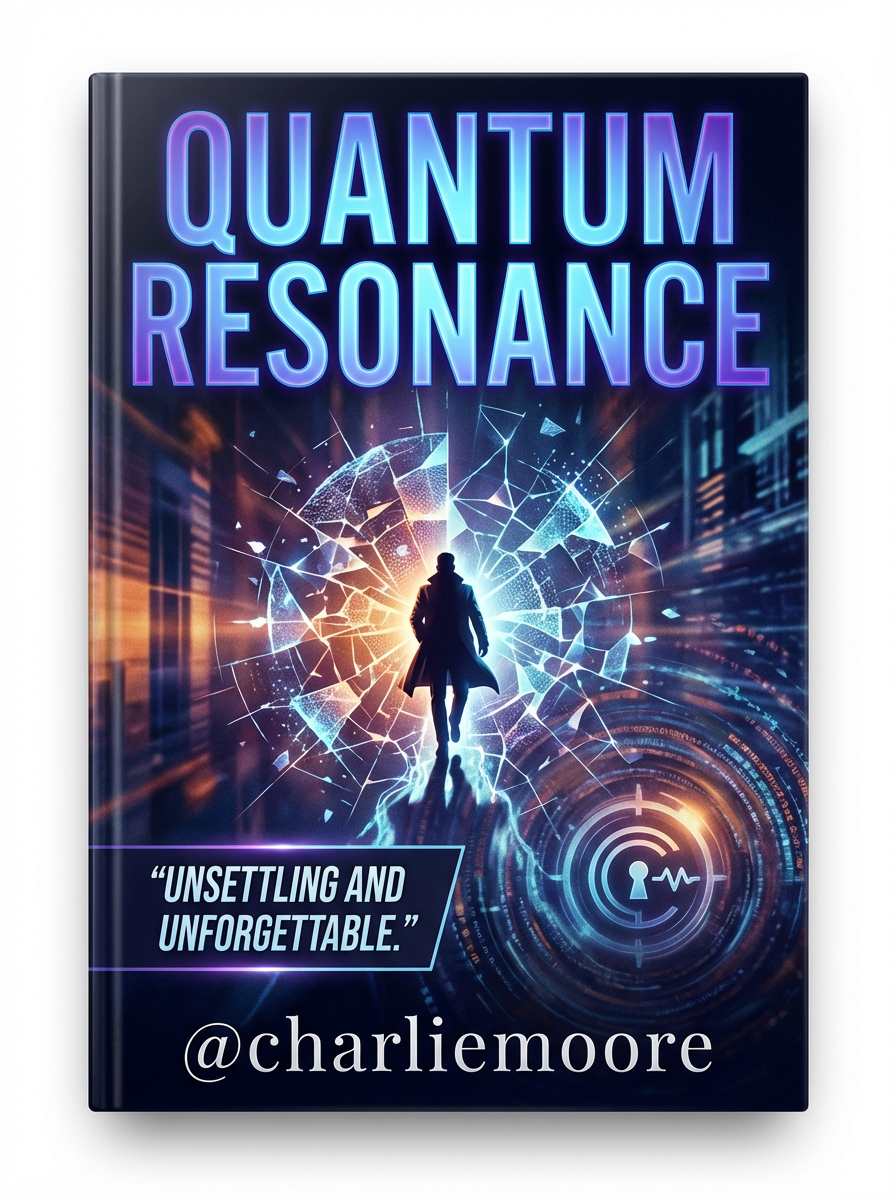
Synopsis
Months after the harrowing events of the 'Quantum Lock,' Dr. Aris Thorne, a disgraced quantum physicist, is pulled back into a world of high-stakes espionage when a new, more insidious quantum anomaly threatens to unravel the fabric of reality itself. A shadowy organization, 'The Ophion Initiative,'
Chapter 1: Echoes of the Collapse
The rain, a relentless, drumming curtain against the stained windowpane, did little to obscure the pervasive grey of the Pacific Northwest sky. Inside, the single fluorescent tube flickering weakly above the kitchenette cast a sickly pallor over the cramped apartment. Dr. Aris Thorne, or rather, Arthur Finch, as his new driver’s license decreed, nursed a mug of lukewarm coffee, the ceramic chipped at the rim, a fitting metaphor for his own existence.
It had been eight months since the Quantum Lock, eight months since he’d stood on the precipice of oblivion, the multiverse screaming its protest against his interference. Eight months since the world had almost ended, and eight months since Aris Thorne had ceased to exist. His new identity was a shroud, a penance for the sins he carried. The quiet, almost monastic life of a freelance software consultant provided the perfect cover for a man who primarily sought to be forgotten. His days were a monotonous loop of coding, instant noodles, and the gnawing silence.
The faint, tinny sound of a local news broadcast emanated from the small, second-hand TV perched precariously on a stack of books. Aris rarely paid attention to current events, preferring the sterile logic of algorithms to the chaotic narrative of humanity. But a phrase caught his ear, slicing through the drone of the rain.
“...unexplained localized disruptions… reports from a small town in rural Ohio…”
He glanced up, his intense blue eyes – the only part of him that age and trauma hadn’t dimmed – narrowing. The reporter, a harried-looking woman, stood before what appeared to be a blurred patch of grass, as if the camera itself couldn’t quite focus.
“Eyewitnesses describe a section of Route 22, approximately thirty yards in length, that simply… wasn’t there for a period of several seconds. Motorists reported feeling a sudden ‘jolt’ or ‘shift’ as their vehicles passed through the affected area, followed by a momentary loss of all electronic functionality. Local authorities are baffled, attributing it to a mass hallucination or unusual atmospheric conditions.”
Aris felt a cold knot tighten in his stomach. Mass hallucination. Unusual atmospheric conditions. The same placating euphemisms used to explain away the early tremors of the Quantum Lock. He pushed the half-empty mug aside, a tremor running through his hand that had nothing to do with caffeine. This wasn’t a hallucination. This was too specific, too localized.
He walked over to his worn laptop, the glow of the screen reflecting dully in his deep-set eyes. His fingers, still nimble despite the months of forced inaction, danced across the keyboard, a latent instinct kicking in. He typed in keywords: “Ohio anomaly,” “localized disappearance,” “electronic failure.” The search results were sparse, buried under conspiracy theories and sensationalist headlines. But there were enough snippets, buried deep in amateur forums and obscure local news blogs, to send a shiver down his spine.
A playground swing set in West Virginia photographed hovering a foot off the ground, then inexplicably slamming back down. A fleeting report from a small town in Maine about a bus driver momentarily losing sight of the road, only for it to reappear as if he’d blinked, yet all passengers confirmed the same experience. A security camera in a Nevada casino recording a slot machine seemingly dissolve into shimmering dust for a split second before reforming.
These weren’t the grand, universe-shattering events of the Quantum Lock, but rather insidious, subtle disturbances. Micro-fissures in the fabric of reality, not a gaping chasm. Like tiny pinpricks, indicating a far larger, more pervasive instability.
He traced a finger over his bottom lip, a habit from his days in the lab when a problem truly stumped him. This wasn't chaos. This was… controlled. Or at least, being observed and, potentially, manipulated. The thought sent a jolt of alarm through him. Someone was toying with quantum mechanics again. And if someone was toying with it, it could only mean one thing: they had bypassed the safeguards, the very global protocol put in place after the last incident to prevent this.
He had tried, truly tried, to forget. To live a normal life. But the ghosts of his past refused to be laid to rest. He saw the faces of the researchers, the innocent bystanders who had been caught in the periphery of his ill-fated experiment. Guilt was an ever-present companion, a lead weight in his gut. He was Aris Thorne, the man who had nearly unmade the universe. And now, the universe was creaking again.
Days bled into a restless week. His work as Arthur Finch suffered. He spent hours poring over academic papers on string theory and quantum entanglement, his mind racing through calculations that had once been second nature. The apartment became a digital cave, illuminated by the cold blue light of his multiple screens, each displaying complex equations or news feeds.
The incidents weren’t isolated anymore. They were growing in frequency, albeit still subtle enough to be dismissed by mainstream media. A fleeting scent of ozone in the air, a momentary visual flicker in an otherwise stable environment, a whisper of a sound that shouldn’t be there – a bell tolling in an empty room, a snippet of a forgotten song. These were the symptoms of something far more troubling, something Aris recognized with a terrifying clarity. This was quantum resonance, but not the stable, predictable kind. This was a chaotic, uncontrolled resonance, and it was spreading.
He knew he shouldn’t get involved. His identity was fragile, his freedom tenuous. One wrong move, one whisper of his real name, and he’d be back under the harsh glare of government scrutiny, likely imprisoned or worse. But the thought of sitting idly by as the world, once again, teetered on the brink, was unbearable. The guilt would consume him entirely.
He picked up his burner phone, a pre-paid device he kept hidden in a deactivated state, only for emergencies. This felt like an emergency. He scrolled through the sparse contact list, stopping at a single, encrypted number. He hesitated, his thumb hovering over the call button. Elena. Dr. Elena Petrova. His former colleague, his confidante. The one person who understood the true scope of what had happened, and what could happen again.
He hadn’t spoken to her since the clean-up, not directly anyway. Their last communication had been terse, coded messages exchanged through an anonymous dead drop, confirming their continued existence and little else. He knew she had returned to her work in theoretical physics, albeit under strict surveillance. Contacting her would put them both at immense risk.
But he trusted her implicitly. Her sharp mind, her pragmatic approach, had often been the only thing grounding him during the chaotic experiments that led to the Lock. If anyone could help him understand these new phenomena, it was Elena.
He pressed call. The phone rang three times, a hollow, digital sound in the quiet apartment, before a clipped, automated voice responded: “The number you have dialed is not in service.”
Aris frowned. Elena was too smart to simply abandon a burner number. This was a pre-arranged signal. She was either compromised, or she was expecting his call and had changed her secure line. He tried a second, even more obscure contact number, one they had devised as a last resort. This one rang. Once. Twice.
Then, a cool, precise voice. “Petrova.” No warmth, no recognition, just a careful challenge.
“Elena,” Aris began, his voice a low rumble, the name feeling foreign on his tongue. “It’s… Arthur. Finch.”
There was a pregnant pause, a nearly imperceptible intake of breath on the other end of the line. “Arthur? I wasn’t expecting to hear from you.” The coolness in her voice remained, a professional detachment that belied the surge of recognition Aris felt.
“I know. I wouldn’t call unless it was… urgent.” He hesitated, choosing his words carefully. He couldn’t afford to be intercepted. “Are you seeing the news reports? The temporal fluctuations? The localized anomalies?”
Another beat of silence. Aris could almost hear her mind racing, connecting the dots. “I’ve been monitoring them,” she finally said, her voice dropping to a near whisper. “They’re… disconcerting. I thought it might be residual effects. Aftershocks.”
“No,” Aris stated, his conviction absolute. “These aren’t aftershocks, Elena. These are new. They’re precise. Orchestrated. Someone is doing this.”
He heard the faint click of a keyboard on her end, the rhythm of her analyzing as she spoke. “Orchestrated? Aris, are you certain? The scale is so small, so inconsistent…”
“That’s the point,” he interjected, a flicker of his old passion igniting in his eyes. “They’re testing the boundaries. Probing the instability we created. They’re learning how to manipulate the tears in the fabric.” He paused, weighing his next words. This was dangerous territory. “I think… I think this is a precursor to something far worse. A new Lock, perhaps. Or something entirely different.”
He heard a sigh, a sound laden with the same weariness he felt. “God help us. You truly believe someone could be weaponizing this?”
“Given our past experience? And the resources required to even attempt this level of quantum manipulation? Absolutely.” Aris ran a hand through his disheveled hair. “I need to meet you, Elena. I need to see what you’ve gathered.”
“Aris, that’s impossible. My movements are… monitored. And yours, I assume, are equally constrained.”
“I’ve been careful,” he assured her, though a part of him knew that wasn’t entirely true. The desire to understand, to prevent a repeat of his past mistakes, was a powerful motivator, eclipsing caution. “I have a location in mind. Remote. Untraceable. The abandoned research facility in the Olympic National Forest. We used to conduct some of our preliminary entanglement experiments there. It’s been derelict for years.”
He waited, holding his breath. It was a risky proposition. The facility was officially decommissioned, a relic of a project that was swept under the rug. But it was private, nestled deep within a thick canopy of old-growth trees, and far from any prying eyes.
“That’s… ambitious, Aris,” Elena said, a hint of steel in her voice. “But I concede. The threat you describe is too grave to ignore. I’ll make arrangements. It will take me three days to shake tail. Can you be there by then?”
“Yes.” Three days to mentally prepare for confronting the ghosts of his past, and perhaps, the harbinger of a new disaster. Three days to become Aris Thorne again.
“One more thing, Aris,” Elena added, her voice dropping to a near whisper. “I have a theory. A terrifying one. I need to verify some data.”
“What is it?” he pressed, his stomach tightening further.
“I think…” she began, and then her voice broke off. There was a faint crackle on the line, a momentary burst of static. “I think… she’s involved.”
Aris felt a cold dread settle over him. *She*. There was only one ‘she’ who could wield quantum mechanics with such precision, such audacity. The one who had taught him everything, and whose own brilliance had now become a terrifying unknown.
“Evelyn,” he breathed, the name a bitter taste in his mouth.
A long silence on the line, more telling than any confirmation. Then, Elena’s voice, grim and resolute. “I’ll bring everything I have, Aris. Be careful.”
The line went dead, leaving Aris alone in the quiet hum of his apartment, the drumming rain outside now sounding like a distant, ominous heartbeat. Dr. Evelyn Reed. His mentor. The woman he had once revered, whose intellect had shaped his formidable mind. Now, the potential architect of a new wave of quantum chaos. The thought chilled him to the bone. Evelyn Reed, brilliant, driven, and consumed by a grief that had warped her moral compass, was a force unlike any other. And if she was indeed behind these anomalies, the stakes had just been raised to an unimaginable level.
He spent the next three days in a flurry of preparation. He emptied his meager savings from the hidden compartment in his wall, enough for essential supplies and travel. He acquired a sturdy backpack, first-aid, navigation equipment, and a powerful, encrypted satellite phone – a relic from his pre-Lock days. Each step was a deliberate shedding of Arthur Finch, a painful reawakening of Aris Thorne.
He drove his beat-up sedan north, away from the city lights, the concrete jungle giving way to the imposing grandeur of the Olympic National Forest. The air grew crisp, laden with the scent of pine and damp earth. The winding roads narrowed, eventually dissolving into overgrown dirt tracks known only to hikers and the occasional lumberjack.
The abandoned research facility was exactly as he remembered it: a cluster of brutalist concrete buildings, partially swallowed by the encroaching wilderness. Moss clung to the walls, vines snaked through shattered windows, and the faint metallic tang of decay hung in the air. The main building, a multi-story structure that once housed their primary quantum resonators, loomed like a haunted cathedral.
He approached with caution, every shadow a potential threat, every creak of a branch a possible intruder. His years in clandestine research had honed his senses, turning suspicion into an instinct. He picked the lock on the rusted access hatch with practiced ease, the mechanism protesting with a sharp groan.
Inside, the air was cold and stale, thick with dust and the smell of long-dormant machines. His flashlight beam cut through the gloom, illuminating ghostly equipment draped in tarpaulins, forgotten schematics tacked to crumbling corkboards. The very air seemed to hum with residual energy, a phantom echo of the titanic forces once unleashed within these walls.
He made his way to the sub-basement, the deepest and most secure level, where their most sensitive experiments had been conducted. He found the hidden power conduit, bypassed the antique security system with a series of quick, expert manipulations, and brought the emergency generator sputtering to life. The faint whirring sound provided a small comfort in the vast silence.
He set up a rudimentary command center in what used to be a clean room, wiping down a rickety table and unfolding a satellite map of the region. He activated his secure communication device, a red indicator light flashing reassuringly. He then connected his encrypted laptop to a portable hard drive, loading it with his own preliminary data and analyses of the recent anomalies.
Aris worked methodically, the muscle memory of a true scientist taking over. He reviewed the sparse snippets of data he’d collected, cross-referencing them with pre-Lock quantum fluctuation patterns. The conclusions solidified into an undeniable truth: someone was not just observing these anomalies, they were orchestrating them. And not just any someone. Someone with a deep understanding of the unstable energies between parallel timelines.
Hours later, a soft, almost imperceptible rustle outside the sub-basement hatch announced Elena’s arrival. Aris drew a hidden pistol from his pack, a grim testament to the changed world they now inhabited. He moved silently towards the hatch, his senses on high alert.
He waited, listening. A soft three-tap knock, their old signal. He lowered the pistol, the tension draining from his shoulders, though a shadow of it lingered. He disengaged the lock, and the heavy hatch swung open with a groan.
Elena Petrova stood there, silhouetted against the weak beam of his flashlights, her dark hair streaked with grime, her practical travel clothes rumpled. But her piercing brown eyes were as sharp and resolute as ever. In her hand, she clutched a reinforced data-pouch.
“Aris,” she said, her voice a low, steady murmur. “You haven’t changed a bit.”
He managed a grim smile. “Neither have you, Elena. Come in.”
As she stepped into the musty, airless space, the scent of ozone seemed to grow stronger, an almost imperceptible hum filling the air. She set her data-pouch on the table, her gaze sweeping over the makeshift command center. “Same old Aris. Still trying to save the world out of an abandoned bunker.”
“Someone has to,” he replied, a weariness in his tone that went beyond physical exhaustion. “What did you find?”
She opened the pouch, her fingers deftly producing a holographic projector. A swirling three-dimensional map of the globe materialized above the table, dotted with blinking red lights. “These are the confirmed anomaly locations. But Aris, it’s not just the *what* and the *where* that’s alarming. It’s the *when*.”
She gestured, and the holographic map cycled through a timeline. The earlier, randomized events gave way to a frighteningly precise pattern. The occurrences were not random. They were converging, slowly but inexorably, towards a single point.
“The frequency is increasing exponentially,” Elena explained, her voice grave. “And the energy signatures… they’re getting stronger. Not just the localized disruptions, but a broader, underlying resonance across the entire quantum field.”
Aris leaned closer, his eyes scanning the data, his mind processing the implications. “A controlled instability. Like a series of small tremors, weakening the bedrock before the big quake.”
“Precisely,” Elena confirmed, her gaze meeting his, a shared understanding of the impending doom. “And my theory about Evelyn… I’ve found data correlating the energy signatures to her old theoretical models. Specifically, her work on inter-timeline harmonic convergence. The very research we all thought she abandoned after her…” She trailed off, discreetly, referring to the death of Reed’s daughter years prior, an event that had deeply affected the brilliant physicist.
Aris felt a cold dread clamp down on his heart. “So it is her. The Ophion Initiative. That’s what they’re calling themselves, isn’t it? The shadowy group supposedly behind the surge in quantum research funding globally?”
Elena nodded grimly. “Yes. And their resources are vast. Unlimited, it seems. They’ve recruited some of the brightest minds, though I’m not sure how many truly understand the ultimate goal.” She paused, her voice hardening. “Evelyn isn’t just testing the boundaries, Aris. She’s trying to punch through them. To weaponize the multiverse.”
The words hung heavy in the stale air, the enormity of the threat pressing down on them. Weaponizing the multiverse. It was a concept so audacious, so terrifying, it bordered on madness.
“Why, Elena?” Aris asked, his voice barely a whisper. “What could she possibly hope to achieve?”
Elena looked at him, her eyes reflecting the flickering holographic map, the myriad of timelines Evelyn Reed was attempting to unravel. “Re-shaping reality, Aris. To correct what she sees as imperfections. To bring back what she lost, perhaps. Evelyn always believed there was a way to control the quantum, not just observe it. Now, it seems, she’s found it. And she’s willing to risk everything to prove her theory.”
The realization hit Aris with the force of a physical blow. Evelyn, his mentor, once a beacon of scientific integrity, was now attempting to tear apart the fabric of existence itself, driven by her own profound grief. The localized anomalies weren't just tests; they were the first, unsettling echoes of a coming collapse. And Aris Thorne, the disgraced physicist, the man who had tried to disappear, was now inextricably drawn back into a nightmare he had helped create. The game had begun anew, more insidious, more dangerous than ever before.
Chapter 2: The Ghost in the Machine
The fluorescent hum of the diner’s overhead lights was a constant drone, a dull counterpoint to the distant urban thrum. Aris Thorne traced the rim of his lukewarm coffee cup, the ceramic cool and smooth against his fingertips. His new identity, Arthur Finch, was just as bland and unmemorable as the toast and eggs he’d barely touched. It had been months since the Quantum Lock, months of self-imposed exile, of trying to erase the indelible stains of that catastrophe from his memory. He’d meticulously crafted this new life, a mosaic of anonymity pieced together from forgotten suburbs and dead-end jobs.
But the world, it seemed, wasn't done with him.
The news reports, vague at first, had grown increasingly specific. A power surge in Düsseldorf that fried half a district's grid; a momentarily flickering skyscraper in Tokyo, its lights winking out and then back on as if controlled by a celestial hand; a stretch of highway in Nevada where cars had simply vanished for a full minute, reappearing equally abruptly. They were calling them “temporal blips” or “energy surges.” Aris called them symptoms. Symptoms of a disease he knew all too well, one that gnawed at the fabric of existence.
He pushed the plate away, the thought of food suddenly unappealing. He missed the precise solitude of his old lab, the hum of the particle accelerators, the quiet communion with equations. His life now felt like a calculation gone wrong, an equation with too many unknown variables.
A shadow fell across his table. He looked up, his intense blue eyes narrowing, a familiar knot tightening in his stomach. Standing there, silhouetted against the diner’s grimy window, was Dr. Elena Petrova.
Her dark, wavy hair was pulled back in a practical, no-nonsense ponytail, and her brown eyes, usually warm, held a glint of steel. She wore a smart-casual blazer over a dark blouse, looking far too composed for the chaos she invariably brought into his carefully constructed solitude.
“Aris,” she said, her voice a low, urgent murmur that cut through the diner’s din. She didn’t bother with the pleasantries, or the pretense of his new name. Their shared past ran too deep for such niceties.
He didn't invite her to sit, but she slid into the booth opposite him anyway, her movements fluid and efficient. “You shouldn’t be here, Elena,” he said, his voice flat, devoid of emotion. He felt a flicker of the old annoyance, mixed with an unwelcome surge of something akin to relief.
“And you shouldn’t be hiding in a third-rate diner pretending to be a… what is it this week, Aris? An insurance adjuster? A reclusive novelist?” Her lips quirked into a thin, humourless smile. “The world’s falling apart, and you’re serving up cold coffee.”
He stared at his hands, calloused from weeks of stacking boxes in a forgotten warehouse. “The world's always falling apart, Elena. I just happen to have had a front-row seat to one particular implosion.”
“This isn’t just ‘one particular implosion,’ Aris. This is universal. And it’s deliberate.”
That caught his attention. He finally met her gaze, a spark of the old curiosity, the scientific hunger, igniting within him. “Deliberate? What are you talking about?”
She leaned forward, her voice dropping even lower. “The anomalies. They’re not random. They’re… focused. Like someone’s shining a laser through a warped lens. Not a natural instability, Aris. A manipulated one.”
The pieces clicked into place, the vague news reports coalescing into a terrifying picture. “The localized 'blips'… the 'surges'…” he murmured, more to himself than to her. “They aren't isolated incidents. They’re ripples.”
“Exactly. We’re detecting something new, something far more sinister than the residual instability from the Quantum Lock. Powerful, patterned energy signatures. Spikes that shouldn’t exist, appearing and vanishing with impossible precision. It’s like a ghost in the machine, Aris. A ghost that’s actively tearing holes in the fabric of spacetime.”
He remembered the bone-deep weariness, the sickening fear that had become a constant companion during the Quantum Lock. He remembered the impossible choices, the sacrifices. He’d sworn he would never go back.
“And you expect me to believe someone is doing this on purpose?” he asked, a bitter edge to his voice. “Because every time someone tries to ‘manipulate’ the quantum field, reality itself pays the price.”
Elena fixed him with a stare, her brown eyes unwavering. “Who else would understand the difference between random quantum noise and deliberate manipulation, Aris? Who else could look at these anomalous signatures and see the design in the chaos?”
He looked at her, truly looked at her. Her face was etched with fatigue, with a desperate urgency he recognized all too well. This wasn't some academic discussion; it was a plea. She was risking everything to find him.
“You’ve been tracking me,” he stated, not a question.
“It wasn’t hard,” she admitted. “You always were predictable in your unpredictability. And I knew you’d be watching the news, even from the fringes. You couldn’t stop yourself.”
He couldn't argue. The urge to understand, to quantify, to solve, was a sickness in his blood.
“What kind of signatures?” he asked, the scientist overriding the recluse.
Elena pulled a folded sheet of paper from her blazer pocket, discreetly sliding it across the table. It was densely packed with graphs and numerical sequences, a language only they truly spoke.
He picked it up, his brow furrowing as his eyes scanned the data. His mind, rusty from months of disuse, began to whir back to life. He recognized the baseline frequencies, the tell-tale distortions. But then there were spikes, perfectly symmetrical and impossibly steep, indicating a colossal energy transfer. And underlying it all, a subtle, rhythmic pattern that echoed the geometry of entanglement itself.
“These can’t be real,” he whispered, his voice barely audible. “The power required… the precision… it's beyond anything we’ve ever theorized as stable.”
“But they are real, Aris. We’ve cross-referenced them with multiple global observatories. They’re all seeing it. Different frequencies, different locations, but the same underlying signature pattern. It’s like a fingerprint, a signature of intent.”
A chill, colder than the deepest winter, snaked its way down his spine. “Someone is actively trying to rewrite reality,” he concluded, the gravity of it pressing down on him. “Or tear it apart. What do you need me for?”
“Our current quantum models can’t account for it. The data is… contradictory. It suggests a manipulation of fundamental constants, a blurring of timelines. I need your intuition, Aris. Your unique, sometimes reckless, insights. Your ability to see the patterns no one else does. We’re blind, and someone is playing God with the universe, using a rulebook we don’t have.”
He pushed the graphs back across the table. “And what makes you think I’m the only one who can decipher this ghost in the machine?”
Elena met his gaze, her expression unwavering. “Because you were the one who almost broke the machine, Aris. You know its limits. You know its vulnerabilities. And you knew before anyone else that these boundaries were meant to be respected, not transgressed.”
He flinched, the words a raw wound. Respect. He had preached respect, then nearly obliterated it in his desperate attempt to prevent the Quantum Lock. It was a hypocrisy that still festered.
“Who is ‘we’?” he asked, changing the subject. “Are the governments involved again? Are Carter’s hounds sniffing around?”
“Not officially. Not yet. After the Lock, they wanted a cleaner, a scapegoat. You were perfect. But I’ve maintained a small, unofficial research team. We’ve been operating under the radar, analyzing the growing anomalies, trying to make sense of the noise.”
“And you think I should emerge from my self-imposed exile to help this 'unofficial research team' fight an unknown entity attempting to weaponize quantum mechanics?” he asked, a bitter laugh escaping him. “I’m a pariah, Elena. A disgraced theoretical physicist. If I show my face, I’ll be shut down, imprisoned, or worse.”
“Perhaps. But if you don't, there might not *be* a face to show, Aris. Not even your carefully constructed 'Arthur Finch' reality. This isn’t a theoretical exercise anymore. We’re seeing evidence of localized timeline divergence. Minor, almost imperceptible – a car that was red is now blue, a café that was there isn’t – but it’s escalating. It’s like reality itself is stuttering.”
The words struck him with a fresh wave of dread. Localized timeline divergence. The very concept was anathema, a violation of the most fundamental laws of causality. He had glimpsed the chaotic beauty of parallel realities during the Lock, but he’d also witnessed the horrifying consequences of their forced interaction.
“You believe someone is trying to exploit parallel timelines?” he asked, the question a hoarse whisper.
Elena nodded slowly, her expression grim. “It's the only explanation that fits the data. The energy signatures, the precise manipulation, the blurring of causality. They’re trying to bleed realities into one another, Aris. We don’t know why, or to what end, but the potential for absolute catastrophe is… unprecedented.”
He closed his eyes for a moment, the weight of a world he’d tried to abandon settling heavily on his shoulders. He saw the faces of the people who had lost everything during the Lock, the bewildered agony in their eyes. He remembered his own desperate scramble to avert a cataclysm, a failure that still haunted his nights.
“Who could do this?” he finally asked, his voice strained. “Who has the knowledge, the resources, the sheer audacity to attempt something so monumentally suicidal?”
Elena hesitated, her gaze becoming distant, contemplative. “There aren’t many. A handful of truly brilliant minds, perhaps. But only one who’s always been willing to push beyond every ethical and scientific boundary. One who truly believes in shaping reality to her own specifications, no matter the cost.”
A name, cold and sharp as a shard of ice, formed unbidden in his mind. He didn't want to say it, didn't want to give it power, to summon the ghost of his past, the ghost of his greatest regret.
But Elena said it for him. “Dr. Evelyn Reed.”
The name hung in the air between them, a specter in the stale diner. Evelyn, his mentor, his intellectual confidante, the woman who had once inspired him, now a dark architect of chaos. The thought twisted his gut. Evelyn, who had been irrevocably changed by the Quantum Lock, by the loss of her research, by the perceived betrayal of the scientific community.
“No,” he breathed, shaking his head. “She wouldn’t. Not like this. Not after everything.”
“You don’t know what she's become, Aris,” Elena said, her voice laced with an almost sorrowful conviction. “Her grief, her ambition, it’s festered into something malignant. She’s acquired funding, attracted a fanatical following, all under the radar. They call themselves ‘The Ophion Initiative.’ And they're building something, Aris. Something immense and terrifying, powered by these manipulated anomalies. We believe she's using the energy signatures to stabilize an inter-dimensional gateway, to harvest resources, maybe even to weaponize control over parallel timelines.”
“Weaponize… timelines?” The absurdity would have been comical, if not for the very real threat.
“Imagine, Aris,” Elena pressed, her voice chilling him, “a reality where your adversaries never existed. A timeline where your country loses a war before it’s even fought. A world sculpted to one woman’s will. That is the ambition. And Reed has always been a woman of boundless ambition.”
The image of Evelyn, once so vivacious and inspiring, now a figure of such terrifying power, made his blood run cold. She had mourned the loss of her research, the unraveling of her life’s work, with a terrifying intensity. Could her grief have been warped into this? A desire not just to reclaim, but to *remake*?
He looked at the graphs again, the impossible data, the ghost in the machine. He saw not just arbitrary fluctuations, but a deliberate code, a language of destruction. And he knew, with a sickening certainty, that Elena was right. Only Evelyn possessed the combination of unparalleled genius, unshakeable conviction, and now, boundless ruthlessness, to attempt such a terrifying feat.
“I can’t,” he said, pushing away from the table, the old fear clawing at his throat. “I'm out. I chose this. I chose to be done.”
Elena reached across the table, her hand resting briefly, firmly, on his. Her touch was a jolt, grounding him in the present, pulling him from the dark eddies of his past. “You can’t, Aris. Not when you’re the only one who can understand the blueprint for her madness. Not when you’re the only one who knows how she thinks, how she operates. You were her student, her prodigy. You know her scientific soul, for better or worse.”
He stared at where her hand had been, then looked into her eyes. He saw the desperation there, but also a bedrock of unwavering professionalism. He knew she wasn’t asking this for herself, but for something far greater than any one individual.
He rose, pushing the chair back with a scrape that echoed in the relative quiet of the diner. He walked to the window, staring out at the indifferent street. The world was still there, still spinning, but beneath its mundane surface, he could feel the faint tremor of its impending unraveling. He could hear the hum of the 'ghost,' a discordant symphony from beyond the veil of reality.
He was a failure. A pariah. A man trying to forget a past he couldn't outrun. But he was also Aris Thorne. And perhaps, just perhaps, he was the only one who could truly understand the ghost in the machine. And the woman who was controlling it.
He turned back to Elena, the resignation heavy in his shoulders, but a resolve, cold and sharp, hardening in his eyes.
“Alright, Elena,” he said, his voice quiet, devoid of his earlier bitterness. “Show me everything. Tell me who you’ve been talking to. Tell me what she’s *really* building. Because if Evelyn Reed is trying to rewrite reality, then we’re going to have to write a new ending for her.”
Chapter 3: A Fragmented Truth
The air in Thorne’s dilapidated apartment was thick with the dust of forgotten ambitions and the stale scent of instant coffee. Petrova’s words, sharp and insistent, had cut through the carefully constructed insulation of his exile. “Interdimensional,” she’d said, her voice a low thrum of urgency. It was a word that once fueled his dreams, now a chilling echo of his deepest fears.
He ran a hand over his unshaven jaw, the stubble rasping against his calloused skin. The memory of the Quantum Lock, the catastrophic event that had shattered his career and nearly fractured reality, was a raw wound. He had vowed never to return to that precipice, never to tamper with forces beyond human comprehension. But Petrova’s desperation was a magnetic pull he couldn’t ignore. The anomalies she described, the fleeting disappearances and technological glitches, were not random occurrences. He knew, with a sinking certainty, that they were the nascent tremors of something far more sinister.
“Explain it again, Elena,” Thorne said, his voice a gravelly whisper, a stark contrast to the brilliant mind it housed. He picked up a crumpled napkin from the table, absently tracing the stain of a forgotten coffee cup.
Petrova, her usually composed demeanor frayed at the edges, pulled a tablet from her worn leather satchel. “These are the latest readings,” she began, her fingers flying across the screen, bringing up a series of complex data visualizations. “Localized spacetime distortions, concentrated energy spikes… it’s unlike anything we’ve ever encountered. Not even during the Lock.”
Thorne leaned closer, his eyes, once dull with resignation, now alight with a rekindled spark of scientific curiosity, a dangerous flame he thought he’d extinguished. The graphs on the tablet pulsed with an eerie luminescence, showcasing anomalies that defied conventional physics. “The signatures… they’re too precise,” he murmured, his brow furrowed in concentration. “Too… intentional.”
Petrova nodded grimly. “Exactly. And the energy output is escalating. It’s almost as if someone is deliberately attempting to tear the fabric of reality.”
The implications of her statement hung heavy in the air, a suffocating weight. Thorne pushed himself up from his chair, pacing the small confines of his living room. “Tearing it, or… weaving it?” he mused, a new, terrifying possibility forming in his mind. “What if this isn't an uncontrolled collapse, but a controlled manipulation?”
Petrova’s eyes widened, a flicker of understanding passing between them. “A resonance,” she whispered, the word hanging like a judgment in the silence. “A quantum resonance.”
The term was a theoretical construct, an elegant mathematical possibility that described a precise, controlled interaction between adjacent realities. It was the holy grail of quantum mechanics, a concept that could unlock untold power, or unleash unimaginable chaos.
“If it’s a resonance,” Thorne continued, his voice gaining a newfound intensity, “then someone is actively trying to bridge the gap between dimensions. And if they succeed, the consequences could be catastrophic. Not just for our reality, but for every parallel timeline.”
The thought sent a shiver down his spine. The multiverse, a concept he had once championed, now felt like a fragile ecosystem, vulnerable to the ambitions of those who sought to exploit its delicate balance.
Petrova stared at him, her gaze unwavering. “We need your expertise, Aris. You’re the only one who can understand these patterns, the only one who can predict their trajectory.”
He ran a hand through his thinning hair, the weight of the world settling on his shoulders once more. He had tried to escape this life, to bury his past, but destiny, it seemed, had other plans. “Where are these readings coming from?” he asked, his voice low and resolute.
“A secure, clandestine research facility,” Petrova replied, pulling up a map on her tablet. “Deep within the Nevada desert. It’s a ghost site, officially decommissioned years ago, but we’ve reactivated it under extreme secrecy.”
The irony was not lost on Thorne. He was being called back to the very type of facility he had once worked in, a place where the boundaries of science were pushed to their breaking point, often with devastating consequences.
“Fine,” Thorne finally said, the word a reluctant acceptance. “I’ll help. But on one condition. No more secrets, Elena. If we’re going into this, we go in with full transparency. I need to know everything.”
Petrova offered a small, grateful smile. “Agreed, Aris. Everything.”
***
The journey to the clandestine facility was a blur of anonymous vehicles and hushed conversations. Thorne found himself in the back of a blacked-out SUV, the desert landscape a desolate expanse outside the tinted windows. Petrova sat beside him, her tablet still clutched in her hands, her brow furrowed in thought. The silence between them was punctuated only by the hum of the engine and the occasional crackle of a radio transmission.
As they approached their destination, the SUV veered off the main road, traversing a winding, unpaved track that seemed to lead nowhere. The sun, a fiery orb in the cloudless sky, cast long, distorted shadows across the barren landscape. Finally, a series of reinforced gates loomed into view, guarded by armed personnel in unmarked uniforms.
The facility itself was an architectural anomaly, a brutalist structure of concrete and steel seemingly carved into the side of a mesa. It was designed for secrecy, for containment, a place where the world could be reshaped without observation.
Inside, the air was cool and sterile, a stark contrast to the arid heat outside. The corridors were a labyrinth of polished steel and flickering fluorescent lights, the only sounds the whir of ventilation systems and the distant hum of machinery. Thorne felt a familiar unease settle over him, a sense of déjà vu that tightened his chest.
Petrova led him through a series of biometric checkpoints, her access privileges seemingly limitless. They finally arrived at a heavily fortified laboratory, a cavernous space filled with blinking consoles, glowing monitors, and an array of sophisticated scientific equipment. Scientists, their faces etched with a mixture of exhaustion and exhilaration, moved with purpose, their hushed conversations a symphony of technical jargon.
“Welcome to Project Chimera,” Petrova said, her voice a low murmur. “Our last line of defense.”
Thorne surveyed the scene, his gaze sweeping over the intricate machinery, the complex schematics displayed on holographic screens. He recognized some of the equipment, advanced quantum entanglement devices, energy containment units – tools designed to manipulate the very fabric of spacetime.
“Show me the source,” Thorne commanded, his voice cutting through the hum of the lab.
Petrova led him to a central console, a massive holographic display showcasing a dynamic, pulsating energy signature. It was a swirling vortex of iridescent light, a miniature supernova contained within the lab’s sophisticated shielding.
“This is it,” Petrova said, her voice laced with a mixture of awe and trepidation. “The primary quantum resonance signature. It’s emanating from a localized point within this facility, but its effects are being detected globally.”
Thorne leaned in, his eyes fixated on the shimmering vortex. He could feel the raw power emanating from it, a subtle vibration that resonated deep within his bones. It was a controlled explosion, a carefully orchestrated dance between realities.
“The energy patterns,” Thorne began, his mind already racing, dissecting the complex data streams displayed alongside the holographic image. “They’re not merely fluctuating. They’re *interacting*. Like two separate frequencies, perfectly aligned, creating a harmonic feedback loop.”
“That’s what we’ve been trying to decipher,” Petrova interjected. “The data suggests a deliberate synchronization, a targeted resonance. But to what end?”
Thorne’s fingers danced across the holographic interface, manipulating the data, isolating specific frequencies, amplifying subtle anomalies. He felt a familiar thrill, the rush of intellectual pursuit that had once defined his existence. “It’s not just a bridge, Elena,” he murmured, his voice barely audible above the hum of the lab. “It’s a conduit. Someone isn’t just trying to observe parallel realities; they’re trying to *channel* them.”
A collective gasp rippled through the nearby scientists. Channeling parallel realities was a theoretical concept, a notion so audacious it bordered on science fiction. It implied not just observation, but active manipulation, the ability to draw resources, information, or even beings from other dimensions.
“Channel them for what purpose?” Petrova asked, her voice tight with apprehension.
Thorne paused, his fingers hovering over the holographic display. The implications were staggering, terrifying. He looked at the swirling vortex, the iridescent light reflecting in his eyes. “For power, Elena. Unimaginable power. If they can harness the energy of an entire parallel reality, they could reshape our own world in ways we can’t even begin to comprehend.”
“Global domination,” Petrova whispered, the words a chilling echo of the warnings she had received.
Thorne nodded grimly. “Or something far worse. The Ophion Initiative. That’s what you called them, isn’t it?”
Petrova’s face hardened. “Yes. They’ve been operating in the shadows for years, acquiring advanced technology, recruiting brilliant minds. We suspected they were involved in something on a global scale, but we never imagined… this.”
Thorne’s mind raced, piecing together fragments of information. The precise energy signatures, the controlled resonance, the audacious goal of interdimensional channeling. It all pointed to a mastermind, someone with a profound understanding of quantum mechanics, someone with the resources and the ruthlessness to attempt such a feat.
“We need to identify the source of this synchronization,” Thorne declared, his voice ringing with renewed purpose. “Who is orchestrating this? Who has the knowledge and the audacity to attempt a quantum resonance on this scale?”
Petrova gestured to a series of monitors displaying encrypted communications and intercepted data streams. “We’ve been tracking their digital footprint, but they’re incredibly elusive. Their network is a labyrinth of proxies and dead ends.”
Thorne turned back to the holographic display, his gaze fixed on the pulsating vortex. “The resonance itself might hold the key. Every interaction leaves a trace, a unique signature. If we can analyze the specific frequencies, the unique harmonic patterns, we might be able to identify the architect.”
He spent the next several hours immersed in the data, his mind a whirlwind of equations and theoretical constructs. The scientists in the lab watched him with a mixture of awe and trepidation, recognizing the ghost of the brilliant Dr. Aris Thorne, the man who had once pushed the boundaries of human understanding.
As the desert sun began to set, casting long, purple shadows across the lab, Thorne finally leaned back, a triumphant glint in his eyes. “I’ve found it,” he announced, his voice hoarse but exhilarated. “A specific harmonic frequency, embedded within the resonance. It’s like a signature, a fingerprint.”
He manipulated the holographic display, isolating a subtle, yet distinct, frequency pattern. It pulsed with an almost imperceptible rhythm, a complex sequence of quantum fluctuations.
Petrova leaned in, her eyes narrowed in concentration. “What is it?”
“It’s a highly advanced encryption algorithm,” Thorne explained, his fingers flying across the interface, dissecting the complex code. “More intricate than anything I’ve ever encountered. It’s designed to mask the true origin of the resonance, to obscure the identity of the operator.”
“Can you break it?” Petrova asked, her voice barely a whisper.
Thorne paused, his gaze fixed on the shimmering code. “It will take time. But if I can, it will lead us directly to the source. To The Ophion Initiative’s inner sanctum.”
Just then, a klaxon blared, its piercing wail echoing through the sterile corridors of the facility. Red emergency lights flashed, casting an ominous glow over the lab.
“What’s happening?” Thorne demanded, his senses immediately on high alert.
A frantic scientist rushed to the central console, his face pale with alarm. “Energy fluctuations! The resonance… it’s becoming unstable!”
On the holographic display, the shimmering vortex began to pulse erratically, its iridescent light flickering with dangerous intensity. The subtle vibrations Thorne had felt earlier now intensified, a low rumble that vibrated through the floor.
“They’re increasing the power output,” Petrova exclaimed, her voice strained. “They’re pushing the resonance to its limits!”
Thorne’s eyes widened in horror. “They’re trying to force a full interdimensional breach! They’re not just channeling; they’re attempting a complete transfer!”
The implications were catastrophic. A full interdimensional breach, uncontrolled and unstable, could tear reality apart, merging timelines, unraveling the very fabric of existence.
“We need to shut it down!” Thorne shouted, his voice filled with urgency. “Now!”
Petrova was already shouting orders into her comms unit, her voice tight with panic. “Initiate emergency containment protocols! Divert all available power to the dampeners!”
But it was too late.
With a deafening roar, the holographic vortex exploded outwards, sending a blinding flash of iridescent light through the lab. The ground shuddered violently, and the lights flickered and died, plunging the facility into an unsettling darkness, punctuated only by the eerie glow of emergency lights.
A chilling silence descended upon the lab, broken only by the distant sounds of alarms and the frantic shouts of scientists. When the dust settled, Thorne looked around, his heart pounding in his chest. The central console was smoking, its holographic display shattered. The air was thick with the acrid smell of ozone and burnt electronics.
“Elena!” Thorne called out, his voice laced with fear.
A faint groan answered him. Petrova lay slumped against a shattered console, a trickle of blood running from a gash on her forehead. Thorne rushed to her side, his hands trembling as he checked for injuries.
“I’m fine,” she gasped, her eyes fluttering open. “Just a little… disoriented.”
He helped her to her feet, his gaze sweeping over the chaos of the lab. The sophisticated equipment was damaged, some of it utterly destroyed. But the most terrifying sight was the gaping, shimmering rift that now pulsed in the center of the lab, a tear in the fabric of reality itself.
It was a window, a portal to another dimension, and through it, Thorne could glimpse a fleeting, distorted image of a world that was both familiar and utterly alien.
“They succeeded,” Thorne whispered, his voice filled with a chilling dread. “They opened the gate.”
From the swirling depths of the rift, a shadowy figure began to emerge, its form indistinct, shimmering with an unearthly light. It was tall, gaunt, and its eyes, though obscured by the distortion of the rift, seemed to burn with an unsettling intensity.
A collective gasp of terror rippled through the remaining scientists.
“Who… what is that?” one of them stammered, his voice trembling.
Thorne stared at the emerging figure, a cold dread settling in his stomach. He knew, with a certainty that chilled him to the bone, that this was no mere anomaly. This was an entity, a being from another dimension, brought forth by the Ophion Initiative’s reckless ambition.
And as the figure stepped fully into their reality, its form solidifying, Thorne recognized the cold, calculating eyes, the cruel twist of its lips.
It was a face he knew, a face that had haunted his nightmares for years.
“No,” Thorne whispered, the word a choked gasp. “It can’t be.”
Standing before them, framed by the shimmering portal, was Dr. Marius Kael, Thorne’s former mentor, his once trusted colleague, now a spectral harbinger of interdimensional chaos. His eyes, once filled with the light of scientific curiosity, now burned with a chilling, ruthless ambition.
Kael offered a slow, predatory smile, his gaze sweeping over the terrified scientists, finally settling on Thorne. “Aris,” he purred, his voice a low, resonant hum, a sound that seemed to vibrate from the very fabric of the newly opened rift. “It’s been a long time, old friend.”
The words hung in the air, a chilling prelude to the interdimensional war that had just begun. The Ophion Initiative had not just opened a door between worlds; they had unleashed a ghost from Thorne’s past, a specter of his own failure, now poised to unravel the very foundations of reality. The fragmented truth of their shared history, once buried under layers of regret and betrayal, had finally emerged, demanding a reckoning.
Chapter 4: The Ophion Initiative
The stale air of Elena’s makeshift lab, a repurposed storage unit beneath a forgotten industrial park, hung heavy with the scent of ozone and desperation. Aris, hunched over a flickering monitor, felt the familiar thrum of his own anxieties amplifying the raw data scrolling across the screen. Elena, a whirlwind of nervous energy, paced the confined space, occasionally pausing to jab a finger at a particular waveform or spectral analysis.
“It’s not just manipulation, Aris,” she declared, her voice tight with a barely contained urgency. “It’s…orchestrated. These energy signatures, they’re too precise, too consistent across disparate locations. Someone isn’t just poking at the quantum fabric; they’re *weaving* it.”
Aris ran a hand through his already disheveled hair, the stubble on his jaw scratching. “Weaving it into what, Elena? A tapestry of chaos?”
“Or a weapon,” she countered, her eyes narrowing as she pointed to a complex algorithm that pulsed with an ominous regularity. “This pattern…it’s a signature. A unique identifier. Like a fingerprint on the quantum field.”
His gaze sharpened, his own professional curiosity now overriding the lingering specter of his past failures. "A fingerprint? You mean someone is actively *designing* these anomalies?"
Elena nodded, her face grim. "Precisely. And what's more, the energies involved... they're beyond anything we've seen before. Far more powerful than the initial Quantum Lock events, yet somehow more contained. It's as if they've learned from our mistakes, Aris. Learned how to control the instability."
The implication hung in the air, a chilling premonition. Someone wasn't just observing the quantum chaos; they were refining it. Mastering it.
"Who?" Aris breathed, the word a whisper against the hum of the cooling fans. "Who has the resources, the knowledge, the sheer audacity to attempt something like this?"
Elena’s fingers flew across her keyboard, bringing up a series of encrypted files. “That’s what I’ve been trying to ascertain. The energy signatures, while unique, have faint echoes of…earlier research. Research that was deemed too dangerous, too volatile, to ever be pursued.”
Aris felt a cold dread creep up his spine. He knew precisely what research she was referring to. The theoretical frameworks, the speculative models, the very blueprints of quantum entanglement manipulation that had been shelved after the Quantum Lock, deemed too perilous for humanity's grasp.
"The Ophion Protocol," he murmured, the name tasting like ash in his mouth. It was a classified government initiative, conceived in the heady days before the Quantum Lock, designed to explore the weaponization of quantum phenomena. He had been peripherally involved, offering theoretical insights, before his ethical objections had led him to distance himself.
Elena’s head snapped up. “Exactly. But the Ophion Protocol was dismantled. The research facilities sealed, the data purged. Or so we were told.”
“Government purges are rarely complete, Elena,” Aris said, a cynical edge to his voice. He knew firsthand the labyrinthine bureaucracy and the shadowy corners where information could fester. “Especially when the potential for power is so immense.”
They spent the next several hours in a frenetic dance of data analysis, cross-referencing the anomalous energy signatures with every scrap of information they could glean from the dark web, from archived scientific papers, from the whispered legends of the quantum community. The picture that slowly emerged was disturbing, a mosaic of ambition and disillusionment.
“It’s not a government project anymore,” Elena announced, her voice strained, as a meticulously compiled dossier materialized on the screen. “Or at least, not one sanctioned by any known authority. These are… splinter groups. Disgruntled scientists, disillusioned military personnel, even some former intelligence operatives.”
Aris leaned closer, his eyes scanning the names, the affiliations, the dates. The dossier, compiled from a series of highly sensitive leaks, painted a picture of a clandestine organization, built from the remnants of the Ophion Protocol. It was a ghost returning from the grave, but with a new, more malevolent purpose.
"The Ophion Initiative," Aris read aloud, the name emblazoned across the top of the leaked document. "Formed by those who believed the Quantum Lock was not a failure, but a flawed proof of concept. Those who saw the instability not as a threat, but as an opportunity."
He scrolled further, the list of names growing, a who's who of brilliant, often marginalized, minds from the cutting edge of quantum physics and theoretical mathematics. Many of them he recognized, some as former colleagues, others as respected figures whose careers had been sidelined by academic politics or ethical concerns.
Then, his breath hitched. The screen blurred for a moment, not from a technical glitch, but from the sudden, visceral shock that coursed through him. A name, in bold, stood out like a beacon in the digital darkness:
**Dr. Evelyn Reed.**
The world seemed to tilt on its axis. The hum of the lab, the frantic energy of Elena, the very air around him, all faded into a distant thrum. Only the name resonated, echoing in the cavern of his memory.
Evelyn Reed. His mentor. The woman who had first ignited his passion for quantum physics, who had guided his early research, who had been a pivotal figure in the nascent stages of the Quantum Lock project. She was brilliant, uncompromising, and possessed an almost messianic belief in the transformative power of quantum mechanics. After the Lock, she had vanished, her silence a stark contrast to her once vocal presence in the scientific community. Rumors had circulated – a nervous breakdown, a self-imposed exile, even a quiet retirement to a forgotten corner of the world. But never this. Never the leader of a shadowy organization bent on weaponizing the very fabric of reality.
"Aris? What is it?" Elena's voice, sharp with concern, cut through his daze. She followed his gaze to the screen, her own eyes widening as she recognized the name. "Evelyn Reed? But... she was a proponent of *containment*, not manipulation. She was devastated by the Quantum Lock's aftermath."
"Devastated, perhaps," Aris said, his voice a low growl, "but also deeply, profoundly frustrated. Evelyn always believed humanity was on the precipice of a new era, an era defined by our mastery of the quantum realm. The Lock, for her, wasn't a warning; it was a setback. A challenge to be overcome."
He remembered their last conversation, weeks before the Quantum Lock, a heated debate in a dimly lit university office. Evelyn, her eyes alight with a fervent conviction, had argued for pushing the boundaries further, for exploring the deeper implications of multiversal entanglement, even as Aris expressed his growing unease about the inherent risks. "The universe is a symphony, Aris," she had said, her voice a hushed reverence. "And we have only begun to learn its notes. To shy away from its full potential is to deny our own evolution."
He had seen it then, the seed of something dangerous in her unwavering conviction. A belief that the ends justified any means, especially when those ends promised a new paradigm for human existence.
"This document," Aris continued, his finger tracing the lines of the manifest, "it describes their core philosophy. They believe the Quantum Lock was a natural progression, a necessary step in understanding the multiverse. They see the instability not as a defect, but as a gateway. A gateway they intend to control."
Elena, her face etched with disbelief, scrolled through the accompanying operational schematics. "They're trying to stabilize the anomalies. To harness them. To *direct* them. But for what purpose, Aris? What could possibly justify such a colossal risk?"
Aris's gaze returned to Evelyn Reed's name, a knot tightening in his stomach. "Global domination, Elena. Or something far more insidious. Evelyn always believed humanity was too fractured, too short-sighted, to truly grasp its own potential. She saw a world teetering on the brink of self-destruction, and she always believed she had the vision to pull it back."
"By force?" Elena scoffed, her voice laced with incredulity. "By manipulating reality itself?"
"Evelyn's definition of 'force' was always… nuanced," Aris replied, a bitter taste in his mouth. "She believed that if you could control the fundamental fabric of existence, you could reshape society from the ground up. Not through brute strength, but through subtle, almost imperceptible alterations to causality, to probability, to the very choices people make."
The leaked manifest detailed the Ophion Initiative's ambitious plans: the establishment of covert research facilities in remote, geopolitically unstable regions, the recruitment of disillusioned scientists and engineers, and the acquisition of vast financial resources from unseen benefactors. It spoke of "quantum resonance emitters" and "temporal displacement matrices," terms that sent a shiver down Aris's spine. These weren't theoretical concepts anymore; they were operational goals.
"They're not just observing the anomalies, Elena," Aris said, his voice flat. "They're generating them. They're testing their control, refining their techniques. The localized phenomena you've been tracking? Those aren't random fluctuations. They're experiments."
The implication was staggering. The Ophion Initiative wasn't reacting to a crisis; they were creating one. They were actively destabilizing reality, not to cause chaos, but to learn how to master it. To bend it to their will.
"And Evelyn… she's at the helm," Elena whispered, the weight of the revelation settling heavily upon her. "The woman who taught us both the ethics of scientific discovery, now leading a project that defies every ethical boundary."
Aris nodded slowly, the image of Evelyn, vibrant and passionate, warring with the chilling reality of her current role. "Evelyn always had a singular focus, Elena. Once she sets her mind to something, there's no deterring her. And if she believes this is the path to a better future, then she will pursue it with ruthless efficiency, no matter the cost."
He scrolled further down the manifest, past the technical specifications and the logistical plans, to a section detailing their ultimate objective: "Project Chronos." The description was vague, cloaked in scientific jargon, but the underlying intent was clear. They sought to manipulate causality itself, to access and potentially *alter* parallel timelines.
"Parallel timelines," Aris breathed, the words a cold dread in his throat. "They're not just trying to control this reality, Elena. They're trying to control *all* realities."
Elena stared at the screen, her face pale. "But that's… that's impossible. The sheer energy, the computational power required… and the inherent risks. Even a minor miscalculation could unravel the entire multiverse."
"Evelyn wouldn't see it as a risk," Aris countered, his voice devoid of emotion. "She would see it as a challenge. A grand, audacious experiment to prove humanity's ultimate dominion over the laws of physics. She always believed that if a thing was theoretically possible, then it was our scientific imperative to make it real."
The silence that followed was heavy, punctuated only by the whirring of the servers and the distant rumble of city traffic. The magnitude of what they had uncovered was overwhelming. The Quantum Lock had been a catastrophic accident. The Ophion Initiative was a deliberate, calculated assault on the very fabric of existence, orchestrated by a woman Aris had once admired, a woman who now stood as a formidable, enigmatic adversary.
"We have to stop them, Aris," Elena finally said, her voice firm, resolute. "Before they succeed. Before Evelyn… before she destroys everything."
Aris looked at her, his eyes reflecting the flickering light of the monitor. The reclusive life he had carved out for himself, the carefully constructed anonymity, shattered. The past he had so desperately tried to outrun had caught up to him, and it was wearing the face of his former mentor.
"I know," he said, his voice a low, gravelly whisper. "And I know exactly where to start looking." He pointed to a code name on the manifest, a cryptic alphanumeric string associated with a remote, decommissioned research facility in the Siberian wilderness. A facility he knew Evelyn had always been fascinated by, a place where the boundaries of physics were rumored to be thin, and the veil between realities, almost transparent.
The Ophion Initiative. A name that now carried the weight of a looming catastrophe, a name inextricably linked to the ghosts of his own past, and to the woman who had once been his guiding light, now poised to plunge the multiverse into an abyss of her own making. The game had begun, and Aris Thorne, the disgraced physicist, was once again, unwillingly, on the board.
Chapter 5: The Nexus Point
The holographic projection of the quantum field shimmered, a maelstrom of iridescent data points that pulsed and refracted in the sterile confines of the clandestine lab. Aris leaned closer, his brow furrowed, the lines of fatigue etched deeper around his eyes. Weeks had blurred into an indistinguishable continuum of caffeine, complex algorithms, and the gnawing anxiety that twisted his gut into knots. Petrova, ever the stoic counterpoint to his restless energy, stood beside him, her gaze fixed on the anomaly at the heart of the projection.
“It’s not just a resonance,” Aris murmured, the words feeling heavy in the air. “It’s… a focal point. Everything is converging here.” He tapped a finger against the shimmering epicenter, the data swirling faster in response. “These energy signatures, they’re not random fluctuations. They’re being pulled in, concentrated.”
Petrova nodded slowly, her expression grim. “Like a drain. Or a nexus.”
The word hung in the air, a chilling realization settling between them. Aris straightened, pushing a hand through his already disheveled hair. “A nexus. Yes. A stable point from which to… what? Observe? Manipulate?”
“Both, I imagine,” Petrova said, her voice flat. “If Ophion intends to weaponize parallel timelines, they would need a central hub. A command center, of sorts. A singular point of entry and exit.”
The implications were staggering. Aris felt a cold tremor run through him. “They’re not just opening doors, Elena. They’re building a goddamn interdimensional switchboard.”
He walked over to a whiteboard, snatching a marker. “Think about it. The localized phenomena we’re seeing – the disappearances, the glitches – they’re not random, are they? They’re deliberate probes. Tests. Like a child poking a stick into an ant farm, trying to see what happens.” He scribbled furiously, equations and diagrams filling the board. “They’re learning the parameters. The resistances. The vulnerabilities of each adjacent reality.”
“And once they understand those parameters,” Petrova continued, her voice laced with dread, “they can choose which reality to interact with. Which to exploit.”
“Precisely.” Aris turned back to the projection, his gaze hardening. “Imagine a world where a specific resource is abundant, but in ours, it’s scarce. Or a timeline where a particular technology was never developed, ripe for the taking. Or, God forbid, a reality where a critical historical event unfolded differently, and Ophion can leverage that divergence for their own gain in ours.”
The sheer audacity of it left him momentarily speechless. Evelyn Reed, his mentor, had always been brilliant, ambitious. But this… this was a level of megalomania that transcended scientific curiosity. This was a bid for absolute, unchallengeable power, rooted in the very fabric of existence itself.
“But how do they stabilize such a point?” Petrova mused, her analytical mind already racing ahead. “The energy required would be immense. And the inherent instability of quantum resonance… it should tear itself apart.”
Aris tapped his chin, a familiar spark igniting in his eyes, even amidst the weariness. “Unless… unless they’re not generating the energy from scratch. What if they’re tapping into an existing energy source? Something powerful enough to anchor the resonance, to withstand the chaotic fluctuations of interdimensional interaction.”
He paced the length of the lab, his thoughts spiraling. “What kind of energy source could possibly achieve that? Nuclear fusion? Geothermal? No, not enough. Not stable enough for this kind of precise, sustained manipulation.”
Petrova had moved to a smaller console, inputting new variables into a simulation. “What about an existing infrastructure? Something designed to handle immense power, to channel and direct it with precision?”
Aris stopped dead in his tracks. His eyes widened. “A particle accelerator.”
The words were barely out of his mouth when Petrova’s screen flashed, a sudden surge of data appearing. “The energy signatures… they’re not just converging. They’re being *focused*. Refracted through a series of magnetic fields, precisely tuned to amplify and stabilize the resonance.”
He rushed back to her side, leaning over her shoulder. The simulation on her screen now depicted a complex array of coils and magnets, a familiar architecture. “It’s textbook particle physics,” he breathed, a grim recognition dawning. “They’re using a collider. Not to smash atoms, but to smash *realities*.”
“But which one?” Petrova asked, her voice tight. “There are hundreds of decommissioned accelerators around the world. And active ones, for that matter. How do we narrow it down?”
Aris’s mind raced, sifting through years of theoretical physics, of discussions with Reed, of the very foundations upon which the Quantum Lock had been built. “Think about the parameters. Stability. Isolation. The ability to operate without drawing undue attention. And… the sheer scale of the operation. This isn’t something you can set up in a suburban basement.”
He pulled up a global map on the main screen, overlaying it with known locations of particle accelerators, both active and defunct. The map became a constellation of red dots. “We need to filter. First, eliminate anything too close to major population centers. Too much risk of detection, too much collateral damage if something goes wrong.”
Petrova began inputting filters, the red dots dwindling. “That still leaves us with dozens. And many of those are active research facilities. Highly secured, but also heavily monitored.”
“Exactly,” Aris said, rubbing his temple. “Ophion thrives in the shadows. They wouldn’t risk operating in plain sight. So, decommissioned. Abandoned. Something that could be repurposed without raising immediate flags.”
More dots vanished from the map. The remaining few were scattered across remote corners of the globe: a defunct accelerator in the Siberian wilderness, a forgotten facility beneath the Australian desert, a relic of the Cold War buried deep in the Andes.
“And the energy source,” Aris pressed, his gaze sweeping over the dwindling possibilities. “It still comes back to that. They need a sustained, powerful current. Something that can be modified, amplified, directed.”
Petrova’s fingers flew across the keyboard. “What about geographical advantages? High altitude, for instance? Less atmospheric interference for certain quantum phenomena. Or tectonic stability for precise alignment?”
Aris paused, his eyes narrowing on a cluster of dots in a particularly desolate region. “The Himalayas.”
Petrova looked up, a flicker of understanding in her eyes. “There was a project in the late 90s. A multinational collaboration, largely funded by a European consortium. Aimed at exploring exotic particles, leveraging the natural cosmic ray shielding of the mountains.”
“The Dharma Project,” Aris supplied, the name surfacing from a dusty corner of his memory. “It was ambitious, cutting-edge for its time. But it ran into funding issues, political squabbles. Eventually, it was abandoned. Too remote, too expensive to maintain.”
He zoomed in on the Himalayan region. A single red dot pulsed, nestled deep within the treacherous mountain range. “An abandoned particle accelerator. High altitude. Extreme isolation. And, if I recall correctly, it was designed with a modular power grid, intended to be expanded with future fusion reactors. It would have the infrastructure for immense power, even if those reactors were never installed.”
Petrova pulled up archived schematics of the Dharma Project facility. Her eyes scanned the complex diagrams. “Look at this. The main collider ring. It’s almost perfectly circular, designed for maximum particle acceleration. But also… ideal for creating a stable resonance field.” She traced a finger along the schematic. “And these secondary chambers, originally for detector arrays. They could easily be repurposed for interdimensional monitoring, for housing the interface technology.”
A cold dread seeped into Aris’s bones. It fit. Too perfectly. The isolation, the existing infrastructure, the sheer scale of the undertaking. This wasn’t just a theory anymore. It was a terrifyingly plausible blueprint.
“The Dharma Project,” Aris repeated, the name tasting like ash in his mouth. “Evelyn would know about it. She was always fascinated by the potential of high-altitude physics. We even discussed it once, years ago. The unique conditions, the potential for breakthroughs.” He closed his eyes, a phantom image of a younger, more idealistic Evelyn Reed flashing in his mind. The betrayal felt like a fresh wound.
“It’s a long shot,” Petrova cautioned, though her voice lacked conviction. The evidence was mounting. “There are still other possibilities.”
“But this one… this one feels right,” Aris said, opening his eyes. There was a grim certainty in his gaze. “It has her fingerprints all over it. The ambition, the disregard for conventional limitations, the choice of a location that screams ‘beyond the reach of law and oversight’.”
He turned to the main console, his fingers already flying across the holographic interface, pulling up satellite imagery of the region. The images were sparse, often obscured by cloud cover or the sheer ruggedness of the terrain. But then, a break in the clouds, a glimpse of something man-made, a faint scar on the pristine white landscape.
“There,” Aris said, pointing to a pixelated anomaly. “The main access road. Partially covered by snow, but still discernible. And look at the heat signatures. Faint, but consistent with subterranean activity.”
Petrova zoomed in, her face pale. “They’ve been busy. They’ve reinforced the structure. Expanded it, perhaps. And those heat signatures… they’re not just from life support. They’re indicative of heavy machinery, powerful energy conduits.”
The air in the lab grew heavy with the weight of their discovery. The silent hum of the equipment seemed to amplify the gravity of the situation. They had found it. The Nexus Point. The heart of Ophion’s insidious plot.
“We need to get eyes on the ground,” Aris declared, his voice firm, the weariness momentarily forgotten, replaced by a surge of grim determination. “Satellite imagery isn’t enough. We need to confirm. We need to understand the full scope of what they’re doing.”
Petrova nodded, her jaw set. “It won’t be easy. That region is notoriously difficult to access. And if Ophion is operating there, they’ll have it locked down tight.”
“Then we find a way around their locks,” Aris countered, already moving towards a secure communication terminal. “We can’t wait. Every moment we delay, they get closer to achieving their goal. And if they succeed in establishing that Nexus Point… the multiverse itself could be irrevocably altered. Or worse, destroyed.”
His mind raced, formulating a plan, however nascent. This wasn't merely a scientific challenge anymore; it was an existential threat. And Aris Thorne, the disgraced physicist who had once nearly unraveled reality, was now the only one who could stop it from being torn apart. The Himalayas. A forgotten relic of science, now poised to become the fulcrum of multiversal domination. The irony was not lost on him. He felt a cold resolve settle deep within his bones. He was going to the mountain. And he was going to confront Evelyn Reed, and the monstrous ambition she now wielded, face to face.
Chapter 6: A Shadow of a Promise
The stale air of the abandoned facility, thick with the scent of ozone and forgotten ambition, pressed in on Thorne. He stood before the flickering holographic display, the schematics of the Himalayan particle accelerator a stark, skeletal outline against the gloom. Petrova, her face etched with exhaustion, traced a finger along a projected energy conduit. “They’re not just building a bridge, Aris. They’re building a control tower.”
Before Thorne could respond, the heavy steel door behind them hissed open with a hydraulic sigh. Thorne’s hand instinctively went to the concealed pocket where he kept a small, obsolete stun pistol – a relic from his last entanglement. He turned slowly, his eyes narrowing as a figure emerged from the shadows.
He recognized the face immediately, though time had etched deeper lines around the eyes and a faint scar now bisected his left eyebrow. Agent Ben Carter. The name alone brought a cold wave of memory: the sterile government debriefing rooms, the pointed questions, the thinly veiled accusations that had ultimately led to Thorne’s professional immolation. Carter had been the sharpest blade in the cleanup crew, the one who’d orchestrated Thorne’s quiet disappearance from the scientific community.
Carter, a man built like a seasoned linebacker, wore an impeccably tailored dark suit that seemed out of place in the derelict lab. His gaze, as always, was a penetrating blue, assessing, weighing. He moved with a quiet authority that filled the space, a stark contrast to the jittery energy of the past few days. Two other agents, equally formidable and silent, positioned themselves by the door, their hands casually near their holstered weapons.
“Dr. Thorne,” Carter’s voice was a low rumble, devoid of inflection, “or should I say, Mr. Davies?”
Thorne offered no reply, merely a tight, humorless smile. “Agent Carter. I presume this isn’t a social call.”
“Hardly,” Carter said, stepping further into the room, his eyes sweeping over the holographic display, taking in the complex equations and projected energy signatures. “Though I admit, your knack for finding trouble remains unparalleled.” He paused, his gaze settling on Petrova. “Dr. Petrova. A pleasure, as always.” Petrova merely nodded, her expression unreadable.
“How did you find us?” Thorne asked, his voice low, a controlled tremor beneath the surface.
Carter’s lips twitched in something that wasn’t quite a smile. “The anomalies, Dr. Thorne, have a unique signature. One we’ve learned to recognize. And when we started picking up traces of your particular brand of theoretical chaos, it wasn’t difficult to connect the dots.” He gestured to the display. “So, Ophion. It seems your old acquaintance, Dr. Reed, has found a new hobby.”
Thorne felt a surge of cold anger. “You know about Ophion?”
“We’ve known for some time,” Carter confirmed, his eyes now fixed on Thorne. “Since before the ‘Quantum Lock,’ in fact. A small, well-funded group of individuals, disillusioned with conventional science, convinced they could rewrite reality. We dismissed them as a fringe element, a theoretical nuisance.” He ran a hand through his short, grizzled hair. “A mistake, it seems.”
“A mistake that’s now threatening to unravel the multiverse,” Petrova interjected, her voice sharp with indignation. “And you’ve done nothing?”
Carter’s gaze shifted back to her, a flicker of something akin to weariness in his eyes. “We’ve tried, Dr. Petrova. Believe me, we’ve tried. Ophion operates with a level of sophistication and secrecy that’s frankly unprecedented. Their infrastructure is a ghost in the machine, their operatives phantoms. Every lead we’ve pursued has evaporated, every attempt to infiltrate their networks has met with impenetrable firewalls and dead ends.” He paused, his gaze returning to Thorne. “They’re always one step ahead, always anticipating our moves.”
“Because they have a window into the future,” Thorne murmured, the realization a cold knot in his stomach. “Or rather, a window into *potential* futures. They’re using the resonance to predict and counter your actions.”
Carter nodded slowly. “Precisely. We’ve had agents vanish, operations compromised before they even began. It’s like fighting an enemy who’s already read your playbook.” He took a step closer, his voice dropping to a near whisper. “Which is why we need you, Thorne.”
Thorne scoffed. “Need me? You ostracized me, Carter. You branded me a pariah, a reckless madman. Now you want my help?”
“Circumstances have changed,” Carter stated, his voice flat. “The stakes are higher. What we dismissed as a fringe theory is now manifesting as a tangible threat. The localized phenomena, the glitches… they’re escalating. We’re seeing temporal distortions, localized gravity fluctuations. The fabric is fraying, Thorne. And we’re out of options.”
He gestured to the agents by the door. “We could, of course, just take you. Force your cooperation.” His eyes met Thorne’s, a challenge in their depths. “But we both know that wouldn’t be effective. You don’t work well under duress. You need to believe in the cause.”
“And what cause is that, Carter?” Thorne asked, his voice laced with cynicism. “To clean up another one of your messes? To be the sacrificial lamb for a government that’s just as dangerous as the terrorists it claims to fight?”
“The cause,” Carter said, his voice hardening, “is preventing the collapse of reality. It’s stopping a group of fanatics from reshaping the world in their own twisted image. It’s about more than just government, Thorne. It’s about everything.” He paused, his gaze unwavering. “And you, whether you like it or not, are the only one who truly understands the intricacies of this particular brand of chaos.”
Petrova, who had been observing the exchange in silence, finally spoke. “What are you offering, Agent Carter?”
Carter turned to her. “Limited resources. Access to what little intelligence we’ve managed to gather. And a precarious alliance.” He held up a hand, anticipating Thorne’s next objection. “I won’t lie to you, Thorne. This isn’t a full-blown government operation with unlimited funding and a blank check. The political landscape is… delicate. There are those who still view you as a liability, a rogue element. But there are also those who understand the gravity of the situation, those who are willing to gamble on your unique insights.”
“Limited resources,” Thorne repeated, a sardonic twist to his lips. “So, you want us to do your dirty work, with one hand tied behind our backs, and take all the fall if it goes wrong.”
“It’s a risk, yes,” Carter admitted, his voice devoid of apology. “But it’s a risk you’re already taking. You’re already involved, Thorne. You’re already on Ophion’s radar, whether you like it or not. Dr. Reed knows you’re out there. She knows you’re the only one who can truly challenge her.”
The mention of Reed’s name struck a nerve. Thorne felt a familiar surge of conflicting emotions: anger, betrayal, and a deep, unsettling fear for what she had become. Reed had been more than a mentor; she had been a confidante, a brilliant mind who had once shared his vision for a better future. Now, she was the architect of its potential destruction.
“What intelligence do you have on Reed?” Thorne asked, his voice tight.
Carter hesitated for a moment. “Minimal. She’s a ghost, even to us. Our best guess is that she’s at the heart of their operation, directing the construction of this ‘Nexus Point.’ Her motives remain… opaque. She speaks of a ‘reordering,’ a ‘correction of cosmic errors.’ Her rhetoric is grandiose, almost spiritual.”
“She’s always been driven by a desire for order, for control,” Thorne mused, remembering their late-night debates, her fierce conviction in the elegance of theoretical physics. “But this… this is beyond anything I ever imagined.”
“She believes she’s saving humanity,” Carter said, a grim note in his voice. “By choosing the ‘optimal’ timeline, by discarding the ones she deems flawed. It’s a terrifying vision of utopia.”
Thorne stared at the holographic schematics, his mind racing. The particle accelerator in the Himalayas. The Nexus Point. Reed’s twisted vision of a perfect reality. He felt the weight of it all pressing down on him, a crushing burden. He had tried to escape this world, to bury himself in anonymity, but the quantum resonance had pulled him back, a relentless tide.
“What about our freedom?” Petrova asked, her voice firm. “If we agree to this… precarious alliance, what assurances do we have that we won’t be locked away the moment this is over?”
Carter met her gaze directly. “None that I can give you in writing. But I can offer you my word that I will personally advocate for your full exoneration, should your efforts prove successful. And I can offer you a stark reality: if you don’t help us, there might not be a ‘normal’ world to return to.” He paused, his gaze sweeping over both of them. “This is a gamble for all of us. A desperate one.”
Thorne closed his eyes for a moment, the images of the past few days flashing through his mind: the flickering anomalies, the desperate plea from Petrova, the chilling realization of Reed’s involvement. He had tried to run, but there was no escaping the quantum entanglement of his own fate.
He opened his eyes, his gaze hard, resolute. “You say you have intelligence. What is it?”
Carter nodded, a subtle shift in his posture, a hint of relief in his otherwise stoic demeanor. “We’ve managed to intercept a series of encrypted communications. They’re fragmented, heavily coded, but we’ve identified a pattern. Ophion is preparing for a major activation. A full-scale test of the Nexus Point. We believe it’s imminent.”
“Imminent?” Petrova’s voice was sharp with alarm. “How imminent?”
“Within the next 72 hours, give or take,” Carter replied, his voice grave. “That’s our best estimate. They’re establishing a primary power conduit, routing energy from a geothermal source deep beneath the mountains. It’s a massive undertaking, and it’s reaching its final stages.”
Thorne felt a cold dread settle in his stomach. 72 hours. Not enough time. Not nearly enough time.
“What about equipment?” he asked, his mind already racing, calculating, strategizing. “We’ll need specialized gear, quantum field stabilizers, resonance dampeners. This isn’t a job for conventional weaponry.”
Carter nodded. “We’ve anticipated that. We have a small, highly specialized team working on reverse-engineering some of Ophion’s captured tech. It’s rudimentary, unstable, but it’s a start. We’ll provide you with what we have. Along with a secure comms channel and a limited tactical support team – individuals who understand the… unconventional nature of this threat.”
“And transportation?” Petrova pressed. “The Himalayas aren’t exactly a short drive.”
“A modified stealth transport,” Carter replied. “It’ll get you in and out, undetected. But once you’re on the ground, you’re largely on your own. Ophion’s security around the accelerator is legendary. We can’t risk a direct military intervention without risking a catastrophic multi-dimensional incident.”
Thorne looked at Petrova, a silent question passing between them. She met his gaze, her expression grim but determined. The fear was there, yes, but so was the fierce spark of scientific curiosity, the unyielding drive to understand and to correct.
“So, a shadow operation,” Thorne finally said, his voice flat. “Unofficial, deniable, and almost certainly suicidal.”
“A shadow of a promise,” Carter corrected, his gaze unwavering. “A chance to make a difference, Thorne. A chance to undo the damage, to prevent something far worse than anything we’ve ever faced.” He paused, his voice dropping slightly. “And perhaps, a chance for redemption.”
The word hung in the air, a potent, bitter taste on Thorne’s tongue. Redemption. He had long since given up on such a concept. But the alternative… the alternative was a multiverse in chaos, a reality fractured beyond repair. And Evelyn Reed, his former mentor, at the heart of it all.
He looked back at the flickering holographic display, at the skeletal outline of the particle accelerator, a monument to a terrifying ambition. He saw not just a weapon, but a twisted mirror of his own past, a reflection of the dangerous precipice he had once stood upon.
“Alright, Carter,” Thorne said, his voice low, heavy with resignation. “You have your reluctant allies. Now, show us what you’ve got. Every scrap of intelligence. Every anomaly signature. Every whisper of Ophion’s plans.” He looked at Petrova, a shared understanding in their eyes. “Because if we’re going to walk into hell, we’re going to do it with our eyes wide open.”
Carter’s expression remained stoic, but a subtle tension in his shoulders seemed to ease. “Understood, Dr. Thorne. The transport will be ready in six hours. A secure debriefing room has been prepared. Everything we have, you’ll have.” He turned to his agents. “Secure the perimeter. No unauthorized access.”
As Carter and his agents began to move, the weight of the decision settled heavily on Thorne. He was back in the game, back in the quantum maelstrom he had so desperately tried to escape. And this time, the stakes were not just his career, or his freedom, but the very fabric of existence itself. The shadow of a promise, indeed. A promise whispered in the gloom, a desperate gamble against the coming storm.
Chapter 7: The Traitor's Gambit
The air in the secure briefing room was thick with the scent of stale coffee and unspoken anxieties. Maps of the Himalayan region, dense with topographical lines and satellite imagery, were projected onto every surface. Thorne, Petrova, and Carter stood before a holographic display of the abandoned particle accelerator, a skeletal ring of concrete and steel nestled precariously in the jagged peaks.
“Our intel suggests Ophion has reactivated the primary accelerator chamber,” Carter began, his voice devoid of its usual casual cadence. “They’re using it as a conduit, a focal point for their… resonance experiments.” He paused, glancing at Thorne, a silent acknowledgement of the absurdity of the situation. “We believe they’re close to establishing a stable Nexus Point.”
Petrova zoomed in on a section of the holographic schematic. “The energy signatures we’ve been detecting align perfectly with a high-energy particle collider operating at maximum capacity. The sheer power required to maintain such a field… it’s unprecedented.”
Thorne felt a familiar chill creep up his spine. He knew, intimately, the destructive potential of such an endeavor. The Quantum Lock had been a desperate attempt to *contain* a nascent instability, not to *exploit* it. Reed, his former mentor, had always possessed a dangerous brilliance, a relentless drive that bordered on obsession. Now, it seemed, that obsession had found its ultimate expression.
“The objective is clear,” Carter continued, his gaze sweeping over them. “Infiltrate the facility, disable the accelerator, and apprehend Reed. We have a small window before they achieve full operational capacity.” He tapped a point on the map. “Insertion will be via high-altitude HALO jump, approximately three kilometers from the target. The terrain is treacherous, the weather unpredictable. Expect heavy resistance.”
Thorne, however, wasn't listening to the tactical details. His mind was elsewhere, sifting through fragments of old conversations, forgotten research notes, and the lingering echoes of Reed’s ambition. He remembered the fierce arguments they’d had, his own cautious approach to the nascent field of quantum entanglement clashing with Reed’s audacious, almost reckless, theories about interdimensional travel.
“There’s something missing,” Thorne stated, his voice low, cutting through Carter’s briefing.
Carter stopped, his brow furrowed. “Missing? We have their location, their objective, and a plan for interdiction.”
“Reed isn’t just looking to manipulate timelines for global domination,” Thorne clarified, turning to face them. “That’s too… generic. Too simple for her. She was always driven by something deeper, something intensely personal.”
Petrova looked at him, her expression thoughtful. “What do you mean, Aris?”
Thorne walked over to a secure terminal and began typing, pulling up archived files from the Quantum Lock project. Images of the catastrophic event flashed across the screen: the crumbling research facility, the swirling vortex of corrupted reality, the faces of the lost. He paused on a photograph, a young man with a bright, eager smile. Dr. Julian Vance, Reed’s protégé, and… her son.
“Julian Vance,” Thorne said, the name a whisper. “He was at the heart of the Quantum Lock event. Caught in the initial collapse. Pronounced dead, body unrecoverable.”
Carter frowned. “What does a casualty from years ago have to do with this?”
“Everything,” Thorne replied, his fingers flying across the keyboard. He pulled up Reed’s personal research logs, meticulously kept, even after the official project shutdown. Buried deep within the encrypted files, he found it – a series of theoretical postulates, highly speculative, concerning the possibility of 'quantum echo resonance' and 'temporal retrieval protocols.'
“She never accepted Julian’s death,” Thorne explained, his voice tight with a dawning horror. “She believed he wasn’t truly lost, merely… displaced. Trapped in a collapsing timeline.” He turned to face Petrova and Carter, the implications of his discovery hanging heavy in the air. “She isn’t trying to weaponize parallel timelines for power, not primarily. She’s trying to merge specific realities. To bring Julian back.”
Petrova’s eyes widened. “To resurrect him? Aris, that’s… that’s madness. An unstable merger of timelines could unravel the very fabric of reality.”
“Precisely,” Thorne confirmed, a cold certainty settling in his gut. “The Ophion Initiative isn’t just a rogue scientific venture. It’s a desperate, personal crusade. A mother’s grief twisted into a universe-shattering obsession.”
Carter slammed his fist on the table. “So our mission just got a hell of a lot more complicated. She’s not just a power-hungry mad scientist; she’s a grieving mother with access to weapons of unimaginable destruction.” His gaze hardened. “That makes her even more dangerous. Grieving people are unpredictable. They’ll stop at nothing.”
“She’s not just *accessing* these timelines,” Thorne continued, his mind racing, connecting the dots. “She’s actively seeking out a specific one – a timeline where Julian survived. And to do that, she needs a stable Nexus Point, a powerful enough resonance field to pinpoint and then *pull* that reality into ours.”
Petrova stepped forward, her voice laced with urgency. “But the energy required… the instability inherent in such a process. It wouldn’t be a clean merger. It would be a catastrophic collision. The very concept of causality would shatter.”
Thorne nodded grimly. “Imagine two distinct streams of water, forced to occupy the same space. Not blending, but violently displacing each other. The ripple effect would be devastating. Entire timelines could cease to exist, others could be irrevocably altered, creating paradoxes that would tear reality apart.”
“And she’s willing to risk that for one person?” Carter asked, a note of disbelief in his voice.
“She’s willing to risk everything,” Thorne corrected, remembering the intensity in Reed’s eyes, the unshakeable conviction in her theories. “Julian was more than just her son; he was her intellectual successor, her legacy. His loss broke her, but not in a way that led to despair. It fueled a new, terrifying purpose.”
The revelation shifted the entire dynamic of their mission. This wasn't just about stopping a generic villain; it was about confronting a deeply personal tragedy twisted into a cosmic threat. Reed wasn’t a cold, calculating mastermind in the traditional sense; she was a woman consumed by grief, wielding unimaginable power with a singular, distorted purpose.
“This changes our approach,” Carter conceded, running a hand through his hair. “We can’t just go in guns blazing. If she perceives a threat to her objective, she might accelerate the process, or even sacrifice the integrity of the Nexus Point to achieve her goal.”
“She’ll be desperate,” Thorne agreed. “And desperation, combined with her genius, makes her incredibly dangerous. She won’t hesitate to use any means necessary to protect her work, and by extension, Julian’s memory.”
Petrova’s brow was furrowed in concentration. “If she’s trying to merge realities, there would be specific energetic signatures associated with that process. More complex than mere timeline manipulation. We need to re-evaluate our sensor data. Look for a ‘signature of convergence’.”
“Good point, Petrova,” Carter said. “Thorne, you know her better than anyone. What would her contingency be if she were cornered? What would she prioritize?”
Thorne closed his eyes for a moment, picturing Reed, her sharp intellect, her unwavering resolve. “She would prioritize the Nexus Point above all else. It’s her gateway, her lifeline to Julian. If the facility is compromised, she’ll have a failsafe, a way to maintain the resonance, even if it means sacrificing everything else.”
“A failsafe?” Carter pressed. “Something that can keep the accelerator running even if we disable the primary controls?”
“Or a way to initiate the convergence from another location, using the existing resonance as a springboard,” Thorne speculated, a cold dread washing over him. “She’s too meticulous to not have a backup plan. She always had redundant systems, layered protocols.”
The realization added another layer of complexity, another knot of tension in the room. They weren’t just dealing with an active threat; they were dealing with a deeply motivated, emotionally driven adversary who had anticipated every possible countermeasure.
“We need to anticipate her moves,” Thorne stated, his voice firm, resolute. “We need to think like her. If she’s trying to merge realities, there will be a specific window, a peak energy output where the convergence is possible. That’s when she’ll be most vulnerable, and most dangerous.”
Petrova was already back at the terminal, her fingers dancing across the interface. “I’m cross-referencing all known quantum resonance theories with her personal research. Looking for any mention of a 'critical threshold' or a 'point of no return' in a convergence event.”
Carter, meanwhile, was adjusting the tactical projections. “If she’s operating under such personal stakes, negotiation is out of the question. She won’t be reasoned with. It’s a direct intervention.” He looked at Thorne, his gaze unwavering. “You’ll be our primary asset. You know her mind, her methods. You’ll be our best chance at predicting her next move.”
Thorne felt the weight of that responsibility settle on his shoulders. He had walked away from this world once, believing he had escaped the shadows of his past. Now, those shadows had coalesced into his former mentor, threatening to consume everything.
“We also need to consider the emotional component,” Thorne added, his voice strained. “If she’s driven by grief, there’s a chance, however slim, that she might be susceptible to a different kind of appeal. Not negotiation, but… a confrontation with the reality of her actions.”
Carter scoffed. “You think you can talk her down from destroying the universe?”
“I don’t know,” Thorne admitted, the honesty raw in his voice. “But if there’s even a fraction of the woman I once knew left in her, a part that valued life, that understood the sanctity of existence… it might be our only hope of stopping her without causing an even greater catastrophe.”
Petrova looked up from her terminal, her face pale. “Aris, I’ve found something. In her theoretical models for ‘temporal retrieval,’ she postulates a feedback loop. If the convergence is initiated, and then disrupted, the resulting instability wouldn’t just prevent the merger; it could trigger a localized, self-sustaining quantum collapse. A black hole of causality, consuming everything in its vicinity.”
A chilling silence descended upon the room. The implications were clear: failure to stop Reed, or even a botched attempt, could be worse than letting her succeed. They weren’t just trying to prevent a disaster; they were walking a razor’s edge, where every action carried the potential for an even greater apocalypse.
“So, no mistakes,” Carter stated, his voice grim. “We go in, we disable the accelerator, we apprehend Reed, and we do it without triggering a universal implosion. Understood?”
Thorne and Petrova nodded, their faces etched with grim determination. The mission had changed from a simple interdiction to a delicate dance on the precipice of reality. They were no longer just fighting a shadowy organization; they were fighting a woman consumed by a love so profound, so distorted, that it threatened to tear the very fabric of existence apart. The traitor’s gambit was not just a play for power; it was a desperate, tragic attempt to reverse the irreversible, and the stakes were nothing less than the multiverse itself.
Chapter 8: Into the Unknown
The biting Himalayan wind, a frigid whisper against Thorne’s exposed skin, was the first sensation that truly registered. It scoured the high-altitude air, carrying with it the scent of ice and ancient rock. He adjusted the night-vision goggles, the world before him resolving into shades of phosphorescent green. Below, nestled in a glacial valley that sunlight rarely touched, lay the Ophion facility.
It was less a building, more a geological excrescence. Carved directly into the sheer face of a towering peak, the entrance was a jagged maw of reinforced steel and darkened composite materials, blending seamlessly with the granite. No visible lights, no tell-tale hum of machinery. It was a predator’s lair, camouflaged and silent.
Beside him, Petrova shivered, pulling her insulated hood tighter. “They’ve chosen their location well,” she murmured, her breath pluming in the frigid air. “Almost impossible to detect from above.”
“That’s the point,” Carter’s voice, a low growl through their comms, cut through the wind. He was several meters above them, perched on a precarious outcrop, his sniper rifle a dark extension of his silhouette. “No thermal signature, no EM emissions. Reed knew what she was doing. Or rather, Ophion’s engineers did.”
Their team was small, a deliberate choice born of necessity. Thorne, Petrova, and two of Carter’s most trusted operatives – a silent, wiry woman named Anya, specializing in demolitions and infiltration, and a burly ex-special forces soldier, Marcus, whose calm demeanor belied a formidable combat prowess. They were ghosts in the night, inching down the treacherous slope, their movements as precise and economical as the falling snow.
Thorne felt a familiar knot of dread tightening in his gut. This wasn’t just a mission; it was an intrusion into the mind of someone he once respected, someone who had twisted their shared knowledge into a weapon. Reed. The thought of her, so close, sent a cold shiver down his spine that had nothing to do with the altitude.
Anya, moving with the grace of a shadow, reached the reinforced entrance first. She pressed a small device against the metallic surface, its tiny green light blinking. “Standard thermal-resistive alloys,” she reported, her voice a low crackle. “But the layering… it’s unlike anything I’ve seen. Almost as if it’s designed to absorb all energy, not just reflect it.”
“Quantum dampening,” Thorne supplied, recognizing the signature. “It’s not just about hiding; it’s about isolating. Preventing any resonance from bleeding out, or in.”
Carter’s voice was grim. “Means they’re doing something inside they don’t want anyone to detect. Or interfere with.”
Anya worked with practiced efficiency, her fingers dancing over the control panel she’d exposed. The air was thick with tension, the only sound the rhythmic click of her tools. Finally, a soft hiss. A hairline crack appeared in the solid metal, widening imperceptibly.
“Got it,” she whispered. “Pressure equalization. Stand by.”
The massive door, weighing tons, slid open with an almost supernatural silence, revealing a cavernous tunnel beyond. The air inside was still, cold, and carried a faint, metallic tang. No light. Just an abyss.
Marcus took point, his weapon raised, a tactical flashlight cutting a stark beam through the gloom. The interior was raw rock, smoothed in places, but retaining the natural contours of the mountain. It felt less like a man-made structure and more like an extension of the earth itself.
“Hold on,” Thorne said, his voice echoing eerily. He pulled out a specialized sensor, a device Petrova had hastily assembled. Its small screen flickered with a faint, undulating pattern. “Energy signatures. Low-level, but pervasive.”
Petrova leaned in, her brow furrowed. “It’s like a background hum. Not localized, but throughout the entire structure. A constant, subtle distortion.”
“Of course,” Thorne breathed, a dawning realization chilling him. “It’s not just a facility; it’s a living organism. The rock itself is permeated with quantum entanglement. Reed isn’t just building *in* the mountain, she’s building *with* it.”
Carter, ever pragmatic, cut in. “Meaning what, Thorne? It’s going to collapse if we sneeze too hard?”
“No,” Thorne replied, his mind racing, piecing together the impossible architecture. “Meaning the entire structure is a resonate chamber. Every tunnel, every chamber, every support beam – designed to funnel and amplify quantum fluctuations. It’s a giant antenna, or rather, a giant *lens*.”
They moved deeper, the tunnel branching into a labyrinth of passages. The air grew warmer, subtly, as they progressed, and a faint, almost imperceptible thrum vibrated through the rock beneath their boots. This wasn’t the hum of conventional machinery; it was something far more alien, a deep-seated resonance that seemed to emanate from the very fabric of reality.
“The design… it’s elegant,” Thorne murmured, almost to himself, his scientific curiosity momentarily overriding his apprehension. “Each junction, each curve… it’s all mathematically precise. Like a fractal, or a naturally occurring crystal structure, but on a colossal scale.”
Petrova nodded, her eyes wide with a mixture of awe and unease. “It’s a direct application of advanced quantum geometry. Reed isn't just manipulating the field; she’s shaping space itself.”
The deeper they went, the more the facility revealed itself as a testament to Reed’s twisted genius. They passed through chambers where walls shimmered faintly, almost imperceptibly, with a strange, iridescent light. In other sections, the air felt strangely dense, as if gravity itself was subtly altered.
“These aren’t just corridors,” Thorne explained, his voice low. “They’re waveguides. Each one designed to direct and focus specific quantum frequencies. This place isn’t just a laboratory; it’s an instrument.”
“An instrument for what?” Marcus grunted, his hand never leaving his weapon.
“For creating the Nexus Point,” Petrova answered. “A focal point where the barriers between realities are thinnest, most pliable.”
Suddenly, Anya, who had been studying a console embedded in a wall, held up a hand. “Motion sensors. And… something else. A bio-signature, but it’s… faint. Fluctuating.”
“Reed,” Thorne whispered, a cold certainty settling over him. “She’s not just here; she’s actively engaged with the system.”
Carter’s voice was sharp. “Can you override it, Anya?”
“Possibly,” she replied, her fingers already flying across the interface. “But it’s deeply integrated. Like trying to hack into a nervous system. The architecture of the facility is literally part of the security.”
As she worked, a faint, high-pitched whine began to permeate the air, growing steadily in intensity. It was a sound that seemed to bypass their ears and vibrate directly in their bones. The shimmering on the walls intensified, the air around them beginning to crackle with static electricity.
“She’s activating something,” Thorne said, his voice strained. “The Nexus. It’s reaching critical mass.”
Anya swore under her breath. “The system is fighting back. It’s adapting. I’m being locked out.”
Suddenly, the whine intensified to an unbearable shriek. The ground beneath them shuddered violently. A wave of disorientation washed over Thorne, his vision blurring, the world seeming to warp and stretch around him. He felt a sudden, inexplicable urge to be somewhere else, anywhere else.
“Temporal distortion!” Petrova cried out, clutching her head. “It’s actively disrupting our perception of time and space!”
Marcus, ever stoic, braced himself against the wall. “Contacts!” he barked, pointing down a branching corridor.
Three figures, clad in Ophion’s dark, featureless uniforms, emerged from the shimmering air. They moved with an unsettling fluidity, their weapons raised. But what truly struck Thorne was their eyes – blank, devoid of emotion, their movements almost robotic.
“These aren’t just guards,” Thorne realized, a new layer of dread washing over him. “They’re… something else. Enhanced. Or perhaps… not entirely human.”
The skirmish was brutal and swift. Marcus and Anya, despite the disorienting effects of the facility, reacted with lethal precision. The Ophion operatives were fast, unnaturally so, but they lacked the tactical ingenuity of trained soldiers. They fought like automatons, following pre-programmed directives.
One of the Ophion operatives, after taking a direct hit from Marcus, crumpled to the ground. Thorne knelt beside the fallen figure, pulling back the hood. What he saw sent a chill down his spine. The operative’s face was pale, almost translucent, and his eyes, though open, were milky and unresponsive. There was a faint, almost imperceptible scar tracing a line from his temple to just behind his ear.
“They’re not just mind-controlled,” Thorne breathed, his voice barely a whisper. “They’re neurologically interfaced. Their consciousness is being overwritten. Their bodies are just… vessels.”
Petrova, her face pale, nodded grimly. “Reed is not just manipulating timelines; she’s manipulating people. Turning them into extensions of her will.”
Carter’s voice, though strained, cut through the comms. “Thorne, Petrova, focus! We have to move. The Nexus is destabilizing the entire facility. If it goes critical, this whole mountain will unravel.”
They pressed on, the oppressive hum growing louder, the disorientation more profound. The architectural marvel that had initially captivated Thorne now felt like a living cage, actively trying to repel them, to tear them apart. The air itself seemed to crackle with an unseen energy, and the shimmering on the walls intensified, displaying fleeting, almost subliminal images – fragments of other realities, other possibilities.
Thorne saw a fleeting glimpse of a city skyline, impossibly futuristic, then a vast, primeval forest, then a barren, alien landscape under a crimson sky. It was as if the walls themselves were bleeding through perceptions of other dimensions, a terrifying preview of what Reed was attempting to unleash.
They reached a vast, circular chamber, its ceiling soaring into the darkness, lost in the swirling energies. In the center, a colossal structure dominated the space – a massive, crystalline apparatus, pulsating with an eerie, internal light. It was a kaleidoscope of shifting colors, each hue representing a different quantum frequency, a different reality. This was the Nexus Point.
And standing before it, her back to them, was Evelyn Reed.
She was different, yet terrifyingly familiar. Her once vibrant hair now streaked with silver, her posture rigid, almost regal. She was bathed in the pulsating light of the Nexus, her silhouette distorted by the shimmering air.
“Evelyn!” Thorne’s voice, raw with a mixture of anger and desperate hope, echoed through the chamber.
She turned slowly, her movements deliberate, almost theatrical. Her eyes, once warm and intelligent, were now cold, calculating, and held a terrifying glint of obsession. She wore a simple, dark jumpsuit, but it seemed to hum with the same energy as the Nexus itself.
A faint, knowing smile played on her lips. “Aris. I knew you’d come. You always were so predictable.” Her voice was calm, almost serene, yet it carried an undercurrent of steel.
“What have you done, Evelyn?” Thorne demanded, gesturing to the pulsating Nexus. “You’re tearing reality apart!”
Reed’s smile widened, devoid of warmth. “Tearing it apart? No, Aris. I am *reforging* it. Correcting the mistakes. Bringing back what was lost.”
Thorne felt a cold dread settle in his stomach. He knew exactly who she was trying to bring back. “This isn’t about correcting mistakes, Evelyn. This is about playing God. You’re risking everything, for one person.”
“One person,” Reed scoffed, her voice hardening, “who was stolen from me! Stolen by you, Aris! By your reckless pursuit of knowledge, your arrogance!”
Thorne flinched. The accusation, though twisted, still stung. He knew the guilt he carried, the demons that haunted him from the Quantum Lock. But Reed’s grief had warped her beyond recognition.
“You’re deluding yourself,” Petrova interjected, stepping forward. “This isn’t bringing anyone back. It’s a violation. You’re creating instability, not a new beginning.”
Reed’s gaze flickered to Petrova, a flicker of contempt in her eyes. “You wouldn’t understand, Elena. You haven’t experienced true loss. You haven’t seen the universe betray you.”
Suddenly, the Nexus pulsed with a violent surge of energy. The chamber lights flickered, and the ground beneath them trembled. A low, guttural roar echoed from within the crystalline structure.
“It’s reaching critical mass!” Thorne yelled, his eyes fixed on the Nexus. “The resonance is overloading!”
Reed’s eyes, however, glowed with a triumphant, almost manic light. “No, Aris. It’s stabilizing. The bridge is almost complete. Soon, he will be here. And this time, nothing will take him from me.”
Carter, ever the pragmatist, raised his weapon. “Step away from the control, Reed. This ends now.”
Reed merely laughed, a chilling, joyless sound that reverberated through the vibrating air. “You think you can stop me, Agent? You think your primitive weapons can counter the fundamental forces of the universe?”
As if on cue, two more Ophion operatives, their movements even more fluid and unnerving than the previous ones, materialized from the shimmering air beside Reed. Their eyes were blank, their faces unnaturally calm.
“They’re not just guards,” Thorne realized, a sickening truth dawning on him. “They’re directly interfaced. Extensions of her will, powered by the Nexus itself.”
The fight was instant, brutal. Marcus and Anya engaged the Ophion operatives, their movements precise but increasingly hampered by the disorienting energies. The air was thick with the smell of ozone and the metallic tang of fear.
Thorne, his scientific mind overriding his fear, focused on the Nexus. He could see the intricate quantum pathways being forged, the delicate balance of probabilities being forced into alignment. Reed wasn’t just opening a door; she was trying to *drag* another reality into theirs, to merge specific timelines.
“She’s not just opening a portal,” Thorne gasped, addressing Petrova. “She’s attempting a full-scale temporal-spatial convergence! It’s too unstable! It will unravel everything!”
Petrova, her face etched with terror, nodded. “We need to shut it down! But how? The entire facility is designed to amplify it!”
Thorne’s gaze swept the colossal chamber, searching for an answer, a weakness in Reed’s magnificent, terrifying design. He saw the intricate network of conduits, the shimmering energy flows, all leading to the pulsating crystalline heart of the Nexus.
“The feedback loop,” Thorne muttered, a desperate plan forming in his mind. “She’s creating a closed system. If we can disrupt the primary energy flow, overload the resonance, it might collapse in on itself.”
He pointed to a series of massive, reinforced conduits snaking up the walls, glowing faintly with contained energy. “Those are the primary conduits. The main power regulators. If we can sever them, cause a critical cascade…”
Reed, overhearing him, turned, her eyes blazing with fury. “You wouldn’t dare, Aris! You’d destroy everything! Him!”
“You’re already destroying everything, Evelyn!” Thorne countered, his voice booming over the rising cacophony. “You’re risking the entire multiverse for your own selfish grief!”
As Marcus and Anya struggled against the unnaturally strong Ophion operatives, Thorne and Petrova sprinted towards the conduits, their path fraught with shimmering distortions and sporadic bursts of energy. Reed, her face a mask of rage, raised a hand. The air around them solidified, pushing them back with an invisible force.
“You will not interfere!” she shrieked, her voice amplified by the Nexus’s power. “He is almost here! He is almost home!”
Thorne felt a profound sadness, a deep despair. Reed, his brilliant mentor, had truly become a monster, consumed by her grief, her intellect twisted into an instrument of destruction. He knew, with chilling certainty, that this would not end with a simple arrest. This would end with a sacrifice.
Chapter 9: Mirrors of Reality
The air within the Ophion facility was not merely cold; it was thin, sharp, and laden with an almost palpable hum that vibrated deep in Aris Thorne’s bones. The concrete corridors, devoid of natural light, stretched into a sterile infinity, punctuated only by heavy, reinforced doors that seemed to absorb all sound. As Carter’s team, a silent, efficient phalanx, moved with practiced ease, Aris found himself lagging, his senses overwhelmed by a dissonant symphony of energies.
He saw it first in a fleeting flicker, a distortion in the polished chrome of a fire extinguisher cabinet. His own reflection, but subtly wrong. The scar above his left eye, a permanent memento of the Quantum Lock, was absent. His hair, usually in disarray, was neatly combed, almost prim. He blinked, and the image vanished, replaced by his familiar, weary countenance. He dismissed it as a trick of the light, a consequence of his own exhaustion.
But then Elena, walking beside him, stumbled. Her hand flew to her head, a soft gasp escaping her lips. “Did you… did you feel that?” she whispered, her eyes wide.
“Feel what, Elena?” Aris asked, his own heart quickening.
“A jolt,” she replied, rubbing her temple. “Like a sudden drop in pressure, then a surge. And for a second… I saw myself.” She pointed to a security camera mounted high on the wall. “In the reflection. But… different. Younger, maybe. Or just… happier. Unburdened.”
Aris felt a cold dread unfurl in his stomach. It wasn’t a trick of the light. It was a symptom. The Nexus Point wasn’t just active; it was bleeding.
Carter, ever vigilant, noticed their pause. “Everything alright, Thorne? Petrova?” His voice was a low rumble, devoid of inflection.
“We’re fine,” Aris lied, not wanting to alarm the team, not yet. “Just a momentary disorientation. The altitude, perhaps.”
Carter merely grunted, his gaze sweeping their surroundings, his hand resting instinctively on the holstered weapon at his hip. His skepticism was almost tangible.
As they navigated deeper into the facility, the anomalies intensified. A faint, almost subliminal echo of laughter seemed to ripple through the ventilation shafts, then vanish. The fluorescent lights overhead flickered in an erratic, rhythmic pulse, casting dancing shadows that mimicked movement where there was none. And the reflections… they became more frequent, more distinct.
In a mirrored panel beside a keypad, Aris caught sight of himself again. This time, he was wearing a crisp military uniform, medals glinting on his chest, his expression stern, resolute. It was the face of a man who commanded, not one who was haunted. He tore his gaze away, a shiver running down his spine. This was more than just a glimpse; it was a window, however brief, into a different path, a different self.
Elena, too, was experiencing similar phenomena. She stopped abruptly in front of a glass-enclosed server rack, her breath hitching. Aris followed her gaze. Inside the reflection, a woman with Elena’s face, but with striking silver streaks in her dark hair, was meticulously wiring a complex circuit board, her concentration absolute, her expression one of fierce satisfaction. This version of Elena was older, perhaps, or simply more advanced in her craft.
“She’s… she’s brilliant,” Elena murmured, a strange mix of awe and fear in her voice. “Look at her. She’s building something incredible.”
“Don’t get lost in it, Elena,” Aris warned, pulling her gently by the arm. “It’s a distraction. A trap, perhaps.”
“Or a warning,” she countered, her eyes still fixated on the spectral image. “A glimpse of what we could become, or what we’ve lost.”
They moved on, the unsettling visions growing bolder. One of Carter’s men, a burly operative named Miller, gasped, pointing a trembling finger at a section of the wall. For a split second, the concrete dissolved, revealing a vibrant, lush forest, sunlight dappling through emerald leaves. Then, as quickly as it appeared, it was gone, leaving behind only the stark, grey wall.
“What in the hell was that?” Miller breathed, his face pale.
“Temporal distortion,” Aris said, his voice tight. “The Nexus Point is actively bleeding across realities. These aren’t just reflections; they’re glimpses, echoes of other timelines breaking through.”
Carter’s jaw tightened. “Reed’s playing a dangerous game.”
“She’s not playing, Carter,” Aris corrected. “She’s actively destabilizing reality. This isn’t a side effect; it’s part of the process. The more realities she can touch, the more power she can exert over them.”
As they approached a wider, more heavily fortified section of the facility, the air grew thick with a subtle, electric hum. The walls here were not concrete, but a seamless, dark material that seemed to absorb ambient light. Large, circular vents pulsed with a faint, blue glow.
“Quantum defense systems,” Aris identified, his voice barely a whisper. “Highly advanced. This isn’t just a research lab; it’s a fortress. Reed anticipated a frontal assault.”
Suddenly, the floor beneath them shimmered. The solid ground warped, rippling like disturbed water. Aris felt a sickening lurch in his stomach, as if the world had momentarily tilted on its axis. The entire corridor was momentarily swallowed by a kaleidoscopic swirl of colors and shapes, a dizzying collage of impossible geometries.
“Hold position!” Carter barked, his team instantly dropping to one knee, weapons raised.
The distortion subsided as quickly as it began, leaving them shaken but unharmed. But the experience was profoundly disorienting. Aris felt a profound sense of unease, a gnawing certainty that their perception of reality was being actively manipulated.
“That wasn’t just a visual distortion,” Elena said, her voice strained. “I felt it. A displacement. For a second, I was… somewhere else. A different gravity. A different smell.”
Aris nodded, his mind racing. “Reed’s using the Nexus Point to generate localized temporal and spatial distortions. It’s a form of active camouflage, a defense mechanism. It’s designed to confuse, disorient, and ultimately, to make any intrusion impossible.”
They pressed on, each step a testament to their resolve. The illusions and distortions became constant companions. A door would appear where there was none, only to vanish as they approached. The voices echoing through the facility grew more coherent, fragments of conversations in languages Aris didn’t recognize, laughter and screams intertwining in a terrifying chorus.
Aris found himself constantly battling the urge to stare, to try and decipher the fleeting glimpses of other lives, other possibilities. He saw himself as a renowned academic, lecturing to a packed auditorium, his face unlined by stress. He saw himself as a father, holding a child’s hand, a warmth in his eyes he hadn’t felt in years. Each vision was a siren’s call, a temptation to linger, to question, to regret.
He knew this was part of Reed’s psychological warfare. She understood his vulnerabilities, his regrets. She knew the power of what-ifs.
They reached a massive, circular chamber, its entrance guarded by two hulking, armored sentinels. These weren't human. Their forms were vaguely anthropomorphic, but their movements were unnervingly fluid, their metallic surfaces glinting with an internal, electric light. Their eyes, a single luminous slit, scanned the corridor with unnerving precision.
“Automated quantum defense drones,” Aris whispered. “Reed’s personal security. They’re designed to detect and neutralize any temporal or spatial anomalies they perceive as a threat. And we are, by our very presence, an anomaly.”
Carter gave a curt nod. “Miller, Jensen, flank left. Harris, cover right. Thorne, Petrova, stay behind us. These things look like they can punch through a tank.”
As they moved to engage, the drones pulsed with a brighter, more aggressive light. A low, guttural whirring emanated from their metallic bodies.
Suddenly, the floor beneath the drones rippled. The air around them shimmered with an intense heat. For a moment, the drones seemed to phase in and out of existence, their forms blurring, their metallic shells momentarily dissolving into a cascade of pixels, only to coalesce again.
“What’s happening?” Jensen hissed, his aim wavering.
“The Nexus Point is interfering with their stability,” Aris realized aloud, a desperate hope blooming within him. “Their quantum architecture is designed for a single reality. The constant cross-temporal bleed is disrupting their internal coherence. It’s making them unstable.”
One of the drones, mid-stride, suddenly froze. Its luminous eye flickered wildly, then went dark. Its metallic body began to vibrate violently, a high-pitched whine emanating from within. Then, with a deafening *CRACK*, it imploded, collapsing into a pile of twisted metal and sparking wires.
“Holy hell,” Miller breathed, lowering his weapon.
The second drone, seemingly unaffected by its counterpart’s demise, surged forward, its glowing eye locked onto Carter. But as it closed the distance, the air around it began to distort again. This time, the distortion was more localized, more intense. A faint, almost transparent image of the drone, but in a slightly different configuration, seemed to flicker in and out of phase with the solid one.
“It’s fighting itself!” Elena exclaimed, her scientific mind overriding her fear. “Different versions of the drone, from different timelines, are bleeding into this one, causing a localized quantum interference pattern!”
The drone roared, a sound that was more electronic screech than organic. It lashed out with a metallic arm, but its strike was off, its trajectory subtly altered by the temporal interference. It struck the wall, gouging a deep furrow in the dark material.
Carter, seizing the opportunity, fired. A burst of rounds slammed into the drone’s chest, but the bullets seemed to pass through it, leaving only faint scorch marks.
“It’s phasing!” Aris shouted. “It’s momentarily existing in multiple realities at once! You can’t hit it consistently!”
Then, Aris saw it. A faint, almost imperceptible ripple in the very fabric of the air, directly above the drone’s head. It was a micro-singularity, a localized point of extreme quantum instability. Reed’s defense systems, in their attempts to adapt to the fractured reality, were inadvertently creating their own weaknesses.
“Carter!” Aris yelled, pointing. “Aim for the temporal distortion above its head! It’s a momentary weak point!”
Carter, without hesitation, adjusted his aim. He fired again, a single, precise shot. The bullet, instead of passing through, seemed to *vanish* into the shimmering ripple.
The drone immediately seized up. Its movements became jerky, spasmodic. Its luminous eye flickered, then exploded in a shower of sparks. The entire drone shuddered, then collapsed, its complex internal mechanisms grinding to a halt.
“Nice shot, Carter,” Aris said, a newfound respect for the agent in his voice.
Carter merely grunted, holstering his weapon. “Lucky shot. But we can’t rely on luck. Reed’s got more of these, I guarantee it.”
They pressed on, the encounter with the drones a stark reminder of the dangers that lay ahead. The Nexus Point was not just a theoretical concept; it was a living, breathing entity, actively tearing at the seams of reality. And Reed, Aris realized with a chilling certainty, was not merely exploiting this instability; she was nurturing it, amplifying it.
They finally reached the heart of the facility, a vast, cavernous chamber. At its center, suspended in a field of crackling, azure energy, was the Nexus Point itself. It was a swirling vortex of light and shadow, a pulsating orb that seemed to contain an infinite number of colors and textures within its depths. Tendrils of energy, like ethereal tentacles, reached out from it, touching the surrounding machinery, imbuing it with an unnatural glow.
The air here was thick with ozone and the scent of burning metal. The hum was no longer a subtle vibration; it was a deafening roar, a symphony of collapsing realities. The floor beneath them was a mosaic of flickering images: glimpses of vibrant alien landscapes, desolate urban ruins, oceans of fire, and skies filled with impossible stars.
And then Aris saw her. Dr. Evelyn Reed.
She stood on a raised platform, her back to them, bathed in the ethereal glow of the Nexus Point. Her silver hair, once meticulously styled, now flew wildly around her face, as if caught in an unseen gale. She wore a pristine white lab coat, but it was singed at the edges, stained with what looked like dried blood. Her posture was rigid, almost defiant, her gaze fixed on the swirling vortex before her.
As they entered the chamber, she turned. Her face, once a beacon of intellectual curiosity and warmth, was now gaunt, her eyes hollow, ringed with dark shadows. But there was a fierce, almost manic energy burning within them, a terrifying resolve.
“Aris,” she said, her voice a low, raspy whisper, yet it cut through the deafening roar of the Nexus Point with unnerving clarity. “I knew you would come.”
Her gaze swept over Carter and his team, then settled on Elena. A faint, almost regretful smile touched her lips. “And Elena. My prodigy. Always so loyal.”
“Evelyn,” Aris said, his voice strained, a knot of grief and anger tightening in his chest. “What have you done?”
She laughed, a thin, brittle sound that was swallowed by the ambient roar. “Done, Aris? I have merely opened the doors. Unlocked the potential that was always there. The universe is not singular, Aris. It is a tapestry of infinite possibilities. And I intend to mend the threads that were so carelessly torn.”
As she spoke, the Nexus Point pulsed, a sudden, blinding flash of light erupting from its core. The entire chamber shuddered. The images on the floor intensified, becoming more vivid, more real. Aris felt a profound sense of *wrongness*, a tearing sensation in the very fabric of his being.
He looked at Elena. Her face was pale, her eyes wide with terror. He looked at Carter, his expression grim, his hand once again on his weapon.
Reed had not merely activated the Nexus Point. She had pushed it beyond its limits. The fabric of reality was not just unraveling; it was being actively, brutally torn apart. And they were standing directly in the crossfire.
Chapter 10: The Confrontation
The hum intensified, a low thrum that vibrated through Thorne’s bones, a sound that was both alien and sickeningly familiar. It was the song of reality fraying at the seams, a melody he’d hoped never to hear again. Petrova, her face a mask of grim determination, gripped her rifle, her eyes scanning the flickering corridors. Carter, ever the pragmatist, moved with a practiced fluidity that belied the surreal chaos surrounding them.
They had navigated a labyrinth of shifting hallways, each turn a gamble against temporal displacement. One moment, they were in a pristine, futuristic laboratory; the next, a rusted, derelict shell, then back again, the transitions jarring, disorienting. The air crackled with residual energy, tasting of ozone and something indefinable, like burnt memories.
“She’s close,” Thorne muttered, not to his team, but to himself. The resonance was stronger here, a pull towards a central point, a gravitational well of distorted timelines. This was it. The Nexus.
They breached a final reinforced door, the explosion a muted pop in the cacophony of quantum interference. Beyond lay a vast, circular chamber, bathed in an ethereal, pulsing blue light. At its heart, suspended within a swirling vortex of energy, was a colossal, crystalline structure, its facets catching and refracting the light, casting ephemeral rainbows across the polished floor. It pulsed like a monstrous, alien heart, each beat sending ripples through the very fabric of existence.
And there, standing before the shimmering construct, her silhouette framed by the tempestuous energies, was Dr. Evelyn Reed.
She turned slowly, her movements deliberate, almost regal. Her silver hair, once meticulously styled, was now slightly disheveled, strands escaping to frame a face that bore the weight of immense stress, yet radiated an unnerving calm. Her eyes, once warm and insightful, were now cold, alight with a fierce, almost fanatical conviction.
“Aris,” she said, her voice carrying an echo of the chamber’s resonance, a chillingly amplified whisper. “I knew you would come.”
Thorne felt a cold knot tighten in his stomach. This wasn't the mentor he remembered, the brilliant, compassionate scientist who had guided his early career. This was a stranger, forged in the crucible of ambition and grief.
“Evelyn,” he responded, his voice flat, devoid of the familiarity they once shared. “Stop this. Now. You’re tearing reality apart.”
A faint, almost imperceptible smile touched her lips, a ghost of her former self. “Tearing it apart? Or simply… reweaving it? A more elegant tapestry, perhaps, one where the threads of sorrow are finally unraveled.”
Petrova raised her rifle, her finger hovering over the trigger. Carter, ever cautious, held up a hand, a silent command for restraint. They were in Reed’s domain, surrounded by unknown energies and potential traps.
“What are you doing, Evelyn?” Thorne pressed, his gaze fixed on the pulsating Nexus. He could feel the reality distortions intensifying, the subtle shifts in his own perception, the unsettling sense that the ground beneath his feet was not entirely stable.
Reed gestured towards the shimmering vortex with an almost theatrical flourish. “I am correcting a grave error, Aris. A cosmic injustice. Do you remember the Quantum Lock? The… *collateral damage*?”
Thorne flinched. The Quantum Lock. The event that had shattered his life, taken countless others, and left him with a lifetime of guilt. He had tried to bury it, to forget the faces of the lost.
“The Lock was an accident,” Thorne said, his voice strained. “An unforeseen consequence of pushing boundaries too far.”
“An accident?” Reed’s laugh was sharp, brittle. “Or a failure of imagination? A failure to see the true potential, the true power, of what we were dabbling in. The Lock wasn't the end, Aris. It was a beginning. A glimpse into the infinite possibilities.” Her eyes, burning with an almost messianic zeal, fixed on his. “Do you know what it’s like, Aris, to hold your child’s hand one moment, and the next… nothing? To feel that void, that absolute, crushing silence?”
Thorne’s breath hitched. He knew. He had seen the devastation, the grief etched onto the faces of those who had lost everything. But he hadn’t connected it to Reed personally. The Quantum Lock had been a global catastrophe, a faceless tragedy.
“Your daughter,” he whispered, the realization dawning on him, chilling him to the core. “Lily.”
Reed’s facade cracked, just for a moment. A flicker of raw pain, of unbearable sorrow, crossed her features before being swiftly replaced by her fierce resolve. “Yes. Lily. My beautiful, brilliant Lily. Taken from me by your ‘accident.’ But what if… what if she wasn’t truly lost? What if, in another timeline, she lived? Thrived? What if I could bring her back?”
Petrova gasped. Carter’s expression hardened. The implications were horrifying.
“You’re trying to pull her from another reality?” Thorne’s voice was barely a whisper. “Evelyn, that’s insane. You can’t just… pluck someone from one timeline and drop them into another. The paradoxes… the universal collapse…”
“Paradoxes?” she scoffed, a dismissive wave of her hand. “Mere theoretical constructs. Limitations imposed by minds unwilling to accept the true plasticity of existence. The universe is far more resilient than you give it credit for, Aris. It can accommodate a minor adjustment, a subtle shift in the grand tapestry.”
“A minor adjustment?” Carter interjected, his voice low and dangerous. “We’ve seen the anomalies, Reed. Entire towns flickering out of existence, technology failing, people experiencing temporal dislocations. You call that minor?”
“Collateral damage,” Reed repeated, the phrase now imbued with a chilling indifference. “Unfortunate, yes, but necessary. A small price to pay for… restoration. For justice.”
“Justice?” Thorne retorted, his own anger finally breaking through. “You’re playing God, Evelyn! You’re sacrificing billions for your own personal grief!”
“And what would you have me do, Aris?” she challenged, her voice rising, echoing through the chamber. “Mourn forever? Live in a world where my child exists, vibrant and alive, just beyond a veil I can tear down? You, of all people, should understand the allure of a second chance. The desperate need to undo a mistake, to reclaim what was lost.” Her eyes bored into his, a knowing glint within their depths. “Don’t pretend you haven’t dreamt of it, Aris. To go back. To change things. To prevent the Lock from ever happening.”
Thorne recoiled as if struck. She was right. He *had* dreamt of it, countless times. The crushing weight of what he had done, the lives he had inadvertently shattered, was a constant companion. But he had learned to live with it, to shoulder the burden, to understand that some mistakes could not be unmade without creating new, more terrifying ones.
“There’s a difference, Evelyn,” he said, his voice regaining its strength, “between wishing for change and actively ripping apart the fabric of reality to achieve it. You’re not just bringing back your daughter. You’re destroying everything else in the process.”
“A necessary sacrifice,” she stated, her conviction unwavering. “The Ophion Initiative understands this. We are not bound by your archaic moral quandaries, your fear of the unknown. We see the potential. The power to shape, to mold, to perfect. Imagine, Aris, a world free of suffering, where every tragedy can be undone, every wrong righted.”
“You’re talking about a utopia built on chaos,” Petrova interjected, her voice tight with disgust. “You’re gambling with the very existence of the multiverse!”
Reed turned her gaze to Petrova, a hint of disdain in her eyes. “You lack vision, Dr. Petrova. You see only the immediate disruption, not the grand design. We are not destroying, we are refining. We are pushing the boundaries of what is possible, just as you once did, Aris, before fear crippled your ambition.”
The Nexus pulsed, and a new anomaly manifested. For a fleeting second, the chamber shimmered, and Thorne saw a different version of himself standing beside Reed, a triumphant, almost manic grin on his face. Then it vanished, leaving behind a lingering chill.
“You’re creating a temporal nightmare,” Thorne said, pointing at the central construct. “The more you interact, the more you pull, the more unstable it becomes. That’s not a gateway, Evelyn. It’s a cancer.”
“It’s the key,” she countered, her voice rising in intensity. “The key to unlocking the true potential of the multiverse. Lily is in there, Aris. I can feel her. Her timeline is vibrant, untouched by the Lock. I just need to stabilize the resonance, to create the perfect conduit…”
As she spoke, her hands moved, manipulating a console embedded in the floor near the Nexus. Holographic projections flickered around her, displaying complex quantum algorithms and energy signatures. The hum intensified, a high-pitched whine now joining the low thrum, assaulting their ears.
“She’s bringing her across,” Petrova yelled over the din. “She’s trying to complete the transfer!”
“We have to stop her!” Carter shouted, raising his rifle.
“No!” Thorne yelled, grabbing Carter’s arm. “Shooting her won’t stop the Nexus. It’s too far along. We need to shut it down. The main power conduits, the resonance stabilizers… they’ll be tied to her console.”
Reed, however, had anticipated their move. As Carter tried to break free, a surge of energy erupted from the floor, forming shimmering, translucent barriers that erupted around them, trapping them in a confined space. The air crackled, and a faint, acrid smell filled their nostrils.
“A simple temporal lock,” Reed explained, a faint smirk on her lips. “It won’t hold you forever, but it will buy me the time I need. You see, Aris, you were always too predictable. Too sentimental. You always chose the path of least resistance, the path of preservation, not creation.”
She turned back to her console, her fingers flying across the holographic interface. The Nexus pulsed wildly now, the blue light turning to a blinding white. The swirling vortex within the crystalline structure grew more turbulent, and Thorne could swear he saw fleeting images within its depths – a child’s face, a sunlit park, a forgotten street.
“Lily,” Reed whispered, her voice laced with a raw, desperate tenderness. “Almost there, my love. Almost home.”
Thorne struggled against the temporal lock, the energy field pushing against him, making his movements sluggish, his limbs heavy. Petrova fired a burst from her rifle, the rounds sparking harmlessly against the shimmering barrier. Carter cursed, slamming his fist against the invisible wall.
“Evelyn, think!” Thorne pleaded, his voice strained. “You’re not saving her, you’re condemning her! That girl, the one you’re trying to pull, she has her own life, her own reality. You’ll rip her from it, shattering her existence, and in doing so, you’ll shatter our own!”
Reed paused, her fingers hovering over the console. Her shoulders slumped, and for a moment, Thorne saw a flicker of doubt, a hint of the woman he once knew.
“Do you truly believe that, Aris?” she asked, her voice softer now, almost fragile. “That her life, in another timeline, is more valid than my grief? Than my right to have her back?”
“It’s not about validity, Evelyn,” Thorne argued, pushing against the temporal lock with all his might, the effort draining him. “It’s about consequence. About the delicate balance of existence. You can’t simply pluck a thread from a tapestry without unraveling the whole thing.”
“The tapestry is already flawed, Aris!” she cried out, her voice regaining its intensity. “It is stained with the injustice of her loss! I am merely repairing it, mending the broken threads.”
As she spoke, a new, more profound shift occurred in the chamber. The air grew heavy, thick with an almost tangible sense of displacement. The images within the Nexus grew clearer, more defined. Thorne saw a young girl, no older than ten, with bright, intelligent eyes and a mischievous smile, playing in a sun-drenched field. Lily.
“She’s beautiful, Evelyn,” Thorne said, his voice laced with a genuine sadness. “And she deserves to live her life, in her own reality. Don’t destroy that for her.”
Reed’s gaze was fixed on the image of her daughter, a tear finally tracing a path down her cheek. For a moment, the fierce resolve in her eyes wavered, replaced by an overwhelming sorrow. It was a fragile moment, a glimpse into the raw, unadulterated grief that fueled her madness.
“She’s happy there, Aris,” Reed whispered, her voice choked with emotion. “So happy.”
“Then let her be happy,” Thorne urged, pressing his advantage, knowing this was their only chance. “You can’t force her into a life that isn’t hers. You can’t undo the past without destroying the future.”
But the moment of doubt was fleeting. As if on cue, the Nexus flared with a blinding intensity, a surge of energy that resonated through the entire chamber, shaking the very foundations of the facility. The temporal lock flickered, weakening for a brief, precious second.
“No!” Reed screamed, her face contorted in a mixture of pain and desperate determination. “I can’t! I won’t let her go again!”
With a primal cry, she slammed her hand down onto the console. The crystalline structure at the heart of the Nexus pulsed one final, apocalyptic time, emitting a deafening, reality-shattering shriek. The vortex within it expanded, consuming the images of Lily, morphing into a chaotic maelstrom of raw, untamed energy.
The temporal lock shattered, sending shards of energy crackling through the air. Thorne, Petrova, and Carter were thrown backward by the concussive force, landing hard on the polished floor.
When Thorne looked up, the chamber was filled with a blinding, swirling white light. And in the center, where the Nexus had been, stood not one figure, but two.
One was Evelyn Reed, her face a mask of triumphant, tear-stained joy, her arms outstretched. The other was a young girl, disoriented and terrified, her eyes wide with fear, staring at the chaotic chamber, at the strange woman embracing her, at the men on the floor.
Lily.
But something was wrong. Terribly wrong. The air shimmered around the girl, not with the stable resonance of a successful transfer, but with the chaotic, destructive energy of utter temporal instability. Her form flickered, like a faulty hologram, her edges blurring, her features shifting, subtly, terrifyingly.
“Lily?” Reed whispered, her voice trembling with a desperate hope. She tried to pull the girl closer, but her hands passed through the flickering form, as if grasping at smoke.
The girl let out a small, terrified whimper, her eyes darting around the chamber, not understanding, not comprehending the impossible reality she had been dragged into.
Thorne pushed himself to his feet, his heart sinking with a horrifying realization. Reed hadn’t just pulled Lily from another timeline. She had ripped her from it, severing her connection, leaving her an unstable, paradoxical ghost, flickering between realities.
“Evelyn,” Thorne said, his voice laced with despair. “What have you done?”
Reed stared at the flickering image of her daughter, her face slowly twisting from triumph to dawning horror. The girl’s form became more fragmented, more transparent, her whimpers growing fainter, swallowed by the rising hum of the destabilized Nexus.
“No,” Reed breathed, her voice barely audible. “No, this isn’t right. She’s… she’s fading.”
The entire chamber began to shake violently. Cracks spiderwebbed across the crystalline walls. The floor beneath them buckled, and the blinding white light intensified, growing unbearable.
“You didn’t save her, Evelyn,” Thorne said, his voice filled with a profound sorrow. “You condemned her to oblivion. And in doing so, you’ve condemned us all.”
The Nexus, now a roaring vortex of pure, unbridled quantum energy, began to tear itself apart, its destructive force threatening to consume not just the chamber, but the very fabric of existence around it. The multiverse was not just fraying; it was unraveling, thread by agonizing thread. And Evelyn Reed, in her desperate, misguided attempt to reclaim her past, had just provided the final, catastrophic pull.
Chapter 11: A Fragile Alliance
The shimmering vortex at the heart of the Nexus Point pulsed with an erratic, malevolent light, casting grotesque, elongated shadows across the control room. The air was thick with the acrid scent of ozone and the high-pitched whine of overloaded machinery, a symphony of impending disaster. Dr. Evelyn Reed, her face a mask of strained concentration, barked orders into her comms, her voice edged with a frantic desperation that even her most loyal lieutenants couldn’t ignore.
“Increase power to the chroniton emitters! We’re losing stability on the tertiary tether! Dr. Chen, what’s your status on phase synchronization?!”
Her pronouncements were met with a chorus of increasingly panicked replies. “Dr. Reed, the temporal flux is exceeding predicted parameters!” “Power core temperatures are critical, ma’am! We risk a cascading energy failure!” “The spatial distortion field is failing! We’re seeing… we’re seeing reality bleed through!”
The last voice belonged to Dr. Li Wei, Ophion’s lead engineer, a man whose quiet brilliance had been instrumental in translating Reed’s theoretical leaps into tangible technology. He stood before a console, his brow furrowed, his usually meticulous movements now jerky with alarm. On the holographic display before him, the Nexus Point, represented as a complex web of interwoven energy strands, was unraveling. Red warnings flashed across the screen, indicating catastrophic failure points.
Li Wei had always been a pragmatist, a scientist grounded in observable data and predictable outcomes. He had joined Ophion not out of a shared delusion of omnipotence, but out of a genuine belief in Reed’s initial vision: a controlled, ethical exploration of parallel realities for the betterment of humanity. The resurrection of a lost child, however, was a deviation he hadn't foreseen, a reckless gamble with stakes far beyond any scientific justification. The raw, untamed power now threatening to tear their facility, and perhaps reality itself, apart, was a stark testament to Reed’s escalating madness.
He glanced around the control room. The faces of the other scientists, once filled with the zealous conviction of pioneers, were now etched with fear. They were witnessing, firsthand, the destructive potential of Reed's singular obsession. A junior technician, no older than twenty, was openly weeping, his hands trembling as he tried to stabilize a fluctuating energy conduit. Another, a veteran physicist named Dr. Anya Sharma, was arguing heatedly with a security guard, demanding to know the evacuation protocol. The carefully constructed facade of scientific detachment was crumbling, replaced by the primal instinct for survival.
“Dr. Reed,” Li Wei interjected, his voice cutting through the cacophony, “the system is rejecting the temporal infusion. The stress fractures are propagating exponentially. We need to disengage, now, before we trigger a full-scale reality inversion.”
Reed spun around, her eyes blazing with an almost manic intensity. “Disengage? After all this? We are on the precipice, Dr. Li! The tether is almost complete! Her timeline… it’s within reach!”
“And what good is reaching it if every other timeline ceases to exist?” Li Wei countered, his voice rising, a rare display of defiance. “The data is unequivocal, Evelyn! Your daughter’s reality is fundamentally incompatible with ours at this specific resonance frequency. Forcing the merger will not bring her back; it will shred both realities into quantum foam!”
A hush fell over the control room. The implications of Li Wei’s statement hung heavy in the air, a chilling prophecy that echoed the very fears Thorne had voiced. Even the security personnel, hardened by years of covert operations, exchanged uneasy glances. The stakes had been theoretical, abstract, until now. Now, they were staring at the tangible, terrifying face of oblivion.
Reed’s gaze narrowed, her lips a thin, white line. “Are you questioning my calculations, Dr. Li? Are you questioning my judgment?”
“I am questioning your sanity, Evelyn,” Li Wei said, his voice dropping to a dangerous whisper, loud enough only for those closest to him to hear. The words were a gauntlet thrown, a direct challenge to her authority.
For a moment, the air crackled with a tension more potent than the quantum fluctuations. Reed’s hand twitched, hovering near a console that controlled the facility’s internal security. Li Wei met her stare, his own eyes unwavering, a quiet resolve hardening his features. He knew the risk, but the alternative – allowing Reed to pursue her destructive path – was unthinkable.
Just then, the entire facility shuddered violently. A deafening roar echoed from the core, and the holographic display of the Nexus Point fractured, showering the control room with ethereal, glowing particles. Emergency lights flickered on, bathing the scene in an ominous red glow.
“The containment field is failing!” someone screamed.
Reed’s attention snapped back to the main console, her personal vendetta momentarily overshadowed by the immediate threat. “Reinforce the field! Divert auxiliary power from sectors Gamma and Delta! We cannot lose her now!”
Li Wei saw his opportunity. While Reed was distracted, he subtly activated a secure uplink on his console, his fingers flying across the interface with practiced ease. He had anticipated this moment, though he hadn’t dared hope it would arrive. He had been quietly compiling data, observing the escalating instability, the increasingly reckless adjustments Reed was making. He knew Thorne was inside, knew he was the only one who might be able to stop this.
He had always admired Thorne, even after the Quantum Lock. Thorne had been a maverick, but he had also possessed a profound respect for the inherent dangers of their field. Reed, once his mentor, had lost that respect, replacing it with a terrifying blend of grief and hubris.
His fingers danced across the holographic keyboard, sending a burst of encrypted data packets through an obscure, back-channel frequency he had painstakingly established months ago as a failsafe. It was a long shot, a desperate gamble that Thorne or Petrova might be monitoring such a channel. The data included real-time schematics of the Nexus Point’s current configuration, its critical stress points, and, most importantly, the precise sequence of chroniton pulse reversals required to destabilize Reed’s specific timeline tether without triggering a catastrophic universal collapse. It was the key to unraveling her work without destroying everything.
He also included a brief, coded message: *’The variable is grief. The constant, chaos. Reverse the chroniton flow at harmonic sequence 7-3-2. Disengage the primary resonance at phase shift 9. Godspeed, Aris.’*
He finished just as Reed turned back, her eyes sweeping the room, suspicion lingering in their depths. Li Wei quickly brought up a fake diagnostic screen, his expression carefully neutral.
“Report, Dr. Li!” Reed demanded.
“Attempting to reroute power, ma’am, but the core integrity is compromised. We’re losing primary containment at a critical rate.” He delivered the lie with a conviction that surprised even himself.
Reed clenched her jaw. The facility groaned again, a sound like a tortured beast. Dust rained down from the ceiling, and a section of the main console sparked violently. The lower-ranking scientists were now openly panicking, a few making tentative moves towards the emergency exits.
“No one leaves!” Reed shrieked, her voice cracking. “We are so close! Dr. Chen, get those emitters back online!”
The chaos was escalating, a symphony of alarms and desperate shouts. Li Wei knew his transmission was a long shot. The sheer amount of static and temporal interference within the Nexus Point facility made any external communication a monumental challenge. But he had done what he could. He had cast his lifeline into the quantum storm.
Meanwhile, Thorne, Petrova, and Carter’s team were navigating a labyrinth of corridors, the air growing increasingly heavy with the scent of ozone and the rhythmic thrum of the Nexus Point. The temporal distortions were more pronounced here, causing their vision to flicker, their comms to crackle with static, and their very sense of time to warp.
“The facility’s integrity is failing,” Carter grunted, checking his tactical display. “Structural damage reports are off the charts. We’re running out of time, Thorne.”
Thorne ignored him, his eyes scanning the flickering energy signatures on his own portable quantum scanner. “Reed’s pushing it too hard. She’s trying to force a resonance that simply isn’t stable. It’s like trying to fit a square peg into a quantum singularity.”
“Any sign of that back-channel frequency you mentioned?” Petrova asked, her voice strained. She was struggling to maintain her footing as the ground beneath them vibrated violently.
Thorne shook his head. “Too much interference. It’s a needle in a haystack of quantum noise.”
Just then, his scanner chirped, a faint, almost imperceptible signal cutting through the static. It was an anomaly, a structured information packet amidst the chaos. Thorne’s heart leaped.
“Wait,” he breathed, adjusting the scanner’s frequency. The signal strengthened, resolving into a string of complex data. “I’m getting something. It’s… it’s heavily encrypted, but it’s a data burst, not just random noise.”
Petrova leaned closer, her eyes widening as she saw the complex algorithms displayed on Thorne’s screen. “That’s Ophion’s proprietary encryption. But it’s not Reed’s signature. It’s… cleaner. More precise. It’s Li Wei’s.”
Thorne’s fingers flew across the scanner’s interface, decrypting the data on the fly. The schematics of the Nexus Point materialized, overlaid with real-time stress fractures and critical failure points. And then, the message.
*’The variable is grief. The constant, chaos. Reverse the chroniton flow at harmonic sequence 7-3-2. Disengage the primary resonance at phase shift 9. Godspeed, Aris.’*
Thorne felt a jolt of adrenaline, quickly followed by a surge of grim satisfaction. Li Wei. He had always known the man possessed a moral compass, even if it had been buried under years of loyalty to Reed. This was it. The critical data, the precise sequence needed to unravel Reed’s dangerous experiment without triggering a catastrophic reality collapse.
“He’s given us the key,” Thorne said, his voice low, filled with a newfound urgency. “The specific sequence to disrupt Reed’s tether. It’s precise. Elegant. It’ll sever her connection to that specific timeline without causing a universal cascade.”
Carter, ever the pragmatist, immediately saw the implications. “So, we don’t blow up the entire facility? Just… disarm her weapon?”
“More than disarm,” Petrova corrected, her eyes scanning the schematics. “We’ll essentially force a controlled collapse of *her* specific, unstable nexus point, isolating it. The broader Nexus Point will stabilize, but her personal connection will be severed, permanently.”
“Which means her daughter remains lost,” Thorne added, a flicker of something akin to pity in his eyes. He understood Reed’s grief, even if he condemned her methods. But the stakes were too high.
“Any ethical qualms about that, Thorne?” Carter asked, his tone flat.
Thorne met Carter’s gaze, his expression resolute. “None that outweigh the obliteration of all realities, Carter. Li Wei knows this. He’s making the difficult choice.”
The facility shuddered again, more violently this time. A deep, resonant thrum emanated from the core, indicating a critical breach.
“We need to get to the main control room, now,” Thorne commanded, his voice sharp with renewed purpose. “Li Wei’s data confirms the Nexus Point is reaching critical mass. If we don’t initiate this sequence within minutes, his elegant solution will be irrelevant.”
They pressed forward, the air around them growing increasingly unstable. Phantom images flickered at the periphery of their vision – glimpses of other versions of themselves, other realities bleeding through. The floor beneath their feet seemed to ripple, and the walls pulsed with an eerie, internal light.
As they approached the main control room, the sounds of chaos intensified. Shouts, alarms, and the persistent, high-pitched whine of overloaded machinery formed a jarring crescendo. Security guards, now openly terrified, were abandoning their posts, their orders from Reed drowned out by the sheer force of the impending disaster.
“Looks like Li Wei’s defection wasn’t the only one,” Carter observed, nodding towards a group of scientists huddled near an emergency exit, their faces pale with fear.
Thorne didn’t spare them a glance. His focus was singular. He burst into the control room, Petrova and Carter close behind, their weapons raised. The scene was even more chaotic than he had imagined. Sparks rained down from the ceiling, consoles exploded with alarming regularity, and the Nexus Point itself pulsed with a blinding, erratic light, threatening to consume the entire chamber.
Reed stood at the main console, her hair wild, her clothes disheveled, her eyes fixed on the holographic display of her daughter’s timeline, which was now flickering in and out of existence. She was oblivious to the approaching team, oblivious to the terror of her own scientists, lost in her desperate, final act.
“Evelyn! Stop this, now!” Thorne’s voice, amplified by the sheer force of his conviction, cut through the din.
Reed flinched, her head snapping up. Her eyes, bloodshot and frantic, finally registered Thorne’s presence, and a fresh wave of fury washed over her face.
“Thorne! You! You always stood in the way! You always doubted! You always feared!” she shrieked, her voice raw with emotion.
“I feared the consequences of your arrogance, Evelyn!” Thorne retorted, moving swiftly towards the main console, his eyes already scanning the interface for the critical controls Li Wei had highlighted. “You are destroying everything for a ghost!”
Reed lunged, a desperate, animalistic cry escaping her lips. She wasn’t armed, but her intent was clear: to stop Thorne by any means necessary. Carter intercepted her, his training kicking in. He grappled with her, subduing her with a practiced efficiency that allowed Thorne to focus on the task at hand.
“Petrova, help me locate the chroniton flow regulator!” Thorne yelled, his fingers already flying across the console, navigating the complex system Li Wei had so meticulously documented.
Petrova was at his side in an instant, her sharp mind quickly grasping the intricate details of Li Wei’s schematics. “It’s integrated into the primary resonance chamber, Thorne. We’ll need to bypass the failsafe protocols, quickly.”
The facility groaned again, more violently this time. The floor buckled, and a section of the ceiling collapsed, sending a shower of debris and dust into the air. The light from the Nexus Point intensified, becoming almost unbearable, threatening to burn out their retinas. The air crackled with raw, untamed energy.
Thorne, sweat beading on his brow, found the designated control. “Initiating chroniton flow reversal… harmonic sequence 7-3-2…”
He felt a deep, resonant hum as the system responded, a subtle shift in the energy signature of the Nexus Point. The chaotic shimmering began to coalesce, to focus, albeit still with alarming intensity.
“Now, the primary resonance disengagement!” Petrova urged, her voice strained. “Phase shift 9!”
Thorne located the control, his heart pounding in his chest. This was it. The final, critical step. He took a deep breath, steeling himself, and slammed his hand down on the activation panel.
A blinding flash of light erupted from the Nexus Point, followed by a deafening roar that shook the entire facility to its foundations. The air was filled with the smell of burning electronics and the gut-wrenching sensation of reality itself being torn apart and then, abruptly, snapping back into place.
The light faded, leaving behind an eerie silence, broken only by the groaning of the strained facility. The Nexus Point, once a chaotic, shimmering vortex, was now a stable, albeit still active, energy field. Its malevolent glow had subsided, replaced by a steady, blue luminescence. The frantic red warnings on the consoles had vanished, replaced by green indicators of relative stability.
Reed, still struggling in Carter’s grip, stared at the Nexus Point, her face a mask of utter devastation. The holographic display of her daughter’s timeline, which had been flickering erratically, was gone. Erased. Severed.
“No…” she whispered, her voice broken, a sound of pure, unadulterated grief. “No… what have you done?!”
Thorne stood over the console, his chest heaving. He had done it. He had stopped her. The universe, for now, was safe. But the cost… the cost was etched on Reed’s shattered face.
Li Wei, who had been watching from his console, slowly walked over to Thorne. He didn’t say a word, but his gaze, filled with a complex mixture of relief, sorrow, and grim understanding, was enough. He had made his choice, and Thorne had executed it. The fragile alliance, forged in the crucible of impending annihilation, had held. The universe had been saved, but at the cost of one woman’s desperate, heart-wrenching hope. The silence in the control room was heavy with the weight of that sacrifice.
Chapter 12: The Quantum Cascade
The data Li Wei had provided pulsed on Thorne’s comm-tablet, a complex lattice of quantum probabilities and interwoven temporal signatures. It was a roadmap to disaster, but also, perhaps, their only way out. Petrova, her face illuminated by the tablet’s cold glow, traced a finger across a particularly dense nodal cluster. “She’s trying to force a resonance cascade,” Petrova murmured, her voice tight with a mixture of awe and horror. “A ripple effect that would drag adjacent realities into this one. Not merge them cleanly, but shatter them, then reassemble the pieces to her specifications.”
“Her daughter’s specifications,” Thorne corrected, the bitter taste of Reed’s twisted grief still fresh in his mouth. “She’s not just pulling her daughter; she’s trying to rewrite the universe around her.”
Li Wei, pale and trembling but resolute, pointed to a shimmering green line on the schematic. “The primary resonance chamber. If we can introduce a counter-frequency at this specific point, we might… disrupt the cascade before it becomes irreversible.” He paused, swallowing hard. “But the timing has to be absolute. A nanosecond off, and we could accelerate the collapse, or worse, create a feedback loop that destroys this reality entirely.”
Thorne felt a cold knot tighten in his stomach. The plan was a tightrope walk over an abyss. “And the energy requirements?”
“Massive,” Li Wei admitted. “We’d need to reroute power from the entire facility. It would effectively shut down the Nexus Point, at least temporarily.”
Petrova’s eyes widened. “That would mean shutting down the containment fields. The temporal distortions, the interdimensional bleed-throughs… they’d intensify exponentially. The facility would become a quantum maelstrom.”
“Precisely,” Li Wei confirmed, his gaze darting between Thorne and Petrova. “It’s a controlled demolition, effectively. A controlled implosion of the Nexus Point, hoping the energy dissipates rather than fragments.”
Thorne looked at the schematic again, then at Petrova, then at Li Wei. The air in the observation deck was thick with the hum of the Nexus Point, a low, guttural thrum that vibrated in their bones. He could feel the reality around them thinning, the edges blurring. Fleeting images flickered at the periphery of his vision – a snow-capped peak dissolving into a desert landscape, the metallic sheen of the console momentarily replaced by ancient stone. The facility was already fraying.
“We don’t have another option, do we?” Thorne asked, though he knew the answer.
Petrova shook her head slowly. “Not one that doesn’t end in universal collapse.”
“Alright,” Thorne said, making the decision. “Li Wei, you know the power conduits, the fail-safes. Petrova, you’re on the counter-frequency calibration. I’ll handle the primary resonance chamber. We’ll need to override Reed’s security protocols.”
“She’ll have redundancies,” Li Wei warned. “Layers of them. And she’ll know the moment we try to divert power.”
As if on cue, a shrill alarm pierced the air, echoing through the vast facility. Red emergency lights began to flash, casting long, distorted shadows. The low hum of the Nexus Point intensified, becoming a guttural roar.
“She knows,” Petrova breathed, her hand instinctively going to the sidearm holstered at her hip.
Footsteps pounded in the corridor outside, growing louder. Carter’s voice crackled over Thorne’s comms. “Thorne, Petrova, what the hell is happening? My team is reporting heavy resistance. Ophion loyalists are mobilizing. We’re taking fire!”
“Reed knows we’re trying to shut down the Nexus,” Thorne replied, his voice calm despite the rising chaos. “She’s trying to stop us. We’re initiating the counter-cascade.”
“A counter-cascade? Are you insane?!” Carter’s voice was laced with disbelief, but then he seemed to grasp the terrifying logic. “Alright, Thorne. My team will buy you as much time as we can. Just… try not to unravel the universe in the process.”
“No promises,” Thorne muttered, already moving towards the access panel Li Wei indicated.
The facility had erupted. The once-orderly corridors were now battlegrounds. The distinct crack of energy weapons mixed with the shouts of men and the constant, unnerving roar of the destabilizing Nexus Point. Smoke began to curl from several distant sections, the acrid smell of burning ozone filling the air.
Thorne, Petrova, and Li Wei worked with a desperate urgency. Li Wei, his fingers flying across a console, began to reroute power, bypassing security locks, his brow furrowed in concentration. The lights in their section flickered, then dimmed further as massive energy reserves were siphoned away.
“She’s fighting back,” Li Wei grunted, sweat beading on his forehead. “She’s trying to lock down the conduits. I’m having to force the override.”
Suddenly, the heavy blast door leading to their observation deck shuddered violently. A distinct *thunk* echoed through the room.
“They’re here,” Petrova said, drawing her weapon. She moved to take cover behind a reinforced console, peering towards the door.
Thorne continued to work on the primary resonance chamber’s access panel, his hands moving with practiced precision, overriding Reed’s intricate encryption. The sheer complexity of the system was a testament to Reed’s genius, and her paranoia. Each layer of code seemed designed to buy her precious seconds, seconds they didn’t have.
Another *thunk*, louder this time. The door groaned.
“Li Wei, how long?” Petrova called out, her voice taut.
“Ten minutes, maybe less, if they breach the door!” Li Wei yelled back, his fingers a blur. “The main power conduit is resisting! It’s like trying to drain an ocean through a straw!”
Thorne felt a tremor run through the floor. The air shimmered, and for a terrifying instant, the console before him seemed to melt and reform, its metallic surface replaced by a swirling vortex of color. He blinked, and it was solid again, but the unsettling sensation lingered. Reality was indeed fraying.
The blast door buckled inward with a deafening screech of tortured metal. Three Ophion loyalists, clad in dark, armored suits and wielding energy rifles, burst into the room. They fired instantly, their shots searing through the air.
Petrova returned fire, her movements fluid and precise. One loyalist staggered back, a smoking hole in his chest. The other two ducked behind cover, returning a volley of shots that sparked against the console where Petrova was hidden.
“Thorne, focus!” Petrova yelled, her voice strained.
Thorne ignored the chaos, his concentration absolute. He finally bypassed the last security layer, the panel hissing open to reveal a nest of intricate wiring and glowing conduits. This was the heart of it, the point of no return.
“Petrova, Li Wei, are you ready?” Thorne shouted over the din of battle.
“Almost!” Li Li Wei’s voice was strained. “Power diversion at 70%! But the Nexus is pushing back, hard!”
“Counter-frequency is locked and loaded!” Petrova yelled, her weapon spitting fire. She dropped another loyalist, but the third was laying down suppressing fire, pinning her behind the console.
Thorne reached into the exposed panel, his fingers trembling slightly. He had to connect three specific conduits, in a precise sequence, and then initiate the counter-frequency pulse. One wrong move, and the entire facility, and perhaps reality itself, would collapse into a singularity.
As he worked, the temporal distortions in the room intensified. The loyalist still firing at Petrova flickered, his image momentarily replaced by a shadowy, distorted figure, then he solidified again, his rifle still spitting blue energy. The air rippled, and Thorne caught a fleeting glimpse of himself, older, scarred, standing in a desolate wasteland. He dismissed it, focusing on the task.
Suddenly, the last loyalist charged Petrova, his rifle held like a club, aiming for her head. Petrova, momentarily distracted by a surge of feedback on her frequency calibration screen, was caught off guard.
“Petrova!” Thorne yelled, instinctively reaching for her sidearm, but it was too far.
Just as the loyalist’s weapon swung down, Li Wei, abandoning his console, lunged, tackling the man from behind. They crashed to the floor, struggling. Li Wei, smaller and less trained, was quickly overpowered, but he bought Petrova the critical seconds she needed.
Petrova, regaining her composure, spun and fired. The loyalist yelped, clutching his leg, and Li Wei scrambled away.
“Now, Thorne!” Petrova shouted, her eyes wide with urgency. “The Nexus is going critical!”
Thorne, his heart pounding, connected the first conduit. A jolt of energy coursed through his arm, making his teeth ache. He ignored it, focusing on the second. The room shook violently, and a section of the ceiling above them groaned, showering them with dust and debris.
“Power diversion at 95%!” Li Wei yelled, struggling back to his console, gasping for breath. “It’s going to blow!”
Thorne connected the second conduit. The air crackled with raw energy, and the light from the Nexus Point intensified, bathing the room in an unholy, shimmering glow. The temporal distortions were no longer fleeting glimpses but sustained, overlapping realities. The floor beneath them seemed to shift, momentarily becoming a churning ocean, then solidifying back into metal.
“Counter-frequency ready!” Petrova screamed, her voice barely audible over the roaring Nexus.
“On my mark!” Thorne yelled back, his hand hovering over the final connection. He could feel the immense power surging through the conduits, the delicate balance of creation and destruction hanging by a thread. This was it. The quantum cascade.
The facility was a war zone. Carter’s team, outnumbered and outgunned, fought valiantly against the Ophion loyalists. The government agents, trained for conventional combat, were struggling against the increasingly surreal environment. One agent screamed as his arm seemed to dissolve into shimmering light, only to reappear moments later, intact but trembling. Another fired his weapon, and the bullet, instead of hitting its target, seemed to loop back on itself, striking a nearby wall with a sickening thud.
“Maintain formation!” Carter roared into his comms, dodging a blast that vaporized the wall behind him. He saw a loyalist flicker out of existence, then reappear several feet to his left, disoriented. “The distortions are getting worse! Don’t engage if they’re unstable!”
But the loyalists, many of them indoctrinated by Reed’s vision, fought with a desperate zeal, unwilling to see their master’s grand design fail. They were willing to die, and perhaps cease to exist, for their cause.
In the primary resonance chamber, Reed herself stood, a defiant figure amidst the chaos, observing the escalating energy readings with a mixture of fury and a strange, almost ecstatic, anticipation. Her long hair, usually meticulously tied back, now streamed around her face, wild and disheveled. She watched Thorne’s frantic work on the monitors, her lips curled into a snarl.
“He thinks he can stop me,” she hissed, her voice barely audible over the roar of the Nexus. “He thinks he understands. But he doesn’t know the true power of what I’ve unleashed.”
She activated a hidden panel, her fingers flying across a holographic keyboard. “Override protocols engaged! Divert auxiliary power to primary containment! Increase resonance output to maximum!”
The Nexus roared louder, a primal scream that vibrated through the entire mountain. The air grew heavy, thick with static electricity. The temporal distortions in Thorne’s chamber intensified further. The walls shimmered, becoming translucent, revealing glimpses of other realities: a lush, alien jungle, a cityscape of impossible structures, a vast, empty void.
“She’s fighting back with everything she has!” Li Wei yelled, his voice cracking. “The power drain is slowing! She’s reinforcing the primary conduits!”
“Thorne, now!” Petrova screamed, her eyes wide with terror as a fresh wave of Ophion loyalists breached another section of the observation deck.
Thorne took a deep breath, the taste of ozone and fear in his mouth. He looked at the final conduit, then at Petrova, then at Li Wei, who was still desperately trying to maintain the power diversion. The fate of countless realities rested on this single, desperate act.
“Mark!” Thorne yelled, and with a decisive motion, he slammed the final conduit into place.
A blinding flash of emerald light erupted from the panel, engulfing Thorne. A wave of raw energy slammed into him, knocking him backward. He felt a searing pain, a thousand needles piercing his skin, and then a profound, terrifying emptiness.
The roar of the Nexus Point reached an unbearable crescendo, then abruptly, violently, began to recede. The emerald light pulsed, then contracted, pulling inward. The shimmering walls of the chamber solidified, then shuddered again, but this time, the distortions were different. They were not chaotic and overlapping, but receding, like ripples in a pond.
The facility lights, which had dimmed to near darkness, flickered back to a dull, emergency red. The acrid smell of ozone intensified, but the crushing weight in the air began to lift.
Thorne lay sprawled on the floor, gasping for breath, his body aching. He pushed himself up, his vision blurry. The primary resonance chamber, usually a vortex of swirling energy, was now dark, inert. The powerful hum of the Nexus had been replaced by a low, mournful groan.
Petrova and Li Wei, both disoriented but unharmed, stared at the now-silent chamber, their faces a mixture of relief and disbelief.
“It… it worked,” Li Wei whispered, his voice hoarse. “The counter-frequency… it shut down the Nexus.”
But the silence was short-lived. A new sound began to emanate from the depths of the facility: a guttural, furious roar. It was Evelyn Reed.
“He thinks he’s won,” Reed’s voice echoed through the comms, distorted but filled with venom. “He thinks he’s stopped me. But he has only delayed the inevitable. The cascade has begun, Aris. Not the one I intended, not controlled, but a wild, untamed collapse. You’ve merely traded one apocalypse for another!”
Thorne felt a fresh wave of dread. He looked at the inert Nexus Point, then at the still-shimmering edges of the room. The quantum cascade might have been disrupted, but the damage was done. The fabric of reality, stretched and torn by Reed’s ambition, was now unraveling in a chaotic, unpredictable freefall. The fight wasn’t over. It had only just begun.
Chapter 13: Echoes of Choice
The hum that had been a persistent, low thrum throughout the facility now escalated to a deafening shriek, a sound that vibrated not just in Thorne’s bones, but in the very air around them. The crystalline structures of the Nexus chamber pulsed with an angry, malignant light, shifting from an ominous violet to a blinding, chaotic white. Reality, in this moment, felt less like a stable construct and more like a stretched, brittle fabric on the verge of tearing.
Evelyn Reed, her face a mask of fierce determination, stood at the central console, her fingers dancing across a holographic interface. Her eyes, usually sharp and calculating, were now wide, almost manic, reflecting the chaotic energies swirling around her. She was oblivious to the desperate shouts of Ophion loyalists clashing with Carter’s operatives in the periphery, oblivious to the desperate pleas of her own scientists, who were now openly abandoning their stations, fleeing the escalating quantum storm. Her focus was absolute, honed to a single, terrifying purpose: the completion of her ritual.
“It’s almost done, Aris!” she shrieked over the din, her voice distorted by the raw energy emanating from the Nexus. “She’s almost here! My Maya!”
Thorne’s gaze flickered between Reed and the central Nexus conduit, a swirling vortex of impossible colors and fleeting images. He saw glimpses of other worlds, other lives – a sun-drenched beach, a bustling city street, a quiet forest. And within those fleeting visions, a child’s laughter, a whisper of a name. Maya. Reed was pouring every ounce of the Nexus’s stolen power into a single, devastatingly precise incision into a specific timeline, a timeline where her daughter had survived the accident that had claimed her in Thorne’s reality.
Petrova, her face streaked with sweat and grime, stumbled towards Thorne, clutching a tablet to her chest. “The data from Li Wei,” she gasped, her voice barely audible above the rising crescendo of the Nexus. “It’s unprecedented. She’s not just pulling a single individual. She’s attempting a full-scale temporal displacement. The energy requirements… it will tear this reality to shreds, Aris. And every adjacent one.”
Thorne knew. He felt it in the pit of his stomach, a cold dread that mirrored the quantum instability radiating from the Nexus. The very air tasted metallic, charged with an unnatural electricity. He could already sense the subtle shifts, the minute discrepancies in the fabric of their own reality – a fleeting scent of ozone, a flicker in the overhead lights that lasted too long, the faint, disorienting echo of a sound that hadn't been made.
His mind raced, a frantic kaleidoscope of probabilities and consequences. Li Wei’s data, painstakingly deciphered by Petrova, offered a slim chance. A complex sequence of resonant frequencies, if precisely applied, could disrupt Reed’s specific manipulation of the Nexus. It wouldn’t just shut it down; it would actively counteract the pull, effectively severing the connection Reed was forging.
But there was a terrible caveat.
“If we sever it,” Thorne said, his voice flat, the words heavy with their unspoken weight, “we lose everything she’s discovered.”
Petrova's eyes were wide, filled with a desperate understanding. “What do you mean?”
“Reed hasn't just opened a gateway, Elena,” Thorne explained, the urgency of his words battling the overwhelming noise. “She's pioneered a method of selective, targeted temporal extraction. Her advancements… they’re beyond anything we’ve ever conceived. If we simply shut down the Nexus now, if we reverse the quantum flow, we don’t just stop her. We erase the very possibility of understanding how she did it. The knowledge, the underlying principles… it will be lost. Forever.”
The implications were staggering. Reed, in her desperate, grief-fueled madness, had stumbled upon a new frontier of quantum mechanics, a way to navigate and even influence the multiverse with unprecedented precision. If Thorne could somehow, even in the chaos, capture a fraction of that data, understand the radical new physics Reed was employing, it could be the key to safeguarding reality itself in the future. It could provide the tools to prevent another Quantum Lock, to build true, lasting safeguards against the existential threats lurking in the quantum foam.
But to do so meant allowing Reed’s ritual to continue, even for a few more excruciating moments. It meant risking an even greater, more catastrophic tear in reality. The Nexus was already screaming, its stability rapidly deteriorating. Every second it remained open, every moment Reed poured more energy into her desperate gambit, the chances of an irreversible collapse multiplied exponentially.
“We can’t, Aris!” Petrova pleaded, grabbing his arm. “Look at it! It’s tearing itself apart! There won’t be a future to safeguard if we let her continue!”
She was right. The very air around them was now shimmering, distorting. A section of the wall to their left flickered, revealing for a horrifying instant a glimpse of a different reality – a lush, alien jungle, then a desolate, snow-covered wasteland. The ground beneath their feet trembled violently.
“She’s almost there!” Reed shrieked again, her voice now a triumphant howl. The central conduit flared, a blinding white light erupting from its core. The crystalline structures around her pulsed with a sickening, rhythmic beat, like a monstrous heart.
Thorne knew, with a chilling certainty, that he was out of time. The choice was no longer theoretical, no longer a philosophical debate. It was here, now, in the deafening roar of the Nexus, in the frantic, desperate face of his former mentor.
Prevent reality’s collapse. Or risk everything for knowledge.
His heart ached with the terrible weight of it. He had seen the devastation of the Quantum Lock firsthand. He had lived with the guilt, the echoes of a world fractured. To knowingly allow another, potentially greater catastrophe, even for the promise of future salvation… it was a gamble of cosmic proportions.
But the alternative, the complete and utter obliteration of Reed’s radical advancements, felt like a surrender. A surrender to ignorance, to the cyclical nature of quantum threats. He couldn’t shake the conviction that this knowledge, however dangerous its genesis, held the key to true, lasting protection.
A sudden, violent tremor shook the entire chamber. Dust and debris rained down from the ceiling. A section of the main console near Reed sparked violently, sending a shower of molten metal across the floor.
“It’s going critical!” Carter’s voice boomed over the comms, laced with a desperate urgency. He and his team were fighting a losing battle against the Ophion loyalists, but their focus was now shifting, their faces reflecting the pure terror of the unfolding quantum catastrophe. “Thorne, you have to shut it down! Now!”
Reed, oblivious to the escalating destruction, let out a gasping cry of elation. “She’s here! Maya, my beautiful girl!” Her hands, trembling with a mixture of exhaustion and exhilaration, reached out towards the swirling vortex of the Nexus.
In that instant, Thorne saw it. A faint, ethereal outline within the chaotic energies of the Nexus. A child’s form, indistinct, shimmering, but undeniably present. Reed wasn’t just attempting to pull her daughter; she was succeeding.
The sight galvanized Thorne, cutting through the paralysis of his impossible choice. He couldn't allow this. Not for Reed's grief, not for his own intellectual curiosity. The cost was too high. The multiverse itself hung in the balance.
“Elena, the frequency sequence!” Thorne barked, his voice raw with a sudden, fierce resolve. “Li Wei’s counter-resonance! All of it!”
Petrova, her face pale but determined, nodded, already inputting the complex data into a portable control unit she carried. “It’s going to be volatile, Aris! The backlash will be immense!”
“I know,” Thorne said, his eyes now fixed on Reed, who was reaching further, her fingers almost touching the shimmering outline of her daughter. “But we have no other choice.”
He lunged forward, pushing past the desperate skirmishes, ignoring the crumbling infrastructure. He had to get to Reed, to her console, to the heart of the Nexus’s controls. Li Wei’s sequence, if applied directly to the primary conduit, had the best chance of disrupting Reed’s specific manipulation without triggering an immediate, uncontrolled implosion.
Reed, sensing his approach, spun around, her eyes blazing with a mixture of fury and despair. “No! You won’t take her from me again, Aris! Not again!” She extended a hand, and a surge of raw quantum energy erupted from the Nexus, forming a shimmering, unstable barrier between them.
Thorne braced himself, the force of the energy blast slamming into him, throwing him backwards. He hit the ground hard, the air knocked from his lungs. The barrier pulsed, crackling with unrestrained power.
“She’s almost through!” Petrova yelled, her fingers flying across the tablet. “I’m initiating the sequence! But I need a direct conduit, Aris! I can’t override her from here!”
Thorne scrambled to his feet, his body aching, his mind clear. The raw power emanating from Reed was a desperate, final surge, fueled by her proximity to her objective. He had to break through.
He looked around frantically, his gaze sweeping over the chaotic chamber. The skirmishes between Carter’s team and the Ophion loyalists were escalating, but now, even the loyalists were looking terrified, their weapons faltering as the reality around them warped and buckled.
His eyes landed on a section of the crystalline structure near Reed’s console. A secondary conduit, smaller, but still linked to the primary Nexus. It was unprotected, but it would require a direct, physical intervention.
“Petrova, aim the counter-resonance at the secondary conduit!” Thorne yelled, pointing. “I’ll create a breach!”
Without waiting for a response, he sprinted towards the conduit, dodging falling debris and stray energy bursts. Reed, seeing his intent, screamed in rage, unleashing another torrent of quantum energy towards him. Thorne ducked, the blast tearing through the air where he had been, vaporizing a section of the wall behind him.
He reached the secondary conduit, its crystalline surface pulsing with an internal, violet light. It was warm to the touch, vibrating with immense power. He knew he couldn’t just smash it. The contained energy would explode, taking them all with it.
He needed a focused disruption, a precise point of impact. His eyes scanned the floor, desperate. His gaze fell upon a discarded energy rifle, dropped by one of the fleeing Ophion scientists. It was a crude weapon, designed for brute force, not quantum precision. But it was all he had.
He snatched it up, the cold metal a stark contrast to the burning heat of the Nexus. He hefted it, aiming the muzzle at a specific point on the conduit, a point where the crystalline structure seemed slightly thinner, a subtle flaw in its construction.
“Aris, the sequence is ready!” Petrova’s voice crackled in his ear, strained with effort. “On your mark!”
Thorne took a deep breath, the metallic taste of the air burning in his lungs. He could see Reed now, her back to him, her hands reaching into the Nexus, her face alight with a desperate, terrifying joy. The ethereal form of Maya was clearer now, a fragile, shimmering ghost on the precipice of their reality.
He closed his eyes for a split second, the image of Maya, of Reed’s broken hope, searing into his mind. He understood her, in a way. The desperate, all-consuming grief that could drive a brilliant mind to such catastrophic lengths. But understanding wasn't absolution.
“Now, Elena!” Thorne roared, pulling the trigger.
The rifle bucked in his hands, spitting a concentrated beam of energy. It struck the conduit with a high-pitched whine, a focused point of impact that sent shockwaves through the crystalline structure. For a terrifying moment, nothing happened. Then, a hairline fracture appeared, snaking across the conduit’s surface.
Reed let out a cry of pure anguish, turning to face him, her face contorted in a mask of betrayal. “No! You fool! You’ll destroy us all!”
But Thorne had already fired again, and again, targeting the spreading fracture. With each shot, the crack widened, deepening, until with a deafening *CRACK*, the secondary conduit shattered.
A violent surge of quantum energy erupted from the broken conduit, an uncontrolled explosion of raw power. It slammed into Thorne, throwing him against the far wall with brutal force. He felt a searing pain, a blinding flash of white light, and then darkness.
But even through the encroaching blackness, he heard it. The shriek of the Nexus, which had reached its terrifying crescendo, suddenly began to falter. The blinding white light dimmed, replaced by a chaotic, flickering purple. And then, slowly, agonizingly, the impossible colors of the Nexus began to recede, drawing back into the central conduit, like a tide going out.
The ethereal form of Maya, which had been so close to solidifying, shimmered violently, then dissolved, like smoke in the wind. Reed let out a guttural scream, a sound of pure, unadulterated grief and desolation that echoed through the now-faltering chamber.
Thorne, his body aching, his head throbbing, forced his eyes open. He saw Petrova, her face streaked with tears and dirt, still hunched over her tablet, her fingers working furiously, her face a mixture of grim determination and profound relief.
The Nexus was retreating. The counter-resonance, now flowing through the fractured conduit and into Reed’s primary manipulation, was doing its work. It wasn’t a clean shutdown, not an immediate cessation. It was a violent, agonizing retraction, forcing the stolen quantum energies back into their original configurations, reversing the temporal displacement.
The chamber still trembled, but the violent shaking had lessened. The impossible colors of the Nexus were fading, replaced by the dull, metallic sheen of the chamber walls. The air, though still charged, no longer tasted of ozone and impending doom.
Reed, her shoulders slumped, her spirit broken, stood before the rapidly dying Nexus, her hands still outstretched, as if trying to grasp at the receding ghost of her daughter. Her scream had died, replaced by a low, keening whimper.
The battle between Carter’s team and the Ophion loyalists had ceased. Everyone stood frozen, staring at the diminishing Nexus, at the broken figure of Dr. Evelyn Reed. The silence that descended upon the chamber, after the deafening roar, was profound, almost sacred.
Thorne pushed himself up, every muscle screaming in protest. He looked at Reed, at the shattered remains of her desperate hope, and a profound sadness washed over him. He had saved reality, yes. But at a terrible cost. Not just to Reed, but to the future of quantum understanding. The complete, radical advancements she had made, the insights into targeted temporal extraction, the very fabric of her revolutionary physics… it was all being swept away, reversed, erased.
He had chosen. He had chosen the stability of the present over the potential of the future. The immediate cessation of a catastrophic threat over the abstract promise of groundbreaking knowledge. And as he watched the last vestiges of the Nexus fade, leaving behind only the cold, hard reality of the abandoned particle accelerator, a cold, hard knot formed in his gut.
He had prevented the collapse. But he had also, irrevocably, closed a door. A door to unimaginable power, yes, but also a door to profound understanding. The echoes of his choice would reverberate not just through this chamber, but through the very fabric of his scientific soul, for a very long time to come.
Chapter 14: The Resonance Lingers
The silence that followed the collapse of the Nexus Point was not a true silence, but a profound absence of the chaotic hum that had permeated every atom of existence moments before. It was the quiet after a scream, a lingering echo of something that had been too loud, too violent, to truly disappear. Thorne stood amidst the wreckage of Reed’s ambition, the taste of ozone and regret thick on his tongue. The air, once shimmering with the bleed-through of countless realities, now felt dull, solid, almost oppressively mundane.
The immediate threat was gone. The multiverse, for now, had been pulled back from the precipice. But the victory felt hollow, a reprieve rather than a resolution. The choice he had made, to disrupt the Nexus without fully comprehending its radical advancements, weighed heavily. He had saved the world, yes, but at what cost to future understanding? The path to knowledge, he knew, was often paved with risks, and he had chosen the safer, more ignorant route. The memory of Reed's face, a mask of desperate hope and then profound despair, flickered in his mind. She had been a villain, yes, but a tragic one, driven by a love so fierce it had threatened to tear the universe apart.
Petrova, her face smudged with grime and exhaustion, stumbled towards him. Her eyes, usually sharp and analytical, were wide with a residual terror. "It's over," she whispered, her voice hoarse. "It's really over."
Thorne nodded, a weary affirmation. "For now." He looked around at the shattered remains of the control room. Twisted metal, sparking wires, and the pervasive smell of burnt circuitry. The facility, once a testament to Reed's genius, was now a tomb of failed ambition. Agent Carter and his team were moving through the wreckage, securing what they could, assessing the damage. The few remaining Ophion loyalists had been subdued, their fanaticism replaced by a stunned, disoriented silence. Dr. Li Wei, pale but resolute, was already assisting Carter's men, pointing out critical systems that needed immediate shutdown to prevent further residual energy leaks.
Thorne felt a tremor, not in the ground, but deep within his own being. It was a subtle vibration, a low frequency hum that he knew wasn't auditory, but something far more fundamental. He closed his eyes, focusing inward. He had felt it before, during the Quantum Lock, and now, after the Nexus Point. It was the 'Quantum Resonance,' a permanent, subtle tremor in the fabric of existence. It was the universe, bruised and battered, trying to realign itself.
"You feel it, don't you?" Petrova asked, her voice barely audible. She was looking at him, her gaze piercing, as if she could read the disturbance within him.
He opened his eyes. "Yes. It's… different this time. More pervasive."
"Like a scar," she offered, "but on reality itself."
He agreed. The Quantum Lock had been a blunt force trauma, a violent ripping. The Nexus Point, however, had been an insidious weaving, a delicate, dangerous tapestry of realities. Even though it had been severed, the threads remained, tangled and frayed, a constant reminder of the near-catastrophe. The multiverse hadn't just been saved; it had been irrevocably altered.
Weeks bled into months. The world, oblivious to its near-demise, slowly returned to a semblance of normalcy. News reports eventually faded from the inexplicable anomalies, replaced by the mundane crises of everyday life. Thorne, however, could not return to normalcy. The Quantum Resonance had become a part of him, a constant, low-level thrum beneath the surface of his perception. It was a subtle shift in the way light bent, a faint echo in the silence of an empty room, a fleeting sense of *otherness* in the most ordinary moments.
He tried to resume his reclusive life, retreating to his isolated cabin, but the quiet was no longer truly quiet. He found himself constantly listening, not with his ears, but with an almost preternatural awareness, for the subtle distortions, the tiny imperfections in the fabric of reality. He spent his days pouring over the limited data salvaged from the Nexus Point, trying to make sense of Reed's radical equations, but it was like trying to decipher a language with half the alphabet missing. The choice he had made, to prioritize immediate safety over dangerous knowledge, gnawed at him. Had he been a coward? Or a pragmatist? The line, in his profession, was often blurred.
Petrova, now working with a newly formed, highly classified international task force dedicated to monitoring quantum anomalies, maintained sporadic contact. She was trying to piece together a comprehensive understanding of the Quantum Resonance, but progress was slow. The phenomena were too subtle, too varied, too elusive to categorize effectively. "It's like trying to catch smoke," she’d once lamented during a late-night call. "We know it's there, we can feel its presence, but we can't quite grasp it."
Carter, ever the pragmatist, had offered Thorne a position within his new task force, a role as a consultant, a guide in this new, uncertain landscape. Thorne had politely, but firmly, declined. He was done with organizations, with the politics and the compromises. He was a scientist, not an operative. His place was in understanding, even if that understanding was borne of isolation.
One evening, as a storm raged outside his cabin, mirroring the tempest within him, Thorne sat by the crackling fire, a half-empty glass of whiskey in his hand. He was staring into the flames, but his mind was far away, dissecting the residual energy signatures from the Nexus Point, trying to find a pattern, a meaning, in the chaos. He felt it then, a distinct shift in the Resonance. It wasn't the usual low thrum; it was a brief, sharp spike, like a plucked string.
He immediately went to his makeshift lab, a collection of salvaged equipment and his own custom-built sensors. The readings confirmed it. A localized, high-energy quantum event. Not another Nexus Point, not yet, but something significant. He traced the coordinates. It was a remote, uninhabited island in the Pacific.
He contacted Petrova. Her voice was tight with urgency. "You felt it too, Aris? We're seeing similar spikes, but they're… ephemeral. Like whispers."
"This one was more than a whisper," Thorne said, his voice grave. "It was a shout."
"What does it mean?" she asked, a thread of fear in her tone.
"It means," Thorne replied, staring at the fluctuating data on his screen, "that the Nexus Point wasn't the end. It was just the beginning of a new chapter."
The Quantum Resonance was no longer just a tremor; it was a constant, subtle hum, a permanent fixture in the fabric of existence. It was a reminder that the multiverse, once a theoretical construct, was now a tangible, albeit fragile, reality. The experience had left indelible marks, not just on the universe, but on Thorne himself. He was no longer just a brilliant, disgraced physicist. He was a man who had stared into the abyss of infinite realities and pulled back. He understood, with a chilling clarity, the dangerous allure of what lay beyond, the siren song of parallel timelines.
He remembered Reed's words, her desperate plea for understanding, her conviction that she was merely trying to correct a cosmic injustice. He understood, now, the seductive power of that belief, the terrifying logic that could lead one to weaponize existence itself.
The incident on the Pacific island was quickly contained, a rogue energy surge, nothing more. Or so the official reports would claim. Thorne knew better. It was a symptom, a consequence. The universe was still healing, still adjusting, and in its vulnerability, it was prone to these violent spasms.
He found himself drawn to the concept of 'quantum entanglement' in a new, more profound way. Not just particles, but entire realities, now subtly entangled, their fates intertwined by the events of the Nexus Point. He began to theorize about a new kind of physics, a 'post-Nexus' physics, where the rules of reality were no longer absolute, but fluid, influenced by the echoes of choices made and paths not taken.
His reclusive life became a solitary vigil. He was no longer just running from his past; he was guarding the future. He meticulously cataloged every subtle anomaly, every fleeting distortion, every whisper of the Resonance. He became a sentinel, a silent observer at the edge of chaos, forever listening for the next tremor.
The irony was not lost on him. He had once sought to control quantum mechanics, to harness its power. Now, he was merely trying to understand its uncontrolled aftermath. He was a doctor, not of bodies, but of realities, trying to diagnose a cosmic illness that had no known cure.
One day, a package arrived at his cabin. No return address. Inside, a single, encrypted data chip. He knew, instinctively, who it was from. Dr. Li Wei. The chip contained fragments of Reed's research, data that had been deemed too dangerous, too unstable, for official channels. It was a lifeline, a secret bequest of knowledge from one scientist to another, a silent acknowledgment of the difficult choice Thorne had made.
He inserted the chip into his system. The data flooded his screens, complex algorithms, theoretical frameworks, and Reed's personal notes, her elegant, precise handwriting detailing her descent into the perilous depths of interdimensional manipulation. It was a treasure trove, a dangerous gift. It was the knowledge he had sacrificed to save the world.
He spent weeks poring over it, his mind racing. Reed’s advancements were indeed radical, terrifyingly elegant. She had found ways to not just access parallel timelines, but to *sculpt* them, to bend their probabilistic nature to her will. The implications were staggering, the potential for both creation and annihilation, immense.
He understood now that the 'Quantum Resonance' was not just a side effect, but an intrinsic part of this new reality. It was the universe's way of communicating, a constant reminder of the delicate balance, the ever-present possibility of rupture. It was a language he was only just beginning to learn.
The weight of this new knowledge settled on him, heavy and unyielding. The easy answers were gone. The clear lines between hero and villain, between salvation and damnation, had blurred into an intricate, terrifying tapestry. He had saved the multiverse, but he had opened a Pandora's Box of understanding.
He looked out at the vast, indifferent ocean, its waves crashing against the shore in a timeless rhythm. He was a solitary figure, standing at the edge of a new frontier, a frontier not of physical space, but of existential possibility. The Quantum Resonance lingered, a constant reminder that the fabric of reality, once thought immutable, was now revealed to be a delicate, shimmering veil, forever susceptible to the whispers of other worlds, and the dangerous allure of what lay beyond. And he, Aris Thorne, was forever bound to listen. The fight was not over; it had merely evolved. And he, a reluctant hero, was now the reluctant guardian of a truth far more complex, and far more terrifying, than he had ever imagined. The multiverse had been saved, but it was forever changed, and so was he.