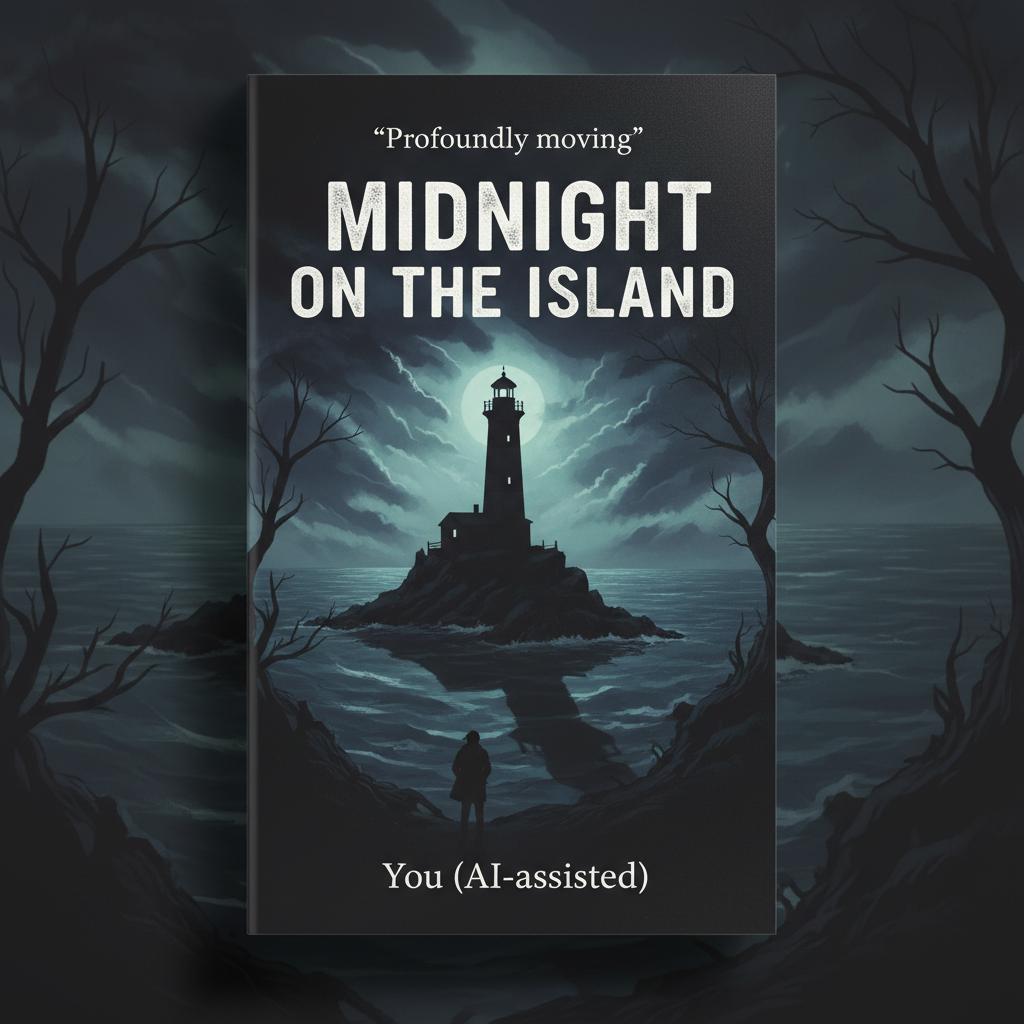
Midnight on the Island
By Mikael Löwgren
Synopsis
When a summer resident is found dead in the desolate off-season, a seasoned detective must unravel generations of island secrets to find a killer hiding in plain sight.
Chapter 1: The Silent Shore
**Disclaimer**
This book was generated using artificial intelligence technology. The content is intended for informational and entertainment purposes only.
Readers are advised to independently verify any facts, figures, dates, or claims presented in this text. Information that appears unusual, spectacular, surprising, or implausible should be treated with particular caution and cross-referenced with authoritative sources.
Librida and the AI systems used in content generation do not guarantee the accuracy, completeness, or reliability of the information contained herein. This material should not be used as a sole source for academic, professional, medical, legal, or financial decisions.
---
The wind, a relentless sculptor, had already begun its winter work on the island. It whistled through the skeletal branches of the pines, raked the shingle beaches bare, and probed the gaps in tightly shuttered cottages. A fine, saline mist clung to everything, blurring the line between the greying sky and the pewter-coloured sea. It was the kind of November morning that promised nothing but more of itself, an endless procession of damp and chill until the spring dared to push its tentative tendrils through the frozen ground.
Agnes Lind, Detective Inspector, pulled her wool scarf tighter, feeling the raw bite of the air through her sensible, thick-soled boots. Three months on the island, and she still hadn’t acquired the local knack for accepting the weather as an unalterable fact of life. She missed the predictable rhythm of the city, the comforting roar of traffic, the anonymous faces that allowed for a certain freedom of thought. Here, every turning of the head seemed to invite a silent assessment, every unfamiliar car a minor event.
The blue and white tape, flapping defiantly in the wind, marked off a section of the beach near the old fishing pier. It was a desolate stretch, overlooked by a few scattered boathouses and a cluster of summer cottages now boarded up like patient, sleeping giants. No dog walkers at this hour, no rosy-cheeked children chasing gulls, only the rhythmic hiss and sigh of the waves breaking on the shore, a sound that quickly became oppressive in its monotony.
“Lars,” she called out, her voice barely carrying above the wind.
Sergeant Lars Dahlberg, his massive frame hunched against the elements, straightened up from where he’d been conferring with a younger officer. He was a man carved from the island’s own granite, steady and unyielding. His weathered face, framed by a cap pulled low, was a roadmap of seasons endured. He’d been on this island, or rather, *of* this island, for fifty-odd years. Agnes, by contrast, felt like a sapling still finding purchase in unfamiliar soil.
“Inspector Lind,” he acknowledged, his voice a low rumble. “The paramedics have done their initial assessment. Nothing conclusive, of course. Just confirming what we all see.”
Agnes nodded, her gaze fixed on the anomaly just beyond the tape. A dark shape against the pale, wet sand. As she approached, the details sharpened into grim understanding. It was a man, lying face down, partially submerged by the receding tide. A wave, bolder than the rest, licked at his shoes before retreating, leaving a shimmering trail on the sand.
The body was clad in a thick, dark coat. The fabric was heavy, waterlogged, clinging to the slumped form. She couldn’t see his face, but the angle of his head, twisted unnaturally, spoke volumes. The hands, visible against the sand, were pale, almost translucent. One was clenched into a fist, as if still grasping for something that had long since slipped away.
“Found by a local fisherman, setting out his nets for eel,” Lars explained, without prompting. “Sven Karlsson. Came in to the station, white as a sheet, barely able to speak. Said he thought it was a log at first, then the tide pulled back a little further…” He trailed off, the implicit horror hanging in the air.
Agnes knelt, keeping a respectful distance, her eyes scanning the immediate vicinity. No footprints other than those already made by the police and paramedics, carefully circumscribed. The sand, a clean slate, offered little. The air smelled of salt and decay, the peculiar, metallic tang that always accompanied death.
“Any identification?” she asked, her voice low.
Lars shook his head. “Not yet. No wallet, no keys in the pockets we’ve checked. Nothing to tie him to a name immediately, beyond his appearance matching that of a seasonal resident. But Sven recognized him.”
“Recognized him?” Agnes stood, turning to face Lars.
“Elias Thorne,” Lars stated, his eyes fixed on the body. “Lived in the red cottage, up on Sjösida Road. The one with the overgrown rose bushes.”
Agnes knew the cottage. It was one of the older, larger ones, set back from the main road, almost swallowed by its own unkempt garden. She’d always imagined it belonging to an eccentric artist or a reclusive academic, given its air of quiet neglect and deliberate privacy. Thorne. She tried to recall if she’d ever seen him. The faces of the islanders, especially the summer people, blurred into a composite memory of suntanned skin and expensive linen.
“Thorne,” she repeated, tasting the name. “When did he usually leave the island?”
“He didn’t,” Lars replied, a faint frown creasing his brow. “That was the thing about Elias Thorne. He stayed. Most of the summer people pack up by late August, or September at the latest. Thorne stayed right through. Said he enjoyed the quiet. Called it ‘the true island experience’.” There was a hint of dry humour in Lars’s tone, though his eyes remained serious. “Always a bit of a loner. Kept to himself. Didn’t mix much with the locals.”
“A recluse, then?”
“Something like that. Had money, or so they say. Never worked a day since he bought the place ten years back. Just tinkered in his workshop, read books, took long walks on the beach. He was a familiar sight, but never a familiar face, if you understand me.”
Agnes understood perfectly. The island was a community of tight concentric circles, and Elias Thorne had evidently remained resolutely outside the innermost ring. He was *from* somewhere else, and that, in itself, was a badge of sorts.
“Any family on the island?”
“None. We’ll have to check his records, see if there’s a next of kin listed somewhere. He was, by all accounts, unmarried.”
Agnes knelt again, this time closer, examining the sand beneath the body. The cold seeped through her trousers, a dull ache in her knees. The water had smoothed away most potential evidence, but she noticed a faint indentation in the sand, just where the man’s jacket seemed to have been pressed down with a bit more force. A ripple of dark fabric, almost black, was caught beneath the shoulder. Carefully, she pointed it out to the forensics officer, a young woman named Elin with watchful, intense eyes.
“Could be a snag, or just the current,” Elin murmured, but she moved with precision, carefully scooping a sample of the sand and the fabric into a sterile bag.
The body was beginning to draw the attention of the gulls, circling high above, their mournful cries adding to the desolate atmosphere. Agnes felt a familiar pang of frustration. A body on a deserted beach, out of season. It was the perfect stage for a hidden truth to remain hidden.
“What about his property?” Agnes asked, rising again. “Has anyone checked his cottage?”
“Not yet, Inspector,” Lars said. “We prioritised the scene here. But I’ll send a patrol car there directly. See if anything seems amiss.”
“Good. And arrange for a post-mortem. As soon as possible. I want to know what happened to Elias Thorne.”
Lars nodded. His eyes, though, were fixed on the rough, pale planks of the old fishing pier. Agnes followed his gaze. The pier, battered by countless storms, stretched out into the choppy water like a skeletal finger, its pilings encrusted with barnacles and seaweed. It was a place of memory, of work, of lives lived and lost to the sea.
“Anything else we should know about our deceased?” Agnes pressed, trying to shake the unsettling sensation that this wasn’t just a tragic accident. The way he lay, the unnatural tilt of his head…
Lars hesitated. “He was particular about his belongings. The red cottage, as I said. Always kept it to himself. Not many folks ever saw the inside.” He paused, then added, almost as an afterthought, “He had a boat.”
“A boat?”
“A small motorboat. Kept it moored at the private jetty down by the cottage. Named it the *Silent Witness*.”
The *Silent Witness*. A name that resonated with an uncomfortable irony, given the circumstances. Agnes felt a chill that had nothing to do with the wind. A reclusive man, a private boat, a body washed up on a desolate shore. The puzzle pieces, though scattered, were beginning to take shape.
Elin, the forensics officer, finished her work, carefully packaging the last of her samples. The scene, for all its stark brutality, was now a tapestry of painstaking evidence collection. Soon, the body would be moved, leaving only the memory of its presence and the faint, unsettling scent of mortality on the air.
Agnes watched the gurney being brought down the slippery incline from the road. The paramedics, their faces impassive beneath the brims of their caps, prepared to transfer the body. The sheer weight of a waterlogged man was apparent as they struggled slightly, the canvas straining.
As they gently turned Elias Thorne onto his back, a collective intake of breath escaped the small group. His face, no longer obscured, was a mask of blue and white, eyes wide and unseeing, staring up at the churning grey sky. His mouth was open slightly, as if attempting a final, silent word.
But it was not merely the pallor, nor the unseeing stare that drew their attention. Streaks of something darker, almost black, ran from his scalp, down his temple, and pooled slightly in the hollow of his ear. And just above his left eyebrow, a small, perfectly circular indentation, no bigger than a thumbnail. Blood, matted into his thinning hair, was clearly visible around it.
Lars Dahlberg let out a low whistle, a soft exhalation of surprise and grim confirmation. “Well, Inspector,” he rumbled, his voice even lower than before, “it seems Mr. Thorne’s ‘true island experience’ was cut rather short, and not by the sea alone.” The words hung in the air, heavy with unspoken implication.
Agnes felt a familiar tightening in her stomach, a surge of adrenaline that cleared the fog of the cold and the desolation. This wasn't merely a body. This was murder. And on an island where secrets were wrapped as tightly as winter blankets, finding the killer would be like peeling back layers of time itself.
She looked out at the relentless, churning sea, then back at the now-covered body. The *Silent Witness* was indeed silent now. But Agnes knew, with a certainty that settled deep in her bones, that the island itself held the answers. And it would be her job to coax them out, one whispered truth at a time. The game, it seemed, had just begun.
Chapter 2: Whispers in the Wind
The salt-laced air, sharp and unyielding, seemed to carry more than just the scent of the sea. Agnes Lind felt it prickle at her skin, a subtle current of unspoken knowledge that hummed beneath the surface of the islanders’ polite greetings. Her breath plumed in the cold morning light as she steered the department’s aging blue Volvo down the narrow lane leading to the general store, its whitewashed façade a beacon against the stark September sky. The store, a weathered timber structure that had stood sentinel over the harbour for generations, served as the island’s unofficial nerve centre, a place where news, both trivial and tragic, took root.
Inside, the bell above the door jingled a tinny welcome, a sound that seemed to echo in the quiet space. The air was thick with the scent of aged cheese, ground coffee, and something indefinably maritime – a blend of dried fish and damp wool. Behind the counter, a woman with a tightly braided grey bun and eyes the colour of a stormy sea wiped down the polished wood with a practiced hand. Her name, Agnes recalled from her predecessor’s sparse notes, was Ingrid. She was the island’s matriarch, its keeper of secrets and its unofficial historian.
“Detective Lind,” Ingrid said, her voice a low contralto, devoid of surprise. Her gaze, direct and unwavering, assessed Agnes in a single, comprehensive sweep. “I expected you.”
Agnes offered a small, professional smile. “Good morning, Ingrid. A difficult morning for the island, I imagine.”
Ingrid merely nodded, her lips pressed into a thin line. Her gaze drifted briefly to the window, where the grey expanse of the sea met the equally grey sky. “Elias Thorne. A shock, yes. Though not entirely unexpected, perhaps.”
Agnes’s internal antennae twitched. “Not entirely unexpected? What makes you say that, Ingrid?”
The old woman began polishing a spot on the counter that was already gleaming, her movements deliberate. “Elias Thorne was a man who lived apart. Even for a summer resident, he kept himself to himself. Built a wall of money and expectation around him. Made few friends. Made fewer enemies, perhaps, but that doesn’t mean he walked without shadows.”
“Shadows?” Agnes prompted gently, leaning forward slightly against the counter.
Ingrid paused, her eyes finally returning to Agnes’s. “He bought that old lighthouse keeper’s cottage on the eastern bluff, refurbished it to a standard the likes of which this island hasn’t seen before. Flown-in Italian tiles, a kitchen that looked like a spaceship, the gossips said. But he rarely entertained. Came for a few weeks in summer, then vanished. A creature of habit, but habits that didn’t involve much interaction with us ordinary folk.”
“Did he have any regular visitors? Friends from the mainland, perhaps?”
Ingrid shook her head slowly. “A housekeeper, from the mainland too, a young woman by the name of Elsa. Came in twice a week. And a garden services company, for the upkeep. Other than that, just deliveries. Groceries, wine, books. All ordered in, never collected from here.” She gestured around the sparsely stocked store. “He was, how do you say, self-sufficient. Or rather, he paid others to be self-sufficient for him.”
“Did he ever speak to you, personally? About anything?”
A ghost of a smile touched Ingrid’s lips. “Once. Needed a specific brand of artisanal marmalade that even his mainland supplier didn’t stock. Had to order it specially. Paid double the asking price without a blink. Said it reminded him of his childhood.”
“Where was he from, originally?” Agnes asked, pulling out a small notebook and pen.
Ingrid frowned, a tiny wrinkle appearing between her brows. “Ah, a good question. He never volunteered the information, and politeness prevents us from asking too directly. One assumed… somewhere industrial, perhaps. Not the kind of sun-kissed Riviera we all dream of. He had a certain precision about him, a way of speaking that was clipped. Not unpleasant, mind you, but… precise.”
“Any family that you know of?”
“None. He was a bachelor, that much was clear. No rings, no photos, no talk of old flames. Just Elias Thorne, and his very expensive cottage.”
Agnes scribbled notes, the precise strokes of her pen a familiar comfort. “You said his death wasn’t entirely unexpected. Could you elaborate on that, Ingrid?”
The old woman sighed, a sound that seemed to carry the weight of years. “The sea, Detective Lind, it claims what it wants. And Thorne, with his solitary walks along those treacherous cliffs, his habit of gazing out at the horizon for hours… he always seemed to be challenging it. Or maybe, challenging something within himself.” Her eyes held a flicker of something close to pity. “He looked… burdened. Especially these last few times he was here. Like a man carrying a heavy stone in his pocket, always feeling its undeniable weight.”
Agnes considered this. A lonely, wealthy man, seemingly burdened, yet without any immediate external threats. It painted a picture, albeit a murky one. “Did anyone on the island have reason to dislike him? Or perhaps, to gain from his absence?”
Ingrid’s lips thinned again. “No open hostilities, not that I observed. He bought his land fairly, paid his bills on time. No feuds over fishing rights or property lines. As for gain… well, he was a rich man. Rich men always have people who might want something from them, don’t they? But none of *us*. He kept us at arm’s length, and we, in turn, respected that distance. It’s the way of things here, Detective. We don’t pry unless invited, and Elias Thorne never extended an invitation.”
Agnes thanked Ingrid, feeling the soft crunch of sand underfoot as she stepped back onto the lane. The information was sparse, a handful of dry crumbs rather than a full meal. But the impression of Thorne as a man adrift, even in his own meticulously curated world, was strong.
Her next stop was the small, weathered boathouse at the end of the ferry dock, where she found Göran, the island’s primary fisherman and general handyman. Göran was a man built like a barrel, with hands scarred by a lifetime of nets and tools. He was meticulously mending a tear in a heavy fishing net, his movements rhythmic and absorbed. The air here was sharp with the tang of diesel and brine.
“Morning, Göran,” Agnes greeted him, her voice carrying over the gentle slap of water against the dock pilings.
Göran, his back to her, paused his work, then turned slowly. His face, weathered and tanned, was etched with lines that spoke of both sun and worry. He pulled a rag from his pocket and wiped his hands before extending one for a firm shake. “Detective Lind. Heard you were asking questions.”
Agnes nodded. “About Elias Thorne. You delivered groceries to his cottage, I understand?”
“Aye. Every Tuesday and Friday morning when he was here. For the last five years.”
“Did you ever go inside the cottage?”
Göran shook his head. “Never past the porch. Always left the crates on the steps. If he was out, he’d leave the payment under a stone. If he was there, he’d just open the inner door a crack, say a word or two, and I’d be on my way.”
“What kind of ‘word or two’?”
“‘Thanks, Göran,’ or ‘Just leave them there.’ Always polite, never chatty. No more, no less.” Göran’s expression was flat, revealing little.
“Did he ever seem… troubled? These last few weeks, in particular?”
Göran scratched his chin, his gaze moving out over the water, as if the answers might be found in the shifting currents. “He was always a quiet one. Not one for small talk. But… a bit more withdrawn, perhaps. Last trip, two weeks ago, I left the groceries and he was just standing there, by the window, looking out. Didn’t even register I was there at first. Just staring, like he was waiting for something that would never come.”
“Did he ever mention any specific worries? Financial, personal?”
Göran let out a short, hollow laugh. “Him? Worried about money? That house cost a fortune. And he paid his bills without a fuss. No, not money. Something else. Something dark, maybe. I don’t know. He wasn’t my friend. Just a customer.”
“Did he have any peculiar habits? Anything that struck you as unusual?”
Göran pursed his lips. “He’d go for those long walks. Head out towards the cliffs, sometimes for hours. Didn’t happen often, but every now and then, I’d see him up there, just standing at the edge, looking down at the waves. Always made me shiver a bit. That’s a dangerous place, those cliffs. Especially when the weather turns.”
Agnes knew the cliffs well; the wind could whip suddenly, and the footing was treacherous. “Did he ever seem nervous? Look over his shoulder?”
“No, not nervous. Resigned, maybe. Like whatever he was watching for, he knew it would come eventually.” Göran paused, his eyes narrowing slightly. “There was one thing, actually. A few months back. I was pulling my boat in after a storm, and I saw a strange car parked up near his cottage. A sleek, black thing, looked out of place here. Only seen it that once. Thought nothing of it at the time, just some visitor.”
“Did you see who was driving it?”
“Too dark. Headlights were on. Just saw the shape of it disappearing into the night when I was done with the boat.”
This was something new. A visitor, unannounced, unexplained. Agnes felt a flicker of anticipation. “Anything else, Göran? Any strange smells, sounds, anything out of the ordinary?”
Göran shook his head. “Only the sea, Detective. Always the sea. It has its own sounds, its own secrets. And sometimes, it gives them up, like it did with Mr. Thorne.”
The wind picked up, rattling the corrugated iron roof of the boathouse, a mournful sigh that seemed to underscore Göran’s words. Agnes thanked him and left, the image of Thorne standing alone at the cliff’s edge, gazing out at the vast, indifferent sea, burning itself into her mind.
Back in her car, the cold seeping through the metal, Agnes reviewed her notes. Elias Thorne, wealthy and reclusive. No obvious enemies, few friends. A meticulous man burdened by some unseen weight. A strange black car, an unfamiliar visitor. The ocean,, ever-present, ever-demanding. The islanders, polite and helpful, yet holding their secrets tightly, like polished stones cupped in their palms.
The silence that followed Göran’s last words, the sense of unvoiced agreements, hung heavy in the air. This island, with its generations of interwoven lives, was a tapestry difficult for an outsider to untangle. But Agnes was no stranger to intricate patterns, nor to the patience required to pick each thread apart. Elias Thorne had been found drowned, but she had an unsettling feeling that the answers lay not in the water, but in the currents of human motive, buried deep beneath the island’s placid surface. And she, Detective Lind, was just beginning to scratch that surface. The whispers in the wind felt less like natural sounds and more like the hushed warnings of a story about to unfold, one she was determined to hear to its chilling conclusion.
Chapter 3: A Web of Old Ties
The scent of damp wool and decaying leaves clung to Agnes as she pushed open the door to the police station. The old building, once a fisherman’s cottage, creaked a welcome, or perhaps a lament, as the wind rattled the single pane of glass in her office window. Thorne’s file lay open on her desk, a thin collection of papers for a man whose sudden departure had stirred such a murky pot.
She’d spent the morning sifting through outdated land deeds at the municipal office, the air thick with the smell of aging paper and faint mildew. Mrs. Johansson, the municipal clerk with glasses perched on her nose like a sentinel, had been less than helpful, her answers clipped and her gaze fixed on some point beyond Agnes’s shoulder. Yet, amidst the dust and disinterest, Agnes had found a flicker – a forgotten boundary dispute from the 1980s involving Thorne and the Åkerlund family. A small thing, perhaps, but it suggested roots, however shallow, in the island’s sandy soil.
Now, back in the quiet hum of her office, Agnes traced the faded signature on one of the old documents. Elias Thorne. The man seemed to be a series of contradictions: a recluse who bought prime beachfront property, a stranger who sparked decade-old resentments.
Her phone buzzed, startling her from her thoughts. It was Bengt, his voice crackling with the usual static of the island’s patchy reception.
“Inspector Lind? I’ve been talking to a few of the old-timers down at the harbor,” he began, his tone conspiratorial. “About Thorne. It seems… he wasn't as new to the island as people let on, not entirely.”
Agnes leaned forward, a pen poised over a blank page. “Go on, Bengt.”
“Old Man Eriksson, he runs the bait shop, remembered Thorne’s father, a man named Anders. Said he owned a small fishing trawler back in the sixties. Used to moor it right here in the harbor. Before he moved off to the mainland, that is.”
A thread, tenuous but present. “So Elias Thorne’s family has a history here?”
“That’s what Eriksson claims. Said Anders Thorne was a hard man, kept to himself, much like his son, apparently. And he had a run-in or two with the Karlsson family. Something about fishing grounds, poaching, that sort of thing. They’ve been fishermen for generations, the Karlssons.”
Agnes scribbled the names. The Karlssons. Another prominent island family. “Any specifics on the run-ins, Bengt?”
“Eriksson just shrugged, said it was a long time ago. But he mentioned a fight in the tavern, broken bottles, a black eye for Anders Thorne. The police were called, but nothing ever came of it. Old grudges, you know how it is. They fester.”
She did know. On an island as small and isolated as this, old grudges were less like wounds and more like scars, deep and indelible.
“And the Åkerlunds?” Agnes asked, shifting topics. “Did Eriksson mention them?”
A pause, then Bengt’s voice, a little softer, as if he were choosing his words carefully. “Ah, the Åkerlunds. Well, that’s a different kind of story. More… personal, you could say. It appears young Elias Thorne, when he was just a boy, was rather taken with Greta Åkerlund. She was a beauty, so they say. Before she married Fredrik Johansson, the boatbuilder’s son.”
Agnes’s pen stilled. A romantic entanglement. Now that was a twist. “Greta Åkerlund. Is that the same Åkerlund family from the land dispute?”
“The very same. Her brother, Lars Åkerlund, was the one who went head-to-head with Thorne over that patch of marshland. Eriksson said Lars was fiercely protective of his sister.”
The pieces, disparate at first, were beginning to form a pattern, albeit a hazy one. Thorne’s return wasn’t just the whims of a wealthy man; it was a re-entry into a landscape littered with his family’s past, with old feuds and forgotten affections.
“Thanks, Bengt. Keep digging.”
As Agnes hung up, the implications settled heavily around her. The islanders weren’t just wary of outsiders; they were wary of opening old wounds. Thorne’s death wasn’t an isolated incident; it was likely rooted in the very fabric of this community.
She decided to visit the Karlsson family. Their fishing boat, the *Sea Serpent*, was usually moored at the far end of the harbor. The journey took her past rows of brightly painted houses, their windows like watchful eyes, and past the small, weathered church whose bells tolled the hours with a mournful sound. The air grew colder as she approached the docks, carrying the bracing tang of salt and brine.
The *Sea Serpent* was docked, its nets neatly piled, smelling faintly of old fish and sea spray. A figure hunched over repairs on the stern, his back to her. As Agnes approached, the man straightened, revealing a face deeply etched by sun and sea, a grizzled beard, and eyes the color of the stormy sky. He couldn't have been much older than sixty, but the hard life had aged him beyond his years.
“Mr. Karlsson?” Agnes inquired, her voice cutting through the cries of gulls overhead.
The man turned fully, his gaze wary. “Lars Karlsson. What can I do for you, Inspector?” His tone was gruff, unwelcoming.
“I’m investigating the death of Elias Thorne,” Agnes stated, preferring directness. “I understand your family had some history with his father, Anders Thorne.”
A muscle twitched in Karlsson’s jaw. He wiped his hands on a greasy rag, his eyes narrowing. “Anders Thorne. The name barely rings a bell. It was a long time ago. My father’s generation.”
“I’m told there was a dispute over fishing grounds,” Agnes pressed gently. “And an incident in the tavern.”
Karlsson snorted, a sound devoid of humor. “Men used to fight over far less back then. A few too many aquavits, a misunderstanding about a catch. Happens. It means nothing now.” He avoided her gaze, focusing instead on a knot in the rigging.
“And Elias Thorne? Did you know him better than his father?”
“Saw him around,” Karlsson admitted, reluctantly. “A quiet man. Kept to his fancy house. Didn’t mix much. Wouldn’t expect him to, not after his father.”
The subtle jab hung in the air. The unspoken animosity was clear, a ghost haunting the present through the generations.
“Did you ever have any dealings with Elias Thorne yourself, Mr. Karlsson? Any disagreements?” Agnes asked, watching his hands. They were strong, calloused, capable.
“No dealings. No disagreements,” he replied, a little too quickly. “He paid his bills at the general store, kept to himself. What more is there to say?”
Agnes felt the wall rise. It was solid, built of stubborn silence and the ingrained island loyalty that guarded against outsiders. She knew pushing too hard would be counterproductive.
“Thank you for your time, Mr. Karlsson,” she said, turning to leave.
As she walked away, Agnes heard him mutter something beneath his breath. It was too low to catch, but the tone was dismissive, almost contemptuous. The islanders weren't just keeping secrets; they were actively guarding them.
Her next stop was the Åkerlund residence. The house stood on a rise, overlooking a stretch of fertile land that spoke of generations of careful cultivation. It was a grander home, built of sturdy stone, hinting at greater prosperity than the fishing cottages.
A woman with silver hair pulled back in a severe bun answered the door. Her eyes, though faded with age, held a sharp intelligence. This had to be Greta Åkerlund.
“Inspector Lind,” the woman said, her voice crisp, without a hint of surprise. “I was expecting you.”
Agnes was momentarily taken aback. “You were?”
“On an island this size, news travels faster than the wind. Elias Thorne. A tragedy. But not entirely unexpected, perhaps, given his… history.” Greta Åkerlund gestured for Agnes to enter, leading her into a parlor filled with antique furniture and the scent of lavender and old wood.
“His history?” Agnes prompted, taking the seat offered to her.
Greta sat opposite, her hands clasped in her lap. “His family’s history, I should say. Anders Thorne was not a popular man. And when Elias returned, buying up that old abandoned lot next to the marshland my brother Lars farmed… well, it stirred memories. Lars was always fiercely territorial, especially with land that had been in our family for generations.”
“There was a dispute over a boundary with Thorne, wasn’t there?” Agnes asked.
Greta nodded slowly. “Indeed. A rather pointless one, in my opinion. A few meters of marsh, hardly worth fighting over. But Lars and Elias both, they are… were… stubborn men. Like two bulls butting heads. The lawyers got involved, but it was never truly settled, just a stalemate.”
“And you, Mrs. Johansson?” Agnes asked, choosing her words carefully, watching for any flicker of emotion. “I hear you and Elias Thorne had a history when you were younger.”
A faint flush touched Greta’s cheeks, a ghost of her youthful beauty. She looked away, towards the window overlooking the gray sea. “Elias was a charming boy. Headstrong, perhaps. But kind. We… were fond of each other, for a time.” Her voice was softer now, tinged with a melancholy that hinted at more than just fondness.
“Before you married Mr. Johansson?” Agnes pressed.
Greta’s gaze returned to Agnes, her eyes cooler now, the brief glimpse of vulnerability gone. “Fredrik and I had an understanding. Elias’s family moved away shortly after. Life, Inspector, rarely goes as planned. Mine certainly didn’t.” The statement carried a hidden weight, the unspoken story of a life perhaps not fully chosen.
“Did Elias Thorne ever try to renew that… fondness… upon his return?” Agnes ventured.
Greta’s lips tightened. “He called upon me once, shortly after he bought the property. We spoke of old times. It was… cordial. But nothing more. I am a married woman, Inspector.” Her tone was frosty, a clear demarcation.
Yet, Agnes sensed a lingering resentment beneath the polite facade. A life unlived, a path not taken. Could that be a motive? The rejection of an old flame, or the resurfacing of a past that someone desperately wanted to keep buried?
“Did your husband, Fredrik Johansson, have any dealings with Elias Thorne?”
“Fredrik is a boat builder. Elias had his own boat. No repairs, no commissions. They were acquaintances at best. Fredrik is a practical man. He doesn’t dwell on the past like some others.” This last statement hung in the air, a subtle jab at her brother, Lars Karlsson, perhaps, or even at Thorne himself.
As Agnes left the Åkerlund home, the twilight was beginning to paint the sky in bruised purples and grays. The wind, which had been a gentle whisper in the morning, now gnawed at her coat. She felt the chill not just from the elements, but from the layers of history she was slowly peeling back.
The island that had seemed so tranquil now felt like a stage for an old drama, where every character had a role, and every line had been passed down through generations. Thorne’s death wasn’t just a homicide; it was the final act in a long, unfolding play.
She thought of the land dispute, the fishing rights, the youthful romance, all intertwined like strands of an old, frayed rope. Each connection, however faint, pointed to a simmering resentment, a dormant anger that Thorne’s return had evidently awakened.
Agnes knew the silence of the islanders wasn’t just about discretion; it was about complicity, about a shared history that bound them together, even in their animosities. And somewhere within that tightly woven tapestry of old ties and grievances, the killer was hiding in plain sight, a shadow among shadows.
The first streetlights flickered on, casting long, distorted shadows across the cobblestones. Agnes pulled her coat tighter, the biting wind whispering the island’s secrets into her ears. She could feel the weight of them, the heavy truth waiting to be unearthed. And she knew, with a chilling certainty, that the island wouldn't give them up easily. The more she dug, the deeper the roots of this crime seemed to go, far beneath the surface, into soil enriched by decades of unspoken stories and simmering betrayals. The night was growing colder, and the real chill, she suspected, was yet to come.
Chapter 4: The Fisherman's Truth
The air in Gunnar’s ramshackle boathouse tasted of salt, diesel, and something indefinably ancient, like the slow decay of forgotten timber. Agnes inhaled deeply, the briny tang a stark contrast to the sterile scent of the morgue back on the mainland. Sunlight, fractured by grimy windowpanes, striped the dusty concrete floor, illuminating drifts of wood shavings and the skeletal frames of half-mended lobster pots. Gunnar, a man whose face was a roadmap of wrinkles carved by sun and sea, sat on an overturned bucket, mending a net with gnarled fingers that moved with surprising dexterity. He was an institution on the island, his taciturn nature as legendary as his uncanny ability to predict a storm.
Agnes had found him after a series of cryptic directions, each leading her further down winding tracks until she’d nearly given up hope. She’d learned quickly that on Åland, direct questions were often met with evasive shrugs or long, contemplative silences. To get to the truth, one had to approach sideways, like baiting a wary cod.
“Morning, Gunnar,” she began, her voice softening instinctively to match the quiet rhythm of his work. “Beautiful day out there.”
He didn’t look up, his eyes, the colour of a stormy sea, fixed on the intricate knot he was coaxing into place. A faint grunt was his only acknowledgement.
Agnes leaned against a workbench cluttered with rusty tools and coils of rope, letting the silence stretch. She watched his hands, mesmerized by their practiced economy of movement. The rhythmic scrape of the net against his calloused skin was the only sound aside from the distant cry of gulls. Patience, she reminded herself, was as much a tool as any in her kit.
After what felt like an eternity, but was likely only a minute or two, Gunnar secured the knot, snipped the excess twine with a small knife, and finally, slowly, lifted his gaze to meet hers. There was no warmth in his eyes, but no animosity either, just the weary acceptance of an old man who’d seen too much to be surprised by anything.
“Heard about Thorne,” he said, his voice a gravelly whisper, like stones tumbling on a shore. It wasn’t a question.
“You fishing today, Gunnar?” she asked, sidestepping his remark.
He grunted again, a sound that could mean anything. “Tides aren’t right. For the good catch, anyway.”
“Pity,” Agnes said, adopting a casual tone she didn’t feel. “I was hoping to ask you about the bay. The currents, that sort of thing.”
He narrowed his eyes. “You’re not thinking of taking up fishing, are you, lass?” A flicker of something, amusement perhaps, crossed his weather-beaten face.
Agnes allowed herself a small, mirthless smile. “Hardly. Just trying to understand things. Things that don’t quite add up.”
He sighed, a deep, rattling sound that seemed to come from his very bones. He paused his net-mending, letting his hands rest in his lap. “Heard you been poking around. Asking about old stories.”
“Old stories often have new endings,” Agnes countered, her gaze unwavering. “Especially when someone winds up dead.”
Gunnar picked at a loose thread on his net. “Thorne wasn’t liked. Not really. Kept to himself, mostly. But that’s not a reason to kill a man.”
“No,” Agnes agreed. “But it’s a reason to have enemies.”
He looked out the open boathouse door, his gaze fixed on the grey-blue expanse of the sea. “He had a temper, that one. Like a hornet’s nest if you poked it.”
“Did you ever see it?” Agnes pressed gently. “His temper, I mean?”
Gunnar shifted on his bucket, his boots scuffing the concrete. “Once or twice. Nothing much. A heated word here, a sharp look there. That’s just… Thorne.”
Agnes waited. She had learned that people like Gunnar didn’t volunteer information. They rationed it, doling it out in small, grudging portions.
“But what about recently?” she prodded. “Did you see anything unusual in the days before… before he was found?”
Another long pause. The air thickened with unspoken thoughts, with the weight of decades of island observation. Gunnar’s eyes, when they finally turned back to her, held a glint of something new, something that hadn’t been there before. Reluctance mingled with a certain, almost mischievous, pride in his own perception.
“Saw him a few days back,” he began slowly, his voice a low almost inaudible growl. “Down by the old ferry dock. Arguing.”
Agnes felt a ripple of excitement, carefully suppressed. “Arguing with whom?”
Gunnar hesitated, his gaze drifting back to the untended net. “Someone young. Didn’t recognize the face, not properly. Too far away for faces. But the voice… raised. And the way Thorne was all puffed up, like a bothered gannet. He was livid, that man.”
“Can you describe the younger man?” Agnes urged, pushing just a little.
“Slim build,” Gunnar rumbled, narrowing his eyes as if trying to conjure the image from the misty recesses of his memory. “Hair was dark, I think. Or maybe it was just the shadows. And agitated. Like a fly buzzing around a wound.” He grunted softly. “Thorne was yelling about money. Something about a promise. And betrayal.”
Money. Betrayal. Those words resonated, cutting through the vague gossip and historical grievances. This wasn’t about old land disputes or simmering resentments from generations past. This sounded personal. Immediate.
“When was this, Gunnar?”
He stroked his chin, a rough rasp against his calloused skin. “Three, maybe four days before they found him floating. Out on the tide, like a piece of drift wood.” He spat a stream of tobacco juice onto the concrete with surprising precision, missing a neatly stacked pile of buoys by inches.
“And you’re sure it was Thorne?”
“Who else sounds like a heron with a fishbone stuck in its throat when it’s angry?” Gunnar retorted, a flash of his blunt island humour. “And the way he stood, always a bit too stiff, even when he was storming. Like he had a ramrod up his back.”
Agnes leaned forward, her heart quickening. This was it. A concrete detail, a specific time, a direct conflict. “Did you hear anything else, Gunnar? Anything at all?”
He shook his head slowly. “Wasn’t trying to listen. Just went about my business. But the shouting carried. And then… the young man, he shoved Thorne. Hard. Thorne stumbled back. Nearly fell in. And he looked… surprised. Not just angry, but surprised. Like he couldn’t believe someone had dared to touch him.”
A shiver ran down Agnes’s spine. A physical confrontation. This was a significant escalation from mere verbal sparring.
“And the younger man? What did he do after he shoved Thorne?”
Gunnar frowned, a deep furrow appearing between his bushy eyebrows. “He… he just walked away. Pretty fast, too. Almost like he was running. Head down, like he didn’t want to be seen. Thorne just stood there, holding his chest, watching him go. And then he yelled something after him. Something about… ‘You’ll regret this, you hear me? You’ll regret this deeply!’”
The words hung in the air, a chilling echo of a confrontation that had escalated into something fatal. Gunnar’s eyes, usually so flat and expressionless, held a flicker of something akin to regret, as if he now understood the ominous weight of what he’d witnessed.
“Thank you, Gunnar,” Agnes said, her voice barely above a whisper. “This is important.”
He grunted again, and picked up his net, his fingers resuming their intricate dance. The interview was over. He had given her what he felt she deserved, no more, no less.
As Agnes turned to leave the boathouse, her mind raced. A young man. Money. Betrayal. And a physical altercation that had left Thorne reeling, surprised, and threatening retribution. This painted a vastly different picture than the vague, decades-old resentments she’d been sifting through. The killer wasn’t necessarily someone from Thorne’s forgotten past, but someone from his very recent present.
Stepping out into the blinding sunshine, Agnes pulled out her notebook, scribbling furiously. The name of the young man was unknown, but the motive was clear: money. And the confrontation had been heated, personal, and potentially violent. The old fisherman, with his keen, weathered eyes, had inadvertently given her the key to unlocking the true nature of Elias Thorne’s final days. The tightly woven tapestry of island life, which had seemed so impenetrable, now had a loose thread. And Agnes intended to pull it, no matter how much of the fabric unraveled. She had a new lead, a fresh direction, and a feeling, stark and undeniable, that the answer to Elias Thorne’s death lay not in the deep past, but in a very recent, very bitter conflict. And she had a feeling she was about to confront the dark heart of the fishing island's murky secrets.
Chapter 5: Flickering Lamplight
The oil lamp on old Gunnel’s counter flickered, throwing elongated, dancing shadows that swallowed the corners of the small, fragrant shop. The cloying scent of dried lavender and something vaguely medicinal, like a forgotten salve, hung heavy in the air. Agnes, perched on a stool that groaned under her weight, felt the insistent chill of the island seep through the thick wool of her coat. Gunnel, her face a roadmap of wrinkles etched by sun and sea wind, had hands that moved with a slow, deliberate grace as she polished a small, tarnished silver locket.
“So, you’re asking about Elias Thorne,” Gunnel said, her voice raspy, like dry leaves skittering across a cobblestone path. Her eyes, pale blue and surprisingly sharp, fixed on Agnes. “What is there to say about a man who said so little himself?”
Agnes offered a small, practiced smile. “We’re trying to understand his last days, Mrs. Gunnarsson. Any unusual visitors? Any arguments, perhaps?”
Gunnel paused her polishing. The locket glinted in the dim light. “Visitors? In late autumn? Only the gulls and the wind. Thorne kept to himself, always. Paid his bills on time, mind you. Always a crisp fifty-kronor note for the bread and the newspaper. Never lingered. Never gossiped. Not like some.” She cast a meaningful glance towards a woven basket filled with tangled yarn.
“And arguments?” Agnes prompted gently.
Gunnel’s eyes narrowed, a tiny flicker of something – amusement? resentment? – playing just beneath the surface. “Thorne wasn't the arguing sort. He was the *observing* sort. Sat on his porch, watched the sea. Watched the islanders. People don’t like being watched, Inspector. Not when they’ve lived here their whole lives and know every crack in every cobblestone, every secret in every family.”
Agnes leaned forward, elbows on her knees. “Did he observe anything that might have upset someone?”
Gunnel chuckled, a dry, rustling sound. “The whole island upsets someone, Inspector. It’s the nature of a place where everyone knows everyone else’s great-grandmother. But Thorne? No. He just… was. A fixture, like the lighthouse. We didn’t pay him much mind, and he didn’t pay us much mind. A fair exchange, I always thought.” She picked up a small, polished stone from a display, turning it over and over in her gnarled fingers. “He bought this, you know. Just a few weeks ago. Said it reminded him of his home by the sea.”
Agnes looked at the stone, smooth and grey, unremarkable. A curious detail. “His home by the sea? He owned the large house on the headland, didn’t he? Why would he need a stone to remind him?”
Gunnel shrugged, putting the stone back. “Some people have more than one home, Inspector. Or more than one memory. That’s all.” She returned to her locket, a faint, almost imperceptible tremor in her hands. “I heard young Peter Svensson saw him talking to someone, down by the old boathouse. Peter’s got a good eye for things that don’t fit, even if he doesn’t always understand them.”
A small victory. Agnes thanked Gunnel, leaving the shop with the lingering scent of lavender clinging to her coat, and the image of the old woman’s knowing eyes burned into her memory. The flicker of unease, however, wasn't just from the lamp. It was the careful way Gunnel had skirted around certain truths, the unspoken history that seemed to cling to the very walls of the island.
Her next stop was the fishmonger, a sturdy, red-faced man named Sven who smelled perpetually of brine and strong coffee. His shop was brighter, fluorescent lights buzzing overhead, but the atmosphere felt no less guarded. He was gutting a cod with practiced, swift movements, the blade flashing.
“Elias Thorne?” Sven grunted, not looking up. “Ordered the same thing every week. Two fillets of cod, precisely. Never a deviation. Always paid in cash.”
“Did he ever speak to you, Sven?” Agnes asked, leaning against a cool, tiled counter. The air had the metallic tang of fresh fish.
Sven finally straightened, wiping his hands on his blood-splashed apron. His gaze was direct, unwavering. “He spoke of the weather. And sometimes, the price of fish. Nothing else. He wasn't one for chitchat.”
“Did you see him a few days before his death?”
Sven thought for a moment, his brow furrowing. “He was in here, right as rain, two days before. Picked up his usual. Said a quick good day. Nothing out of the ordinary.”
“Did you see him talking to anyone on the island?” Agnes pressed, remembering the fisherman’s tip about a younger man.
Sven shook his head firmly. “No. Thorne was usually alone. Never saw him with anyone, really. Not for a proper conversation, at least. He kept to himself, like we all do in the cold season. Folks hunker down.”
“Even arguing?”
Sven scoffed. “Thorne? Argue? He barely raised his voice above a whisper. If he was arguing, it must have been with himself.” He paused, then added, almost as an afterthought, “Though I did see him once, maybe a week before, walking near the cliffs, just past the old lighthouse. He was with someone. A young man. Couldn’t make out who it was from a distance. Too windy, too grey. Just saw two figures, then they went out of sight.”
Agnes felt a small electric jolt. This was the second mention of a young man. “Can you describe him?”
Sven frowned, his memory being coaxed like a stubborn mussel from its shell. “Tallish. Dark hair… or a dark hat, maybe. Couldn’t say for sure. They were just… walking. And then a bit later, I saw the young man walking back alone, towards the village. Thorne’s house is out past the lighthouse, mind you. Not many reasons for someone to be walking that way in the wind if they weren’t visiting him.”
“Did they look like they were arguing?”
Sven shrugged his thick shoulders. “Couldn’t tell you. They were too far. Just two figures against the grey. But the young man, he was walking fast. Like he had somewhere important to be.”
Agnes thanked Sven, leaving the fishmonger with a sense of forward momentum, however slight. Two individuals, both independently, mentioning a young man. It was enough to follow.
Her next interview was with Klas, the taciturn ferryman, whose schedule was less about timings and more about the whims of the tides and his own internal clock. He sat in his small, drafty office by the dock, surrounded by coils of rope and the lingering smell of diesel. He was mending a fishing net, his thick fingers moving with surprising dexterity.
“Elias Thorne?” Klas repeated, his voice as rough as barnacles. He didn’t look up from his work. “Took the ferry twice a year. Once in summer, once in autumn. Like clockwork. Carried a small leather suitcase. Never checked a bag. Never spoke a word more than ‘return ticket, please’.”
“Did you see him on his last journey back to the island?” Agnes asked.
Klas nodded slowly. “Ay. Three weeks ago. Landed the evening boat. He was himself. Quiet. Got off, walked towards his house. The usual.”
“Did he seem worried, or troubled?”
Klas finally looked up, his eyes, the color of a stormy sea, meeting hers. “Worried? Thorne was like an old stone. He didn’t show worry. He just *was*. But I did see something that time, something that stuck in my mind.”
Agnes waited, holding her breath. This was the island, where information was extracted like a stubborn tooth.
“A young man met him at the dock,” Klas continued, his voice low. “Same lad that Old Peter saw arguing with Thorne, I reckon. Peter’s got eyes like a hawk, even if he pretends he doesn’t.”
Agnes felt her pulse quicken. Peter Svensson. The gruff old fisherman from Chapter 4. Everyone on the island seemed to have a connection, a shared knowledge that they guarded fiercely. “Describe this young man, Klas.”
“Tall. Dark hair, yes. And a good stride to him. Peter was right, they were talking. Seemed heated, even from the distance of the ferry. Waving hands. Thorne, he usually kept his hands to himself. But this time, he was gesturing. Like they were… negotiating.”
“Negotiating what?”
Klas grunted. “Who knows what old Thorne had to negotiate about. Money, I reckon. Always money, in the end, isn't it? The young man looked a bit desperate, I thought. Like he needed something from Thorne. And Thorne, well, Thorne looked like he was tired of being asked.”
“Did you see where they went?”
“They walked a little ways, then the young man turned and headed back towards the village. Thorne walked on, alone, towards his house on the headland. Normal enough, I suppose. Just the heated talking that caught my eye. Thorne wasn't one for heated talking.”
Agnes felt a growing frustration. Each person corroborated parts of the story, but the crucial details, the identity of the young man, his possible motive – these remained shrouded in the island’s collective discretion. They were protecting their own, even from an outsider asking about a man who was, by all accounts, an outsider himself.
Before she left, Klas leaned forward, his voice dropping to a near whisper. “There’s talk, Inspector. Old talk. About Thorne’s house. About what’s buried beneath it. Not bodies, mind you. Older than that. Secrets. Sometimes, the oldest secrets are the most dangerous.”
Agnes, armed with these tantalizing but maddeningly vague clues, knew her next step was crucial. She needed to identify this young man. He was the one thread, repeatedly mentioned, that suggested a recent and perhaps violent conflict. The old secrets Klas hinted at, the land disputes, the family feuds – those were perhaps the roots, but this young man, he was the freshly cut shoot, the direct connection to Thorne’s final moments.
Back in her rented cottage, the wind howled around the eaves, a mournful sound that echoed the island’s secrets. Agnes poured herself a cup of strong tea, the warmth a welcome antidote to the pervasive chill. She spread out her maps of the island, tracing the paths from the dock, past the fishmonger, towards the headland. The dots connected, even if the picture remained blurry. A young man, met Thorne at the ferry, argued with him, seen near the cliffs, walking fast back to the village. Desperate, perhaps.
She looked out her window, at the blackness beyond, punctuated only by the distant, rhythmic flash of the lighthouse. The island, with its flickering lamplight and its deep-set shadows, was slowly, reluctantly, giving up its pieces. And tonight, Agnes knew, she was a step closer to assembling the puzzle. But the thought that kept tugging at her, a cold tendril of unease, was not just who the young man was, but what ancient secret, what entrenched loyalty, had driven this island community to protect him, even at the cost of justice. The hook was set, and Agnes felt its pull, deeper into the dark waters of the island’s past.
Chapter 6: Shadows of the Past
The sterile breath of the forensic lab, a stark contrast to the salt-laced air of the island, clung to Agnes’s nostrils. Dr. Lindqvist, his spectacles perched precariously on his nose, gestured towards the images projected onto the wall, each one a stark, unflinching window into Elias Thorne’s final moments.
“Abrasion patterns consistent with a struggle, Inspector,” he droned, his voice devoid of emotion, a practiced neutrality that spoke volumes of his daily interaction with death. He pointed with a laser to a faint, crimson line across Thorne’s temple. “A blow, not necessarily lethal on its own, but indicative of a forceful impact against a hard surface.”
Agnes leaned closer, her eyes tracing the contours of the injury. It wasn’t a clean, clinical strike, but something ragged, untidy. A fight, then. Not a cold-blooded ambush from the shadows, but something fuelled by anger, by desperation. The image shifted, displaying Thorne’s hands, the knuckles bruised, the skin under his fingernails revealing specks of foreign material.
“And this, Inspector.” Lindqvist clicked again. A close-up of Thorne’s right hand, specifically, the clenched fist that hadn’t quite relaxed in death. “We found organic residue. Faint, but present. Skin cells, and… a fragment of fabric. Rather coarse, I’d say. Not what one would expect from an assailant’s clothing.”
Agnes felt a familiar prickle of intuition, a subtle shift in the air that signalled a new thread. “Coarse fabric? You mean, like a work glove, or something similar?”
The doctor paused, adjusting his glasses. “More like… canvas. Or a very old, much-worn sailcloth, perhaps. Something that’s seen a great deal of use.” He moved on, oblivious to the ripple his words had sent through Agnes.
The next image was a wide shot, taken at the edge of the rocky cove where Thorne’s body had been found. The tide had been high, washing away much, but forensics had been meticulous. A small, dark object lay nestled between two moss-covered stones, almost invisible against the damp earth. Lindqvist zoomed in.
It was an intricately carved wooden bird. Not a common gull or a sleek tern, but something older, mythical almost, with exaggerated wings and a long, curving beak. Its dark, polished surface gleamed dully under the harsh lab lights. It was chipped in places, worn smooth in others, as if it had been handled countless times, passed from hand to hand over generations.
“Found approximately three feet from the high tide mark,” Lindqvist reported, his voice continuing its monotone rhythm. “No discernible fingerprints, though the wood is quite porous. However, Inspector, this is where it gets interesting.” He motioned for Agnes to approach the examination table.
Spread out on a white cloth was the bird, protected by a clear plastic dome. Next to it, in a small, sealed bag, were faint traces of green paint, almost iridescent.
“Spectrographic analysis confirms this was once painted a vibrant emerald green,” Lindqvist explained, tapping a pencil against the dome. “And the specific pigment… it’s quite unusual. A very old type, rarely used since the early 20th century. Locally sourced, perhaps. The kind of thing an hobbyist might have mixed themselves, rather than bought commercially.”
Agnes felt a chill that had nothing to do with the air conditioning. Emerald green. Old paint. A carved wooden bird. Her mind flew back to the dusty, forgotten corner of the island archives she’d visited, to a brittle, yellowed newspaper clipping she’d dismissed as local colour. A story about a notorious feud, a forgotten tragedy.
“Doctor,” she said, her voice tight, “has this specific paint been seen anywhere else on the island? Perhaps on a historical artifact?”
Lindqvist frowned, recalling. “Not that I’m aware of, officially. But I can make some inquiries with the local museum curator. Why do you ask, Inspector?”
Agnes didn’t answer directly. “Could I… could I take this?” she asked, gesturing vaguely at the bird figurine. “For further investigation on the island?”
He raised an eyebrow, a flicker of surprise in his normally impassive gaze. “It’s evidence, Inspector. We’d prefer it remain here for further analysis.”
“Understood,” Agnes replied, her tone firm. “But if it links to an unsolved case, a cold trail… The context might be lost if it stays in this lab.” She met his stare evenly. “I’ll be careful with it. Just a few hours. I have a hunch.”
Lindqvist sighed, running a hand through his sparse hair. “Very well. But every precaution, Inspector. And it must be returned by morning.”
Clutching the evidence bag containing the small wooden bird, Agnes stepped back into the brisk autumn air. The grey sky had begun to weep a fine, persistent drizzle, mirroring the somber mood that had settled over her. The sound of distant gulls, their cries mournful, was the only break in the quiet.
She drove back towards the coastal road, the image of the carved bird swimming before her eyes. It was a stylistic match. She was sure of it. That old clipping… the story of the ‘Green-Eyed Curses.’ A foolish local superstition, she’d initially thought, born from resentment and fading memory. Now, it echoed with a sinister resonance.
The story had recounted a bitter dispute between two prominent island families, the Österlunds and the Kristiansens, dating back to the late 1800s. A prime piece of harbour land, a woman, and a perceived betrayal. The legend claimed that a member of the Kristiansen family, a master carver renowned for his skill, had crafted a series of twelve wooden birds, each painted with a distinct, unsettling shade of green. He had then, in a fit of rage and despair, hidden them on disputed lands, uttering a curse that stated if any of the birds were disturbed, or if the families failed to reconcile, calamity would befall them. One death for each generation, until the wrong was righted.
The story was vague on specifics, a whisper passed down rather than a documented fact. But the clipping had mentioned that the carvings were distinct, depicting an old, mythical beast, not unlike a sea serpent, but with wings. And that unusual green paint.
Agnes parked her vehicle near the desolate docks, the mist clinging to the skeletal masts of fishing boats. She pulled out her phone, dialling the one person on the island who might have a deeper understanding of such archaic tales – old man Karlsson, the gruff fisherman.
He answered on the third ring, his voice raspy with sleep. “Inspector? What now? Haven’t you caused enough trouble for one day?”
“Mr. Karlsson,” Agnes began, choosing her words carefully, “I have a question about something I found. Something old. A wooden bird, carved, depicting a winged sea creature. And it might have once been painted green.”
A beat of silence stretched between them, punctuated only by the crackle of the phone line. Then, a low, guttural cough from Karlsson. “The Green-Eyed Curses,” he muttered, the words like pebbles in a dry stream. “I thought those were just old wives’ tales. What have you unearthed, Inspector?”
“One of them was found near Elias Thorne’s body,” Agnes explained, keeping her voice level. “And the forensics suggest a struggle. Mr. Karlsson, do you know anything of these carvings? Where they were hidden? Who made them?”
Another pause, longer this time. Agnes could almost hear the gears turning in the old man’s mind, sifting through decades of island lore. “They were made by old Lars Kristiansen,” he finally said, his voice softer now, tinged with a solemn weight. “A master craftsman, they say. Before he went mad with grief. He put the curse on the Österlunds, after his daughter… after she ran off with a young Österlund and then disappeared at sea. The land feud was just the spark, you see. The real fire was in his heart.”
Agnes’s pulse quickened. “And the land, Mr. Karlsson? What land was it?”
“The land around Österlund’s Point,” he replied, the words a weary sigh. “Where Elias Thorne built his fancy summer house. It was disputed for generations. Eventually, the Kristiansens lost the claim, due to some dusty old legal loophole. But the resentment never died. Not truly.”
Agnes leaned against her car, the cold metal seeping through her jacket. Elias Thorne’s secluded summer house, built on land contested for over a century. A land dispute that had festered, intertwined with love, loss, and a dark, ancient curse. And now, a carved bird, a relic of that bitter past, found lying beside Thorne’s deceased body.
“Mr. Karlsson,” she said, her voice barely a whisper, “do you remember who owned the Österlund land before Thorne bought it? And who bought out the last of the Kristiansen line?”
Karlsson chuckled, a dry, mirthless sound. “Inspector, on this island, no one truly buys out a line. They just… inherit the silence. Old Axel Österlund, the last of his family, he sold it to Thorne a decade ago. Axel, he was a good man, but he’d seen too much sorrow, blamed the island for it, maybe. And the Kristiansens… well, their line thinned out. The last one to live here was a distant cousin, a woman named Inga. She moved off island years ago, after her little boy drowned. A tragic accident, they said. But the whispers never quite went away.”
Inga. Axel Österlund. Two families intertwined by tragedy, resentment, and a very old curse. And now Elias Thorne was dead, caught in the crosscurrents of betrayals thought long forgotten. Old man Karlsson’s words echoed in her ears: *“He’d seen too much sorrow, blamed the island for it, maybe.”*
Agnes thanked Karlsson and ended the call. The drizzle intensified, turning the grey world into a muted watercolour. She gazed out at the turbulent grey sea, imagining the secrets it held, the stories it had swallowed. Thorne’s death was not just a present-day crime, but a ripple from the past, a dark current that had finally broken the surface.
She thought of the young man the fisherman had described arguing with Thorne. Was he a Kristiansen descendant, driven by generations of unaddressed injustice? Or an Österlund, protecting a deeper secret? The coarse fabric found under Thorne’s fingernail. It wasn’t just a random detail. It was a clue that pointed to someone who worked with their hands, someone grounded in the island’s tough, physical life. A fisherman? A boat builder? Someone who used old sails, worn canvas.
The old grievances, the ancient feuds, the land that had changed hands through both legal means and underhanded dealings – it all coalesced into a chilling scenario. Elias Thorne hadn’t just stumbled upon a local land shark. He had disturbed a hornet’s nest of familial hatred and supernatural legend, a nest built by grudges that simmered for generations.
The wind picked up, whipping Agnes’s hair across her face, carrying with it the scent of churned earth and brine. Standing there, on the desolate shore, she knew her investigation had just veered from a simple murder into something far more ancient and complex. The killer wasn’t just hiding in plain sight; they were woven into the very fabric of the island’s history. And that little wooden bird was a dark key to unlocking it all.
Agnes drove towards the municipal archives, ignoring the biting wind and cold. There was an old photo that had caught her eye, displayed in a glass case, depicting a family portrait from the late 19th century. A Kristiansen family, the plaque had read. And now, a detail she’d dismissed as insignificant gnawed at her. One of the figures, a stern-faced man with calloused hands, held something in his lap. Something that, in the grainy black and white, looked remarkably like a carved wooden bird. His gaze, even in the faded image, held a simmering intensity that might have been mistaken for sorrow, but now, Agnes suspected, was pure, unadulterated rage. And his daughter, a young woman with defiant eyes, stood beside him. The curse. The land. The sea. It was all beginning to make a terrible, haunting sense.
Chapter 7: The Unveiling
The fluorescent lights of the interview room hummed, a flat, sterile counterpoint to the wild, restless energy of the sea still echoing in Agnes’s mind. Across the scarred laminate table, Leo Karlsson shifted, his gaze darting from the stain on the ceiling to the scuffed toes of his worn trainers, anything but Agnes's unwavering stare. He was young, barely out of his twenties, with the raw, unpolished look of someone who’d spent more time battling the elements than navigating the finer points of social interaction. His hands, gnarled and strong, were clasped tightly between his knees, the knuckles white. The air bristled with an unspoken challenge, a tension that had been building since the moment Agnes had walked into his fish-gutted shed an hour ago.
“Leo,” Agnes began, her voice a low, steady current in the confined space. “We found a fishing lure, a very distinctive one, near Elias Thorne’s body.”
Leo flinched, a subtle tightening around his eyes. He didn’t reply, just swallowed hard, a prominent Adam’s apple bobbing in his throat.
Agnes paused, letting the silence stretch, heavy and uncomfortable. She’d learned that the truth, like a shy crab, often scuttled out when you gave it enough space. “It was a custom-made piece. Hand-painted, even. The kind of thing only a few people on this island would recognize. The kind of thing your grandfather used to make, isn’t it?”
His head snapped up then, eyes blazing with a mixture of fear and defiance. “My grandfather’s been dead ten years.”
“Indeed,” Agnes acknowledged, leaning forward slightly, her elbows on the table. “But you inherited some of his gear, didn’t you? Including a tackle box full of his unique lures.”
Leo’s breath hitched. He ran a hand through his damp, sandy-blonde hair, dislodging a few stray strands. “So what? Half the old men on this island had some of my granddad’s lures. He was the best.”
“He was,” Agnes agreed. “But this one… it had a small chip on the eye, right where the paint had flaked off. A perfect match for a lure we found in your boat, Leo. A boat you were out in the night Thorne died.”
The carefully constructed wall around Leo began to crumble. His face, usually a canvas of easygoing indifference, contorted. His gaze fixed on a point just beyond Agnes’s shoulder, seeing something only he could. “I didn’t kill him,” he rasped, the words tumbling out in a rush, thin and reedy. “I swear to God, I didn’t.”
“Then tell me what happened,” Agnes urged, her voice soft, but firm. “Tell me everything.”
Leo hesitated, his big hands clenching and unclenching. The island’s unspoken code of silence, a deeply ingrained distrust of outsiders, warred with the primal fear of being implicated in a murder. Finally, with a ragged sigh that seemed to deflate him, he began.
“I saw him a few times, yeah,” Leo started, his voice a low monotone, barely audible above the hum of the lights. “Thorne, I mean. He’d be down by the old jetty, looking out at the sea. Always alone. I didn’t think much of it, at first. Just another rich summer man looking for peace and quiet.” He paused, a bitter laugh escaping him. “‘Peace and quiet’ for him meant ‘taking’ for everyone else.”
Agnes remained silent, letting him find his own rhythm.
“It was about the land,” Leo continued, his voice growing stronger, imbued with a simmering resentment. “The old Karlsson property. Down by the cove, the one with the sheltered beach.”
Agnes’s mind quickly cross-referenced her notes. The Karlsson family, one of the oldest on the island, had owned a significant portion of the western cove for generations. A prime piece of real estate now.
“My grandfather… he lost it,” Leo said, his voice laced with uncharacteristic shame. “Years ago. A bad fishing season, a bad debt. Thorne bought it from the bank, cheap. Said he was going to ‘preserve the natural beauty.’ Preserve it by building a fucking mansion, he meant.”
A new piece clicked into place for Agnes. Thorne’s desire for isolation, his apparent reclusiveness, could all be seen as a calculated move to secure a valuable piece of land and develop it without interference. The resentment Leo felt was thick in the air, a palpable force.
“I tried to talk to him,” Leo admitted, his eyes flashing with a memory. “Went down to his house, knocked on the door. Told him it was our family land, that we had history there. That my granddad had spent his whole life saving it, only to lose it like that. He just looked at me. Like I was dirt. Said, ‘The land was legally acquired, young man. History buys you nothing but a good story to tell your children.’ He laughed, Agnes. He fucking laughed.”
The anger was raw now, coloring Leo’s cheeks a mottled red. “That’s why I was out there. That night. I saw him walking, down along the beach, near the old boathouse. I’d had a few beers, I won’t lie. I’d been thinking about what he said, about my granddad. About how he’d just taken it all, like he had some kind of right.”
“Did you confront him?” Agnes pressed, her voice even.
Leo nodded, slowly, heavily. “Yeah. I did. I pulled my boat in close to the beach, cut the engine. He looked surprised to see me. I yelled at him. Told him he was a thief. That the island remembered. That no amount of money could make him one of us.” He took a shaky breath. “He just stood there. Calm as anything. Said he’d done nothing wrong. Said I was a ‘hot-headed fool’ who should know his place.”
“And then?” Agnes prompted, a knot tightening in her stomach. This was it. The confession.
“And then we argued,” Leo said, staring at the scarred table. “He started walking away, ignoring me. I got out of the boat. I was so angry, Agnes. So damn angry. I followed him, trying to make him really listen. He turned, told me to get lost, that he’d call the police. I grabbed his arm. Just to stop him. He tried to shake me off. And we… we stumbled.”
Leo’s voice dropped to a whisper. “The ground there, it’s treacherous. Rocks, seaweed. We fell. He hit his head on something, hard. He went down. I just… I froze. I didn’t mean to, Agnes, I swear. I helped him up, tried to. He was dizzy, bleeding a little from the side of his head. He pushed me away. Said he was fine. Said he didn’t need my ‘help.’ He just wanted me gone.”
Agnes watched him closely, searching for the tell-tale signs of deception, but Leo’s anguish seemed genuine. “So you left him there?”
Leo nodded, his eyes welling up. “Yeah. He seemed okay, just a bit dazed. He was already walking away, towards the path leading up to his house. I got back in my boat and left. I figured he’d just go home and forget about it. Or call the police, like he said. I didn’t think… I didn’t think he’d die.” His voice cracked on the last word, choked with remorse.
“And the lure?” Agnes asked, testing the waters.
“It must have fallen out of my pocket when we struggled,” Leo mumbled, wiping a hand across his nose. “I always keep a few good ones in my jacket. Just in case.”
Agnes considered his story. It was plausible, tragically so. A drunken confrontation, a slip, an accidental head injury that, combined with the cold water, could have led to Thorne’s drowning. It explained the struggle, the lure, the anger. It fit the narrative of impulsive, hot-headed youth clashing with an older, arrogant man.
But it didn’t feel complete. There was a hesitation, a subtle deflection in Leo’s eyes whenever Agnes mentioned Thorne’s deeper history on the island. A carefully constructed cage around a specific piece of information.
“Leo,” Agnes said, her voice dropping to a near whisper. “A man died. You were the last person to see him alive, aside from the person who killed him. And you haven’t told me everything.”
He flinched again, a tremor passing through his sturdy frame. His gaze once more sought out the stain on the ceiling. “I’ve told you what happened, Agnes.”
“Did Thorne mention anyone else?” Agnes probed, pushing into the unspoken territory. “Did he threaten someone, or did someone threaten him? Did he mention any other grievances, beyond the land?”
Leo shook his head vehemently. “No. It was just us. I swear.”
Agnes leaned back, allowing a hint of frustration to enter her voice. “Leo, don’t you think it’s a coincidence that Thorne purchased your family’s land, only to end up dead after an argument with you? An argument where he allegedly fell and hit his head, only to be found drowned hours later? Did he tell you about any other plans for that land? Beyond building his house?”
A flicker of something Agnes couldn't quite decipher—panic? loyalty?—crossed Leo’s face. He finally met her eyes, and there was a desperation in them she hadn’t seen before. “He didn’t tell me anything like that, Agnes. Really. I mean it. He was just… he was just Thorne. A bastard.”
Agnes knew she was close. She could almost taste the secret, clinging to the edges of Leo’s reluctance. “The forensic report says Thorne was alive when he entered the water, but unconscious or severely disoriented. Your story explains his head injury. But it doesn’t quite explain how he ended up in the sea, unconscious, if he was already walking away, heading for his house.”
Leo swallowed, the muscles in his jaw working. He clenched his hands even tighter, his knuckles bone-white. The fear in his eyes deepened, a primal terror that went beyond his own immediate predicament. He was protecting someone, or something.
“There was… there was someone else,” Leo finally admitted, the words barely audible, a fractured whisper. His eyes darted to the door, as if expecting someone to burst in. “Someone else down by the boathouse that night. Not with Thorne. Just… there.”
Agnes felt a jolt of ice in her stomach. “Who, Leo?”
He shook his head, a single, insistent negative. “I can’t say. They didn’t… they didn’t do anything. They were just watching. I think. They were hidden.”
“Hidden from whom? From you, or from Thorne?” Agnes pressed, sensing the fragile nature of his confession.
Leo squeezed his eyes shut, as if trying to block out the image. “From Thorne. And from me. I only saw a glimpse. A shadow. Near the old pilings. They didn’t see me see them. I don’t think.”
“Was it a man or a woman?”
“I don’t know. Just… a shape.” His voice was laced with genuine fright now, a raw, exposed nerve. “I thought I was just seeing things, at first. The beers, the dark. But then… then I recognized something. A hat. A distinctive cap. Like the type old Manos wears sometimes, when he’s down by the docks, smoking.”
Manos. Agnes knew the name. An old fisherman, a contemporary of Thorne's, known for his eccentricities and his uncanny knowledge of island lore. This was a man with deep roots, and deeper secrets.
“Leo, you have to tell me everything,” Agnes insisted, her voice resonating with an authority that brooked no argument. “Thorne was murdered. If you know something, if you’re shielding someone, you’re complicit.”
Leo’s eyes were wide now, shimmering with tears. “I saw something else first, Agnes. Before I even talked to Thorne. That’s why I went over there in the first place. I saw Thorne talking to someone… down by the old smuggler’s cave. They were arguing, shouting. And I recognized the other person. That’s why I was so angry, seeing Thorne just walking the beach, like nothing had happened. Like he always did.”
“Who was it, Leo?” Agnes asked, a cold dread seeping into her bones. The conspiracy, the shadows of the past, were coalescing into something far more sinister than a simple act of revenge.
Leo took a shuddering breath, the weight of the island’s secrets pressing down on him. “It was him, Agnes. Manos. And he was holding something. Something small and dark. Like an old-fashioned pistol. And he wasn’t aiming it at Thorne. He was giving it to him. Or Thorne was taking it from him. I didn’t see clearly. But I saw the glint of metal.”
The implications hung in the air, thick and suffocating. A hidden meeting, a weapon, Thorne’s earlier dispute with Leo, and then his fall. And then Manos, lurking in the shadows, watching.
Agnes stared at Leo, her mind racing. The pieces were starting to connect, forming a chilling tableau. This wasn’t just about land or a family grudge. This was about something much older, much darker, a clandestine world of secrets that had just begun to surface. And at the heart of it, Elias Thorne, a man who had seemingly bought his way into a quiet life, only to find that some debts could never truly be paid. The island, she realized, was a graveyard of old promises, and Thorne was just the newest casualty.
“Tell me about Manos, Leo,” Agnes said, her voice barely above a whisper. “Tell me everything you know. Start from the beginning. About the gun. About the cave. About what Thorne was really doing on this island.”
Leo looked at her, his eyes filled with the haunted knowledge of a man who had finally broken his sacred oath of silence, unraveling a thread that led not only to a killer, but to the very heart of the island’s long-buried past. And as he began to speak, Agnes knew, with a chilling certainty, that the tide was about to turn.
Chapter 8: The Storm Gathers
The wind began its low moan in the late afternoon, a keening sound that promised more than just a change in weather. By nightfall, it had escalated to a full-throated roar, a beast clawing at the windows of the small police station, rattling the panes in their frames. Rain lashed against the glass, not in drops, but in sheets, obscuring the already dim light from the distant lighthouse. The island, usually a place of quiet solitude, was now a tempest-tossed vessel, groaning under the assault.
Agnes sat hunched over the worn oak desk, the single lamp casting a feeble circle of light on the jumble of notes, photographs, and witness statements. A half-eaten sandwich lay forgotten beside a lukewarm mug of tea, the steam long since vanished. The insistent drumming of rain against the rooftop provided a relentless rhythm to her thoughts, mirroring the tumultuous churn within her own mind.
The confession, extracted piecewise from young Erik, had been a raw nerve, exposed and twitching. He’d confessed to the argument, to the shove, to seeing Thorne fall. But the fear in his eyes, even after admitting to so much, had spoken volumes. It wasn’t just fear of the law, not simply the terror of a mistake. It was the fear of something deeper, something ingrained in the very fabric of the island’s ancient stones and whispering pines. He’d protected someone else. That much had become chillingly clear.
She spread out the photographs of Elias Thorne’s body, now thankfully devoid of the ocean’s grim embellishments. The small, almost imperceptible abrasions on his knuckles, the faint bruising along his jawline – evidence not just of a fall, but of resistance. A fight. And the broken clasp of the antique locket, a detail that had nagged at her since the first forensic report, now seemed to scream for attention. It hadn't simply come undone; it had been torn.
Agnes pushed a hand through her short, damp hair, feeling the chill seep into her bones despite the heated room. The storm outside mirrored the one gathering inside her head, each gust of wind a fresh jolt in her calculations. She’d been too focused on the immediate, on the obvious. Erik’s bitterness over the broken promise of land, the thwarted love for Thorne’s niece – it was a classic motive playbook entry. But the reluctance, the deep-seated discomfort in the islanders, it wasn't about one young man’s desperation. It was about something collectively held, collectively hidden.
She picked up the old maps she’d retrieved from the island’s rudimentary archives, crinkled parchment detailing property lines from generations past. Thorne’s recent purchases, the aggressive expansion of his summer estate, had been a festering sore. Old Man Svensson, the gruff fisherman, had been right. Thorne hadn’t made friends; he’d created enemies, or rather, awakened dormant ones.
Her gaze drifted to the crumpled sketches of the locket – the unique family crest, almost indistinguishable from a distance, yet so fiercely protected within certain island bloodlines. It was a symbol, not just of wealth, but of deeply entrenched heritage. It belonged to the Åkerblom family, a name that had surfaced again and again in the land disputes, a family whose fortunes had waned as Thorne’s had risen.
And then there was Ingrid. Ingrid Åkerblom, Erik’s mother, a woman with eyes that held the stoicism of generations of island women, but whose hands had trembled when Agnes had first questioned her. She’d dismissed Erik’s affair with Thorne’s niece as youthful folly, her voice devoid of conviction. She had been protecting him, of course, but it had felt like more. A curtain drawn, not just over her son, but over a vast, dark window.
Agnes leaned back in her chair, the springs groaning in protest. The storm outside howled, a banshee’s wail. The power flickered, plunging the room into momentary darkness before the generator sputtered to life, casting the shadows into a wild dance. It was almost as if the island itself was trying to speak, to confess its ancient secrets through the gale.
She remembered the look in Erik’s eyes. Not just fear for himself, but dread for what his confession might unleash on others. He’d said, in a hushed tone, “You don’t understand, Detective. Some things here… they’re older than all of us.”
The implication had been clear: a collective silence, an unspoken agreement. But what was the agreement? And who were the players?
Agnes pulled out her notes from the interviews. The cautious Mrs. Dahl, who owned the general store, had spoken of Thorne’s “ambition,” a word she’d spat out like a bad taste. Old Jari, the taciturn lighthouse keeper, had merely grunted when Thorne’s name was mentioned, but his eyes had held a flicker of something close to contempt. Even Elara, Thorne’s niece, had seemed less saddened by his death than relieved, a strange, veiled calm about her when she’d described his increasingly erratic behaviour.
The pieces, like fragments of a shattered mirror, were beginning to align, not into a single perpetrator, but into a constellation of complicity. Thorne had not just one enemy, but many. And Erik, in his rage, had simply been the match that lit a long-smouldering fuse.
What if Erik hadn't been the only one on that cliff edge? What if, after the initial shove, after Thorne had fallen and struggled, someone else had been there? Someone who saw an opportunity. Someone who had a motive just as strong, if not stronger, than Erik’s youthful indignation.
The broken locket. It was the key. If it had been torn from Thorne's neck, it suggested a struggle, yes, but also an objective. Someone wanted it. Not just a random piece of jewellery, but this specific piece, with its unique crest. The Åkerblom crest.
Ingrid Åkerblom had inherited land that bordered Thorne’s expanding estate. Land that he had been trying to acquire, aggressively, for years. There had been whispers of Thorne digging into the Åkerblom family history, unearthing old debts, forgotten scandals, to leverage his position. Blackmail. It was a classic Thorne move, according to the whispers.
Agnes picked up a forensic report she’d almost dismissed as irrelevant – trace fibres found beneath Thorne's fingernails. Not Erik’s, according to the DNA. They were from a much older, finely woven material, common in some of the island’s more traditional households. An antique shawl, perhaps? Or a blanket? Something that could have been clutched, torn in a desperate struggle.
She looked at the image of the locket again, then at the details of the Åkerblom crest. It was a stylized seagull, flying against a depiction of a turbulent sea. A symbol of resilience, and perhaps, defiance.
What if Ingrid had confronted Thorne, not just about Erik, but about something far more personal, far more devastating than a land dispute? What if Thorne had found a way to truly ruin the Åkerblom family, to strip them of their name, not just their land? And what if, in that confrontation, at the precipice of ruin, Thorne had gone too far?
The storm outside seemed to crescendo, the structural groans of the old station echoing the profound shift in her understanding. The islanders’ collective silence wasn’t a pact to protect one person from justice, but a web of self-preservation, a shield built to protect their entire way of life. They knew what Thorne was capable of. They knew what he had done to others, what he intended to do. And they had been willing to let him disappear into the sea, his death conveniently attributed to a fall, perhaps even to Erik’s hand, if it meant the end of Thorne’s destructive presence.
Agnes looked at the clock. It was well past midnight. The ferry wouldn’t run in this weather. The island was cut off, a solitary speck in the churning blackness of the North Sea. Just like Thorne had been.
She remembered Erik’s words, the terror in his eyes when he’d whispered, “He said… he said he would take everything. Not just our land. Everything.”
Everything. Not just property, but identity, history, the very essence of what it meant to be an Åkerblom.
The pieces clicked, sharp and cold, into place. Erik, filled with youthful rage and betrayal, had stumbled upon the scene. He’d pushed Thorne, perhaps. But the real confrontation, the fatal struggle, had already taken place, or was still ongoing. His mother, Ingrid. The woman whose legacy, whose family name, was being threatened with annihilation.
She had been there, on the cliff, with Thorne. Perhaps to plead, perhaps to warn. And Thorne, in his arrogant cruelty, had pushed her to the edge, figuratively and literally. The locket, torn from his neck in the struggle. A struggle to defend her family, her son, her honor.
Erik, reeling from his own betrayal, would have seen his mother, desperate, perhaps stained with Thorne’s blood or simply the mud from the fall. His confession, a desperate attempt to protect her, to take the blame for the final, fatal act.
Agnes stood up, pushing her chair back with a scrape that was almost lost in the storm’s din. Her initial instinct about the collective silence had been right. It wasn’t just about protecting a single individual; it was about protecting a deeply wounded family, and by extension, the tacit code of an island community that guarded its own fiercely.
Erik had been a convenient scapegoat, a distraction. Or perhaps, a willing sacrifice. He had admitted to being there, to seeing Thorne fall. He had omitted the part about his mother being there too, about the true nature of the struggle, about whose hand ultimately delivered the final, irreversible push.
The storm outside roared, a mighty chorus. It wasn't merely a weather phenomenon; it was a character in this grim drama, a force of nature mirroring the tempestuous human emotions that had culminated in Thorne’s death. The island had secrets, generations deep, and Elias Thorne had tried to unearth them for his own gain. In doing so, he had awakened something ancient, something primal.
Agnes walked to the window, pressing her forehead against the cool glass. She could see nothing but the swirling chaos of rain and wind. The lighthouse beam, usually a comforting sentinel, was swallowed by the impenetrable gloom. The storm would continue through the night, isolating them further.
And in the morning, when the first tentative rays of sun pierced through the receding clouds, she would have a difficult conversation. Not just with Erik, nor just with Ingrid. She would have to confront an entire island, an entire way of life, with the truth it had so fiercely tried to bury. The storm outside was dying down, but the storm within the island, the one she had just uncovered, was only just beginning.
Chapter 9: Beneath the Lighthouse
The lighthouse stood vigil against the churning greyscale of the sky, a sentinel carved from the same hard stone as the island’s core. Its beam, a rhythmic exhalation of light, sliced through the encroaching gloom, momentarily illuminating the spray as waves shattered against the rocks below. Agnes felt the wind’s sharp teeth on her cheeks, tasting the salt as she climbed the last few slippery steps to the small, square dwelling at its base. The air thrummed with the ancient groaning of the structure, a lament to countless storms weathered.
The door, thick and weathered, was ajar, a sliver of yellow light promising temporary reprieve from the raw elements. She pushed it open, the protesting squeal of hinges swallowed by the wind’s howl. Inside, the air was warm, smelling of stale coffee and something else… something metallic and vaguely unsettling, like old coins. He was there, seated at a worn wooden table, a thick book open before him, though his gaze was fixed on the flickering flame of a small oil lamp. His profile, etched against the dim light, was sharper than she remembered, the lines around his eyes deeper, as if etched by the very winds that buffeted the lighthouse.
“Agnes,” Erik’s voice was surprisingly calm, a stark contrast to the storm raging outside. It lacked the nervous tremor she’d come to associate with her recent encounters, replaced by a quiet resignation, a terrible peace. He didn’t look up, his fingers tracing patterns on the book’s yellowed pages without actually reading them.
“Erik,” she replied, her voice low, a counterpoint to the rising crescendo of the wind finding purchase in the tower’s narrow windows. She closed the door behind her, the solid *thud* making the small room feel suddenly claustrophobic. The silence that followed was heavy, pregnant with unspoken truths. The only sound was the insistent clatter of rain against the thick panes, and the distant, mournful cry of a seabird.
Her eyes scanned the room, absorbing the details: a neatly made bed in the corner, a kettle simmering gently on a small, rusted stove, a map of the island tacked to the wall, its edges curled with age. More than just a keeper’s dwelling, it felt like a retreat, a place where secrets were kept as closely guarded as the light itself.
Finally, Erik lifted his head, his blue eyes, usually gentle and creased with a lifetime of watching the sea, now held an unreadable depth. “You found me.” It wasn't a question, but an acknowledgement.
“I did,” Agnes confirmed, stepping further into the room, maintaining a respectful distance. “It took me a while, Erik. Longer than it should have.”
He offered a wry, humorless smile. “The island has a way of holding onto its secrets. A way of protecting its own.”
“And Thorne?” she pressed, the name hanging in the air like a discarded fishing net. “Was he protected too, in some perverse way?”
Erik’s gaze drifted to the window, watching the hypnotic dance of the lighthouse beam. “Thorne… Thorne was a scar on this island. A reminder of what we, or rather, what *my family* had tried to bury.” His voice was laced with a bitterness Agnes hadn't heard before, a resentment that had clearly festered for decades.
“Tell me, Erik,” Agnes prompted, her voice soft but unwavering. “Tell me everything.”
He exhaled slowly, the sound like the hiss of a dying ember. “It started long ago, Agnes. Before you ever set foot on these shores, before many of us were even born. My grandfather… he was a good man, for the most part. But he was struggling. A bad fishing season, a sick child. Desperate times, as they say.”
Agnes leaned against the rough-hewn wall, her jacket still damp, but she ignored the chill. She knew this part of the island’s folklore, the whisper of old land deals gone sour, of families ruined by circumstance and cunning.
“Thorne’s father,” Erik continued, his fingers now gripping the edge of the table, his knuckles white. “He saw an opportunity. He offered my grandfather a loan, a way out of his troubles. But the terms… they were impossible. Designed to fail. Thorne’s father wanted the lighthouse land. He coveted it, saw it as his own personal domain.”
The silence stretched, broken only by the incessant drumming of the rain. Agnes waited, knowing that the most difficult confessions often emerged in their own time.
“My grandfather eventually lost everything,” Erik’s voice was hoarse now, laced with a raw emotion he could no longer suppress. “The boat, the house, his dignity. He died a broken man, convinced he’d failed his family. My father carried that burden, Agnes. And I… I carried it too. A weight passed down through the generations, the shame of being… dispossessed.”
“And Elias Thorne, the son, he inherited more than just his father’s money, didn’t he?” Agnes observed.
Erik nodded, a grim acknowledgment. “He inherited the arrogance, the sense of entitlement. He’d return every summer, strutting about like he owned the place, a constant reminder of what had been stolen from us. He’d taunt my father, subtle little digs about how his family were the true keepers of this light, not ours.” His jaw tightened, a muscle jumping beneath his weathered skin.
“What changed this year, Erik?” she asked, knowing there had to be a more immediate catalyst. Old resentments rarely boiled over with such sudden, violent force after so many years.
He finally met her gaze, and in his eyes, Agnes saw a pain so profound it mirrored the storm’s fury. “This year, it was different. Thorne wasn’t just taunting us. He had found something. Documents… old letters, land deeds that proved, beyond a shadow of a doubt, the fraudulent nature of his father’s original claim. He had them, Agnes. And he was going to expose us all. Expose our family’s shame to the entire island, solidify the narrative that my grandfather was a fool, easily duped. He was going to put it in the local paper, make a spectacle of it.”
Agnes felt a chill that had nothing to do with the damp air. The weight of generations, the desperate need to protect a tarnished legacy… it was profoundly human, profoundly dangerous.
“He confronted you, didn’t he?” she deduced. “Showed you the papers.”
Erik’s head bowed, a silent admission. “He cornered me down by the old boathouse. The night before… the night he died. He laughed, Agnes. He actually *laughed* at the pain he was inflicting. Said it was time for the truth to come out, no matter who it hurt. Said my family deserved to be remembered as the fools they were.” His voice dropped to a near whisper. “My father… he would have been destroyed. My children, my grandchildren, forced to live with that stain, that public humiliation. I couldn’t let that happen.”
He finally looked directly at her, his eyes pleading for understanding, if not forgiveness. “I tried to reason with him. I begged him to reconsider, to just… let it go. History was history. But he was relentless. He saw my desperation as weakness, fueled his cruel intentions even more.”
Agnes pictured the scene, Erik, the quiet lighthouse keeper, usually so placid, pushed to the brink, his family’s honor, his very identity, under attack. She understood the primal instinct to protect, to defend what was sacred.
“And the argument the fisherman overheard?” she pressed, remembering the detail from earlier in the investigation.
“That was it,” Erik confirmed. “He was shouting. Threatening. He had a flask in his hand. He even said something about finding the perfect cliff edge for my family’s shame to be cast from. He pushed me, Agnes. Literally pushed me, right there by the boathouse. Laughed again.” He paused, a long, ragged breath escaping his lips. “I just… I snapped.”
He didn’t need to say more. The ‘how’ of Elias Thorne’s death had become terribly clear. The struggle, the precise, unfortunate location. The unique item found near the body, a small, worn token from Erik’s grandfather, etched with the lighthouse’s image – a symbol of his family’s rightful inheritance, now tragically stained.
“You didn’t mean for him to die, did you, Erik?” Agnes asked, not as an interrogation, but as an attempt to understand the depths of his despair.
He shook his head slowly, a single tear tracing a path down his weathered cheek. “No. God, no. I just wanted him to stop. To shut him up. He was falling, stumbling back, still mocking me. I reached out… I grabbed him… I think I pushed him again, harder this time. He went over the edge. It was… an accident, Agnes. A terrible, terrible accident.” His voice broke, dissolving into a ragged sob. “But I can’t claim that, can I? Not truly. I pushed him. I caused it.”
The confession hung heavy in the air, a final, definitive answer to the island’s long-held secret. The lighthouse beam continued its unwavering rhythm, a silent witness to the human drama unfolding below. Agnes felt a profound sadness, the tragedy of good intentions gone horribly wrong, of a proud man pushed beyond endurance.
“The papers,” she said, her voice gentle. “Where are they, Erik?”
He gestured vaguely towards a small, heavy box hidden beneath a loose floorboard near the stove. “In there. I burned the most damaging ones. The ones that detailed my grandfather’s ruin. But I kept the others. The proof of Thorne's father’s malice. I couldn’t bring myself to destroy them all. A part of me… still wanted the truth to be known. But not in the way Thorne intended.”
Agnes knew her duty. She had found her killer. The layers of generational trauma, of old land disputes and pride, had finally unraveled into a tragic present. The storm outside seemed to intensify, as if the island itself mourned the quiet lighthouse keeper and the dark secret he had carried for so long.
“Erik,” she began, her voice firm once more, “we need to go.”
He finally stood, movements slow and deliberate, his gaze sweeping across the small room as if committing it to memory. He picked up a small, smooth piece of sea glass from the windowsill, turning it over and over in his fingers. “It’s ironic, isn’t it, Agnes? All these years, tending the light, guiding others away from danger. And all the while, the deepest danger was lurking right here, within me, within our history.”
He turned to face her, his eyes now holding a weary acceptance. “I knew you’d come. I knew this was inevitable. The island might keep its secrets, but eventually, the tide always brings something to shore.”
Agnes walked towards him, the weight of the moment pressing down on her. The storm howled its protest, but within the lighthouse, a quiet, terrible peace had settled. The truth, finally, had found its way into the light, illuminating not just a crime, but the profound human cost of silence, pride, and the ghosts of a long-forgotten past.
As she reached for his arm, guiding him gently towards the door and the roaring darkness outside, the lighthouse beam swept past the window, casting their shadows long and distorted against the stone walls. The island, she knew, would never quite be the same. And neither, she suspected, would she.
Chapter 10: The Calm After
The fog, thick as a shepherd’s fleece, had finally lifted, revealing a sky scrubbed clean, a startling blue that seemed to mock the recent turmoil. A crisp, cool breeze, laden with the scent of salt and turning leaves, whispered through the skeletal branches of the oaks that lined the path to Agnes’s cottage. Weeks had passed since the confession beneath the lighthouse, since the pale, drawn face of Mrs. Johanson – the respected matriarch, the pillar of the community – had crumbled, revealing a raw, desperate fear beneath layers of carefully cultivated composure.
The island, in its own slow, methodical way, was beginning to breathe again. A collective sigh, almost imperceptible to an outsider, but acutely felt by Agnes, who had, against all expectations, begun to attune herself to its subtle rhythms. The hushed whispers that had followed her like a phantom tide were fading, replaced by nods of tentative recognition, even some hesitant smiles. The fear, the suspicion that had hardened faces and tightened lips, had started to recede, leaving behind a residue of melancholy, a quiet sorrow for the fractured trust, for the image of their island, irrevocably altered.
Agnes sat on her small, sheltered porch, a mug of steaming black coffee warming her hands. The distant cry of gulls, an age-old soundtrack to island life, drifted on the air. She watched a lone fisherman, a silhouette against the shimmering pewter of the water, cast his net with the practiced grace of generations. Life, stubbornly, continued.
Yet, the scars remained. Agnes saw them in the way people held themselves, a certain wariness in their eyes, a hesitation before speaking. The revelation of Mrs. Johanson’s guilt, of a conspiracy woven through families, spanning decades, had torn at the fabric of their tightly knit community. Elias Thorne’s death, originally a shock, had become a catalyst, exposing raw nerves and festering wounds.
She picked up a smooth, grey pebble from the wooden railing, turning it over and over in her palm. It was cold, dense, ancient. Like the island itself. And like the island, it held secrets. Mrs. Johanson, driven by a fierce, almost primal need to protect the legacy of her family, had confessed to the murder of Thorne, a man who, in his youth, had been responsible for the death of her brother, a secret buried by the island’s powerful elite for fear of scandal. Thorne’s return had threatened to unearth it all. And then there was young Filip, the fisherman’s son, whose rash actions, fueled by his own grievances against Thorne, had inadvertently set the final tragedy in motion. He hadn’t killed Thorne, but his confrontation had left the man vulnerable, weakened just enough for Mrs. Johanson to deliver the fatal push from the clifftop. The intricate tapestry of human nature, Agnes mused, was never simple threads. It was knots and snarls, unexpected colours bleeding into others, creating patterns that were both beautiful and terrifying.
The door creaked open behind her. “More coffee, Inspector?”
It was Elara, her landlady, her face softer now, the habitual lines of worry around her eyes less pronounced. Elara placed a plate of warm cinnamon buns on the small table beside Agnes. “You look like you’re carrying the weight of the world on your shoulders again.” There was genuine concern in her voice now, a warmth that had been absent in their initial, strained interactions.
Agnes offered a small, tired smile. “Just thinking.”
Elara sat on the step, her gaze following Agnes’s out to the horizon. “It was a shock, you know. About Mrs. Johanson. We all… we all thought we knew her.” She paused, a shadow passing over her features. “It makes you wonder, doesn’t it? What else is buried under all the pleasantries?”
“It does,” Agnes agreed. The unsettling knowledge that even in the most idyllic settings, darkness could linger just beneath the surface, was a truth she knew all too well, but one that always left a bitter taste. The island, with its picturesque cottages and rugged beauty, had presented a particularly stark contrast. The beauty was a mask, expertly crafted, hiding generations of compromises, betrayals, and ultimately, murder.
“Filip is back at sea,” Elara said quietly, changing the subject, but not truly. “His father, Anders, says it’s good for him. Gets the sea air in his lungs, clears his head.”
Agnes nodded. Filip had been given a lenient sentence, his role more one of circumstance than malice. He’d helped Mrs. Johanson cover her tracks in a panicked moment, but the true burden of murder lay elsewhere. Justice, on this island, had been meted out with a measured hand, acknowledging the deep-seated grievances that had fueled the tragedy. It wasn’t perfect, Agnes knew, but it was *their* justice, shaped by their insular world.
The sound of children’s laughter drifted from down the lane, bright and unburdened. A reminder that life here, despite the recent shadows, was resilient. The islanders would heal, in their own time, in their own way. They would forgive, perhaps not entirely, but enough to move forward. They were survivors, their ancestors having carved a life from the harsh whims of the sea. This, too, was a storm they would weather.
“Are you staying?” Elara asked, her voice tentative, almost hopeful.
Agnes looked at the worn wooden planks beneath her feet, the familiar pattern of the grain, the tiny imperfections. She had come to the island an outsider, a detective dispatched to right a wrong. She had done her job. The culprit was apprehended, the truth, however ugly, brought to light. Her transfer was temporary, a short assignment. But something had shifted within her. The sharp edges of her own solitude, a quiet companion she had unknowingly carried for years, felt somewhat smoothed by the raw honesty, the unforgiving beauty of this place.
“I haven’t decided,” Agnes admitted, a flicker of uncertainty in her voice. It was a conscious choice not to immediately dismiss the thought of putting down roots, even shallow ones, in this windswept corner of the world. She had arrived with a briefcase and a detached professionalism, ready to unravel a crime and leave. But the island had, in its quiet way, begun to unravel her.
The slow, deliberate pace of life here had a rhythm that was both comforting and challenging. It demanded patience, demanded a certain surrender to the elements, to the ebb and flow of the tides. Her previous life, a blur of city lights and neon-lit anxieties, seemed a distant memory, almost a dream. Here, the concerns were more fundamental: the vagaries of the sea, the harvest from the land, the health of one’s neighbours.
The island had also shown her the stark reality of human connection, the intricate dance of loyalty and betrayal, the fierce protective instincts that could bloom into both love and violence. She had witnessed the deep-seated pride of these islanders, a pride that could both uphold honour and conceal dark truths.
Agnes closed her eyes, letting the cool breeze wash over her face. She thought of Per, the gruff old fisherman who had reluctantly given her that crucial detail about Thorne, his eyes holding a lifetime of stories untold. She thought of the slight, almost imperceptible nod from Erik, the store owner, when she’d bought her morning provisions, a silent acknowledgement of a shared experience. The islanders, once a wall of polite resistance, had become, in their own understated way, fellow inhabitants of a place that had revealed its true, complex self.
Elara stood up, collected the empty coffee mug and the plate of half-eaten buns. “Well, if you do, there’s always room for another. We’re a strange bunch, but we stick together.” There was a gentle finality in her tone, a quiet invitation that hung in the air.
Agnes watched her go, then turned her gaze back to the sea. The fisherman had pulled in his net, a silver flash of fish glinting in the sunlight before being gathered into the boat. A new day, a fresh catch.
The case was closed. The official paperwork would follow, a dry recounting of facts and testimonies. But the real story, the one etched into the island’s very soul, would live on, a cautionary tale whispered in the wind, a reminder of the darkness that could lurk beneath the surface of even the most tranquil beauty. Agnes had peeled back the layers, revealed the truth, and for the first time in a long time, felt a flicker of something akin to peace. The silence that had once felt oppressive now held a different resonance, a quiet understanding.
The decision of whether to stay or go remained, a delicate question mark hanging in the crisp island air. She considered the quiet hum of the island, the way it had pulled her in, slowly, inexorably. She considered the intricate tapestry of human nature, a pattern she had glimpsed in all its beauty and savagery. And she finally considered herself, a woman who had, perhaps, found a place where the weight of the world, though still present, could be understood, if not entirely lifted. The wind stirred the leaves in the ancient oaks, a rustling whisper that carried the faint scent of salt and earth. The island had laid bare its secrets, and in doing so, had presented her with her own.
Agnes took a deep breath, the lingering aroma of coffee and sea air filling her lungs. The sun, now higher in the sky, cast long, benevolent shadows across the porch. She stood up, the pebble still warm in her hand. The investigation was over, but her journey, she realized, might have just begun.