Fire Season
By Mikael Löwgren
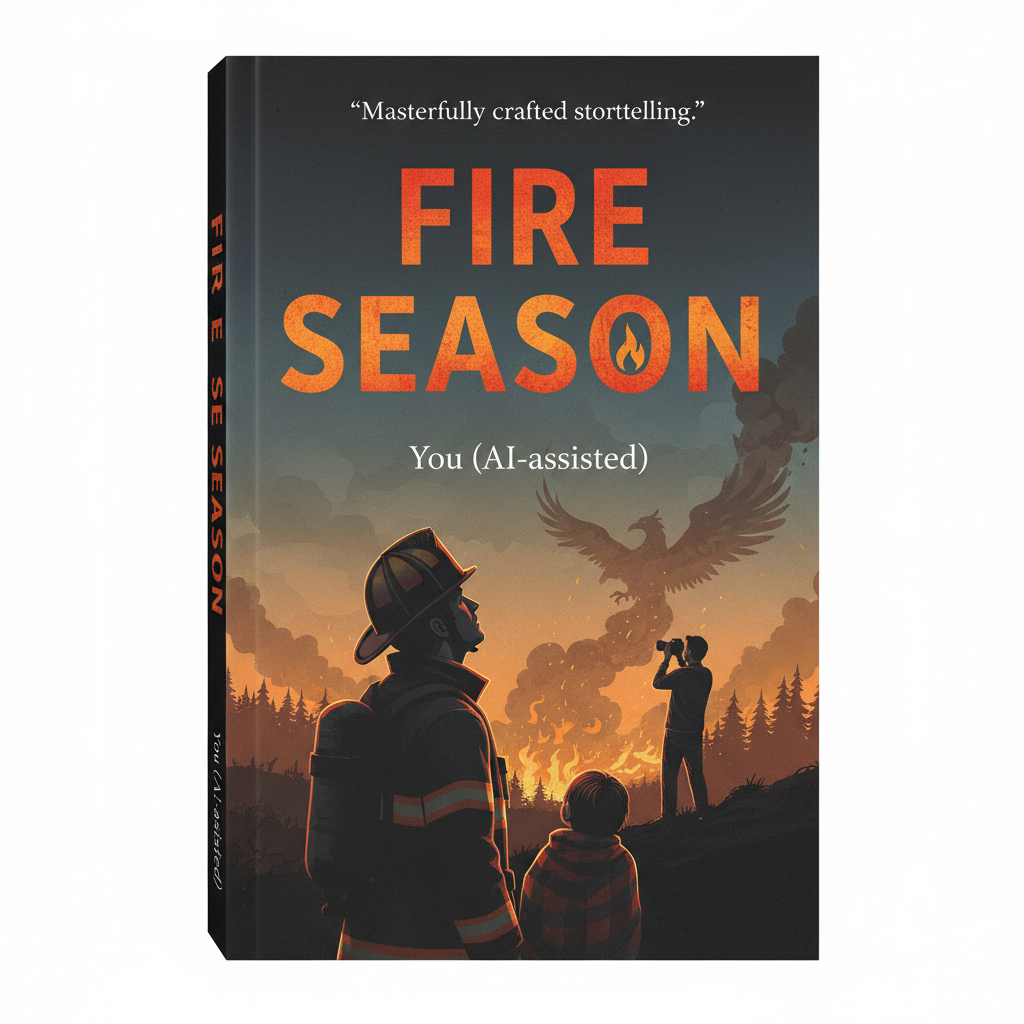
Synopsis
Amidst the scorching embrace of unprecedented wildfires, an unlikely trio—a weary firefighter, a child uprooted by the flames, and a searching journalist—forge a fragile bond, navigating a landscape reshaped by both destruction and an enduring human spirit.
Chapter 1: The First Ember
The air itself tasted of grit and foreboding. It wasn't just the usual dryness of late spring in Northern California; it was a parched, metallic tang that clung to the back of Elara’s throat, a premonition she knew all too well. Ash, fine as dust, drifted like premature snow, dusting the windshield of her worn pickup truck, settling on the wilting lavender in her front yard. Each fleck was a whispered warning, a cinder from a fire not yet seen but undoubtedly coming. She watched it fall, a silent, grey snowfall, marking the end of one season and the slow, agonizing inception of another.
She ran a hand through her short, practical hair, feeling the faint rasp of ash even there. The old dread, a familiar, unwelcome companion, coiled in her stomach. It began as a tightness, just beneath her ribs, a subtle hardening that would, with time, spread through her limbs, stiffen her jaw, and sharpen her eyes. It was the dread of the fire season, a beast stirring from its winter slumber, growing hungrier with each passing day.
The radio crackled then, a low, guttural murmur that cut through the imagined silence of the impending storm. “Brush fire, Highway 101, mile marker 67, southbound, near the old Oakhaven turnoff. Size up in progress. Units responding.” The dispatcher’s voice, a calm, practiced monotone, couldn’t quite mask the underlying ripple of urgency. It was early, too early for a call like this. The last frost had barely retreated, the ground still clinging to pockets of moisture, yet here it was. The first ember.
Elara’s breath hitched, a small, involuntary gasp. Oakhaven. That was barely twenty minutes from her home. It was always like this, the beast testing the boundaries, nipping at the edges of the familiar. Her hand, calloused and strong, moved instinctively towards the keys hanging by the door. She didn’t need to be told. She was a volunteer, yes, but her commitment ran deeper than any official designation. This was her land, her community.
She pulled on her heavy-duty work shirt, the one with the faded fire department emblem stitched above the pocket, and her thick denim jeans. Her boots, scuffed and solid, laced up quickly. Each movement was deliberate, practiced, a ritual born of many seasons. As she walked out to her truck, the light outside had taken on a strange, milky quality, the sun a pale disc struggling to penetrate the nascent haze. The smell was stronger now, not just the acrid scent of ash, but the deeper, more unsettling aroma of burning vegetation, pine needles, and dry earth. It was a smell that burrowed deep into her memory, evoking images of orange skies and frantic winds.
The drive to the Oakhaven turnoff was a blur of familiar agricultural fields and low-slung hills, all wearing the faded green of a landscape slowly yielding to summer’s relentless heat. Already, the tall grasses along the roadside were bleached to a brittle yellow. She passed a vineyard, its trellises marching in neat rows, the nascent buds already turning, promising a harvest that felt increasingly precarious. Each year, the fire season encroached further, nibbling at the edges of their livelihoods, their lives.
When she arrived, the scene was already organized chaos. Several engines from the county and a few other volunteer departments were already on site, their personnel moving with a practiced urgency. The fire, initially described as a brush fire, had indeed found purchase. A plume of thick, dark smoke, the color of bruised plums, was already boiling into the sky, tainting the gentle blue with its malevolent presence. Flames, surprisingly aggressive for such an early season blaze, licked at the dry grass and low-lying scrub that bordered the highway, advancing with a hungry speed towards a stand of young oaks.
Elara parked her truck hastily, grabbing her helmet and going bag from the passenger seat. The heat, even from a distance, was immediate and oppressive, a physical blow. The air shimmered above the asphalt, distorting the scene, making the world feel unreal. She could hear the roar of the fire now, a low, guttural growl that was both terrifying and mesmerizing. It was the sound of a living thing, flexing its power.
“Elara! Over here!”
It was Mark, the captain of the Oakhaven volunteer squad, his face already streaked with soot and sweat, his eyes fixed on the advancing flames. He was a good man, steady and experienced, but even he carried the weight of the coming season in the tired slump of his shoulders.
“Rough start,” Elara said, her voice a little breathless as she joined him, adjusting her helmet. The first blast of heat washed over her, making her skin prickle.
Mark nodded, not taking his eyes from the fire. “It’s moving fast. Wind’s picking up out of the east. Looks like it jumped the highway already, trying to get into the oaks. We’re laying down a line on this side, trying to protect the power lines. Got a crew heading around to the other side to outflank it.”
Elara surveyed the scene, her gaze quick and comprehensive. The wind, she noticed, was indeed shifting, a capricious breath that seemed intent on fanning the flames. The air was thick with the smell of burning leaves and the sharp, chemical tang of wild grasses. Sparks, like tiny, malevolent fireflies, danced in the air, carried by drafts and landing on fresh fuel, igniting new, smaller fires in their wake. This was no ordinary brush fire. This was a warning.
She joined a crew already unwinding hoses, their movements fluid and coordinated. The weight of the hose in her hands was familiar, the grit of the couplings against her gloves. The pump roared to life on the engine, sending a surge of water through the lines, a brief, cool satisfaction before the heat consumed it. They moved with a synchronized rhythm, pushing back against the encroaching fire, a team of human ants battling a giant, fiery beast.
The flames were higher now, reaching for the sky, their orange and red fingers clawing at the blue. The oaks, still green but parched, hissed and crackled as the heat reached them, their leaves curling and browning at the edges. Elara felt the familiar adrenaline coursing through her veins, a stark contrast to the dread that had accompanied her drive. Here, amidst the heat and the smoke, there was action, a purpose. The dread receded, replaced by a fierce, protective focus.
She worked alongside a younger volunteer, a nervous-looking man named Gabe, whose eyes darted around, wide with a fear he was trying to suppress. “It’s…it’s hotter than I expected for this time of year,” he yelled over the roar of the fire, his voice almost lost in the din.
Elara gave him a brief, grim smile. “It always is, Gabe. The fires don’t care about the calendar.” She directed him on where to aim the stream, showing him how to angle the hose to get the most impact, explaining the nuances of cooling the fuel ahead of the main burn. She remembered her first fires, the overwhelming sense of chaos, the fear. Now, it was a finely tuned dance between human will and natural destruction.
Hours passed in a blur of smoke, sweat, and effort. The sun, now a hazy orange disc, began its slow descent, bleeding across the sky in hues that mimicked the fire’s own destructive palette. The wind, stubbornly persistent, continued to push the flames, making their pushback a relentless, uphill battle. They managed to establish a perimeter, digging fire lines, dousing hot spots, but every gain felt fragile, temporary. This fire, though small in the grand scheme of what was to come, was tenacious, a harbinger of a harsher season.
At one point, Elara caught a glimpse of a familiar face amongst the onlookers gathered at a safe distance down the road – Sarah, a local journalist, her camera raised, snapping photos of the billowing smoke. Sarah was new to the area, having moved from the city just a few years ago, but she had a dogged determination to tell the stories of this valley, even the uncomfortable ones. Elara knew Sarah was here for the same reason she was: to bear witness.
As night fell, plunging the landscape into a deeper gloom that only intensified the fiery glow, the fire finally began to yield, battered by their concerted efforts. The main front was contained, though hot spots continued to flare, requiring constant vigilance. The air was thick with the acrid smell of burnt earth, a smell that would cling to their clothes and hair for days.
Elara leaned against the side of her engine, drinking greedily from a bottle of water, her muscles aching, her throat raw. Her face was streaked with soot, her eyes red-rimmed but alert. The dread was back, but now it was a sharper, more defined edge, honed by the day’s struggle. This, she knew, was only the beginning. The first ember had landed. The beast had awoken.
She looked out at the smoldering landscape, a patchwork of black and grey, still dotted with small, glowing embers like angry eyes. The thought of the weeks and months to come, the relentless battle against an increasingly powerful and erratic force, settled deep within her. It was a weariness that went beyond physical exhaustion, a soul-deep fatigue that threatened to consume her even before the true fight truly began. But beneath the weariness, a spark of resolve flickered, sturdy and unfailing. She would fight. They all would. Because that was what they did. They stood between the fire and what it threatened to destroy. This season, she knew, would test that resolve like never before. The air might be thick with the taste of ash, but the fire in her spirit, though tired, was nowhere near extinguished. It was, in its own way, just beginning to burn.
Chapter 2: A World Ablaze
The sky had always been a bruised purple at sunset, sometimes a fiery orange when the fog rolled in from the coast and caught the last of the light. But this was different. This was not the gentle fade of day into night, nor the comforting shroud of coastal mist. This was an orange that screamed, an apocalyptic hue that bled into everything, staining the very air with its urgency. It was a color Lena had never seen before and wished she never would again. Sunlight, even at midday, was a memory. Now, only this insistent, unnatural glow filtered through the thick curtain of smoke.
It had been weeks since the first tremors of unease, since the news reports had started whispering of distant smoke plumes, of towns on high alert. Weeks of the air growing heavier, smelling of something primal and menacing, like a struck match held too long. Now, that whisper had become a roar. The scent of pine and rich earth had vanished, replaced by the acrid, metallic tang of burning.
From her bedroom window, Lena watched the chickens in their coop, their normally bright feathers dulled by a fine, pervasive layer of ash. They pecked listlessly at the dust, their usual bustling energy muted by the surreal light. She pressed her face against the cool glass, a thin barrier between her and the suffocating outside. Even inside, the air felt strange, thinner, as if some vital component had been sucked out of it. Her throat felt scratchy, a constant tickle that made her want to cough, but she held it in, a small, futile act of defiance against the overwhelming presence of the smoke.
Mother had been different these past few days. Her movements were jerky, her eyes wide and darting, always scanning the horizon, always snatching at news from the ancient radio in the kitchen. The radio, usually a source of forgotten country tunes, now hummed with stern, disembodied voices listing towns, roads, evacuation orders. Each place name struck Lena with a fresh pang of fear, pulling the world she knew further out of reach.
“Lena, pack your bag. Now,” her mother’s voice had been tight, not angry, but frayed at the edges like old cloth.
Lena had stood frozen in the middle of her small room, a worn denim backpack clutched in her hands. What did one pack, when everything felt like it was dissolving around her? What was important when the sky itself was falling? Her gaze fell on Mr. Bear, his fur soft and matted from years of sleepy cuddles, his single remaining button eye gazing back with unwavering loyalty. She picked him up, his familiar weight a small comfort in the rising tide of panic. Mr. Bear was always important.
Her mother appeared in the doorway, her slender frame silhouetted against the unnatural light from the hall. She held a large plastic trash bag, already filled with clothes and linens. Her chestnut hair, usually pulled back in a neat braid, was escaping its confines, wisps sticking to her temples. Her lips were a thin, pale line.
“Just clothes, honey. And Mr. Bear,” she said, her voice a little softer now, as if sensing the tremor in Lena’s small hands. “Everything else…we can get more.”
But Lena knew. The way her mother looked at the packed bags, the way her eyes lingered on the photographs on the mantelpiece, told a different story. They wouldn’t get more. Not all of it. Not the way it was.
The scent of smoke intensified, no longer a distant threat but a present danger, seeping under the doorframes, through the cracks around the windows. It was no longer the smell of autumn bonfires. This was a hungry, aggressive smell. Ashes, fine and grey, drifted past the glass, clinging to the window screens like spectral snowflakes.
Then came the sound. A low, continuous rumble, like a far-off train, but deeper, more primal. It vibrated through the floorboards, through Lena’s small body. It was the sound of the earth groaning, of a monstrous furnace devouring everything in its path.
“Lena! Now!” Her mother’s voice was sharp, cutting through the haze of the smoke and the growing panic.
Lena shoved a handful of clothes into her backpack, mostly T-shirts and old jeans, then tucked Mr. Bear among them, his head poking out, a silent sentinel. She zipped the bag with a trembling hand.
Her mother was already at the front door, struggling with two large suitcases. She glanced at Lena, her face etched with a desperate resolve. “We have to go. They’ve issued the mandatory evacuation. The fire…it’s crested the ridge.”
Crested the ridge. The words hung in the air, heavy with meaning. The ridge was the barrier, the natural wall that had separated their small valley from the vast wilderness beyond. Now, the fire was over it. It was here.
Lena followed her mother out onto the porch. The air was a suffocating blanket, hot and thick with ash. She gasped, a small, involuntary sound. The world outside was bathed in that terrifying, unearthly orange. The tall pines at the edge of their yard, usually majestic and green, were now silhouetted against a backdrop of angry, pulsating red. The rumble was louder now, accompanied by a new sound: a crackling, snapping fury, like a million brittle branches breaking at once.
Neighboring houses, usually a comforting backdrop of familiar shapes, were shrouded in a haze, their outlines blurring into the oppressive atmosphere. She could see Mrs. Henderson's porch light flickering erratically, a lone defiant glow against the encroaching darkness. But there was no sign of Mrs. Henderson, or anyone else. Just their lonely little house, standing vulnerable under the burning sky.
Her mother wrestled the last suitcase into the back of their old pickup truck, its paint dulled by years of sun and dust. “Get in, Lena. Quickly.” Her voice was tight, her breath coming in ragged gasps.
Lena scrambled into the passenger seat, backpack clutched to her chest. Mr. Bear's head bumped against her chin. She strapped herself in, fumbling with the unfamiliar buckle, her fingers clumsy with fear. The interior of the truck smelled faintly of old coffee and her father’s pipe tobacco, ghosts of a quieter time. She looked back at their house, a small, weathered cottage with a porch swing and rambling rose bushes, all of it now caught in the orange glow. It looked like a photograph, a memory already fading.
Her mother started the engine. It sputtered once, then caught with a strained roar that seemed to mock the inferno around them. The headlights cut through the smoke, two weak beams struggling against the apocalyptic haze.
As they pulled onto the gravel driveway, Lena pressed her face against the window again. The fire was visible now, not just as a glow, but as distinct flames, leaping and dancing along the top of the ridge, thin, hungry fingers clawing at the sky. A shower of embers, like deadly orange confetti, rained down, striking the dry leaves in their yard, igniting small, instant flares that flickered and died, only to be replaced by more.
Her mother drove slowly, carefully, the truck bumping over the uneven terrain. The air inside the cab was hot, despite the open windows. Small sparks, carried on the errant breeze, drifted in, landing on the dashboard like tiny, malevolent jewels.
The road out of their valley was usually quiet, a narrow ribbon of asphalt winding through dense forest. Now, it was choked with a procession of cars, all moving in the same direction, away from the roaring threat. Each vehicle was a silent tableau of fear and loss: a young couple in a beat-up sedan, a family crammed into an SUV, an old man in a rusty pickup, all with faces grim and eyes fixed on the path ahead. Most cars had household items strapped precariously to their roofs – bicycles, mattresses, even an antique rocking chair.
Lena watched them, a kaleidoscope of desperate journeys. Everyone carried their own pieces of the world, salvaged from the encroaching fire. Their faces, illuminated by the unearthly light, seemed to radiate a shared, unspoken dread.
Her mother gripped the steering wheel, knuckles white. She kept glancing in the rearview mirror, then ahead, her eyes constantly searching. “It’s okay, honey,” she murmured, more to herself than to Lena. “We’ll be okay.”
But Lena knew it wasn't okay. The world was ablaze.
They crept along, the air growing thicker with every turn of the wheel. The trees lining the road, once a comforting canopy of green, were now tinged with an ominous, reddish-brown, their lower branches already singed. Lena held Mr. Bear tighter, burying her face in his worn fur, trying to breathe through the familiar scent of old cotton and childhood.
Suddenly, a gust of wind, hot and fierce, swept through the valley. It slammed against the truck, shaking it violently. Sparks rained down, bright and terrifying. The rumble of the fire intensified, a deafening crescendo.
Her mother gasped, veering slightly. Up ahead, she could see a cluster of emergency vehicles, their lights flashing erratically through the smoke, painting streaking reds and blues across the orange canvas. A group of firefighters, their faces obscured by large masks and helmets, stood by the roadside, directing traffic, their movements urgent and precise. They looked like figures from a nightmare, apparitions in the smoky gloom.
As they neared the checkpoint, a firefighter, tall and broad-shouldered, stepped forward, his gloved hand raised. He leaned down, his voice muffled by the mask, but Lena could still hear the urgency in his tone. "Ma'am, you need to keep moving. The wind shifted. It's coming fast. Head to the community center in Willow Creek. It's safe there for now."
Her mother nodded, her voice choked. "Thank you. Is there…any hope?"
The firefighter paused, his eyes, grim and weary, met her mother's. Lena saw the flicker of something unsaid, something in the man’s eyes that confirmed her deepest fears. He just shook his head slowly, a small, almost imperceptible movement. "Just drive safe, ma'am."
Her mother shifted gears, her jaw set. They lurched forward, leaving the checkpoint and the weary firefighter behind. Lena pressed her forehead against the cool glass of the window, watching the fire’s relentless march. It consumed everything in its path, turning trees into torches, homes into pyres. The scent of pine needles, woodsmoke, and something else, something metallic and sharp, of plastic and fabric melting, permeated the air.
She squeezed her eyes shut for a moment. This wasn’t a dream. It was real. The heat was real. The smoke was real. The fear was horribly, terribly real.
When she opened her eyes, the scene outside had changed yet again. The flames were closer now, licking at the very edge of the road, sending tendrils of heat through the closed windows. The roar was deafening, a hungry, living thing. Through a brief, terrifying break in the smoke, she saw it – a massive wall of fire, stretching across the entire horizon, consuming everything in its path. It was no longer just the ridge. It was the world. Their valley, their home, all of it was dissolving into the terrifying orange glow.
And then, just as suddenly, they turned a bend, and the inferno seemed to recede, replaced by a slightly less dense curtain of smoke. The orange was still there, but muted, less aggressive. The road ahead, though still crowded, felt a little less threatened. They were, for a moment, out of its immediate grasp.
Lena let out a breath she hadn’t realized she was holding. Her hands were shaking. Mr. Bear, his face smudged with Lena’s tears and charcoal dust, stared ahead, his one good eye reflecting the flickering, fiery world, a silent witness to their escape.
Her mother reached over, her hand trembling as she squeezed Lena's arm. Her face was streaked with ash, her eyes red-rimmed, but a sliver of resolve had returned. “We’re safe now, honey. For a little while.”
But Lena knew. Safe was a fragile thing, a temporary state. The world had changed. And they were just beginning their journey into a landscape remade by the fire. The roar of the flames, though receding, would echo in her ears for a long, long time. And Mr. Bear, her one small piece of the world, would have to watch it all.
Chapter 3: Searching for Stories
The air, thick enough to chew, tasted of ash and desperation. Liam coughed, a dry, rasping sound that rattled in his chest, and pulled the scratchy bandanna higher over his mouth and nose. It did little to filter the acrid stench that permeated everything – his clothes, his hair, the very skin of his hands. He wiped at his eyes, stinging and gritty, with the back of a gloved hand, smearing the fine layer of soot that had settled there. This wasn't the kind of light he usually worked with, the carefully curated glow of a studio or the sharp, impartial glare of a newsroom. This was a brutal, unfiltered sun, wrestling with a sky choked orange and brown.
His rental car, a practical but unimpressive sedan, was coated in a uniform dust that suggested it had driven through a geological epoch rather than a few hundred miles of highway. He’d left the main arteries hours ago, navigating increasingly rural roads, relying more on intuition and the deepening gloom of wildfire smoke than on GPS. The small towns he’d passed through were somber, hushed, windows often boarded up, their few remaining inhabitants moving with a weary resignation that spoke volumes. They weren't just fleeing; they were waiting. Waiting for the wind to shift, for a miracle, for the worst to be over. Or perhaps, just waiting for the next instruction.
Liam pulled the car to the shoulder of a service road, the tires crunching on loose gravel. He killed the engine, and the sudden silence was profound, broken only by the distant, disembodied roar that could have been wind or, more ominously, fire. He reached for his camera bag on the passenger seat, the familiar weight a small comfort. He wasn’t here for the sensational headlines, not primarily. He wasn’t just chasing the flames for dramatic visuals. He was after the threads of human experience, the quiet bravery, the profound losses, the nascent hopes that somehow always managed to sprout in the most barren landscapes. He wanted the stories that whispered beneath the roar, the ones that often got lost in the stark black-and-white of disaster reporting.
Unclipping the heavy lens, he scanned the immediate surroundings. The landscape was a mosaic of desolation and defiance. To his left, a stand of skeletal trees stood like charred sentinels against the bruised sky, their branches reaching up in silent supplication. To his right, a cluster of still-green pines, miraculously spared, clung to a small ridge, their needles dusted with ash but vibrant. In the distance, a column of smoke, thicker and darker than the ambient haze, pulsed like a living thing, a grim heartbeat against the horizon.
He saw the first signs of organized activity further down the road – a makeshift checkpoint, orange cones, and a flailing banner that read 'Evacuation Point - Mandatory.' A state trooper, looking tired but resolute, waved him through after a brief, tense exchange and a flash of his press credentials. The air thickened here, the stench of resin and burning timber almost unbearable.
The road opened into a vast, flat expanse, an improvised staging area. It was a tableau of organized chaos. Fire engines, their chrome dulled by soot, lined up like silent sentinels. Ambulances idled, their red and white a stark contrast to the grim palette of the surroundings. Utility trucks, heavy equipment, and a surprising number of personal vehicles, caked in ash, filled the space. People moved with a focused urgency, their faces grim, their movements precise.
He watched them for a while, a silent observer from the edge of the organized disorder. Firefighters, easily identifiable by their heavy gear and the distinct yellow of their protective suits, moved like weary titans. Some sat on tailgates, hunched over water bottles, their helmets discarded beside them, revealing sweat-strestreaked faces etched with fatigue. Others conferred in hushed tones, pointing at maps, their voices low and gravelly. They were covered in soot, their uniforms stained with the indelible marks of their battle, but their eyes, when he caught them, held a fierce, unyielding light.
He began to walk, his camera hanging heavy against his chest. He moved slowly, deliberately, trying not to intrude, to simply be present. He raised his camera, capturing a wide shot – the expanse of the staging area, the plumes of smoke in the distance, the raw, brutal beauty of the struggle. He zoomed in, focusing on a group of firefighters gathered around a tablet, their brows furrowed, their expressions mirroring the gravity of their task. The lines of fatigue around their eyes were deep, permanent. Their shoulders, broad and strong, seemed to carry the weight of more than just their equipment.
He spotted a woman, her hair pulled back in a severe bun, her face smudged, meticulously refilling water bottles from a huge cooler. Her movements were economical, practiced. Her hands, when he snapped a close-up, were calloused, her nails broken. She wasn’t a firefighter, not in the traditional sense, but her contribution was vital, a small act of sustaining grace in the face of so much destruction.
A little further on, under the sparse shade of a portable canopy, a family sat huddled together on folding chairs, their few possessions piled neatly beside them. An elderly woman, her face a road map of worry lines, clutched a worn blanket. A young man, probably her son, stared blankly into space, his gaze distant, as if seeing something beyond the immediate reality. A child, perhaps seven or eight, traced patterns in the ash-laden dirt with a stick, seemingly oblivious, or perhaps willfully ignoring, the unfolding tragedy around her. Liam hesitated, his finger hovering over the shutter release. These were the stories he sought, the quiet narratives of displacement and resilience. But he felt a pang of ethical discomfort. Was he exploiting their vulnerability, their raw pain, for the sake of a photograph? He lowered the camera, deciding to wait, to observe longer, to seek an unspoken invitation before intruding.
He walked past a row of portable toilets, their plastic walls shimmering faintly in the oppressive heat. He could hear snippets of conversation, hushed and strained. "Lost everything, they say." "The wind shifted, just like that." "Any word from Sector Four?" The words hung in the air, heavy with unspoken fears.
His initial journalistic objectivity, a shield he usually carried with practiced ease, began to fray at the edges. The sheer scale of it, the relentless, suffocating presence of the smoke, the tangible exhaustion etched on every face he saw – it was eroding his detachment. He wasn’t just observing a news event; he was witnessing something profoundly human, something primal.
He paused near a group of volunteers, recognizable by their brightly colored vests, handing out sandwiches and coffee. He approached a woman with kind eyes and a weary smile, her vest proclaiming her affiliation with a local church group.
"Rough out here, isn't it?" Liam offered, his voice a little hoarse.
She nodded, wiping a stray strand of hair from her forehead. "It's… relentless. But people are pullin' together. That's what matters." She gestured with a bread roll towards the scattering of evacuees. "We've had folks coming in all morning. Some of them, they barely got out with the clothes on their backs."
"Any specific areas hit hardest?" he asked, bringing out a small notebook and pen.
She sighed, a tired, resigned sound. "Hard to say where it stops. It’s moving so fast. We heard about the Canyon Creek area… pretty much gone, they say. And the foothills around Pine Ridge… devastating." Her voice trailed off, a catch in her throat. "My cousin lives out that way."
He felt a familiar flicker of professional obligation, the urge to press for more details, for names, for specifics. But something held him back. He saw the tremble in her lower lip, the unshed tears in her eyes. This wasn't just information; it was grief, communal and personal.
He moved on, deeper into the thicket of parked vehicles and temporary encampments. He saw children playing abstractly in the ash, their faces streaked, their laughter a strange, fragile counterpoint to the somber mood. He noted a makeshift charging station where people huddled around power strips, their phones clutched like lifelines, trying to connect with a world that felt increasingly distant.
He noticed a man, younger than most, sitting apart, his head buried in his hands. His clothes were singed, his face grimy, and his shoulders shook with silent, uncontrollable sobs. Liam felt a knot tighten in his stomach. He raised his camera, framing the man in his viewfinder, the stark profile of despair. He held it there, the lens focused, the moment captured. But he didn’t press the shutter. He couldn't. It felt too invasive, too cruel an act in that moment of raw, unguarded pain. He lowered the camera, the professional detachment he usually relied on crumbling a little more.
He had come seeking stories, the profound human narratives of resilience and loss. And he was finding them, in every weary glance, every hushed conversation, every silent act of sorrow or compassion. But they weren’t just stories anymore. They were becoming something else, something personal, seeping into him, leaving their indelible mark. This wasn't a detached assignment, a series of frames and captions. This was humanity laid bare, struggling for breath under a burning sky, and he, for the first time in a long time, felt less like an observer and more like a participant in its grim, beautiful testament.
As the sun began its painful descent, painting the smoke-choked sky in hues of angry orange and blood red, Liam found himself gravitating towards a cluster of firefighters, taking a brief respite near a small, improvised mess tent. They were eating quickly, their faces grim, their movements still burdened by the day’s exertion. He recognized Elara from a previous community event he'd covered, a volunteer fire captain known for her quiet strength. Her face, usually open and friendly, was smudged and grim, her eyes red-rimmed from smoke and strain. She was speaking in low tones with another firefighter, a woman with a strong, determined jaw, her helmet tucked under her arm.
He knew he needed to speak to them, to glean details, to understand the strategic battle against the inferno. He knew he needed to turn these observations into an article, to convey the urgency and the cost. But as he approached, camera still hanging heavy, he realized his priorities were shifting. The journalist’s instinct for the immediate scoop was giving way to a deeper, more unsettling curiosity. He wasn’t just searching for facts now. He was searching for the pulse of something vital, something enduring, in the heart of the destruction. He watched Elara, her gaze fixed on the pulsating smoke in the distance, and felt a strange pull, an unspoken invitation into the profound reality of this fire season. He had come for the stories, but he was finding himself immersed in a narrative far larger and more powerful than he had anticipated, a narrative that threatened to reshape not just the land, but perhaps, him as well.
Chapter 4: Temporary Sanctuaries
The fluorescent lights of the gymnasium hummed, a relentless, unblinking glare that stripped the world down to its most unromantic truths. Lena sat on a cot, its flimsy canvas stretched taut over a metal frame, watching the parade of legs. Thick legs in worn jeans, thin legs in pajama bottoms, restless legs pacing the worn linoleum. Her own legs dangled, barely reaching the floor, heels tapping a silent, nervous rhythm against the metal. The air was thick with a thousand different smells: stale coffee, disinfectant, unwashed bodies, and underlying it all, the acrid, lingering scent of smoke that clung to everyone like a second skin.
She clutched her bear, Barnaby, a faded brown lump of well-loved fur, pressing his scratchy ear against her cheek. His one remaining button eye, black and unblinking, seemed to take everything in with a silent, stoic wisdom. He understood. He remembered the crackling fireplace, the scent of pine needles, the familiar squeak of her bedroom door. Here, there was only the constant murmur of voices, a low, indistinct roar that vibrated through the floorboards and settled in her bones. The sheer volume of people, all moving, talking, existing in such close proximity, made her head ache.
Earlier, a woman with kind, but tired eyes, had tried to offer her a coloring book. Lena had shaken her head, shrinking slightly into the folds of the oversized sweatshirt someone had given her. It smelled like lavender and an unfamiliar detergent. The woman had smiled, a small, sad curve of her lips, and moved on to another child, who snatched the crayons with an almost desperate eagerness. Lena just wanted her own crayons, the fat, stubby ones her mom had bought her, tucked in her pencil case with the unicorn stickers. It felt like a lifetime ago.
Across the sprawling expanse of the gym, tables laden with donated clothes rose in chaotic mountains. Children’s shoes, mismatched and worn, lay in piles like discarded shells. A single, forgotten doll, its plastic hair matted, lay face down near a rack of unfamiliar coats. Everything here felt borrowed, temporary, like a stage set awaiting the next act. Lena pressed her cheek harder against Barnaby, wishing he could whisper a plan, a way to make this dissolve, to find herself back in her own bed, the scent of her mother’s baking drifting from the kitchen.
She watched a woman across the aisle, her face etched with a worry that mirrored Lena’s own, attempt to soothe a wailing infant. The sound was sharp, piercing, cutting through the general din and making Lena flinch. Her own throat felt tight, a lump that wouldn't swallow. She hadn’t cried, not really. Not since the car ride, when the smoke had turned the world orange and her mother’s hand had trembled on the steering wheel. Her tears felt stuck, like splinters beneath her skin.
A small tremor ran through the cot as someone brushed past. She looked up. A woman, her face smudged with soot and exhaustion, her hair pulled back in a loose, untidy pony tail, was navigating the narrow aisle between the cots. Elara. Lena had seen her earlier, directing people, her voice a quiet authority amidst the rising panic. Now, Elara carried a cardboard box, its contents rattling softly. She moved with a weariness that Lena understood, a deep-seated fatigue that seemed to pull at her shoulders.
Elara’s gaze, sweeping the crowded room, snagged on Lena. For a moment, their eyes met. Elara’s were a startling blue, wide and intelligent, but underscored with a profound exhaustion that mirrored Lena’s own. A flicker of something passed between them, a silent recognition of shared burden, though for vastly different reasons. Elara gave a small, almost imperceptible nod, a gesture of quiet acknowledgement, before moving on, disappearing behind a stack of blankets.
Lena watched her go, a strange, unexpected sense of something akin to comfort settling within her. It was fleeting, like a wisp of smoke, but it was there. Elara hadn’t tried to talk to her, hadn’t offered another coloring book, hadn’t even smiled. She had simply seen her. And in this sprawling, chaotic landscape of temporary lives, being seen felt like a small, precious victory.
Elara navigated the maze of cots, the flimsy cardboard box bumping against her leg. The weight of it, filled with water bottles and energy bars, felt negligible compared to the weight in her chest. Each face she passed was a story, a loss, a fresh layer of dust on an already grimy landscape. The air in the gym was thick, not just with the lingering smoke, but with the palpable presence of fear and uncertainty. It seeped into everything, a silent, pervasive hum beneath the noise.
Her boots, caked with fine white ash and red earth, seemed to drag. Off-shift, finally, after a brutal thirty-six hours, she’d volunteered to help distribute supplies. Anything to keep moving, anything to postpone the moment when she would be forced to sit still, where the images of the past days would replay in an endless, horrifying loop behind her eyelids. The orange glow on the horizon, the crackle of burning timber, the acrid taste of smoke that never quite left her tongue.
She’d caught the glimpse of the child. Small, curled on a cot, gripping a faded teddy bear. Lena. She remembered the name from the intake log, one of the many children separated from a parent, brought in by a neighbor, a family friend, the details a blur of frantic communication. The child's eyes, wide and dark, had held a quiet despair, a stillness that was far more heartbreaking than any outward display of distress. It was the same stillness she’d seen in the eyes of deer caught in the headlights, bewildered and utterly lost.
Elara paused by a table near the back, dropping the box with a soft thud. A volunteer, a woman with kind eyes and a name tag that read 'Sarah,' looked up. “Elara. Thanks for this. You look like you’ve been through it.”
Elara managed a weak smile. “Tell me about it. Any word on the containment lines?”
Sarah shook her head, her hand smoothing the front of her apron. “Nothing definitive. They’re saying it’s still highly unpredictable. The wind shifts… it's a monster.”
Elara nodded, her gaze drifting back to Lena. The child hadn’t moved, a small, still point in a constantly shifting landscape. “That little girl,” Elara gestured with her chin, “the one with the bear. Does she have family with her?”
Sarah sighed, pulling a water bottle from the box. “Her mother was still looking for her father when they had to evacuate. A neighbor brought Lena in. We’re doing our best to connect them, but the communication lines are… well, you know. Everyone’s looking for someone.”
Elara’s jaw tightened. This was the quiet heartbreak of it all, the unraveling of families, the severed connections in the chaos. She’d seen it before, but never on this scale, never with this ferocity. The human cost. It was always the human cost.
“She hasn’t eaten much,” Sarah continued, her voice lowered, “and barely spoken a word. Just holds onto that bear like it’s the last piece of home.”
Elara’s chest tightened. She knew that feeling, the need to cling to something tangible when everything else was dissolving into ash. For her, it was the scuffed leather of her turnout coat, the familiar heft of her axe. For a child, a worn teddy bear was the entire world.
She watched Lena for another moment, feeling the pull, the familiar tug of empathy that was both a strength and a burden in her line of work. She considered approaching her, but a heavy hand landed on her shoulder.
“Elara. You’re off, right? Get some sleep.” It was Jake, another firefighter from her crew, his face grimy, his eyes bloodshot. “We’ve got a call in an hour. Fuel truck at the old lumber mill. Looks like the damn thing jumped the retardant line.”
A fresh wave of dread washed over Elara, pushing aside the brief reprieve of her supply run. The lumber mill. That was close to the residential areas they’d been trying to protect.
She gripped Jake’s arm. “A fuel truck? That’s going to be a bitch.”
He grunted in agreement. “Yeah. A real bitch. But it’s Wednesday. We’ll be ready.” And just like that, the brief stillness of the evacuation center shattered. The familiar urgency of her calling slammed back into her. Her mind, already exhausted, shifted gears. Tactics, equipment, safety protocols – they all clicked into place, pushing aside the softer, more vulnerable thoughts.
She glanced at Lena one last time. The child was still watching, her eyes wide, holding Barnaby tightly. Elara offered a ghost of a reassuring smile, a silent promise, perhaps, that she was still here, still fighting. Then, she turned, the cardboard box of supplies forgotten, and walked with Jake towards the main doors of the gymnasium. The fluorescent lights still hummed, the chaotic symphony of temporary lives continued, but Elara was already gone, her thoughts already on the next inferno, the next battle, the next desperate attempt to salvage what little remained. The door closed behind her, a whisper of a draft stirring the stale air, and the quiet girl on the cot gripped her bear even tighter, the memory of those blue, tired eyes a small, persistent warmth in the chilly air of displacement.
Chapter 5: The Weight of Witnessing
The acrid scent of smoke, though diluted by the air conditioning of the makeshift press office, still clung to Liam’s clothes, a phantom reminder of the inferno that devoured the landscape just beyond the town’s periphery. He watched Elara approach, her movements economical, almost weary, yet there was a deep-seated resolve in the set of her shoulders. She held a styrofoam cup of lukewarm coffee, her fingers tracing the rim as if seeking warmth from the flimsy material. Her eyes, shadowed by fatigue, held a depth that drew him in, a quiet strength that belied the faint tremor in her hand.
“Ms. Rossi,” Liam began, rising slightly from his plastic chair, his recorder already nestled on the table between them. “Thank you for taking the time.”
She offered a small, almost imperceptible nod, settling into the chair opposite him. The fluorescent lights hummed above, casting a harsh glow on the lines etched around her eyes. “It’s Elara,” she corrected, her voice a low murmur, raspy from smoke inhalation. “And it’s fine. Better to talk than to just… sit.” She gestured vaguely towards the window, beyond which the sky was a perpetual bruised purple.
Liam nodded, clicking the recorder to life. The tiny red light glowed, a silent witness. “I’m interested in your experience, Elara. Not just the facts of the fire, but… what it feels like. What you’ve seen.” He watched her closely, searching for the crack in the composure he knew she must maintain for her work.
She took a slow sip of her coffee, her gaze drifting. “What it feels like,” she echoed softly, the words hanging in the air. “It feels like a beast, Liam. One with an insatiable hunger.” Her eyes, when they met his, were ancient, holding the weight of countless sunrises stained orange. “You stand in front of it, sometimes a hundred feet away, sometimes ten, and you feel the heat scorch your eyebrows even through the gear. It roars, a sound that vibrates in your bones, a sound that promises obliteration.”
He scribbled a note, his pen scratching against the page, an almost intrusive noise in the quiet space. “And the work itself? The day-to-day… the effort?”
Elara let out a small, dry laugh, devoid of humor. “The effort,” she repeated, her gaze falling to her hands, calloused and smudged with soot even now. “It’s a dance with exhaustion. Your body screams for rest, but the fire doesn’t rest. So you keep going. You push. You dig lines, sometimes in terrain so steep you’re practically climbing. You drag hoses, heavier than you’d believe, uphill, downhill. You watch the embers fly, sparks of hell, landing fifty feet inside your containment line, and you run, you just run, to stomp them out before they become another front.”
She paused, taking another slow breath. “The smoke. It’s everywhere. It thickens the air, fills your lungs, burns your eyes. Sometimes you can barely see the person next to you. It’s disorienting. You learn to rely on the sound of the wind, the crackle of burning brush, the shouts of your crew.”
Liam felt a knot tighten in his stomach. He’d seen the smoke from a distance, smelled it, yes, but to be *in* it, to breathe it, to fight through it… He felt a familiar journalistic distance begin to fray around the edges. He was an observer, gathering facts, assembling narratives, but he wasn’t *there*, not in the way she was.
“The destruction,” he prompted, trying to steer her back to what he needed, the tangible losses, the impact.
Her gaze sharpened, a flicker of pain in their depths. “The destruction is comprehensive. You see homes, entire lives, reduced to ash and twisted metal frames. We find remnants. A child’s bicycle, melted to the asphalt. A porcelain doll, its face blackened, staring blankly at the sky. A photograph album, pages fused together by the heat, unreadable. Those are the moments that… that stick.” She trailed off, her voice growing even softer. “You try not to let them in, not fully, because if you do, it will break you. You have to keep a wall up, just enough to function.”
He imagined those melted bicycles, the charred dolls, and felt a cold dread spread through him. He’d meticulously documented the charred remains of houses, but he hadn’t considered the personal artifacts, the specific tragedies that made each loss unique and devastating.
“Is there… is there one image that you can’t get out of your mind?” he asked, a question he often asked, seeking a visceral detail for his story.
Elara was silent for a long moment, her eyes fixed on some point beyond him, beyond the room. “Yes,” she said finally, her voice so faint he had to lean in to catch it. “A garden. A small, carefully tended garden, full of roses, even in the dry heat. And the fire, it just… swept over it. In minutes. The roses, perfect and vibrant one moment, then shriveling, turning to ash, as we fought to save the house behind it. Watching something so beautiful, so alive, just… perish. It felt wrong. Violating.”
He wrote it down, the image of those burning roses, feeling a profound sadness that transcended the journalistic imperative. It was a small detail, seemingly insignificant in the grand scale of the disaster, but it held a powerful emotional resonance.
“And the fear?” he pressed gently. “For yourself? For your crew?”
She met his gaze directly now, and for a fleeting moment, he saw the raw terror she must have faced. “Fear is a constant companion. You learn to work with it, to acknowledge it, but not to be paralyzed by it. For your crew… that’s different. They are your family out there. You trust them with your life, and they trust you with theirs. When the wind shifts unexpectedly, when the fire jumps a line, when you hear a cry for help over the radio… that’s when the fear is sharpest. Because you’re not just fighting for yourself anymore. You’re fighting for them.”
He thought of the photographs he’d taken of firefighters, their faces grimed with ash, eyes fixed on the distant plumes of smoke. He’d seen their camaraderie, but he hadn’t understood its depth until now, hadn’t understood the profound trust forged in the crucible of impending disaster.
“What keeps you going?” Liam asked, genuinely curious now, beyond the scope of his article.
Elara hesitated, then sighed, a sound that seemed to carry the weight of the entire fire season. “The hope, I suppose. The hope that we’re doing some good. That we’re protecting someone’s home, someone’s memories, someone’s future. Even if it’s just one house, one fence line, one tree. And the community. Seeing people come together, bringing water, food, offering shelter. That’s what reminds you that there’s still something worth fighting for.” She paused, then added, almost as an afterthought, “And the quiet moments. After a long shift, when the sun is coming up, and you’ve held a line, and the air is still and cool for a brief moment. Those small victories.”
He felt a strange guilt begin to brew within him. He was here to extract stories, to document the suffering, to shape narratives. He was a consumer of their experiences, translating their raw pain into digestible paragraphs for readers miles away, safe in their homes. He felt a gulf widen between them, between her lived experience and his observed one. He was witnessing, yes, but he wasn’t participating. He was gathering, not enduring. The weight of her words, the stark honesty of her pain, pressed down on him.
“I heard you were seen at the evacuation center,” Liam ventured, attempting to shift the topic, perhaps to something less emotionally searing, but still connected to the human element. “Connecting with a child, I believe?”
Elara’s expression softened, a subtle shift that made her seem younger, more vulnerable. “Lena,” she murmured, a faint smile touching her lips. “Yes. Small girl. Quiet. Lost everything, I think.”
“What was that like, seeing her?”
“It was… it was a reminder,” Elara said, her gaze drifting again, as if seeing Lena in the air before them. “A reminder of why we do what we do. Not just for the property, but for the lives. For the hope that even after all this, children can still find a way to heal, to rebuild. She had this little teddy bear, worn thin. She clutched it like it was the only thing left in the world. And maybe it was.”
Liam felt a lump form in his throat. He’d seen children at the evacuation centers, their faces smudged, their eyes wide with confusion. He’d taken photos, carefully framing them to convey the sense of loss without being exploitative. But he hadn’t exchanged a word with them, hadn’t connected on that raw human level. He was an observer, always an observer.
“How do you… how do you cope with that?” he asked, the question escaping him almost involuntarily. “With seeing so much loss, so much devastation, and then seeing the faces of those who have lost everything?”
Elara looked at him, her eyes unreadable for a moment. “You don’t, not entirely,” she admitted, her voice dropping to a near whisper. “It stays with you. It changes you. But you find small ways to carry it. You find solace in the shared burden with your crew. You remind yourself that you did everything you could. And sometimes,” she paused, taking a deep, shuddering breath, “sometimes you just tell yourself that tomorrow, maybe tomorrow, the wind will shift in your favor. That tomorrow, you’ll gain some ground.”
The recording light continued its steady glow, silently absorbing her words. Liam felt the tremor in his own hand as he jotted down keywords, unable to capture the full emotional landscape of her confession. He was gathering material for an article, but he was also bearing witness, and the weight of that witnessing was heavier than he’d anticipated. He was reporting on a tragedy, but he realized, with a jolt, that he was also experiencing it, albeit from a remove. The fire, Elara’s words, the image of Lena clutching her worn teddy bear—they were not just stories anymore. They were etched into his own consciousness, demanding a response beyond a published byline. The line between observer and participant, once so clear, had begun to blur.
Chapter 6: Small Comforts
The air in the evacuation center, thick with the scent of recycled air conditioning and disinfectant, still carried a faint undertone of smoke. Elara, hunched over a lukewarm cup of instant coffee, watched the ebb and flow of bodies—families huddled on cots, volunteers bustling with clipboards, the occasional flash of a television screen broadcasting grim updates. Her usual breaks were spent in a stupor, staring at a blank wall, trying to un-stick the images of roaring orange and collapsing timber from the inside of her eyelids. But lately, her gaze had found a quiet anchor.
Lena.
The child often sat by herself, tucked away in a corner where the industrial beige partition met a concrete pillar, a small island of stillness in the swirling currents of anxiety. Her worn teddy bear, its fur matted and nose almost worn smooth, was always clutched tight in her lap. Today, Lena was tracing patterns on the dust motes dancing in a stray shaft of fluorescent light, her expression a careful blend of concentration and profound absence.
Elara pushed herself up, the familiar ache in her spine a dull companion. She navigated the maze of cots and abandoned belongings, her boots scuffing softly on the polished linoleum. When she reached Lena, she didn't speak immediately. She simply sat down on the floor beside her, leaning back against the cool concrete. The low hum of the ventilation system filled the silence between them.
After a long moment, Lena’s head tilted slightly, her eyes, wide and the color of shadowed moss, met Elara’s. There was no fear, no surprise, just a quiet acknowledgment.
"Rough day?" Elara’s voice was softer than she usually allowed it to be, a deliberate act of shedding the hard-edged efficiency of her uniform.
Lena nodded, a barely perceptible dip of her chin. She hadn't spoken more than a handful of words in their previous brief encounters, responding mostly with gestures or a quiet withdrawal.
"Mine too," Elara offered, staring at the scuff marks on the industrial carpet. She stretched out her legs, feeling the stiff fabric of her trousers pull across her knees. "The smoke's still pretty bad out there. Makes it tough to see."
Lena shifted, her small hands smoothing the teddy bear’s fur. Then, with a hesitant motion, she extended the bear slightly towards Elara. Its button eyes stared up, unblinking.
Elara smiled, a genuine, unforced curve of her lips that felt foreign after so many days. "Hello there, little guy," she murmured, gently stroking the bear's head. The fabric was surprisingly soft, despite its age. "What's his name?"
Lena's lips parted. A soft, breathy sound emerged. "Barnaby."
It was the first actual word Elara had heard Lena speak directed at her. A small victory, almost imperceptible, yet it bloomed in Elara’s chest like a surprising wildflower. "Barnaby. That’s a good strong name."
Lena seemed to take comfort in the sound of her voice. Her gaze drifted back to the light motes, but Elara felt a subtle shift in the air, a loosening of the almost suffocating tension that usually clung to the child.
"Did Barnaby like to go on adventures?" Elara asked, keeping her tone light, just above a whisper.
Lena nodded again, a little more emphatically this time. "He climbed the big oak tree." Her voice was still quiet, a delicate thread, but it held a flicker of a story.
"The one near your house?" Elara guessed, remembering the brief blur of information she’d gleaned about Lena’s origin from a volunteer's hastily scrawled notes.
Another nod. "He watched the squirrels." A ghost of a smile, fleeting as a falling leaf, touched Lena’s lips.
Elara imagined a small, sun-drenched yard, a sturdy oak, a child’s world. It was a stark contrast to the sterile, temporary haven they now occupied. "I bet he saw all sorts of things from up there," Elara said, her mind conjuring images of green leaves and dappled sunlight, a world untainted by smoke and ash. "Did he ever tell you what he saw?"
Lena hugged Barnaby closer. "He saw the clouds that looked like dragons." Her voice was gaining a little more strength, a fragile confidence. "And sometimes, he saw the deer in the early morning, eating the grass."
Elara imagined the stillness of a dawn landscape, hushed and alive. It was a memory she herself hadn’t had the luxury of entertaining in weeks, years even, it felt. Her own memories were of the sharp crackle of radio static, the roar of wind, the searing heat.
They sat in comfortable silence for a while, Elara simply listening to the distant drone of the building, Lena lost in her quiet observations. It wasn't a conversation in the traditional sense, but a weaving of presences, a shared space of quiet contemplation.
Later that afternoon, during Elara’s allotted dinner break, she found Lena again, this time near a makeshift art station set up for the children. Lena held a crayon, a vivid orange, paused over a blank sheet of paper. Her brow was furrowed in concentration.
Elara settled onto a low plastic chair nearby, picking up a stray blue crayon. "Making something beautiful?" she asked, without looking directly at Lena. She sketched a clumsy, lopsided circle on a scrap of paper.
Lena didn't answer immediately. Her crayon tip hovered, then touched the paper, drawing a small, hesitant line. It was a curve.
"I like blue," Elara said, coloring in her circle with the crayon. "It reminds me of the sky. Before."
Lena’s head snapped up, her eyes wide. "Before the smoke?"
"Exactly," Elara confirmed, meeting her gaze. "When it was just… blue. And sometimes clouds, white and fluffy like cotton candy."
Lena looked back at her drawing. She added another curve, then another, until two large, rounded shapes dominated the page. "The hills," she whispered, her voice barely audible.
Elara leaned closer. "They look like the hills in the early morning, when the mist rolls over them." She watched Lena draw a smaller, intricate shape inside one of the hills. "What's that?"
"The deer," Lena said, her voice now a little firmer. "He's eating the dew drops."
Elara remembered Barnaby’s stories. The images were so vivid in Lena’s mind, untarnished by the devastation that had driven her from them. It was a powerful kind of resilience, she realized, this ability to hold onto the beauty of what was.
"That's a lovely picture, Lena," Elara said honestly. "You're really good at drawing."
A blush, faint as a moth’s wing, touched Lena’s cheeks. She added a small, almost invisible dot of orange to the sky above the hills.
"What's that?" Elara asked, curious about the tiny speck of color.
Lena hesitated, then looked up at Elara, her eyes clear. "The sun. It's coming up."
In her mind's eye, Elara saw it—the early morning sun, a gentle orange glow, just beginning to peek over the untouched hills, before the inferno devoured everything in its path. For a moment, the heavy weight always settled around Elara's heart lifted, replaced by a surprising lightness. It was a small comfort, this shared imagining of a pristine world, but it was enough to breathe a little space into the relentless pressure of her days.
Later that evening, after a shower that tasted of chemicals and exhaustion, Elara found herself drifting towards Lena's corner again. The child was tucked into her cot, Barnaby nestled beside her, but she wasn't asleep. Her eyes were open, staring at the white ceiling.
"Can't sleep?" Elara asked softly, perching on the edge of the cot next to her.
Lena shook her head, a tiny movement.
"Me neither," Elara admitted. The images usually rushed in the moment she closed her eyes – the heat, the smoke, the desperate radio calls.
"My mom used to sing a song," Lena murmured, her voice almost swallowed by the noise of the center. "About a little bird."
"A little bird?" Elara prompted, her own fatigue momentarily forgotten.
Lena nodded. "He flew away when the wind blew too hard. But he always came back."
Elara wondered if Lena saw herself as the little bird, blown away from home. "Did your mom have a pretty singing voice?"
Lena gave another small nod. "Soft. Like feathers."
Elara paused, searching her own memory. Her folks hadn’t been singers. Her mother hummed old folk tunes sometimes while cooking, but that was it. Still, the idea was comforting. Elara, without quite knowing why, began to hum a tune she barely remembered from her own childhood, a simple lullaby her grandmother used to sing. It was wordless, just a gentle rise and fall of notes, uncertain at first, then gaining a quiet rhythm.
Lena lay still, her gaze fixed on Elara’s face, tracing the lines of fatigue and worry that etched themselves around Elara’s eyes. As Elara hummed, she felt a peculiar sense of peace settle over them both. It was a silence filled with the gentle current of the music, a small island of calm in the midst of the chaos.
Eventually, Lena’s eyelids began to droop. Her breathing deepened, falling into the even rhythm of sleep. Elara continued to hum for a few more minutes, watching the quiet rise and fall of Lena’s chest. The air still smelled of smoke, faint but persistent, a reminder of the unrelenting reality outside. But for a few precious moments, the world inside the evacuation center had shrunk to just these two, a quiet melody shared, a fragile connection forged amidst the fire’s aftermath.
Elara carefully disentangled herself from the cot, the old aching in her back reminding her of her physical limits. She stood for a moment, looking down at Lena, the child's face serene in sleep, Barnaby a silent guardian by her side. A strange warmth spread through Elara's chest, a protective instinct she hadn’t fully acknowledged until now. These small, unexpected interactions with Lena, these shared moments of quiet and imagining, were slowly becoming her own unexpected comfort, a tiny flame of hope in the vast, charred landscape of her reality.
As she walked away, back towards the dim glow of the nurses' station and the ever-present weight of her next shift, Elara allowed herself a fleeting thought: perhaps, in the midst of all this destruction, there was something new growing, something resilient and tender, like a sapling pushing through scorched earth. And perhaps, just perhaps, she would be strong enough to witness it bloom.
Chapter 7: A Moment of Respite
The air, for the first time in what felt like an eternity, carried less the acrid bite of burning timber and more the damp promise of earth. A new breath, cool and hesitant, drifted down from the north, nudging the monstrous plumes of smoke not away entirely, but upward, thinning their suffocating grasp on the horizon. The sun, a bruised orange for weeks, began to regain a hint of its former yellow, casting tentative shafts through the haze. It was a reprieve, fragile as spun glass, but a reprieve nonetheless.
In the temporary town square of what was left of Willow Creek's main street—a collection of tents and makeshift tables set up amongst the skeletal remains of buildings—a collective sigh seemed to ripple through the assembled evacuees and volunteers. The relentless, primal roar of the fires, a sound that had become the terrifying backdrop to their lives, had softened, receding to a distant, hungry growl. Children, usually clinging to their parents’ legs, ventured a few feet away, their laughter, though still subdued, carrying a note of rediscovered freedom.
Liam, adjusting the lens on his camera, felt the subtle shift in the atmosphere acutely. His fingers, usually calloused from constant focus, now tingled with a different kind of energy. The smoke in his lungs had loosened its grip a little, allowing for deeper, less painful breaths. He had spent days documenting the horror, the destruction, the raw despair etched onto faces. Now, his eyes hunted for something else – not an end to the suffering, but a hinge point, a moment where life asserted itself against the odds.
He watched as a woman, her face smudged with soot and exhaustion, carefully poured coffee into chipped mugs, handing them to a small cluster of people huddled around a folding table. Their hands, gnarled and trembling, closed around the warmth as if it were a fragile bird. No words were exchanged, but the silent offering, the shared warmth, spoke volumes. Liam raised his camera, framing the moment, the contrast between the tender gesture and the ash-dusted backdrop stark and poignant.
Further down the makeshift street, two men, their shoulders slumped with fatigue, struggled to hoist a large tarp over a stack of donated goods. Suddenly, a teenager, all lean muscle and restless energy, materialized from seemingly nowhere, grabbing a corner of the tarp and pulling with an unexpected strength. The men exchanged a surprised glance, then a grateful nod. The teenager, his face half-hidden by a baseball cap, offered a shy, almost imperceptible smile before melting back into the periphery. It was a fleeting interaction, easily missed amidst the general bustle, but Liam caught it. He saw the subtle exchange, the quiet understanding, the unasked help. He pressed the shutter button, preserving the moment of nascent collaboration.
He remembered Elara's tired eyes, Lena’s quiet vigilance, the heavy weight of their shared burden. He understood, then, that resilience wasn’t a defiant roar, but often a whisper, a series of small, persistent acts woven into the fabric of daily life. It was the careful folding of a donated blanket, the sharing of a stale biscuit, the whispered word of comfort.
The smell of freshly baked bread, impossibly, wafted from an outdoor oven cobbled together from bricks and corrugated metal. A volunteer, her apron dusted with flour, pulled out golden-brown loaves, their crusts glistening. A line had already formed, long and winding, its participants patient, not out of resignation, but out of a shared understanding of this small miracle. Liam noticed a child at the end of the line, no older than Lena, eyes wide and fixed on the steaming bread, her small hand clutching a much-loved, if somewhat singed, doll. He focused his lens on her, capturing the pristine hope in her gaze against the backdrop of an uncertain future.
He moved through the crowd, a silent observer with his camera as an extension of his senses. He saw a group of senior citizens, their faces etched with the lines of long lives lived, gathered around a crackling battery-powered radio, listening intently to the latest news reports. They weren't clutching at hope, not yet, but simply waiting, their quiet endurance a testament to their unwavering spirit. He captured the tableau: the weathered faces, the slight lean of heads, the shared solemnity.
Later, as the sun dipped below the smoke line, painting the sky in bruised purples and oranges, a different kind of gathering began. Someone had found an old guitar, salvaged perhaps from a half-burned home. Its strings were dull, its body scratched, but when a young woman with nimble fingers began to strum a simple melody, a hush fell over the weary crowd. Her voice, clear and sweet despite the grit in the air, carried a folk tune, a melody of loss and longing, but also of enduring love.
People began to sing along, their voices hesitant at first, then gaining strength, weaving together in a rough harmony. These weren't professional singers, just neighbors, friends, strangers bound by a shared ordeal. Their eyes, previously downcast, now lifted, meeting across the flickering light of a few lanterns. Tears streamed freely down some faces, unashamed and unconcealed, but mingled with them was a quiet strength, a gentle defiance. This wasn't a celebration, not yet. It was a communal act of healing, a shared acknowledgement of the pain, and a fragile reach towards something beyond it.
Liam watched, his camera resting by his side. For a few moments, he forgot his objective, the need to document, to capture. He simply existed within the sound, within the human connection, feeling its warmth spread through him, thawing the professional detachment he had so carefully cultivated. He felt a lump in his own throat, an unfamiliar prickle behind his eyes. He wasn't just observing resilience; he was experiencing its quiet, powerful presence.
After a few songs, the music faded, leaving behind a comfortable silence, punctuated only by the distant growl of machinery and the rustling of the cool night wind. People lingered, unwilling to break the spell. He saw a young mother gently rock her baby to sleep, humming the last notes of the song. He saw an old man, his hand resting on the shoulder of another, their gazes fixed on some distant memory.
He finally raised his camera again, his movements deliberate, almost reverent. He wanted to capture not just the scene, but the emotion, the raw, beautiful vulnerability of these people. He focused on the faces, illuminated by the soft glow of the lanterns, each one a testament to sorrow and survival. He clicked, preserving the moment, a fragment of fragile hope in the midst of overwhelming devastation.
As he packed his equipment, the smell of burning wood, still present but now mingled with the scent of damp earth and baking bread, felt less threatening, more like a memory than a current threat. The wind, which had brought such terror, now offered a slight cooling comfort, a whisper of a shift in the relentless war against the flames. It was far from over. Everyone knew that. But for tonight, there was a lull, a breath, a moment of respite where the human heart, battered but unbroken, could begin its slow, arduous work of mending.
He walked past a makeshift bulletin board, already filling with hand-written notes: "Looking for my dog, Sparky, black lab." "Offering rides to Redwood City." "Free child care, Tent C." Each note, a small prayer, a plea for help, a gesture of community. It was a network, frail yet strong, woven from the threads of shared misfortune and unwavering human kindness. He paused, reading one that simply said: "Thank you, firefighters." No name, no address, just a simple expression of profound gratitude. He felt the weight of it, the quiet power.
Leaving the temporary square, Liam felt a subtle but significant change within himself. The cynicism that had been a thin shield, protecting him from the raw emotions of his subjects, had begun to fray at the edges. He was no longer just a witness, an impartial observer. He was a part of this, touched by its quiet beauty, its tenacious spirit. And he knew, with a certainty that settled deep in his bones, that his photographs, now, would carry a new weight, a deeper resonance. He walked towards his rented SUV, the faint sounds of the town square receding behind him, leaving him with the quiet hum of the night and the indelible images etched in his mind, images of resilience rising, like embers, from the ashes. He knew he had to find Elara, to find Lena. He knew the story was far from over, but for a moment, he understood it a little better.
Chapter 8: The Lingering Smoke
The wind, a fickle beast, had shifted its temperament once more. What began as a gentle murmur of relief, a whisper promising a reprieve, had curdled into a hot, malevolent gust. The air, which had briefly thinned enough to hint at blue, now pressed down, thick and acrid, carrying with it the undeniable scent of burning timber and regret. The brief respite had been just that: a breath held, now exhaled into another choking cloud.
Elara felt it in her bones before the radio crackled its urgent message. A deep thrumming ache behind her eyes, a premonition that settled like ash in the pit of her stomach. The crew, gathered around the scratched plastic table in the makeshift operations tent, felt it too. Conversations, which had begun to lighten with cautious optimism, died a quiet death, replaced by the clink of mugs and the rustle of maps being consulted with grim certainty.
Then came the call. Not a single fire, but multiple reports, flaring up simultaneously, like venomous eyes opening in the deepening twilight. The wind was feeding them, fanning embers that had been smoldering beneath layers of ash, transforming them into hungry tongues of flame.
“Alright, let’s move!” Commander Jensen’s voice, usually a steady drumbeat, held an edge of something frayed. “Elara, your crew, Sector 7. Looks like a spot fire jumped the containment line near the old logging road.”
Sector 7. Elara’s heart gave a familiar lurch. That was dangerously close to the western edge of the evacuation zone, an area they’d thought secure. She nodded, her jaw tight, and pushed back from the table. Her eyes met those of Miguel, his face already smudged with soot even before they’d left the tent. He offered a small, weary smile that didn’t quite reach his eyes. “Here we go again,” he murmured, the words hollow, resigned.
The roar of the engine was a familiar comfort, a beast of burden carrying them into the fray. The landscape outside the window was no longer just trees and hills; it was a canvas of orange and black, painted with furious strokes. Plumes of smoke, dense and oily, climbed into the bruised sky, obscuring the horizon. Each gust of wind seemed to bring with it a fresh volley of embers, swirling like mad, fiery insects.
When they arrived, the scene was worse than the reports had suggested. The spot fire had indeed jumped, not just once, but multiple times, creating a new, chaotic front. Flames, some twenty feet high, danced with terrifying joy, devouring the dry brush with a furious crackle. The air vibrated with the heat, a physical pressure against Elara’s skin, even through her turnout gear. She could feel the hairs on her arms prickling despite the heavy fabric.
“Water on the flanks!” Elara yelled over the din, her voice hoarse, pointing to where the fire was creeping dangerously close to a stand of healthy pines. “Miguel, I need a direct attack on that head fire, aim for the base!”
The choreography began. Hoses uncoiled like sleeping serpents, hissing to life as the pumps engaged. The water, a precious resource, arced in silver streams against the inferno. The heat was relentless, baking the exposed skin around their eyes, making their lungs ache with every shallow breath. Ash rained down, clinging to their gear, coating them in a fine, gritty layer. It got into their eyes, their mouths, a constant, irritating presence that underscored the relentless nature of their task.
Hours bled into an indistinguishable haze of exertion and a choking, desperate fight. The sun, a muted orange disc behind the smoke, began its slow descent, offering no aesthetic beauty, only the grim promise of another long night. Elara moved with the practiced efficiency of a machine, her body responding to commands before her mind fully registered them. She swung a Pulaski, chopping at the underbrush to create a firebreak, each swing a protest against the encroaching destruction. Her muscles screamed, but she pushed through the pain, fueled by an adrenaline that felt less like a surge and more like a steady, dull current.
The fire pushed back, a relentless antagonist. Every time they thought they had gained ground, a new flair would erupt, a fresh challenge. The fire seemed to mock their efforts, whispering promises of unstoppable consumption. The smell of burning wood was so deeply ingrained in Elara’s senses that she wondered if she would ever truly smell anything else again. It mingled with the sharp metallic tang of sweat and exhaustion.
Back at the base camp, miles away from the raging battle, Lena was restless. The evening light filtered through the thin tent flap, muted and weak. The hubbub of the evacuation center had been punctuated all afternoon by the low, insistent rumble of heavy machinery and the distant, ever-present growl of helicopter rotors. The air here, though not as thick as at the front lines, still carried the faint, undeniable scent of smoke, a constant reminder of the unseen enemy.
She’d spent the morning colouring, dutifully sketching pictures of improbable pink horses and blue birds. But now, the crayons lay scattered, forgotten. Her eyes kept straying to the entrance of the tent, to the stream of people moving in and out: volunteers with grim faces, emergency personnel barking into radios, and the occasional firefighter, caked in ash, looking utterly spent.
Her gaze snagged on a woman carrying a crate of water bottles, her movements tired but purposeful. Lena recognized her as one of the volunteers who sometimes helped in the children’s area. She watched her for a moment, then, moved by a sudden impulse, got up.
“Can I help?” Lena’s voice was small, barely a whisper against the low hum of activity.
The volunteer, a kind-faced woman with tired eyes, looked down, surprised. “Oh, Lena! Are you sure? It’s a bit heavy.”
Lena nodded with a solemn determination that belied her small frame. “I can carry some.”
The volunteer smiled, a genuine, weary smile. “Alright, a couple of bottles then. Just for the front desk. And be careful not to drop them.”
Lena’s heart swelled with a quiet pride. Carefully, she took two bottles, clutching them tightly in her small hands. She walked with a new purpose now, navigating the crowded aisles of cots and stacked supplies. She felt important, a small cog in the large, groaning machine of the relief effort.
She helped the volunteer stack the bottles at a designated station, then, emboldened by her success, asked, “Are there more to take to the firefighters?”
The volunteer hesitated, then looked around. The few other volunteers were busy with other tasks. “Well, yes, there are. But you’ll have to be very careful. And you’ll need to make sure you give them to someone who’s on a break, okay? They need to stop for a moment.”
Lena nodded vigorously. “I know Elara.”
The volunteer’s eyebrows rose slightly. “Elara? You know one of the firefighters?”
Lena nodded again, a shy smile touching her lips. “She talks to me sometimes.”
“Well,” the volunteer said, a new warmth in her voice, “that’s wonderful. She’s a good one, Elara. Alright, Lena, you can take a small box then. Just for her crew, if you can find them.” She handed Lena a cardboard box, lighter than it looked, containing about six bottles of water. “And don’t go too far. Just to the edge of the camp.”
The box was a bit unwieldy for Lena, but she held it tight, her arms aching slightly. She walked towards the area where the fire trucks were parked, where the air was thick with the smell of diesel and exhausted men and women moved with slow, weary steps. She scanned faces, looking for the familiar smudge of Elara’s cheek, the steady kindness in her eyes.
She spotted Elara’s engine, its side still splattered with mud and soot. A few figures were slumped against its tires, or wiping their faces with grimed towels. Elara wasn’t among them yet. Lena lingered, unsure, feeling a surge of shyness. She didn’t want to bother anyone.
Then, she saw her. Elara emerged from the mess tent, her helmet clutched under one arm, her face a mask of exhaustion, streaked with ash. Her eyes, sunken and red-rimmed, scanned the camp, perhaps looking for someone, or nothing at all. She looked utterly spent. The sight of her, so tired, made Lena feel a curious stab of protective empathy.
Lena took a deep breath, gathered her courage, and walked towards Elara. The box felt heavier now, its importance magnified. “Elara?” she called out, her voice barely audible.
Elara paused, her head turning slowly. Her eyes, still unfocused, slowly found Lena. For a moment, there was no recognition, only a blank weariness. Then, a flicker. “Lena?” she rasped, her voice husky with smoke. A small, tired smile touched her lips, a fragile opening in the wall of her exhaustion.
Lena held out the box, her arm trembling slightly. “For you. And your crew. Water.”
Elara’s eyes softened completely. She knelt, slowly, her knees cracking faintly. She took the box from Lena, her fingers brushing the child’s. Even through the grit of her gloves, Lena felt the warmth, the calloused strength. “Thank you, Lena,” Elara said, her voice rough but genuine. She held the box, looking at the water bottles as if they were precious jewels. “This… this means a lot. More than you know.”
She peeled open one of the bottles, twisted the cap, and took a long, desperate drink. The water, simple and clear, seemed to revive something in her. She sighed, a deep, cleansing sound. “How did you get these?”
Lena explained, her words tripping over each other in her eagerness. “The lady said I could help. She said firefighters needed water. And you were so… so tired.”
Elara’s smile was unforced now, a genuine warmth radiating from her tired face. She reached out, a gloved hand gently ruffling Lena’s hair. “You’re a good helper, Lena. The best.” She paused, then looked at the remaining bottles. “My crew will be grateful for these. Come on, you can help me hand them out. If you don’t mind.”
Lena’s heart soared. She walked beside Elara, a small shadow moving with purpose. When Elara offered a bottle to Miguel, who was still propped against the truck tire, his eyes were closed, his face slack with fatigue. He opened them slowly at Elara’s touch, then blinked, seeing Lena beside her. A faint smile touched his lips as he took the water. “Kid,” he murmured, his voice equally rough, “you’re a lifesaver.”
Lena, despite the weariness and the lingering smoke that permeated everything, felt a blossoming warmth in her chest. Amidst the chaos and the never-ending battle, she had found a small way to contribute, a fragile thread connecting her to the grown-ups who fought to protect their world. The fires still raged, a monstrous, ever-present threat, but in this small act, a tiny flicker of hope had been kindled, a testament to the enduring human spirit that refused to be extinguished. Elara felt it too, a quiet strength flowing from the small hand in hers, a stark contrast to the oppressive heat and the relentless, suffocating smoke. The battle was far from over, but for a moment, the world felt a little less bleak.
Chapter 9: Shared Scars
Their weariness was a taste in the back of their throats, a grit between their teeth that no amount of water could rinse away. The air, though no longer thick with the acrid bite of immediate danger, still carried the ghost of smoke, clinging to clothes, hair, and the very fabric of the sky. It was a bruise, a perpetual twilight even in the afternoon sun. But the fire, that ravenous beast, had finally been wrestled into submission. Contained. The word itself felt like a small, hard stone of victory in the mouth, solid and improbable.
Elara leaned against the pitted metal of the fire truck, the engine quiet now, its power spent. Her helmet, a familiar extension of her skull for weeks, rested on the ground beside her muddied boots. She ran a gloveless hand over her face, feeling the rough stubble of emerging hair, a testament to the days blurred into a single, endless vigil. Her skin, usually a healthy flush, was pale beneath the grime, etched with fine lines that hadn’t been there before. The silence, after weeks of the roar, the crackle, the incessant radio chatter, was almost deafening. It hummed in her ears, a faint echo of the terror that had once filled it.
Liam found her there, not with his camera slung across his chest as was his usual posture, but with his hands stuffed into the pockets of his dust-coated jeans. He looked as worn as she felt, the lines around his eyes deeper, the easy glint of curiosity replaced by a solemn weight. He merely nodded, a gesture that conveyed more than a thousand spoken words. They had seen too much, felt too much, to bother with pleasantries.
"They're setting up a small mess in the old community hall," Liam said, his voice a low rumble. "Said there's stew. Real stew, not MREs."
Elara pushed herself off the truck, her joints stiff, protesting the sudden movement. The promise of something hot, something that tasted of home rather than processed desperation, was a powerful lure. As they walked towards the hall, their steps slow and measured, the landscape around them unfolded in stark relief. It wasn’t just black and charred; there were patches of untouched green, stubborn islands in a sea of ash. But the dominant image was one of devastation, skeletal trees reaching towards the bruised sky like tortured supplicants, their branches stripped bare, their leaves consumed. The air was still thick with the metallic tang of ruin, a scent that would forever be seared into her memory.
Inside the hall, the atmosphere was muted, a low thrum of exhaustion. Volunteers, their faces streaked with soot and worry, moved with a tired efficiency. Lena sat at a long trestle table, her small form almost swallowed by the rough-hewn bench. Her teddy bear, now even shabbier, was clutched in her lap. She was methodically pushing peas around her plate with a plastic fork, her brow furrowed in concentration. When she saw Elara, a flicker of something close to recognition, to relief, softened her gaze.
Elara slid onto the bench beside her, the wood cool against her weary legs. Liam took the seat opposite, placing a steaming bowl of stew in front of Elara and another in front of himself. The aroma, rich with vegetables and beef, was a sudden, overwhelming comfort.
"Are you hungry, Lena?" Elara asked, her voice softer than she'd intended.
Lena nodded, a barely perceptible motion. She looked smaller, somehow, now that the immediate urgency had passed. The forced maturity, the wide-eyed composure she’d worn during the fires, had begun to recede, revealing the fragile child beneath.
"Eat," Elara encouraged, gently nudging Lena's bowl closer. "It's good."
They ate in silence, the clinking of spoons against plastic bowls the only sound for a long moment. Each mouthful was a slow unraveling of tension, a small step back towards normalcy. Elara found herself savoring the bland warmth of the potatoes, the tender bite of the carrots. It was a meal, not merely sustenance.
Liam, after a few bites, looked up, his gaze sweeping over the small hall, over the faces of the other firefighters, the volunteers, the displaced. He wasn’t looking with a journalist’s objective eye, not anymore. His gaze held a different sort of understanding, a shared burden.
"It’s… quiet," Lena finally whispered, breaking the prolonged silence. "Too quiet."
Elara nodded, understanding the sentiment perfectly. The absence of the fire’s roar, the helicopter’s thrum, the shrieks of sirens, left a void that hummed with its own unsettling energy. It was the quiet of aftermath, of exhaustion, of profound change.
"It will take some getting used to," Elara said, reaching out to gently touch Lena's arm. The child’s skin felt surprisingly fragile beneath her calloused fingers. "The quiet can be a good thing, sometimes."
Liam cleared his throat. "I… I saw your house, Lena," he said, his voice hushed. He had been out capturing images of the ravaged areas, the places where homes once stood, the stark skeletons of life. He hadn't meant to cause distress, but the truth, even gently delivered, was often sharp.
Lena froze, her spoon hovering halfway to her mouth. Her eyes, magnified by tears that suddenly welled, fixed on him. "My bunny," she whispered, her voice barely audible. "Did you see my bunny?"
Liam’s face crumpled slightly. He had seen the remains of a single, charred wooden hutch, a child's forgotten swing set, but no sign of a pet, living or otherwise. He had spared himself, and others, the gruesome details. "I'm so sorry, Lena," he said, his voice thick. “We – I didn’t see anything like that.” He understood her question was not about the physical object, but about the hope, the tiny thread of continuity she clung to.
Elara placed her hand on Lena’s back, a comforting pressure. She felt the small frame tremble. "We can look again, when it's safe to go back," Elara said, knowing it was an empty promise, a necessary lie. There would be little left to find. But the hope, however fleeting, was necessary oxygen.
Lena didn't reply, just sniffled, and a single tear traced a path through the grime on her cheek. The stew, once so inviting, now sat untouched before her.
"It's a strange kind of victory, isn't it?" Liam mused, not looking directly at either of them, but at the scarred landscape outside the hall's grimy windows. "To have beaten it back, but to have lost so much in the process."
Elara knew exactly what he meant. The fire was out, but the scars would remain, etched into the hills, into their memories, into the very bedrock of their lives. She thought of the faces of her crew, the quiet pride mixed with utter devastation. The shared experience had forged an unbreakable bond, a silent language of hardship and resilience.
"It means we fought," Elara said, her voice raspy. "It means we didn't give up."
Liam nodded slowly. "And what happens now?" he asked, his gaze finally meeting Elara's. It was a question on the lips of everyone in the hall, everyone in the region. The immediate danger had passed, but the future was a vast, unknown territory, a smoke-filled landscape stretching out before them.
Elara sighed, running a hand through her short, tangled hair. "We rebuild," she said, the word a heavy weight. "And we remember. So we can do better next time." The 'next time' was not a question, but a certainty. The fire season might be over in its immediate fury, but the cycle of nature, amplified by a changing climate, guaranteed a return.
Lena, having quieted, leaned into Elara's side, a small, trusting gesture. It was a profound shift from the wary, self-contained child she had been just weeks ago. The fires had burned away her defenses, replacing them with a quiet need for connection.
Liam watched them, a thoughtful expression on his face. He had come here seeking a story, a narrative to capture the tragedy and resilience of a community. What he had found was something far more personal, something that had changed him from an observer into a participant, however peripheral. He no longer felt the journalistic detachment he had initially cultivated. The lines between his professional role and his human empathy had blurred, perhaps irrevocably.
"I need to write," he said, almost to himself. "More than just facts. Something… else." He didn't elaborate, but Elara understood. He needed to write the truth of the emotional landscape, the quiet heroism, the raw grief, the unexpected tenderness.
Elara patted Lena’s arm once more, a comforting gesture that felt less like a duty and more like an instinct. "You do that," she told Liam, her gaze steady. "And we'll keep putting one foot in front of the other. That’s all any of us can do."
The collective exhaustion in the hall was palpable, a shared cloak. But beneath it, a different current flowed—a tenuous thread of hope, woven from shared suffering and the quiet understanding that had grown between them. They were three disparate lives, brought together by the crucible of fire, now bound by the shared scars, seen and unseen. The stew, now cold, no longer mattered. It was the presence of each other, the quiet acceptance of their shared trauma, that nourished them in a way food could not. The fire had taken so much, but it had also, inexplicably, given them this—a fragile, profound connection in the quiet aftermath. And as the last vestiges of twilight outside gave way to a starless night, the promise of dawn, however distant, felt more real than it had in weeks.
Chapter 10: New Foundations
The ground still smelled of char and damp ash, a scent that had woven itself into the fabric of daily life, into hair and clothing and the very breath drawn. But now, it was a receding echo, softened by the clean, sharp tang of pine needles and the faint, hopeful tremor of new growth. Weeks had passed since the last tendrils of smoke had climbed the bruised sky, since the air had stopped scratching at the throat with every inhale. Life, in its stubborn, insistent way, was pushing back.
Elara knelt, her knees sinking into the soft, pulverized earth of what had once been the Peterson’s rose garden. Now, it was a skeletal frame of blackened stalks, a desolate monument to beauty consumed. Beside her, Mrs. Peterson, her face still etched with the fine lines of grief, sifted through a bucket of what remained. Mostly ceramic shards, a few melted glass beads, and then, with a choked sound, a small, porcelain bird, its wings singed but otherwise miraculously intact.
“My mother’s,” Mrs. Peterson whispered, her voice reedy. Elara reached out, her calloused fingers gently touching the woman’s arm. She offered no words, knowing how hollow they would ring against such a loss. Instead, she just squeezed, a silent promise of presence.
Elara had traded her fire-retardant gear for work gloves and sturdy boots. The adrenaline that had propelled her through weeks of choking smoke and blistering heat had receded, leaving behind a profound weariness, but also a quiet sense of purpose. She wasn’t battling flames anymore; she was wrestling with debris, with twisted metal, with the ghosts of homes. Every day, she joined other volunteers, a disparate collection of neighbors and strangers, their movements slow and methodical, sifting through the remains. They worked largely in silence, the rhythmic scrape of shovels, the clink of metal against rock, the occasional muffled curse, forming a soundtrack to their shared endeavor.
Sometimes, a child’s toy would emerge from the grey wasteland, a bright splash of color against the desolation. Sometimes, it was a photograph, its edges curled and seared, but the faces within still discernible, holding memories hostage. These discoveries were met with a range of reactions – a choked sob, a small, triumphant cry, or just a shared, understanding glance. Each object, no matter how small, was a testament to a life that had been.
Elara paused, wiping a streak of ash from her cheek with the back of her gloved hand. The sun, finally unmarred by smoke, beat down with a gentle warmth, encouraging the faint green shoots that were beginning to push through the blackened soil. Nature, indifferent to human suffering, was always in recovery. It was a humbling thought, a quiet reminder of endurance.
Later that afternoon, a familiar sedan, its paint dulled by a fine layer of dust, pulled up to the edge of what had once been the community park. Liam emerged, his camera bag slung across his shoulder, his eyes scanning the industrious tableau. He looked different, Elara noticed. Less harried, perhaps, less consumed by the urgent need to capture the unfolding disaster. There was a quiet intensity about him now, a patience that hadn't been there before.
He walked over to where Elara was helping load a wheelbarrow full of scrap metal. “Morning, Elara,” he said, his voice soft.
She straightened, pushing a stray lock of hair from her eyes. “Liam. What brings you out here?”
He gestured vaguely with his hand. “Finishing touches. The series is going to print next week.” His gaze swept across the landscape, lingering on the determined faces of the volunteers. “I wanted to see it all one last time. Hear the quiet.”
Elara nodded, understanding. The quiet was a relief, but also, at times, a heavy weight. It was the quiet of absence. “It’s a different kind of story now, isn’t it?”
“It is,” he agreed, his eyes thoughtful. “Not just the devastation, but the persistence. The way things find a way to grow back, even if they’ll never be exactly the same.” He paused, then added, “It’s been… an education. For me.”
He was talking about more than journalism, Elara knew. He was talking about the way the fire had stripped away illusions, revealing the raw, unvarnished core of things. She had seen that transformation in him, a subtle shift from observer to something more deeply, intrinsically connected.
As Liam walked away, his camera now hanging untouched at his side, Elara returned to her task, the rhythm of her work a balm to her soul. She thought about Lena, who was embarking on her own journey of rebuilding.
Lena’s new school was a temporary structure, a collection of brightly colored portable classrooms set up in the sprawling field beside the unaffected community center. It smelled of fresh paint and new textbooks, an antiseptic freshness that was a stark contrast to the lingering scent of smoke that had impregnated every corner of her old life.
On her first day, the unfamiliar hallways had felt vast and echoing. Her small hand had clutched Elara’s, her knuckles white. Elara, taking a rare morning off from cleanup efforts, had walked Lena to her classroom, a bright space filled with mismatched tables and chairs, and the quiet murmurs of other children. Mrs. Castillo, the teacher, a woman with kind eyes and a warm smile, had bent down, her voice a gentle murmur, asking Lena about her favorite color, her favorite animal. Lena had answered in monosyllables, her gaze fixed on her battered teddy bear, whose once-fluffy fur was now matted and slightly singed.
Today, though, was different. Weeks into the new routine, a tentative sense of belonging had begun to take root. Lena sat at a table with three other girls, their heads bent over a shared drawing, crayons scattered like colorful confetti. She hadn’t arrived with much, but the community had rallied, providing her with a new backpack, new pencils, and even a brand-new, if slightly stiff, art kit.
Her drawing was a riot of color, a stark contrast to the charcoal landscapes that still sometimes haunted her dreams. A bright blue sky, a yellow sun, and a green patch of grass where a small, red house stood. A house that looked remarkably like the one she had lost, but rendered with the unburdened imagination of a child. She was drawing a tree, its branches laden with plump, purple fruit. A tree that would, perhaps, someday grow in her imagination’s garden.
Across the room, Mrs. Castillo smiled, watching Lena. The new students, those displaced by the fire, had started out like small, frightened birds, but slowly, tentatively, they were beginning to unfurl their wings. Laughter, once rare, now punctuated the quiet hum of the classroom.
During recess, Lena found herself gravitating towards the edges of the makeshift playground. The other children, full of boisterous energy, chased each other across the dusty field. Lena watched, a slight frown creasing her brow. She hadn’t quite learned the rules of these new games.
A smaller girl, with bright red hair and a smattering of freckles, approached her. “Do you want to play tag?” she asked, her voice a little shy.
Lena hesitated, then shook her head. “No, thank you.” She wasn’t ready for running and shouting. The memory of running, wild and panicked, still clung to her.
The red-haired girl sat down beside her in the dry grass. “My name’s Lily,” she offered. “My house didn’t burn down. My grandma’s did, though.” Her voice was quiet, contemplative. A shared sadness, a common ground.
Lena looked at her, truly looked at her. Lily’s eyes were a warm hazel, filled with a gentle understanding. “My name’s Lena,” she whispered.
Lily smiled. “Do you want to build a fort? Out of branches?” She gestured towards a small grove of scraggly pines at the edge of the field.
Lena considered. Building. Creation. It felt safe. “Okay,” she said, a small, tentative smile gracing her lips.
As they gathered fallen branches, a sense of lightness began to ripple through Lena. The fort they built was a ramshackle affair, leaning precariously, but within its fragile walls, a small, new foundation was being laid. The scent of pine was clean, fresh, utterly devoid of smoke.
Liam’s fingers hovered over the keyboard. The final edits. The series, titled “Phoenix Rising,” spanned seven articles, each accompanied by evocative photographs. He had poured himself into it, more than he had ever poured himself into a story before. It wasn’t just about the fires; it was about the aftermath, the smoldering embers of hope.
The first piece, “Ashes to Ashes,” detailed the raw destruction, the apocalyptic landscapes he had witnessed. His words were stark, unflinching, painting a vivid picture of loss. The accompanying photographs were equally powerful: a charred swing set, a lone chimney piercing an empty sky, a firefighter’s weary face streaked with soot.
But the subsequent articles moved beyond the desolation. “The Hands that Rebuild” focused on the immediate volunteer efforts, the tireless work Elara and countless others had undertaken. He had captured images of people sifting through rubble, their faces grim but determined, their hands outstretched to help.
“Small Sprouts” was a poignant look at the tentative signs of recovery, both natural and human. He had written about the first green shoots emerging from the blackened earth, and about children like Lena, slowly, bravely, finding their footing in a new world. His picture for this one was of Lena, her head bent in concentration, sketching with bright crayons. He remembered the quiet intensity in her eyes, the way she clung to her teddy bear. He had asked Elara for permission to use the photo, and she had agreed, a silent testament to her trust in him.
The final piece, “A Community Reborn,” was an ode to resilience. It spoke of the shared trauma that had, paradoxically, forged an unbreakable bond. It wasn’t about forgetting what had been lost, he wrote, but about remembering what remained. The enduring spirit, the shared humanity, the quiet courage of everyday people. He had spoken to dozens of individuals, listened to their stories, each one a thread woven into the larger tapestry of recovery. Their words, raw and honest, filled the pages with an authentic, resonant voice.
He attached the final photograph to the last article: a wide shot of the community meeting at the temporary town hall, faces illuminated by the soft glow of a projector. There was Elara, her arm casually around Lena’s shoulders, both of them listening intently. And in the background, a dozen other familiar faces, survivors, neighbors, all united by something profound and ineffable.
He leaned back, his chair creaking. A profound sense of accomplishment settled over him, different from the fleeting satisfaction of a breaking news story. This was something lasting, something that would, he hoped, resonate beyond the immediate disaster. He wasn't just a journalist anymore. He was a chronicler of courage, an interpreter of resilience.
He sent the final package to his editor, then sat for a long moment, the quiet hum of his laptop the only sound in his small apartment. The aroma of coffee, lingering from his early morning start, filled the air. He thought about Elara, her quiet strength, her unwavering commitment. He thought about Lena, her fragile bravery, her nascent hope. And he thought about this scarred land, slowly, stubbornly, beginning to knit itself back together.
It wasn’t a happy ending, not in the traditional sense. Too much had been lost, too much pain endured. But it was an ending of sorts, a new beginning. A foundation, built not on concrete and wood, but on shared human experience, on the unspoken promise to move forward, together. The fire had reshaped everything, but it had also, in its brutal way, revealed an elemental truth: that in the face of annihilation, the human spirit, like the earth itself, would always find a way to rise. And Liam, in telling their story, found that he, too, had been irrevocably changed, his own foundations shifted, deepened, by the scorching embrace of an unforgettable season.