Echoes of Honor
By @izzadmoktar
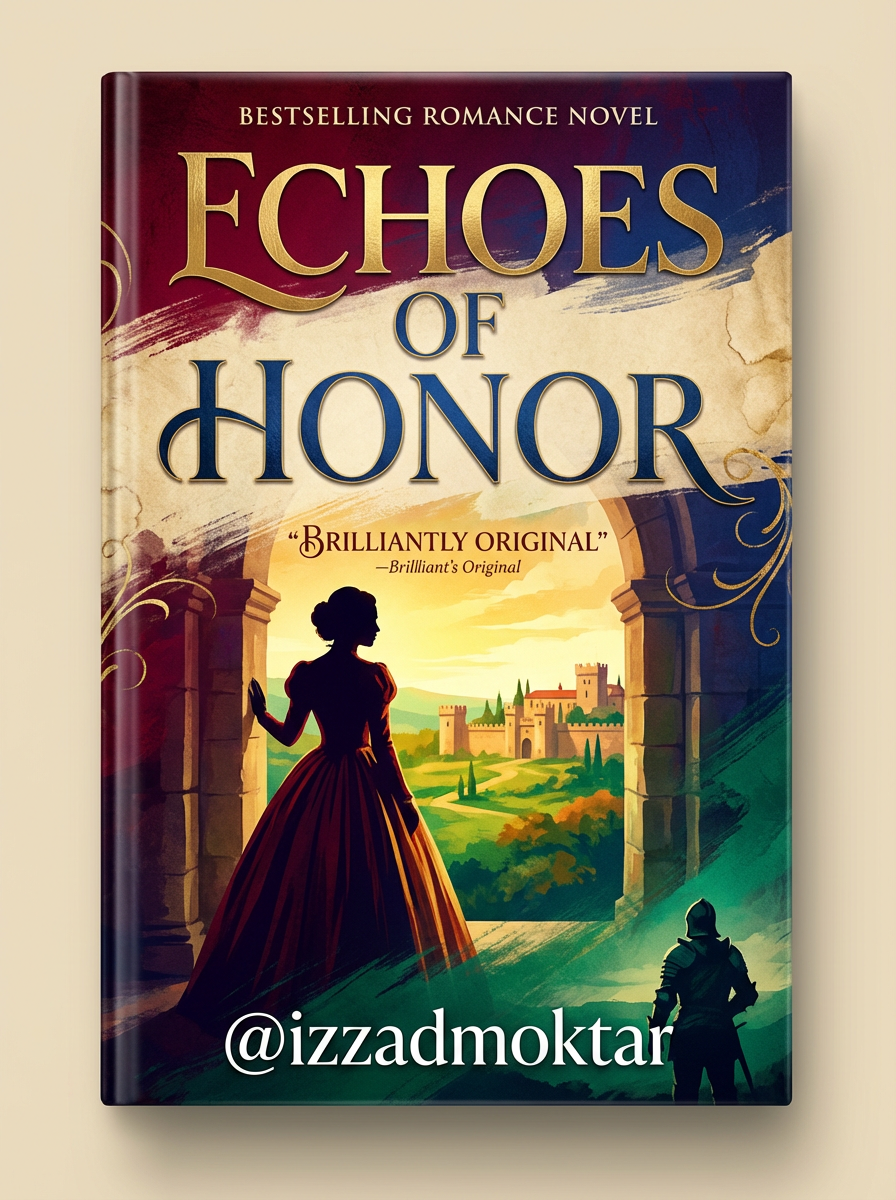
Synopsis
In a society where marriage is merely a transaction of land and legacy, Rosalind Vance, the intellectually formidable daughter of a declining noble family, has coldly resigned herself to a loveless union with a wealthy, older duke to save her ancestral estate. However, the rigid social season is thr
Chapter 1: The Weight of Vance Manor
The chill November wind, raw and persistent, whistled through the ill-fitting panes of Vance Manor, a melancholy accompaniment to the creaking timbers and the rustle of fading tapestries. Rosalind Vance, seated in the morning room amidst the ancestral clutter, did not shiver. Her slender fingers, though accustomed to the fine embroidery that adorned her practical, yet elegant, gown, moved with a determined precision as she itemized the household accounts. The columns of figures, stark and unforgiving, were a far greater chill than any bluster of wind.
Vance Manor, once a proud testament to generations of unbroken lineage and prosperity, now sagged beneath the weight of its own history. The grandeur, though undeniable in its faded glory, was a constant, eloquent reminder of what they had lost, and what she, Rosalind, was bound to regain. The peeling paint of the ceiling, the threadbare Turkish rugs, the faint, pervasive scent of damp and age – these were the physical manifestations of their dwindling fortune, and the silent, pressing arguments for her impending sacrifice.
Mrs. Penelope Vance, Rosalind’s mother, entered the room with a sigh that seemed to echo the very lamentations of the manor itself. Her once-beautiful face, perpetually anxious, was framed by a cascade of light brown hair that, even in its dishevelled state, hinted at past glories. “Rosalind, my dear,” she began, her voice a plaintive melody, “must you always be immersed in such dreary ledgers? Is there no respite from the drudgery of our… our circumstances?” She gestured vaguely towards the window, as if the bleak landscape outside were somehow culpable.
Rosalind merely glanced up, her intelligent, observant eyes holding a flicker of something akin to weariness, quickly suppressed. “Someone must, Mama. The quarterly arrears for the garden staff alone would purchase a modest country cottage, and the stable renovation, though desperately needed, remains a distant dream.” She neatly closed the ledger, the faint thud resonating in the quiet room. “A dream that recedes further with each passing week.”
“Ah, but my dear girl,” Mrs. Vance continued, settling onto a chaise lounge with a theatrical slump, “surely this engagement to the Duke will alleviate all such… unpleasantness? Ashworth wealth is legendary, is it not?” Her voice rose with a hopefulness that Rosalind knew to be entirely devoid of practical understanding.
“Indeed, Mama,” Rosalind replied, her tone even, betraying no hint of the turmoil within her. “The Duke of Ashworth’s fortune is substantial. Sufficient to restore Vance Manor to its former standing, and to secure Eleanor’s future, as well as ensure your comfort.” This last she added with a pointed, though subtle, emphasis.
The mention of Eleanor typically brought a swift distraction to their mother. “Poor, sweet Eleanor,” Mrs. Vance sighed, her expression softening. “So delicate, so sensitive. She dreams of a love match, you know. Such a romantic little thing. It would quite break her heart to consider such a… a practical arrangement.”
Rosalind’s lips thinned almost imperceptibly. Eleanor, sweet, naive, and utterly oblivious to the true precipice upon which their family teetered, was currently humming a cheerful tune in the adjacent drawing room, diligently tending to a wilting plant with far more concern than she afforded their financial woes. Rosalind loved her sister dearly, a fierce, protective love that transcended the chasm of their differing temperaments. It was this love, as much as her duty to the Vance name, that had sealed her resolve.
The Duke of Arthur Ashworth was, in Rosalind’s pragmatic assessment, a man crafted entirely of lineage and lucre. Elderly, portly, with a florid face that bespoke a life of undisturbed indulgence, he carried himself with an air of self-importance that grated on Rosalind’s intellectually astute sensibilities. His conversation, when it deigned to include her, was invariably a pronouncement upon his own vast landholdings or the shortcomings of those beneath his station. He valued pedigree above all else, a quality he found in abundance in the Vance name, even if the coffers had long since emptied. He saw in Rosalind a suitable, undeniably beautiful, and impeccably bred Duchess, a magnificent ornament for his vast, though somewhat sterile, existence. There was no affection, no warmth, no meeting of minds. There was only the transaction, cold and clear.
It was this very clarity, this grim inevitability, that had allowed Rosalind to accept her fate with a quiet stoicism. A love match, as Eleanor so ardently desired, was a luxury the Vance family could ill afford. Duty, not capricious sentiment, was the bedrock of their world.
Later that afternoon, as Rosalind took her customary solitary walk through the neglected grounds, the skeletal trees mirroring the gaunt state of their finances, she allowed herself a rare moment of introspection. The engagement had been official for a fortnight now, the Duke's proposals delivered with an unhurried, almost regal condescension that suggested he merely expected acceptance. And she had accepted.
Her mind, usually a labyrinth of calculations and careful planning, drifted to the unbidden thought of what *might* have been. Not love, precisely – that mythical beast she understood to be the stuff of novels and Eleanor’s girlish dreams – but perhaps… companionship. A shared intelligence, a respect for wit, a flicker of genuine interest in the world beyond the drawing rooms and ballrooms. But such thoughts were dangerous, unproductive, and ultimately, selfish.
She paused by the crumbling stone wall of the old garden, where rose bushes, once meticulously trained, now tangled in a wild, unkempt embrace. The thorns, though softened by the approaching winter, still pricked when she reached out. She understood those thorns. She understood their necessity.
The following day brought a diversion, albeit a superficial one, in the form of a visit to the Sterling estate. Lord and Lady Sterling, though struggling with their own burgeoning debts, were renowned for their hospitality. Lady Marianne Sterling, a woman whose primary intellectual pursuit lay in the cataloguing and dissemination of local gossip, had extended an invitation for an afternoon tea, undoubtedly eager for any tidbit concerning the impending Vance-Ashworth union.
As Rosalind carefully selected a modest gown, mindful of appearances but equally mindful of the need for frugality, Eleanor flitted about her room, her fair hair catching the weak winter light. “Oh, Rosalind,” she exclaimed, holding up a delicate lace shawl, “do you think Mr. Thompson will be there?”
Rosalind offered a faint smile. “It is quite possible, Eleanor. Lord Sterling often extends his invitations widely. Mr. Thompson is, after all, a frequent visitor.” Mr. Edward Thompson was a young man of respectable, though not aristocratic, lineage. He was kind, unassuming, and quite evidently smitten with Eleanor. Rosalind approved of him; he had a steady head and a promising, if not spectacularly lucrative, career in law. He was, in short, a sensible option, and Rosalind harbored a quiet hope that Eleanor’s romantic heart might find contentment in such a good man.
Upon their arrival at Sterling Court, the air thrummed with the usual genteel chatter. Lady Marianne, a woman whose eagerness to please was often betrayed by her restless, darting eyes, greeted them effusively. “My dear Miss Vance, and Miss Eleanor! So delightful to see you. The Duke of Ashworth sends his regrets, I trust?”
Rosalind inclined her head. “His Grace is attending to matters of estate in the north, Lady Marianne. He sends his sincerest regards.” A convenient truth, as the Duke found social gatherings beneath his dignity unless they directly advanced his own interests.
The drawing room was a kaleidoscope of bonnets and silks, hushed conversations punctuated by polite laughter. Rosalind found herself drawn into a familiar circle of acquaintances, each offering veiled congratulations on her engagement. “Such a splendid match, Miss Vance,” chirped one elderly matron, her eyes glinting with curiosity. “The Ashworth fortune is, of course, beyond compare.”
Another, a younger lady, ventured, “And the Duke, such a… established gentleman. So much wisdom, no doubt.” The emphasis on ‘established’ spoke volumes. Rosalind acknowledged these remarks with a practiced grace, her expression serene, her replies concise and entirely unrevealing.
Eleanor, meanwhile, blossomed under the attention of Mr. Thompson, her giggles echoing lightly from across the room. Rosalind watched them, a small, involuntary smile touching her lips. For Eleanor, perhaps, the world might still hold such simple joys.
It was during a lull in the conversation, as Lady Marianne bustled about arranging more tea, that a new voice cut through the polite drone. It was a voice of unexpected depth, resonant and imbued with an authority that commanded attention without demanding it.
“Lady Sterling,” the voice stated, devoid of effusiveness, “I must apologize for my tardiness. Matters regarding Lord Sterling’s… financial obligations delayed my journey.”
Rosalind, along with every other lady in the room, turned towards the entrance. A man stood framed in the doorway, a presence quite unlike any she had encountered in their quiet corner of society. He was tall, broad-shouldered, and carried himself with a quiet confidence that bordered on formidable. His face, though weathered, was strikingly handsome, with features that conveyed strength and intelligence. But it was his eyes that held Rosalind’s gaze – piercing and dark, they seemed to observe, to assess, to understand far more than any casual glance suggested. He was impeccably dressed, yet there was an unfamiliar directness in his bearing, a lack of the affected nonchalance so common among gentlemen of leisure.
Lady Marianne, momentarily flustered, recovered with a nervous flutter of her fan. “Captain Thorne! You are most welcome, though we had not expected you at tea. And your… your business with Lord Sterling, I trust it is proceeding amicably?” Her voice, usually so confident, held a tremor of anxiety.
Captain Thorne. The name was vaguely familiar. Rosalind recalled snippets of drawing-room whispers, hints of a self-made man from humble origins, a man who had amassed considerable wealth through mercantile endeavors and investments. A man who, it was rumored, now held a significant portion of Lord Sterling’s debts.
He offered a curt, yet not impolite, bow. “Amicably, Lady Sterling, as amicably as such matters can ever be. Lord Sterling and I have concluded our discussions for the day.” His gaze swept across the room, lingering for a fraction of a second on Rosalind before moving on. There was something in that brief glance – an unreadable quality, a flicker of interest that Rosalind, despite her guarded nature, registered with a faint, unfamiliar prickle of awareness.
“Then please, Captain,” Lady Marianne urged, clearly eager to diffuse the uncomfortable atmosphere his presence, and the unspoken weight of debt, had created, “do join us for tea. You must be weary from your travels.”
Captain Thorne accepted with a polite nod, his movements economical and purposeful. He did not seek out the most prominent seat, nor did he attempt to ingratiate himself with the most influential members of the company. Instead, he found a relatively private corner near a large window, accepting a cup of tea from a nervous footman.
Rosalind, usually impervious to the fleeting novelty of new acquaintances, found her attention inexplicably drawn to this Captain Thorne. He was an anomaly in their meticulously ordered world. His confidence was not born of inherited privilege, but of self-possession. His intellect, she suspected, was keen and unvarnished by the soft edges of polite society. He was, in essence, a challenge to every societal rule she had sworn to obey, a living embodiment of the upheaval that threatened the very foundations of families like hers.
She observed him discreetly. He conversed with a quiet civility when addressed, yet offered no unnecessary pleasantries. He listened intently, his dark eyes missing nothing. When Lady Sterling, ever the gossip-monger, began a thinly veiled discussion of the upcoming social season and the latest marital prospects, Captain Thorne’s expression remained impassive, betraying neither interest nor disdain.
It was then that Lady Marianne, emboldened perhaps by a lack of overt disapproval, turned her attention to Rosalind once more. “And Miss Vance, dear, we are all so eager to hear of your wedding preparations. The Duke, I am certain, will spare no expense for such a distinguished bride. Will it be a spring wedding?”
Rosalind prepared her usual polite, non-committal response, when Captain Thorne’s clear voice cut across the room. “Indeed, Lady Sterling, Miss Vance is to be commended for her admirable pragmatism. A union with the Duke of Ashworth is, by all accounts, a wise arrangement to secure the prosperity of her ancestral home. A transaction, one might say, of admirable foresight.”
The words, though seemingly innocuous, carried a subtle edge. A ‘transaction’. The very word Rosalind used in the cold, private corners of her mind, yet one rarely spoken aloud in polite society, particularly concerning a lady’s marriage. A collective intake of breath could be felt amongst the ladies, a ripple of discomfort spreading through the room.
Rosalind felt a jolt. Her intelligent, observant eyes locked with his across the room. There was no mockery in his gaze, but something far more disconcerting: a recognition. He saw past the polite veneer, beyond the expected pronouncements, to the very heart of her sacrifice. It was an unnerving, almost invasive, understanding.
She met his gaze steadily, though her internal composure wavered for a fleeting moment. “Captain Thorne,” she replied, her voice calm and level, despite the unexpected intrusion, “one might indeed use the term ‘transaction.’ For families such as mine, the preservation of lineage and legacy is not merely a matter of sentiment, but of an enduring responsibility.”
His lips, firm and unsmiling, twitched almost imperceptibly. “A responsibility I understand well, Miss Vance. Though I have found that responsibility manifests itself in many forms. And not always, might I add, through the exchange of inherited titles for acquired wealth.”
There was a quiet challenge in his tone, a subtle defiance of the very hierarchy that dictated her life. He spoke not as a man who understood the constraints, but as one who had circumvented them entirely. Rosalind felt a flicker of something she rarely experienced: curiosity, sharp and unexpected. She wanted to know more about this man who dared to speak so plainly, who saw things with such unblinking clarity, and who, in his own person, represented a world entirely separate from her own rigid, confining sphere.
Lady Marianne, aghast at the turn of the conversation, quickly interjected with a flurry of trivialities, effectively cutting short the exchange. But the moment had passed, leaving in its wake a subtle tremor. Rosalind, though she quickly rejoined the flow of polite conversation, found her mind returning to Captain Thorne’s words, to the piercing gaze that had peeled back the layers of her carefully constructed composure. His arrival, a self-made man of lower birth, acquiring the Sterling family’s debts, was already a disturbance. His directness, his unsettling perception, was something far more.
As the carriage rumbled its way back to Vance Manor, Eleanor chattered happily about Mr. Thompson’s attentiveness. Mrs. Vance, oblivious to the undercurrents, spoke of Lady Sterling’s new bonnet. Rosalind, however, remained silent. The weight of Vance Manor, a physical and emotional burden, still lay heavy upon her shoulders. But now, amidst that familiar weight, there was a new, unexpected stir. A faint echo, emanating from a man who had dared to speak of transactions, and who, with a single look, had seemed to see the unspoken truth of her heart. The rigid social season, she sensed, was perhaps not as unalterable as she had always believed. And her world, carefully ordered and entirely predictable, might yet hold unforeseen complexities.
Chapter 2: A Gale from the Sea
The Sterling Ball, an annual ritual of the landed gentry, rarely deviated from its well-trodden path of polite conversation, predictable quadrilles, and lukewarm sherry. This evening promised no exception. The grand ballroom of Sterling Hall, though opulent in its dimensions, invariably felt constrained by the weight of expectation and the rigid adherence to social convention. Rosalind Vance, dutifully attending alongside her mother and an effervescent Eleanor, found herself observing the familiar tableau with a weary detachment. The Duke of Ashworth, her designated future, was holding court by the fireplace, his florid face flushed with too much port and self-congratulation, his discourse punctuated by the sycophantic laughter of those eager to curry his favour.
“Really, Rosalind,” Mrs. Vance whispered, fanning herself with agitated vigour, “you must endeavor to engage with the Duke. Your indifference is quite apparent. He will think you ungrateful.”
Rosalind offered a tight smile, her gaze already straying. “Mother, a woman must preserve some mystery. Over-eagerness is hardly becoming.” Her eyes scanned the familiar faces, each a testament to generations of intermarriage and inherited privilege, and she felt the familiar knot of dread tighten in her stomach. Would this be her life? A gilded cage, furnished with all the trappings of wealth, but devoid of intellectual spark or genuine affection? The thought was a bitter draught.
Eleanor, however, was blissfully oblivious, her delicate hand resting lightly on the arm of young Mr. Edward Thompson, whose unassuming charm and quiet devotion seemed to warm her sister’s usually reserved demeanour. Rosalind felt a pang of envy, swiftly suppressed. Eleanor was permitted the luxury of youthful infatuation; her own path had been irrevocably set by the precarious state of Vance Manor.
The orchestra struck up a new set, a lively country dance, but before the first couples could take their places, a hush descended upon the room. It began subtly, a ripple of whispers emanating from the entrance hall, quickly escalating into a collective gasp. Heads craned, programmes were lowered, and even the Duke of Ashworth paused mid-sentence, his brow furrowed in annoyance at the interruption.
Then he appeared.
He was a man not merely taller than the average, but possessed of an undeniable presence that seemed to fill the very air of the ballroom. His shoulders were broad, his frame powerful, and his manner of entering, without apology or fanfare, bespoke a confidence that bordered on audacity. He was not dressed in the muted velvets and brocades favoured by the gentry, but in a tailored coat of dark, unassuming wool, cut with an almost military precision, and breeches of a similar plainness. Yet, there was nothing plain about him. His face, though tanned by sun and wind, was strikingly handsome, strong-boned with a firm jaw and a pair of piercing dark eyes that seemed to miss nothing. He moved with a purposeful stride, his gaze sweeping over the assembled company with an almost insolent ease, as if he were assessing a cargo manifest rather than surveying the crème de la crème of local society.
Lady Sterling, a woman whose every breath seemed choreographed for social effect, rushed forward, her customary composure momentarily abandoned. “Captain Thorne! You… you were not expected quite so soon!” Her voice, usually a delicate trill, cracked with a mixture of apprehension and forced welcome.
A low murmur rippled through the room. “Captain Thorne?” A few shared bewildered glances. The name was unfamiliar, a jarring note in the carefully orchestrated symphony of the ball.
The man, Captain Thorne, offered Lady Sterling a curt, almost unsmiling nod. “My apologies, Lady Sterling. I find myself disinclined to adhere strictly to the whims of the clock. Business, you understand, often necessitates a promptness that social niceties might deem imprudent.” His voice was deep, resonant, and utterly devoid of the elaborate courtesies expected in such company. It was the voice of a man accustomed to issuing commands, not receiving invitations.
Mrs. Vance, ever attuned to the shifting tides of social status, gasped softly. “Captain Thorne? But… who is he, Rosalind? He has certainly never attended before. And that name… not a title, is it?”
Rosalind, utterly captivated by the newcomer, shook her head slowly. “No, Mother. It sounds… naval. Or mercantile.” Her mind, ever analytical, was already working, piecing together the fragmented information. Such a man, so self-possessed and yet so clearly *not* of their world, was an anomaly.
He turned his piercing gaze towards a small cluster of gentlemen, including Lord Sterling, who suddenly looked considerably more flustered than usual. “Lord Sterling,” Captain Thorne stated, his voice carrying clearly across the still-hushed room, “I believe we have matters to discuss. The particulars of your excellent Madeira, for example, which I find myself in receipt of, amongst other… assets.”
Lord Sterling’s face, usually amiable, turned a shade of sickly green. A fresh wave of whispers erupted, this time more pointed, more incredulous. Rosalind’s sharp ears caught fragments: “Sterling’s debts… purchased… unthinkable… a mere commoner…”
The implications hit Rosalind with the force of a physical blow. Sterling’s debts. Extensive, well-known, and now… owned by this man? This self-made Captain Thorne? It was an unprecedented act, a direct challenge to the polite fictions upon which their society was built. Debts were to be subtly acknowledged, discreetly managed, perhaps occasionally paid off by opportune marriages, but never so starkly, so overtly, brought into the open by an outsider.
The Captain’s gaze, as if drawn by her focused attention, suddenly met Rosalind’s across the crowded room. She felt an unexpected jolt, a sudden awareness of her own posture, the steady beat of her heart. His eyes, dark and intelligent, held her for a long moment, a moment in which the clamour of the ball faded to a dull roar. There was no flirtation in his gaze, no overt admiration, merely an intense, almost clinical assessment, as if he were cataloguing her features, her bearing, her very essence. It was unsettling, yet strangely exhilarating. She felt a frisson of something she couldn't quite name – curiosity, challenge, perhaps even a hint of recognition. For a brief, dizzying second, she felt truly *seen*, not as the dutiful daughter of Vance Manor, but as an individual.
Then, as abruptly as it had begun, he broke the connection, turning his attention back to Lord Sterling, leaving Rosalind to reclaim her composure, her cheeks warmer than she would have liked.
“Good heavens!” Mrs. Vance exclaimed, thoroughly scandalized. “He has purchased Lord Sterling’s debts? The man must be a complete barbarian! What sort of gentleman airs out such… unpleasantness in a ballroom?”
Eleanor, wide-eyed and clutching Mr. Thompson’s arm, whispered, “But Edward, he is so… imposing! And quite handsome, in a rugged way.” Mr. Thompson merely cleared his throat, clearly uncomfortable with the direction of the conversation.
The Duke of Ashworth, having recovered from his initial surprise, now fixed the Captain with a disdainful glare. “Indeed, Lady Sterling, it appears your esteemed guest has mistaken this occasion for a mercantile exchange. One hardly conducts such affairs amidst polite society.” His voice dripped with condescension, dismissive and sharp.
Captain Thorne, as if sensing the challenge without even actively listening, turned his head slowly towards the Duke. His expression remained unreadable, but a subtle tightening around his mouth suggested a steeliness that belied his calm exterior. “Your Grace,” he acknowledged, with a sardonic twist of his lips that was anything but deferential, “I find that matters of import rarely respect the arbitrary divisions of your ‘polite society.’ Debts, like tides, flow irrespective of the season.”
The Duke’s face purpled. An audible gasp went through the room. To speak to a Duke with such bluntness, such disregard for his elevated status, was virtually unheard of. This man was truly an anomaly, a gale from the sea that threatened to overturn the carefully arranged furniture of their world.
Rosalind, standing beside her mother, felt a surge of something akin to admiration, quickly followed by a chill of apprehension. This man was dangerous. Not physically, perhaps, but dangerous to the carefully constructed order she was obligated to uphold. He represented everything the Duke despised, everything her marriage was intended to shore up: unbridled ambition, a fortune made outside the hallowed halls of inherited wealth, and an utter disdain for the subtle codes of their aristocracy.
Lady Sterling, now verging on hysterics, attempted to mediate. “Captain Thorne, perhaps a private word with Lord Sterling later? We have… entertainment planned!”
“Indeed, Lady Sterling,” he replied, his gaze still holding the Duke’s with unflinching intensity. “And I find myself rather entertained. There is a certain… honesty, in witnessing the uncomfortable truths beneath the veneer of gaiety, would you not agree, Your Grace?”
The Duke merely sputtered, incapable of forming a coherent retort in the face of such effrontery. He was an immovable rock, but Captain Thorne was the irresistible force, and the collision was both shocking and riveting.
Rosalind observed the exchange with an almost scientific interest. While her mother bemoaned the Captain’s lack of breeding, Rosalind saw only a man possessing an unusual degree of clarity and self-possession. He did not seek to emulate them; he simply *was*. His confidence was not born of inherited privilege, but of battles fought and victories earned.
The orchestra, intimidated by the palpable tension, tentatively began to play again, a slow waltz, as if hoping to soothe the ruffled feathers of the gentry. But the harmony of the evening had been irrevocably shattered.
Captain Thorne, having delivered his subtle, yet devastating, broadside, seemed to relax marginally. He surveyed the room once more, his eyes lingering for a fraction of a second on Rosalind before moving on. He then approached a small group of gentlemen, not those of the highest rank, but men who looked rather more astute, their expressions a mix of unease and veiled curiosity. He spoke to them in a low, even tone, and though Rosalind could not discern the words, she saw the men listen intently, even nod occasionally. He was, she realised, not merely challenging their world, but perhaps already cultivating new alliances within it.
“He is a most uncouth individual,” Mrs. Vance declared, still fanning herself vigorously. “To think such a person might gain entry to Sterling Hall! Whatever was Lady Sterling thinking?”
“Perhaps, Mother,” Rosalind interjected, her voice calmer than she felt, “Lady Sterling had little choice. A significant creditor, particularly one so… direct, is not easily ignored.” She considered Captain Thorne again, now engaged in what appeared to be spirited, if still quiet, conversation. There was a strength in his profile, a determination that echoed her own, albeit in a vastly different sphere. His wealth, earned through sheer force of will and intellect, stood as a stark contrast to the decaying fortunes of Vance Manor, inherited through a long line of increasingly imprudent ancestors.
The Duke of Ashworth, recovering his composure, made a point of approaching Rosalind and her family, as if to reassert his claim and their allegiance. “Rosalind, my dear,” he rumbled, his smile a thin veneer over his lingering annoyance, “I trust this… vulgar display has not unduly disturbed your evening?” He cast a pointed glance towards Captain Thorne across the room.
“Not at all, Your Grace,” Rosalind replied, her tone perfectly even, though her eyes betrayed a faint spark of something unbidden. “Indeed, it has proven quite… illuminating.”
The Duke missed the subtle irony in her voice, but a fleeting image of Captain Thorne’s intelligent gaze flickered in her mind. Illuminating, indeed. He had, in one audacious stroke, brought a bracing gust of reality into an atmosphere thick with artifice.
As the evening wore on, Captain Thorne remained a focal point of hushed conversations and surreptitious glances. He did not dance, he did not flirt, and he did not engage in the superficial pleasantries expected of a guest. He simply observed, spoke when necessary, and demonstrated a quiet authority that unnerved some and intrigued others.
Rosalind, though she tried to focus on the Duke’s tedious discourse on the merits of selective breeding in horses, found her gaze repeatedly drawn to him. He was a disrupter, an element of chaos in her carefully constructed world of duty and sacrifice. She thought of her ancestral home, Vance Manor, its crumbling facade a testament to a bygone era. She thought of the cold, hard reality of impending ruin, and the warmth, the superficial comfort, that the Duke of Ashworth represented.
And then she thought of Captain Thorne, a self-made man, a commoner who had dared to purchase the debts of a lord, dared to look a Duke in the eye with scorn, dared to stride into their gilded cage and scatter its carefully placed feathers. He was a challenge, a question mark in the sentence of her predetermined life.
Later, as Mrs. Vance made a laborious farewell to Lady Sterling, Rosalind found herself momentarily alone, Eleanor having wandered off with Mr. Thompson. Her gaze, as if by an invisible thread, found Captain Thorne once more. He was standing near a window, looking out into the moonlit gardens, his silhouette powerful against the pane. For a brief instant, his head turned, and his eyes, those startlingly dark and discerning eyes, locked with hers across the ballroom. This time, there was no clinical assessment, no public pronouncement. There was only a shared, unspoken understanding, a flicker of recognition between two analytical minds, two individuals who, in their separate spheres, had grappled with the harsh realities of their existence. It was a fleeting, almost imperceptible connection, yet it left Rosalind with a distinctly disquieting sensation.
As they finally departed Sterling Hall, the cool night air was a welcome relief. Mrs. Vance lamented the impropriety of the evening, Eleanor chattered happily about Mr. Thompson’s kindness, and the Duke, having endured much, was already well on his way to his estate. But Rosalind, seated quietly in the carriage, felt something shift within her. The weight of her duty, which had always felt as solid and unyielding as the ancient stones of Vance Manor, now seemed almost… fragile. A fissure had appeared, a tiny crack in the edifice of her resolve, and through it, a gale from the sea, raw and invigorating, had blown into her carefully barricaded heart. Captain Julian Thorne had arrived, and with him, the unsettling possibility that the walls she had built around herself might not be as impenetrable as she had believed. The tranquil waters of her predetermined future had been churned into unfamiliar, turbulent currents. And Rosalind, for the first time in a very long while, felt not resignation, but a strange, unsettling anticipation.
Chapter 3: Unsettling Encounters
The late afternoon sun, usually a benevolent presence, seemed to cast a particularly unforgiving light upon Lady Vance’s garden party. The meticulously manicured lawns of Vance Manor, though still verdant, bore a subtle hint of wear, a metaphor Rosalind found increasingly apt for her family’s fortunes. The air, heavy with the scent of roses and the cloying sweetness of societal expectation, hummed with the polite chatter of the county’s elite. Rosalind, clad in a gown of pale lavender that seemed to mock the burgeoning anxieties within her, moved among the guests with a practiced grace, offering smiles that felt increasingly brittle. Eleanor, by contrast, flitted about like a butterfly, utterly absorbed in the frivolous flirtations of the younger set, blissfully unaware of the financial precipice upon which they all teetered.
The arrival of Captain Thorne, as ever, was not announced but simply manifested. One moment, the conversation flowed with predictable currents; the next, a ripple of hushed whispers and darting glances indicated his presence. He stood near the fountain, a figure of stark contrast amidst the pastel finery, his dark coat and trousers a testament to a world far removed from the drawing-rooms and ballrooms of the aristocracy. His gaze, keen and unwavering, swept across the gathering, missing nothing, judging everything. Rosalind felt the familiar prickle of irritation and, to her dismay, a flicker of something akin to anticipation.
Lady Vance, ever the vigilant hostess, had, despite her earlier pronouncements of Captain Thorne’s unsuitability, deemed it prudent to extend him an invitation. After all, he held the Sterling family’s debts, a significant portion of the county’s financial landscape, and to snub him entirely would be an act of social and economic folly. She now held court near the refreshment tables, her voice, usually a delicate instrument, carrying with surprising clarity as she expounded upon the virtues of societal order.
“Indeed,” Lady Vance declared, her fan fluttering with genteel emphasis, “a lady’s greatest asset lies in her discretion, her adherence to the established norms. It is through such steadfastness that the very fabric of our society is preserved, ensuring the proper lineage, the appropriate alliances.” She paused, allowing her words to settle like a benediction upon her attentive audience, a group of matrons whose expressions ranged from earnest agreement to thinly veiled boredom. “For, without these pillars of tradition, chaos would surely ensue. One cannot simply disregard the wisdom of generations for the fleeting whims of personal inclination.”
A murmur of agreement rippled through the circle. Rosalind, who had been conversing with a rather dull young baronet about the merits of different breeds of hunting dogs, felt a familiar weariness descend. Her mother’s pronouncements, while undeniably true in their social context, grated upon her intellect. The “fleeting whims of personal inclination” were, for Rosalind, often the very bedrock of genuine thought, a concept far more appealing than the rigid dictates of inherited position.
It was then that Captain Thorne, who had been ostensibly admiring a particularly robust rose bush, spoke. His voice, deeper than the light conversational hum, cut through the air with an almost startling clarity. “And yet, Lady Vance,” he interjected, his tone devoid of deference, “it is often in the disregard of established norms that progress, true progress, is forged. To cling solely to tradition for tradition’s sake is to risk stagnation, to deny the very spirit of ingenuity that has, in many instances, allowed for the flourishing of certain… lineages.”
A sudden hush fell over the gathering. Lady Vance’s fan froze mid-flutter. A gasp, quickly stifled, escaped from a young woman near the lemonade stand. To challenge Lady Vance directly, and in her own garden, was an act of astonishing impudence, one rarely witnessed in such polite company. Rosalind felt a jolt, a mixture of mortification and a peculiar, illicit thrill.
Lady Vance, though visibly flustered, quickly recovered her composure, her spine stiffening imperceptibly. “Captain Thorne,” she said, her voice now edged with a coolness that could curdle cream, “I fear you misunderstand the delicate balance of our society. It is not merely about ‘progress,’ as you so bluntly put it. It is about stability, about ensuring the continuity of all that is good and proper.”
Captain Thorne merely inclined his head, a gesture that managed to convey both respect and an unwavering defiance. “Stability, indeed, Lady Vance. But at what cost? At the cost of individual agency? Of genuine merit? Is a society truly stable when its foundations are built upon the suppression of innovation and the enforced adherence to custom, regardless of its inherent wisdom?”
Rosalind, despite herself, found her attention wholly captivated. Her mother, usually so unassailable in her pronouncements, seemed to struggle for a retort. The Captain’s words, though blunt, held a certain undeniable logic, a directness that resonated with the often unspoken doubts Rosalind harbored about the very system she was bound to uphold.
“Innovation,” Lady Vance finally managed, her voice a little strained, “is hardly a virtue to be sought above all else, Captain. Especially not when it threatens the very order that protects us all.” She cast a glance at Rosalind, a silent command for support.
Rosalind knew her duty. She should step forward, offer a polite but firm rebuttal, defend her mother’s position, and restore the social equilibrium. Yet, her feet felt rooted to the spot. Her mind, usually so quick to formulate a suitable response, was racing, not to defend, but to analyze.
Captain Thorne, sensing the slight hesitation in Lady Vance’s voice, pressed his advantage, his gaze now sweeping over the assembled guests, as if inviting them to consider his words. “Order, Lady Vance, can also be a gilded cage. And sometimes, the chains of tradition, however beautifully wrought, can chafe. Perhaps a society that truly thrives is one that is not afraid to examine its own foundations, to question the very ‘wisdom of generations’ you speak of, and to adapt, to evolve.”
He then, to Rosalind’s astonishment, turned his piercing gaze directly upon her. “Miss Vance,” he said, his voice lowering slightly, yet still carrying, “as a lady of considerable intellect, I am certain you have pondered such matters. Does one truly find honor in unwavering adherence, even when that adherence demands a sacrifice of one’s own convictions?”
The question hung in the air, a challenge thrown not just to Rosalind, but to the very essence of her existence. The surrounding chatter had died completely. All eyes were on her, awaiting her response. Her mother’s gaze was a silent plea, a desperate entreaty to uphold the family’s honor, to quell this audacious upstart.
Rosalind felt a flush rise to her cheeks, a mixture of indignation at being so openly called upon and a strange, almost exhilarating, sense of intellectual engagement. She stepped forward, her lavender gown swaying gently.
“Captain Thorne,” she began, her voice, though carefully modulated, held a distinct edge, “you speak of conviction as if it were a luxury afforded to all. For many, particularly for women in our society, conviction must often be tempered by pragmatism, by the very necessity of maintaining that ‘order’ my mother so rightly values.” She met his gaze, her own unwavering. “To disregard tradition entirely, to chase after every novel idea, would be to invite anarchy. There is a delicate balance, is there not, between progress and preservation?”
A faint, almost imperceptible smile touched Captain Thorne’s lips. It was not a smile of amusement, but rather one of appreciation. “Indeed, Miss Vance. A delicate balance. But where, precisely, does that balance lie? And who, pray tell, is to determine its precise location? Is it the purview of those who benefit most from the established order, or should it not be a constant re-evaluation, a dialogue between those who seek to preserve and those who seek to improve?”
His phrasing, though polite, was pointed. Rosalind felt a surge of irritation. He was attempting to draw her into a philosophical debate in the middle of her mother’s carefully orchestrated garden party, in front of the entire county. It was audacious, impertinent, and utterly captivating.
“The determination, Captain,” Rosalind retorted, a spark igniting in her eyes, “is often made by the collective wisdom of those who have the most to lose should that balance be disturbed. Those who bear the burden of maintaining the social fabric understand its intricacies far better than those who merely observe from the periphery.” The implication, that he was an outsider, was clear.
Captain Thorne’s gaze sharpened, but the faint smile remained. “And what if, Miss Vance, those who bear the burden are also those whose vision is obscured by the very weight of that burden? What if the ‘intricacies’ they perceive are merely the well-worn grooves of habit, mistaken for immutable truths?” He took a step closer, his voice dropping to a more intimate tone, though still audible to those nearest. “Does the fish truly understand the ocean when it has never known the shore?”
Rosalind’s breath hitched. His analogy, though simple, was devastatingly effective. It struck at the heart of her own unspoken anxieties, her private moments of doubt regarding the very path she was compelled to follow. She found herself, for a fleeting moment, speechless.
Lady Vance, seeing her daughter’s momentary lapse, seized the opportunity. “Captain Thorne,” she interjected, her voice regaining some of its former authority, “I believe this discussion has strayed rather far from the pleasantries of a garden party. Perhaps we might discuss the merits of the new hybrid roses?” She gestured vaguely towards a particularly vibrant bush, attempting to steer the conversation back to safer, more superficial waters.
But Captain Thorne did not take the bait. His gaze remained fixed on Rosalind, a silent challenge in its depths. “I find, Lady Vance,” he said, without looking away from Rosalind, “that the most illuminating discussions often arise from unexpected deviations. And Miss Vance, I daresay, is more than capable of navigating such intellectual currents.”
Rosalind felt a perverse thrill at his words, even as she bristled at his presumption. He was treating her as an equal, a sparring partner, rather than a mere adornment to be admired or dismissed. It was a sensation both discomfiting and undeniably stimulating.
“Perhaps, Captain,” Rosalind said, her voice regaining its composure, “but there are times when intellectual currents must yield to social imperatives. Not all truths, however compelling, are suitable for public dissection.” She cast a subtle glance at her mother, a silent apology for having engaged him so deeply.
Captain Thorne’s smile finally faded, replaced by a more serious expression. “A pity, Miss Vance. For it is in the very act of dissection, of open inquiry, that genuine understanding is found. To suppress such discourse, even for the sake of decorum, is to deny oneself the opportunity for growth.” He paused, his gaze lingering on her. “And I, for one, would never wish to deny a mind such as yours the opportunity to truly flourish.”
With that, he offered a slight bow, a gesture that was both respectful and, in its context, subtly mocking, and then, to the astonishment of all, he turned and walked away, melting back into the periphery of the garden party.
A collective exhale rippled through the guests. Lady Vance, her face a mask of barely contained indignation, immediately turned to Rosalind. “Rosalind, my dear! What on earth possessed you to engage him so? Such a display! It was most… unseemly!”
Rosalind felt a weariness settle deep within her bones. The intellectual jolt, the brief, exhilarating clash of minds, was now replaced by the familiar weight of social consequence. “Mother,” she said, her voice quiet, “he addressed me directly. To have remained silent would have been equally impolite, and perhaps even more remarked upon.”
Lady Vance huffed, patting her brow with a lace handkerchief. “He is an insufferable man. A boor. To speak so to one’s hostess, and in such a manner!”
Rosalind, however, found her thoughts lingering not on her mother’s indignation, but on Captain Thorne’s words. “Does the fish truly understand the ocean when it has never known the shore?” The question echoed in her mind, a subtle poison, undermining the carefully constructed edifice of her beliefs. He had, in his audacious manner, managed to tap into a vein of disquiet she had long suppressed.
Later, as the sun dipped below the horizon, painting the sky in hues of orange and purple, Rosalind stood by her window, looking out over the fading grandeur of Vance Manor. The garden party was a distant echo, but Captain Thorne’s words resonated with an unsettling clarity. He was everything she had been taught to despise: an upstart, a man of no consequence, a disruption to the established order. Yet, he possessed a directness, an intellectual candor, that she found herself, despite her best efforts, drawn to.
He had challenged not just her mother, but her. He had seen past the carefully constructed facade of Rosalind Vance, the dutiful daughter, the future Duchess of Ashworth, and had spoken to the intellect beneath. It was infuriating, impertinent, and utterly captivating.
The prospect of her marriage to the Duke of Ashworth, a union that promised stability and the salvation of her family’s estate, now seemed even more stark, more devoid of genuine connection. The Duke, for all his wealth and position, would never engage her in such a manner, would never challenge her to truly think, to truly question. He would offer comfort, security, and a quiet, predictable existence.
Captain Julian Thorne, however, offered something far more dangerous: a disturbance. A disruption of the carefully ordered world she inhabited. He was a gale from the sea, and Rosalind, though she knew she should batten down the hatches, found herself, against her will, leaning into the wind. The encounter had left her feeling both irritated and, to her profound disquiet, undeniably, irrevocably intrigued. The rigid social season, she realized, was far from over, and its most unsettling chapters, she suspected, were yet to be written.
Chapter 4: The Price of Legacy
The drawing-room at Vance Manor, usually a sanctuary of faded gentility, felt particularly oppressive that afternoon. Sunlight, filtered through ancient, heavy drapes, cast long, somber shadows across the worn Aubusson carpet. Rosalind, seated with impeccable posture upon a fauteuil whose velvet was more threadbare than plush, awaited the inevitable. Her hands, clasped loosely in her lap, betrayed none of the tremor that assailed her spirit.
A soft tap at the door preceded Mrs. Higgins, the housekeeper, who announced, with a slight dip of her head, "His Grace, the Duke of Ashworth, to see Miss Vance."
Rosalind rose, a movement as graceful and deliberate as the unrolling of a scroll. “Show him in, Mrs. Higgins.”
The Duke entered, a figure of imposing stature and impeccable tailoring. His silver hair, meticulously brushed, framed a face that, while not unkind, bore the indelible marks of age and a certain weary entitlement. He carried a cane, more for effect than necessity, tapping it lightly against the polished floorboards as he made his way towards her.
“Miss Vance,” he began, his voice a low rumble, “a pleasure, as always.” He took her hand, raising it to his lips with a gesture that was more a formality than an expression of affection. His touch was cool, dry, and utterly devoid of passion.
“Your Grace,” Rosalind replied, her voice steady, betraying nothing of the turmoil within. She gestured to the adjacent settee. “Pray, be seated.”
He settled himself with a sigh that seemed to emanate from the very depths of his being. “I trust I find you well?”
“As well as can be expected, Your Grace, given the season’s demands.” A polite evasion, for how could she possibly convey the constant gnawing anxiety that had become her most faithful companion?
The Duke’s gaze, shrewd and appraising, swept over her. “Indeed. The season is a demanding mistress, is it not? Especially for one of your… particular circumstances.” He paused, allowing the implication to hang in the air, a silent reminder of their unspoken agreement.
Rosalind met his gaze without flinching. She knew precisely what he meant. Her circumstances, as he so delicately put it, were a tapestry woven of depleted coffers, neglected estates, and a family name that, while still venerable, was rapidly losing its luster.
“I believe, Miss Vance,” the Duke continued, his tone shifting, becoming more direct, “that we have reached a point where further prevarication would be… unseemly. My intentions, I trust, are clear.”
“They are, Your Grace,” Rosalind confirmed, her voice barely a whisper. This was it. The moment she had braced herself for, yet dreaded with every fiber of her being.
The Duke leaned forward slightly, resting his hands upon the head of his cane. “Then I shall be equally direct. Rosalind, I wish to offer you my hand in marriage.”
The words, though anticipated, still fell upon her like a heavy cloak, suffocating and binding. She felt a phantom chill despite the warmth of the room. “Your Grace, I am honored by your proposal.” The lie tasted like ash on her tongue.
He offered a faint, almost imperceptible smile. “Your honor, I assure you, is not in question. My proposal, however, carries with it certain… expectations. As you are aware, my estate, Ashworth Park, is considerable. My fortune, substantial. And my lineage, as ancient and distinguished as your own.”
He paused, allowing these undeniable truths to resonate. Rosalind simply nodded, her expression carefully neutral.
“In return,” he continued, his voice losing its formal edge, becoming more businesslike, “I expect a wife who will uphold my name with grace and dignity. A chatelaine who will manage my household with efficiency and discretion. And, of course, a mother to my future heirs.” He observed her closely, searching for any sign of resistance, any flicker of doubt.
Rosalind’s stomach clenched. The thought of bearing his children, of sharing his bed, was a cold, desolate prospect. Yet, she had long ago extinguished such personal sentiments, convinced they were luxuries she could not afford.
“I understand, Your Grace,” she managed, her voice remarkably even. “I am prepared to fulfill all the duties and responsibilities that come with such a union.”
The Duke’s smile widened a fraction. “Excellent. I had no doubt you would be. You are, after all, a Vance, and your family has always understood the importance of duty.” He paused, then his tone grew graver. “However, there is another matter we must address. A rather delicate one, I confess, but one that cannot be ignored.”
Rosalind braced herself. She knew what was coming.
“Your family’s financial situation, Miss Vance,” he stated, his gaze unwavering, “is, to put it mildly, precarious. The whispers in society, though regrettable, are not entirely unfounded. Vance Manor, I am led to believe, is burdened by significant debts. Your mother, bless her heart, has not always exercised the most… prudent management of her affairs since your father’s passing.”
Rosalind felt a flush creep up her neck, but she kept her composure. The Duke was merely stating the unvarnished truth, a truth she lived with every day.
“Indeed, Your Grace,” she admitted, her voice low. “My mother has always been of a more… artistic temperament, less inclined to the rigors of estate management.” A polite euphemism for her mother’s extravagant tendencies and willful ignorance of their dwindling resources.
The Duke inclined his head. “Precisely. And it is this very predicament that makes my proposal so… opportune, would you not agree? My intervention, Miss Vance, would not merely secure your future, but that of your sister, Eleanor, and indeed, the very survival of Vance Manor itself.”
He paused, allowing the weight of his words to settle upon her. He was not merely offering a marriage; he was offering a lifeline, a rescue from the precipice of ruin. And he wanted her to understand the full extent of the price.
“My solicitors have, of course, reviewed your family’s ledgers,” he continued, his tone dispassionate, as if discussing a business transaction, which, in essence, it was. “The outstanding mortgages, the unpaid bills, the loans taken against the land… it is a considerable sum. My dowry to you, Rosalind, would be substantial, enough to clear these debts and restore Vance Manor to a semblance of its former glory. But it is a dowry that comes with a solemn understanding.”
His eyes, though veiled by the years, were sharp and penetrating. “I expect, in return, a wife who understands the gravity of this arrangement. A wife who will not bring scandal or disrepute upon my name. A wife who will be, in all respects, exemplary.”
Rosalind’s breath hitched. He was not merely asking for her hand; he was demanding her soul, her absolute obedience, her complete surrender to the terms of their bargain. The terms were clear: her happiness for her family’s survival.
“I understand, Your Grace,” she repeated, the words feeling hollow and distant. “I assure you, I am fully aware of the responsibilities I would undertake. And I would endeavor, with every fiber of my being, to be a wife worthy of your name and your expectations.”
A flicker of satisfaction crossed the Duke’s face. “Good. Very good. Then we are in agreement.” He rose, a slow, deliberate movement, and extended his hand. “I shall make the formal announcement in the coming weeks. You will, of course, inform your family.”
Rosalind took his hand. It was a cold, firm clasp, devoid of warmth or tenderness. “I shall, Your Grace.”
As he turned to leave, he paused at the doorway. “One more thing, Rosalind. I trust that this… Captain Thorne, will not prove to be an impediment to our arrangement.” His tone was light, almost conversational, yet it carried an unmistakable undertone of warning.
Rosalind’s heart gave a sudden, unwelcome lurch. The image of Thorne’s direct gaze, his unsettling confidence, his challenging wit, flashed through her mind. She had been so careful to keep her interactions with him purely intellectual, to dismiss the strange pull she felt towards his unconventional spirit. But the Duke, with his vast network of informants and his keen understanding of society’s undercurrents, had clearly taken note.
“Captain Thorne?” Rosalind managed, feigning a slight bewilderment. “I confess, Your Grace, I am not entirely certain what you refer to. He is merely an acquaintance, a new face in the county. I have had very little interaction with him.” The lie felt heavier than the truth.
The Duke’s lips curved into a faint, knowing smile. “Indeed. A new face, certainly. And one who has, shall we say, caused a certain degree of chatter. His acquisition of the Sterling debts, his… unusual manner. One cannot help but notice such things.” He paused, his gaze lingering on her for a moment longer than necessary. “I merely wish to ensure that such… novelties do not distract from the more significant matters at hand. Our marriage, Rosalind, is a foundation, not a diversion.”
“Of course, Your Grace,” she replied, her voice firm, though her heart hammered against her ribs. “I assure you, my focus is entirely on our future.”
He nodded, seemingly satisfied, and exited the drawing-room, leaving Rosalind alone in the oppressive silence.
As the heavy oak door clicked shut, the carefully constructed facade Rosalind had maintained began to crumble. She sank back onto the fauteuil, her hands trembling uncontrollably. The weight of her decision, which she had intellectually accepted long ago, now settled upon her with a crushing physical force.
She had done it. She had secured her family’s future. Vance Manor would be saved. Eleanor would have a life free from the anxieties that plagued Rosalind. Her mother would no longer lament their misfortunes. But the cost… the cost was her own life, her own happiness, her own spirit.
A single tear, hot and unwelcome, traced a path down her cheek. She quickly wiped it away, angry at her momentary weakness. She was a Vance. She was strong. She had made her choice, and she would abide by it.
Yet, even as she reaffirmed her resolve, a defiant echo stirred within her. An echo of Captain Thorne’s irreverent smile, his challenging words, the way his eyes seemed to see beyond the societal masks. It was an echo that, despite her best efforts, refused to be silenced, a faint whisper of what might have been, of a life unburdened by the price of legacy. And in that moment, she acknowledged, with a chilling certainty, that the Duke of Ashworth’s warning about Captain Thorne was not entirely unfounded. For in the very act of dismissing him, she had only solidified his unsettling presence in her thoughts, a presence that threatened to unravel the carefully constructed tapestry of her duty-bound existence.
Chapter 5: A Debt of Honor
The afternoon sun, usually a balm against the chill of early spring, felt uncommonly harsh as it streamed through the drawing-room windows of Vance Manor. Rosalind, engaged in the delicate art of embroidery – a pursuit she found both tedious and necessary for the appearance of genteel idleness – felt its warmth only as a superficial comfort. Her mother, Lady Vance, had retired with a headache, a frequent occurrence when faced with the household accounts, and Eleanor was off on some youthful excursion, leaving Rosalind alone to receive Captain Thorne.
His visit, ostensibly to discuss a trivial matter concerning the shared boundary with the Sterling estate – now his, by right of purchase – carried an undertone that Rosalind could not quite decipher. He had arrived promptly, without the usual flourish of a carriage and liveried footmen, preferring to ride his own horse, a handsome bay that he tethered himself before entering. Such disregard for custom, while admirable in its efficiency, spoke volumes of his unconventional nature.
He stood now, leaning against the mantelpiece, a posture that, while informal, suited his rugged frame. His gaze, often direct and unwavering, swept over the room, lingering on the faded tapestries and the worn velvet of the furniture. Rosalind felt a familiar prickle of discomfort under his observation, a sense that he saw beyond the superficial veneer of gentility to the precarious reality beneath.
“I trust the journey was not too arduous, Captain?” Rosalind inquired, her voice betraying none of the apprehension she felt. She gestured towards a vacant armchair, though he showed no immediate inclination to sit.
“On the contrary, Miss Vance,” he replied, his voice a low rumble that seemed to fill the quiet room. “A pleasant ride. The lands here are fertile, even in these early months.” He paused, his eyes returning to hers. “Though I daresay, they require diligent stewardship.”
Rosalind’s needle stilled. The implication, however subtly delivered, was not lost on her. “Indeed, Captain. Stewardship is a responsibility my family has taken seriously for generations.”
A faint, almost imperceptible smile touched his lips. “So I have observed. And yet, even the most diligent stewardship cannot always withstand the vagaries of fortune, can it?”
Rosalind met his gaze, her own unwavering. “Fortune, Captain, is often a fickle mistress. But honor, I believe, is a more constant companion.”
“Honor,” he repeated, the word a soft echo in the room. He pushed himself away from the mantelpiece and walked slowly towards the window, his back to her. “A valuable commodity, Miss Vance. Though not one, I have found, that always commands the highest price in the market of society.”
Her fingers tightened around her embroidery hoop. He was circling, she realized, like a predator, but with an intellectual precision that was far more unsettling than any overt aggression. “And what, Captain, do you find commands the highest price?”
He turned, his eyes once more fixed on her. “Information, Miss Vance. And, perhaps, a certain leverage.”
Rosalind felt a shiver trace its way down her spine. “I confess, Captain, I do not entirely comprehend your meaning.”
“Do you not?” he asked, his tone devoid of accusation, yet laced with an undeniable knowing. He walked to a small occasional table, upon which lay a stack of letters and ledgers, items Rosalind had been perusing earlier. He picked up one of the ledgers, its cover worn from years of use, and thumbed through its pages with a casual ease that made Rosalind’s heart pound.
“These,” he said, his voice quiet, “are the Sterling family’s debts. Or, rather, a portion of them. A considerable portion, I assure you.” He looked up, his gaze piercing. “And in my acquisition of their holdings, Miss Vance, I have become intimately acquainted with the full extent of their entanglements.”
Rosalind felt a cold dread begin to coil in her stomach. “I understand you purchased the Sterling estate, Captain. That is a matter of public knowledge.”
“Indeed. But the nature of their liabilities, the true depth of their financial imprudence, is not so widely broadcast. And among those liabilities, Miss Vance, are several… arrangements… with your own esteemed family.”
Rosalind’s composure, usually unshakeable, threatened to crack. She had known of the Sterling family’s debts to some degree, but the full picture, the intricate web of loans and guarantees that had slowly bled the Vance estate, had always been shrouded in euphemism and evasion by her father. Her mother, in her delicate way, had only ever hinted at the “difficulties” and the “unfortunate circumstances.”
“My family has always been honorable in its dealings,” Rosalind stated, her voice taut with a defensive edge.
“I do not doubt it, Miss Vance,” he conceded, setting the ledger down with a soft thud. “Honor, as you said, is a constant companion. But constant companions, even honorable ones, sometimes find themselves in the company of less scrupulous individuals. The Sterling family, for instance, had a rather unfortunate habit of leveraging their assets, and indeed, the assets of those connected to them, against an ever-increasing tide of debt.”
He paused, letting his words hang in the air, heavy with unspoken implications. “I have, in my possession, documents detailing loans made to the Sterling family, secured by portions of Vance Manor’s lands. Not minor parcels, Miss Vance, but significant tracts. Lands that, should these debts remain unpaid, would legally revert to the Sterling estate. Or, rather, to its new owner.”
Rosalind felt a wave of dizziness. This was far worse than she had ever imagined. Not merely a matter of pride or inconvenience, but a direct threat to the very foundations of Vance Manor. The Duke of Ashworth’s offer, which had once felt like a necessary evil, now seemed a desperate lifeline.
“My father,” Rosalind began, her voice barely a whisper, “was always meticulous in his accounts.”
“Your father, Miss Vance,” Captain Thorne interjected, his tone softening slightly, “was a man of great trust, and perhaps, too great a heart. He extended credit, offered guarantees, and allowed the Sterling family to use portions of your land as collateral for their own ventures, I believe, out of a sense of long-standing friendship and familial connection.”
He walked towards her, stopping a few feet away. His proximity, combined with the gravity of his words, was almost overwhelming. “These arrangements, while perhaps made with the best intentions, were not always… financially sound. And now, Miss Vance, those debts, those arrangements, those parcels of land, are mine.”
Rosalind’s gaze dropped to her hands, which were now trembling slightly. She looked up at him, her eyes wide with a mixture of fear and defiance. “Are you implying, Captain, that you intend to… claim these lands?”
He regarded her with an unreadable expression. “I am implying, Miss Vance, that I am now in possession of the means to do so. The legal right, as it were.”
A cold anger began to simmer beneath Rosalind’s fear. “And what, pray tell, is the purpose of this revelation, Captain? To gloat? To demonstrate your newfound power?”
His expression remained impassive. “No, Miss Vance. Not to gloat. Merely to inform. To ensure that you are fully aware of the precarious position your family now occupies. A position that, I believe, was not entirely clear to you before this moment.”
He was right, and the truth of it stung. She had been shielded, perhaps deliberately, from the full extent of their financial ruin. Her mother’s vague anxieties, her father’s stoic silence – it all made a terrible sense now.
“And what do you propose, Captain?” Rosalind asked, her voice regaining some of its former steel. “Do you intend to evict us from our ancestral lands?”
He finally moved to the armchair and sat, leaning forward, his elbows resting on his knees. The posture, though relaxed, conveyed an intense focus. “I propose nothing, Miss Vance. Not yet. I am merely laying out the facts. The Sterling family’s debts are substantial. The portion owed by your family, or rather, secured by your family’s assets, is not insignificant. And as the new owner of these debts, I am now burdened with the decision of how to proceed.”
He paused, his eyes holding hers. “I have the power to press for repayment, Miss Vance. To claim the lands that are legally mine, according to these documents. Or… I have the power to alleviate your family’s predicament.”
The unspoken part of his statement hung in the air, a heavy, tangible presence. *At what cost?* Rosalind wanted to scream. *What do you want in return?*
“And what would persuade you, Captain, to choose the latter path?” she asked, her voice barely a whisper. The weight of her family’s future, of Vance Manor itself, felt suddenly crushing.
He leaned back, his gaze unwavering. “That, Miss Vance, is a matter that requires careful consideration. On both our parts, I believe.” He rose from his chair, his movements fluid and decisive. “I merely wished for you to understand the true nature of the situation. To be fully apprised of the… options… available.”
He walked to the door, his hand on the latch. “I shall take my leave now, Miss Vance. I trust you will reflect upon our conversation.”
Before she could formulate a reply, he was gone, leaving Rosalind alone in the silent drawing-room, the afternoon sun now casting long, distorted shadows across the worn carpet. The ledger, still lying on the occasional table, seemed to pulse with a malevolent energy.
She closed her eyes, pressing her fingers to her temples. The Duke of Ashworth’s proposal, once a difficult but clear path, now seemed fraught with even greater complexity. She had believed she was sacrificing her happiness to save Vance Manor. But what if the manor itself was already compromised? What if her sacrifice, however painful, was not enough?
Captain Thorne’s words echoed in her mind: “I have the power to either alleviate or exacerbate their predicament.” He had not asked for anything directly, yet his implication was clear. He held the fate of Vance Manor in his hands, and with it, the honor and legacy of the Vance family. And Rosalind, who had always prided herself on her intellectual prowess and her ability to navigate the intricacies of society, felt utterly, terrifyingly, powerless. The debt of honor, she realized with a chilling certainty, was far greater than she had ever imagined. And Captain Julian Thorne, the self-made man of lower birth, held the receipt.
Chapter 6: Forbidden Conversations
The Season, a relentless carousel of balls, soirées, and assemblies, ground on, each event a fresh opportunity for society to scrutinise and dissect. Lady Ashworth, as Rosalind was now increasingly referred to in hushed, anticipatory tones, found herself a reluctant star in this grand theatrical. Her engagement to the Duke, though yet to be publicly announced, was an open secret, a whisper carried on every fan and behind every gloved hand. Yet, amidst the glittering superficiality, a curious anomaly persisted: Captain Thorne.
He seemed to possess an uncanny knack for appearing wherever Rosalind happened to be, not with the overt pursuit of a suitor, but with a quiet, almost accidental regularity that defied explanation. At Lady Danbury’s musical evening, where the soporific strains of a string quartet usually lulled even the most ardent music-lovers into a polite stupor, Rosalind found herself cornered near a particularly draughty window. She had sought refuge there, hoping to escape the cloying attentions of a particularly persistent Baronet, when Captain Thorne materialized beside her, his presence as solid and unyielding as the oak paneling.
“Miss Vance,” he began, his voice a low timbre that cut through the genteel murmurings, “you appear to be contemplating the merits of a hasty retreat. Does the performance displease you, or merely the company?”
Rosalind, startled by his directness, tightened her grip on her fan. “Neither, Captain. I confess I find myself rather… reflective this evening.” She offered a cool, polite smile, the kind she had perfected over years of social maneuvering.
He returned her gaze, his eyes, the color of a stormy sea, holding hers with an unsettling intensity. “Reflection is a luxury few in our society can afford, Miss Vance. Most are content to merely skim the surface of existence, much like a pebble skipping across a pond.”
“And you, Captain?” she challenged, a flicker of her usual intellectual curiosity sparked despite herself. “Do you delve into the depths?”
He gave a slight, almost imperceptible shrug. “I endeavor to understand the currents, at least. And the currents, I find, are often far more powerful than the ripples on the surface.” He paused, then continued, his tone shifting, becoming more serious. “I observed earlier the rather effusive praise bestowed upon Lord Harrington’s latest land acquisition. A triumph of shrewd negotiation, they called it.”
Rosalind knew precisely to what he referred. Lord Harrington, a man of impeccable lineage but questionable ethics, had recently acquired a substantial tract of land from a struggling gentry family, leaving them in considerable financial distress. “Indeed,” she replied, her voice carefully neutral. “Such transactions are, unfortunately, a necessity of our age.”
“A necessity, or a symptom?” Captain Thorne countered, his gaze unwavering. “Is it truly a triumph when one man’s gain necessitates another’s ruin? Or is it merely the predictable outcome of a system that values birthright and inherited wealth above all else?”
His words struck a chord, resonating with a secret frustration Rosalind had long harbored. She had witnessed firsthand the devastating effects of such “necessities” within her own family. Yet, to voice such an opinion openly would be to invite censure, to betray the very principles upon which her society was built. “One might argue, Captain,” she said, choosing her words with precision, “that such acquisitions ensure the stability of the landed gentry, preventing fragmentation and maintaining the established order.”
“The established order,” he repeated, a hint of something akin to disdain in his voice. “A delicate edifice, Miss Vance, built upon the backs of those who possess little more than their labor. Is stability truly worth such a price?”
Their conversation, though outwardly polite, held an undercurrent of intellectual sparring that Rosalind found both discomfiting and undeniably stimulating. She had grown accustomed to conversations that revolved around weather, fashion, and the latest gossip. Captain Thorne, however, seemed intent on peeling back the layers, exposing the raw nerves beneath the polished facade of society.
A few days later, at a rather tedious afternoon tea hosted by the formidable Lady Fitzwilliam, Rosalind again found herself in Captain Thorne’s orbit. She had been attempting to navigate a particularly convoluted discussion about the proper etiquette for calling cards when he approached, a faint, almost imperceptible smile playing on his lips.
“Miss Vance,” he greeted, a cup of tea held with a surprising delicacy in his large hand. “I trust the intricacies of social stratagem are proving less taxing than the moral dilemmas of land ownership?”
Rosalind allowed herself a small, genuine smile. “Perhaps equally so, Captain. Both, it seems, require a certain degree of artifice.”
“Indeed,” he agreed. “Though one might argue that the stakes are rather higher in the latter. A misplaced calling card may cause a momentary social embarrassment, but a misjudged land deal can ruin a family for generations.”
He had a way of bringing every conversation, no matter how trivial, back to the core tenets of their society, challenging its foundations with a quiet persistence. Rosalind, though outwardly composed, felt a familiar prickle of irritation mingled with a grudging respect. “You seem to possess a rather… revolutionary perspective, Captain,” she observed, her voice carefully modulated.
“Revolutionary, or merely pragmatic?” he countered, his gaze sweeping across the opulent drawing-room, lingering for a moment on the various portraits of ancestors that adorned the walls. “I have found, Miss Vance, that the world often presents itself in a rather different light when one is not born into its established patterns. When one must forge one’s own path, the perceived wisdom of inherited privilege often appears as little more than an illusion.”
His words, spoken with a quiet conviction, resonated deeply with Rosalind. She, too, had often felt the suffocating weight of expectation, the prescribed path laid out for her from birth. The notion of forging one’s own path, though seemingly impossible for a woman of her standing, held a strange and alluring appeal.
“But surely, Captain,” she ventured, knowing she was treading on dangerous ground, “there is merit in tradition, in the continuity of lineage and the preservation of ancient estates?”
“Merit, perhaps, in the abstract,” he conceded. “But when tradition becomes a cage, and continuity demands the sacrifice of individual spirit, then one must question its true value. What good is an ancient estate, Miss Vance, if it houses a hollow shell?”
The unspoken implication hung heavy in the air between them. He was, she realized, subtly referencing her own situation, her impending marriage to the Duke of Ashworth. The thought sent a jolt through her, a mixture of indignation and a chilling recognition of truth. How could he, a man of such different origins, so accurately perceive the internal struggles she so carefully concealed?
Their next encounter took place at a charitable fête, a chaotic affair of brightly colored stalls and boisterous laughter, designed to raise funds for indigent orphans. Rosalind, having dutifully purchased several overpriced trinkets, found herself seeking a moment of peace near a stall selling rather unappetising gingerbread.
“A worthy cause, Miss Vance,” Captain Thorne remarked, appearing beside her, a small, rather lopsided gingerbread man clutched in his hand. “Though I often wonder if such gestures truly address the root of the problem, or merely offer a temporary palliative.”
Rosalind, accustomed to the polite platitudes surrounding such events, was momentarily taken aback. “One must, at least, attempt to alleviate suffering, Captain.”
“Indeed,” he agreed, taking a bite of his gingerbread. “But true alleviation, I believe, lies in addressing the systemic injustices that create such suffering in the first place. These orphans, for instance, are products of a society that offers little safety net to those who fall from its precarious heights.”
He spoke with an earnestness that was both refreshing and unsettling. Most gentlemen of her acquaintance would have simply offered a polite donation and moved on. Captain Thorne, however, seemed to possess a fundamental belief in the concept of societal justice, a concept rarely discussed in the drawing-rooms of the gentry.
“And what, Captain,” Rosalind asked, her voice tinged with a genuine curiosity she rarely allowed herself to display, “would be your proposed solution to such systemic injustices?”
He turned to her then, his gaze thoughtful. “I believe, Miss Vance, in the inherent value of every individual, regardless of their birth. I believe that merit, industry, and integrity should be the true measures of a person’s worth, not the dusty parchments of their lineage.” He gestured vaguely towards the bustling fête. “Imagine a society where a man such as myself, without a title or inherited lands, could rise not merely by acquiring the debts of others, but by the sheer force of his intellect and endeavor.”
Rosalind found herself momentarily speechless. His words, though radical, painted a picture that was both compelling and, in her current circumstances, deeply poignant. She, too, valued intellect and endeavor, yet she was bound by a system that placed lineage and inherited wealth above all else.
“Such a society, Captain,” she finally managed, her voice a little breathy, “would be a considerable departure from the one we inhabit.”
“A departure, perhaps, but not an impossible one,” he replied, a glint of determination in his eyes. “The tides, Miss Vance, are beginning to turn. The old ways, though deeply entrenched, cannot hold forever against the rising tide of progress.”
Their conversations were forbidden, not by any explicit decree, but by the silent, unyielding strictures of their society. A woman of Rosalind’s standing, engaged to a Duke, was simply not meant to engage in such profound and challenging discussions with a man of Captain Thorne’s origins. Yet, she found herself drawn to him, to the intellectual sparring that awakened a part of her she had long suppressed.
She began to anticipate their chance encounters, to subtly steer conversations towards topics that might elicit his unique perspective. She found herself weighing his words, turning them over in her mind long after the events had concluded. He challenged her assumptions, forced her to confront the uncomfortable truths of her world, and, in doing so, offered a fleeting glimpse of an alternative reality.
One evening, at a particularly grand ball at the Sterling estate, the very place where Captain Thorne had first made his disruptive entrance, Rosalind found herself observing him from across the ballroom. He was engaged in conversation with a group of merchants, his manner confident and assured, yet devoid of the haughty condescension she often witnessed amongst the aristocracy. He seemed utterly at ease in his own skin, a stark contrast to the carefully constructed personas that surrounded her.
As if sensing her gaze, he looked up, his eyes meeting hers across the crowded room. A faint, almost imperceptible smile touched his lips, and for a moment, the music, the laughter, the entire bustling scene, seemed to fade, leaving only the two of them in a shared, silent understanding.
Later, as the evening wore on, she found herself near the library, a quiet sanctuary from the relentless gaiety. She had sought refuge there, hoping to compose herself before facing the Duke, who was, no doubt, waiting to whisk her away for a polite dance.
Captain Thorne appeared in the doorway, his presence filling the space with a quiet intensity. “Seeking solace amongst the printed word, Miss Vance?” he inquired, his voice low.
“Indeed, Captain,” she replied, feigning a composure she did not entirely feel. “Books, I find, offer a more reliable sense of order than society.”
He stepped further into the room, his gaze sweeping over the leather-bound volumes. “Order, yes. But also, sometimes, the seeds of rebellion. The greatest thinkers, I have found, are often those who dared to question the established order.”
He moved closer, stopping a respectful distance from her. “I have been observing you, Miss Vance,” he said, his voice dropping to a near whisper. “You wear your duty as a finely tailored gown, elegant and impeccably fitted, yet I detect a certain… constraint beneath its folds.”
Rosalind’s breath caught in her throat. His perception was unnervingly acute. She felt a sudden, desperate urge to confess, to lay bare the crushing weight of her obligations, the hollowness of her impending marriage. But propriety, ingrained from childhood, held her captive.
“You presume much, Captain,” she managed, her voice a little sharper than intended.
He merely smiled, a knowing, almost sympathetic curve of his lips. “Perhaps. Or perhaps I merely observe what others choose to ignore. This world, Miss Vance, demands much of its women, particularly those of your station. It expects them to be beautiful, accomplished, and, above all, compliant.”
He paused, his gaze softening. “But I sense in you a spirit that yearns for more than mere compliance. A mind that seeks deeper truths, a heart that desires more than a gilded cage.”
His words, spoken with such quiet conviction, struck Rosalind to her very core. It was as if he had peeled back the layers of her carefully constructed facade, exposing the vulnerability she so diligently concealed. A wave of conflicting emotions washed over her: fear, at being so utterly seen; anger, at his audacity; and a strange, undeniable sense of profound connection.
“You speak of cages, Captain,” she said, her voice barely above a whisper, “yet you yourself operate within a world that values acquisition above all else. Is that not a cage of a different sort?”
He considered her words, his expression thoughtful. “Perhaps. But it is a cage of my own making, Miss Vance. And one from which I believe I have the capacity to escape, should I choose to do so. The same cannot always be said for those born into a pre-ordained destiny.”
The truth of his statement hung heavy in the air, a silent indictment of her own circumstances. She was trapped, bound by the chains of legacy and obligation, while he, a self-made man, possessed a freedom she could only dream of.
A sudden, sharp burst of laughter from the ballroom jolted them back to reality. The moment, charged with unspoken truths and dangerous implications, was broken.
Captain Thorne took a step back, his expression once again composed, though a lingering intensity remained in his eyes. “I have perhaps trespassed upon your sensibilities, Miss Vance. Forgive my candor.”
“No, Captain,” Rosalind found herself saying, her voice surprisingly firm. “Do not apologize for candor. It is a rare commodity in this society, and one I confess to finding… refreshing.”
He offered her a slight, almost imperceptible bow. “Then I shall endeavor to provide it, whenever our paths may cross.” He then turned and, with a final, lingering glance, merged back into the glittering throng of the ballroom, leaving Rosalind alone with the echoes of their forbidden conversation, and the unsettling realization that Captain Julian Thorne, a man of no consequence in the eyes of her world, was slowly, irrevocably, dismantling the carefully constructed walls around her heart. The weight of her duty, once a familiar burden, now felt like a suffocating shroud, and for the first time, Rosalind Vance allowed herself to question the sacrifice she had so stoically embraced.
Chapter 7: The Duchess's Dilemma
The chill that had settled over Vance Manor seemed to follow Rosalind even into the gilded drawing-rooms of London. It was a chill not of winter air, but of the heart, a premonition of the life she was soon to embrace. The Duke of Ashworth, her betrothed, was a man of impeccable lineage and vast estates, yet his presence offered no warmth, only the distant gleam of polished brass and the unyielding certainty of granite.
Rosalind had, in her youth, imagined love to be a tempestuous affair, a grand passion that swept one off one’s feet. As she matured, reason had tempered such romantic notions, replacing them with a more pragmatic understanding of marriage as a societal contract, a means to an end. Yet, even in her most cynical calculations, she had not anticipated the profound emptiness that the Duke’s company evoked.
Their courtship, such as it was, was a meticulously orchestrated affair. Dinners at his grand townhouse, where the conversation was as stiff and formal as the starched linens; leisurely drives in his opulent carriage, during which the Duke offered pronouncements on politics and property, rarely inviting her opinion, and never truly engaging with it. He possessed a voice that, while not unpleasant in tone, carried an unshakeable conviction of its own authority, rendering any dissent not merely unwelcome, but seemingly incomprehensible to him.
One particularly protracted evening, at a soiree hosted by the Marchioness of Fenwick, Rosalind observed the Duke from a detached vantage point. He stood by the fireplace, a glass of claret in hand, holding court among a small circle of gentlemen. His posture was rigid, his expression one of mild disdain for the general frivolity of the assembly. A young man, a distant cousin of the Marchioness, approached the group with an eager, almost deferential air, attempting to contribute to the conversation about the latest agricultural innovations. The Duke listened, his gaze fixed somewhere beyond the young man’s shoulder, then offered a terse, dismissive remark that effectively silenced the aspiring conversationalist, whose face flushed a mortified crimson. The Duke then turned back to his original companions, resuming his discourse as if the interruption had been a minor inconvenience, easily rectified.
Rosalind felt a familiar knot tighten in her stomach. It was not merely a lack of civility; it was an ingrained belief in his own unassailable superiority that permeated every glance, every gesture. He did not merely disagree with opinions; he dismissed the very right of certain individuals to hold them. This was not the indifference she had expected, but a more insidious form of social cruelty, veiled beneath a veneer of aristocratic detachment.
Later that evening, as the Duke escorted her to her carriage, he spoke of his plans for their future. "Our estates, Rosalind, will form a formidable alliance. The Vance lands, though somewhat neglected of late, possess a certain potential, which, under my management, will undoubtedly flourish. We shall be a power to be reckoned with." He spoke of their union as if it were a merger of corporations, a strategic acquisition. He did not ask for her thoughts, nor did he offer any intimation of affection. His hand, when it briefly touched her elbow, was cool and impersonal.
"Indeed, Your Grace," Rosalind replied, her voice as level as she could manage. The words felt hollow, echoing in the cavernous space between them. She thought of Vance Manor, its ancient stones whispering tales of generations, of lives lived and loved within its walls. To him, it was merely "potential," a resource to be exploited.
The following week brought another series of social engagements, each one a fresh opportunity for Rosalind to witness the Duke’s character in stark relief. At a musicale, a young debutante, clearly nervous, stumbled over a note during her performance. The Duke, seated beside Rosalind, offered a barely perceptible sigh, then leaned in to whisper, "A lamentable display. One wonders why some individuals insist upon exhibiting their mediocrity in public." Rosalind felt a flash of indignation, quickly suppressed. The girl was clearly distressed, and the Duke’s pronouncement, though delivered sotto voce, was cutting in its disdain.
Such instances, small in isolation, accumulated into a formidable edifice of disillusionment. Rosalind had always prided herself on her ability to reason, to approach matters with a clear, unsentimental mind. She had accepted that love was not a prerequisite for a successful marriage, but she had always believed that mutual respect, at the very least, would form its foundation. With the Duke, even that seemed an unattainable luxury. He respected her lineage, her family’s position, and the financial advantages her dowry, however diminished, would bring. But Rosalind Vance, the woman with her own thoughts and feelings, seemed to exist outside his sphere of regard.
It was during these increasingly bleak observations that Captain Thorne’s presence became not merely a distraction, but a beacon, albeit a dangerous one. He appeared at events with an almost uncanny regularity, his dark eyes often finding hers across a crowded room. There was no artifice in his gaze, no calculating assessment, only a directness that was both unsettling and strangely comforting.
Their encounters, initially marked by intellectual sparring, had begun to soften, evolving into something more akin to shared understanding. At a particularly tedious dinner party at the home of Lady Albright, where the conversation revolved entirely around the merits of various pedigree dogs, Rosalind found herself seated opposite Captain Thorne. He caught her eye, a faint, almost imperceptible twitch at the corner of his lips acknowledging the absurdity of the discourse. It was a small gesture, but it felt like a lifeline in a sea of polite inanity.
Later, as guests moved to the drawing-room, Captain Thorne sought her out. "Miss Vance," he began, his voice a low murmur that cut through the polite chatter. "I confess I found myself envying the dogs this evening. Their concerns, at least, are genuine."
Rosalind allowed herself a rare, genuine smile. "Indeed, Captain. Though I suspect even their genuine concerns are often misconstrued by their doting owners."
He chuckled, a rich, warm sound that seemed out of place in the stifling room. "A fair point. But tell me, Miss Vance, do you find such diversions preferable to the more… substantial topics of debate?"
"Substantial topics are often inconvenient, Captain," she replied, her gaze flicking towards the Duke, who was engaged in earnest discussion with an elderly Baron about land enclosures. "They demand thought, and sometimes, uncomfortable truths."
"And uncomfortable truths are precisely what society prefers to avoid," Thorne agreed, his eyes darkening. "Yet, they are often the most vital." He paused, his gaze holding hers with an intensity that made her heart quicken. "Do you not find it so, Miss Vance? That the truth, however unpalatable, is always preferable to a gilded deception?"
The question hung in the air, weighted with unspoken meaning. Rosalind knew he was not merely referring to the evening’s trivialities. He spoke of the grand deceptions, the societal expectations, the compromises she was making. He spoke, she suspected, of her impending marriage.
She felt a sudden, fierce protectiveness of her choices, even as her own conviction wavered. "Sometimes, Captain, a gilded deception can offer a necessary shield. A means of survival."
He did not argue, merely studied her with an unnervingly perceptive gaze. "Survival at what cost, Miss Vance? Is a life lived behind a shield truly living?"
His words, though gentle, pricked at the raw nerve of her growing unease. The Duke's cold dismissiveness, his unwavering belief in his own superiority, were proving to be not merely character quirks, but fundamental flaws that threatened to suffocate any semblance of joy or companionship in their union. And Captain Thorne, with his inconvenient truths and his unwavering gaze, was forcing her to confront the full implications of her bargain.
One afternoon, a week before the official announcement of her engagement was to be made public, Rosalind found herself at the Royal Academy of Arts, ostensibly to admire the new exhibits, but in truth, seeking a few moments of solitude. She stood before a vast landscape painting, its muted greens and browns offering a temporary balm to her troubled mind, when a familiar voice broke her reverie.
"A rather somber depiction of the British countryside, would you not agree, Miss Vance?"
She turned to find Captain Thorne beside her, his presence as unexpected as it was, increasingly, anticipated. He wore a dark, impeccably tailored coat, and his eyes, as always, held a depth that belied his often-blunt demeanor.
"It has a certain melancholy beauty," Rosalind replied, her voice softer than usual. "Like a truth revealed on a grey morning."
He nodded, his gaze fixed on the painting. "Indeed. No false sun, no idealized verdure. Only the stark reality of the land." He then turned to her, his expression serious. "I confess, Miss Vance, I have been pondering our last conversation. About gilded deceptions and the cost of survival."
Rosalind’s stomach fluttered. She had hoped to avoid such directness, especially now, with her commitment to the Duke so perilously close to becoming immutable. "And what conclusions have you drawn, Captain?"
"That a life of genuine connection, even with its inherent challenges, is always preferable to one of polite estrangement," he said, his voice low and earnest. "And that to sacrifice one’s truest self for the sake of perceived security is a bargain rarely worth the price."
His words resonated with a painful truth that Rosalind had been desperately trying to suppress. The image of the Duke, cold and self-contained, flashed in her mind. She imagined a lifetime of his dismissive glances, his unwavering superiority, his profound lack of genuine interest in her as an individual. The prospect, which had once seemed merely tedious, now felt like a slow, agonizing suffocation.
"You speak in generalities, Captain," she said, attempting to regain her composure, to erect the intellectual barriers she usually employed. "Life is rarely so simple as a choice between absolute truth and absolute deception."
"Perhaps not," he conceded, taking a step closer, his voice dropping to a near whisper. "But some choices, Miss Vance, carry a greater weight than others. Some lead to a path from which there is no easy return." His gaze was unwavering, piercing through her carefully constructed defenses. "Tell me, do you truly believe that the path you are choosing will bring you happiness? Or even, a genuine peace?"
The question, so direct, so utterly devoid of societal artifice, struck Rosalind with the force of a physical blow. Happiness? Peace? These were luxuries she had long ago convinced herself she could not afford. Duty, family honor, survival – these were the imperatives that had guided her. Yet, in the face of Captain Thorne’s sincerity, his genuine concern, her carefully constructed rationale began to crumble.
She looked at him, at the unwavering honesty in his eyes, and a sudden, desperate longing for something she had never truly known, or had long since dismissed, surged within her. A longing for understanding, for intellectual companionship, for a connection that went beyond the transactional.
"Happiness," she murmured, the word tasting foreign on her tongue. "Is that truly a reasonable expectation, Captain, for a woman in my position?"
He took another step closer, his hand subtly reaching out, as if to touch her, then hesitating. "It is a fundamental human longing, Miss Vance. And one that, I believe, you deserve as much as any other." His voice was gentle, yet firm. "Do not settle for less, simply because it is offered with the promise of gold and status. Those are fleeting things. A true connection, a genuine spirit, those are treasures that cannot be bought."
Rosalind found herself unable to speak. His words, though challenging her very foundation, also offered a strange, intoxicating sense of validation. He saw her, truly saw her, beyond her family’s debts, beyond her societal obligations, beyond the role she was destined to play.
The gallery, with its hushed reverence and the muted murmur of distant voices, seemed to fade into insignificance. Only Captain Thorne’s earnest gaze, and the profound weight of his words, existed. Her planned marriage, once a grim necessity, now felt increasingly unbearable. The chill of the Duke’s presence, the emptiness of his company, the suffocating certainty of a life devoid of genuine connection – all of it coalesced into a truth she could no longer deny.
Her duty to her family, a burden she had willingly shouldered, now felt like a betrayal of herself. And Captain Thorne, the self-made man of lower birth, the disruptor of societal norms, had become the unexpected catalyst for a seismic shift within her heart and mind. The choice, once clear and undeniable, now presented itself as a terrifying, exhilarating chasm, demanding she choose between the gilded cage of duty and the perilous, uncharted territory of a love that could shatter her world. And for the first time, Rosalind Vance, the formidable daughter of a declining noble family, found herself questioning everything she had ever believed.
Chapter 8: Eleanor's Plea
The late afternoon sun, usually a cheerful harbinger of evening, cast long, melancholic shadows across Eleanor’s embroidery frame. Her needle, typically a blur of activity, now lay idle, the silken thread a tangled, forgotten whisper of colour. Rosalind, observing her sister from the chaise lounge where she was ostensibly engrossed in a volume of poetry, noted the unusual stillness, the subtle slump of Eleanor’s shoulders that spoke not of weariness, but of a deeper disquiet.
“Eleanor, are you quite well?” Rosalind’s voice, usually crisp and composed, held a rare note of concern.
Eleanor started, her gaze lifting slowly from the intricate floral pattern she had been neglecting. Her eyes, typically bright with youthful exuberance, were clouded, lending her delicate features a gravity Rosalind had seldom witnessed. “Forgive me, Rosalind. My thoughts were… astray.”
Rosalind closed her book, setting it aside with a soft thud. “Astray? Or perhaps, rather pointedly focused on some matter you deem too weighty to share?” She offered a small, encouraging smile. “You know you may confide in me, dear sister.”
Eleanor hesitated, picking at a loose thread on her fabric. “It is merely… I have been observing, Rosalind. More closely than perhaps you imagine.”
A flicker of unease stirred within Rosalind. She had always prided herself on her composure, her ability to mask the true extent of her burdens from her younger, more impressionable sister. “Observing what, pray tell?”
Eleanor finally met her gaze, and in the depths of her blue eyes, Rosalind saw a nascent understanding, a burgeoning awareness that belied her years. “You are not yourself, Rosalind. Not since… not since the Duke’s proposal was accepted.”
Rosalind’s breath hitched. She had anticipated a complaint about a new gown, or perhaps a lament over a missed social engagement. This was far more profound. “And what, pray tell, is ‘myself,’ Eleanor?” she asked, a defensive edge creeping into her tone.
“You are… quieter,” Eleanor began, her voice soft, almost hesitant, as if treading on fragile glass. “Your laughter, when it comes, does not reach your eyes. And you spend so much time… calculating. Like a general preparing for a siege, rather than a young woman anticipating her nuptials.”
The comparison struck Rosalind with an unnerving accuracy. She had indeed felt herself to be in a perpetual state of strategic planning, every smile, every conversation, every interaction a calculated move in the elaborate game of social survival. “You perceive too much, Eleanor,” Rosalind said, attempting a dismissive wave of her hand. “It is merely the natural solemnity that accompanies such a significant step in one’s life. Every woman of sense approaches marriage with due consideration.”
“But not with such… resignation,” Eleanor countered, her voice gaining a quiet strength. “It is as if you are preparing for a sacrifice, Rosalind, not a union.”
The word hung in the air between them, heavy and undeniable. Sacrifice. It was the very essence of Rosalind’s predicament, the unspoken truth she had desperately sought to shield Eleanor from. Her carefully constructed facade threatened to shatter under the weight of her sister’s innocent, yet piercing, observation.
“Do not be fanciful, Eleanor,” Rosalind said, her voice a little sharper than she intended. “Such talk is unseemly. We are fortunate, indeed, that the Duke has offered his hand. It secures our family’s future, as you well know.”
Eleanor lowered her gaze again, her fingers still toying with the embroidery thread. “And what of your future, Rosalind? Does it not matter?”
The question, so simple, yet so profound, resonated deep within Rosalind’s soul. What of *her* future? It was a luxury she had long ago ceased to consider, a personal indulgence she could not afford. “My future is inextricably linked with that of our family, Eleanor. And I accept that.”
A long silence descended, broken only by the gentle ticking of the grandfather clock in the hall. Rosalind watched her sister, a knot of apprehension tightening in her chest. Eleanor was not easily swayed by platitudes, and her current demeanor suggested a depth of thought Rosalind had not previously attributed to her.
Finally, Eleanor spoke again, her voice barely above a whisper. “I have been thinking, Rosalind… about what it means to truly *choose*.”
Rosalind raised an eyebrow, intrigued despite herself. “And what have your ponderings yielded on this philosophical matter?”
Eleanor took a deep breath, and when she looked at Rosalind again, there was a vulnerability in her eyes that Rosalind had rarely seen. “I… I have met someone, Rosalind.”
Rosalind’s heart gave a jolt. This was unexpected. Eleanor, for all her vivacity, was usually quite demure in such matters. “Indeed? And who is this fortunate gentleman who has captured your attention?”
Eleanor’s cheeks flushed a delicate pink. “His name is Mr. Thomas Finch. He is… he is the son of the new steward at Lord Ashworth’s estate.”
A cold dread seeped into Rosalind’s veins. The son of a steward. A man of significantly lower standing. This was precisely the kind of entanglement that could jeopardize everything. Her own impending marriage, meant to secure their position, would be undermined by such an unsuitable attachment.
“Mr. Finch?” Rosalind repeated, her voice carefully neutral, though her mind raced. “I confess I am not acquainted with him.”
“He is very kind,” Eleanor continued, her eyes alight with an earnestness that both touched and alarmed Rosalind. “And intelligent. He speaks of… of things beyond the drawing-room, Rosalind. Of books, and ideas, and how the world might be improved.”
Rosalind felt a chilling echo of her own conversations with Captain Thorne. The very same kind of discourse that had, against her will, begun to stir something within her that she had long believed dormant. The hypocrisy of her position, so painstakingly constructed, began to press in on her.
“Eleanor, you must be careful,” Rosalind said, striving for a tone of gentle caution rather than outright disapproval. “Such acquaintances, however agreeable they may seem, can lead to… complications.”
Eleanor’s earlier vulnerability hardened into a quiet defiance. “Complications? Or merely a life that is not dictated by ledgers and titles?” She paused, then pressed on, her voice imbued with a newfound passion. “He does not have a grand estate, no. Nor a ducal title. But he has a keen mind, and a good heart. And when he speaks, Rosalind, I feel… seen. Truly seen, not merely as a potential asset to be weighed and measured.”
The words struck Rosalind with the force of a physical blow. *Seen*. It was precisely what she had felt in those unsettling, yet undeniably stimulating, exchanges with Captain Thorne. He had seen past her carefully constructed facade, past her societal role, to the woman beneath. And now, her own sister, her innocent, unburdened sister, was experiencing the very same awakening.
“Eleanor, you are young,” Rosalind began, struggling to maintain her composure. “And your judgment, while keen, may not yet fully grasp the realities of our world. A union with a man of Mr. Finch’s station would be… unthinkable.”
“Unthinkable to whom, Rosalind?” Eleanor challenged, her voice rising slightly. “To Mama? To the gossips of the assembly rooms? Or to us, who must live with the consequences of such ‘thinkable’ unions?” Her gaze, direct and unwavering, pinned Rosalind. “You speak of sacrifice, Rosalind. And I see you enacting it with every breath. But what if the sacrifice is too great? What if it costs you… everything?”
Rosalind flinched. *Everything*. The word resonated with the hollowness of her own impending marriage. She was sacrificing her heart, her intellect, her very sense of self, all for the preservation of Vance Manor and the illusion of security. And now, her sister, emboldened by her own nascent feelings, was holding a mirror to Rosalind’s carefully constructed world, exposing its inherent hypocrisy.
“Our family’s position, Eleanor, rests on these foundations,” Rosalind stated, her voice tight with suppressed emotion. “We cannot afford such romantic notions. They are luxuries we simply do not possess.”
“But what if they are not luxuries, Rosalind?” Eleanor persisted, her eyes shining with unshed tears. “What if they are necessities? What if a life without… without that connection, that understanding, is no life at all?” She wrung her hands, her voice dropping to a desperate plea. “I see you, Rosalind. I see the light dimming within you, day by day. And I fear… I fear for what you are giving up.”
The raw honesty of Eleanor’s words pierced Rosalind’s carefully constructed defenses. She saw, in her sister’s tear-filled eyes, a reflection of her own burgeoning despair. Eleanor, with her untainted perspective, was articulating the very fears Rosalind had suppressed, the very questions she had refused to ask herself.
“You speak of a connection, Eleanor,” Rosalind said, her voice barely a whisper, “but such connections, when they defy societal expectations, bring only ruin. For us, for our family.”
“And what of Captain Thorne?” Eleanor asked, her voice dropping to a conspiratorial whisper, as if sensing the crack in Rosalind’s armor. “He does not fit into any of your carefully constructed categories, does he? Yet, when you speak with him, Rosalind, your eyes… they sparkle. You are more alive than I have seen you in months.”
Rosalind froze. The unexpected mention of Captain Thorne, coupled with Eleanor’s uncanny perception, sent a jolt of alarm through her. Had her carefully guarded interactions with him been so transparent? Had her inner turmoil, her reluctant fascination, been so evident to even her comparatively naive sister?
“That is merely intellectual discourse, Eleanor,” Rosalind said, attempting to regain her composure, though her cheeks felt warm. “A clash of ideas, nothing more.”
Eleanor shook her head, a small, sad smile playing on her lips. “Perhaps. But a clash that ignites something in you, Rosalind, that the Duke’s pronouncements never could. I have seen the way he looks at you, too. And the way you… respond.”
The truth of Eleanor’s observation was undeniable, yet terrifying. Rosalind had fought against it, intellectualized it, dismissed it as a fleeting distraction. But Eleanor, with her innocent clarity, had seen through her defenses. She had witnessed the subtle shifts, the unspoken connections, the nascent stirrings of a forbidden possibility.
“Eleanor, you must understand,” Rosalind pleaded, her voice laced with a desperation she rarely allowed herself to show. “Our family… our very survival… depends on this marriage. My marriage. There is no other path.”
“But what if there is?” Eleanor countered, her voice now firm, resolute. “What if the path you are on is merely the one you believe you *must* take, not the one that truly serves us? What if another path, a more… honest path, could also lead to security, but with something more? With… happiness?”
The word, “happiness,” hung in the air, a distant, almost forgotten melody. Rosalind had long ago reconciled herself to a life devoid of such frivolous pursuits. Duty, honor, legacy – these were the pillars of her existence. But Eleanor’s plea, imbued with the simple, unvarnished truth of a young heart, chipped away at those foundations.
“You speak of ideals, Eleanor,” Rosalind said, her voice heavy with weariness, “but the world does not operate on ideals. It operates on practicalities, on alliances, on financial stability.”
“And what is the stability worth if it comes at the cost of your very soul?” Eleanor asked, her voice cracking with emotion. “I do not wish for us to be saved if it means you must be lost, Rosalind. I do not wish for Vance Manor to stand if its mistress is but a ghost within its walls.”
Tears welled in Rosalind’s eyes, blurring Eleanor’s earnest face. Her sister’s vulnerability, her raw concern, had broken through every barrier Rosalind had erected. She saw, in Eleanor’s desperate plea, not a naive romantic, but a young woman of profound empathy, one who understood, perhaps better than Rosalind herself, the true cost of her path.
“Oh, Eleanor,” Rosalind whispered, her voice thick with emotion, reaching out to grasp her sister’s hand. Eleanor’s fingers, usually so nimble with embroidery, were cold and trembling. “You do not know the full extent of it. The debts, the demands… Mama’s anxieties. There is no other way. I have searched, I have calculated, I have considered every permutation. This is the only solution.”
“But is it a solution you can *live* with, Rosalind?” Eleanor pressed, her gaze unwavering. “Truly live with? Or merely endure?” Her eyes, still brimming with tears, held a quiet challenge. “And if you cannot, then what example does that set for me? Am I to believe that my own heart, my own desires, must be forever sacrificed on the altar of our family’s name?”
Eleanor’s words resonated deeply, striking at the core of Rosalind’s carefully constructed rationale. Her sacrifice was not just for her family’s immediate survival; it was, in its own way, a template for Eleanor’s future. If Rosalind, the formidable, intellectual Rosalind, could find no alternative but a loveless marriage, what hope was there for her younger sister, who now openly admitted to harbouring feelings for a man of lower standing?
The hypocrisy of her own duty-bound path was laid bare, stark and undeniable. She was demanding of herself a sacrifice she would never wish upon Eleanor, yet she was, by her very actions, endorsing it as the only viable option.
Rosalind squeezed Eleanor’s hand, a silent acknowledgment of the pain, the truth, and the impossible choice that lay before them both. The afternoon sun, now dipping below the horizon, cast the room in a deepening twilight, mirroring the shadows that had begun to gather in Rosalind’s heart. Eleanor’s plea, born of innocent love and profound observation, had not merely revealed her own nascent desires, but had irrevocably shattered Rosalind’s illusion of control, leaving her exposed to the terrifying possibility that perhaps, just perhaps, there *was* another way. And that, in her desperate pursuit of duty, she might be sacrificing not just her own happiness, but the very essence of what it meant to truly live.
Chapter 9: A Tempestuous Ride
The carriage wheels, usually a comforting rhythm across the familiar lanes of Kent, now churned through growing puddles with an unsettling splash. Rosalind, returning from an afternoon visit to her ailing aunt in Maidstone, watched the sky darken with a speed that defied the gentle predictions of the morning. Her maid, Bess, huddled opposite, her face a pale oval of concern.
"I fear, Miss Rosalind," Bess whispered, her voice barely audible above the rising wind, "we are in for a proper soaking."
Rosalind nodded, a knot forming in her stomach. The landscape, moments ago a tapestry of autumnal golds and russets, was now a blur of deepening grey. The trees along the roadside thrashed their branches like angry spectres, and the air grew heavy with the scent of impending rain. Within minutes, the heavens opened, not with a gentle shower, but with a furious deluge that hammered against the carriage roof and streamed down the windows, obscuring all but a few feet of the road ahead.
The coachman, a seasoned man named Thomas, wrestled with the reins, his grunts of effort carrying even over the storm’s roar. The carriage lurched violently, once, twice, then with a sickening crack, dipped sharply to the left. A collective gasp escaped Rosalind and Bess as the left wheel snagged in a deep rut, the carriage tilting precariously. Thomas shouted a string of expletives, unheard above the tempest, and the horses, spooked by the lightning that now streaked across the sky, whinnied in terror.
"Are we stuck, Thomas?" Rosalind called out, trying to keep her voice steady, though her heart hammered against her ribs.
"Aye, Miss! Deep as a grave, it is! The road’s washed out, I reckon." His voice was strained, laced with a fear that chilled Rosalind more than the plummeting temperature. "We’ll have to wait it out, or try to find shelter."
Shelter, however, seemed an impossible dream. They were miles from Vance Manor, and the nearest cottage was a good half-hour’s drive in fair weather. The wind howled, tearing at the carriage, threatening to overturn it altogether. Rain lashed in through the ill-fitting windows, soaking their cloaks and chilling them to the bone. Bess began to whimper, her fear palpable, and Rosalind, despite her own rising panic, reached out to pat her hand.
Just as a particularly violent gust shook the carriage, a flicker of light pierced the gloom. Then another, closer, and the distinct sound of a horse approaching, its hooves splashing through the deluge. Rosalind strained her eyes, a flicker of hope warring with the dread that it might be a highwayman, for such times of isolation often emboldened such rogues.
But the figure that emerged from the driving rain was no highwayman. Tall and broad-shouldered, cloaked against the storm, he dismounted with an ease that spoke of familiarity with harsh conditions. Even in the dim light, Rosalind recognised the purposeful stride, the unyielding set of his jaw. It was Captain Thorne.
A strange mix of relief and renewed apprehension washed over her. Relief, that help had arrived, and from a source undeniably capable. Apprehension, for the circumstances of their meeting were once again far from conventional, and promised another unsettling intimacy.
He spoke to Thomas first, his voice surprisingly clear and authoritative over the storm’s din. Rosalind could not make out the words, but the coachman’s deferential nods indicated a swift assessment of the situation. Then, Captain Thorne approached the carriage door, his face grim, rain plastering his dark hair to his forehead.
"Miss Vance," he said, his eyes, dark and intense even in the gloom, meeting hers. "You are in a perilous position. This road is impassable for your carriage. My man, Davies, is a mile back with a smaller, more robust phaeton. I happened upon your predicament whilst returning from a land survey."
His explanation, though plausible, struck Rosalind as remarkably fortuitous. She merely nodded, her teeth chattering despite her efforts to remain composed.
"You must come with me," he continued, his tone leaving no room for argument. "Vance Manor is too far. I know of a small hunting lodge, rarely used, a few miles hence. It will offer better shelter than this."
Rosalind hesitated. To be alone with Captain Thorne, in a remote lodge, for an unknown duration, was an affront to every social convention she had been raised to uphold. Yet, the carriage groaned, the wind howled, and Bess was now openly weeping. The choice, if indeed there was one, was stark.
"Very well, Captain," she managed, her voice a little thin. "My maid as well, if you please."
He nodded. "Of course. Thomas, you and your horses will be safer here in the carriage for the moment. My man will return with provisions when the storm abates sufficiently."
With surprising gentleness, Captain Thorne helped Rosalind and Bess out of the tilting carriage. The wind nearly ripped her cloak from her shoulders, and the rain was so cold it stung her skin. He guided them through the mud, his hand firm on her elbow, lending her his strength. The phaeton, when they reached it, was indeed a more rugged vehicle, and Davies, a sturdy man with a weathered face, was already holding the horses steady.
The journey to the lodge was a blur of driving rain and the rhythmic splash of hooves. Rosalind sat huddled in the small phaeton, Bess beside her, shivering. Captain Thorne, riding beside them on his own horse, seemed impervious to the elements, his gaze fixed ahead. The lodge, when they finally reached it, was a sturdy stone structure, nestled amongst a copse of ancient oaks. It looked deserted, but Captain Thorne dismounted swiftly, produced a key, and pushed open the heavy wooden door.
Inside, the air was cold and damp, but blessedly still. He moved with an efficient grace, lighting a lantern, then quickly building a fire in the large stone hearth. The crackle of burning wood, the sudden warmth, and the flickering light were a balm to Rosalind’s frayed nerves. Bess, still trembling, was directed to a bench near the fire, where she slowly began to thaw.
Captain Thorne removed his soaked cloak and hung it by the fire. He was dressed in plain, practical clothes, his shirt damp and clinging to his powerful frame. He looked less like a gentleman of leisure and more like a man forged by the sea and the land, a stark contrast to the impeccably tailored men of her acquaintance.
"I apologise for the lack of comfort, Miss Vance," he said, his voice softer now, the urgency of the rescue past. "There should be some dry blankets in the chest by the wall. And perhaps some dried fruit or biscuits, though I cannot promise anything substantial."
Rosalind, still bundled in her damp cloak, nodded. "You have done us a great service, Captain. I am most grateful."
He merely inclined his head, his gaze lingering on her for a moment, a depth there that she could not quite decipher. He then rummaged through a small cupboard, producing a flask and two tarnished silver cups.
"Brandy," he offered, pouring a measure into each cup. "To ward off the chill."
Rosalind accepted the cup, the warmth of the spirit a welcome shock to her system. Bess, after some persuasion, took a smaller sip. The silence stretched between them, broken only by the crackle of the fire and the diminishing roar of the storm outside.
"It is a peculiar turn of events, Captain," Rosalind finally said, her voice a little huskier than usual. "To be rescued by you, once again."
He raised an eyebrow, a faint, almost imperceptible smile touching his lips. "Indeed, Miss Vance. Though I confess, I prefer our encounters to be less… tempestuous."
Rosalind found herself smiling in return, a genuine smile that felt foreign on her face. "As do I, Captain."
He sat on a sturdy wooden chair opposite her, his elbows resting on his knees, his hands clasped. The firelight cast his features in a warm glow, highlighting the strong lines of his face, the slight scar above his left eyebrow. He looked thoughtful, almost pensive.
"You are far from your usual haunts, Miss Vance," he observed, his tone devoid of judgment, merely an observation.
"My aunt is unwell," Rosalind explained, feeling a strange urge to justify her presence. "I was visiting her in Maidstone."
"A dutiful niece," he murmured, his eyes searching hers. "Always fulfilling your obligations, it seems."
The remark, though seemingly innocuous, struck a chord. It was an echo of her own internal struggles, a subtle acknowledgement of the chains that bound her. "It is what is expected of me, Captain," she replied, her voice losing a little of its earlier warmth.
"And what of what *you* expect of yourself, Miss Vance?" he countered, his gaze unwavering. "Are they always in perfect alignment?"
Rosalind looked away, into the flickering flames. The question hung in the air, a challenge she had been avoiding for weeks, months. "Such questions are a luxury, Captain," she said, her voice quiet. "One not afforded to those in my position."
"A luxury?" he scoffed softly. "Or a necessity? To know one's own mind, one's own heart, before allowing others to dictate its course?" He paused, then continued, his voice lower, more intense. "You speak of duty, Miss Vance, and I understand its weight. But there comes a point when duty becomes a cage, and the bars are forged not of circumstance, but of fear."
Rosalind felt a flush creep up her neck. His words, so direct, so uncomfortably accurate, were a mirror reflecting her deepest anxieties. "You presume much, Captain," she said, attempting to inject a note of frost into her tone, though it quickly melted under the warmth of the fire and the sincerity in his eyes.
"Perhaps. But I observe, Miss Vance. And I have observed a woman of intellect and spirit, one who chafes beneath the constraints of her world, even as she strives to uphold them." He leaned forward slightly, his gaze piercing. "Tell me, Miss Vance, when you stand before the altar, will it be your spirit that walks down the aisle, or merely your shadow?"
The bluntness of his question, the stark imagery, stole her breath. She had never allowed herself to articulate such a fear, even to herself. The thought of her impending marriage to the Duke of Ashworth, usually a distant, almost abstract dread, now loomed large and terrifying.
"You have no right to speak to me thus," she whispered, though the protest lacked conviction.
"Perhaps not by the rules of your society," he conceded, a wry twist to his lips. "But we are beyond those rules tonight, are we not? Stranded by the storm, two souls seeking shelter. In such circumstances, the masks tend to slip."
He was right. The storm, the isolation, the unexpected intimacy of their shared predicament, had stripped away the layers of polite artifice. She felt raw, exposed, and strangely, liberated.
"And what of your own masks, Captain Thorne?" she challenged, finding a sliver of her usual composure. "You, a man who has defied convention at every turn. Do you never feel the weight of expectation?"
He chuckled, a low, rich sound that surprised her. "Indeed, Miss Vance. Every day. The expectation that I, a man of no birthright, should fail. That my success is a fluke, a temporary aberration. But I find a certain satisfaction in defying those expectations." His eyes met hers, a spark of defiance and something else she couldn't name. "And what is more, I have the luxury of choosing which expectations I will honour, and which I will cast aside."
"A luxury born of your independence," Rosalind mused, a touch of wistfulness in her voice. "A luxury I do not possess."
"Is it truly a luxury, or a choice?" he pressed. "To choose freedom, even if it means hardship? Or to choose gilded captivity, for the sake of… what? A name? A decaying estate?"
His words stung, yet they resonated with a truth she had long suppressed. Vance Manor, her ancestral home, was both her burden and her anchor. Her mother’s constant laments, Eleanor’s innocent dreams, her own ingrained sense of responsibility – all conspired to keep her bound.
"My family's honour, Captain," she said, her voice low. "Their future."
"And what of your honour, Miss Vance?" he retorted, his voice gentle but firm. "Does it not count? Is your happiness, your very self, to be entirely sacrificed on the altar of ancestral pride?"
Rosalind flinched, the sharpness of his words cutting through her carefully constructed composure. She had always prided herself on her stoicism, her ability to compartmentalise her emotions. But now, under his relentless, intelligent gaze, those walls were crumbling.
"You speak as if I have a choice," she said, her voice barely above a whisper. "As if I could simply walk away."
"You always have a choice, Miss Vance," he countered, his voice a low rumble. "Though sometimes, the choices are grim, and the courage required immense. But to deny the existence of choice is to surrender before the battle has even begun." He rose, moving to replenish the fire, his movements fluid and strong. "Tell me, Miss Vance, if you could choose, truly choose, what would that choice be?"
The question hung in the air, potent and dangerous. Rosalind looked at Bess, who was now dozing by the fire, exhausted by the ordeal. She looked at Captain Thorne, his silhouette outlined by the flames, a man who dared to live by his own rules. And she looked inward, into the depths of her own heart, where a fragile, nascent hope had begun to bloom, a hope she had ruthlessly tried to suppress.
If she could choose… the thought was intoxicating, terrifying. To choose a life not dictated by ledgers and titles, but by genuine connection, by shared intellect, by a passion that ignited her soul. To choose a man who saw her, truly saw her, beyond the veneer of her social standing.
"I… I don't know," she admitted, the words escaping her like a sigh. It was the most honest confession she had made in years.
Captain Thorne turned from the fire, his expression unreadable. He walked towards her, stopping just a few feet away. The air crackled between them, thick with unspoken emotions.
"Perhaps," he said, his voice a low murmur that sent a shiver down her spine, "it is time you allowed yourself to find out." He reached out, his hand hovering for a moment, then gently took hers. His touch was warm, firm, and surprisingly comforting. "The storm will pass, Miss Vance. And when it does, the world will still be there. But you will have faced a truth, tonight, that cannot be unlearned."
Rosalind’s gaze was locked with his. In his eyes, she saw not judgment, but understanding, and something else… a deep, resonant affection that mirrored the turmoil in her own heart. The shared ordeal, the raw honesty of their conversation, had stripped away the carefully constructed barriers between them. The polite distance, the societal dictates, the conscious efforts to maintain decorum – all had been washed away by the tempest.
She felt a pull towards him, an undeniable magnetism that defied all logic, all reason. Her hand, nestled in his, felt as though it belonged there. In that moment, surrounded by the flickering firelight and the lingering echoes of the storm, Rosalind Vance knew, with a certainty that chilled and thrilled her, that her carefully ordered world was about to shatter. And she was no longer entirely sure she wished to prevent it. The ride had been tempestuous indeed, and she suspected the journey ahead would be even more so.
Chapter 10: Whispers and Warnings
The whispers, like a pernicious vine, began to twine themselves around the hallowed halls of society, growing bolder with each passing day. At first, they were but faint rustlings, heard only in hushed tones behind fans and in the secluded corners of drawing-rooms. "Such a self-made man," some would murmur, with a barely concealed sneer, "but entirely unsuitable for a lady of quality." Others, more direct, would declare him "an adventurer," a man whose fortune, however substantial, could never truly elevate him to their exalted sphere.
Rosalind, though she endeavored to appear indifferent, found herself unable to escape the insidious tendrils of these pronouncements. At Lady Ashworth's tea, a gathering she usually endured with practiced grace, the hushed conversations seemed to coalesce around her, the very air thick with implied censure. Mrs. Bennet, a woman whose tongue was as sharp as her wit was dull, leaned conspiratorially towards a sympathetic ear, her voice a stage whisper. "My dear, have you heard? The Captain Thorne, quite the talk of the town, is he not? Such an unfortunate lack of connections. One wonders how he acquired his wealth, does one not?" A knowing glance was then cast in Rosalind's direction, as if she, by mere proximity, was somehow implicated in this societal transgression.
Later, at the Stirling soirée, where the chandeliers glittered and the music swelled, the pronouncements grew more pointed. Young Lord Harrington, a man whose lineage far outstripped his intellect, held forth to a small, captive audience. "One must consider the implications, ladies and gentlemen," he pontificated, adjusting his cravat with an air of self-importance. "A man of such obscure origins, without a shred of familial standing… why, to associate too closely with him would be to invite… well, one hardly dares to think of the consequences to one's reputation." His gaze, though fleeting, again sought Rosalind, as if to gauge her reaction. She met it with a placid expression, her thoughts, however, a tumultuous sea.
The culmination of these insidious murmurs arrived, as it invariably must, in the form of her mother. Lady Vance, a woman whose delicate nerves were perpetually frayed by the precariousness of their financial standing, approached Rosalind one blustery afternoon in the drawing-room. The air was heavy with the scent of lavender and impending admonition.
"Rosalind, my dear," Lady Vance began, her voice a low, tremulous register that always portended a serious discussion. She settled herself on a chaise lounge, fanning herself with a lace-edged handkerchief, though the day was far from warm. "We must speak plainly."
Rosalind, who had been attempting to engross herself in a volume of poetry, laid it aside, her posture immediately assuming a defensive rigidity. She knew, with a sinking certainty, the subject that was to be broached.
"The Duke of Ashworth," her mother continued, her gaze fixed upon a distant, imagined stain on the ceiling, "is a man of unimpeachable standing. His fortune, his position, his very name… they are beyond reproach. And he has, as you know, done us the singular honor of proposing to you."
Rosalind offered a noncommittal hum, her fingers tracing the intricate embroidery on the arm of her chair.
"This is not a matter to be treated lightly, Rosalind," Lady Vance said, her voice gaining a sharper edge. "Our future, the very future of Vance Manor, rests upon this alliance. You understand this, do you not?"
"I do, Mama," Rosalind replied, her tone even, though a tremor ran through her heart.
"Then you must understand," her mother pressed on, her eyes finally alighting upon Rosalind, their expression a mixture of anxiety and stern resolve, "that any indiscretion, any hint of impropriety, could shatter everything."
Rosalind’s breath caught in her throat. The implication, though unspoken, was as clear as a bell.
"I speak, of course," Lady Vance said, leaning forward conspiratorially, her voice dropping to an urgent whisper, "of Captain Thorne."
Rosalind felt a flush creep up her neck, though she fought to maintain her composure. "Captain Thorne, Mama? He is merely an acquaintance."
"An acquaintance, Rosalind, whose presence has caused a considerable stir," her mother retorted, her lips tightening. "He is a man, by all accounts, of good character in his own sphere, I suppose. But his sphere, my dear, is not ours. He lacks the lineage, the connections, the… the established refinement that our society demands."
Lady Vance paused, gathering her thoughts, her expression one of profound earnestness. "I have heard the whispers, Rosalind. And they are growing louder. Your conversations with him, the incident during the storm… while I am certain there was no impropriety, such things are easily misconstrued by those who delight in gossip."
Rosalind felt a surge of indignation. "Mama, Captain Thorne rescued me during a most trying circumstance. To imply anything untoward is deeply unfair."
"Unfair or not, my dear, it is the perception that matters," Lady Vance countered, her voice rising slightly. "And the perception is that you, the future Duchess of Ashworth, are perhaps… too familiar with a man of his standing."
She rose from the chaise, her movements agitated, and began to pace the length of the room. "Think, Rosalind, of the consequences. The Duke, a man of such consequence, would never tolerate such a stain upon his future Duchess. It would be an affront to his dignity, an insult to his family name. He would, I have no doubt, withdraw his offer."
The words hung in the air, heavy and suffocating. Rosalind felt a cold dread seep into her bones. Her mother’s fears, though born of societal convention, were not unfounded. The Duke of Ashworth was a man of immense pride, and any perceived slight would be met with swift and unyielding retribution. The thought of his cold, appraising gaze, his dismissive manner, filled her with a familiar sense of despair.
"And what then, Rosalind?" Lady Vance continued, her voice now a plaintive plea. "What would become of us? Vance Manor, already teetering on the brink, would be lost. Your sister, Eleanor, would have no prospects. We would be utterly ruined. Cast out. There would be no recovering from such a disaster." Her hand flew to her chest, as if to quell a sudden palpitation.
Rosalind closed her eyes, the weight of her mother's words pressing down upon her with crushing force. She envisioned the stately, albeit fading, grandeur of Vance Manor, the home that had sheltered generations of her family, crumbling into dust. She saw Eleanor, her bright, optimistic spirit dimmed by poverty and social ostracization. And she saw herself, adrift and alone, having failed in the very duty she had so stoically embraced.
"I understand, Mama," she said, her voice barely a whisper, the words tasting like ash in her mouth.
Lady Vance, seeing the effect of her words, softened her tone slightly, though the underlying urgency remained. "It is not that I wish to deny you companionship, my dear. But you must be circumspect. You must remember your position, and the immense responsibility that rests upon your shoulders. The world, Rosalind, is not always kind to those who deviate from the established path."
She then approached Rosalind, placing a hand gently on her arm. "Your engagement to the Duke is a matter of honour, of legacy. It is a sacrifice, I know, but one that will secure our family's future for generations to come. You are strong, Rosalind, and intelligent. You will make an excellent Duchess. But you must not, for any fleeting attraction, jeopardize all that we strive for."
"Fleeting attraction," Rosalind repeated inwardly, the words echoing with a hollow mockery. Was it merely a fleeting attraction that had drawn her to Captain Thorne’s keen intellect, his unconventional charm, his surprising depth of understanding? Was it a fleeting attraction that had made her heart race during their tempestuous ride, that had made her feel more alive, more truly herself, than she had in years?
She thought of the Duke, with his cold pronouncements and his self-important airs. She thought of the life that awaited her as his Duchess – a life of impeccable order, of lavish comfort, but utterly devoid of warmth, of genuine connection. A gilded cage, crafted by duty and necessity.
And then she thought of Captain Thorne, his direct gaze, his challenging questions, the unexpected tenderness in his voice during their shared ordeal. The memory of his strong, reassuring presence, the comfort of his hand on her arm, sent a shiver through her. It was not merely attraction; it was something far more profound, something that resonated with the deepest parts of her being.
But her mother's words, stark and unyielding, still held sway. The irreparable damage to their reputation, the impending ruin, the shattered prospects of Eleanor – these were not specters to be easily dismissed. Her duty, so long accepted as her inescapable fate, now felt like a crushing weight, threatening to suffocate the burgeoning feelings within her.
"I shall endeavor to be mindful, Mama," Rosalind finally said, her voice carefully modulated, betraying none of the turmoil within. She knew, with a chilling clarity, that this was not a simple warning, but a dire pronouncement, a stark reminder of the chasm that lay between her heart's burgeoning desires and the unyielding demands of her station. The whispers, once a mere annoyance, had now become a tangible threat, a warning bell tolling the end of any nascent hope for a different path. The path of duty, bleak and uninviting, stretched out before her, seemingly the only road left to travel.
Chapter 11: The Weight of a Promise
The air within Vance Manor, already thick with the scent of fading potpourri and unspoken anxieties, grew heavier still with each passing day. Rosalind, seated at the polished mahogany desk in her father’s study, ostensibly reviewing the estate ledgers, felt the pressure of her family’s expectations coalesce into a physical weight upon her shoulders. Her mother, ever vigilant in her pursuit of propriety, had begun a relentless campaign to finalise the engagement details with the Duke of Ashworth. Each morning brought a fresh memorandum of tasks: the selection of the wedding gown’s silk, the discussion of the guest list, the delicate negotiations concerning the Duke’s ancestral jewels.
“Rosalind, my dear,” Lady Vance had declared only yesterday, her voice a brittle whisper of excitement, “the Duke’s solicitors have requested a meeting next week to confirm the marriage articles. You must ensure your father is prepared. This is, after all, the culmination of all our hopes.”
The word 'hopes' echoed in Rosalind’s mind, hollow and disingenuous. For her mother, it signified financial salvation, a return to the gilded cage of society’s upper echelons. For Rosalind, it was merely the culmination of a sacrifice, a binding contract signed in the ink of her own burgeoning despair.
The Duke of Ashworth, meanwhile, had grown noticeably impatient. His visits to Vance Manor, once infrequent and formal, had become more regular, his presence more demanding. He spoke of their future with an air of possessive certainty, outlining the alterations he intended for her drawing-room at Ashworth Hall, the specific lineage of the hounds he expected her to oversee. His pronouncements, delivered with an unyielding conviction, chipped away at Rosalind’s composure, leaving her feeling increasingly diminished, a mere appendage to his grand designs. He had even, on one particularly stifling afternoon, taken her hand and, without a word, traced the lines of her palm with a cold, almost clinical detachment, as if assessing the value of a prize mare. The gesture had sent a shiver of profound unease through her, a premonition of the life that awaited her: one of meticulous order, devoid of warmth or genuine connection.
Each encounter with the Duke served as a stark reminder of the chasm between her duty and the burgeoning, dangerous hope that had begun to take root in her heart – a hope she had never thought possible, and one that now threatened to shatter her carefully constructed world.
The source of this perilous hope, Captain Julian Thorne, seemed to appear at every turn, a constant, unsettling presence in the periphery of her awareness. His eyes, dark and knowing, met hers across crowded ballrooms, his voice, when he spoke, carrying a resonance that cut through the polite chatter of society. He offered no grand pronouncements, no promises of rescue, only a quiet understanding that spoke volumes. It was in the shared glance, the brief, almost imperceptible tilt of his head acknowledging a hidden thought, the intelligent glint in his eyes that seemed to say, *I see you, Rosalind, for who you truly are.*
This unbidden connection, nascent and fragile, was a perilous thing, akin to a delicate bloom pushing through frozen ground. Rosalind knew, with a chilling certainty, that to cultivate it would be to invite ruin. Her mother’s recent warnings, steeped in the fear of social disgrace, had only underscored the impossibility of such a path. “Any indiscretion, Rosalind,” her mother had intoned, her voice trembling with the weight of her anxieties, “would not merely damage our reputation; it would obliterate it. The Duke would withdraw his offer, and then where would we be? Homeless, destitute, and the laughingstock of all polite society.”
The words were a whip-lash, stinging with the truth of their predicament. Rosalind knew, intellectually, that her mother spoke with the desperation of one facing utter destitution. Yet, the heart, she was discovering, did not always heed the dictates of reason.
One afternoon, as the autumn light began its gentle fade, Rosalind found herself alone in the Vance Manor library, a rare respite from her mother’s orchestrations. She had sought solace amidst the dusty tomes, hoping their silent wisdom might offer some clarity. Instead, her gaze kept straying to the window, where the last golden rays of the sun illuminated the gravel path leading to the main road. She imagined Captain Thorne riding along that path, his confident stride, the easy grace with which he navigated a world that had, by all accounts, sought to exclude him.
A soft knock at the door startled her. It was Eleanor, her younger sister, her face unusually pale, her eyes wide with a mixture of apprehension and resolve.
“Rosalind,” Eleanor began, her voice barely above a whisper, “I must speak with you. It is of the utmost importance.”
Rosalind put down the volume of Byron she had been pretending to read. “What is it, Eleanor? You seem distressed.”
Eleanor wrung her hands, a nervous habit Rosalind recognised. “It is about… about Captain Thorne.”
Rosalind’s breath caught in her throat. “What about him?” she asked, striving for a composure she did not feel.
“He called upon us this morning,” Eleanor confessed, her gaze fixed on the worn carpet. “Mother sent him away, of course, stating that you were indisposed. But before he left, he… he spoke with me.”
A cold dread began to coil in Rosalind’s stomach. “What did he say?”
Eleanor finally met her sister’s gaze, her eyes brimming with a mixture of admiration and concern. “He asked after you, Rosalind. He said… he said he was concerned for your welfare.”
Rosalind felt a flush rise to her cheeks. “That is highly improper, Eleanor. You should not have entertained such a conversation.”
“But Rosalind, you do not understand,” Eleanor insisted, stepping closer. “He did not speak as others do. He did not gossip or pry. He spoke with a… a genuine concern. He said that he believed you were being pressured, and that he wished to ensure you had made your choices freely.”
Rosalind stared at her sister, a myriad of emotions warring within her. Anger at Thorne’s presumption, fear of the repercussions, and a strange, undeniable warmth that bloomed in her chest at the thought of his concern. “He has no right to interfere in my affairs,” she said, her voice sharper than she intended.
Eleanor flinched but pressed on. “Perhaps not, but he also said… he said that if you ever found yourself in need of assistance, if you ever felt trapped, you should not hesitate to send word to him. He said he would not abandon you.”
The words hung in the air, a potent mixture of forbidden promise and dangerous temptation. Rosalind felt her carefully constructed walls begin to crumble. She pictured Thorne’s face, the earnestness in his eyes, the unwavering strength in his demeanour. He was offering her an escape, a lifeline, even as she knew it was a snare.
“Eleanor,” Rosalind said, her voice now a strained whisper, “you must understand the gravity of what you are saying. Such an association would be ruinous. Not just for me, but for all of us.”
“But Rosalind,” Eleanor pleaded, her eyes welling with tears, “are you truly happy? When you speak of the Duke, your eyes are like distant stars, cold and unseeing. When you speak of Captain Thorne, there is a light, a flicker of something… alive.”
Eleanor’s words, though naive, struck at the very heart of Rosalind’s dilemma. She saw herself through her sister’s eyes: a woman sacrificing her very essence for the sake of a crumbling legacy. The thought was unbearable.
Later that evening, after Eleanor had retired, Rosalind found herself unable to sleep. The weight of the promise she was about to make, the promise of her hand to the Duke of Ashworth, felt heavier than any burden she had ever known. She walked to the window of her bedchamber, gazing out at the moonlit grounds of Vance Manor. The ancient trees, silhouetted against the night sky, seemed to watch her, silent sentinels of her family’s long history.
She thought of the Duke, his cold, calculating gaze, his unwavering belief in the transactional nature of marriage. She imagined her life at Ashworth Hall, a gilded cage filled with expensive objects and empty silences. She would be a duchess, yes, but at what cost?
Then, like a beacon in the darkness, Captain Thorne’s words returned to her: *He would not abandon you.* His offer, however imprudent, was a testament to a different kind of honour, a personal code that transcended the rigid strictures of society. He saw her, truly saw her, and offered her a choice, even when she believed she had none.
The choice, however, was not merely her own. It was intertwined with the fate of her family, with the very roof over Eleanor’s head. Could she condemn them to destitution, to social ostracism, for the sake of a feeling, a dangerous, fleeting hope for a love she had no right to expect?
The image of her mother’s tear-streaked face, the memory of her father’s stoic resignation, the fragile beauty of Eleanor’s dreams – all these flashed before her eyes, binding her to her duty with invisible, unbreakable chains.
She closed her eyes, a single tear tracing a path down her cheek. The promise she was about to make was not merely to the Duke, but to her family, a promise to uphold their honour, to secure their future, no matter the personal cost. It was a promise forged in the crucible of necessity, tempered by generations of expectation.
Yet, even as she resigned herself to her fate, a tiny, defiant spark ignited within her. A spark of resentment, of longing, of a fierce, unyielding desire for a life that was her own, a life where love was not a luxury but a fundamental right.
The dawn, when it finally arrived, brought with it a chilling clarity. Rosalind knew what she had to do. She would go through with the engagement, she would become the Duchess of Ashworth, and she would save her family. But she also knew, with a certainty that chilled her to the bone, that a part of her, the part that had dared to hope, would die with the uttering of those vows.
The weight of her promise settled upon her, heavy and unyielding. It was a promise of sacrifice, of duty, of a life lived without the vibrant colours of true affection. And as Rosalind prepared to face the day, she wondered if, even in the grand halls of Ashworth, she would ever truly escape the echoes of a love she had been forced to deny. The decision, though made, felt less like a choice and more like a surrender, a quiet capitulation to a fate she had been born into, but one which, for the first time, felt utterly and irrevocably her own. The hope that Captain Thorne had ignited, however briefly, now felt like a cruel illusion, a tormenting glimpse of a path she could never walk. The promise had been made not to him, but to the ghosts of her ancestors, and the crushing reality of her present.
Chapter 12: The Engagement Ball Beckons
The air in Vance Manor, usually thick with the scent of fading potpourri and a faint undercurrent of decay, was now permeated with the cloying sweetness of hothouse lilies and the sharp tang of freshly polished silver. Tonight was the night, the culmination of months of carefully orchestrated sacrifice and calculated compromise. Tonight, Rosalind Vance would officially become engaged to His Grace, the Duke of Ashworth.
In the cavernous drawing-room, where a thousand small indignities had been endured over the years, a deceptive gaiety now held sway. The grand piano, long silent, was being coaxed into a lively waltz, its notes echoing through the polished halls. Servants, their faces flushed with exertion, hurried past, laden with trays of sparkling wine and delicate confections. Mrs. Vance, her cheeks rouged to an unnatural vibrancy, flitted amongst the arriving guests, a fixed, triumphant smile plastered to her lips, accepting congratulations with an air of one who had personally orchestrated the very stars. Eleanor, dressed in a gown of softest lavender, her eyes bright with a mixture of excitement and trepidation, moved with a hesitant grace, a blossom on the verge of opening.
Upstairs, however, in the quiet sanctuary of her bedchamber, Rosalind felt none of this manufactured joy. The maid, an elderly woman named Martha whose hands trembled with a lifetime of service, carefully fastened the intricate clasps of Rosalind’s gown. It was a creation of ivory satin and delicate lace, a relic from her grandmother’s trousseau, meticulously restored for the occasion. It fit her perfectly, a second skin that felt both exquisite and suffocating. A string of pearls, gifts from the Duke, lay cool and heavy against her throat, a tangible chain binding her to her fate.
She gazed at her reflection in the cheval glass, a stranger staring back. Her face, usually composed, was pale, her eyes, typically vibrant with intelligent light, seemed shadowed, almost hollow. Tonight, she was not Rosalind Vance, the daughter of a once-proud lineage, the woman who found solace in dusty tomes and intellectual debate. Tonight, she was merely the vessel for a transaction, the embodiment of a dowry, the future Duchess of Ashworth.
A profound sense of despair, cold and inexorable, washed over her. It was not a sudden wave, but rather a slow, creeping tide that had been gathering force for weeks, threatening to drown her entirely. Tonight, it had finally arrived, a recognition of the irreversible step she was about to take. With each pearl Martha fastened, with each rustle of silk, Rosalind felt another piece of herself slipping away, dissolving into the gilded cage that awaited her.
She thought of Vance Manor, its crumbling facade, its leaking roof, the silent testimony to generations of genteel decline. She thought of her mother’s fretful pronouncements, her father’s stoic resignation, Eleanor’s innocent dreams. All of it, all of them, depended upon this. Her sacrifice was not merely for herself, but for the very fabric of their existence, for the preservation of a name that had once commanded respect.
But what was she sacrificing, truly? Her youth, certainly. Her freedom, undeniably. But beyond these tangible losses, there was something far more precious, far more insidious in its erosion: her spirit. The intellectual curiosity that had always been her compass, the quiet joy she found in a well-turned phrase or a challenging argument, the nascent hope for a partnership of minds and hearts – these, she knew, would wither under the Duke’s indifferent gaze. He sought a wife, a hostess, an adornment to his vast estates, not an equal. His conversation was predictable, his opinions unyielding, his affections, if they existed at all, were reserved for his ledgers and his hounds.
And then, unbidden, Julian Thorne’s face rose in her mind’s eye. His dark, intelligent eyes, the way his lips curved in a sardonic smile when he challenged her, the surprising tenderness in his voice during their tempestuous ride. He was everything the Duke was not: vibrant, unconventional, possessed of a quick wit and a genuine interest in the world beyond his own making. He had seen her, truly seen her, not as a commodity, but as a woman of intellect and spirit. He had dared to speak of justice, of merit, of a world where birthright did not dictate destiny. He had, in his own audacious way, offered her a glimpse of a different path, a path she had always believed closed to her.
The comparison was a cruel torment. The Duke offered security, status, and the preservation of her family’s legacy. Captain Thorne offered uncertainty, societal censure, and the shattering of every rule she had sworn to obey. Yet, with the Duke, she foresaw a life of quiet despair, a slow, elegant suffocating. With Captain Thorne, she glimpsed a life of vibrancy, of challenge, of a love that could shatter her world, but perhaps, also rebuild it anew.
“You look exquisite, Miss Rosalind,” Martha murmured, her voice soft with admiration. “His Grace will be quite taken.”
Rosalind offered a faint, practiced smile. “Thank you, Martha.”
Taken. Yes, he would be taken. As one would be taken by a well-bred mare or a particularly fine piece of antique furniture. She was an acquisition, a necessary component of his grand design.
She walked to the window, pushing aside the heavy velvet curtains. The night was clear, a vast expanse of inky blackness punctuated by the cold glitter of stars. Below, carriages continued to arrive, their lamps casting dancing shadows on the gravel drive. The murmur of voices, the occasional burst of laughter, drifted up to her, a discordant symphony of a world she felt increasingly detached from.
What was she losing? Not merely the potential for love, though that ache was profound and undeniable. She was losing the very essence of self-determination, the right to choose her own path, to forge her own destiny. She was surrendering to the dictates of a society that valued lineage and wealth above all else, a society that had systematically stripped her of her agency.
Eleanor’s words, spoken in hushed tones during their last intimate conversation, echoed in her mind: *“You are sacrificing too much, Rosalind. I see it in your eyes.”* And Eleanor, with her own burgeoning feelings for a man of lower standing, was a living testament to the hypocrisy of Rosalind’s chosen path. How could Rosalind advise her sister to follow her heart, when her own was being so ruthlessly suppressed?
The whispers and warnings of her mother, of society, of her own ingrained sense of duty, were a relentless chorus. *“Any indiscretion would be irreparable.” “Think of the family’s reputation.” “The Duke is a most advantageous match.”* These pronouncements, once unassailable, now felt like shackles, binding her to a future she recoiled from.
She closed her eyes, picturing the Duke’s heavy-lidded gaze, his dismissive wave of a hand, the subtle sneer that often played about his lips when discussing those he deemed beneath him. She imagined a lifetime of such small cruelties, of intellectual stagnation, of emotional aridness. A shiver, not of cold, but of profound dread, traced its way down her spine.
And then, she recalled the warmth of Julian Thorne’s hand on her arm, the unexpected comfort of his presence during the storm, the way his eyes held a spark of understanding that few others possessed. He had seen past the veneer of her breeding, past the expectations of her station, to the woman beneath. He had offered her a connection, a resonance of spirit, that felt more real, more vital, than anything she had ever known.
This night, this ball, was not a celebration of love, but a public declaration of surrender. It was the formal sealing of a pact, a transaction of land and legacy, where Rosalind Vance was the primary currency. She was signing away her future, her happiness, her very self, for the sake of a crumbling estate and a name that was slowly fading into obscurity.
The irony was not lost on her. She, who prided herself on her intellect, on her ability to see situations clearly, was walking willingly into a gilded trap. She was choosing duty, honor, and societal approval over the profound, dangerous whispers of her own heart.
A gentle rap on the door startled her from her reverie. “Rosalind, my dear,” her mother’s voice, artificially bright, chirped from the hallway. “Are you ready? The Duke has arrived.”
The words were a death knell. Rosalind took a deep, shuddering breath, forcing herself to compose her features, to arrange the practiced smile that had become her shield. She smoothed the exquisite satin of her gown, adjusted the heavy pearls, and turned from the window, leaving the starlit sky and the faint echoes of hope behind her.
She was about to descend the grand staircase, to enter the deceptive gaiety below, to take the irreversible step. She was about to become engaged to a man she did not love, and in doing so, she would forever sever the tenuous thread that connected her to a love that could shatter her world, but perhaps, also make it whole. The weight of that decision pressed down upon her, heavy and unyielding, as she stepped out into the brightly lit hallway, a solitary figure moving towards her fate.
Chapter 13: A Daring Proposition
The scent of night-blooming jasmine, heavy and sweet, hung in the air, a stark contrast to the tightening knot in Rosalind’s stomach. The ballroom, a mere stone’s throw away, hummed with the eager anticipation of her betrothal announcement. Each distant chime of the grandfather clock in the hall seemed to toll the death knell of her own heart. She had sought refuge in the relative solitude of the rose garden, a final, desperate attempt to compose herself before donning the mask of serene acceptance. The chill of the evening air did little to soothe her fevered brow.
“Rosalind.”
His voice, low and resonant, cut through the quiet like a finely honed blade. She turned, her breath catching in her throat. Captain Thorne stood there, a shadow amongst shadows, his dark coat blending with the deepening twilight. He had materialised with the uncanny silence she had come to associate with him, his presence as unexpected as it was profoundly disquieting.
“Captain Thorne,” she managed, her voice a reedy whisper. “You should not be here. Not now.”
He stepped closer, his gaze, usually so direct, now held a fierce, almost desperate intensity that made her instinctively recoil, yet simultaneously held her captive. “I could not allow it, Rosalind. Not without speaking to you first.”
“Allow what?” she asked, though she knew, with a dreadful certainty, precisely what he meant. The very air between them throbbed with unspoken words, with the weight of choices unmade and roads untaken.
“This charade,” he said, his voice husky, “this sacrifice you are about to make.” He stopped mere feet from her, close enough for her to discern the faint scent of sea salt and something uniquely his – a clean, masculine scent that had, against all reason, become deeply comforting to her. “I have watched you, Rosalind. I have seen the light dim in your eyes with each passing day. The Duke is not worthy of you. He sees only a transaction, a means to an end. He sees a manor, a lineage, but he does not see *you*.”
Rosalind’s composure, so painstakingly constructed, began to fray at the edges. “You presume too much, Captain. My choices are my own, and they are made with a clear understanding of my duty.”
“Duty?” he scoffed, a bitter edge to his tone. “Is it duty that drains the colour from your cheeks and the laughter from your lips? Is it duty that makes your eyes, once so full of fire, now appear as if veiled by a perpetual sorrow?” He reached out, his hand hovering inches from her arm, as if seeking permission to touch, then withdrew it, clenching his fist. “Do not mistake my presumption for insensitivity, Rosalind. It is born of a profound… regard.”
He paused, and in that brief silence, the distant strains of a waltz from the ballroom seemed to mock her, a reminder of the inevitable.
“I have never been a man to mince words,” he continued, his voice gaining a new, startling intensity. “And I shall not begin now. Rosalind, I love you.”
The declaration, stark and unadorned, hung in the air, shattering the carefully maintained decorum of their interactions. It was a brazen, impossible statement, utterly devoid of the polite circumlocutions expected in their society. Rosalind felt a shock run through her, a tremor that threatened to buckle her knees. Her mind, usually so sharp and analytical, spun in disarray.
“Captain Thorne,” she whispered, her voice barely audible, “you cannot mean this. You must not.”
“But I do,” he insisted, taking another step closer, his eyes burning into hers. “With every fibre of my being, I mean it. I have fought against it, Rosalind. I have told myself it is folly, that a man of my station has no right to aspire to a lady of yours. But I cannot silence my heart. It speaks your name, Rosalind, in every beat.”
He reached for her then, gently, his fingers brushing her cheek, sending a jolt of warmth through her. She did not pull away. The touch was both forbidden and exquisitely tender, a sensation she had never known, a promise of something she had never dared to dream.
“I know the world you inhabit,” he continued, his voice softer now, yet no less earnest. “I know the rules, the expectations, the suffocating weight of your family’s honour. And I know what I am asking of you is… audacious. Scandalous, even. But I cannot stand by and watch you condemn yourself to a life of quiet despair.”
He took a deep breath, and his gaze swept over her, taking in every detail as if imprinting her image upon his soul. “I am not a duke, Rosalind. I have no ancient lineage, no vast estates inherited through generations of privilege. What I have, I have earned. With my own hands, my own wits, and my own determination. I have built a fortune, yes, but more than that, I have built a life of purpose. And I offer it to you.”
His hand dropped, and he took a step back, creating a small space between them, a space that felt charged with the magnitude of his next words.
“Leave with me, Rosalind,” he said, the proposition hanging in the night air, bold and dangerous. “Tonight. Before the announcement. Before you bind yourself to a man who will never truly see you, never truly cherish you.”
Rosalind gasped, a small, involuntary sound. The audacity of it, the sheer, unbridled recklessness, stole her breath. To leave? To simply walk away from everything she had ever known, everything she had been groomed for? It was beyond comprehension.
“You speak of ruin,” she managed, her voice trembling. “You speak of defying all norms. Do you understand what that would mean? For my family? For me?”
“I understand it perfectly,” he replied, his gaze unwavering. “It would mean whispers, condemnations, perhaps even ostracisation. Your family would face hardship, yes, for a time. But I am not without means, Rosalind. I would ensure their comfort, discreetly, if you would allow it. And as for you… it would mean freedom. A life where your mind is valued, your spirit is cherished, and your heart is loved, truly and without reservation.”
He stepped forward again, closing the distance, his eyes pleading with an intensity that pierced through her carefully constructed defenses. “I cannot offer you a dukedom, Rosalind, nor the gilded cage of societal approval. But I can offer you a partnership. A life built on respect, on shared intellect, and on a love that will endure beyond the fleeting judgments of a fickle society.”
“Think of it, Rosalind,” he urged, his voice dropping to a near whisper, yet carrying the weight of an unbreakable promise. “A life where you are not merely a decorative fixture, but an equal. A life where your opinions are sought, your counsel valued. A life where you can be truly, completely yourself, without apology or reservation. With me, Rosalind, you would never be alone. You would be cherished.”
The words painted a picture in her mind, a vision so starkly different from the one she had resigned herself to. A life of intellectual companionship, of genuine affection, of shared journeys and discoveries. It was a dangerous, alluring dream, a siren’s song that threatened to drown out the clamour of duty and expectation.
Her mind reeled, her heart a frantic drum against her ribs. The Duke of Ashworth, with his cold propriety and calculating eyes, stood on one side, an embodiment of security, of family honour preserved, yet a life devoid of passion. Captain Thorne, with his searing gaze and audacious offer, stood on the other, a beacon of true affection and intellectual kinship, yet promising a path fraught with uncertainty, scandal, and the very real possibility of social ruin for all she held dear.
The ballroom music swelled, a cruel reminder of the impending announcement. The jasmine scent, once sweet, now felt cloying, suffocating. Rosalind looked at Captain Thorne, his face etched with a desperate hope, his eyes reflecting the depth of his devotion. The choice, once clear, was now a chasm, gaping and terrifying, demanding a leap of faith she was not certain she possessed.
Her family’s honour, her mother’s fragile peace, Eleanor’s future… all weighed heavily on one side of the scale. Her own yearning for a love she had never thought possible, for a life where her spirit could soar unburdened, for a partnership of minds and hearts… all beckoned from the other.
The silence stretched, broken only by the distant strains of the waltz and the frantic beat of her own heart. Rosalind Vance, daughter of a proud, declining house, stood at the precipice of an impossible decision, caught between the echoes of honour and the wild, untamed whisper of her own burgeoning desire. The next few moments would determine not only her fate, but the very trajectory of her soul.