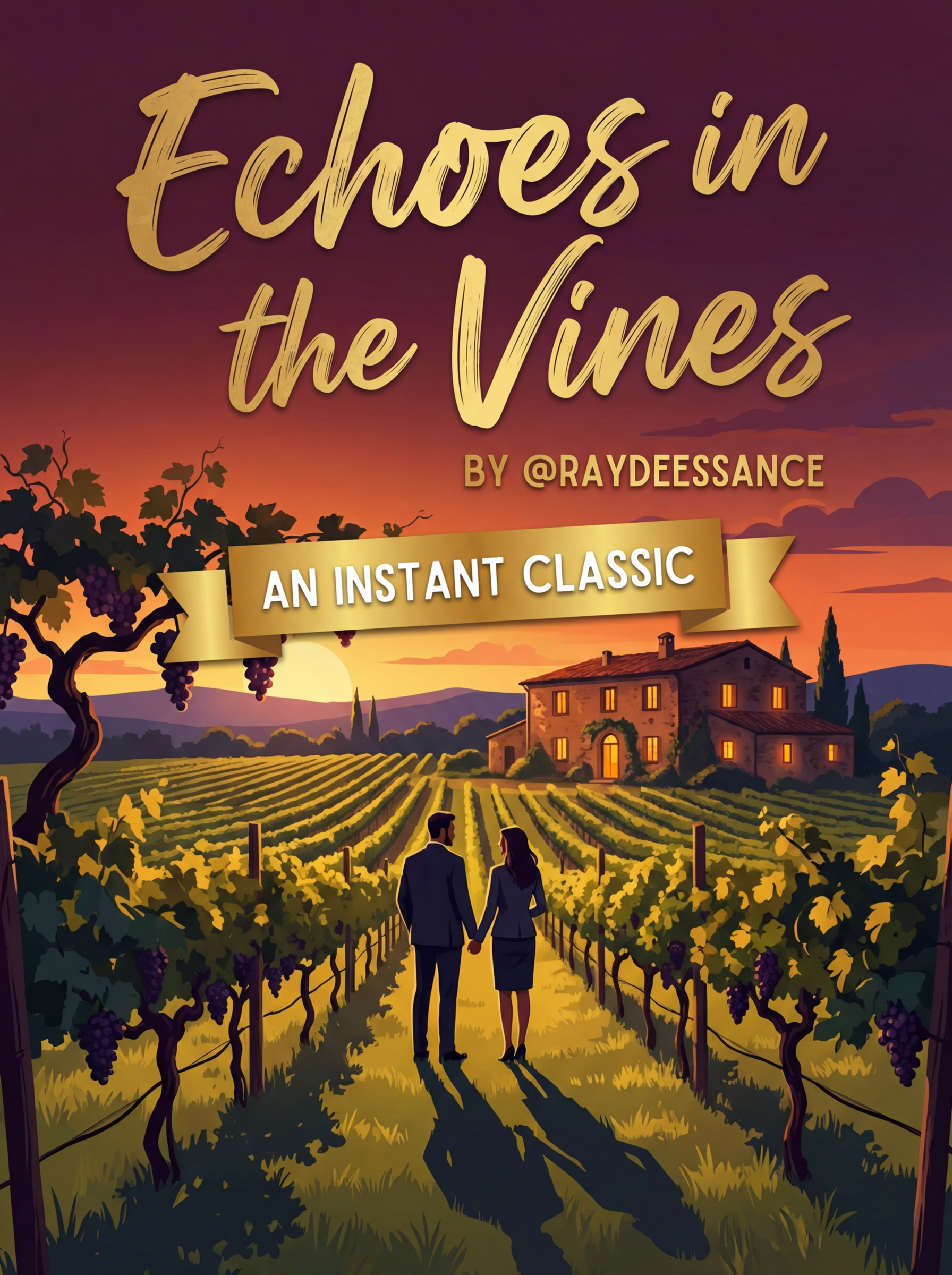
Echoes in the Vines
By @raydeessance
Synopsis
Ten years after a gut-wrenching separation, Dr. Eleanor Vance, a pragmatic botanist haunted by her past, and Noah Caldwell, a restless architect battling his own demons, are thrust together by the unexpected inheritance of a dilapidated Sonoma vineyard from their deceased college friend. Forced to n
Chapter 1: The Weight of the Will
The news arrived on a Tuesday, carried by a gust of wind that rattled the windowpanes of Dr. Eleanor Vance’s meticulously organized office. It wasn’t a gale, not a storm, but a precise, cold draft that seemed to slice through the very calm she so carefully cultivated. The email, a stark black-on-white missive from a Sonoma law firm, informed her of William Thompson’s passing. Followed by a summons.
Eleanor, pragmatic to her core, felt the familiar dull throb behind her eyes. William. Dear, jovial William, with his laugh lines carved deep like ancient oak roots. William, who had once patiently explained the miracle of fermentation while she, a gangly, bright-eyed botany student, listened with the reverence of a acolyte. The thought of him gone, reduced to legal jargon and an impending estate hearing, felt like a small, precise incision in her own well-guarded heart.
She reread the email, her sharp green eyes skimming over clauses and dates, seeking a logical anchor in the sea of grief that threatened to tug at her composure. A bequest. Her, Eleanor Vance, beneficiary. A half-share. Of what, she wondered, scanning further down. Whispering Oak Vineyard. And then, the next line hit her like a sudden, unexpected punch to the gut, stealing the very air from her lungs.
*The other half-share, along with management duties, will be held by Mr. Noah Caldwell.*
The name, etched in the digital parchment, seemed to hum with a malevolent energy, a forgotten frequency now jarringly resurrected. Ten years. Ten years she had meticulously, surgically, removed him from the vital organs of her memory. Ten years of building a fortress of academic rigor and structured routine around the gaping chasm he had left. Noah. The architect of her ruin, the artist who had painted her world in vibrant hues only to systematically erase them. The man whose absence had left an echo so profound it still sometimes reverberated in the quietest corners of her life.
Her slender fingers, usually so steady, trembled as she clicked the ‘reply’ button, confirming her attendance. The taste in her mouth was ash. Sonoma. The very word felt like a brand. It was a place she had vowed never to return to, a landscape haunted by the ghosts of what-ifs and the simmering embers of a love she had desperately tried to bury alive.
The day of the will reading dawned with a false crispness, the kind of aggressive cheerfulness California inflicts upon its grieving. Eleanor, dressed in functional charcoal trousers and a crisp white blouse – armor against emotional onslaughts – drove the familiar winding roads that led to the small, unassuming law office in Sonoma. Each turn was a tug on a frayed nerve, each sun-drenched vine a painful memory. She passed the old diner where they’d shared milkshakes after a long day of field research, the twisted oak where he’d first told her he loved her. The landscape, once vibrant with shared promise, now felt bleached, hollowed out.
She parked her sensible sedan precisely between the white lines, a small act of rebellion against the chaos churning within her. The law office, a Queen Anne Victorian with an overly zealous rose garden, felt suffocating before she even stepped inside. The air inside was thick with the scent of old paper and stale coffee, a fitting prelude to the dissection of a life.
She walked in, her spine straight, her expression a careful mask of polite professionalism. Mr. Albright, a man whose face was as rumpled as his tweezed suit, greeted her with a sympathetic nod. “Dr. Vance. So glad you could make it.”
Eleanor offered a thin smile. “Of course. William was a dear friend.”
Her gaze, however, was already drawn to the figure standing by the window, his back to her, silhouetted against the bright Sonoma morning. Even after all this time, the lean strength of his shoulders, the slight dishevelment of his dark hair, was unmistakable. A sharp intake of breath. He was still tall, still imbued with that restless energy she knew so well. Noah.
He turned slowly, as if sensing her presence, his movements economical, carrying a weight she recognized. His blue eyes, once sparkling with mischief and an intensity that could melt her resolve, were now shadowed, world-weary. Lines fanned out from their corners, deeper than she remembered, etching a story on his face she almost, almost, wanted to read. But the wall she had built around her heart held firm.
Their eyes met across the antiseptic sterile space. For a split second, the air crackled, thick with unspoken grievances, with raw, unhealed wounds. It was like two charged particles, repelling and attracting in the same terrifying instant. A flicker of something – surprise? regret? – crossed Noah’s face, quickly replaced by a stoic mask as formidable as her own.
“Eleanor,” he said, his voice a low rumble, the familiar timbre sending an unwelcome shiver down her spine. It was deeper, rougher, like gravel turned smooth by a decade of unseen erosion.
“Noah,” she replied, her voice flat, betraying nothing. It was a single word, a stone dropped into a deep well.
Mr. Albright, oblivious to the emotional maelstrom swirling between them, coughed lightly. “Please, both of you, have a seat. We have much to discuss.”
They settled into the high-backed leather chairs, carefully avoiding eye contact. The distance between them was only a few feet, but it felt like an ocean. The lawyer cleared his throat, adjusting his spectacles. “As you know, we are here today to discuss the last will and testament of the late William Thompson.” He launched into the legal preamble, a monotonous drone that was both a blessing and a curse. It gave Eleanor time to breathe, to reinforce her defenses, but it also forced her to be in the same room, breathing the same air, as the man who had torn her world apart.
She stole a glance at Noah. He was leaning forward, his forearms resting on his knees, his hands clasped, knuckles white. A familiar habit when he was deep in thought, or, she remembered with a pang, when he was trying to hold himself together. He looked – different. Not just older, but… hardened. The restless energy that had once animated him now seemed to be churning beneath the surface, contained, but barely. His well-worn denim and work shirt, though stylish in their own way, spoke of a life lived outside the polished confines of an architect’s office.
“—and therefore,” Mr. Albright continued, pulling her back, “it is William’s express wish that Dr. Eleanor Vance and Mr. Noah Caldwell jointly inherit Whispering Oak Vineyard, inclusive of all land, buildings, and existing stock.”
Eleanor’s breath hitched again. Jointly. Noah’s head snapped up, his eyes meeting hers, a mirroring of the shock and disbelief that surely etched her own face.
The lawyer pressed on, oblivious. “Furthermore, it is stipulated that you, Dr. Vance, with your expertise in viticulture, and you, Mr. Caldwell, as the primary beneficiary of his personal library and research notes, are expected to assume full operational responsibility for the vineyard. William was quite particular about that.” He adjusted his glasses once more, a faint smile on his lips. “He believed you both possessed the unique blend of passion and knowledge necessary to carry on his legacy.”
Passion. The word hung in the air, heavy with irony. Eleanor felt a bitter laugh rise in her throat, but she swallowed it down. Passion had been the instrument of her undoing. William, dear, blind William, had orchestrated this reunion with a loving, albeit utterly naive, hand.
Noah finally spoke, his voice rough. “Operational responsibility? You mean… run the place?”
“Precisely,” Mr. Albright confirmed, looking pleased with himself. “His will explicitly states that neither of you may sell your share for a period of ten years, unless by mutual agreement. And even then, William strongly suggested you give the business a fair shot. He even included a substantial endowment, contingent on your active involvement. He truly believed in this, gentlemen… and Dr. Vance.”
The conditions of the will, laid out with such finality, felt less like a bequest and more like a carefully constructed prison. A shared prison, with Noah Caldwell as her cellmate. The thought made her skin crawl.
“This is… unexpected,” Eleanor managed, her voice tight, betraying none of the turmoil within.
“Indeed,” Noah muttered, running a hand through his already disheveled hair. “He never mentioned anything about this.”
“William was a private man, particularly in his later years,” Mr. Albright said gently. “But he was shrewd. He loved that vineyard like it was his own child. And he loved you both. Perhaps,” he added, his gaze lingering on each of them in turn, “he had a vision for its future, and for yours.”
Eleanor felt a cold knot of dread form in her stomach. A vision. William’s well-meaning, utterly misguided vision. He had, in his dying act, chained her to the very man she had spent a decade trying to escape.
The meeting concluded with the usual formalities, each signature on the legal documents feeling like a nail hammered into the coffin of her peace of mind. As they rose to leave, Mr. Albright produced a worn, leather-bound journal. “This was for you, Mr. Caldwell. William’s personal vineyard journal. He wanted you to have it.” And then, to Eleanor, he handed a slim, elegant case. “And this, Dr. Vance, a set of William’s vintage pruning shears. He said you’d know what to do with them.”
The shears felt cold and heavy in her hand, a solid, tangible link to a past she had thought was neatly compartmentalized. She glanced at Noah. He was holding the journal loosely, his thumb tracing the worn cover, his expression unreadable.
They stood awkwardly in the small reception area, the silence a thrumming entity between them. Mr. Albright, sensing the tension, excused himself to take a call.
“William was a master manipulator,” Eleanor finally said, the words forced, her gaze fixed on a wilting rose in a vase on the table. “Even in death.”
Noah’s voice was low, laced with a bitterness that matched her own. “You think he knew what he was doing?”
“He knew us,” she retorted, finally looking at him, her green eyes sharp as shards of glass. “He knew exactly what he was doing. And it was a cruel joke.”
He flinched, a subtle tightening of his jaw. “You think this is a joke?” He gestured around the sterile office, then in the general direction of the vineyard. “I just inherited a half-share in what Mr. Albright’s assistant subtly hinted was a ‘struggling’ enterprise, with the woman who hates my guts as my business partner. I assure you, Eleanor, I’m not laughing.”
“Oh, spare me the self-pity, Noah,” she snapped, her control fraying at the edges. “You left. You disappeared. Don’t pretend this is some kind of cosmic injustice when you’ve been drifting for ten years.”
His eyes, once pools of a heartbreaking vulnerability she had adored, now held a steely glint. “And you stayed, didn’t you, Eleanor? Built your fortress of intellect and sterile ambition. Conveniently forgetting the part you played.”
“The part I played?” Her voice rose, dangerously. She took a step closer, her anger a hot, cleansing flame after years of suppressed cold. “I played the part of the woman you abandoned, Noah! The woman who picked up the pieces of her broken life while you were off… God knows where, doing God knows what!”
He took a step closer too, their faces now inches apart, the air between them charged with a dangerous current. “And you think you were so innocent? So blameless, Eleanor? You left a chasm in *my* life too.”
The words were a physical blow. She recoiled, a small, involuntary gasp escaping her lips. The raw accusation in his eyes, the undeniable pain etched on his face, momentarily silenced her. He was hurting too. The thought was a jarring, unwelcome revelation.
“This is pointless,” she finally whispered, her voice trembling. “We can’t do this, Noah. We can’t work together. It’s impossible.”
He ran a hand over his face, a gesture of weary resignation. “William clearly thought otherwise. He always had a way of seeing things, didn’t he? Even the things we tried to hide.” He met her gaze, and for a fleeting moment, she saw a flicker of the old Noah, the one who saw beneath her carefully constructed exterior. “Maybe,” he said, his voice softer, “he saw something in this arrangement that we can’t right now.”
But Eleanor’s pragmatic mind, honed by years of academic discipline and the brutal lessons of a broken heart, refused to entertain such romantic notions. “He saw a naive botanist and a restless architect, Noah. He saw two people who shared a brief, intense history. He didn’t see the wreckage, the decade of silence, the absolute, unadulterated pain.”
She turned abruptly, unable to bear the proximity, the memories his presence so effortlessly evoked. “I’ll be in touch with Mr. Albright about the particulars of this… this mess. I need to understand the financial standing of the vineyard. The output. The soil composition. Everything.” Her voice, though still tight, regained its professional cadence, a shield against the emotional vulnerability that threatened to overwhelm her. “I’ll need to make an informed decision as to whether this is even salvageable.”
He watched her, a brooding intensity in his eyes. “Salvageable,” he echoed, the word a quiet accusation. “You always were good at dissecting things, weren’t you, Eleanor? Breaking them down to their constituent parts. Figuring out if they were worth keeping.”
His words, aimed at her professional demeanor, twisted into a subtle, insidious jab at their past. Was that how he saw her? As someone who had coldly assessed their love, found it wanting, and discarded it? The thought stung. But she had no intention of engaging in that particular, painful argument now.
She walked towards the door, the heavy pruning shears clutched in her hand. “I’ll expect a full accounting of all assets and liabilities from Mr. Albright by the end of the week, Noah. I suggest you do the same.”
And with that, Dr. Eleanor Vance, pragmatic botanist, walked out of the law office, leaving Noah Caldwell standing alone amidst the echoes of William Thompson’s will, a will that had not only resurrected a dilapidated vineyard but also the very ghosts they had both worked so hard to bury. The weight of the will, she realized with a chilling certainty, was far heavier than any financial burden. It was the crushing weight of their unresolved history, poised to erupt in the heart of Sonoma.
Chapter 2: Soil and Scars
The Sonoma sun beat down, a blazing crucible designed to bake secrets from the very earth. Eleanor felt its relentless heat even through the shaded windows of the rented SUV, its air conditioning fighting a losing battle against the encroaching summer. Beside her, Noah navigated the winding country road, his jaw set, a muscle ticking beneath the tanned skin of his cheek. The silence between them was not comfortable; it was the suffocating quiet of a tomb, each unspoken word a headstone marking the grave of their past.
They had left the sterile polished floors of the lawyer’s office for this—Whispering Oak Vineyard. The name itself felt like a cruel joke, a whispered promise of peace that mocked the churning tempest within Eleanor. As the gravel crunched under the tires, announcing their arrival, she saw it: a grand,, if weary, entrance. Weathered wrought-iron gates, adorned with a graceful oak leaf motif, sagged slightly off their hinges, hinting at past elegance and current neglect. Beyond lay a driveway, cracked and lined with unruly weeds, leading to a sprawling stone house that looked as though it had once reigned supreme over the landscape but now merely endured it, a queen deposed.
“William always did have a flair for the dramatic,” Noah murmured, his voice gritty, pulling Eleanor from her uneasy assessment.
“Or a penchant for romantic delusion,” she retorted, the words sharper than she intended, an automatic defense mechanism.
He spared her a glance, his blue eyes – those damn blue eyes, still capable of unraveling her if she let them – holding a flicker of something she couldn’t quite decipher. Pain? Resignation? Or perhaps, just like her, he saw only the ghosts.
The house, honey-colored stone draped in ivy, held the faded grandeur of a bygone era. Shutters hung askew, some missing altogether, like broken teeth. The once-manicured gardens were a riot of overgrown roses fighting a losing battle against tenacious blackberry brambles. But it was the vines that truly caught Eleanor’s eye. Row after row, stretching across the undulating hills as far as she could see, their leaves a vibrant, desperate green against the parched earth. Yet, even from a distance, she could tell they were… ragged. Unpruned. A botanist’s nightmare.
Noah killed the engine, and the sudden cessation of sound was jarring. The air hummed with cicadas, a relentless, high-pitched thrumming that seemed to echo the frantic beat of Eleanor’s own heart. He got out first, slamming his door with a decisive thud that vibrated through the ground. Eleanor followed, the heat immediately enveloping her, clinging like a shroud. The scent of dry earth, sun-baked leaves, and something else – a faint, sweet, decaying smell – filled her nostrils. The smell of neglect.
As she surveyed the scene, a sense of desolation settled upon her. This wasn’t the picture-perfect vineyard of brochures; this was a broken dream. “It’s… more rundown than I imagined,” she said, the understatement a palpable weight in the air.
Noah had his hands on his hips, his gaze sweeping across the property, an architect’s critical eye dissecting decay. “More than you *imagined*? Eleanor, William lived here for ten good years. Did you think he was running a five-star resort?”
“I thought he was making wine,” she snapped back, “not hosting a dust-bowl reenactment.”
His jaw tightened. “And what did you expect, Dr. Vance? A pristine laboratory? This is a working vineyard, even if it hasn’t been working well.”
The unspoken accusation hung between them: *You haven’t been here. You haven’t checked in on your friend. You were too busy with your perfect, sterile life.* The words burned, because there was a kernel of truth there, twisted and ugly, but still truth. She had allowed her carefully constructed emotional barriers to extend even to William in the last few years, a self-imposed isolation after the wreckage of her final year of college.
Their argument was cut short by the appearance of a woman from the side of the house. Early fifties, strong, with a kind, weathered face and dark hair pulled into a practical braid. Her hands, Eleanor noted, were calloused, the knuckles a testament to years of hard labor.
“You must be Eleanor and Noah,” the woman said, her voice warm, with a gentle Spanish lilt. “I’m Maria Rodriguez. William’s foreman.”
Eleanor felt a surprising wave of relief. A grounding presence. Someone who knew this place, who knew William. “Maria,” she said, extending her hand. “It’s good to meet you.”
Maria’s grip was firm, surprisingly strong. “William talked about you both, often. He was very fond.” Her eyes, dark and perceptive, lingered on them for a moment, an understanding born of years spent observing human dramas.
“He had a strange way of showing it, bequeathing us this… mess,” Noah interjected, his sarcasm thinly veiled.
Maria’s smile faltered, replaced by a shadow of sadness. “It was not a mess to him. It was his life.” She turned, gesturing towards the house. “Come, I’ll show you around. We have much to discuss.”
The tour was a bleak inventory of William’s failing enterprise. The modest tasting room, once vibrant, was now dusty and quiet. The cellar, cool and dark, held a mere handful of aging barrels, symbols of a dwindling dream. The bottling line was a relic, clunky and inefficient. And the office, a small, cramped space overlooking the main vineyard, gave Eleanor her first true look at the financial abysss.
Maria laid out the ledgers, her voice calm but her words painting a stark picture. “William loved this place with all his heart, but his health… it made things difficult. He invested in things he didn’t need, neglected what he did. We’re losing money, badly. The last harvest was insufficient, the quality declining. Mr. Thorne, from Blackwood Vineyards, he’s been circling like a vulture for months. Making offers, lowballing, trying to scare me into selling what isn’t mine to sell.”
Eleanor picked up a ledger, her fingers tracing the red ink of mounting debt. Her pragmatic mind, usually so adept at problem-solving, felt overwhelmed. “He left us a monumental task, Noah,” she whispered, more to herself than to him.
Noah leaned against the doorframe, arms crossed, his gaze fixed on the wilting vines outside. “Monumental doesn’t begin to cover it. This is a shipwreck.”
“And what’s your brilliant solution, Architect?” Eleanor shot back, the frustration bubbling over. “Draw up some fancy blueprints for a sinking ship?”
He pushed off the doorframe, striding towards her, his presence suddenly dominating the small room. “My ‘brilliant solution’ would be to salvage what we can, sell it for pennies on the dollar, and cut our losses. This isn’t a passion project, Eleanor. This is a failing business.”
“This was William’s life!” she exclaimed, slamming the ledger shut with a thud. “His legacy! You think he’d want us to sell it off to the first predator who comes along?”
“And what exactly is your plan, Dr. Vance? Wave a magic wand and make these vines profitable again? Write a dissertation on the optimal pH level of bankruptcy?” His voice was low, dangerous.
The old hurt, never truly dormant, stirred within her. His casual dismissal of her work, his condescending tone. It was the same old pattern. She saw it, clear as a flash of lightning, the echo of another argument, years ago, in a cheap college apartment.
*“You’re always so clinical, Eleanor,” Noah had said, throwing his hands up in exasperation. “Can’t you just feel something without dissecting it?”*
*“I’m trying to be logical, Noah! You’re being reckless! This project, this money, it’s everything we have to get through next semester!”*
*He’d stormed out that night, and the breach between them, once a hairline fracture, had begun to widen.*
The memory seared. “No, Noah. My plan is to save it. Because William would have wanted us to.” She met his furious gaze, refusing to back down. “And because *I* want to.”
Noah stared at her, his blue eyes stormy. “You don’t want to save anything, Eleanor. You want to prove a point.”
“Perhaps we should talk about how much money is available for repairs and immediate needs,” Maria interjected, her calm voice cutting through the escalating tension like a balm. “Then we can make plans.”
Her practicality was a cold shower. Eleanor and Noah reluctantly turned their attention back to the grim numbers. William’s attorney had assured them there was still some capital, enough to keep operations afloat for a few months, perhaps six, if they were judicious.
“Six months,” Noah scoffed, running a hand through his already disheveled hair. “That’s not a business plan, Maria, that’s a death sentence.”
A shadow fell across the office window, and they all looked up. A sleek, black luxury sedan pulled up the gravel drive, stopping directly in front of the house. From it emerged a man in an impeccably tailored suit, his sharp features and cold grey eyes instantly recognizable. Bartholomew Thorne.
Eleanor felt a visceral surge of revulsion. Thorne. The name whispered through the Sonoma wine community like a bad rumor. Ruthless, ambitious, and with a particular disdain for anyone he deemed beneath him, which, in his estimation, was most of humanity.
Maria’s jaw tightened. “Speak of the devil.”
Thorne approached the house with an air of proprietary confidence, his expensive shoes crunching on the gravel. He paused at the doorway, a predatory smile playing on his lips. “Well, well. The prodigal children return. And the good Dr. Vance, looking as… studious as ever.” His gaze swept over Eleanor, dripping with condescension.
Noah stepped forward, placing himself slightly in front of Eleanor. “Thorne. What a surprise.” The sarcasm was thick enough to cut with a knife.
Thorne chuckled, a dry, unpleasant sound. “Not a surprise at all, Mr. Caldwell. I make it my business to know what happens in *my* valley. And William’s… unfortunate passing, well, it opens up certain opportunities.” He gave a dismissive flick of his hand towards the sprawling vines. “This place is a wasteland. A money pit. Frankly, it’s a blight on the reputation of Sonoma.”
“And you, I presume, are the blight remover?” Eleanor asked, her voice dangerously calm.
Thorne’s smile tightened, his grey eyes glinting. “Indeed. I'm offering you a clean solution. My original offer, though generous considering the state of this derelict property, stands. Take the money, save yourselves the headache, and go back to whatever sterile corners of the world you’ve carved out for yourselves.” He paused, letting his gaze drift meaningfully between Eleanor and Noah. “Unless, of course, you’re here for more… sentimental reasons. A rekindling of old flames, perhaps? Over a dying vineyard?”
The insult stung, hot and sharp. Thorne knew. Eleanor felt the familiar icy grip of shame, a fear that her past mistakes, the ruin of her heart, were laid bare for this man to dissect and mock. Thorne had always had an unhealthy obsession with her college life, a bizarre personal vendetta that Eleanor had never fully understood, stretching back to interactions with his late wife, Laura.
Noah’s hand instinctively reached back, briefly brushing Eleanor’s arm in a fleeting, protective gesture before dropping away. The unexpected contact sent a jolt through her, a phantom echo of a time when his touch was a promise, not a remembered scar.
“We’re not selling, Thorne,” Noah said, his voice low and firm, overriding Eleanor’s simmering rage. “Not to you. Not to anyone.”
Thorne’s eyes narrowed. “Foolish. Sentimentalists are always so… vulnerable. But then, William always was. You, Caldwell, with your architectural fantasies. And you, Vance, with your books and your sterile theories. You think you can resurrect this husk?” He gestured wildly at the vineyard. “These vines are diseased. The soil is tired. There’s nothing here but memories and a mountain of debt.”
He paused, letting his words hang heavy in the air. “I’ll give you a week. To come to your senses. Don’t waste your time. You’ll only find yourselves deeper in the mire.” With a final, contemptuous glance, Thorne turned and returned to his car, leaving a silence colder than the grave.
The hum of his departing car faded, leaving a vacuum where the tension had been. Noah turned to Eleanor, his face grim. “He’s right about one thing,” he said, his voice stripped of antagonism. “These vines are sick. And six months, that’s nothing. If we’re going to save this, we need a miracle.”
Eleanor looked out at the rows of vines, the late afternoon sun casting long, skeletal shadows across the land. The memory of Thorne’s words, his sneering dismissal, fueled a quiet fire within her. He thought she was merely a theoretician, incapable of living in the real world, of getting her hands dirty. He thought she was soft. Weak.
“No,” Eleanor said, her voice quiet, but imbued with a steely resolve that surprised even herself. “We don’t need a miracle, Noah. We need an intervention. And I don’t intend to let Bartholomew Thorne win.” She turned to face him, the anger and the pain of the past still simmering, but now, beneath it, a nascent spark of purpose. “You want to sell it? Fine. I’ll make you an offer. Let me control the vineyard operations for the next six months. Get us back in the black. If I can’t, if we’re still sinking, then you can sell it to the highest bidder, and I’ll walk away. But until then, you stay out of my way, and I’ll stay out of yours.”
Noah stared at her, a flicker of something unreadable in his eyes. Curiosity? Respect? The hint of a ghost of a smile, perhaps, that quickly vanished. “A wager, Vance? Ten years later, and you’re still pushing the envelope.”
“Consider it my final academic challenge,” she retorted, a ghost of her own academic confidence returning.
He sighed, running a hand over his face. The weariness in him was profound, a raw, exposed nerve. “Fine,” he conceded, the word dragged from him. “Six months. But if you fail, Eleanor, I’m calling in the wrecking crew myself. And don’t think for a second that our paths won’t cross. This is still a partnership, whether you like it or not.”
He cast a long, weary look across the vineyard, at the setting sun painting the sky in fiery hues, turning the neglected land into a canvas of desperate beauty. Eleanor watched him, the sharp lines of his profile etched against the fading light. He was still the man who could make her pulse quicken, still the architect of her deepest heartbreak. But now, in the face of this shared burden, this decaying legacy, there was something else. A fragile truce, forged in the dust and despair of Whispering Oak.
The wind picked up, rustling through the gnarled leaves of the ancient oak that gave the vineyard its name. It carried a whisper, like a sigh from the earth itself, a lament for what was lost, and a fragile hope for what might yet be found. The soil was indeed tired, scarred by neglect. But Eleanor, a botanist to her core, knew that even in the most broken ground, with enough care and determination, something new could still take root. She just didn’t know if her own scarred heart, or Noah’s, was capable of the same resurrection.