DONWINE
By @okog
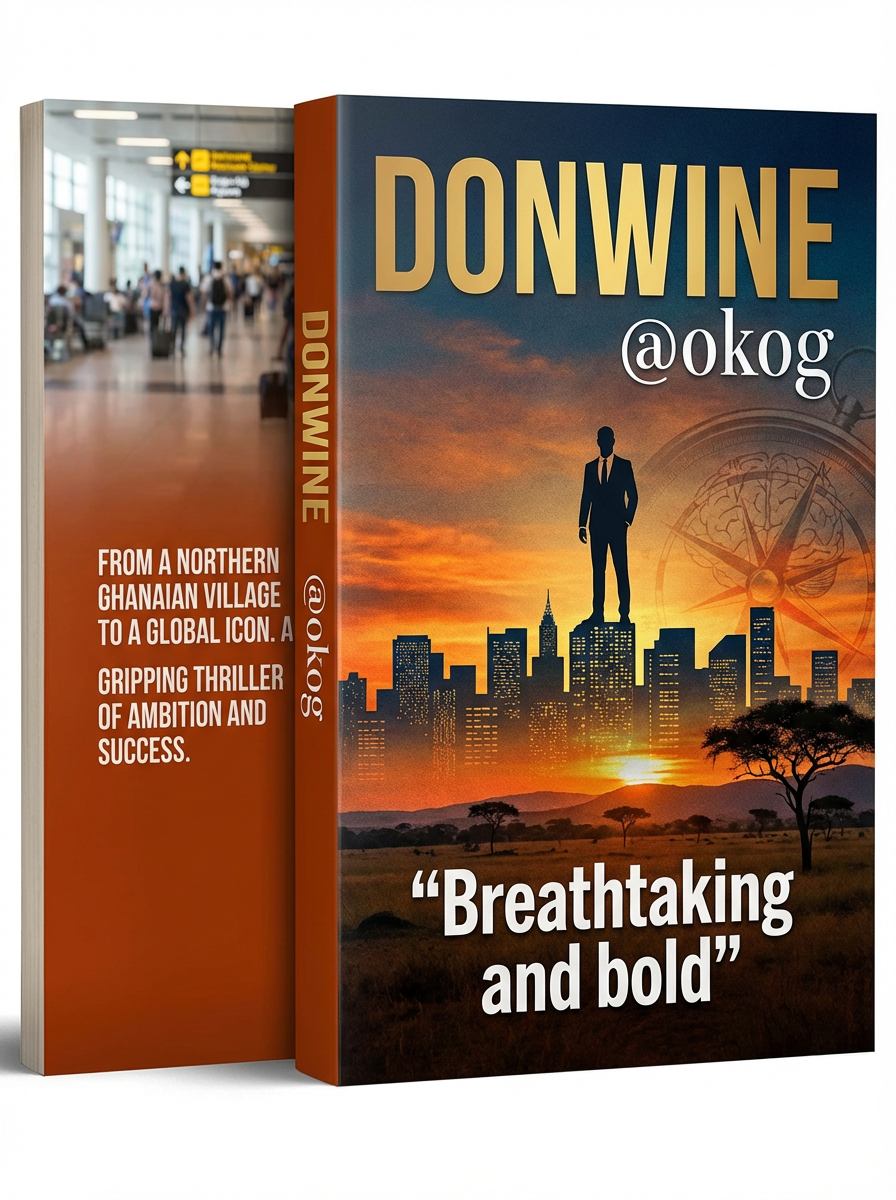
Synopsis
From the parched lands of Jirapa to the glittering boardrooms of Accra, Donwine, a brilliant boy born into poverty, navigates a treacherous landscape of systemic corruption, tribal animosity, and ruthless ambition to forge an empire, only to discover that the very power he sought carries a heavy, is
Chapter 1: Dust and Dreams
The sun, a tireless, brassy orb, beat down on Jirapa, bleeding colour from the already muted landscape. Dust, fine as flour and the colour of dried blood, coated everything: the straggly thorn trees, the sun-baked mud walls of the compounds, even the thoughts that ran through the minds of its inhabitants. It was the dust that defined Jirapa, clinging to clothes, rasping in throats, a constant, gritty companion. For ten-year-old Mr Donwine Abayatey, the dust was both a burden and a canvas.
He sat beneath the gnarled baobab tree that marked the edge of his family’s compound, a tattered schoolbook open on his bony knees. Around him, the village breathed its accustomed rhythm: the distant thud of pestle on mortar, the shrill cries of children chasing a deflated football, the desultory buzz of flies. Donwine, however, was elsewhere. His sharp, intelligent eyes, already alert beyond his years, scanned the intricate text, devouring words with a hunger that defied the stifling heat and the gnawing emptiness in his stomach.
It was a history book, donated by some well-meaning but ultimately detached NGO, its pages smelling faintly of mildew and printed on paper too thick for the village’s meager library. He was reading about the rise and fall of ancient empires, their grand strategies and fatal flaws. While other boys his age dreamt of owning a new pair of sandals, Donwine mentally dissected military campaigns, tracing power shifts across continents he would never see.
His older brother, Kofi, emerged from the compound, wiping sweat from his brow with the back of a calloused hand. Kofi was already a man, heavy with responsibilities, his face etched with the weariness of endless toil. He squinted at Donwine, a familiar exasperation softening his gaze.
"Still with your books, little professor?" Kofi’s voice was warm, but the underlying resignation was palpable. "There are goats to feed. Your mother is calling for water."
Donwine sighed, but without complaint. He closed the book carefully, marking his place with a dried leaf. "I was reading about Alexander the Great, Kofi. Did you know he conquered almost the entire known world by his thirtieth year?"
Kofi grunted, hoisting a rusty metal bucket onto his shoulder. "And did he feed his goats first? Did he fetch water for his mother? This 'known world' of yours, Donwine, will not quench your thirst or fill your belly."
Donwine watched his brother walk towards the borewell, his shoulders stooped. He understood Kofi’s point, deeply, intimately. The practicalities of survival – the ceaseless struggle for water, food, shelter – eclipsed all else in Jirapa. Knowledge, while revered, was a luxury, a distant echo in the face of immediate need. Yet, even as he rose to fetch the water, a different kind of ambition stirred within him, a quiet, insistent hum. He would not just feed the goats and fetch water. He would understand the forces that condemned them to this cycle, and he would break free.
His mother, a woman named Adisa whose hands were permanently stained with the rust-red earth, greeted him at the compound entrance. Her face, though lined, still held a gentle strength. "Thank you, my son," she murmured, taking the heavy bucket from him. "Your head is always in the clouds, but your hands know work."
He smiled, a rare, fleeting expression that transformed his serious face. Later, as the sun dipped below the horizon, painting the sky in fiery hues of orange and purple, Donwine sat by the flickering light of a kerosene lamp. The air, though cooler, remained heavy with the scent of woodsmoke and dust. He was not reading now, but sketching. On a scrap of paper, meticulously salvaged from the torn cover of a discarded textbook, he drew. Not of goats or baobab trees, but of geometric shapes, abstract patterns that hinted at complex calculations. He was captivated by the idea of systems, of order emerging from chaos.
His father, Mr Abayatey, a man of few words but considerable dignity, watched him from the doorway of their single-room home. His father, like Kofi, worked the sparse land, coaxing reluctant crops from the unwilling soil. His greatest ambition was to send his youngest son, Donwine, to the regional secondary school in Wa, a dream that felt as distant and shimmering as a mirage over the parched plains.
"What intricate thoughts occupy your mind tonight, my son?" his father asked, his voice a low rumble.
Donwine looked up, his eyes bright with a nascent intellectual fire. "I was thinking, Papa, about how the water flows from the borewell. The pump, the pipes, the energy needed. It is all a system. And I was imagining how one could improve it, make it more efficient."
His father nodded slowly. "Efficiency. That is a word of the city, not of Jirapa. Here, we celebrate the water simply for its presence." But a flicker of pride, too, passed in his eyes. He saw in Donwine not just a son, but a mind charting its own, extraordinary course.
Life in Jirapa was a constant lesson in scarcity. Every grain of millet, every drop of water, every hour of daylight had to be accounted for. Donwine absorbed these lessons not with resignation, but with meticulous observation. He noticed the subtle advantages of well-placed shade, the most fertile pockets of earth, the most resilient seeds. He saw the systemic failures — the lack of proper irrigation, the reliance on rain that often didn't come, the predatory middlemen who bought their meagre harvests for a pittance. These observations, filed away in his sharp mind, were not just laments; they were data points, problems to be solved.
His only real confidante, beyond the pages of his books, was Ms Fatima Haruna, a girl a year older than him, whose family compound was a stone’s throw away. Fatima possessed a grounded wisdom, an innate understanding of the earth and its rhythms, honed by years of practical experience. She was all instinct and resilience where Donwine was all intellect and calculation.
They would often meet by the shallow, often-dry riverbed, under the shade of a mango tree. Donwine would read to her from his books, stories of scientific breakthroughs, of grand architectural feats. Fatima, her hands deftly weaving grass mats, would listen, occasionally interjecting with a practical question or a skeptical frown.
"So, these scientists," she’d said once, after he described a complex chemical process he’d gleaned from a dilapidated science textbook, "they can make anything they want? Even water from thin air?"
Donwine considered. "Not exactly from thin air, Fatima. But they can purify dirty water, extract it from unlikely places. It's about understanding the elements."
Fatima clicked her tongue. "And why do they not share this knowledge with us? Is the Jirapa water not dirty enough? Are our stomachs not empty enough?" Her questions, sharp and direct, were a constant reminder to Donwine that knowledge, without application, was mere luxury.
One afternoon, a government official, a portly man in a stifling suit, visited Jirapa. He came with promises of development, a new school building, a borewell that would never run dry. He spoke in flowery language, words that painted pictures of a future where dust was banished and prosperity bloomed like the desert rose after a rare rain. The villagers, desperate for hope, listened with rapt attention, their faces mirroring a mixture of awe and cautious optimism.
Donwine, however, watched the official with a different kind of scrutiny. He saw the slick sheen on his shoes, the well-fed roundness of his belly, the condescension in his eyes. He noticed the way the official spoke of "our people" but kept a discreet distance from the villagers, his gaze sweeping over them rather than engaging.
After the official departed in a cloud of dust kicked up by his gleaming government vehicle, the villagers buzzed with renewed hope. But Donwine, sitting quietly by the baobab tree, felt a cold knot of suspicion tighten in his gut. He had read enough history to recognize the patterns of hollow promises, the rhetoric that masked self-interest. He had read about rulers who spoke of their people's well-being while enriching themselves.
"He promised a new borewell, Donwine," Fatima said, her voice filled with a tentative excitement. "Imagine, water flowing freely all year round!"
Donwine’s expression was unreadable. "He promised," he echoed, the word tasting like ash in his mouth. "But what does a promise cost? And who pays the true price?"
His skepticism, born of an instinctive understanding of power dynamics and buttressed by his voracious reading, set him apart. He saw the flaws in the systems, the cracks in the promises, where others saw only hope. This nascent critical thinking, in a place where obedience and trust in authority were often the only survival mechanisms, was both his greatest asset and a potential source of isolation.
The school in Wa, a distant and formidable institution, was a dream that haunted Donwine. To leave Jirapa, to immerse himself in a world of proper libraries and dedicated teachers, to truly unleash the torrent of his intellect – it was a yearning that burned in him with a quiet intensity. His father, through unimaginable sacrifice, managed to scrape together the necessary funds for his admission. The day arrived, heavy with conflicting emotions.
As he prepared to leave, his mother pressed a small, worn pouch into his hand. "Remember where you come from, my son," she whispered, her eyes shining with unshed tears. "Remember the dust."
His father, standing stoically by the threshold, placed a firm hand on Donwine’s shoulder. "Learn everything, Donwine. And come back to us, a man whose knowledge brings rain to this thirsty land."
Donwine nodded, his throat tight. He understood the unspoken weight of their hopes, the collective village aspiration resting upon his slender shoulders. He was not just leaving for himself; he was leaving for Jirapa.
The journey to Wa was an odyssey in itself. Jammed into the back of a battered lorry, surrounded by crates of yams and clucking chickens, Donwine watched Jirapa recede, a collection of humble mud huts slowly swallowed by the vast, undulating savanna. He felt a pang of loneliness, a visceral wrenching from the only world he had ever known. Yet, beneath the apprehension, a fierce determination burned. The dust of Jirapa would always be a part of him, a reminder of the poverty he vowed to overcome, not just for himself, but for every child who sat under a baobab tree, dreaming of a world beyond the parched horizon.
The challenges in Wa were immediate and stark. He was a boy from the village, his clothes patched, his accent thick. His classmates, many from more comfortable urban backgrounds, looked at him with a mixture of curiosity and disdain. He felt the weight of their judgment, the subtle snobbery of those who had never known true scarcity. But Donwine, fueled by the silent sacrifices of his family and the unspoken expectations of his village, met their derision with an unwavering focus.
He devoured every textbook, every lecture, every scrap of information. He was often the last to leave the school library, his mind alight with new concepts. He excelled in mathematics, history, and economics, his prodigious memory and analytical mind absorbing complex theories with effortless ease. He saw the world not as a collection of isolated facts, but as an intricate web of interconnected systems. He understood cause and effect, the levers of power, the subtle currents that shaped human destiny.
His ambition, once a quiet hum, now resonated with a clear, powerful note. He wasn't just interested in improving the borewell; he wanted to understand the financial structures that determined who built the wells, who controlled the water, and who profited from its scarcity. He saw poverty not as an accident, but as a carefully constructed system, and he was beginning to intuit its architects.
In the solitude of his small, sparsely furnished dormitory room, Donwine often reflected on his conversations with Fatima. Her questions – "why do they not share this knowledge with us?" – echoed in his mind. He was acquiring knowledge, a formidable arsenal of it. The next question, the critical one, was what to do with it. Would he return to Jirapa and attempt to apply what he had learned, bit by painstaking bit? Or would he seek to dismantle the very structures that kept Jirapa in its dusty embrace?
The answers were not yet clear, but the path ahead, though fraught with uncertainty, held an irresistible allure. The boy from Jirapa, with dust still clinging to the edges of his memory, was beginning to see the glittering, complex machinery of the modern world, and he knew, with an unshakeable conviction, that he was destined to not just observe it, but to master it. The seeds of a formidable ambition, tempered by the harsh realities of his birth, had been sown. And in the fertile ground of his brilliant mind, they were beginning to sprout, strong and unyielding. The empire he would one day build was, even then, a nascent dream, taking shape in the quiet corners of his consciousness, fueled by an insatiable thirst for knowledge and a relentless desire to overcome the dust.
Chapter 2: A Glimmer of Hope
The scholarship letter arrived in a brittle, government-issued envelope, its corners softened by the arduous journey from Accra. It bore the crest of St. Augustine’s College, an institution whose name, spoken in Jirapa, carried the weight of myth. For Donwine, it was not merely an invitation; it was a detonation, a violent sundering from the dust-choked reality of his existence. The air, thick with the scent of sun-baked earth and distant fires, suddenly seemed too thin, too confining.
His mother, her face a canvas of hard-won resilience, traced the embossed crest with a trembling finger, her eyes, usually clouded with the quiet anxieties of poverty, alight with a stark, bewildered joy. His father, a man whose silence was as profound as the vast northern plains, merely nodded, a single, deep furrow appearing between his brows – a mark of both pride and a nascent, unarticulated fear. Their silence, though outwardly affirming, spoke of a chasm that was opening, a distance that even love could not bridge. Donwine, despite his tender years, felt it keenly. He was being offered passage to a world they could never inhabit, a world whose very foundations were alien to their understanding.
The journey south was a blur of grinding gears and diesel fumes. The landscape slowly transformed, the sprawling savanna giving way to lush, humid greenery, the occasional homestead replaced by larger, more permanent structures. Accra, when it finally coalesded from the haze, was an assault on the senses: ceaseless noise, a torrent of humanity, and the dizzying, bewildering complexity of concrete and glass. It was a city perpetually in motion, indifferent to the quiet dignity of Jirapa, a place where everyone seemed to be hurrying towards an unseen prize. Donwine felt the weight of its indifference, a small boy swallowed by its colossal appetite.
St. Augustine’s College was another world entirely. Its manicured lawns, stretching like emerald carpets, were meticulously kept by silent men who moved with the regimented purpose of machines. The buildings, imposing colonial structures of red brick and white trim, spoke of permanence, of institutions built to outlast generations. The air, far from the familiar scent of wood smoke and millet, carried the faint, antiseptic tang of polished linoleum and the pervasive aroma of expensive toiletries.
His arrival was met with a practiced indifference by the school administration, a brisk efficiency that flattened his innate sense of wonder into something approaching alarm. He was just another scholarship boy, one in a long line of hopefuls plucked from the hinterlands. He was assigned a bed in a dormitory, a spartan space shared with a dozen other boys, most of whom had already established their cliques, their pecking orders.
The cultural chasm was immediately apparent. The language, though ostensibly the same, was infused with subtle inflections, urban slang he could not decipher. The food, though plentiful, tasted foreign, overly spiced or bland in ways his palate found jarring. His accent, a flat, melodic cadence of the North, marked him instantly. "The bush boy," he overheard once, delivered with the casual cruelty of adolescent superiority. He was an outsider, an anomaly, a curiosity.
Prejudice manifested in myriad forms, sometimes overt, often subtle as a change in atmospheric pressure. He was consistently chosen last for sports teams, his inquiries met with feigned distraction, his presence often overlooked entirely. There was the incident with the stolen textbook from his locker, an act never proven but understood by the nervous sidelong glances of his dorm mates. And the constant, low hum of assumptions: that he was slower, less sophisticated, fundamentally less *refined*.
But Donwine was not merely brilliant; he was possessed of a singular, unyielding will. The memory of Jirapa, of the dust and the hunger, of the quiet desperation in his parents’ eyes, was a constant, searing flame within him. He had not come here to make friends, to be liked. He had come to escape. His resolve crystalised in those early, lonely months: he would never return to that destitution. The shame of being 'the bush boy' fueled a quiet, furious determination.
He buried himself in his studies with the zealous devotion of a convert. The classroom became his sanctuary, the pursuit of knowledge his only companion. He devoured textbooks, not merely reading them, but dissecting them, interrogating their premises, seeking their underlying logic. Mathematics, once a laborious exercise in calculation, transformed into a language of elegance and precision. Science, a series of abstract observations, became a window into the fundamental workings of the universe. History, once a dry recounting of dates, unveiled the grand, often brutal, narratives of human power and ambition.
His grades, initially a flicker, soon blazed incandescently at the top of every class list. He outpaced his Southern peers, boys with private tutors and endless resources, with a relentless, almost frightening efficiency. His intellect was not merely keen; it was voracious, absorbing information with an unwavering focus that left others struggling in his wake. Teachers, initially hesitant, soon spoke of him in hushed, reverent tones. He was a prodigy, a genuine phenomenon.
Yet, his academic triumph offered little solace for the profound alienation he experienced. The other students, while perhaps grudgingly acknowledging his brilliance, kept their distance. He was not one of them, could never truly be one of them. He was the exception, the outsider who had, by sheer force of intellect, clawed his way into their world but not their affections. He observed them, these sons of Accra’s elite, with a quiet, analytical eye, noting their effortless confidence, their easy assumption of privilege. He began to understand that achievement alone was not enough; one also needed access, connections, the implicit understanding of how power truly operated.
He spent his free hours in the library, a vast, echoing space filled with the scent of aged paper and hushed whispers. He read indiscriminately, from classical literature to economics texts, absorbing narratives of rise and fall, of empires built and shattered. He was not merely learning facts; he was learning the architecture of the world, the invisible scaffolding that held societies together and tore them apart. He saw in the stories of industrialists and politicians a reflection of his own burgeoning ambition, a nascent understanding of the machinery of wealth and influence.
It was during one of these solitary hours in the library, hunched over a volume on ancient trade routes, that he first encountered Dr. Mawuli Dzirasa. Dr. Dzirasa, a visiting lecturer in Economic History, was a man whose presence filled any room he entered, not with bluster, but with a quiet, intellectual gravity. His silver hair framed a face etched with the wisdom of years, his eyes, behind spectacles perched on the bridge of his nose, held a thoughtful, empathetic gaze.
Dr. Dzirasa had observed Donwine for some weeks, the lone figure always in the library, always with a book, always with an intensity that verged on obsession. One afternoon, he approached Donwine's table, his footsteps soft on the polished floor.
"A rather dry subject for a boy your age, wouldn’t you say?" Dr. Dzirasa remarked, a faint, kind smile playing on his lips, gesturing towards the tome on the Silk Road.
Donwine looked up, startled, his customary guard instantly erected. "It explains how empires are built, sir," he replied, his voice still carrying the slight northern lilt.
Dr. Dzirasa's smile widened. "Indeed it does. And what, young man, do you hope to build?"
Donwine hesitated, a rare moment of vulnerability. He wanted to tell him about Jirapa, about the crushing weight of poverty, about the impossible dream of lifting his people from the dust. But the words caught in his throat, too raw, too personal. Instead, he said, "A better life, sir. For myself and my family."
Dr. Dzirasa nodded slowly, his gaze perceptive, seeing deeper than the carefully constructed facade. "A noble ambition. But remember, Donwine, the foundations of any empire, whether personal or political, matter deeply. What you build it upon will determine its strength, and its legacy."
That brief exchange marked the beginning of an unlikely mentorship. Dr. Dzirasa, seeing in Donwine a raw intelligence and an unparalleled drive, took the young man under his wing. He lent him books, engaged him in long, probing discussions about economics, ethics, and societal structure. He challenged Donwine’s assumptions, pushed him to consider the broader implications of ambition, the responsibilities that came with power. He was not merely a teacher; he became a confidante, the first person in Accra who saw beyond "the bush boy" to the formidable intellect within.
Through Dr. Dzirasa, Donwine began to grasp the intricate web of influence that governed the burgeoning nation. He understood that knowledge was power, yes, but equally potent were connections, understanding unspoken rules, and the willingness to navigate complex, often morally ambiguous, landscapes. The initial purity of his ambition – merely to escape poverty – began to subtly shift, to encompass something larger, more intricate. He saw that true change required not just individual success, but systemic leverage.
The loneliness never fully dissipated, but it receded, replaced by a fierce self-sufficiency. Donwine learned to rely solely on himself, to draw strength from the very isolation that had once threatened to overwhelm him. He observed the other boys, their laughter, their camaraderie, their ease within a system designed to benefit them, and a cold, analytical resolve solidified within him. He would not just be *in* their world; he would master it. He would not just survive; he would conquer.
Each letter home to Jirapa was a carefully curated narrative of success, omitting the prejudice, the alienation, the quiet struggles. He painted a picture of achievement, of a future bright with promise. He knew that their hopes were entirely invested in him, and he bore that weight with a stoic determination. He was their beacon, their single, shining hope in a world that had offered them so little. And he would not, could not, fail.
As his final year drew to a close, Donwine stood at the precipice of a new beginning, his academic record a testament to his unparalleled brilliance. He had entered St. Augustine's a naive boy, clutching a scholarship like a lifeline. He emerged a transformed young man, sharp-edged and formidable, armed with an intellect honed to a deadly precision and a will hardened by adversity. He possessed an unshakeable conviction that Jirapa's dust and the humiliation of his early years would forever be behind him. The glimmer of hope that had brought him south had ignited into a burning ambition, a fire that would consume anything in its path, propelling him towards an empire he was already beginning to envision. The first battle was won. Countless more awaited.
Chapter 3: Accra's Crucible
The air in Accra was a humid, suffocating blanket compared to the dry, dusty breath of Jirapa. It clung to Donwine’s skin, a constant, cloying reminder of the city’s omnipresent vitality and its underlying decay. The University of Ghana, a sprawling complex of concrete and manicured lawns, felt less like a sanctuary of learning and more like a carefully constructed stage upon which the nation’s future elite would perform their initial acts. Donwine, a scholarship student in Economics, observed it all with the dispassionate scrutiny of a field anthropologist.
He saw the children of ministers and industrialists, their privilege worn like an invisible uniform, their conversations peppered with casual references to overseas holidays and family connections that opened doors. He saw the ambitious, the ones like him, albeit from less abject beginnings, who understood that a degree from Legon was merely a ticket to the next, more exclusive club. And he saw the desperate, those clinging to education as their only escape, their eyes reflecting a hunger he recognized in himself.
Donwine understood, with a clarity that bordered on premonition, that the official curriculum was but a superficial veneer. The real lessons were taught in the sprawling, chaotic markets of Makola, in the hushed tones of campus political societies, and in the intricate dance of patronage and influence that permeated every facet of Ghanaian life. Money, he quickly deduced, was the undisputed sovereign. And power, its loyal consort.
His initial ventures were small, almost imperceptible. He began by tutoring. Not just the struggling students, but the children of wealthy parents who needed a gentle nudge towards academic success. He charged a modest fee, enough to cover his basic necessities and to start a small reserve. He observed how these families operated, the casual ease with which they deployed resources, the intricate web of favors and obligations that bound them.
One evening, while walking through the bustling streets surrounding campus, he noticed a vendor struggling to sell a large crate of imported electronics – faulty mobile phones, discarded by European markets, yet still desirable in Accra. Donwine, with his inherent understanding of supply and demand, saw an opportunity. He approached the vendor, a grizzled man named Kofi with eyes that had seen too much.
“Your prices are too high, Papa,” Donwine said, his voice calm, devoid of youthful impudence. “These phones, they have issues. People want cheap, but they also want reliable.”
Kofi grunted, wiping sweat from his brow. “Reliable is a luxury, boy. This is Accra.”
“Perhaps. But what if you could offer a guarantee?” Donwine continued, undeterred. “A small repair, a refurbished casing. A perception of quality, even if the core is compromised.”
Kofi scoffed. “And where would I find this magic repairman for a few cedis?”
“I know a boy,” Donwine lied smoothly, already picturing himself hunched over schematics. “He is very clever. He can fix these. For a small commission, of course.”
He bought a single faulty phone from Kofi, promising to return with a solution. That night, under the dim light of his dormitory room, Donwine dismantled the device. He had no formal training in electronics, but his mind, a relentless problem-solver, devoured the circuit board, tracing connections, identifying common points of failure. He spent hours poring over textbooks he borrowed from the engineering faculty, cross-referencing information, experimenting. By dawn, the phone, albeit with a slight hum, was functional.
He returned to Kofi, the repaired phone in hand. Kofi’s eyes widened in surprise, then narrowed in suspicion. “You fixed this yourself, didn’t you, boy?”
Donwine offered a slight, almost imperceptible smile. “Let’s just say, the ‘boy’ I know is very resourceful.”
This marked the beginning of his first real enterprise. He would buy the faulty phones from Kofi at a discounted price, repair them in his dorm room, and then sell them back to Kofi for a profit, who in turn sold them to his customers. The profit margins were slim, but the volume was significant. Donwine learned the art of negotiation, the delicate balance between asserting value and maintaining a good working relationship. He learned the rhythm of the market, the ebb and flow of demand, the subtle indicators of consumer preference.
His dormitory room, once a Spartan space, began to resemble a makeshift workshop. Soldering irons, tiny screwdrivers, and discarded phone parts littered his desk. His roommates, initially curious, grew accustomed to the faint smell of burnt plastic and the occasional spark. They saw Donwine as an eccentric, but harmless. They did not see the meticulous ledger he kept, detailing every transaction, every profit, every calculated risk.
Word of the “clever boy who fixes phones” began to spread. Soon, students and even some faculty members brought their malfunctioning devices to Donwine. He never advertised, never overtly sought out customers. The network grew organically, fueled by word-of-mouth and the undeniable quality of his work. He became a silent, indispensable cog in the university’s informal economy.
Beyond the electronics, Donwine observed the broader economic currents. He noticed the influx of cheap Chinese goods, the rise of mobile money, the burgeoning construction boom transforming Accra’s skyline. He saw the palpable desire for progress, often at any cost. He understood that Ghana, a nation perpetually on the cusp of something greater, was a land fertile for those who understood its unique blend of aspiration and pragmatism.
His economics courses, with their dry theories and abstract models, seemed to him a pale reflection of the vibrant, often brutal, reality he witnessed daily. He devoured books on economic history, on the rise and fall of empires, on the mechanisms of capital accumulation. He found particular resonance in the writings of Machiavelli and Sun Tzu, not for their explicit political advice, but for their profound understanding of human nature, of power dynamics, of the art of the strategic maneuver.
He joined the university’s debating society, not out of a desire for public recognition, but to hone his rhetorical skills, to learn how to articulate complex ideas with precision and persuasion. He observed the political machinations within the society, the subtle alliances, the tactical betrayals. He learned to read people, to discern their true motivations behind their spoken words.
One such person was Kwesi Mensah, a charismatic and well-connected student from a prominent Ashanti family. Kwesi was a natural leader, effortlessly charming, with an easy smile that masked a shrewd intellect. He represented everything Donwine was not – born into privilege, possessing an innate social grace. Yet, Donwine saw in Kwesi a reflection of his own ambition, albeit expressed through different means.
They met during a particularly heated debate on national economic policy. Donwine, arguing for a more integrated, export-oriented approach, presented a compelling case, backed by meticulously researched data. Kwesi, advocating for a more protectionist stance, countered with passionate appeals to national pride and self-reliance. Donwine admired Kwesi’s ability to sway emotions, to tap into the collective consciousness of the audience.
After the debate, Kwesi approached Donwine, a genuine admiration in his eyes. “You have a formidable mind, Donwine,” he said, extending a hand. “I haven’t seen such incisive analysis in a long time.”
Donwine shook his hand, a firm, steady grip. “And you, Kwesi, possess a rare gift for persuasion. A powerful combination.”
They began to meet regularly, initially to discuss economics and politics, but soon their conversations broadened. Kwesi introduced Donwine to his circle of friends – the sons and daughters of prominent lawyers, doctors, and civil servants. Donwine, initially an outsider, learned to navigate these social circles. He listened more than he spoke, absorbing information, identifying connections, and understanding the unspoken rules of this elite stratum.
He noticed how information flowed, how opportunities were created, how favors were exchanged. He saw that the true wealth of these families lay not just in their bank accounts, but in their networks, their influence, their ability to open doors that remained firmly shut to others. Donwine, the boy from Jirapa, understood that to truly ascend, he needed more than just intellect. He needed to build his own network, his own web of influence.
His small electronics venture continued to thrive, providing him with a steady, if modest, income. He used a portion of his profits to invest in books, in a small, discreet mobile phone that allowed him to communicate beyond the university campus, and in carefully chosen opportunities. He bought small quantities of scarce goods – certain types of imported fabric, popular brands of cosmetics – from traders in Makola, and sold them at a slight markup to students and faculty members who preferred the convenience of campus delivery. These were not grand ventures, but they were invaluable laboratories.
He learned the importance of reputation, of delivering on promises, of cultivating trust. He learned that even in a city rife with corruption, a reputation for honesty and reliability was a powerful currency. He also learned the subtle art of leveraging information. A casual comment overheard in the common room, a piece of news from a trader in the market, a rumor circulating among Kwesi’s friends – Donwine filed it all away, cross-referencing, connecting the dots. He began to see patterns, to anticipate trends, to identify nascent opportunities.
One such opportunity arose when the government announced a new initiative to promote local artisanal crafts. Kwesi, whose mother ran a successful boutique selling high-end African fashion, mentioned it during one of their conversations. “It’s a good idea in theory,” Kwesi mused, “but the logistics are a nightmare. Most of these artisans are in remote villages, unorganized, with no access to proper markets.”
Donwine’s mind immediately went to Jirapa. He remembered the intricate weaves, the beautiful pottery, the unique carvings produced by the skilled hands of his people. He saw an opportunity, not just for profit, but for connection, for upliftment.
“What if there was a way to bridge that gap?” Donwine proposed, his voice carefully measured. “To connect the artisans directly to the urban market? To provide them with raw materials, with design input, and with a reliable distribution channel?”
Kwesi looked at him, intrigued. “That would require significant capital, Donwine, and a deep understanding of the local landscape. And trust, something in short supply.”
“Trust can be built,” Donwine replied, a flicker of resolve in his eyes. “And capital… capital can be found.”
He began to research the government initiative, scrutinizing the fine print, identifying the key players. He understood that such programs were often riddled with inefficiencies, with opportunities for rent-seeking. But he also saw the genuine desire for development, albeit often poorly executed.
He proposed a pilot project to Kwesi, a small-scale operation focusing on a specific type of craft, perhaps hand-woven baskets from the Upper West Region. He outlined a plan for fair sourcing, quality control, and efficient distribution to Kwesi’s mother’s boutique. He presented it not as a grand scheme, but as a low-risk, high-potential venture that could serve as a proof of concept.
Kwesi, recognizing Donwine’s meticulous planning and his innate understanding of the local context, agreed to present the idea to his mother. Mrs. Mensah, a shrewd businesswoman in her own right, was initially skeptical. But Donwine’s detailed proposal, his calm demeanor, and Kwesi’s enthusiastic endorsement eventually won her over.
This collaboration marked a significant turning point. It was Donwine’s first foray into a larger, more complex business venture, one that required navigating not just market forces, but also social dynamics, logistical challenges, and the intricate dance of family connections. He learned to work with suppliers from his home region, to understand their needs, their challenges, and to build a relationship of mutual respect. He learned the intricacies of urban retail, the demands of discerning customers, the importance of branding and presentation.
The project, though small, was a success. The hand-woven baskets, marketed as ethically sourced and traditionally crafted, sold well in Mrs. Mensah’s boutique. Donwine’s share of the profits was substantial, far exceeding anything he had earned from his electronics repairs. More importantly, he gained invaluable experience, a trusted partner in Kwesi, and a growing reputation within a more influential circle.
He continued his academic studies, excelling in his courses, but his true education was happening outside the lecture halls. He was learning the mechanics of money and power not from textbooks, but from the raw, vibrant, often brutal reality of Accra. He was building a network, not of casual acquaintances, but of strategic alliances, of people who saw in him not just a clever student, but a man of immense potential, a force to be reckoned with.
Donwine, the boy who had arrived in Accra with nothing but his intellect and his ambition, was slowly, meticulously, laying the foundations of an empire. He understood that the city was a crucible, a testing ground where only the strongest, the most adaptable, and the most strategically astute would survive and thrive. And Donwine, with his quiet intensity and his relentless drive, was proving himself to be exceptionally well-suited for the heat. He was observing, learning, and preparing. The glittering boardrooms of Accra, he knew, awaited his arrival. And he would be ready.
Chapter 4: The First Stone
The air in Makola Market hung thick and heavy, a humid tapestry woven from the scent of smoked fish, fermenting fruit, and the acrid exhaust of tro-tros. Donwine, his university textbooks temporarily abandoned for the grittier curriculum of Accra’s commerce, navigated the labyrinthine stalls with an unnerving calm. His eyes, sharp and assessing, missed nothing. He was searching, not for goods to buy, but for the invisible currents that flowed beneath the surface of everyday transactions – the unfulfilled needs, the overlooked inefficiencies, the gaps.
His small ventures, born of necessity and observation, had thus far yielded only meager returns. Selling pirated textbooks, tutoring the academically challenged scions of the city’s elite, even a brief, ill-fated foray into mobile phone repairs – all had served to line his pockets barely enough to cover his rent and a steady supply of gari and groundnut soup. But these were mere skirmishes, training exercises. Donwine craved something more substantial, a true leverage point.
It was during one particularly sweltering afternoon, while haggling over a sack of bruised plantains for a friend, that he stumbled upon it. A group of women, their faces etched with a familiar despair, were arguing vehemently with a wholesaler. The dispute, Donwine gathered, centered on the price of imported rice. Specifically, a particular brand of Thai jasmine rice, inexplicably scarce in the market despite its high demand amongst the city’s burgeoning middle class.
He listened, unobtrusively, as the wholesaler, a corpulent man named Kojo with a gold tooth that glinted like a malevolent eye, dismissed their pleas. "The ships are delayed, my sisters! Customs is a beast! What do you expect me to do?" He gestured vaguely towards the port, a distant, shimmering haze on the horizon. The women, small-scale retailers, were losing customers, their livelihoods threatened by the sudden, artificial scarcity.
Donwine’s mind, a finely tuned instrument of logic, began to whir. He knew, from his clandestine network of contacts that stretched from the student dorms to the docks, that the ships were not delayed. And customs, while indeed a beast, rarely held up entire consignments of staples without a very specific, and usually venal, reason. He saw the pattern, a familiar one in the opaque world of Ghanaian commerce: artificial scarcity engineered to inflate prices, a classic tactic of powerful cartels.
He approached one of the women, a formidable matriarch named Auntie Ama, her head tie a vibrant explosion of color, her eyes snapping with frustration. "Auntie," he began, his voice low and respectful, "I heard your predicament. This rice… it is in demand, yes?"
Auntie Ama eyed him suspiciously, a young man, clearly educated, but with the raw hunger of the streets in his gaze. "Demand? My brother, my customers are screaming for it! But Kojo here, he says it is nowhere."
"And if I could find you a direct source?" Donwine asked, his gaze unwavering. "A source that bypasses Kojo, and his… delays?"
Auntie Ama snorted. "Then you would be a magician, my son. Or perhaps a smuggler."
"Neither," Donwine countered, a faint smile playing on his lips. "Only a man who understands how things truly move in this city."
He spent the next two days, not in the lecture halls, but in the labyrinthine corridors of the Tema Port. He spoke to dockworkers, to customs officials on their lunch breaks, to truck drivers sharing lukewarm Club Beer in dusty roadside chop bars. He pieced together the puzzle. A major shipment of the Thai jasmine rice had indeed arrived a week prior. It had been intentionally diverted, held in a private bonded warehouse under the pretense of "administrative irregularities," while Kojo and his cohort slowly released limited quantities to drive up the price. It was a classic squeeze.
Donwine, however, had also discovered a crucial vulnerability in their scheme. The warehouse, while "private," was still technically under the jurisdiction of a mid-level customs officer, a man named Mensah, known for his meticulous adherence to regulations, and his equally meticulous aversion to bribes that were too small.
Donwine’s plan was audacious, bordering on reckless. He approached Mensah, not with a brown envelope, but with a meticulously drafted, perfectly legal, and undeniably inconvenient report detailing the precise dates of arrival, the manifest discrepancies, and the potential violations of various import and trade regulations. He presented it not as a threat, but as a "courtesy," a heads-up that such irregularities, if allowed to persist, could draw the unwelcome attention of higher-ups.
Mensah, a man who valued his unblemished record above all else, stared at the document, his face a mask of carefully controlled apprehension. He knew the game. He knew Kojo. But he also knew the consequences of being caught on the wrong side of an investigation, especially one that came from an unexpected, anonymous source.
"What is your interest in this, young man?" Mensah finally asked, his voice low, a tremor of suspicion in it.
"My interest, sir," Donwine replied, meeting his gaze directly, "is in efficiency. And in ensuring that the market operates fairly. These delays… they hurt the ordinary people of Accra." He paused, then added, "And they create unnecessary administrative burdens for diligent officers like yourself."
Mensah considered this. Donwine had offered him a way out, a path to correct the "irregularity" without implicating himself too deeply, while simultaneously appearing proactive. The rice, he realized, had become a liability.
Within 24 hours, the "administrative irregularities" were miraculously resolved. The rice, a mountain of it, was released from the bonded warehouse.
Donwine, however, did not go to Kojo. He went directly to Auntie Ama and her network of retailers. He had negotiated a direct, albeit slightly smaller, consignment from the suddenly cooperative importer, bypassing the cartel entirely. He offered the rice at a price significantly lower than Kojo’s inflated rates, but still with a healthy margin for himself and the retailers.
The impact was immediate and seismic. The market, starved of the popular rice, devoured the new supply. Auntie Ama and her colleagues, grateful and astonished, hailed Donwine as a savior. Their sales skyrocketed. Kojo, meanwhile, found himself with a warehouse full of overpriced rice that no one wanted, his carefully constructed scarcity shattered.
This was Donwine’s first stone. It was not a grand edifice, but it was a perfectly placed, precisely aimed projectile that disrupted the existing order. He had demonstrated not just intelligence, but a ruthless understanding of power dynamics and a willingness to exploit them.
The ripple effects were felt far beyond Makola Market. Within weeks, whispers of the "young man who broke Kojo's rice monopoly" began to circulate in the dimly lit backrooms and air-conditioned boardrooms of Accra.
Some were impressed. Kwesi Botwe, a shrewd businessman who had made his fortune in timber and now dabbled in everything from construction to media, heard the story from one of his drivers. "This boy," Botwe mused to his aide, a man named Adjei, "he understands leverage. He understands the weakness in the system." Botwe, a man who had built his own empire through similar, albeit larger, maneuvers, saw a kindred spirit. He dispatched Adjei to "make discreet inquiries."
Others were wary. The established figures, the old guard who had grown fat on the inefficiencies and opaque dealings of the Ghanaian economy, saw Donwine as an unwelcome interloper. Kojo, his face a mask of impotent rage, stewed in his ill-gotten gains, vowing retribution. He sent his own men, less discreet than Botwe’s, to dig into Donwine’s past, to find the dirt, the weakness, anything that could be used to discredit or destroy him.
"He's a Northerner," Kojo spat to his cronies, puffing on a fat cigar that seemed to mock his dwindling profits. "An uppity boy from Jirapa. What does he know of Accra’s ways?" The tribal animosity, a simmering undertow in Ghanaian society, was immediately invoked. For Kojo, Donwine’s success was not just an economic affront, but a social transgression.
Donwine, meanwhile, remained outwardly calm, though internally, a new fire had been lit. The rice deal had provided him with a substantial sum, enough to pay off his university fees for the year, move into a slightly better room, and, crucially, to invest. He was no longer just surviving; he was building.
He understood the implications of his actions. He had thrown a stone, and the ripples were spreading. He knew he had made enemies. But he also knew he had gained allies, however informal, in the market women who now swore by his name. More importantly, he had gained a reputation. A reputation for being sharp, for being resourceful, for being dangerous to those who sought to exploit.
He sat in his cramped room, the whirring of a solitary fan barely stirring the humid air, and meticulously reviewed his ledger. The numbers, though still modest by Accra’s standards, represented a fundamental shift. He had moved from being a participant in the market to being an actor who could influence it.
He thought of Jirapa, the dust, the hunger, the suffocating limitations. He remembered the faces of the market women, their relief, their gratitude. This was not just about money; it was about power, about carving out a space for himself, for his people, in a world that had always sought to deny them.
He knew Kojo would come for him. He knew the established cartels would not tolerate such a blatant challenge to their authority. But Donwine, the boy from Jirapa who had seen the vulnerabilities in the system, was ready. He had fired his first shot, and he was prepared for the inevitable war. The first stone had been cast, and the foundations of Donwine’s empire, however small and precarious, had begun to settle. The glittering boardrooms of Accra, once distant and unattainable, now seemed a little closer, a little more within reach, and a great deal more dangerous.
Chapter 5: Building Blocks
The years that followed were not merely a passage of time but a relentless, almost geological, accretion of enterprise. Donwine, no longer the eager student of Accra’s back alleys, became its architect. His early ventures, tentative probes into the urban economy, solidified into formidable structures. The small import-export operation, initially a conduit for low-margin textiles, expanded. He saw the gaps, the inefficiencies, the points of friction where profit could be squeezed like water from a stone. He diversified, not haphazardly, but with the precision of a surgeon.
First came logistics. He observed the chaotic dance of goods from port to market, the bribes, the delays, the pilfering. He acquired a fleet of used trucks, then new ones, establishing a network that promised reliability in a landscape defined by its absence. His drivers were disciplined, his routes optimized, his warehouses strategically placed. Competitors, steeped in generations of informal practices, found themselves outmaneuvered, their traditional margins evaporating in the face of Donwine’s cold, systematic efficiency. He didn't just move goods; he moved the very concept of timely delivery.
Then, sensing the burgeoning appetite of a growing middle class, he ventured into construction. Not the grand, government-funded projects rife with kickbacks and shoddy workmanship, but the smaller, more immediate needs: affordable housing, commercial units for burgeoning businesses. He employed local labor, paid them fairly – or at least, fairly by his own calculated standards – and demanded uncompromising quality. His buildings rose with a speed and solidity that defied the prevailing norms of Ghanaian construction. Each completed project was a testament to his method, a concrete manifestation of his will. The whispers began then, in the construction yards and the offices of city planners: *Donwine builds strong.*
His reputation, once a nascent hum, became a resonant thrum. It was the sound of a man who understood the intricate machinery of the market, who could foresee its movements with an almost preternatural clarity. He was an anomaly, an outsider who had mastered the insider’s game. The established figures, those who had initially viewed him with a mixture of amusement and disdain, now regarded him with a grudging respect, tinged with a growing apprehension. He operated without the usual patronage, without the overt political affiliations that often served as the bedrock of Ghanaian business success. This independence was both his strength and, many suspected, his ultimate vulnerability.
His empire was not built on charisma, nor on the easy smiles and back-slapping camaraderie that oiled the wheels of Accra’s elite. It was built on data, on contracts meticulously drafted, on a network of informants and loyal operatives who understood that Donwine rewarded competence and punished failure with swift, dispassionate finality. He rarely appeared in public, preferring the quiet efficiency of his inner sanctum. His public face was handled by a carefully selected cadre of spokesmen, articulate and impeccably dressed, who projected an image of corporate responsibility and forward-thinking vision.
The media, always hungry for a narrative, began to craft one around him. He was the "Boy from Jirapa," the "Northern Star," the "Silent Mogul." Each headline, each speculative article, added another layer to the myth. He was depicted as a man of iron will, a relentless innovator, a patriot investing in his nation’s future. These narratives, carefully cultivated by his public relations machinery, presented a sanitised version of his rise, omitting the sharp edges, the calculated ruthlessness, the quiet accumulation of power that underpinned his success.
But the myth also contained a kernel of truth. Donwine was indeed relentless. He worked with an intensity that verged on the obsessive, his days a blur of meetings, phone calls, and detailed reports. Sleep was a necessary evil, leisure a foreign concept. His personal life, if one could call it that, was as spare and functional as his office. He had no entourage, no lavish parties, no conspicuous consumption. His wealth was not for display; it was a tool, a means to an end, a weapon in the ongoing battle for economic dominance.
He understood the power of information. He invested heavily in intelligence gathering, both overt and covert. His network extended into government ministries, competitor boardrooms, and even the informal markets of the city. He knew who was buying what, who was selling to whom, who was vulnerable, who was corruptible. This knowledge was his currency, allowing him to anticipate market shifts, to exploit weaknesses, and to protect his burgeoning interests.
His ventures branched further. He saw the potential in digital infrastructure, investing in an internet service provider that brought connectivity to underserved areas, a move lauded as philanthropic but which also opened up new markets for his other businesses. He acquired agricultural lands, transforming inefficient subsistence farms into commercial operations, leveraging modern techniques and supply chain management to produce high-yield crops for both domestic consumption and export. He even dipped a toe into mining, securing concessions for lesser-known minerals, knowing that the global appetite for raw materials was insatiable.
Each expansion was a calculated risk, a move on a grand chessboard where the pieces were industries and the stakes were national influence. He never overextended, never acted on impulse. Every decision was subjected to rigorous analysis, every potential pitfall meticulously mapped out. He built his empire brick by painstaking brick, each one laid with an almost inhuman precision.
The whispers, however, were not always complimentary. In the hushed tones of the elite clubs and the back rooms of political power, a different narrative began to circulate. How had a boy from Jirapa, with no established connections, no inherited wealth, risen so quickly, so comprehensively? The speed of his ascent was deemed unnatural, almost impossible. There were murmurs of "unconventional methods," of "unseen hands," of "favours granted in the dark." No one could point to concrete evidence, but the questions persisted, like a low thrum beneath the polished surface of his success.
Donwine, for his part, remained impervious to the gossip. He understood that such speculation was the inevitable byproduct of extraordinary achievement in a society accustomed to slower, more predictable patterns of accumulation. He knew that envy was a powerful force, and that suspicion often shadowed success. He had built his empire on the bedrock of his own intellect and relentless effort, and he saw no reason to justify his methods to those who lacked his vision or his will.
He cultivated a small, fiercely loyal inner circle. These were individuals he had personally vetted, often from humble backgrounds like his own, who understood the value of hard work and discretion. They were his eyes and ears, his enforcers, the executors of his will. They shared his vision, or at least, they were convinced that their fortunes were inextricably linked to his. Loyalty, he understood, could be bought, but true devotion was earned through shared struggle and mutual benefit.
One such individual was Kwesi, a former military man with an unblemished record and an uncanny ability to anticipate threats. Kwesi managed Donwine’s security, not just personal protection, but also the intricate web of corporate intelligence that protected his various enterprises from industrial espionage, sabotage, and the ever-present threat of extortion. Kwesi’s gaze was as sharp and unblinking as Donwine’s own, and he moved through the shadows of Accra’s underbelly with a quiet authority that commanded respect and instilled fear.
Another was Ama, a brilliant financial analyst he had headhunted from a multinational bank. Ama was the architect of his financial strategies, the one who navigated the complex world of international finance, ensuring that his assets were diversified, protected, and leveraged for maximum growth. Her mind was a steel trap, her calculations precise, her understanding of global markets encyclopedic. She was the financial brain to his strategic brawn.
These individuals, and a handful of others, formed the core of his operations. They were not friends in the conventional sense; Donwine permitted no such emotional entanglements. They were colleagues, cogs in the meticulously crafted machine, each performing their function with unwavering dedication. Their loyalty was to the vision, to the power, to the sheer, undeniable force of Donwine’s will.
As the years advanced, Donwine’s empire became a sprawling, multi-faceted entity, a testament to his singular ambition. It touched almost every aspect of Ghanaian life, from the food on tables to the roads people drove on, from the internet connecting their homes to the very buildings they inhabited. He had not merely built businesses; he had woven himself into the very fabric of the nation.
But with this immense power came a profound isolation. The boy from Jirapa, who had once dreamed of escaping poverty, now stood atop a mountain of wealth and influence, looking down on a world he had, in many ways, reshaped. The view was breathtaking, but also solitary. He had few confidantes, fewer friends. The price of his ascent was a detachment from the ordinary human connections that define most lives.
He remained an enigma, even to those closest to him. His motivations were inscrutable, his emotions rarely displayed. He was a force of nature, a relentless engine of progress and profit. He had built his empire, brick by calculated brick, and now, it stood, a towering monument to his singular will. But the very scale of his creation, its meteoric rise, was beginning to attract attention from quarters that preferred to keep such power within established, predictable boundaries. The building blocks were in place, the structure complete. Now, the scrutiny would begin.
Chapter 6: Whispers and Foundations
The red dust of Jirapa, once a persistent adversary, now clung to the tires of a fleet of gleaming white Land Cruisers, vehicles that announced their arrival with the understated authority of a presidential motorcade. Donwine, emerging from the lead vehicle, felt the familiar heat on his skin, a sensation that transported him back to the boundless horizons of his boyhood. He stood taller now, the lean frame of his youth replaced by a cultivated solidity, a man who carried the weight of empires on his shoulders. But here, in Jirapa, the weight felt different, a blend of obligation and a curious, almost unsettling nostalgia.
His return was not a quiet pilgrimage. It was an event, meticulously orchestrated, a public declaration of remembrance. The villagers, a sea of expectant faces, lined the pathways, their murmurs a low hum that swelled into a cheer as he approached. Children, their eyes wide with a mixture of awe and bewilderment, pointed at the man whose name had become a legend whispered in their humble compounds. Donwine, the boy who left, had returned as Donwine, the benefactor.
The cornerstone of his return was the “Jirapa Renaissance Foundation,” a name conceived in a boardroom far removed from the parched earth it sought to uplift. Its initial mandate was ambitious: a state-of-the-art primary school, a community health clinic, and a vocational training center. These were not mere buildings; they were edifices of hope, tangible proof that the forgotten corners of Ghana could, indeed, be remembered.
“Education,” Donwine’s voice, amplified by a crackling loudspeaker, resonated across the village square, “is the bedrock of progress. It is the light that dispels the darkness of ignorance, the tool that carves a path from poverty to prosperity.” His words, carefully chosen, were a blend of genuine conviction and political rhetoric. He spoke of the children, of their potential, of a future where no child in Jirapa would be denied the opportunity he himself had so desperately craved. He spoke of his humble beginnings, a narrative carefully polished, emphasizing the struggle, the perseverance, the triumph.
The crowd, their faces etched with the hard lines of a life lived under a relentless sun, nodded in agreement. They saw in Donwine not just a wealthy man, but one of their own, a testament to what could be achieved. He was the living embodiment of their dormant aspirations. The elders, their wisdom etched in the furrows of their brows, watched with a cautious optimism. They remembered the hungry boy, the one with eyes that saw beyond the immediate. They wondered, silently, at the vast chasm between that boy and the man who now commanded such power and resources.
The construction began with a furious efficiency that shocked the villagers. Teams of engineers and contractors, brought in from Accra, descended upon Jirapa, transforming the landscape with a speed that defied the traditional rhythms of the village. Concrete mixers roared, excavators clawed at the earth, and steel skeletons rose against the azure sky. The air, once thick with the scent of woodsmoke and drying millet, now carried the metallic tang of progress.
Donwine, despite the demands of his sprawling empire, made frequent visits. He walked the construction sites, his gaze sharp, missing nothing. He spoke to the foremen, to the local laborers he had insisted be hired, to the women who cooked meals for the workers. He was meticulous, demanding, but always with a veneer of accessibility, a carefully cultivated image of the man of the people. He wanted these projects to be perfect, not just for the beneficiaries, but for the narrative they represented.
The school, a brightly painted structure with ample classrooms and a small library, was completed first. The inauguration was a grand affair, attended by local chiefs, regional dignitaries, and a contingent of national media. Donwine, surrounded by beaming children in crisp new uniforms, cut the ribbon, his smile a picture of benevolent triumph. He announced further initiatives: scholarships for promising students, a teacher training program, and a commitment to equip the school with modern technology.
The clinic followed, a sanctuary of white walls and sterile equipment in a land where ailments often went untreated, left to the mercy of traditional healers and fate. Doctors and nurses, attracted by the promise of good facilities and a generous salary, arrived from the cities. The sight of a fully stocked pharmacy, of examination rooms with gleaming instruments, was a revelation for the villagers. They lined up patiently, their faces a mixture of hope and trepidation, for the healthcare they had long been denied.
The vocational training center, with its workshops for carpentry, masonry, and tailoring, aimed to equip the youth with practical skills, a pathway to self-sufficiency that transcended subsistence farming. Donwine spoke passionately about empowering the next generation, of breaking the cycle of poverty through tangible skills.
These acts of philanthropy were not confined to Jirapa. News of the “Jirapa Renaissance Foundation” spread, fueled by carefully managed media campaigns. Donwine’s companies, now a ubiquitous presence across Ghana, were increasingly associated with corporate social responsibility. Similar, albeit smaller, initiatives were launched in other neglected communities, always with the Donwine imprimatur. He was building not just schools and clinics, but a formidable public image, a shield against the whispers that had begun to circulate.
For the truth was, Donwine’s meteoric rise had not gone unnoticed, nor had it been universally applauded. The sheer scale of his wealth, the speed with which he had accumulated it, stirred a potent brew of admiration and suspicion. In a nation where fortunes were often built on nepotism, patronage, and outright corruption, Donwine’s story, though compelling, felt almost too perfect, too unblemished.
The first whispers came from the financial districts of Accra, hushed conversations in air-conditioned offices, among men who understood the labyrinthine pathways of capital. “Donwine,” they would say, a hint of envy in their voices, “he moves like a phantom. No one sees the hand, but the money flows.” His diversification into mining, telecommunications, infrastructure development, and even agriculture seemed to defy the natural pace of growth. Each venture, launched with audacious confidence, yielded unprecedented returns.
Then came the questions, initially subtle, disguised as journalistic curiosity. A prominent investigative journalist, Kojo Mensah, known for his relentless pursuit of truth, began to peel back the layers of Donwine’s public persona. Kojo, a man with a sharp mind and an even sharper pen, found himself increasingly drawn to the Donwine enigma. He had seen too many overnight millionaires in Ghana, too many rags-to-riches stories that, upon closer inspection, revealed a murky underbelly of illicit dealings.
Kojo’s initial articles, published in a respected national newspaper, were innocuous enough. They lauded Donwine’s philanthropic efforts, praised his vision for Jirapa, and highlighted his entrepreneurial spirit. But beneath the surface, a careful reader could detect a subtle shift in tone, a growing inquisitiveness. He began to pose questions, not directly of Donwine, but of the systemic conditions that allowed such rapid accumulation of wealth.
“In a nation grappling with persistent economic disparities,” Kojo wrote in one of his columns, “where the average Ghanaian struggles to put food on the table, the emergence of a new class of billionaires, seemingly from nowhere, demands scrutiny. While we celebrate their philanthropic endeavors, we must also ask: what are the foundational principles upon which these empires are built? Are they truly born of ingenuity and hard work, or do they exploit the very vulnerabilities they later seek to alleviate?”
These were not direct accusations, but they were a gauntlet thrown. Donwine’s public relations team, a sophisticated machinery of image management, initially dismissed Kojo’s inquiries as the ramblings of a cynical journalist. They countered with more press releases, more images of Donwine smiling alongside grateful villagers, more statistics on the impact of his charitable works. They emphasized transparency, highlighting the meticulous audits of the Jirapa Renaissance Foundation.
But Kojo Mensah was not easily deterred. He began to delve deeper, employing a network of informants, anonymous sources within government ministries, disgruntled former employees, and even competitors. He traced the origins of Donwine’s early capital, the initial ventures that had laid the groundwork for his empire. He found inconsistencies, small anomalies that, taken individually, seemed insignificant, but when pieced together, began to form a disquieting pattern.
There were whispers of shell companies, of offshore accounts, of unusually favorable government contracts awarded to Donwine’s enterprises, contracts that bypassed standard bidding procedures. There were rumors of land acquisitions, vast tracts of prime real estate, secured at suspiciously low prices, often displacing local communities with little compensation. The narrative of the self-made man, the brilliant boy from Jirapa, began to fray at the edges.
Donwine, in his Accra headquarters, a monolithic structure of glass and steel that dominated the city skyline, was aware of Kojo Mensah’s relentless pursuit. He received daily intelligence reports, summaries of media coverage, and analyses of public sentiment. He saw the subtle shifts, the growing skepticism in the once adulatory press. The whispers, faint at first, were growing louder, carrying the insidious scent of doubt.
He understood the game. In Ghana, power was a delicate balance of public perception and hidden influence. His philanthropy in Jirapa was not merely an act of benevolence; it was a strategic investment, a foundational pillar of his legitimacy. It was meant to inoculate him against precisely this kind of scrutiny, to paint him as a savior, not a predator.
One evening, in his opulent penthouse office, overlooking the sprawling lights of Accra, Donwine sat before a bank of screens displaying stock market fluctuations, global news feeds, and a detailed financial analysis of his various holdings. Beside him, a tablet displayed Kojo Mensah’s latest article, dissecting the opaque ownership structures of one of Donwine’s mining concessions.
His face, usually impassive, showed a flicker of something akin to annoyance. He was not afraid of the truth, he told himself, for the truth, in his world, was often a malleable construct. But he was aware of the fragility of reputation, the ease with which a carefully constructed image could be shattered by a single, well-placed revelation.
He picked up a secure phone. “Get me Mr. Adjei,” he instructed his executive assistant, his voice smooth, devoid of any discernible emotion. Mr. Adjei was his chief legal counsel, a man whose expertise lay in navigating the murky waters of corporate law and, when necessary, in silencing inconvenient truths.
The conversation that followed was brief, coded, and to the point. Donwine did not issue explicit instructions, but the implication was clear: Kojo Mensah was becoming a problem. And in Donwine’s world, problems were to be managed, contained, and if necessary, eliminated.
The philanthropic foundations, the schools, the clinics, the vocational centers – they were more than just acts of charity. They were anchors, binding Donwine to the perception of good, a bulwark against the rising tide of suspicion. But even the strongest anchors could drag if the currents beneath were too powerful, if the seabed of truth was too treacherous.
The whispers continued, growing in volume, carried on the airwaves, debated in market stalls, and dissected in online forums. They spoke of Donwine’s connections to powerful political figures, of unusual customs exemptions for his imports, of sudden policy changes that coincidentally benefited his ventures. The narrative of the brilliant boy from Jirapa was evolving, transforming from an inspiring tale into something more complex, more sinister.
Donwine had built his empire on ambition, intellect, and a ruthless pragmatism. He had overcome poverty, prejudice, and the entrenched resistance of the establishment. He had returned to Jirapa a hero, a benefactor, a symbol of hope. But now, in the glittering boardrooms of Accra, under the relentless scrutiny of a determined journalist, he was beginning to understand that the foundations of his empire, no matter how grand, were built not just on ambition, but also on secrets. And secrets, like dust, had a way of settling, of revealing the hidden contours of a landscape that was far more treacherous than it appeared. The true test of his legacy was not in what he built, but in what he could conceal. The game had truly begun.
Chapter 7: The Lion's Den
The air in the parliamentary chamber was thick with the scent of old paper, stale coffee, and the barely suppressed anxieties of men and women who lived and died by the shifting tides of public opinion. Donwine did not sit among them, not yet. His seat was in the periphery, in the hushed, carpeted offices where policy was forged long before it reached the floor for debate. He moved like a shadow through these corridors, a whisper in the ears of ministers, a silent benefactor to aspiring MPs, a strategic financier for campaigns that promised a future he had meticulously engineered.
His entry into this political arena was not a sudden, audacious leap, but a deliberate, almost imperceptible seep. He understood that direct confrontation with the entrenched powers was a fool's errand. Instead, he sought to lubricate the gears of the state, to guide its direction from within its very mechanisms. He began with infrastructure projects – roads connecting his burgeoning agricultural enterprises to major markets, power grids extending to his industrial complexes. These were presented as national development initiatives, and indeed, they were. But they were also arteries pumping lifeblood directly into the heart of his empire.
He cultivated alliances with a surgical precision. There was Minister Kojo Mensah, a man of formidable intellect but limited financial resources, whose campaign Donwine had discreetly funded. Mensah, now Minister of Trade, was instrumental in shaping import-export policies that favored Donwine's burgeoning manufacturing sector. Then there was Madam Akua Boateng, a formidable parliamentarian from the Ashanti region, whose passion for education aligned perfectly with Donwine's philanthropic ventures. Her support ensured that his educational initiatives received parliamentary backing and, crucially, significant government grants.
These alliances were not built on sentiment, but on a mutual understanding of utility. Donwine offered capital, strategic insight, and an almost preternatural ability to identify opportunities. In return, he received influence, legislative leverage, and a protective shield against the more predatory elements of the political landscape. He was building a network, not of friends, but of dependencies. Each thread, carefully woven, strengthened the fabric of his power.
His most audacious move, however, was his quiet backing of the new presidential candidate, Solomon Adjei. Adjei was a charismatic outsider, a former academic with a clean public image and a platform built on anti-corruption and economic reform. He was also, crucially, a man who lacked the deep-pocketed patrons of the established parties. Donwine saw in Adjei not just a potential president, but a malleable instrument for systemic change. He poured millions into Adjei’s campaign, not in overt donations that would raise eyebrows, but through a labyrinthine network of shell companies and proxy donors, each contribution meticulously laundered through legitimate business transactions.
The election was a brutal, mud-slinging affair. Donwine, from his vantage point behind the scenes, observed the spectacle with a detached fascination. He saw the naked ambition, the desperate compromises, the thinly veiled threats. He saw how easily principles were shed for power. It was a mirror reflecting the very world he had come to dominate, only on a larger, more volatile scale.
When Adjei won, the victory was celebrated with a fervor that bordered on hysteria. The nation, weary of the old guard, embraced the promise of a new dawn. Donwine, watching the jubilant crowds on television from his Accra penthouse, felt a flicker of something akin to satisfaction. His investment had paid off. The lion was now in the den, and Donwine had been instrumental in putting him there.
But the victory, while sweet, brought with it a new set of challenges. Adjei’s rise had unsettled the established order. The old guard, the families and factions who had carved up the nation’s resources for decades, viewed Donwine with a mixture of suspicion and resentment. He was an anomaly, an outsider who had bypassed the traditional channels of power. He had built his empire not on inherited privilege or political patronage, but on a ruthless intellect and an almost inhuman capacity for work. This made him dangerous.
One such figure was Elder Kwesi Amoah, a septuagenarian titan of industry and a patriarch of one of the nation’s most influential families. Amoah had seen countless ambitious young men rise and fall, and he viewed Donwine’s meteoric ascent with particular disdain. To Amoah, Donwine represented a disruption, a vulgar display of new money threatening the delicate balance of power that had sustained his family for generations.
Their first direct encounter was at a state dinner, a celebratory affair marking Adjei’s inauguration. Donwine, impeccably dressed, moved with a quiet confidence that belied his humble origins. Amoah, a man whose presence commanded deference, approached him with a slow, deliberate gait.
“Mr. Donwine,” Amoah’s voice was a gravelly rumble, like stones shifting in a riverbed. “A pleasure to finally meet the architect of our new dawn.” The sarcasm was barely concealed beneath a thin veneer of civility.
Donwine offered a polite, almost imperceptible nod. “Elder Amoah. The pleasure is mine.”
“Indeed,” Amoah continued, his eyes, dark and piercing, raking over Donwine. “You have achieved much in a remarkably short time. A truly… exceptional individual.” The word “exceptional” hung in the air, laden with unspoken accusation.
“I strive to contribute to the nation’s progress,” Donwine replied, his voice even, devoid of any emotional tremor.
Amoah chuckled, a dry, humorless sound. “Progress, yes. A noble ambition. But tell me, Mr. Donwine, does your concept of progress involve… a reordering of the established hierarchy?”
Donwine met his gaze unflinchingly. “My concept of progress involves efficiency, innovation, and opportunity for all Ghanaians. If that reorders what was inefficient or unjust, then so be it.”
Amoah’s smile tightened. “Bold words, young man. But the roots of this nation run deep. And those who forget that often find themselves… uprooted.” He paused, letting the veiled threat hang in the air, a subtle warning delivered with the precision of a seasoned predator.
Donwine merely inclined his head again. “I am keenly aware of history, Elder Amoah. And I believe in building on strong foundations, not clinging to crumbling ones.”
The exchange was brief, but the message was clear. Donwine had entered the lion’s den, and the alpha was not pleased.
The political reverberations of Donwine’s influence were not confined to the old guard. Even within Adjei’s nascent administration, fissures began to appear. Some of Adjei’s more idealistic appointees, particularly those from the civil society sector, grew uneasy with Donwine’s pervasive presence. They saw his hand in too many policies, his companies benefiting from too many contracts, his name whispered in too many corridors of power.
Dr. Anya Sharma, a brilliant economist appointed to head the National Planning Commission, was one such individual. She was a woman of fierce integrity, unburdened by political expediency. Her initial admiration for Donwine’s business acumen slowly curdled into suspicion. She began to notice a pattern: policies that, while ostensibly beneficial to the nation, invariably created opportunities for Donwine’s diversified portfolio.
Her office became a repository of data, meticulously compiled. She cross-referenced government contracts with Donwine’s company registrations, tracked the legislative progress of bills that favored certain industries where he held significant stakes, and scrutinized the financial disclosures of key political figures known to be close to him. She was not driven by personal animosity, but by a deep-seated belief in transparency and accountability.
She voiced her concerns to President Adjei in a private meeting. “Mr. President,” she began, her voice calm but firm, “while Mr. Donwine has undoubtedly been a significant supporter of your vision, we must be vigilant. The concentration of economic power in the hands of one individual, particularly one with such extensive political influence, poses a considerable risk to the integrity of our democracy.”
Adjei, still basking in the glow of his electoral triumph, listened with a slight frown. He respected Anya’s intellect, but he also remembered Donwine’s unwavering support during the darkest days of his campaign. “Anya, Donwine has been instrumental in securing crucial investments. His projects create jobs, uplift communities. He is a patriot.”
“Patriotism,” Anya countered, “can sometimes be a convenient cloak for self-interest. I am not accusing him of anything illegal, Mr. President. But the optics, the potential for undue influence, are undeniable. We must ensure that government policy serves the people, not a select few, however well-intentioned they may appear.”
Adjei sighed, running a hand through his hair. “I understand your concerns, Anya. And I assure you, I will keep a close eye on the situation. But for now, we need his continued support to stabilize the economy.”
Anya left the meeting feeling a familiar chill. The revolution, it seemed, was already beginning to compromise.
The media, always hungry for a story, began to pick up on the whispers. Initially, the reports were laudatory, hailing Donwine as a national success story, a self-made titan. But as his political influence became more pronounced, the tone shifted. Investigative journalists, emboldened by the new administration’s promise of press freedom, began to dig deeper.
One such journalist was Akwasi Osei, a veteran reporter with a reputation for fearlessness. He started by examining the procurement processes for several large government contracts awarded to Donwine’s companies. He meticulously cross-referenced bid specifications, contract values, and the timelines of legislative changes that preceded these awards. He noticed discrepancies, unusual speed in approvals, and a remarkable consistency in Donwine’s bids being the most competitive, often by a suspiciously narrow margin.
His first major article, published in the influential *Daily Chronicle*, was a carefully worded piece titled “The Invisible Hand: How One Tycoon’s Fortune Shapes National Policy.” It didn’t make direct accusations of corruption, but it laid out the circumstantial evidence with a cold, journalistic precision. It highlighted the undeniable correlation between Donwine’s political contributions and the favorable policy shifts that benefited his enterprises.
The article sent ripples through Accra. The public, already wary of the cozy relationship between business and politics, began to question. The opposition, licking its wounds from the recent election, seized upon the narrative, using it as a cudgel against the new government.
Donwine, observing all of this from his insulated world, felt no panic, only a calculated assessment of the evolving threat. He understood that power, once acquired, demanded constant vigilance. He was not surprised by the scrutiny; he had anticipated it. He knew that the higher one climbed, the more exposed one became to the winds of public opinion and the knives of political rivals.
He called a meeting with his inner circle – his chief legal counsel, his head of corporate communications, and his most trusted political strategist. The room was stark, minimalist, reflecting Donwine’s disdain for unnecessary ornamentation.
“The whispers are becoming shouts,” Donwine stated, his voice calm, his gaze sweeping across the faces of his advisors. “Osei’s article is merely the opening salvo. They will come for us, with greater ferocity.”
His legal counsel, Mr. Asante, a man whose sharp mind was matched only by his even sharper suits, cleared his throat. “Sir, the article is speculative. We have grounds for libel, but pursuing it might only dignify the accusations and draw more attention.”
“Precisely,” Donwine responded. “We do not engage in petty skirmishes. We prepare for war.”
His head of communications, a young, ambitious woman named Femi, spoke next. “We need to control the narrative. Emphasize the positive impact of our projects, the jobs created, the communities uplifted. Double down on the philanthropy. We paint Mr. Donwine as a benevolent force, a nation builder.”
Donwine nodded slowly. “And for the more direct attacks?”
His political strategist, a former intelligence officer named Kumi, leaned forward. “We identify the sources. We understand their motivations. Is it genuine concern? Political opportunism? Or are they acting on behalf of entrenched interests?” Kumi’s eyes held a glint that suggested he was adept at navigating the murkier depths of political maneuvering. “Elder Amoah, for instance, has a long memory and deeper pockets. He stands to lose the most from your continued ascendancy.”
“Amoah is a dinosaur,” Donwine stated, dismissively. “He represents a dying order. But he still wields influence. And he will not hesitate to use it to protect his diminishing empire.”
The meeting concluded with a clear directive: identify the threats, neutralize them, and reinforce the narrative of Donwine as a national asset. He was not just defending his business; he was defending his very right to exist in this new, politically charged landscape.
He knew that the political arena was a different kind of battlefield than the cutthroat world of business. In business, the rules were clear: profit, efficiency, market dominance. In politics, the rules were fluid, often unwritten, and constantly shifting. Reputation was currency, public perception a weapon.
As the days turned into weeks, the scrutiny intensified. The opposition called for parliamentary investigations into Donwine’s contracts. Civil society groups organized protests, albeit small ones, demanding greater transparency. The whispers grew louder, fueled by anonymous leaks and thinly veiled insinuations.
Donwine, however, remained outwardly imperturbable. He continued to meet with ministers, subtly guiding policy, always with a plausible deniability. He launched new philanthropic initiatives, building schools in remote villages, funding medical outreach programs in underserved areas. He used his media contacts to ensure these acts of benevolence received prominent coverage.
He understood that he was walking a tightrope. Every move he made was now subject to intense scrutiny, every decision weighed against the backdrop of his immense power. He had sought influence, and he had achieved it. But with that influence came an inescapable vulnerability. He was no longer just a businessman; he was a political figure, whether he liked it or not.
The lion was indeed in the den, but the den was filled with other, older, more cunning beasts, each guarding its own territory, each ready to pounce on any perceived weakness. Donwine had built an empire, piece by meticulous piece. Now, he had to defend it, not just from market forces, but from the relentless, often irrational, forces of politics. He knew, with an icy clarity, that the battles ahead would be far more personal, and far more dangerous, than any he had faced before. His past, the hidden truths of his meteoric rise, were about to be dragged into the harsh light of public inquiry. And in that glare, even the most carefully constructed edifice could crumble.
Chapter 8: The Investigation Begins
The stale air of the newsroom hung heavy, a perpetual miasma of old coffee and unfulfilled deadlines. Ama Serwaa, her spectacles perched precariously on her nose, traced the lines of a government gazette with a red pen. Her desk, a battlefield of crumpled papers and overflowing files, bore testament to weeks of relentless digging. For too long, the narrative surrounding Donwine had been one of unblemished triumph – the self-made titan, the benevolent philanthropist, the quiet orchestrator of progress. But Ama, a journalist hardened by years of sifting through official obfuscation, knew that such narratives rarely survived close inspection.
Her current obsession: the ‘National Infrastructure Development Initiative,’ a grandiose title for a series of sprawling, multi-billion cedi projects scattered across the country. On paper, it was a marvel of public-private partnership, a testament to Ghana’s burgeoning economy. In reality, Ama suspected it was a carefully constructed facade, a labyrinth of shell corporations and inflated invoices designed to siphon public funds into private pockets. And at the heart of this labyrinth, like a spider in its web, sat Donwine Global Holdings.
She’d started with the obvious: the bidding process. Or rather, the conspicuous lack of it. Project after project, from the ‘Jirapa Rural Electrification Scheme’ to the ‘Accra-Kumasi Superhighway Expansion,’ had been awarded to subsidiaries of Donwine Global without competitive tenders. The official explanation was always ‘national urgency’ or ‘unique technical expertise,’ but Ama knew these were euphemisms for ‘backroom deals’ and ‘unquestioning loyalty.’
Her red pen hovered over a particularly egregious entry: a contract for water purification plants in three northern regions, awarded to ‘AquaPure Solutions Ltd.’ for an astronomical sum. A quick cross-reference with the Registrar General’s Department revealed AquaPure Solutions had been incorporated just six months prior, with a listed address that turned out to be a derelict storefront in a bustling market, and its directors were shadowy figures with no discernible track record in water treatment. Yet, the contract had been approved with startling alacrity by the Ministry of Water Resources, a ministry whose minister, Ama recalled, had been a vocal recipient of Donwine Global’s ‘philanthropic donations’ during the last election cycle.
The pattern was unmistakable, a recurring motif of opaque transactions and convenient coincidences. Donwine’s charitable foundations, once lauded as beacons of hope, now appeared to Ama as sophisticated instruments for influence peddling. The schools and clinics he built in Jirapa, while undoubtedly beneficial, were often constructed by his own companies, at costs that seemed disproportionately high, funded by government grants that bypassed standard oversight. The circle was complete: public money, channelled through Donwine’s companies, then recycled through his foundations, cementing his image as a benefactor while simultaneously enriching his empire.
She pulled out a fresh sheet of paper, her fingers already stained with ink, and began to sketch a diagram. At the centre, a large, intimidating box labelled ‘Donwine Global Holdings.’ Radiating outwards were smaller boxes: ‘AquaPure Solutions,’ ‘Northern Roads Construction,’ ‘Jirapa Power Systems,’ and dozens more, each connected by a spiderweb of dotted lines representing contracts, directorships, and undisclosed affiliations. Her narrative was taking shape, a chilling expose of systemic corruption operating under the guise of national development.
But while the evidence was mounting, it remained circumstantial, a collection of suspicious anomalies rather than irrefutable proof. She needed an insider, a disgruntled employee, a paper trail that led directly to Donwine himself. And she knew, with a certainty that chilled her, that Donwine Global Holdings was a fortress, its internal workings as impenetrable as a state secret.
It was this realization that led her to Kweku Adom.
Kweku’s office was not an office in the conventional sense. It was a single, sparsely furnished room above a bustling mechanic’s workshop in Osu. The air hummed with the distant thrum of engines and the occasional clang of metal. Kweku himself was a study in contradictions: a man whose sharp intellect was often obscured by a perpetually weary expression and clothes that looked like they’d seen better decades. He was a private investigator, but not the kind who chased runaway spouses. Kweku dealt in shadows, in the unspoken truths that the official channels preferred to ignore.
Ama had known of Kweku for years, his reputation as a man who could dig where others feared to tread preceding him. He was a former police detective, dismissed under a cloud of unspecified allegations, but whispered to have been too honest for the force. He carried the weight of that dismissal, a quiet, simmering resentment that fuelled his work.
She found him hunched over a battered laptop, the screen flickering with lines of code. He grunted a greeting, waving her to a rickety plastic chair. “Ama Serwaa. To what do I owe this… unexpected pleasure?” His voice was a low rumble, tinged with cynicism.
“I need your help, Kweku,” she began, cutting straight to the chase. “I’m investigating Donwine.”
The name hung in the air, a bell tolling a warning. Kweku’s fingers stilled on the keyboard. He leaned back, his eyes, dark and intelligent, fixed on her. “Donwine? That’s a big fish, Ama. A very big fish. And he bites.”
“I’m aware,” she replied, her voice steady. “But I have reason to believe his empire is built on rot. Government contracts, shell companies, inflated prices. It’s all interconnected.” She laid out her findings, the gazette entries, the company registration details, the suspicious timelines. She spoke with a quiet intensity, her passion for truth overriding any fear.
Kweku listened, his expression unreadable. He tapped a rhythm on the desk with his index finger, a habit she knew indicated deep thought. “So, you’re suggesting the great Donwine, the philanthropist, the man who brought light to Jirapa, is just another common thief, albeit a very sophisticated one?”
“I’m suggesting he’s a man who mastered the art of exploiting a broken system,” Ama corrected. “And I think he’s done it on a scale that makes previous scandals look like petty theft.”
Kweku nodded slowly. “And what makes you think I can help you, Ama? The police won’t touch this. The politicians are either in his pocket or too scared to go near him. And the media… well, you’re trying, but you’re one woman against an army of PR consultants.”
“Because you’re not afraid, Kweku,” Ama said, meeting his gaze directly. “And you have a nose for this kind of thing. You know how to find the cracks in the facade, the loose threads that unravel the whole tapestry.”
He let out a short, humourless laugh. “I have a nose for trouble, that’s for sure. And this, Ama, smells like a whole heap of it.” He paused, then his expression shifted, a glint of something akin to resolve entering his eyes. “Tell me, what’s your angle? Just the story, or something more?”
“Justice,” Ama said, without hesitation. “For the people whose money is being stolen, for the development that never fully materializes, for the truth.”
Kweku’s gaze softened almost imperceptibly. He recognized that fire, that unwavering commitment to an ideal. It was a rare commodity in their cynical world. He’d seen it in himself, once.
“Alright, Ama,” he said, pushing himself up from his chair. He walked to a dusty filing cabinet, its drawers groaning as he pulled one open. “Let’s see what we can dig up.”
His own motivations were complex, a tapestry woven from professional pride, a simmering disdain for unchecked power, and a personal history that had left him with a deep-seated distrust of authority. He’d watched too many powerful men escape accountability, their crimes swept under the rug by a complicit system. Donwine, with his meteoric rise and untouchable aura, represented everything Kweku despised.
He remembered the whispers from his police days, hushed conversations about Donwine’s early ventures, the rapid acquisition of assets, the quiet elimination of rivals. Nothing concrete, of course, just the pervasive sense that the rules didn’t apply to him. Kweku had always been a stickler for rules, a man who believed in due process and transparent governance. His dismissal from the force, while officially for insubordination, had truly stemmed from his refusal to ignore inconvenient truths, truths that often implicated powerful figures.
He pulled out a thick, leather-bound notebook, its pages filled with his neat, almost archaic handwriting. “I’ve been keeping an eye on Donwine for a while,” he admitted, surprising Ama. “Not actively investigating, mind you, but collecting snippets. Rumours. Innuendo. You hear things, working in this line of business. And Donwine’s name comes up often, usually in conjunction with something… unsavoury.”
He flipped open the notebook, his finger tracing an entry. “Remember the ‘Great Northern Land Acquisition’ of five years ago? Thousands of acres, ostensibly for agricultural development, bought up for pennies on the cedi. Locals displaced, promised compensation that never fully materialized. Guess who was the primary beneficiary?”
Ama’s eyes widened. She remembered the headlines, the brief outcry, quickly silenced by government assurances and Donwine’s PR machine. “Donwine Global Holdings?”
Kweku nodded. “Through a series of proxy companies, of course. Untraceable, unless you know what you’re looking for.” He then outlined his plan. Ama would continue her journalistic work, building the public narrative, exposing the surface irregularities. Kweku, on the other hand, would delve deeper, into the shadows. He would use his network of informants, his skills in digital forensics, and his considerable experience in tracking illicit financial flows.
“We need to find the money, Ama,” he stated, his voice low and serious. “Follow the cedi, and you’ll find the truth. And we need to find the people who can talk. The disgruntled employees, the disillusioned partners, the ones who were squeezed out.”
He knew it would be dangerous. Donwine had built his empire not just with shrewd business acumen, but with an iron fist. Those who crossed him rarely prospered. But a sense of righteous indignation, long dormant, was stirring within Kweku. He looked at Ama, her face alight with professional zeal, and saw a reflection of his younger self.
“This won’t be easy, Ama,” he warned. “Donwine operates with impunity. He has powerful friends. He has eyes and ears everywhere. And he doesn’t take kindly to people poking around in his affairs.”
“I’m not looking for easy, Kweku,” Ama replied, her voice firm. “I’m looking for the truth.”
And so, the investigation began. Ama, hunched over her desk in the newsroom, continued to meticulously comb through public records, gazettes, and corporate filings, piecing together the visible threads of Donwine’s empire. She wrote scathing editorials, carefully worded to avoid libel, but laced with enough insinuation to prick the conscience of the public and, more importantly, to draw the attention of those within Donwine’s orbit who might be willing to talk.
Kweku, meanwhile, vanished into his own world. He spent hours in dimly lit internet cafes, his fingers flying across keyboards, tracing IP addresses and digital footprints. He met with shadowy contacts in bustling markets and secluded back alleys, trading information for information, sifting through rumour and gossip for nuggets of truth. He reactivated old informants, men and women who owed him favours, or who, like him, harboured a quiet resentment against the powerful.
He began by scrutinizing the financial flows of AquaPure Solutions, the company Ama had flagged. He discovered a pattern of inflated invoices for imported components, funnelling money through offshore accounts in jurisdictions known for their lax financial oversight. The trail was deliberately convoluted, designed to obscure the ultimate recipient, but Kweku was a master at untangling such knots.
He found a former employee of Northern Roads Construction, a disgruntled engineer who had been fired after raising concerns about the quality of materials being used in the ‘Accra-Kumasi Superhighway Expansion.’ The engineer, a timid man named Kwasi, was initially reluctant to speak, terrified of Donwine’s reach. But Kweku, with a blend of empathy and quiet persistence, eventually convinced him to share his story. Kwasi’s testimony painted a damning picture of cost-cutting measures that compromised structural integrity, of substandard materials approved by corrupt officials, all to maximize profit margins for Donwine Global.
The deeper Kweku delved, the more pervasive the corruption appeared. It wasn't just a few bad apples; it was a systemic rot, a carefully orchestrated network of influence and illicit financial transactions that permeated every level of government procurement. Donwine, Kweku realized, hadn't just exploited the system; he had, in many ways, become the system.
One evening, as the city lights twinkled outside his grimy window, Kweku made a chilling discovery. He had been tracking a particular shell company, ‘Horizon Enterprises,’ which consistently appeared as a subcontractor for Donwine Global’s most lucrative projects. Using his considerable hacking skills, he managed to access a rarely used, unsecured server linked to Horizon. What he found there was a series of encrypted communications, disguised as innocuous business reports.
After hours of painstaking decryption, Kweku uncovered a series of financial transactions that linked Horizon Enterprises directly to the personal accounts of several high-ranking government officials, including the very minister who had approved the AquaPure Solutions contract. The payments were disguised as ‘consultancy fees’ or ‘advisory services,’ but their regularity and size left no doubt as to their true nature. They were bribes, pure and simple, a systematic payoff to ensure Donwine Global’s continued dominance in government contracts.
But the most disturbing revelation came when he traced the ultimate beneficiaries of these payments. The money, after passing through a series of offshore accounts and intermediary companies, didn’t just stop in the personal accounts of the ministers. A significant portion of it flowed back, in smaller, carefully laundered increments, to a series of trusts and holding companies that, through a complex web of ownership, ultimately led back to… Donwine Global Holdings itself.
It was a brilliant, horrifying scheme. Donwine wasn’t just bribing officials; he was effectively paying them with their own stolen money, recycled through his vast financial apparatus. He was not merely profiting from corruption; he was orchestrating it, leveraging it, and consolidating his power by making others complicit in his grand design.
Kweku stared at the screen, the fluorescent glow reflecting in his tired eyes. The sheer audacity of it, the layers of deception, the meticulous planning. Donwine wasn’t just a businessman; he was an architect of a parallel economy, a master manipulator who had bent the entire system to his will.
He picked up his phone, his fingers hovering over Ama’s number. The quiet certainty of his initial assessment had hardened into a cold, undeniable truth. Donwine was not just a symbol of ambition; he was a symbol of unchecked power, a man who had built his empire on the very foundations of the nation’s trust, only to systematically dismantle them for his own gain.
The investigation had begun. But Kweku knew, with a chilling certainty, that this was just the first tremor before a devastating earthquake. Donwine, the benevolent titan, was about to be exposed, and the fallout would be immense, shaking the very foundations of Ghanaian society. And Kweku, the quiet man in the cluttered room, knew he was now irrevocably entangled in a battle against a force far greater than he had ever imagined.
Chapter 9: Unraveling Threads
The air in Donwine’s penthouse office, usually a sterile testament to his calculated ascent, now felt thick with an invisible dust, a byproduct of the relentless scrutiny that had begun to settle like a shroud. The panoramic windows, which once offered a god-like view of Accra, now seemed to frame a city poised to judge. Kweku Adom’s initial inquiries, dismissed by Donwine’s inner circle as the yappings of a lone dog, had metastasized into a full-blown investigation, its tendrils reaching into every corner of his sprawling empire.
The first thread to unravel was a seemingly innocuous one: a series of missing invoices from a subsidiary company, ‘Jirapa Holdings’, responsible for the procurement of construction materials for a government-funded infrastructure project. On their own, these discrepancies might have been brushed aside as administrative oversights in a vast conglomerate. But in the context of persistent whispers and Adom’s increasingly pointed questions, they became a glaring omission, a structural weakness in Donwine’s meticulously crafted edifice.
Kwame, Donwine’s long-serving Chief Operating Officer, a man whose loyalty had been forged in the crucible of their early struggles, stood before him, his face a mask of strained composure. “The auditors are requesting the originals, sir. For the last three quarters. Says their copies are… incomplete.”
Donwine’s gaze, usually unreadable, flickered with an almost imperceptible tremor. He knew exactly what ‘incomplete’ meant. It meant blanks where figures should be, phantom invoices for non-existent materials, the ghost of profits siphoned off into untraceable accounts. “And the originals?” he asked, his voice low, a dangerous hum.
Kwame shifted his weight, avoiding Donwine’s eyes. “They’re… not where they should be, sir. The filing system, it seems, was… compromised.”
A cold dread began to coil in Donwine’s stomach. Not ‘misplaced’. Not ‘lost’. But ‘compromised’. The word hung in the air, heavy with implication. It spoke not of accident, but of intent. “Who had access to that filing system, Kwame?”
Kwame hesitated, a bead of sweat tracing a path down his temple. “Several people, sir. But primarily… Mensah.”
Mensah. Daniel Mensah. Donwine’s head of logistics, a man he had plucked from obscurity, molded, and entrusted with the intricate web of his supply chain. A man who had dined at his table, whose children attended the schools Donwine had funded. The betrayal, when it came, was not a sudden, violent blow, but a slow, insidious poisoning.
“Find Mensah,” Donwine commanded, his voice now devoid of warmth. “And bring him to me. Discreetly.”
The external pressure was equally relentless. The investigative journalist, a woman named Ama Nkrumah, with eyes that seemed to bore into the very soul, had published a damning article in the ‘Daily Chronicle’. It detailed the lavish lifestyles of certain government officials who had inexplicably grown wealthy after awarding contracts to Donwine’s companies. While no direct link was drawn, the insinuation was a hammer blow to Donwine’s carefully cultivated image as a self-made titan. The public, already susceptible to narratives of corruption, began to turn. Social media, a beast Donwine had largely ignored, now roared with accusations and demands for accountability.
His political allies, once so eager to bask in his reflected glory, began to distance themselves. Calls went unreturned. Meetings were cancelled with flimsy excuses. The very ground upon which Donwine had built his influence began to crumble. He saw it in the guarded glances of his security detail, the subtle shift in tone from his legal team, the way his personal assistant now averted her gaze when delivering news of another cancelled appointment.
The hardest blows, however, were those that threatened his family. His wife, Akosua, a woman of quiet strength and unwavering loyalty, found herself subjected to the cruel glare of public scrutiny. Her charitable work, once lauded, was now questioned, her every expenditure scrutinized for hidden meaning. His children, shielded from the harsh realities of his world, began to ask difficult questions, their innocent confusion stabbing at Donwine’s carefully constructed armor.
One evening, as the news droned on in the background, a commentator dissecting the ‘Donwine scandal’ with relish, Akosua turned to him, her eyes filled with a pain he rarely saw. “They’re saying… they’re saying you took money, Donwine. From the people.”
He wanted to dismiss it, to wave it away as the baseless ramblings of envious detractors. But the words caught in his throat. He had taken money. Not from the people directly, not in the way they imagined, but from the system, from the margins, from the opportunities that presented themselves in a land where rules were often fluid and ambition was the only true currency. He had justified it, rationalized it, told himself it was the cost of doing business, the necessary evil to build something monumental, to uplift his people. But now, in the face of Akosua’s gentle accusation, the justifications felt hollow, brittle.
The next morning, Mensah was brought to Donwine’s office. He was a shadow of his former self, his usually confident demeanor replaced by a cowering subservience. His eyes, when they met Donwine’s, were filled not with defiance, but with a plea for mercy.
“Why, Daniel?” Donwine asked, his voice flat, devoid of emotion. He sat behind his imposing desk, the city spread out behind him, indifferent to the personal drama unfolding within its concrete heart.
Mensah stammered, his words a jumble of fear and self-preservation. “They… they approached me, sir. The opposition. They offered… a great deal of money. And promises. They said… they said you were vulnerable. That you would fall, and I could rise.”
Donwine felt a surge of contempt. Not just for Mensah’s betrayal, but for his pathetic weakness. To believe such promises, to trade loyalty for a fleeting illusion of power. “And the invoices?”
Mensah’s head dropped. “I… I gave them copies. And access to the originals. They said they would make them disappear. Make it look like… poor record-keeping.”
The pieces clicked into place. The missing invoices, the sudden interest from the auditors, Ama Nkrumah’s uncanny accuracy in her reporting. It was a coordinated attack, an elaborate trap laid by his enemies, both political and corporate, who saw his growing influence as a threat to their own entrenched positions. Mensah was merely a pawn, a useful tool to pry open the cracks in Donwine’s armor.
Donwine leaned back in his chair, a profound weariness settling over him. He had built his empire with steel and cunning, but he had underestimated the corrosive power of envy and the insidiousness of betrayal. He had always believed in the strength of his own intellect, his ability to outmaneuver any opponent. But this was different. This was not a business negotiation; it was a battle for his very legacy, his very freedom.
He had two choices. He could fight, expose Mensah, try to mitigate the damage, and risk a protracted, public war that would further tarnish his name and potentially destroy everything he had built. Or he could make a difficult choice, a compromise, one that would protect his empire, his family, but would demand a heavier toll on his conscience.
He looked at Mensah, trembling before him. He saw not just a traitor, but a desperate man, caught in a web of his own making. Donwine knew that if he exposed Mensah, the man’s life would be ruined, his family disgraced. But if he didn’t, the unraveling would continue, piece by painful piece.
“Leave us,” Donwine said to Kwame, who stood silently by the door, a witness to the unfolding drama. Kwame hesitated, then nodded, his face etched with understanding.
When they were alone, Donwine rose from his desk and walked around to stand before Mensah. He looked down at the man, his eyes, usually so sharp, now clouded with a deep, internal conflict.
“You have a family, Daniel,” Donwine said, his voice softer than Mensah expected. “Children. They respect you, I presume.”
Mensah looked up, hope flickering in his eyes. “Yes, sir. My daughter, she just started university. Thanks to your scholarship program, sir.”
The irony was not lost on Donwine. He had built the very foundations that now threatened to consume him. He had sought to uplift, and in doing so, had created avenues for exploitation, for those who sought to tear him down.
“I will give you a choice, Daniel,” Donwine continued, his voice hardening once more. “You will disappear. Tonight. Your family will be taken care of. They will want for nothing. But you will never contact them again. You will never return to Ghana. If you do, I will ensure that every single one of your lies, every single one of your betrayals, is brought to light. And not just to the authorities, Daniel, but to your wife, to your daughter. Do you understand?”
Mensah’s face crumpled. The choice was stark, brutal. Exile and anonymity, or public disgrace and the destruction of his family’s honor. He knew Donwine was not bluffing. He had seen the ruthlessness beneath the veneer of philanthropy.
“I… I understand, sir,” Mensah whispered, his voice barely audible.
“Good,” Donwine said, turning back to his desk. “Kwame will make the arrangements. You have one hour to pack what you can carry. No goodbyes. No explanations. Just go.”
Mensah stumbled out of the office, a broken man. Donwine watched him go, a bitter taste in his mouth. He had protected his empire, for now. He had contained the immediate threat. But at what cost? He had sacrificed a man, albeit a betrayer, to the altar of his ambition. He had allowed his own principles to bend, to fracture, under the immense weight of self-preservation.
He knew this was just the beginning. The investigation would intensify. Kweku Adom and Ama Nkrumah would not be deterred. They would dig deeper, uncover more. And Donwine would have to make more choices, more compromises. The threads of his carefully constructed life were unraveling, and he was left holding the frayed ends, wondering how much more he would have to sacrifice to keep his empire from collapsing entirely. The glittering boardrooms of Accra, once symbols of his triumph, now felt like gilded cages, and the burden of his power, once a source of pride, now pressed down on him with suffocating weight. The isolation, a constant companion throughout his journey, had never felt so profound.
Chapter 10: A Past Confronted
The fluorescent hum of the interrogation room was a sterile counterpoint to the storm brewing within Donwine. Detective Inspector Mensah, a man whose face seemed carved from granite, sat opposite him, a stack of folders a silent accusation between them. Kweku Adom, the private investigator, leaned against the wall, his gaze a disquieting blend of curiosity and judgment. This was not the opulent boardroom Donwine commanded, nor the hushed sanctity of his private study. This was a stripped-down arena, where every word was weighed, every glance scrutinized.
“Mr. Donwine,” Mensah’s voice was a flat, uninflected instrument, “we are merely seeking clarity. Your rise has been… remarkable. Unprecedented, some might say.”
Donwine met his gaze, a practiced mask of composure firmly in place. “Ghana is a land of opportunity, Inspector. For those with vision and diligence.”
Adom pushed off the wall, moving closer. “Or for those willing to bend the rules, Mr. Donwine.”
Donwine’s jaw tightened imperceptibly. He had faced down hostile shareholders, ruthless competitors, and cynical politicians. These men, however, represented something more fundamental: the unblinking eye of the state, probing the very bedrock of his existence.
“Let’s start,” Mensah continued, opening a folder with a deliberate rustle, “with the acquisition of the Jirapa Gold Concession in 2008. Your company, Apex Holdings, secured the rights over several established mining firms. A minor miracle, given your relative youth in the industry at the time.”
A jolt, sharp and precise, went through Donwine. Jirapa Gold. The cornerstone. The moment his trajectory truly diverged from the ordinary. He remembered the parched earth, the desperate faces of his people, the gnawing hunger for change. And the gnawing hunger within himself.
“It was a competitive bid,” Donwine stated, his voice steady. “Apex Holdings presented a superior proposal, focusing on sustainable practices and community development, not just extraction.”
“Indeed,” Mensah said, a faint, almost imperceptible curl of his lip. “A proposal that, according to our records, involved a significant ‘consultancy fee’ paid to a Mr. Kwasi Nkrumah, then a senior official in the Ministry of Mines.”
The name hung in the air, a bell tolling a forgotten truth. Kwasi Nkrumah. A man whose handshake had felt like a viper’s coil, whose smile never quite reached his eyes. Donwine remembered the stifling heat of Nkrumah’s office, the air thick with the smell of stale ambition. Nkrumah had been a gatekeeper, a man whose signature could unlock fortunes or condemn ventures to dusty oblivion.
*“Your proposal is… compelling, young man,”* Nkrumah had purred, leaning back in his leather chair, his fingers drumming a slow, deliberate rhythm on his desk. *“But the competition is fierce. These multinational corporations, they have… established relationships.”*
Donwine had known what that meant. He had seen it in the hungry eyes of the village elders, in the desperation of his own family. He had come to Accra to escape the poverty of Jirapa, not to replicate it in a different form. He had promised himself he would never be powerless again.
*“What kind of relationships, Mr. Nkrumah?”* Donwine had asked, his voice low, his heart a frantic drum against his ribs.
Nkrumah had smiled, a predatory gleam in his eyes. *“Relationships that demonstrate a… proper understanding of how things work in this country. A recognition of the… value of expert guidance.”*
The sum Nkrumah had demanded had been astronomical, a significant portion of Apex Holdings’ fledgling capital. Donwine had hesitated, the moral compass of his upbringing spinning wildly. But the alternative – failure, a return to the dust of Jirapa, the crushing weight of unfulfilled promise – had been unthinkable. He had seen the despair in his mother’s eyes, the resignation in his father’s shoulders. He would not let that be his legacy.
He had paid. A discreet transfer to an offshore account, meticulously laundered through a chain of shell companies. It had been his first true compromise, a shard of his idealism sacrificed on the altar of ambition. He had rationalized it then as a necessary evil, a pragmatic step in a corrupt system. Now, under Mensah’s unblinking gaze, it felt like a stain.
“Mr. Nkrumah advised us on the intricacies of the bidding process,” Donwine said, the words tasting like ash. “His expertise was invaluable in navigating the bureaucratic landscape.”
“And his expertise was valued at five million cedis?” Adom interjected, his voice sharper now. “An amount that, coincidentally, was transferred days before the final decision on the concession was made.”
Donwine felt a cold sweat prickle his skin. They had the dates. They had the amounts. The meticulously constructed wall of plausible deniability was crumbling.
“It was a legitimate consultancy fee,” Donwine insisted, though the conviction in his voice wavered.
Mensah merely nodded, a gesture that conveyed both understanding and unwavering skepticism. “Let us move on to the acquisition of the Accra Central Market redevelopment project in 2012. Another remarkable victory for Apex Holdings, given the established players in the construction sector.”
This time, the memory was of the bustling market, a labyrinth of stalls and humanity, a place where fortunes were made and lost in a single transaction. Donwine had seen the potential, the opportunity to transform a chaotic, vibrant space into a modern commercial hub. But the vendors, a powerful and entrenched bloc, had resisted.
He remembered the meeting with Mama Adwoa, the matriarch of the market, her face a roadmap of resilience and suspicion. She had sat across from him, her arms crossed, her eyes piercing.
*“You city boys,”* she had said, her voice raspy with years of hawking and haggling. *“You come with your big plans, your promises. But what happens to us? To our livelihoods? We have built this market with our sweat and our blood.”*
Donwine had offered generous compensation, alternative stalls, training programs. But Mama Adwoa, a shrewd negotiator, had sensed his desperation. The project was crucial for Apex Holdings’ expansion, a high-profile endeavor that would solidify their reputation.
The resistance had escalated. Protests, media campaigns, political lobbying. Donwine had felt the pressure mount, the whispers of “outsider” and “opportunist” growing louder. He had needed to neutralize the opposition, and quickly.
He remembered the late-night meeting in a dimly lit restaurant, far from the prying eyes of the public. The man across from him was a fixer, a silent operator known for his ability to “persuade” difficult individuals. His name was Osei.
*“Mama Adwoa is a woman of principle,”* Osei had stated, stirring his tea. *“But principles, like everything else, have a price.”*
Donwine had known what that meant. It wasn't about bribery in the traditional sense. It was about leveraging influence, about exploiting vulnerabilities, about finding the cracks in the facade of resistance. Osei had orchestrated a series of “donations” to key community leaders who, in turn, had put pressure on Mama Adwoa. He had also engineered a smear campaign against some of the more vocal protestors, discrediting their motives. It had been brutal, effective, and ethically abhorrent.
Mama Adwoa had eventually capitulated, her eyes filled with a weary resignation that had haunted Donwine for weeks. He had given her a substantial sum, far more than she had initially demanded, but it felt less like compensation and more like blood money. The market project had proceeded, a gleaming testament to Apex Holdings’ power, built on the quiet despair of those who had been forced to surrender.
“The Accra Central Market redevelopment was a triumph of urban planning,” Donwine stated, his voice now a little strained. “It modernized a vital commercial hub and created thousands of jobs.”
“And it involved the sudden cessation of all opposition from the market vendors’ association,” Mensah observed, his gaze unwavering. “A feat that, according to our sources, was achieved through the generous ‘philanthropic contributions’ made by Apex Holdings to certain community organizations, coincidentally led by relatives of the association’s most vocal opponents.”
Adom, ever the provocateur, added, “And the subsequent disappearance of the association’s financial records, making it impossible to audit those ‘contributions’.”
Donwine felt a tremor run through him. This was not just about money, not just about influence. This was about the erosion of trust, the manipulation of communities. He had seen the poverty, the desperation, and he had used it. He had offered a hand, but it had been a hand that also held a hidden blade.
“These were legitimate acts of corporate social responsibility,” Donwine argued, the words hollow even to his own ears. He had started Apex Holdings with a genuine desire to uplift, to create, to build. But the path to power had been paved with compromises, each one a small chip away from his original ideals.
Mensah leaned forward, his voice dropping to a near whisper, yet carrying immense weight. “Let’s talk about the alleged ‘land dispute’ in Ejura in 2015. Apex Holdings was developing a large agricultural project, and local farmers claimed ancestral rights to a portion of the land. The dispute was resolved, rather abruptly, after several of the protesting farmers were arrested on dubious charges and held without bail.”
Ejura. The memory was a bitter taste in his mouth. The vast tracts of fertile land, the promise of food security, of economic independence for hundreds. And the small, defiant community of farmers, their faces etched with the wisdom of generations, refusing to yield.
Donwine had offered them fair market value, more than fair. But their connection to the land transcended monetary worth. They had spoken of spirits, of ancestors, of an unbreakable bond. He had seen their conviction, and for a fleeting moment, he had understood it. But the project was too big, too important. Delays meant financial ruin, a domino effect that could threaten the entire Apex Holdings empire.
He remembered the meeting with the local police chief, a man whose uniform barely concealed the sheen of corruption. The chief had listened, his eyes darting between Donwine and the thick envelope that lay on the table.
*“These farmers are… stubborn,”* Donwine had said, his voice carefully neutral. *“Their resistance is hindering progress, impeding development.”*
The chief had picked up the envelope, weighing it in his hand. *“Progress often requires… sacrifices, Mr. Donwine. Some people just don’t understand the bigger picture.”*
The arrests had followed, swift and brutal. Fabricated charges of public disturbance, of resisting arrest. The farmers, terrified and bewildered, had languished in jail, their families left destitute. The land, once sacred, had been cleared, bulldozers tearing through generations of heritage. Donwine had watched the news reports, the images of weeping women and distraught children, and a cold knot had formed in his stomach. He had told himself it was for the greater good, for the thousands who would benefit from the agricultural project. But the faces of those farmers, their dignity stripped away, had haunted his dreams.
“The Ejura land dispute was a regrettable incident,” Donwine said, struggling to keep his voice level. “Apex Holdings always operates within the confines of the law. The farmers were obstructing a legally sanctioned development, and the authorities acted accordingly.”
Adom let out a short, cynical laugh. “The authorities, Mr. Donwine, often act according to the highest bidder. And in this case, the highest bidder was Apex Holdings.”
Mensah closed the folder with a sharp snap. “These are not isolated incidents, Mr. Donwine. They form a pattern. A pattern of leveraging influence, of exploiting loopholes, of… eliminating obstacles, regardless of the ethical cost.”
Donwine felt a profound weariness settle over him. He had built an empire, lifted thousands out of poverty, created opportunities where none existed. He had done it with intelligence, with relentless effort, with a vision that few possessed. But he had also done it with compromises, with decisions that had gnawed at his conscience, decisions he had buried deep beneath layers of success and philanthropy.
He had started with a pure ambition: to escape the dust, to build a better future for himself and his people. But the path had been treacherous, the landscape rife with corruption, tribal animosity, and ruthless ambition. To survive, to thrive, he had been forced to adapt, to play by the unwritten rules of a system he despised. He had become a part of the very thing he sought to overcome.
The investigators were not just accusing him of breaking laws; they were forcing him to confront the moral ambiguities of his journey. They were holding up a mirror, reflecting a distorted image of the man he thought he was.
“You’re painting a picture of a criminal enterprise,” Donwine said, his voice tight with suppressed anger. “I have built schools, hospitals, provided clean water to villages that had nothing. I have invested in Ghana, created jobs, fostered innovation. Is that the work of a criminal?”
“It is the work of a man who has accumulated immense wealth in a remarkably short period,” Mensah countered, his eyes unblinking. “And we are simply trying to understand how that wealth was truly acquired. The ends, Mr. Donwine, do not always justify the means.”
Donwine looked from Mensah to Adom, then to the sterile walls of the room. He saw not just their faces, but the faces of Nkrumah, of Mama Adwoa, of the Ejura farmers. He saw the choices he had made, the lines he had crossed, the slivers of his soul he had traded for power.
He had always believed he was operating within the system, bending it, yes, but not breaking it entirely. He had convinced himself that the good he did outweighed the questionable means. Now, under the harsh light of scrutiny, that conviction felt fragile, a house of cards built on shifting sand.
The investigation was not just an external threat to his empire; it was an internal reckoning. It was forcing him to revisit the crucial moments, the forks in the road where he had chosen the pragmatic over the principled, the expedient over the ethical. He had become a master of self-deception, convincing himself that every compromise was a necessary step towards a greater good. But the truth, unvarnished and brutal, was now laid bare.
He had sought to escape the poverty of Jirapa, to ensure that no one he cared for would ever experience such destitution again. He had built his empire as a shield, a fortress against the forces that had once held him captive. But in building that fortress, he had become isolated, a king in a golden cage, haunted by the ghosts of his past.
The silence in the room stretched, thick and oppressive. Donwine knew this was just the beginning. They had merely scratched the surface. There were more concessions, more projects, more discreet transfers, more silenced voices. The tapestry of his success was interwoven with threads of moral compromise, and now, those threads were being painstakingly unraveled.
He had to protect his legacy, his family, the future of his people. But what if the very foundation of that legacy was tainted? What if the truth, fully exposed, would shatter everything he had built? Donwine, the brilliant boy from Jirapa, the powerful tycoon of Accra, suddenly felt very small, very vulnerable. The empire he had forged, the power he had amassed, now felt like a heavy, isolating burden, and the ghosts of his past were finally demanding their due.
Chapter 11: The Reckoning
The air in Accra hung heavy, not just with humidity, but with the cloying scent of accusation. It seeped from every newsprint, crackled from every radio, and vibrated through the hushed conversations in the city’s opulent cafes and dusty marketplaces. The narrative, once a whisper, had become a roar. The evidence, meticulously gathered by Adom and amplified by the relentless pen of the journalist, had coalesced into a damning indictment.
It began subtly enough, a series of leaked documents detailing inflated contract prices for government infrastructure projects – roads that crumbled too soon, schools built with substandard materials, clinics that lacked essential equipment. Then came the testimonies, hesitant at first, then emboldened by the growing public outrage: former employees of Donwine’s myriad companies, disgruntled subcontractors, and even a few minor officials caught in the dragnet. They spoke of shell corporations, of opaque financial transfers, of favors exchanged for lucrative deals. Each revelation was a hammer blow, chipping away at the carefully constructed edifice of Donwine’s philanthropy and business acumen.
The public, initially enamored by the rags-to-riches tale, now felt a collective sense of betrayal. The same people who had celebrated his rise, who had seen him as a beacon of hope for a nation grappling with endemic corruption, now turned on him with a ferocity born of disillusionment. Editorials thundered, calling for justice. Talk shows buzzed with indignant callers, demanding accountability. The image of the benevolent benefactor, the self-made titan, was rapidly being replaced by that of a cunning exploiter, another predator in the long line of those who had feasted on the nation's resources.
Donwine, cloistered in the sterile opulence of his Accra mansion, felt the walls closing in. The marble floors, once a testament to his triumph, now felt cold and unforgiving beneath his bare feet. The panoramic windows, which once offered a commanding view of the city he had conquered, now seemed to frame a world baying for his blood. His legal team, a formidable phalanx of the nation’s sharpest minds, huddled in the grand study, their voices a low murmur of strategies and counter-strategies.
“The public sentiment is…unfavorable, to say the least, Mr. Donwine,” Barrister Mensah stated, his tone carefully neutral, yet laced with a professional concern that bordered on alarm. He gestured to a stack of newspapers, their headlines screaming variations of “Donwine’s Empire of Lies” and “The Emperor Has No Clothes.”
Donwine, seated behind his vast mahogany desk, a relic imported from a bygone era, merely nodded. His face, usually a mask of controlled composure, was etched with a fatigue that went beyond mere sleeplessness. His eyes, once sharp and piercing, now held a haunted, distant quality. He had faced adversity his entire life, but this was different. This was not a business rival, nor a political adversary. This was the collective judgment of a nation.
“The evidence, while circumstantial in some areas, paints a compelling picture,” another lawyer, Mrs. Owusu, interjected. “The paper trail connecting the inflated contracts to offshore accounts, the sudden wealth of certain government officials after deals with your companies… It’s a narrative that resonates with the public’s existing distrust of the elite.”
“And the testimony of Mr. Azuma,” Mensah added, referring to a former finance manager of one of Donwine’s subsidiaries, who had turned state’s witness. “His detailed accounts of the ‘facilitation fees’ and ‘project adjustments’ are particularly damaging.”
Donwine clenched his jaw. Azuma. A man he had plucked from obscurity, mentored, and entrusted with sensitive financial operations. The betrayal stung, a cold, bitter taste in his mouth. But he knew, intellectually, that such betrayals were an inevitable consequence of the power he had wielded. He had always been aware of the precarious tightrope he walked, the fine line between ambition and avarice, between necessity and corruption.
The legal arguments were complex, a labyrinth of corporate law, financial regulations, and constitutional rights. But beneath the legal jargon, the core issue was stark: Was Donwine a visionary who had bent the rules to achieve greatness, or a criminal who had exploited his position for personal gain?
The government, sensing the shift in public mood, had moved swiftly. The Attorney General’s office, initially hesitant to touch a figure as powerful as Donwine, now saw an opportunity to demonstrate its commitment to combating corruption, a political win that would resonate deeply with a frustrated populace. A formal investigation was underway, leading inevitably towards an indictment.
“We have two primary avenues, Mr. Donwine,” Mensah continued, his voice dropping to a confidential tone. “We can fight this head-on. Challenge every piece of evidence, discredit every witness, expose the political motivations behind this prosecution. It will be a protracted, brutal battle. It will cost an unprecedented amount of resources, both financial and personal. It will drag your name through the mud for years, regardless of the outcome.”
Donwine listened, his gaze fixed on a point beyond the lawyers, beyond the walls of his study, perhaps towards the dusty roads of Jirapa, where it all began. He knew what a protracted legal battle entailed. It would consume him, his family, his legacy. Even if he won, the shadow of suspicion would forever cling to him. The narrative of the humble boy who rose to power would be irrevocably tainted.
“The alternative,” Mrs. Owusu said, her voice softer, almost mournful, “is a public confession.”
The words hung in the air, a physical weight. Donwine flinched, as if struck. A confession. The thought was anathema. It was an admission of guilt, a surrender. It would validate every accusation, every whispered doubt. It would strip him bare, expose his vulnerabilities, and dismantle the very myth he had meticulously crafted.
“A partial confession, of course,” Mensah clarified quickly, sensing Donwine’s visceral reaction. “An acknowledgment of ‘errors in judgment,’ of ‘unintentional oversights’ in the complex world of large-scale business and government contracts. A narrative where you, as the visionary, were perhaps too focused on the grand vision, leaving the minutiae to subordinates who may have… acted improperly.”
Donwine scoffed, a bitter, humorless sound. “You want me to throw my people under the bus?”
“It would be a strategic sacrifice, Mr. Donwine,” Mrs. Owusu pressed, her voice gentle but firm. “It would show remorse, a willingness to take responsibility. It might, with skillful negotiation, lead to a plea bargain, a reduced sentence, a way to mitigate the damage to your family and your foundations.”
The silence that followed was profound, broken only by the distant hum of the city. Donwine closed his eyes, picturing the faces of the children in the Jirapa schools he had built, the patients in the clinics he had funded. He saw the proud, hopeful faces of the villagers, who still revered him as their son, their champion. What would they think, if he confessed? Would they see him as a repentant leader, or a fallen idol?
The irony was not lost on him. He had built an empire to escape the indignity of poverty, to protect his people from the systemic neglect that had defined their lives. And now, the very mechanisms he had employed, the compromises he had made, threatened to destroy it all.
He thought of the early days, the desperate hunger for success, the unyielding drive to prove himself. He remembered the first “facilitation fee” he had paid, a small sum to expedite a crucial permit. It had seemed a minor transgression then, a necessary evil in a system riddled with them. But each subsequent compromise, each morally ambiguous decision, had been a step further down a path he now found himself trapped on. He had rationalized them all at the time, convincing himself that the ends justified the means, that the greater good of his vision outweighed the ethical shortcuts.
But now, the ‘means’ were being exposed, and the ‘ends’ threatened to crumble.
To fight meant to risk everything. A lengthy trial, the public spectacle, the possibility of a devastating conviction, and the complete annihilation of his legacy. His name would forever be synonymous with corruption, his empire dissolved, his family disgraced.
To confess meant to admit culpability, to surrender the narrative of his life to his accusers. It would be a public humiliation, a shattering of the myth. But it offered a sliver of hope, a chance to salvage something, to protect his family from the full force of the storm, to ensure that his charitable works, at least, might endure.
He opened his eyes, meeting Mensah’s expectant gaze. “What would a ‘reduced sentence’ entail?”
Mensah exchanged a look with Mrs. Owusu. “Potentially, a significant fine, forfeiture of certain assets, and perhaps a period of supervised release. Prison time is still a possibility, but less likely to be extensive if a full cooperation and public apology are part of the agreement.”
Prison. The word hung heavy, a stark, brutal reality. Donwine, the architect of an empire, confined to a cell. The thought was almost unbearable.
But then, another thought, colder and more piercing, cut through the noise: what if he lost the fight? What if the evidence, however circumstantial, was enough to convince a jury? What if the public outrage, the political pressure, swayed the scales of justice against him? The alternative to a negotiated confession was not necessarily vindication; it could be a far more crushing defeat.
He stood up and walked to the window, his back to his legal team. The city lights twinkled below, a vast, indifferent expanse. He had built a life, a legacy, from nothing. He had dared to dream bigger than anyone from Jirapa had ever dreamed. And now, he stood at a precipice, forced to choose between two equally unpalatable paths.
The choice, he realized, was not just about his freedom or his fortune. It was about the narrative of his life. It was about what he would leave behind. Would he be remembered as a defiant titan, battling injustice, even if ultimately defeated? Or as a contrite leader, acknowledging his flaws, seeking a measure of redemption?
The weight of the decision pressed down on him, a physical burden. He had always been a man of action, of decisive choices. But this choice, this reckoning, felt different. It was a choice that would define not just his future, but his past. It would rewrite the story of Donwine, the boy from Jirapa, forever.
He turned from the window, his face a mask of grim determination. The air in the room seemed to thicken, the anticipation palpable. He looked at his lawyers, then at the stack of damning headlines. The public outcry was a raging fire. He could try to extinguish it, or he could try to control the burn.
The silence stretched, a taut wire humming with unspoken consequences. Donwine took a deep breath, the decision forming, a bitter pill he knew he had to swallow. The path he chose would not be easy, but it would be his. And for the first time in a long time, the future, once so clear, was shrouded in an impenetrable fog.
Chapter 12: The Fall and The Future
The air in the courtroom was thick with the scent of old wood, stale anticipation, and the faint, metallic tang of fear. Donwine sat, a solitary figure at the defense table, the weight of a nation’s gaze pressing down on him. The relentless hum of the fluorescent lights above seemed to mock the solemnity of the proceedings, casting a harsh, unforgiving glow on his face. He no longer wore the tailored suits of his glory days, but a simple, understated tunic, a conscious choice meant to project humility, yet it only served to highlight the stark lines of exhaustion etched around his eyes.
Across the aisle, Kweku Adom watched him, a quiet, unwavering sentinel. The journalist, Ama Serwaa, sat beside Kweku, her pen poised, her gaze a mixture of professional detachment and something akin to sorrow. They had meticulously peeled back the layers of Donwine’s empire, exposing the rot beneath the gilded surface. Now, the final act was upon them.
The prosecution’s closing argument was a brutal symphony of facts and accusations. Each word, each date, each figure, was a hammer blow against the edifice Donwine had so painstakingly constructed. They spoke of shell companies, inflated contracts, diverted funds, and the systematic exploitation of state resources. They painted a picture not of a visionary entrepreneur, but of a calculating predator, whose ambition had consumed his conscience. The phrases "betrayal of public trust," "systemic corruption," and "moral decay" echoed through the chamber, each a fresh cut.
Donwine listened, his face a mask of carefully cultivated impassivity. Yet, within him, the memories flickered like dying embers. He saw the parched earth of Jirapa, the hollow eyes of children, the desperate hope in his mother’s gaze. He remembered the sting of poverty, the gnawing hunger that had driven him, not just for himself, but for his people. He had promised them a future, a way out of the dust. Had he become the very thing he fought against?
His own defense council, a seasoned barrister with a reputation for salvaging lost causes, had done his best. He had argued for context, for the complexities of a developing economy, for the pressures faced by those who dared to dream big in a land where opportunity was often synonymous with patronage. He had presented Donwine as a victim of a system he had merely navigated, a product of his environment, a man whose philanthropy outweighed his transgressions. But the evidence, meticulously gathered and presented, was a fortress of undeniable truth.
When it was Donwine’s turn to speak, the silence in the courtroom was absolute, broken only by the frantic clicks of cameras. He rose slowly, his gaze sweeping across the faces before him – the judge, the jurors, the press, the public. He saw the anger, the disillusionment, the disappointment. He also saw, in some eyes, a flicker of the old admiration, a wistful memory of the promise he once held.
“I stand before you today,” he began, his voice surprisingly steady, “not to deny the facts presented. The evidence… it speaks for itself.” A collective gasp rippled through the room. His lawyer, visibly startled, made a subtle gesture for him to reconsider, but Donwine ignored it. “I admit that I have made decisions that were ethically compromised. I admit that I have navigated a system that rewarded expediency over integrity. And yes,” he paused, his gaze meeting Kweku Adom’s, “I admit that I have, in my relentless pursuit of power and progress, caused harm.”
He spoke not of grand schemes, but of the small, incremental choices. The first time he’d authorized a payment to a civil servant for "expedited services." The quiet agreement to overlook a competitor’s unethical practices in exchange for a strategic partnership. The subtle manipulation of regulations to secure a lucrative contract. Each step, he explained, had felt necessary at the time, a minor compromise for a greater good. But the sum of these minor compromises, he now saw, was a colossal betrayal.
“I told myself,” Donwine continued, his voice now tinged with a raw vulnerability that silenced even the most cynical observers, “that these were the costs of doing business in Ghana. That to achieve anything significant, one had to play the game. I believed that the ends justified the means. My ambition, born of the desperation of Jirapa, blinded me. It made me believe that my personal success was intrinsically linked to the nation’s progress, and that any obstacle to my ascent was an obstacle to Ghana’s future.”
He spoke of the foundations he had built, the schools, the clinics, the scholarships. “These were not merely acts of atonement, nor were they cynical ploys for public image. They were genuinely an attempt to fulfill the promise I made to myself as a boy, a promise to lift my people out of poverty. But I see now that one cannot build a just society on an unjust foundation.”
He looked at Ama Serwaa. “Ms. Serwaa, you have pursued the truth with a relentless dedication that I once admired, and now, I respect. You have shown me the mirror I refused to look into.” Then, his gaze fell on Kweku Adom. “Mr. Adom, your unwavering pursuit of justice, your refusal to be swayed by power or influence, is a testament to the ideals I once claimed to uphold. You have reminded me of what it truly means to serve one’s nation.”
The confession was not a calculated maneuver, but a purging. The burden of his secret compromises, the weight of the lies he had told himself, was finally being lifted. He spoke of his family, of the shame his actions had brought upon them, and of the profound realization that true legacy was not measured in wealth, but in integrity.
“I have failed,” Donwine concluded, his voice resonating with a quiet dignity that had been absent in his earlier years of unchecked power. “I have failed myself, my family, and the people of Ghana. I accept the consequences of my actions, whatever they may be.”
The courtroom erupted in a cacophony of whispers and gasps. Donwine’s lawyer looked as if he had been struck by lightning. The judge, a stoic figure throughout the trial, leaned forward, his expression unreadable.
The verdict, when it came, was swift and definitive: guilty on multiple counts. The sentence, however, was not the draconian punishment many had anticipated. The judge, in his pronouncements, acknowledged the unprecedented nature of Donwine’s confession, his genuine remorse, and the significant philanthropic contributions he had made. He spoke of the need for justice, but also for rehabilitation and a clear message about the path forward for a nation grappling with corruption. Donwine was sentenced to a substantial prison term, a heavy fine that would dismantle much of his remaining wealth, and a lifetime ban from holding public office or engaging in public contracts. Crucially, the judge ordered the establishment of an independent oversight committee to ensure the ethical and transparent management of his remaining charitable foundations.
As Donwine was led away, the cameras flashed, but the triumphant air that usually accompanied such a public downfall was strangely absent. There was a sense of profound sadness, a collective acknowledgement of a dream that had soared too high, only to crash under the weight of its own ambition.
***
Months later, the dust began to settle. Donwine’s fall had sent shockwaves through Ghanaian society. The immediate aftermath was a period of intense scrutiny and reform. Other powerful figures, previously untouchable, found themselves under investigation. The media, emboldened by Ama Serwaa’s success, pursued stories of corruption with renewed vigor. The judiciary, its reputation bolstered by the Donwine trial, showed a newfound resolve in tackling graft.
Kweku Adom, now a celebrated figure, found himself at the forefront of a movement for greater transparency and accountability. He worked tirelessly, partnering with civil society organizations, advocating for stronger anti-corruption laws, and mentoring a new generation of investigative journalists. He knew that Donwine’s case was not an isolated incident, but a symptom of a deeper malaise. The fight was far from over, but a crucial battle had been won.
Ama Serwaa, her journalistic career solidified, continued to expose injustices, but her reporting now carried a deeper understanding of the complex forces that shaped human ambition and compromise. She had witnessed Donwine’s transformation, a stark reminder that even the most powerful could be brought to their knees by the truth, and that redemption, however painful, was possible.
In Jirapa, the news of Donwine’s conviction was met with a mixture of grief and understanding. The initial shock gave way to conversations about the true meaning of development. The schools and clinics he had built remained, tangible symbols of his initial promise. But now, the community began to look inward, understanding that true progress could not be bought with tainted money. They started to organize, to demand greater transparency from their local leaders, to take ownership of their own future. The seed of self-reliance, planted by Donwine’s early ambition, was finally beginning to sprout, nurtured by a newfound understanding of integrity.
***
Donwine’s prison cell was stark, a universe away from the opulent boardrooms and palatial residences he once inhabited. The bars on the window offered a sliver of the outside world – a patch of sky, the distant rumble of traffic, the calls of unfamiliar birds. He spent his days in quiet contemplation, reading, writing, and reflecting. The noise and clamor of his former life had been replaced by an almost monastic solitude.
He received occasional visits. His family, initially devastated, slowly began to reconcile with his new reality. They saw a man stripped of his power, but not his spirit. They saw the humility, the remorse, and a quiet strength that had been obscured by his relentless drive.
One afternoon, Kweku Adom visited him. It was not an official visit, but a private one, arranged through the prison chaplain. The meeting took place in a small, sterile room, the air thick with unspoken history.
“You look… different,” Kweku observed, sitting opposite Donwine.
Donwine offered a faint smile. “The uniform has a way of simplifying things. And the quiet… it forces one to listen.”
“To what?”
“To the truth,” Donwine replied, his gaze steady. “The truth I ran from for so long. The truth that the boy from Jirapa, desperate for a better life, became a man who rationalized away his conscience.”
Kweku nodded slowly. “It took a lot of courage to do what you did in court.”
“It took more courage to live with the lies,” Donwine countered. “The weight of it was crushing. I thought I was building an empire for Ghana, but I was building a gilded cage for myself.”
They spoke for a long time, not as adversaries, but as men who had, in their own ways, sought to shape the future of their nation. Donwine spoke of the systemic pressures, the deep-rooted corruption that permeated every level of society, the impossible choices he believed he faced. Kweku listened, not excusing, but understanding the complexities. He spoke of the need for institutions, for a culture of integrity, for a collective will to reject the easy path.
“Do you regret it?” Kweku asked finally, the question hanging in the air. “All of it? The empire, the power, the ambition?”
Donwine looked out the barred window, his eyes distant. “I regret the compromises. I regret the harm. But the ambition… the desire to see Ghana rise, to see my people free from poverty… that was never a regret. It was simply misdirected, corrupted by a flawed understanding of how true progress is achieved.”
He turned back to Kweku. “I learned the hard way that power without integrity is a poison. That true leadership is not about control, but about service. And that the future of Ghana, of any nation, is not built by one man’s ambition, but by the collective integrity of its people.”
Kweku rose to leave. “The work continues, Donwine. Your fall… it was a painful but necessary lesson for us all. It opened eyes.”
“Then perhaps,” Donwine said, a glimmer of the old fire in his eyes, “my greatest contribution to Ghana will not be the empire I built, but the lessons learned from its collapse.”
As Kweku walked away, he knew that Donwine’s story was not merely a tale of a rise and fall, but a complex testament to the enduring struggle for progress in a world still grappling with its own moral ambiguities. Donwine’s empire had crumbled, but in its ashes, a new foundation was being laid – one built on the difficult, often painful, but ultimately essential pillars of truth and accountability. The future of Ghana, forged in the crucible of Donwine’s grand ambition and his profound fall, was still unwritten, but it would be a future shaped by the echoes of his choices, and by the enduring hope that integrity, however hard-won, would ultimately prevail.
Chapter 13: Legacy and Hope
The scent of shea butter and frankincense still clung faintly to the air, a phantom memory of Jirapa, even here, in the sterile, air-conditioned silence of the National Archives. Donwine, his hair now streaked with silver that glinted under the recessed lighting, traced a finger over the brittle, yellowed parchment of the 1968 Land Tenure Act. It was a document he knew intimately, a foundational text in the complex tapestry of his nation’s legal framework, and in the intricate web of his own empire.
Decades had passed since the boy from Jirapa had first gazed upon the glittering lights of Accra, a city that promised both salvation and damnation. Donwine had built, undeniably. The Donwine Group, a sprawling conglomerate encompassing mining, telecommunications, agriculture, and infrastructure development, was a behemoth that touched every corner of Ghana. From the bustling port of Tema to the remote northern villages now connected by fiber optic cables, his influence was palpable, undeniable. The poverty he had vowed to escape, to eradicate for others, had receded in many areas, replaced by opportunities, by schools, by hospitals bearing the distinctive, stylized ‘D’ logo.
Yet, the cost of this ambition, this relentless drive, was etched into the lines around his eyes, the slight tremor in his hand as he turned the page. He was a man of immense wealth, of unparalleled power, but also a man profoundly alone. The investigative whispers, the relentless scrutiny that had plagued him for years, had solidified into a concrete reality. The Special Prosecutor’s office, under the relentless leadership of Ama Serwaa, was building a case, meticulously dissecting every acquisition, every contract, every concession. The narrative they sought to construct was one of illicit gain, of corruption cloaked in philanthropy, of a meteoric rise too perfect to be legitimate.
He remembered a conversation with his mentor, the late Professor Mensah, during those early, heady days in Accra. "Power, Donwine," Mensah had warned, his voice a low rumble, "is a hungry beast. It devours everything in its path, including the man who wields it, if he is not careful." Donwine had dismissed it then, confident in his own moral compass, his unwavering commitment to progress. Now, he understood. The beast had indeed devoured much, leaving behind a hollow space where genuine human connection once resided.
His son, Kwame, a sharp, astute young man, now managed the day-to-day operations of the Group. Kwame possessed his father’s intellect, his drive, but also, Donwine observed with a pang of regret, a certain detachment, a weariness that belied his youth. He had grown up in the shadow of his father’s empire, privy to both its triumphs and its controversies. He understood the accusations, the whispers of “state capture,” the cynical pronouncements that Donwine was merely another iteration of the very system he claimed to dismantle.
“Father,” Kwame’s voice, calm and measured, broke the silence of the archive. He held a tablet, its screen glowing with a complex spreadsheet. “The preliminary audit from the Special Prosecutor’s office is in. They’re focusing on the Jirapa Gold Concession, specifically the initial land acquisition and the environmental impact assessments.”
Donwine nodded, his gaze still fixed on the Land Tenure Act. “As expected. They always go for the roots.” The Jirapa Gold Concession was the jewel in his crown, the venture that had truly catapulted the Donwine Group into the stratosphere. It had brought unprecedented prosperity to his home region, transforming a dusty, forgotten corner of Ghana into a hub of economic activity. But it had also been the most contentious, the most fiercely debated, the acquisition that had drawn the first serious accusations of impropriety.
“Ama Serwaa is relentless,” Kwame continued, his brow furrowed. “She’s digging into the tribal council meetings, the compensation packages, even the initial geological surveys. She has a team of forensic accountants and environmental specialists. They’re meticulous.”
“Meticulous, or desperate for a scalp?” Donwine retorted, his voice edged with a familiar weariness. He had faced down countless challenges, political machinations, economic downturns, but this felt different. This was an assault on his very character, on the narrative of his life.
Kwame remained silent for a moment, then spoke, his voice softer. “She believes this is about justice, Father. Not just for the state, but for the people of Jirapa.”
Donwine finally looked up, his eyes meeting his son’s. “And what do you believe, Kwame?”
The question hung in the air, heavy with unspoken history. Kwame had been a child when the Jirapa Gold Concession was secured. He had witnessed the transformation, the visible improvements in the lives of his people. But he had also heard the dissenting voices, the accusations of coercion, of inadequate compensation, of environmental degradation masked by grand pronouncements of progress.
“I believe,” Kwame said slowly, choosing his words with care, “that the truth is rarely as simple as either side presents it. I believe you built something extraordinary, Father. But I also believe that power, even when wielded with good intentions, leaves scars.”
Donwine turned back to the parchment, his finger tracing the obsolete legal jargon. Scars. Yes. The landscape of Ghana was indeed scarred, not just by the environmental impact of mining, but by the relentless pursuit of development, by the difficult compromises made in the name of progress. He had always believed that the ends justified the means, that a little unpleasantness in the short term was a small price to pay for long-term prosperity. But what if the unpleasantness had festered, eroding the very foundations of trust and legitimacy?
He thought of the early days, the desperate struggle to secure funding, to navigate the labyrinthine bureaucracy, to convince skeptical elders in Jirapa that this new path was the only path out of perpetual poverty. He had made promises, grand and sweeping, and he had, by and large, delivered on them. Schools had been built, clinics established, roads paved, boreholes drilled. The children of Jirapa now had access to opportunities that had been unimaginable a generation ago. Was that not a legacy worth fighting for?
Yet, he also remembered the faces of those who had resisted, the stubborn, unyielding few who had clung to tradition, who had seen the land not as a resource to be exploited, but as a sacred trust. He had considered them obstacles then, remnants of a past that needed to be shed for the nation to advance. Had he truly listened to their concerns, or had he simply steamrolled over them in his relentless pursuit of his vision?
The door to the archive creaked open, and a young archivist, a woman in her late twenties, entered. She carried a stack of bound volumes. “Mr. Donwine, these are the tribal council meeting minutes from 1998, pertaining to the Jirapa land negotiations. As requested.”
Donwine nodded his thanks, but his gaze remained fixed on the Land Tenure Act. He knew what those minutes contained. The carefully worded resolutions, the signatures of the elders, the record of the compensation agreements. On paper, it was all meticulously documented, legally sound. But the nuances, the unspoken pressures, the subtle shifts in power dynamics that had taken place in those smoke-filled huts – those were not captured in the official record.
He remembered the old Chief, Nana Kwaku, a man of immense dignity and quiet wisdom. Nana Kwaku had initially resisted the mining proposal, speaking of the spirits of the land, of the sacred burial grounds. Donwine had spent weeks, months even, respectfully engaging with him, explaining the economic benefits, demonstrating the potential for the region. He had brought engineers, environmentalists, economists – all carefully selected to present the most compelling case. Eventually, Nana Kwaku had conceded, not with enthusiasm, but with a weary acceptance, placing his trust in Donwine’s vision. Had that trust been honored, or had it been subtly betrayed in the relentless pursuit of profit?
The question of true success, Donwine realized, was not measured solely in financial statements or infrastructure projects. It was measured in the hearts of the people, in the enduring sense of justice and fairness. And it was there, in that intangible realm, that Ama Serwaa aimed to strike.
“We need to prepare,” Donwine said, his voice firm, turning his full attention to Kwame. “Every document, every transaction, every impact assessment. We leave no stone unturned. We will cooperate fully, transparently.”
Kwame nodded, a flicker of resolve in his eyes. “We are already doing so, Father. Our legal team is working round the clock. But Serwaa isn’t just looking at the legality. She’s looking at the morality. The public perception.”
“The narrative,” Donwine corrected. “She wants to rewrite my narrative, to paint me as a villain instead of a builder.” He paused, then continued, his voice dropping to a near whisper. “And perhaps… perhaps there are elements of truth in her accusations. Not of outright corruption, not of theft, but of a certain ruthlessness, a single-mindedness that overlooked certain human costs.”
Kwame looked at his father, surprised by the admission. It was rare for Donwine to acknowledge any flaw in his own judgment, especially concerning the foundations of his empire.
“The nation building,” Donwine mused, almost to himself, “it was never a clean process. It was always a messy, complicated affair, fraught with compromises. We were building from nothing, Kwame. We had to make difficult choices. Some were good, some were… less so.”
He remembered the nationalistic fervor of his youth, the dream of a prosperous, independent Ghana, free from the shackles of poverty and foreign exploitation. He had seen himself as an instrument of that dream, a force for positive change. But the path to that dream had been paved with complexities, with the clashing interests of tribes, of politicians, of international corporations. He had learned to navigate those treacherous waters, to play the game, to anticipate the moves of his adversaries. In doing so, had he become indistinguishable from the very system he sought to reform?
“The enduring challenge,” Donwine continued, his gaze distant, “is how to reconcile the ambition of a nation with the individual rights of its citizens. How to build without destroying. How to progress without leaving too many behind.”
This was the question that haunted him, the lingering doubt that had gnawed at him for years. He had brought prosperity, yes, but at what cost to the communal spirit, to the traditional way of life? Had the glittering promise of development overshadowed the quieter, more fundamental values of his people?
The investigation, he realized, was not just about his past. It was about the future of Ghana. It was about the integrity of its institutions, the accountability of its leaders, the very definition of legitimate success in a nation still grappling with its post-colonial identity. If he, Donwine, the paragon of Ghanaian self-made success, could be revealed as a corrupt opportunist, what hope was there for anyone else?
“We will fight this, Kwame,” Donwine declared, his voice regaining its customary strength. “Not just for the Donwine Group, not just for my legacy, but for the very idea that a man from Jirapa can rise, can build, can contribute to the greatness of this nation, without being branded a thief. We will lay bare every detail, every decision, every compromise. Let the truth, in all its messy complexity, be known.”
Kwame nodded, a newfound determination in his eyes. He understood the stakes now, not just financially, but philosophically. This was more than a legal battle; it was a battle for the soul of the nation, and for the very definition of progress in a developing world.
As Donwine left the National Archives, the afternoon sun cast long shadows across the bustling streets of Accra. The city he had helped build hummed with life, a vibrant, chaotic symphony of ambition and aspiration. He saw the gleaming high-rises, the crowded markets, the children in their school uniforms, the sleek cars weaving through traffic. He saw the tangible results of his life’s work.
But he also saw the lingering questions, the unresolved tensions, the persistent struggle between the ideal and the real. The legacy of Donwine, he knew, would not be determined by the verdict of a court, but by the judgment of history, by the enduring impact of his choices on the lives of ordinary Ghanaians.
He had sought to build an empire, to lift his people out of poverty. He had succeeded, to a remarkable degree. But in the relentless pursuit of that ambition, he had also discovered that the weight of power was a heavy, isolating burden, and that true success was a far more elusive and nuanced concept than he had ever imagined. The parched lands of Jirapa had given birth to a titan, but the glittering boardrooms of Accra had taught him the profound and often painful truth: that the future of Ghana, and his place within it, would always remain a legacy of hope, tempered by the enduring, often uncomfortable, lessons of the past. The relentless scrutiny would continue, the questions would persist, and the answers, like the truth itself, would always be more complex than any single narrative could ever fully capture.