Disposition
By @palaki
Synopsis
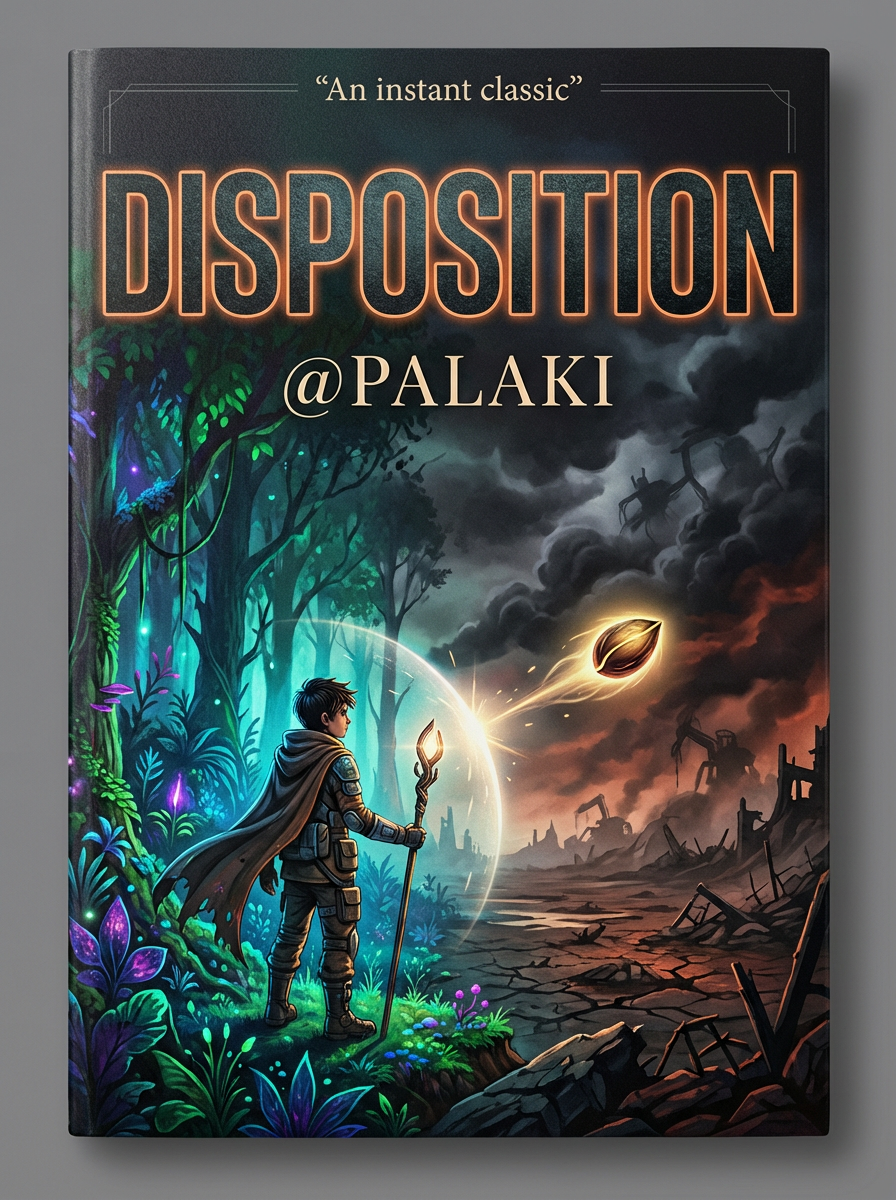
In a desolate 30th-century Earth, the last vibrant forest is the sanctuary and burden of Elias Thorne, a lone ranger battling ruthless corporate interests and desperate newcomers, forcing him to devise a radical, morally ambiguous plan to protect his precious, verdant home from utter annihilation.
Chapter 1: Ashes and Emeralds
The air tasted of ash and rust beyond the invisible boundary, a perpetual iron tang that spoke of dust storms and industrial decay. But within the sanctuary, Elias Thorne breathed deeply, inhaling the damp, earthy scent of humus and the delicate perfume of blooming epiphytes. Here, the sky was a fractured mosaic of green, sunlight dappling through layers of unseen leaves, painting shifting patterns on the forest floor. He moved with the quiet grace of a predator, his lean frame slipping through tangles of ancient vines, each footfall precise, muted. Weathered skin, etched with sun and wind, blended with the dappled light, and his piercing green eyes, ancient and watchful, missed nothing.
Elias was a living anachronism, a flicker of the past in a future that had forgotten how to live. His patched, practical clothing, woven from scavenged fibers and mended countless times, was a uniform of survival. He carried no grand weapons, only the worn multitool at his hip, a hunting knife, and the profound weight of a world on his shoulders. He was the last guardian, a solitary sentinel in a colossal, verdant cathedral, the only place on Earth where life still hummed with genuine vibrancy.
The forest was a teeming tapestry, each organism a thread. He knew them all. The whispering wind through the colossal crimsonwood, whose roots ran deeper than any skyscraper. The chittering of iridescent leaf-hoppers on the broad, waxy fronds of the canopy. The rhythmic thrum of the underground aquifers, the lifeblood of this emerald heart. It was an encyclopedic knowledge, learned not from data-slates, but from generations of lived experience, passed down through whispers and observations, now held solely by him. He was a keeper of secrets, a living library of nature's forgotten language.
He paused by a gnarled, luminous fungus, its bioluminescence pulsing faintly in the undergrowth. A rare strain, vital for the forest’s delicate bio-luminescent cycle. A single touch, a caress of his calloused fingers, and he felt the delicate thrum of its life force. He had witnessed the slow death of the world outside, the desertification, the toxic winds, the endless grey. He carried the grief of it, the ghosts of a thriving planet haunting his memories, mingled with the faces of his parents, who had taught him to listen to the silent symphony of the trees before they, too, became part of the dust.
The forest was beautiful, yes, but it was fragile. Every vibrant hue, every rustle of leaf, every chirping insect was a testament to its precarious existence, constantly battling against the encroaching desolation. Elias was the shield. He patrolled its periphery, mapping the encroaching blight, cataloging the subtle shifts in climate that threatened its delicate balance. The responsibility was a heavy cloak, woven with solitude.
Suddenly, a tremor. Not the familiar rumble of an underground current or the distant echo of a meteorological event. This was different. A deep, resonant thrum, a vibration that resonated through the very root system, a metallic groan that spoke of massive machinery tearing through rock. Elias froze, his senses stretched taut. He pressed his ear to the moss-covered earth, feeling the rhythmic pulse intensify. It was still faint, a whisper of a distant threat, but it was growing. It was coming from the northwest, the direction of the old abandoned mining sites, long since stripped bare, or so he had thought.
A shadow passed over his face, hardening the lines around his eyes. He had known this day would come. The world outside, starved and desperate, would inevitably turn its hungry gaze towards the last untouched Eden. He had held them off before, scattered scavengers, desperate nomads, but this felt different. More organized. More powerful.
He climbed, not with ropes or technology, but with the fluid ease of a creature born to the canopy. Up the massive trunk of a sky-reaching ironwood, his hands and feet finding purchase in bark crevices and natural footholds. Higher and higher he ascended, until he broke through the lower canopy, then the middle, finally emerging into the blinding upper layer, suspended above a world of emerald and gold.
From this vantage point, the forest stretched out beneath him like an endless, rippling sea, a vibrant green bruise on the pallid face of a dying planet. And beyond it, staining the horizon, was the dull, monotonous khaki of the barren badlands, stretching to meet a sky perpetually hazed with ochre dust. He scanned the distant landscape with eyes sharper than any sensor.
There, on the distant horizon, a faint line of dust. Not a natural dust storm, but localized, moving. Behind it, a glint of metal, like a predator’s eye. Then another. And another. A small convoy of hulking vehicles, bristling with unseen technology, crawling across the wasteland. They were Apex Corporation. He knew their symbol, splashed across discarded data-slates and derelict automated drones that sometimes sputtered their way too close to his border. They were the architects of this desolation, the masters of the corporate dystopia, the endless extraction, the unending hunger.
A cold certainty settled in his gut. They weren't just passing through. They were here for the forest. His forest. The tremor grew stronger, a persistent low hum that vibrated through the ironwood, a prelude to an assault.
Elias descended as swiftly as he had climbed, his mind already racing, calculating distances, resources, vulnerabilities. He had prepared for this, as much as one man could prepare to face an industrial leviathan. He had booby traps, warnings, hidden pathways, all woven into the very fabric of the forest’s defense. But a gnawing fear, ancient and cold, tightened its grip around his heart. Could he truly protect this vast, living entity against an enemy with limitless resources and no moral compass?
He reached the forest floor, his landing softer than a falling leaf. He moved towards his hidden cache, a subterranean alcove hewn from rock and shored with ancient timber. Inside, a rudimentary comms unit, scavenged and painstakingly repaired, hummed faintly. A map, holographic and painstakingly detailed by hand, glowed with various markers — resource points, patrol routes, potential infiltration zones. Next to it, a small, worn photograph, its colors faded but the faces still discernible: his parents, youthful and smiling, surrounded by a vibrant, long-dead meadow. He touched it briefly, a silent vow to the past, before turning his focus back to the encroaching future.
The sun began its slow, crimson descent, painting the sky in garish shades of orange and bruised purple, a fitting backdrop for the encroaching darkness. The wind changed, carrying with it a faint, acrid scent of burnt bio-matter, a familiar smell from the barren lands, a testament to Apex's destructive footprint.
Elias didn’t sleep that night. He patrolled the forest’s edge, a silent shadow in the bioluminescent gloom. He heard the distant grind of machinery, the faint, disembodied voices carried on the wind, the occasional harsh beam of a distant searchlight cutting through the dust-hazed darkness. Apex Corporation was setting up. They were staking their claim.
He stopped at a sheer rock face that marked the northwestern boundary, a natural fortress overgrown with tenacious ferns. Below, beyond the forest’s immediate embrace, the land dissolved into a scorched, pockmarked expanse. A new light flickered there, a beacon of cold, clinical white against the desolation. A temporary outpost. The first clawmark.
His hand tightened on the hilt of his knife. His moral compass, once a clear northern star, had long since become a swirling vortex, twisted by the grim realities of this world. To protect this last bastion of life, he knew he would have to make choices that would chill the blood of any ‘civilized’ man. The forest demanded it. His ancestors demanded it. His survival, and the survival of all creation, depended on it.
And so, as the first rays of a jaundiced dawn broke over the horizon, painting the sky in sickly yellows and greens, Elias Thorne stood poised on the threshold of war. The ashes of the old world had given way to the emerald resilience of the new, and he, its lone protector, was ready to burn it all down to save it. His emerald eyes, usually calm and reflective, now burned with a cold, desperate fire. The tremor was no longer distant. It was at his doorstep.
Chapter 2: The Whispers of Progress
The tremor from yesterday had faded, a ghost in Elias’s memory, but its echo remained, a tightening in his gut. Today, the world outside his emerald sanctuary breached the invisible wall he had so meticulously constructed.
He’d been checking the perimeter traps, a routine chore that kept the forest’s delicate balance in check against the ravages of small, desperate scavengers. The sun, a pale, anemic orb in the perpetual haze, cast long, distorted shadows through the dense canopy. A glint of reflected light, alien and out of place among the natural greens and browns, snagged his attention. Not metal, not a drone. Fabric.
He moved silently, a whisper himself among the rustling leaves, his patched clothing blending with the undergrowth. His heart, usually a steady drum within his chest, quickened. It had been years since he’d seen another human face not reflected in a cracked piece of scavenged mirror.
What he found was a crude shelter, cobbled together from torn plastic sheeting and spindly branches, nestled precariously at the edge of the forest. Near it, three figures. A man, gaunt and stooped, huddled over a sputtering fire, trying to coax warmth from damp kindling. A woman, slender yet somehow radiating resilience, sat beside him, cradling a small form. And a boy, no older than Finn, his own lost brother, clutching a tattered, fabric toy.
Liam Hart, Elara Hart, Finn Hart. The names floated unbidden into his mind, the way he cataloged every species of plant, every unique rock formation. He watched them for a long moment, piercing green eyes raking over their worn clothes, their hollowed cheeks, the desperation etched into their very posture. They were the world, distilled into three frightened souls. The world he had fled, the world he protected himself from.
A stick snapped under his boot. All three heads whipped up, their movements jerky, filled with a primal fear. Elias remained still, a statue carved from shadow and regret.
“Who’s there?” The man, Liam, croaked, his voice raspy with thirst and disuse. He fumbled for something at his side – a sharpened piece of rebar, rusty and pathetic.
Elias stepped into the sliver of sunlight filtering through the leaves, his face grim, his weapon – a scavenged bolt-action rifle, well-maintained and deadly – held loosely at his side. He didn’t raise it, but its presence was a clear statement.
Elara gasped, pulling the boy, Finn, closer, her eyes wide with a mixture of terror and a faint, fragile hope. Finn, with his wide, innocent eyes, stared at Elias, then at the rifle, then back at Elias, as if trying to reconcile the image of a man with the stark reality of the weapon.
“You’re… you’re real,” Liam whispered, the rebar clattering to the ground as his strength seemed to desert him.
Elias said nothing. He simply looked at them, assessing, calculating. They were starving, dehydrated, and clearly at the end of their rope. They posed no immediate physical threat, but their presence was a threat of another kind entirely.
“We mean no harm,” Elara said, her voice softer, though still trembling. “We just… we saw the green. We heard the old stories. We didn’t think it was true.”
Elias’s gaze sharpened on Elara. She possessed a quiet strength, an almost defiant humanity that unsettled him. “This isn’t a refuge,” he finally said, his voice a low growl, unused and rough. “It’s protected.”
“Protected?” Liam echoed, a bitter laugh escaping him. “From what? The dust? The hunger? People like us, trying to survive?”
“From everything,” Elias countered, his eyes sweeping over the ancient trees, the vibrant undergrowth. “Especially from people like you. You bring the dust with you. The decay.”
Finn, clutching his worn toy, peeked out from behind Elara. “Are you a tree-man?” he asked, his voice a small, curious chirp.
Elias flinched, the unexpected innocence a punch to his gut. He remembered his own childhood, his father telling him stories of the forest, weaving tales of its protectors. He was no tree-man. He was just a man, holding back an ocean of ash with nothing but his bare hands and a lifetime of grief.
Elara’s elbow nudged Liam. “Please,” she pleaded, her eyes fixed on Elias. “We can’t go back. There’s nothing left out there. Just…” She gestured vaguely towards the dust-choked horizon. “We’ll be careful. We won’t touch anything.”
“You already have,” Elias said, his voice flat. “By being here.” He knew he sounded cruel. He knew it was necessary. Any breach, any crack in his solitude, risked everything.
The moral complexities gnawed at him, a dull ache beneath the stoic facade. His primary directive was the forest. His personal feelings, his hidden grief for the humanity he’d lost, had to be secondary. One life, three lives, versus the last bastion of life on Earth. The choice, in his mind, was tragically clear.
“You must leave,” he stated, his grip tightening on his rifle. “Now.”
Liam, spurred by Elias’s unwavering resolve, tried to stand, then swayed, putting a hand to his head. “We can’t,” he rasped. “Finn… he’s sick. Been sick since before we left the last settlement. The dust, it’s in his lungs.”
Elias looked at Finn, at the faint tremor in his small frame, the paleness of his skin. He knew the dust sickness. He had watched countless succumb to it, including his own parents. The forest did not offer immunity to something already pervasive in the air. Yet, for a brief, terrifying moment, something within him hesitated. He remembered his brother, small and vulnerable, succumbing to the coughs and the slow, suffocating decline.
“The forest… it’s cleaner here,” Elara said, sensing his flicker of humanity. “Maybe… maybe it could help him breathe.”
Elias closed his eyes for a fraction of a second, battling the ghosts of his past. He opened them, his gaze hardening once more. “I can’t. This isn’t a hospital. It’s not a shelter for the dying.” He knew the words were brutal, designed to cut, to drive them away. “Go back the way you came. There might be others.”
Liam, surprisingly, found a reserve of strength. “Others like us, you mean? Scavenging in the dust until we drop dead? We’ve seen them. There’s nothing to go back to.” He pointed a trembling finger at Elias. “You live here, in this… this paradise, while the rest of us choke. You think you’re better than us?”
Elias felt a surge of cold fury. “I don’t think anything about you. I just protect what’s mine. What’s left.” He raised his rifle, aiming not at them, but at a bare branch high above, and fired. The crack of the shot echoed through the sudden silence, a violent punctuation mark to his threat. The branch splintered, falling harmlessly to the ground.
Finn whimpered, burying his face deeper into his mother’s side.
“Leave,” Elias repeated, his voice low, dangerous. “Or you will regret it.”
Elara, with a haunted look at Elias, then at her small, trembling son, began to help Liam to his feet. She shot Elias one last, unreadable glance, a mixture of despair and a flicker of something close to understanding. They began to gather their meager belongings, Liam leaning heavily on her. As they hobbled away, Finn looked back, his innocent eyes meeting Elias’s for a moment, a silent question hanging in the air. Elias felt a familiar, sickening twist in his stomach, the same one that always accompanied necessary cruelty.
He watched until their gaunt figures disappeared back into the hazy, desaturated landscape, then turned, his shoulders slumping, and plunged deeper into the welcoming shadows of the forest. The air still tasted of their desperation, clinging to his tongue like ash.
***
The drone reports were far less ambiguous, far less emotionally charged, and therefore, in some ways, far more terrifying. Elias was hunched over his makeshift console, a relic of pre-Collapse technology he had painstakingly restored and maintained, powered by scavenged solar panels and a micro-fusion generator of his own design. The air was thick with the scent of ozone and damp earth.
His automated scouting drones, small, bird-like machines designed to blend with the environment, had been pushed further than ever before. He had felt the tremor; he knew something was coming. He just hadn't wanted to believe it, not really.
The screen flickered to life, displaying a fragmented satellite image. A massive land train, a behemoth of steel and reinforced ceramic, churned across the cracked, barren plains. Its sheer size was staggering, a moving city of industry. Behind it, a convoy of smaller, heavily armored vehicles, all bearing the stark, angular logo of the Apex Corporation.
“Damn them,” Elias muttered, his voice raw.
He zoomed in, his fingers flying across the worn interface. Dr. Kira Hansen. Commander Victor Sterling. The names, culled from intercepted comms and corporate manifests, scrolled across his screen. Apex. The corporate leviathan that had cannibalized what little remained of planetary resources, leaving behind dust and desperation in its wake. They had been moving eastward for months, a slow, inevitable crawl. And now, they were here.
The drones provided startlingly clear schematics of the land train itself. Mobile refining units. Heavy excavation equipment. And then, the chilling detail: “Resource Specific Scanner – Bioprinter Protocol.”
Bioprinter Protocol. The words sent a cold dread through Elias. He knew what that meant. Apex wasn’t just here for some forgotten mineral deposit. They were here for something unique to *his* forest. Something that could only be found here. Something alive.
A series of infrared scans followed, revealing heat signatures within the land train. Hundreds of them. Not just workers, but trained security personnel. Commander Sterling’s notorious “Peacekeepers,” as Apex euphemistically called them. Brutes. Mercenaries.
Elias’s gaze sharpened on another report, a coded comms intercept from Dr. Kira Hansen to a high-ranking Apex executive. His translation software highlighted key phrases: *“High-yield biomass indicators… unparalleled genetic integrity… potential for rapid replication… project critical for planetary terraforming initiative… minimal losses acceptable…”*
Terraforming? They wanted to replicate his forest, not just destroy it. The irony was a bitter taste in his mouth. They sought to steal its very essence, not to save the world, but to fuel their insatiable expansion, to create more sterile, managed environments under their corporate thumb.
Minimal losses acceptable. That meant him. That meant any life that stood in their way.
He opened a file he rarely consulted, one filled with historical data, geological surveys from before the Collapse. He specifically searched for "rare earth elements" and "biological anomalies" within his forest’s coordinates.
His eyes snagged on a single, alarming entry. A unique mycorrhizal fungus, previously thought extinct, thriving in the forest’s subsoil, symbiotic with the ancient sequoia-analogue trees. Its properties, described in archaic scientific terms, spoke of incredible resilience, rapid nutrient cycling, and… a faint, almost mystical, energy signature.
Apex wasn’t just after wood or clean water. They were after the very soul of the forest. The symbiotic network that made it so vibrant, so resistant to the ash. They wanted to dissect it, exploit it, replicate it solely for their profit.
Elias felt a cold rage building within him, replacing the familiar ache of solitude with a burning purpose. He had thrown out three desperate souls to protect this. Now, an army of steel and greed was coming to take it all.
He activated his internal comms, a secure network linked only to his various defense systems and surveillance drones. “Status report,” he barked, his voice carrying an edge of steel.
Across the forest, various automated systems responded in a series of blips and chirps. Perimeter sensors, ground traps, camouflage nets… all active. But he knew it wouldn’t be enough. Not against Apex.
He pulled up another screen, displaying a complex topological map of the forest and its surrounding wasteland. His eyes traced lines, identified choke points, potential ambush locations. He had built this sanctuary, maintained it through sheer willpower, and he would not let it fall. Not to Apex. Not to anyone.
The image of Finn’s innocent, questioning eyes flashed in his mind, followed by the stark, unwavering corporate logo of Apex. He had made his choice regarding the refugee family – a choice born of his singular, desperate purpose. Now, that purpose was about to be tested as never before.
The whispers of progress, as Apex called their relentless march, were not gentle. They were the thunder of heavy machinery, the glint of corporate steel under a dying sun, and the cold, unfeeling calculations of men and women driven by profit over life. Elias Thorne, the solitary guardian of the world’s last emerald, knew his fight was about to begin. And this time, there would be no turning back.