Daughter of the Cave
By Mikael Löwgren
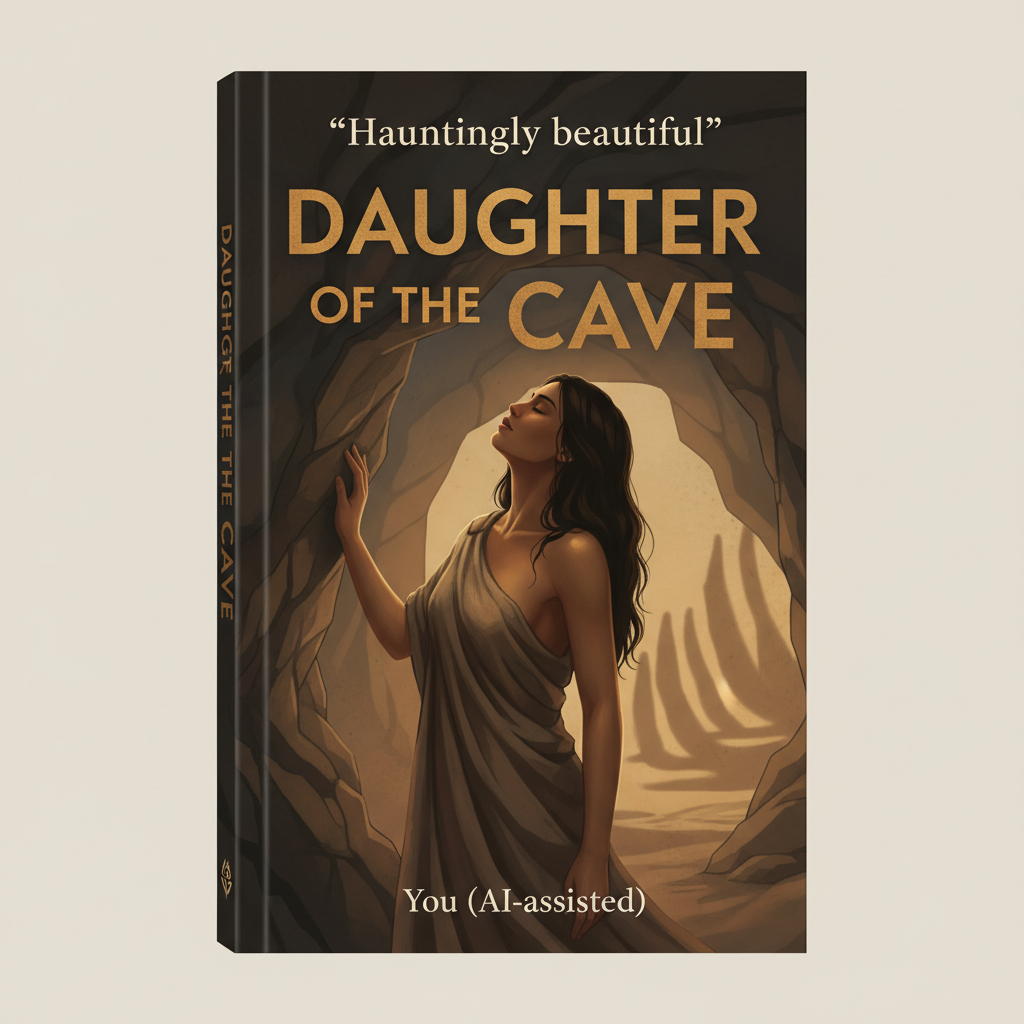
Synopsis
In a primal world where the whisper of the wind carries both danger and ancient wisdom, a young woman's journey of self-discovery is inextricably linked to the survival of her clan and the blossoming of forbidden love.
Chapter 1: The Chill of the Dawn
The chill of the dawn bit at Ayla’s exposed skin, a familiar, unwelcome greeting from the turning world. She shivered, pulling the rough hide closer, its animal scent a comfort against the lingering cold of the night. Her breath plumed in the air, a fleeting ghost against the vast, dark expanse of the cave mouth. Outside, the last vestiges of stars, pinpricks in the velvety black, began to dim, surrendering to the encroaching pallor of the coming day.
Inside the deep cavity of the cave, the air was thick with the scent of woodsmoke, old ash, and unwashed bodies. Her clan still slept, a muffled symphony of snores and murmurs. Ayla could discern the rhythmic breathing of her mother nearby, and the smaller, quicker puffs of her younger brother, Brolin. Her own place, a small hollow scooped from the packed earth, felt both confining and safe.
She pushed herself up, her joints creaking softly in protest. Her eyes, still heavy with sleep, swept over the huddled forms. Each one a life, inextricably linked to hers, a tiny flicker in the immense, indifferent wilderness that lay beyond their fragile sanctuary. She knew them all, every curve of their sleeping backs, every unique snore, every whispered dream word. They were her family, her protectors, her burden, and her future.
Ayla’s gaze drifted to the dying embers of the central fire. A few red coals pulsed faintly, like sleeping hearts. Soon, someone would stir, and the daily ritual of rekindling the flame would begin. It was always so. The fire, the lifeblood of their existence, was never truly allowed to die. Its warmth kept predators at bay, cooked their meager meals, and offered a focal point for their weary spirits.
Her stomach rumbled, a sharp reminder of the previous night’s meager supper. A few strips of dried meat, tough and sinewy, shared amongst too many mouths. The autumn hunt had not been as bountiful as hoped, and the cold season was already beginning to tighten its grip on the land. Anxiety, a cold knot in her belly, had become a constant companion.
She rose silently, careful not to disturb the others. Her feet, calloused and thick, moved soundlessly over the uneven ground. Her long, tangled hair, the color of rich earth, fell about her shoulders, offering a small measure of warmth. She wore only a simple tunic of prepared deer hide, its edges worn smooth by countless rubbings against her skin.
At the cave mouth, the light grew stronger, painting the eastern sky with faint streaks of rose and apricot. A flock of swift-winged birds, dark against the brightening horizon, cut through the air with purposeful precision. Their early flight was a signal, a harbinger of another day lived on the razor’s edge.
Ayla stepped outside, inhaling deeply. The air was crisp, clean, and bracing. It carried the scent of pine, damp earth, and something wilder – the faint, musky scent of animals that had stalked the night. She scanned the immediate surroundings, her senses sharpened by instinct and years of training. Every rustle of leaves, every snap of a twig, every distant cry carried a potential message: food, or foe.
Their cave overlooked a narrow valley, carved by a swift-running river that now glinted silver in the emerging light. On the opposite bank, a thick forest of ancient trees, their branches heavy with needles, stretched towards the sky. Beyond that, the land rose sharply, culminating in jagged, snow-capped peaks that seemed to pierce the very heavens. It was a world of breathtaking beauty and brutal indifference.
She walked to the edge of the small plateau where their cave was nestled, her eyes continuing their ceaseless survey. A faint trail, worn smooth by generations of footsteps, led down to the river. It was there they gathered water, and sometimes, if fortune favored them, caught fish.
As the sun’s first golden rays touched the highest peaks, painting them in hues of orange and gold, Ayla felt a familiar ache in her chest. It was a yearning she couldn’t quite name, a restless stirring that set her apart from the quiet acceptance of her clan. They lived for survival, for the perpetuation of their line, for the simple rhythms of life and death. Ayla, too, understood these imperatives, but she felt a pull towards something more, something undefined and elusive, hidden just beyond the visible world.
Her brother, Brolin, was the first to emerge from the cave, yawning widely and scratching at his tangled hair. He was barely seven winters old, all gangly limbs and bright, curious eyes. He still held the innocence of childhood, untouched by the deeper anxieties that plagued the adults.
“Ayla,” he mumbled, his voice thick with sleep. He shuffled towards her, seeking the familiar warmth of her presence.
She smiled, a rare, soft curve of her lips. “Good morning, little brother.” She ruffled his hair, a gesture of affection they both readily accepted.
He leaned against her, his small body a warm weight. “Are we going to find berries today?” he asked, his voice now imbued with the eager hope of a child.
Ayla sighed inwardly. Berries were long gone, claimed by the biting cold and the hungry mouths of winter animals. “Not today, Brolin. Soon, though. When the sun returns in full.” She hoped her voice carried conviction, even though she knew such a season was many moons away.
More clan members began to stir, their forms emerging from the cave like shadows stretching with the dawn. Her father, Theron, a stoic and powerful man, was among the first. He was the clan’s hunter-chief, his broad shoulders and weathered face bearing the weight of their survival. His eyes, dark and sharp, met Ayla’s across the clearing. A silent acknowledgment passed between them. He saw the girl, but also the nascent woman, the one whose keen eyes and agile hands were becoming increasingly vital to their small band.
Theron moved with a quiet authority, his movements economical and purposeful. He went straight to the dying fire, kneeling and carefully coaxing the faint embers back to life. He added small, dry twigs, blowing gently until a tiny flame flickered, then grew, devouring the fuel with greedy hunger. The light danced across his craggy features, highlighting the lines etched by sun, wind, and worry.
Soon, the crackle and warmth of the rekindled fire drew the clan together. Women moved with practiced ease, preparing for the day’s tasks. They gathered small bundles of dry grass to use as tinder, checked their hide bags for tools, and whispered among themselves, their voices low and comforting. The men, for their part, began to sharpen their hunting spears and inspect their bows, their faces grim and focused. The demands of the hunt were paramount.
Ayla watched them, her heart a tangled mix of love and longing. She loved her people, had always known only their company. Their ways were her ways, their stories her stories. Yet, the longing persisted, a whisper of something beyond the cave, beyond the valley, beyond the familiar routines.
She felt the gaze of Elara, her grandmother, fall upon her. Elara was the oldest woman in the clan, her face a roadmap of ancient wisdom and resilience. Her eyes, though clouded with age, still held a piercing intelligence. Elara always seemed to see more than others, to understand the unspoken.
“Dreaming again, Ayla?” Elara’s voice, raspy with age, was surprisingly gentle.
Ayla turned, a faint blush warming her cheeks. She knew her grandmother saw her yearning. “Just watching the dawn, Grandmother.”
Elara nodded, her gaze sweeping over the valley. “The dawn reveals much. But it also hides much, child.” Her words were laced with a deeper meaning, a warning Ayla was not yet ready to fully grasp.
The clan began to stir in earnest. The smoke from the newly rekindled fire curled upwards, carrying the scent of pine and burning wood into the crisp air. Children, once roused, began to squabble playfully, their laughter a brief, joyous counterpoint to the underlying tension of the adults.
Ayla’s mother, Mara, beckoned her towards the fire. Mara was a kind woman, though her life had been a hard one. Her hands, thick and strong, were skilled in all the tasks of a clan woman – preparing hides, gathering nuts and roots, caring for the young, and keeping the family fed.
“Ayla, fetch the water skins,” Mara instructed, her voice laced with the usual morning urgency. “The men will need them for the hunt.”
Ayla nodded, the familiar command a welcome distraction from her restless thoughts. It was a simple task, one she had performed countless times since she was a small girl. She walked to the deeper part of the cave, where the prepared hides, cured and sewn into watertight containers, lay stacked. Their weight, when full, would be substantial, but Ayla was strong for her sixteen winters. Her muscles, honed by constant activity, were lean and capable.
As she gathered the water skins, her fingers brushed against a small, smooth river stone she kept tucked into a crevice in the cave wall. It was not a tool, not a weapon, just a stone, perfectly shaped, its surface cool and smooth beneath her touch. She had found it years ago, polished smooth by the river, and had kept it for reasons she couldn’t quite articulate. It was beautiful, held a certain silent truth, a sense of enduring presence. She often pondered its journey, how many years it had tumbled in the river’s relentless current to achieve such perfection.
She retrieved the skins, their supple leather rustling softly. As she walked back towards the light, the scent of morning came in stronger. The men were now fully arrayed for the hunt, their spears gripped tightly, their bows strung and ready. Her father, Theron, stood tall among them, his expression a mask of hardened resolve.
He met Ayla’s gaze again, and this time, his dark eyes held a weight of unspoken concern. “Ayla,” he said, his voice deep and measured, “be careful today. The forest is quiet.”
Ayla understood. The quiet forest was often more dangerous than the noisy one. It meant predators were about, stealthy and unseen. “I will, Father.”
He gave a curt nod, then turned to his men. His words were few, but they carried the weight of experience. He spoke of the wind, of tracking signs, of the patience required. As he spoke, Ayla could feel the fear and determination emanating from the group. Hunting was their highest-stakes gamble, the thin line between survival and starvation.
The men moved out, their leather-clad forms disappearing quickly into the encroaching woods. Ayla watched them go, a pang of fear and worry twisting in her gut. Every hunt was a risk, a constant dance with death. She knew some would not return. It was the way of their world.
With the hunters gone, the women and children settled into their daily routines. Some began to process leftover hides, scraping and softening them with bone tools. Others sorted through dried roots and herbs, preparing them for storage or use in poultices. Brolin and the other children chased each other, their shouts echoing in the clear air, until a sharp word from one of the older women quieted them.
Ayla picked up her own basket, woven tightly from dried reeds. Her task today was to gather what small, edible roots and dried berries remained on the fringes of the forest, avoiding the deeper, more dangerous areas. She would also check the snares they had set for small game. It was a tedious, often frustrating task, requiring keen eyes and endless patience.
She tied her basket to her back, adjusting the leather straps across her shoulders. The weight of it settled comfortably. She looked out once more at the vast, wild landscape, a sense of both dread and exhilaration stirring within her. It was a world that demanded strength, resilience, and an unyielding will to live.
As she began her descent down the worn path, her senses fully alert, a whisper of wind rustled through the dry leaves. It carried the faint, enticing scent of something distant, something unknown. It was a promise, or perhaps a warning, hinting at possibilities beyond the familiar confines of her world. Ayla paused, her hand instinctively going to the small, smooth river stone hidden in the pouch at her waist. A silent, questioning gaze flickered in her eyes, a longing for something that lay just beyond the edge of her knowing. The day had begun, and with it, the uncertain journey into the unknown.
Chapter 2: Echoes of the Hunt
The sun, a pale eye in the vast morning sky, had barely climbed above the jagged horizon, painting the eastern cliffs in hues of bruised purple and watery gold. A chill still clung to the air, tasting of damp earth and woodsmoke from the banked fire, but Ayla felt a different kind of shiver ripple through her. It was not from the cold, nor the familiar tremor of anticipation that preceded a good day’s foraging. This was a prickling unease, a tightening in her belly that she had learned, in her short years, to heed.
Today was a root-gathering day, a task typically left to the women and the younger children who were not yet skilled enough for the hunt. Ayla walked a little apart from the chattering group, her worn hide tunic rustling softly with each step. Her basket, fashioned from tightly woven willow branches, swayed rhythmically against her hip. She watched the others, her mother, Alta, amongst them, her laughter bright as she pointed out a patch of early spring greens to a younger woman. Ayla often felt a disconnect, a small, subtle separation from the easy camaraderie of the women, though she tried to melt into their rhythm, to mimic their easy gait and their relaxed expressions. Yet, an inner tension often pulled at her, a sensing of things beyond the immediate.
Her nose, sharper than most, twitched. A faint scent, carried on the breath of the rising breeze, tickled her nostrils. It was not the sweet decay of fallen leaves, nor the earthy perfume of awakened soil. This was something else, something… predatory. It was a familiar ghost, the scent of the meat-eater, but diluted, distant.
She paused, her head cocked, listening. The rhythmic thud of their own footsteps, the murmur of voices, the rustle of dry grasses beneath their weight – all these everyday sounds were clear. But beneath them, a subtle silence seemed to ripple through the forest, a hush that animals understood instinctively, and Ayla, too, found herself attuned to its subtle message. The usual twittering of small birds was absent, replaced by an eerie stillness. Even the insects seemed to hold their breath.
Alta, noticing her daughter’s sudden halt, turned. “Ayla? What is it? You lag behind.” Her tone was gentle, but carried the expectation of obedience.
Ayla didn't answer immediately. Her eyes, the color of moss-covered stones, scanned the treeline, searching, her gaze piercing the dappled shadows. She sniffed again, deeper this time, letting the air fill her lungs, separating the myriad smells of the forest. The faint, musky odor was stronger now, a hint of something feline, something powerful.
“There is… a scent,” Ayla finally whispered, her voice low, almost a breath.
Alta gave a small, indulgent chuckle. “The forest is full of scents, child. Come, the best roots are further up the slope.” She gestured with her digging stick, its tip hardened by fire.
Ayla, however, remained rooted. Her gaze fixed on a clump of dense evergreens, their needles dark against the lighter foliage. “No, Mother. Not the usual scents. The scent of… stripped muscle. Of danger.”
A few other women had turned, their expressions ranging from mild curiosity to a touch of annoyance. Young Ayla was often prone to these flights of fancy, these moments of intense, almost unnerving perception. It was her way, but it could be disruptive.
One of the older women, Elara, whose face was a map of deep lines etched by sun and wind, squinted at Ayla. Elara was a skilled gatherer, her knowledge of roots and herbs unparalleled, but she had little patience for what she considered fanciful imaginings. “You are imagining things, Ayla. Too much dreaming makes one’s eyes see what is not there, and one’s nose smell what has long since passed.”
Ayla bit back the retort that sprang to her lips. She knew what she smelled. She could almost taste the fear, the raw power that emanated from that barely detectable trace. It was the scent of the great stripped cats that roamed these lands, their paws as silent as falling snow, their hunger vast.
She took a step forward, away from the group, drawn by an instinct she couldn’t ignore. The ground was softer here, a carpet of fallen leaves and pine needles. Her eyes, usually so sharp, now scoured the earth, seeking a sign, a confirmation. And then, there it was. A faint depression in the damp soil, barely discernible, but unmistakable to one who had spent hours studying the prints of the forest creatures. A large, rounded print, lacking the claw marks of a wolf, showing the tell-tale indentation of a padded foot. A cat. A very large cat.
“Look!” Ayla pointed, her voice a low cry of discovery. “Here! The tracks!”
The women gathered around, their lighthearted chatter silenced. Elara knelt, a crease of doubt beginning to form on her brow. She touched the ground, her fingers feeling the subtle compression. Then her eyes narrowed, tracing the almost invisible line of the print. It was indeed a cat print, larger than any she had seen in these immediate hunting grounds for many turns of the moon.
Alta, seeing Elara’s change of demeanor, felt a prickle of alarm herself. Her daughter, for all her youthful intensity, rarely cried wolf falsely. If Elara, seasoned and pragmatic, was concerned, then there was cause for their collective unease.
“How old?” Alta asked, her voice hushed.
Elara ran her fingers along the edge of the print. “Fresh. Not long past. The soil is still damp within the hollow.” Her gaze swept the surrounding trees, now with a new intensity. The pleasant day had turned, subtly, ominously.
A wave of fear, cold and sharp, rippled through the small group. The women instinctively drew closer together, their baskets clattering softly against each other. Gathering roots suddenly seemed an infinitely less pressing task. Their eyes darted nervously from one shadow to another, seeing danger in every rustling leaf, every snapping twig.
“We should turn back,” one of the younger women whispered, her face pale.
“And leave the day’s meal wanting?” Elara countered, though her voice lacked its usual conviction. The scarcity of food was a constant companion, a more insidious threat than even the immediate danger of a predator. To return empty-handed was to face the slow gnawing of hunger, a threat just as potent as sharp claws and teeth.
Ayla, however, had moved beyond the initial fear. A strange exhilaration, cold and sharp, now coursed through her veins. Her senses, once on edge, seemed to have sharpened further, honed by the very presence of danger. She scanned the treeline, not with terror, but with a hunter’s focused intensity. She knew, with an uncanny certainty, that the cat was near. She could feel its presence, a low thrumming in the air, a tension in the undergrowth.
“It watches us,” Ayla murmured, not to anyone in particular, but to the forest itself. Her eyes fixed on a dense thicket of blackberry bushes, where the shadows seemed a little deeper, a little more absolute than elsewhere.
Just then, a small, terrified cry echoed through the quiet woods. One of the young boys, no older than six, who had wandered a little ahead, trying to catch a brightly colored beetle, stumbled back, his eyes wide with uncomprehending terror. He pointed with a trembling finger towards the thicket.
The flash of movement was almost too fast for the eye to follow. A tawny blur, then a growl, low and guttural, that seemed to shake the very foundations of the earth. A great stripped cat, its fur the color of dry grass, its eyes like molten gold, emerged from the bushes, not fully out, but glaring, its powerful shoulders bunched, its tail twitching. It was a cave lion, larger than any Ayla had ever seen in the few glimpses she had caught.
Panic erupted. The women screamed, a collective, shrill sound of terror. Baskets were dropped, their contents scattering across the forest floor. The women scrambled back, pulling the younger children with them, their movements clumsy with fear. Flight was their only thought.
But Ayla didn't move. Her heart hammered against her ribs, but her mind was clear, impossibly so. She saw the cat’s focus—it was on the boy. The small, vulnerable prey that was now frozen in sheer terror.
Without conscious thought, Ayla snatched up a fallen branch, a stout piece of oak, as thick as her forearm. It was not a weapon against such a beast, she knew that, even as she raised it. It was a defiance, a desperate, primal scream of warning.
“Away!” she cried, a raw, powerful sound torn from her throat. She stepped forward, deliberately placing herself between the lion and the terrified child. Her small, lithe frame, so insignificant against the massive predator, seemed to expand with the sheer force of her will.
The lion, arrested by her sudden, unexpected movement, paused. Its golden eyes, which had been fixed on the child, now swiveled to Ayla. A low snarl ripped through its bared fangs, a sound of ancient warning, of undisputed territorial right. It was a sound that usually paralyzed, that froze the blood.
But something had shifted in Ayla. The fear was still there, a cold knot in her stomach, but it was overshadowed by a fierce, protective instinct. She felt a surge of ancient power welling within her, the spirit of her ancestors, of the huntresses who had walked these lands for countless generations.
She brandished the branch, not as a weapon, but as an extension of her defiant will. She let out another cry, a guttural, almost animalistic sound that spoke of strength and fury. “Away! This is *our* hunting ground! You will not touch him!”
The lion blinked, its heavy head tilting slightly. This was not the typical flight response it expected. This small, frail creature, smelling of soft skin and youth, was challenging it?
For a long, agonizing moment, the world seemed to hold its breath. The forest was utterly silent, save for the thudding of Ayla’s own heart, and the shallow, terrified gasps of the women huddled further back.
Then, with a sudden, unnerving speed, the cave lion lowered its head, its muscles tensing. It bunched its powerful hindquarters, preparing to spring. Ayla knew, in that crystalline instant, that her meager defense was futile. But she did not falter. Her breath caught, her eyes wide, but she stood her ground.
Just as the great cat launched itself forward, a sharp, whistling sound ripped through the air, followed by a dull thud. The lion roared, not in aggression this time, but in pain and fury. An arrow, fletched with eagle feathers, protruded from its massive shoulder, burying itself deep in the muscle.
The sudden pain, the unfamiliar sting, startled the beast. Its charge faltered, its massive body twisting in mid-air. It landed heavily, snarling, tearing at the arrow with its teeth, its golden eyes now blazing with a mixture of pain and bloodlust. It turned away from Ayla and the child, its focus shifted to the source of the unexpected attack.
Through the trees, a group of hunters emerged, their faces grim, their bows drawn. Their leader, a tall, powerfully built man with a scar running down his cheek – Jon, Alta’s brother, Ayla’s uncle – stared at the retreating lion, then at Ayla, still standing defiantly, the fallen branch clutched in her hand.
The lion, wounded and confused, let out a final, frustrated bellow as the hunters, moving with practiced efficiency, began to surround it. It knew when it was outmatched. With a swift, powerful leap, it vanished back into the dense thicket, leaving a faint trail of crimson on the forest floor.
The tension, held taut for so long, suddenly snapped. The women surged forward, Alta among them, rushing to Ayla, their cries a jumble of relief and concern. Alta pulled her daughter into a fierce embrace, her hands running over Ayla’s hair, her face, as if to reassure herself that she was whole, untouched.
“Ayla! My brave, foolish child!” Alta sobbed, half-chiding, half-praising.
Ayla, now that the immediate danger had passed, felt her knees tremble. The branch slipped from her grasp, falling with a soft thud. Her defiant pose crumpled, and she leaned into her mother’s embrace, shaking, the cold sweat of fear now clinging to her skin.
Jon approached, his expression unreadable. He looked at the retreating tracks of the wounded lion, then back at Ayla, his gaze holding a new regard. He had seen her, standing alone, facing down the great beast. He had seen the raw, untamed courage in her eyes, the stark defiance that had bought them the precious moments needed for the hunters to arrive.
“You… you stood against it,” he said, his voice deep, gravelly. It wasn’t a question.
Ayla could only nod, still trembling.
Elara, her face now devoid of her earlier skepticism, walked up to Ayla, her old eyes studying the girl with a newfound respect. She reached out a gnarled hand and gently touched Ayla’s shoulder. “She sensed it first. She knew. We should have listened.” Her words were a quiet admission, a rare concession from the elder woman.
Ayla looked from Elara to Jon, then to the women who now regarded her with something akin to awe, not just relief. Her heart, though still thrumming with the aftershocks of fear, swelled with a strange pride. She had faced the beast, and she had not fled. She had not been helpless.
The hunt for the wounded lion would commence now, a dangerous pursuit that would occupy the men for the rest of the day, perhaps longer. But as the sun climbed higher, casting long, slender shadows through the trees, Ayla felt a seed of understanding begin to sprout in her own heart. The whispers of the wind, the scents of the forest, the subtle signs of danger – these were not just random sensations. They were messages, a language she was learning to understand. And in this harsh, beautiful world, where survival was a daily struggle, such understanding was not merely a gift. It was a potent, undeniable strength.
As the women gathered their scattered baskets, their chatter muted, filled with the lingering echo of fear and the awe of what had transpired, Ayla looked back towards the thicket where the lion had disappeared. The forest, so recently a place of everyday tasks, now hummed with a different energy. She was no longer just a girl gathering roots. She had stood on the precipice of danger, and she had looked it in the eye. And in that terrifying, exhilarating moment, she had found a part of herself she never knew existed: the nascent spirit of a protector, a warrior in the making. The echoes of the hunt would follow her, guiding her steps into a future that was, even now, beginning to unveil itself.
Chapter 3: The Lore of the Ancients
The lingering scent of dried blood and charred wood still clung to Ayla’s hunting tunic, a grim reminder of the close call. Her hands, usually adept at braiding wild grasses or shaping clay, twitched with a residual tremor when she thought of the snarling fangs. But more than the fear, a new sense of purpose had taken root within her, an understanding of the delicate balance between life and death that pulsed in the ancient woods. It was this burgeoning awareness, perhaps, that drew her footsteps toward the solitary dwelling at the edge of the camp, a place usually skirted with a mixture of reverence and unease.
The Elder’s cave was not a cave in the common understanding, but rather a shallow overhang carved into the living rock face, its mouth almost hidden by a tangled curtain of ancient vines. A single plume of smoke, thin and blue against the morning sky, was the only sign of life. Ayla hesitated, her bare feet silent on the frosted earth. She had seen the Elder before, a stooped figure with skin like weathered bark and eyes that seemed to hold the condensed wisdom of countless seasons. They called her Lyra, and whispers followed her name: healer, dream-walker, keeper of the old ways.
Taking a deep breath, the chill air sharp in her lungs, Ayla pushed aside a thick vine. The air inside was warm, thick with the scent of smoldering herbs and something else, something sweet and earthy, like overturned soil after a spring rain. Lyra sat cross-legged on a mat of woven rushes, her back to the entrance, facing a small, flickering fire. Strewn around her were an assortment of dried plants, smooth river stones, and tools crafted from bone and horn. The only sound was the gentle crackle of the fire and Lyra’s soft, rhythmic breathing.
Ayla cleared her throat softly. Lyra did not startle, did not even turn immediately. Instead, a gnarled hand, etched with the roadmap of a long life, reached out and stirred a small clay pot simmering beside the fire. Finally, slowly, she turned. Her eyes, deep-set and the color of moss-covered stones, met Ayla’s. There was no surprise in them, only a calm acceptance.
“The scent of courage follows you,” Lyra’s voice was a low rasp, like dry leaves skittering over rock. “And the taste of curiosity.”
Ayla felt a blush creep up her neck. She had not realized her intentions were so transparent. “I… I came to learn,” she managed, her voice feeling too loud in the quiet space.
Lyra’s lips, thin and pale, curved into a faint smile. “Learn what, child? The path of the hunter is clear, the path of the gatherer, known. What new trail do your feet seek?”
“The plants,” Ayla said, gesturing vaguely to the piles of dried flora. “And… the stories. My mother speaks of your knowledge of healing. And when the cave lions came… I felt something… an awareness before they appeared.”
Lyra nodded, her gaze unwavering. “The world speaks in many tongues, Ayla. Most hear only the loudest roar. Few listen to the whisper of the wind through the tall grasses, or the creak of sap in the bark of the ancient oak.” She gestured to a small stool fashioned from a tree stump. “Sit. There is much to see, little to tell in words.”
And so began Ayla’s apprenticeship. Her mornings, once dedicated to collecting berries or preparing skins, now began at the Elder’s cave. Lyra rarely spoke in direct instruction, preferring to show rather than explain. She would pick a plant, crumble its leaves, and bring it to Ayla’s nose, silently urging her to inhale its essence. “Mint,” she would occasionally murmur, a breathy sound. “For the churning stomach.” Or, holding up a cluster of crimson berries, “Caution. These ease pain, but too many bring sleep eternal.”
Ayla learned the subtle language of the earth. She discovered how certain roots, when pounded and steeped, could draw infection from a wound, or how specific barks, chewed with care, could dull the ache of tired muscles after a long trek. Lyra taught her to distinguish between the vibrant green of life and the sickly pallor of decay, to read the stories etched in the veins of a leaf, and to understand the urgency in the trembling of a dew-kissed petal.
They ventured beyond the immediate vicinity of the camp, Lyra moving with surprising agility for her age, her eyes constantly sweeping the landscape. She taught Ayla to look for the places where the earth held its secrets most closely – the damp hollows where rare fungi thrived, the sunny slopes where certain herbs basked in the warmth, the shadowed crevices where unique mosses clung. Ayla's hands, once somewhat clumsy, grew deft, carefully plucking, stripping, and crushing, her fingers gradually acquiring the tactile memory of each plant.
In the late afternoons, when the sun dipped low and painted the sky in hues of orange and purple, Lyra would turn from the plants to the stories. Not the stories of their immediate clan, of recent hunts and victories, but the deeper, older tales, woven from the fabric of time itself. She spoke of the Great Mother, who birthed the stars and spun the rivers from her tears. She told of the First People, who walked the earth when the animals still spoke plainly, and of the spirits that resided in every rock and tree.
Lyra would sit, her back to the entrance, the fire casting dancing shadows on the cave walls, and her voice would take on a different timbre, resonant and ancient. “Before the First Frost, the Great Bear walked upright, and shared his wisdom with Man,” she would begin, her gaze fixed on the flickering flames. Ayla would listen, mesmerized, piecing together a worldview far older and more profound than anything she had known. The stories were not idle entertainment; they were maps, guides to understanding their place in the vast, interconnected web of life.
One cool evening, as the first stars pricked through the twilight, Lyra pointed a gnarled finger upward. “Look, Ayla. The Hunter’s Belt. It heralds the cold moons.” She traced patterns in the sky with her finger, constellations that Ayla had never noticed before. “The Serpent, coiling across the sky. The Woman, dancing in eternal joy. Each star a pinhole in the blanket of the sky, letting the light of the Great Beyond shine through.”
Lyra taught Ayla to navigate by the stars, to understand their slow, majestic dance across the heavens, to know which ones signaled the changing seasons, which promised the richness of autumnal hunts, and which forewarned of the biting breath of winter. Ayla felt a new dimension open within her, a connection to the vastness above as well as the richness below. The universe was not just sky and earth; it was a living tapestry, each thread contributing to the whole.
The clan, for the most part, left Ayla and Lyra to their own devices. Some of the older women, remembering Lyra’s calming brews for fretful children or poultices for aching joints, nodded with approval as Ayla entered the Elder’s cave. The younger men, engrossed in their own pursuits of hunting and carving, barely noticed. Ayla found herself speaking less, observing more. The frantic chatter of the camp, once a constant backdrop, now seemed distant, a muffled roar. Her senses, sharpened by Lyra’s tutelage, picked up on nuances others missed: the subtle shift in wind direction that foretold a change in weather, the faint scurry beneath fallen leaves that indicated a hidden creature, the unique hum of a blooming plant.
One afternoon, while grinding dried roots with a smooth stone, Ayla ventured a question, her voice hesitant. “Lyra… you spoke of the First People understanding the animals. Do you… do you speak with them?”
Lyra paused in her sorting of a cluster of thorny stems. Her eyes, ancient and knowing, met Ayla’s. “Not in the way you speak to your kin, Ayla. Not with words that flutter on the tongue. But there is a language beyond sound. A language of kinship. A recognition of shared breath, shared earth, shared sky.” She held up a slender feather, iridescent and shimmering. “This feather does not speak, yet it tells of the swift flight of the bird, of its grace, of its freedom. The deer does not speak, yet its tracks tell of its passage, its fear, its hunger. The air carries the scent of the badger, and it warns you to tread carefully.”
Ayla thought of the cave lions, of the cold dread that had tightened in her gut even before the first growl. Was that the language Lyra spoke of? A primal understanding, woven into the very fibre of her being?
“The awareness you felt,” Lyra continued, as if reading Ayla’s unspoken question, “is the stirring of that ancient language within you. Most choose to ignore it, to drown it out with the noise of their own thoughts. But you… you listen.”
Ayla felt a surge of warmth within her, a sense of validation she hadn't realized she craved. It was not just about knowing which herb healed which ailment, or which star guided the way. It was about seeing the invisible threads that connected everything. It was about recognizing the sacredness in every rustle of leaf, every ripple on the water, every beat of a bird’s wing.
As the days blended into weeks, and the vibrant greens of summer gave way to the fiery reds and golds of autumn, Ayla’s knowledge deepened. Her connection to Lyra grew, forged in shared silence and the patient unfolding of ancient wisdom. Ayla felt herself changing, shedding the remnants of her youthful innocence for something more profound, more rooted. She was no longer just a girl of the clan; she was becoming a vessel for something older, something essential.
One evening, as the moon, fat and luminous, rose above the dark silhouette of the hills, Lyra looked at Ayla, a rare, gentle smile gracing her lips. “The moon grows full, Ayla. It breathes abundance into the earth, and draws wisdom to those who seek it. Tomorrow, we will gather the night-blooming herbs. They hold a different kind of power, a power woven from the dreams of the forest.”
Ayla felt a thrill course through her. The night. The dreams of the forest. Her journey into the ancient lore was far from over. It was just beginning, each revelation a new thread in the beautiful, complex tapestry of her destiny. She felt a whisper of anticipation, a nascent sense of her own power beginning to unfurl, like a tightly wound bud preparing to blossom under the pale light of the moon.
Chapter 4: A Flicker of the Other
The autumn sun, a weakening eye in the vast blue, cast long, distorted shadows across the valley. Ayla, her small pack slung over one shoulder, moved through the russet and gold undergrowth with the silent grace of a deer. She had ventured further this day than the Elder had strictly advised, drawn by the whisper of a new herb, a promise glimpsed in a faded рисунок on a cave wall. The Elder’s teachings, slowly unwrapping the secrets of the earth, had only sharpened Ayla’s already acute senses, turning every rustle, every scent, into a question waiting for an answer.
Today, the air felt different. Not the familiar chill that portended winter’s bite, nor the usual earthy perfume of decaying leaves. There was something else, faint but insistent, a metallic tang beneath the sweetness of pine and the sharpness of frost-kissed berries. It was the scent of blood, fresh and disturbing, carried on the crisp breeze.
Ayla stopped, her breath held. Her ears, finely tuned to the pulse of the wild, strained. No snarl of carnivore, no desperate bleat of prey. Just the sigh of the wind through the tall grasses and the anxious thrum of her own heart. She lowered her pack, her hand instinctively going to the small, smooth stone she kept tucked into her deerskin pouch—a gift from the Elder, said to ward off evil.
Curiosity, a potent force that often outweighed fear in Ayla, tugged at her. The Elder had taught her to respect borders, both seen and unseen, but she had also imparted the wisdom of observing, of understanding. And this scent, this unusual stillness, demanded investigation.
She moved forward again, more slowly now, her bare feet pressing lightly against the mossy earth, barely disturbing a fallen leaf. The blood scent grew stronger, leading her to a small clearing nestled between a cluster of ancient oaks. And there, sprawled at the base of the largest tree, was a figure.
Ayla froze, eyes wide, her blood turning to ice. Not an animal. A person. But not one of her people.
He was larger than any man of her tribe, his limbs long and lean, not the compact, powerful build she was accustomed to. His hair, a shock of sun-streaked brown, was pulled back from a face that was narrower, more finely boned, than the broad, flattened features of her kin. His skin, though pale now from injury, was a different hue, a lighter shade of ochre. He wore garments of tanned hide, much like her own, but stitched and cut in unfamiliar ways, adorned with tiny, polished stones that caught the faint light.
He lay still, one arm bent at an unnatural angle beneath him, a dark stain spreading across the thigh of his hide breeches. A crude spear, its stone tip snapped, lay nearby, alongside a small pouch that had spilled its contents: dried berries, strips of meat, and a handful of smooth, river-worn pebbles.
Ayla’s mind raced, a jumble of the Elder’s warnings and her own burgeoning empathy. Her people spoke of the Others, the strangers who roamed beyond their familiar hunting grounds. They were dangerous, unpredictable, their ways different, their spirits touched by unknown magic. Stay away, the stories cautioned. They bring trouble, sickness, and strife.
But this man, this Other, was clearly in trouble himself. His breathing was shallow, ragged, a faint moan escaping his lips. His face, even in unconsciousness, was etched with pain.
The rational part of Ayla’s mind screamed at her to flee, to put as much distance between herself and this stranger as possible. Yet, a deeper current, an instinct she couldn’t name, held her rooted. The Elder had taught her compassion, the sacred duty to aid those in need, regardless of tribe or tongue. Was that not a universal truth, a law inscribed upon the very rocks?
She took a cautious step closer, then another. No sudden movements. She watched his chest rise and fall, listened to the troubled intake of his breath. His eyes were closed, long, dark lashes resting against his cheekbones. He was young, she realized, perhaps a few seasons older than herself.
A small tremor ran through her. He was beautiful, in a stark, unfamiliar way. His features, though different, held a symmetry, a certain chiselled sharpness that was compelling. It was a beauty that hinted at the swiftness of a predator, the grace of a mountain goat, yet tempered by something softer, more vulnerable, in his current state.
She knelt slowly, her senses absorbing every detail. The scent of blood was strong now, mingled with the earthy smell of his skin and the sour tang of sweat. A large, jagged wound marred his thigh, the bone beneath perhaps broken. There were gashes on his arm and shoulder, as if he had tangled with a large animal, or fallen violently.
Fear warred with a growing sense of urgency. He would not last long here, unattended. The sun was dipping lower, and the night chill would soon descend, bringing with it scavengers.
Ayla looked around, her eyes scanning the forest for any sign of others, any indication of what had befallen him. Nothing. Only the quiet hush of the approaching evening.
She reached for her own pack, her movements deliberate, hesitant. From it, she extracted the small, carefully wrapped bundles of herbs the Elder had entrusted to her. Yarrow for bleeding, willow bark for pain, a poultice of plantain leaves for wounds. The Elder’s teachings echoed in her mind: care for the injured, for they are the most vulnerable.
Her fingers, nimble and accustomed to delicate work, hovered over his bleeding leg. He twitched, a low groan escaping him, and Ayla paused, her eyes darting to his face. His eyelids fluttered, then opened, revealing eyes the color of a winter sky, startlingly bright against his pale skin.
He looked at her, confusion warring with a primal fear in their depths. A guttural sound, not unlike a growl, rumbled in his throat. His uninjured hand, surprisingly strong, went to his waist, searching for a weapon that wasn’t there.
Ayla held up her empty hands, a gesture of peace universal enough to be understood. “No harm,” she murmured, her voice soft, careful. Her people’s language. Would he understand? Probably not.
He stared at her, his breathing still shallow, his gaze raking over her deerskin tunic, her beaded hair clasps, her simple bone necklace. A flicker of something crossed his features—recognition? Curiosity? The fear, though, remained, a raw, animal awareness.
Ayla gestured to his leg, then back to the herbs in her hand, trying to convey her intent. “Injury,” she said slowly, clearly. “Help.” She mimed applying the poultice, then wrapping the wound.
He watched her, his sky-colored eyes unblinking. The guttural sounds he made now seemed less a threat, more a question. His gaze lingered on her face, on the small scar above her left eyebrow, on the curve of her lips. There was an intelligence in his eyes, a depth that defied the warnings of her people. He was not just an “Other.” He was a man.
Ayla took a deep breath, pushing aside the fear and the ingrained caution. The blood was still welling, a steady seep that would soon drain him of life. “I must,” she whispered, more to herself than to him.
She gently pushed aside the torn hide of his breeches, exposing the angry wound. He flinched, a low sound escaping him, but did not try to pull away. His eyes, however, never left hers. There was a challenge in their depths, a silent plea, and something else… a spark of something she couldn’t quite decipher.
Ayla quickly worked, first cleaning the wound as best she could with snowmelt from her water skin, then applying the crushed yarrow leaves to stem the flow of blood. She mixed the plantain with a little water to form a thick paste, spreading it carefully over the damaged flesh. The willow bark, she knew, would bring little relief chewed in his unconscious state. That would come later, if he lived.
As she worked, his eyes remained fixed on hers, a silent communication passing between them that transcended words. She felt the heat of his skin, saw the faint tremor in his limbs, smelled the unique scent of him—a blend of forest, sweat, and something subtly different, perhaps from the plants unique to his own hunting grounds.
When she finished, wrapping the wound tightly with strips of soft hide she carried for such purposes, she sat back on her heels, exhausted and oddly exhilarated. The danger had not passed, but for now, the bleeding had slowed.
The sky-eyed man closed his eyes, a long, shaky breath escaping him. For a moment, Ayla thought he had slipped back into unconsciousness. Then his eyes opened again, and this time, the fear in them was lessened, replaced by a profound weariness.
He lifted his uninjured hand, slowly, shakily, and pointed to his chest. He made a low, soft sound, attempting to mimic her word for herself, a garbled half-whisper. Then he pointed to her.
Ayla understood. He was asking her name. No one from outside her people had ever asked her name. It was another crack in the wall of difference, a surprising bridge.
“Ayla,” she whispered, touching her own chest.
He struggled with the sound, a faint flicker of a smile touching his lips. “A-yla,” he repeated, the unfamiliar syllables taking on a gentler cast from his tongue. Then he pointed to himself again, a new sound, deeper and more resonant, a swift rush of breath and a hard consonant. “Jondar.”
Jondar. The name resonated in her ears, unusual and strong.
The sun had sunk below the horizon now, painting the western sky in hues of fiery orange and deep violet. The air grew colder, biting at her exposed skin. Ayla knew she should go, should seek the safety of her tribe, report this encounter, gather the men. But Jondar was still here, still injured, still vulnerable. And the look in his sky-colored eyes, a mixture of gratitude and a nascent trust, held her captive.
She understood the risks. Her people would be furious, perhaps even banish her for consorting with an Other. But as she looked at Jondar, at the slow, steady rise and fall of his chest, she knew she could not leave him to the mercy of the coming night. A strange, powerful connection had been forged in the shared silence, a flicker of understanding that transcended the chasm of their different worlds. And in that moment, for Ayla, the fear of her people’s anger paled in comparison to the quiet imperative to help this stranger, this Jondar, whose unique beauty and desperate need had awakened something new and undeniably compelling within her.
Chapter 5: Whispers of Connection
The last rays of the setting sun bled across the mouth of the small, sheltered alcove as Ayla carefully peeled back the moss and leaves she had used to conceal the stranger. Kael, as he had hoarsely whispered his name, lay still, his breathing shallow, a fine sheen of sweat glistening on his brow in the fading light. The wound on his leg, though meticulously cleaned with cold spring water and bound with fresh linen torn from her only spare tunic, still weeping a viscous, yellowish fluid. Ayla’s jaw tightened. The Elder’s teachings had been explicit about such infections. Fire in the blood, the Elder called it. Death often followed.
She knelt beside him, her fingers brushing lightly against the tanned skin of his forehead. It was hot, far too hot. Ayla remembered the Elder’s words, 'When the body burns, the spirit can take flight unless cooled.' She hurried to the small clay pot she had hidden nearby, retrieved the powdered willow bark, and mixed it with water from her waterskin. She lifted Kael's heavy head, propping it gently on her thigh, and carefully brought the concoction to his lips. He stirred, his eyelids fluttering, but he remained largely unresponsive. She trickled the bitter liquid past his lips, a small amount at a time, until the pot was empty.
The scent of damp earth and crushed herbs filled the air, mingling with the faint, metallic tang of drying blood that still clung to Kael's coverings. Ayla’s gaze lingered on his face. He was unlike any man she had ever seen in her own band. His hair, dark as a raven’s wing, fell in thick, unruly waves around a strong, angular face. His nose was straight, his mouth firm even in unconsciousness, and his cheekbones high, carved as if from ancient stone. There was a raw, untamed quality to his features that spoke of distant winds and unknown trails.
As dusk deepened into night, Ayla sat vigil. She replenished the willow bark poultice on his leg, pressing the cool, damp paste gently against the inflamed skin. She hummed a low, wordless melody, a lullaby her own mother had sung to her, hoping its soft vibrations would soothe the fevered spirit within him. The air grew colder, and she pulled a fur cloak, usually reserved for her own sleeping, over his broad chest and shoulders. The warmth was a scant comfort, but it was all she could offer.
Through the long hours, Ayla would occasionally place her hand over his heart, feeling the faint, rhythmic thrum beneath her palm. It was a tangible anchor, a small reassurance that life still clung to his weakening form. She found herself talking to him in soft whispers, recounting the day’s quiet events – the way the sun had painted the peak of the Tall Mountain in shades of fiery orange before it dipped below the horizon, the call of the night owl echoing from the forest, the distant cry of a wolf. She spoke of her own yearnings, the quiet stirrings within her soul that sought something beyond the familiar rhythms of her band. She spoke of the Elder’s stories, the ancient sagas of creation and the spirits of the earth. She spoke of her fear, too, the cold dread that gripped her whenever she thought of her own people discovering her secret.
The second night passed much like the first, a silent vigil punctuated by the rustling of leaves and the distant calls of nocturnal creatures. But as the third dawn approached, a subtle shift occurred. The fever still burned, but it seemed to have lessened its grip. The thin, rapid pulse beneath her fingertips felt a fraction stronger. And then, he stirred.
Kael’s eyes, the color of deep forest moss, opened slowly, blinking against the pale light filtering into the alcove. They were clouded with pain and confusion, but they were open. His gaze swept the unfamiliar surroundings, then landed on her. Curiosity warred with apprehension in their depths.
Ayla offered him a small, hesitant smile. "Kael," she whispered, her voice a little hoarse from the long silence.
He attempted to speak, but only a dry rasp emerged. He licked his parched lips.
"Water," she said, understanding. She held the waterskin to his lips, supporting his head as he drank greedily, the cool liquid streaming down the corners of his mouth. He drank until he could drink no more, then let his head fall back against her thigh, a ragged sigh escaping his lips.
His eyes found hers again, and this time, there was a glimmer of something more than just confusion. Recognition, perhaps. Gratitude. He tried to lift his hand, his fingers trembling, but it fell back to his side.
Ayla sensed his question, unspoken but clear in his gaze. "Your leg. It was badly hurt," she explained, her hand tracing the outline of the bandage. “I have tended it.”
He watched her, silent, absorbing her words, though she knew he likely understood little of her tongue. Their languages were different, carved from different earth, shaped by different spirits. Yet, a bridge, fragile but growing, was forming between them. It was built not of words, but of shared vulnerability, of the stark reality of life and death.
Over the next few days, Kael began to heal, slowly but steadily. He could sit up with her help, leaning against the cold stone of the alcove’s wall. He learned to accept the bitter willow bark, grimacing but swallowing it down. He ate the small portions of dried meat and berries she brought, his hunger a testament to his returning strength.
Their communication remained a dance of gestures, expressions, and the occasional word. Ayla pointed to herself, "Ayla." Then to him, "Kael." He repeated her name, his voice deeper than she had imagined, roughened by disuse. "Ay-la." The sound of her name on his lips sent a strange tremor through her.
He watched her with intense concentration, his moss-green eyes following her every movement as she changed the dressings on his wound, gathered firewood, or prepared their meager meal. There was no judgment in his gaze, no criticism, only a deep, abiding curiosity.
One afternoon, as Ayla was stirring a pot of thin gruel over a small, carefully concealed fire, Kael gestured to the surrounding forest. He made a low, guttural sound, pointing to his leg and then outward. He mimed running, then falling.
Ayla understood. He was from the forest, a hunter. He had been injured there. She nodded, then pointed to the west, to the setting sun. She gestured to the distant mountains, then brought her hands together, forming a protective circle, indicating her own people dwelling among the peaks.
Kael seemed to grasp her meaning. He frowned thoughtfully, then shook his head, a subtle gesture of negation. He extended his hand, palm up, then made a sweeping motion, indicating a great distance. He pointed to his own chest, then again to the west, a different direction from the one Ayla had indicated for her own people. His people were from even further.
Ayla felt a flicker of both sadness and understanding. He was truly a stranger, from a land beyond her known world. The chasm between them was wider than she had first imagined. Yet, the bridge of their connection remained, strengthened by each shared moment.
His questions, though unspoken, were clear in his eyes. He pointed to the delicate bone carvings that adorned her tunic, the smooth, polished stones that hung around her neck, gifts from the Elder. Ayla carefully removed one of the small, carved bird effigies and offered it to him. He took it, his strong fingers surprisingly gentle as he turned it over and over, examining the intricate details. He rubbed his thumb over the smooth surface, a look of quiet wonder on his face.
Then, he reached inside the inner fold of his buckskin tunic, pulling out a small, intricately worked leather pouch. From it, he extracted a flat, polished piece of dark, shimmering stone, smooth as river ice. He held it out to her. It was obsidian, a stone prized for its sharp edges, but this piece was not for cutting. It was a dark mirror, reflecting the faint light of the fire.
Ayla accepted it, her fingers brushing against his. The contact sent a jolt, a sudden awareness, through her. His skin was rough, calloused, but warm. She looked into the stone, seeing her own reflection, distorted and shadowed, framed by the dark, glistening surface.
He made a gesture, drawing an imaginary line across his brow, then pointed to the stone. He was showing her how it was used to see one’s own face, perhaps to adjust the braids of his hair or to apply ochre. A simple tool, yet one born of artistry and ingenuity.
She smiled, a genuine, unburdened smile that warmed her features. She looked up at him, her eyes shining with simple pleasure. He returned her smile, a rare, fleeting curving of his lips that transformed his stern face, softening its harsh lines. In that moment, the differences between them seemed to melt away, lost in the quiet warmth of shared understanding.
As the moon climbed high, casting long, ethereal shadows, Kael began to speak more. His words were guttural, peppered with clicks and strong consonants, utterly alien to her ear. Yet, the cadence of his voice, the rise and fall of his tone, conveyed emotion. He pointed to the constellations above, tracing patterns she recognized instinctually but called by different names. He mimed hunting, stalking prey, his strong hands moving with grace and power even in his weakened state. He spoke of his land, a place of rushing rivers and towering trees, of vast plains stretching to the horizon.
Ayla listened, captivated, her imagination painting vivid pictures of his world. She realized that despite the wounds on his leg and the exhaustion etched on his face, a deep, restless energy vibrated within him. He was a creature of movement, of the open spaces even more so than her own people who cherished their caves and rock shelters.
One evening, as she was helping him to adjust his position for sleep, her hand accidentally brushed against his chest. She felt the powerful thrum of his heart beneath her palm, the ripple of muscle, the warmth of his skin. He stiffened, his breath catching, and their eyes met. The moment stretched, electric with unspoken sensation. A strange, unfamiliar heat bloomed in Ayla’s cheeks. She quickly pulled her hand away, her heart pounding a frantic rhythm against her ribs.
Kael's gaze lingered on her, not with anger or offense, but with a new, intense awareness. His breath hitched again, and she saw a deep, unreadable fire ignite in his moss-green eyes. The unspoken connection between them, a fragile bridge built on shared vulnerabilities, now pulsed with a nascent, elemental force. The chasm had not just been bridged; it was being filled, slowly, irrevocably, with a new, potent kind of understanding.
Ayla turned away, her breath shallow, her own body alive with a sensation she had never known. She felt a profound shift within her, a pull towards this stranger that defied all the teachings of her people, all the warnings instilled since childhood. She knew, with a certainty that resonated deep within her bones, that her world, and perhaps his, would never be the same. The whispers of connection had become a roar, and it left her utterly breathless.
Chapter 6: The Gathering Storm
The world outside the entrance of the Great Cave had become a cruel, shimmering expanse of white and gray, a landscape flayed bare by the endless wind. Week upon week, the snow had fallen, first in soft, swirling flurries that painted the firs with delicate lace, then in a relentless, blinding onslaught that buried the ancient stones and sculpted drifts taller than a man. The biting cold seeped into every crevice, stealing warmth, stealing hope.
Ayla stood at the mouth of the smaller dwelling cave, a shaggy wolf pelt pulled tight around her shoulders, its coarse hairs tickling her chin. Her breath plumed in frosty clouds, and the icicle at the cave’s lip, fat as her arm, stretched down almost to her eye level. The world had gone silent, swallowed by the drifts, save for the groan of ancient trees bending under their burden and the ceaseless, mournful howl of the wind. Even the usually raucous caws of the raven clan had ceased, banished by the deep freeze.
Inside, the air was thick with the smell of drying hides, smoldering moss, and the faint, acrid scent of woodsmoke from the small, carefully nurtured fire—a luxury that was becoming harder and harder to maintain. The usual bustle had dwindled to a muted rustle of movement, punctuated by the coughs of the very old and the plaintive whines of the very young. The children, usually a whirlwind of energy, huddled closer to their mothers, their faces pale and drawn. Their laughter, once a constant melody, was now a rare, fragile sound.
The hunting parties, once returning laden with aurochs or wild horse, now came back with less and less. Sometimes, they returned empty-handed, their faces gaunt, their hands stiff with cold. The mammoth herd, their primary sustenance through the long winters, had moved south, far beyond the familiar hunting grounds, driven by the exceptional severity of the season. The smaller game—hares, ptarmigans—were buried deep beneath the snow, harder to track, harder to catch. The stored provisions of dried meat and berries, usually overflowing, were dwindling at an alarming rate. Each shared meal was a somber affair, stretched thin, leaving stomachs aching with a persistent hollowness.
Ayla felt the gnawing emptiness in her own belly, a constant reminder of the encroaching scarcity. She smoothed a hand over her tightly woven tunic, then tugged at the fur-lined edges of Kael’s makeshift sleeping platform in the deepest, most secluded corner of the cave. He stirred, a low rumble in his chest, his golden-brown hair, now clean and unbound, fanned across the sleeping pelts. His arm, still healing but significantly stronger, was wrapped around his middle. He had been a silent, watchful presence, his eyes, the color of warm honey, missing nothing. But his presence, once a secret, now cast a long, unsettling shadow.
The elders, their faces etched deeper with worry lines each passing day, exchanged increasingly frequent glances towards Kael’s corner. Their whispers, once discreet, now carried further in the quiet, tense air. Ayla knew what they spoke of, even if she did not hear every word. The strange one. The outsider. The one who brought them no meat, no skins, only consumed their precious stores.
The Matriarch, her usually composed face a mask of weary concern, had summoned Ayla to her side just the day before. Her voice, usually soft and melodic, had been raspy with unspoken fears.
“The winter… it bites deeper than any I remember, child,” the Matriarch had said, her gaze sweeping over the dwindling pile of dried meat hung from the smoke-stained ceiling. “The spirits are displeased. We have angered them.”
Ayla had remained silent, her heart quickening. She knew where this conversation was heading.
“Such winters… they are often a sign,” the Matriarch continued, her eyes fixed on Ayla now, wide and searching. “A sign that something is amiss. A transgression. An imbalance in our world.”
Ayla’s blood ran cold. The Matriarch did not accuse directly, but her implication was clear, heavy as the snow outside. The ‘something amiss’ was Kael. He was the foreign element, the unpredictable variable in their carefully balanced existence.
“He consumes our stores,” Grunn, one of the older men, a hunter whose face was scarred by an ancient bear encounter, grumbled to his neighbor that evening, loud enough for Ayla to hear. “He does not hunt. He does not gather. He is a burden.”
His words, like shards of ice, pierced Ayla’s already frayed nerves. She knew it was true, in a way. Kael, still recovering, could not contribute in the traditional ways. But he had so much to offer, if only they would see it. His stories, shared with Ayla in hushed tones, spoke of lands beyond the mountains, of different ways of making tools, of hunting strategies unknown to her people. He had shown her a way to tie a snare that was almost invisible, a method for flint knapping that produced a sharper, more delicate blade. But these were small things, shared in secret, not seen by the suspicious eyes of the tribe.
Ayla retreated to Kael’s side, her hand instinctively resting on his shoulder. He roused, his eyes opening slowly, a hint of concern clouding their depths. He had spent enough time among them, and his senses were sharp enough, to feel the thickening tension, the subtle shift in the air when he was near.
“They speak of me,” he stated, his voice a low, throaty rumble, still a little rough from disuse. It was not a question.
Ayla nodded, her gaze cast down. “The winter is hard, Kael. It brings fear. And fear… it makes people look for answers, for reasons.”
He reached out a hand, his fingers, still lean but gaining strength, brushing against her cheek. A tremor ran through her at his touch. “And I am their reason.”
His tone held no bitterness, only a weary understanding. He had seen the apprehension in the eyes of the hunters, the thinly veiled distrust of the women. He was an anomaly, an outsider, and in a world where survival hinged on rigid tradition and unwavering unity, an anomaly was a danger.
The next sunrise brought no relief, only a sky the color of slate and a wind that cut through even the thickest furs. Children cried with persistent hunger. The dwindling fire cast flickering shadows on worried faces. The Matriarch called a council, a rare event, only for matters of extreme importance.
Ayla watched from the periphery, Kael a silent presence beside her. He had insisted on being present, though he understood nothing of their words. He merely watched their faces, their gestures, absorbing the collective mood.
The Matriarch sat on her customary hide, her back straight despite her age, her eyes, usually kindly, now sharp with purpose. Around her sat the elders, faces grim. Grunn spoke first, his voice gravelly with frustration.
“The stores diminish. The hunters return with little. The cold… it steals the breath from our children.” He paused, then his gaze, pointed and accusing, darted to Kael. “And we keep a stranger, one who does not work, who does not add to the stores, but only takes.”
A murmur rippled through the small gathering. Ayla felt a flush creep up her neck. She wanted to speak, to defend him, but she knew the Matriarch would expect respectful silence from her.
Another elder, a woman known for her strict adherence to tradition, added, “The spirits of the land are angered. This cold, it is not natural. This hunger, it is a punishment.” Her eyes, too, fell upon Kael. “Perhaps… perhaps it is because we harbor one who is not of our blood, one who does not follow the ancient ways.”
Kael’s grip on Ayla’s arm, though light, tightened almost imperceptibly. He felt the weight of their scrutiny, the collective accusation.
The Matriarch held up a hand, silencing the murmurs. Her gaze, clear and unyielding, rested on Ayla. “Ayla. You brought this outsider into our dwelling. You tended his wounds. You have vouched for him.”
Ayla’s heart hammered against her ribs. This was it. Her moment to speak, to plead. She took a deep breath, the cold air burning her lungs.
“Matriarch,” she began, her voice quivering slightly, but gaining strength with each word. “Kael… he is not a burden. He is wounded, yes, but he is gaining strength. He has knowledge, Matriarch. Ways of hunting that are different, ways of making tools that are sharper. He has shown me…”
“Knowledge?” Grunn scoffed, a sneer twisting his lips. “What knowledge could a lone wanderer have? Our ways are the old ways, the true ways. We have survived through countless winters with the knowledge of our ancestors. We have no need for strange tales.”
“He is a mouth to feed,” the elder woman stated, her voice sharp as flint. “When our own children starve, how can we justify feeding an outsider?”
The Matriarch’s eyes, however, stayed on Ayla. “He is not of our blood. He is not of our tribe. He is a child of another people, with different gods, different spirits. Our ancestors would say that his presence here offends the spirits of *our* land. Is that not why the hunting is bad? Why the cold holds us in its grip?”
Ayla looked from the stern faces of the elders to Kael, whose golden eyes met hers, filled with a quiet intensity. He understood the gravity of the situation, even without the words. She saw the unwavering trust in her that shone from his gaze, and it fueled her courage.
“Matriarch, remember the stories of the Great White Bear,” Ayla pleaded, her voice now clear and strong. “How the Ancient Mother taught us that all creatures of the earth, even those we do not understand, have a place, have a spirit. Kael is a man. He breathes our air, walks our earth. He is as much a child of the spirits as we are.”
Ayla saw the Matriarch’s lips tighten. The appeal to shared stories, to ancient lore, was a powerful one, but the Matriarch's worries were deeper.
“The Great White Bear speaks of respect, Ayla, not recklessness,” the Matriarch admonished, her tone softening slightly, but her resolve firm. “We respect the ways of others, yet we must protect our own. Our people are weakening. Our children cry from hunger. This relentless winter… it is a terrible test. We cannot afford division. Our very survival depends on our unity, on our adherence to the ancient ways that have sustained us.”
The implication hung in the air, heavy and inescapable. Kael, his differences, his otherness, was becoming a wedge, a crack in the fragile unity of the hungry, fear-stricken tribe.
“He cannot stay here, Ayla,” the Matriarch finally declared, her voice imbued with a sorrowful finality. “Not through this hardest of winters. The spirits demand it. Our people demand it.”
Ayla’s breath hitched in her throat. Her world seemed to tilt on its axis. She glanced at Kael, his face a stoic mask, but the subtle clenching of his jaw betrayed his inner turmoil. He was a wanderer; he had no people, no kin to return to in this harsh land. To send him out now, in the grip of such a winter, was a death sentence.
“Matriarch, no!” Ayla cried, abandoning all pretense of respectful silence. Her voice echoed in the suddenly hushed cave. “He will surely perish! He is not yet fully healed, and the snows outside are deadly. We cannot condemn him to certain death!”
Grunn grunted. “Perhaps the spirits wish for him to perish, child. Perhaps that is the offering they seek, to end this cruel winter.”
Ayla glared at him, a fury simmering beneath her fear. Kael, however, placed a hand on her elbow, his touch a silent plea for calm.
The Matriarch rose slowly, her gaze sweeping over the silent, watchful faces of her people. Her decision, she knew, would weigh heavily on her soul, but the needs of the many outweighed the fate of one.
“He will not be cast out immediately, Ayla,” the Matriarch said, her voice softer now, sensing Ayla’s distress. “But he cannot remain here, within the Great Cave, consuming our dwindling stores, causing dissent when we need unity above all else. He will be provided with a smaller shelter, at the mouth of the valley, a short walk from our hunting paths. He will have a fire, and enough dried meat and warm pelts to last him until the first thaw, should the spirits bless us with an early spring. But he must remain separate. He must not come into the Great Cave, nor venture into our hunting grounds.”
Ayla knew it was a compromise, a desperate attempt to appease both the fearful elders and her own rebellious spirit, but it was still a exile. The smaller shelter, though offering some protection, was exposed, vulnerable. The dried meat, while a lifeline, would not last indefinitely if the winter persisted. And to be alone, cut off from humankind in such a season, was a torment she couldn’t bear to imagine for him.
Kael looked at her, then back at the Matriarch. He inclined his head slightly, a gesture of quiet acceptance that tore at Ayla’s heart. He was agreeing. He was allowing himself to be cast out, to protect her, to protect her people.
Ayla’s eyes burned with unshed tears. The Great Cave, once her sanctuary, now felt like a prison. The relentless winter was not just a threat to their bodies, but to their souls, amplifying the suspicion and fear that simmered beneath the surface of their communal life. What was once a subtle unease regarding Kael had now hardened into a tangible accusation, a palpable tension that hung in the air, thick and suffocating. The decision was made. The storm outside was matched by a growing storm inside her heart, a tempest of sorrow and fierce, forbidden love, raging against the harsh dictates of survival. And Ayla knew, with a chilling certainty, that the struggle for Kael’s life, and perhaps for her own place within her band, had only just begun.
Chapter 7: A Plea for Understanding
The gnawing hunger had etched itself onto every face in the cave. Gaunt cheeks, eyes sunken deep in their sockets, movements slowed to a listless drag. Even the children, usually boisterous and demanding, huddled silently closer to their mothers, their small hands clutching at empty pouches. The blizzard that had raged for days had given way to an indifferent, biting cold, leaving behind a land draped in a shroud of white that promised little but emptiness.
Ayla watched them from her place near the crumbling fire, the meager flames struggling against the vast cavern’s chill. She saw the despair settle in their shoulders, the way their gazes fell to the dirt floor rather than meeting one another’s. And then she looked to the shadows, where Kael sat, a silent monument to their fear. His presence, a stark reminder of the ‘Others,’ had become a focal point for their anxieties, a convenient scapegoat for the relentless winter’s cruelty. She felt the tightening in her belly, not just from hunger, but from a burgeoning resolve. The Elder’s teachings, the quiet understanding that had grown between her and Kael – it all coalesced into a single, undeniable truth: they could not stay silent.
She took a slow, deep breath, the cold air rasping in her throat. The scent of damp earth and stale woodsmoke filled her lungs, bracing her. She pushed herself to stand, her every muscle protesting the effort, and moved into the center of the gathering, disrupting the silent tableau of desperation. Heads slowly lifted, eyes, dulled by hunger, turning towards her, a collective, questioning gaze. Even the Chief, a man hardened by seasons of harsh leadership, looked at her with a flicker of irritated surprise.
“We are hungry,” Ayla’s voice, though soft, carried an unexpected resonance in the quiet space. It was not a plea, but a statement of undeniable fact. A few murmurs rippled through the gathered forms. “The snow holds the land in its icy grip. The game is scarce. Our stores… are nearly gone.”
She paused, letting her words sink in, the stark reality of their situation. Her gaze swept over them, settling on the hunters, their faces tight with frustration and shame. They had tried, she knew, returning day after day with little more than frozen rabbits or a few scrawny birds.
“We have hunted as our fathers hunted,” one of the younger men, Doran, grumbled, his voice rough with resentment. “We know the ways of the forest. The forest gives nothing now.”
“And it will give nothing tomorrow, or the day after, if we continue as we have,” Ayla countered, her voice gaining strength, steeling herself against the rising tide of unease her words generated. She could feel the stares, feel the weight of their disapproval, but she refused to back down. This was not about tradition; it was about survival.
“What would a woman know of hunting, Ayla?” the Chief’s brother, Garon, asked, his tone laced with dismissive contempt. His distrust of Kael was palpable, his eyes frequently darting toward the stranger. “Your place is with the women, gathering what meager scraps the forest offers, not questioning the ways of men.”
Ayla met his gaze head-on. “I know what I have seen,” she said, her voice steady. “And I know what I have learned.” She turned, her arm extending towards Kael, her gesture open and resolute. “We have a hunter among us who knows other ways. Ways that might make the forest give what it now withholds.”
A ripple of fear, cold and sharp, went through the cave. The mothers instinctively pulled their children closer. A few men shifted uncomfortably, their hands unconsciously going to the stone tools at their belts. Kael, who had been a silent, unmoving presence, now straightened, his eyes, dark and watchful, fixed on Ayla. He understood the danger she was placing herself in, and by extension, him.
“He is one of the Others,” Garon spat, his voice rising in outrage. “His ways are not our ways! His presence has brought this cold, this hunger upon us!”
“Do not be so quick to blame what you do not understand, Garon,” the Elder’s voice, frail but firm, cut through the rising tension. She sat a little apart from the main group, her ancient eyes, clouded with age, seeing more keenly than any younger person present. “The cold comes from the Sky-Spirit. We have offered our prayers, but perhaps the Sky-Spirit demands more than our usual offerings.” She turned her gaze to Ayla, a silent encouragement passing between them.
Ayla nodded, grateful for the Elder’s intervention. “Kael’s ways are different, it is true,” she conceded, her voice softer now, more persuasive. “But different does not mean evil. Different could mean survival.” She walked towards Kael, her steps deliberate, her heart pounding a frantic rhythm against her ribs. She placed her hand on his arm, a defiant gesture of acceptance that shocked many in the cave. Kael’s gaze met hers, a silent question in their depths. She gave him a tiny, reassuring squeeze.
“He knows ways to snare game when the snow is deep, when the sounds of our footsteps warn the animals away from our spears,” Ayla continued, her voice resonating with conviction. “He knows traps that do not rely on strength or speed, but on cunning. He knows how to lure them from their hiding places, even when they wish to remain hidden.”
A snort of derision escaped Doran. “Traps? We are hunters, Ayla, not scavengers!”
“And what are we now, Doran?” Ayla challenged, her voice hard. “We starve. We watch our children grow thinner by the sun. Is that what a hunter’s pride has brought us?” Her words hung in the air, heavy with the unspoken truth.
A few more heads bowed. No one could deny the grim reality of their situation.
“He also knows how to find things that we do not often seek,” Ayla pressed on, sensing a shift in the atmosphere, a fragile crack in their resistance. “Roots and tubers that hide beneath the snow, berries that cling to the branches throughout the winter. Food that can sustain us until the snows retreat.”
She turned to Kael. “Show them, Kael,” she urged, her eyes pleading with him. “Show them what you know, so they understand.” This was the true test, not just of his skills, but of his willingness to bridge the chasm.
Kael hesitated, his gaze sweeping over the faces, etched with suspicion and fear. His people, the flat-browed ones, rarely sought to explain themselves to others. Their ways were their ways, passed down through generations. But Ayla’s hand on his arm, the trust and desperate hope in her eyes, broke through his innate reserve. He stood, his movements fluid, silent.
He walked to the entrance of the cave, where the light, though dim, was a little clearer. He knelt, his keen eyes scanning the frozen ground just beyond the threshold. He pointed with a long, slender finger. “Bear berry,” he rasped, his voice rough, unused to speaking their tongue in sustained sentences. “Good for hunger. Also stomach ache.”
Ayla, quickly translating for those who strained to understand his heavily accented words, reiterated, “He says the bear berry, though small, can bring warmth to our bellies and ease the sickness from hunger. And look, he sees them even under the thin layer of ice and snow.”
Kael then found a small, withered branch poking through the snow, its leaves long shed. He indicated the tiny, hard buds clinging to it. “Winter buds,” he said, his voice a little clearer now, as if the act of teaching loosened his tongue. “Eaten when hungry. Not much, but fill. Like a small seed.”
He picked up a loose stone, heavy and smooth, and scratched at the frozen earth near the cave’s mouth. With surprising ease, he dislodged a gnarled, dark root. “Wild turnip,” he stated, holding it up for all to see. “Deeper. But there.”
A murmur rippled through the crowd again, this time with a hint of wonder, even a trace of awe. They had walked past these very spots for days, their eyes blind to the hidden sustenance beneath their feet.
“He can find these, not just here, but further out,” Ayla explained, her voice ringing with triumph. “He knows where they hide. And he knows how to set snares, small traps for rabbits and ptarmigan, that do not even require him to be there. We could be gathering these plants, while his traps are gathering the game.”
She turned to the Chief, her voice earnest. “Chief,” she began, choosing her words carefully, “our hunters are strong. They are brave. But they cannot hunt what is not there, or what hides too well. Kael’s knowledge, his different ways… they could save us. They could give us time. Time until the snow melts. Time until the great beasts return.”
The Chief remained silent for a long moment, his gaze shifting from Ayla to Kael, then to the faces of his own people. He saw the flicker of curiosity, the glint of desperate hope in their eyes. He saw the growing fear, the slow erosion of their fighting spirit. His pride warred with the stark reality of their situation.
Garon stepped forward again, his face a mask of disapproval. “Chief, you cannot truly consider this. He is an outsider. We do not know his intentions. His magic, if it is magic, could be dark. He could lead us astray, or worse, to our deaths.”
“His magic is the magic of knowing the earth, Garon,” Ayla retorted, her own patience wearing thin. “The same earth that nourishes us, that our ancestors sang to. Has he offered you harm? Has he spoken of evil? He has been here, weakened and helpless, and has sought nothing but healing and peace.”
She turned back to the Chief. “Let him show us, Chief. Not just to us, but to our young hunters. Let them learn these ways, add them to our own. This winter will not be the last. If we learn new ways now, we will be stronger in the seasons to come. Our people will not face such hunger again, if we embrace what can help us.”
The Chief’s eyes, normally stern and unwavering, held a flicker of uncertainty. He looked at the Elder, who offered a small, encouraging nod. The ancient woman’s wisdom was rarely disputed.
Finally, the Chief let out a long sigh, the sound weary. “Ayla speaks of hunger, and hunger is a truth we all know,” he said, his voice flat. “She speaks of new ways, and perhaps, the Old Ways are not enough for this new hardship.” He looked at Kael, a long, searching look. “You,” he said, his voice gruff, “you would share your knowledge with us? You would help the people who have kept you hidden, who have watched you with fear?”
Kael looked at Ayla, then back at the Chief. His eyes, usually so guarded, held a surprising depth of understanding. “I know hunger,” he said, his voice low, but clear. “My people have known it. Yes. I would teach.” He gestured with his hands, indicating the vastness of the land. “Many ways. Many knowledge.”
A collective intake of breath could be heard. Kael’s willingness to share, after their suspicion and hostility, was a powerful statement.
“Then it shall be so,” the Chief declared, the words slow, heavy with the weight of tradition broken. He looked at his son, Doran, and then at Garon. “Doran, Garon, and two others… you will go with him. Ayla will go also, to interpret, to watch. You will learn these ways. And if he tries to lead you astray, if he harms you…” He left the threat unspoken, but its meaning was clear.
Garon’s face was a thundercloud, but he said nothing, his eyes narrowed with resentment. Doran, however, looked a little intrigued, despite his earlier cynicism. The thought of finding food, of alleviating the crushing hunger, was a powerful motivator.
Ayla felt a surge of elation, quickly followed by a shudder of fear. She had won this battle, but the war was far from over. Leading a party of suspicious hunters, teaching them the ways of an outsider, all while navigating the treacherous terrain of a frozen landscape… it was a formidable task. Yet, as she met Kael’s gaze, seeing the quiet strength and unspoken gratitude there, she knew she would face it, heart and soul. Their survival, and perhaps even their love, depended on it.
The next morning, the biting wind was a constant companion as the small group made ready to venture out. The hunters, bundled in furs, their faces grim, carried their spears and slings, not entirely trusting Kael’s methods. Ayla carried her healing pouch, a staff for balance, and an extra skin of water for the meager rations they would be taking. Kael, meanwhile, carried only a small, tightly woven bag, and a sharp flint knife.
As they stepped out of the cave, the world was a blinding expanse of white, the air sharp and clean, glittering with dormant ice crystals. Kael paused at the entrance, his broad shoulders squared, his senses already reaching out, testing the wind, feeling the subtle shifts in the frozen earth. He looked back at Ayla, a silent agreement passing between them.
She knew this journey would be fraught with danger, not just from the elements, but from the simmering mistrust of their companions. But as Kael turned and led the way, his steps sure and purposeful, Ayla followed, a whisper of hope stirring within her. Perhaps, just perhaps, they could unearth not only food from the frozen earth, but also understanding from the hardened hearts of her people. The fate of her clan, and her own destiny, now rested on the untamed wilderness and the fragile bridge of trust she was attempting to build.
Chapter 8: The Crucible of Survival
The murmurs rippled through the gathering like stones skipped across a still pond, each one carrying a weight of doubt and grudging acceptance. The Elder, her face a roadmap of countless seasons, finally raised a gnarled hand, silencing the dissenters. “She speaks with the spirits of the wild,” she rasped, her voice thin but unwavering. “And the stranger… his eyes hold knowledge we have forgot. For now, we listen.” Her gaze swept across the faces, lingering on Ayla, a silent question in its depths.
Ayla met it with a steady courage she didn’t fully feel. The clan’s survival hung by a thread, and her audacious proposal – to venture into the treacherous lands beyond their usual hunting grounds for the obsidian and the specific medicinal herbs Kael had described – was their last, desperate hope. The thought of the wolves that roamed those high country passes, the sudden blizzards that swept down from the unforgiving peaks, sent shivers through her. But the hunger pains that gnawed at their bellies were a far greater terror.
Kael, standing a respectful distance behind her, remained impassive, his presence a quiet strength in the turbulent air. When the final decision was given, a reluctant nod from the Chief, a tangible sigh of collective relief and apprehension escaped the band.
Preparations began before the next dawn, a flurry of purposeful activity. Ayla meticulously selected her strongest leather thongs, mended the tear in her fur cloak with a fine bone needle, and sharpened her favorite flint knives. Kael, with an economy of movement that spoke of long solitary journeys, fashioned a sturdy carrying frame from interwoven branches and sinew, testing its balance carefully. He instructed her on wrapping the precious jerky and dried berries in multiple layers of hide, explaining how even a small amount of dampness could spoil their scant provisions.
The morning they set out was cold and crisp, the air sharp with the scent of pine and impending frost. A thin sheet of ice veiled the puddles left by yesterday’s melting snow. The clan stood before their shelters, a silent phalanx of concern. No one spoke, but their eyes, wide and apprehensive, followed Ayla and Kael as they walked away. Ayla felt the weight of their expectations, a heavy cloak upon her shoulders, but beneath it, a thrill of anticipation sparked. This was not just a quest for survival; it was a journey into the unknown, a test of her own burgeoning capabilities.
Their path initially followed the familiar game trails along the river, the air still damp with the lingering mists of dawn. Ayla moved with the grace of a forest creature, her bare feet silent on the frozen earth, her senses alive to every nuance of their surroundings. Kael, just a few paces behind her, mirrored her movements, his stride long and unhurried. He carried the heavy frame, its empty space a testament to the bounty they hoped to find.
As the sun climbed higher, casting long, stark shadows through the skeletal trees, they left the river behind, veering off into the more rugged terrain. The elevation began to rise, the air growing thinner, colder. The familiar comfort of their valley receded, replaced by the stark beauty of the deep wilderness. Here, the snow lay deeper, untouched by the sun’s weak rays, crunching under their feet with every step.
Ayla pointed out a series of claw marks raked deeply into the bark of a pine, signs of a bear recently roused from its slumber. Kael paused, studying the marks, then surveyed the surrounding dense undergrowth. "We will be mindful," he said, his voice a low rumble, blending with the whisper of the wind through the branches. "They are hungry this time of year."
They spoke little at first, a comfortable silence settling between them, born of shared purpose and the demanding focus of their task. Yet, in the quiet moments, small gestures, fleeting glances, communicated more than words. When Ayla’s foot slipped on a patch of ice, Kael’s hand was instantly there, steadying her. When she shivered, he offered a piece of dried meat from his own pouch, knowing the energy would warm her from within.
Their first night was spent huddled beneath the overhang of a granite cliff, a meager fire coaxed to life from a few precious pieces of ancient, dry wood Kael found tucked away. The flames danced, casting flickering shadows against the rock face, and the warmth, though fragile, felt like a blessing against the glacial cold. As Ayla watched Kael tend the fire with a meticulous hand, adjusting a branch here, blowing gently on an ember there, she felt a profound sense of connection. He didn’t question her knowledge of the land, didn’t dismiss her instincts as mere feminine fancy. He simply listened, absorbed, and often, acted on her unspoken observations.
The second day brought them to the foothills of the jagged peaks. The vegetation grew sparse, replaced by gnarled, wind-stunted trees clinging precariously to the rocky slopes. The ground was now a treacherous mosaic of ice and snow-covered scree. Ayla found herself relying on Kael’s uncanny sense of direction, his ability to read the subtle shifts in the wind, the almost imperceptible changes in the terrain that spoke of paths unseen.
"The obsidian… it will be higher still," Kael had explained, sketching a crude map in the dirt with a stick. "Where the earth bleeds fire, where the mountains themselves were born of molten rock." His words, though simple, carried a weight of ancient knowledge, a connection to the very forces that shaped their world.
They scaled a steep, icy ridge, their movements slow and deliberate, each handhold, each foot placement, a conscious decision. Ayla’s muscles ached, her lungs burned with the effort, but the sheer exhilaration of the climb, the ever-expanding vista opening up below them, fueled her. When they finally reached the summit, breathless, a gasp escaped her lips.
Before them, nestled in a high, desolate valley, was a shimmering black outcropping of rock – the obsidian. It caught the weak sunlight, reflecting it in sharp, dark facets, like the eyes of a slumbering giant. And nearby, in the crevices where the snow had melted, grew the vibrant, purple-flowered herb Kael had described, its tiny blooms a startling contrast against the stark white and grey landscape.
"There," Kael said, his voice a quiet reverence. "The earth provides."
They spent the remainder of the day gathering. Ayla, with painstaking care, scraped away the snow from around the fragrant herbs, gently pulling them from the frozen earth, careful not to damage the delicate roots. She packed them in woven grass baskets, cushioned with dry moss, to preserve their potency. Kael, meanwhile, selected pieces of obsidian, testing their edges with a practiced thumb, his movements focused and precise. He chipped away flakes with a smaller stone, the sharp, ringing sound echoing in the silent valley, creating blades of astonishing keenness.
As the sun began its descent, painting the sky in fiery hues of orange and purple, a sudden shift in the wind heralded a change. The air grew still, heavy, then a flurry of snowflakes began to fall, soft and hesitant at first, then thickening, swirling down from the darkening sky.
"Snow," Ayla whispered, her eyes wide with concern. They were high, exposed, and a blizzard here would be deadly.
Kael, already packing the last of the obsidian into the sturdy frame, nodded grimly. "We must find shelter, quickly. There is a cave I know of, higher still, protected from the worst of the wind."
Their hasty descent was fraught with peril. The fresh snow, now falling heavily, obscured their footing, making the treacherous slopes even more dangerous. The wind picked up, whipping flakes into blinding eddies. Ayla, her heart pounding, followed Kael’s lead, placing her feet precisely where his had been, trusting his judgment implicitly.
They reached the cave entrance, a dark maw in the side of the mountain, just as the blizzard unleashed its full fury. The wind howled like a hungry beast, driving snow horizontally, tearing at their clothes. Inside, the relative quiet was a blessing, though the air was still frigid.
Kael immediately set about building a fire, his movements urgent but efficient. He scraped away the fresh snow from the small patch of bare rock, piled kindling, and carefully worked the flint and pyrite, sparks flying into the dry moss. The tiny flame that sprang to life was a fragile beacon against the encroaching cold and darkness.
As the cave filled with the acrid scent of wood smoke, Ayla found a small nook away from the drafts, unwrapping their provisions. The warmth from the fire, however meager, began to thaw the numbness from her fingers and toes. She watched Kael, his face illuminated by the flickering light, the lines etched by years of exposure softened by the glow. He looked tired, his broad shoulders slumped, but his eyes, when they met hers, held a depth of quiet reassurance.
"We are safe here, for now," he said, his voice a balm against the storm’s fury. He passed her a piece of jerky, the dried meat surprisingly tender between her teeth.
They sat in companionable silence, listening to the roaring wind outside, the occasional distant rumble of ice breaking away from the peaks. The cave was small, intimate, and in its confines, the boundaries that had once separated them seemed to dissolve. They were simply two humans, facing the raw power of nature, relying on each other for survival.
Ayla felt the heat from the fire on her face, and an answering warmth spread through her chest. It was more than the physical comfort; it was the warmth of shared experience, of trust forged in the crucible of danger. She looked at Kael, truly looked at him, and saw not just the stranger from another tribe, but a partner, a protector, someone whose strength and quiet understanding had become indispensable. Their journey, born of desperation, had become something else entirely. It had woven a thread between them, thin but unbreakable, binding them together against the vast, indifferent wilderness. The storm outside raged, but within the small cave, a different kind of warmth bloomed, soft and undeniable, promising a future as unpredictable and powerful as the land itself.
Chapter 9: Fire in the Hearth
The figures on the horizon were small at first, dark smudges against the vast, pale canvas of the snow-covered plains. Then, they grew, slowly, deliberately, into two distinct silhouettes, one taller and broader, the other leaner, yet equally purposeful. A lone hunter, perched on a rocky outcrop guarding the approach to the valley, straightened, his breath momentarily catching in the frigid air. He squinted, then let out a low, guttural cry that carried surprisingly far in the crisp quiet.
The sound rippled through the encampment below, stirring heads from their tasks. Children, previously engaged in spirited, muffled chases, paused, their eyes wide and curious. Women paused their scraping of hides and tending of embers, their hands stilled. Men, whittling tools or mending nets, let their work rest in their laps. A collective intake of breath seemed to draw the cold air deeper into every chest.
As the two shapes drew nearer, their forms became undeniable. It was Ayla, her familiar wolf-skin cloak now cinched tighter, her steps resilient, and beside her, Kael, his gait fluid and powerful, a long, heavy pelt slung over his shoulder. The sight of them, together, striding purposefully out of the seemingly endless white expanse, was a tableau of quiet triumph.
Ayla’s eyes, usually quick to scan for danger, were fixed on the hearth fires curling smoke into the sky, on the familiar shapes of the lodged shelters. A strange lightness bubbled within her, a relief so profound it almost buckled her knees. Kael, beside her, seemed to hold his breath, his gaze sweeping over the expectant faces, searching, perhaps, for lingering doubt.
Then, they were close enough for individual faces to be seen. The Elder, her face a map of ancient wisdom, stood at the forefront, her expression unreadable, yet her eyes held a flicker of something akin to hope. Behind her, the clan gathered, a wall of silent observers. No shouts of welcome, no excited cries, only a profound, watchful quiet.
Kael slid the heavy pelt from his shoulder, letting it fall with a soft thud onto the snow. It was a massive winter elk, its fur thick and lustrous, its antlers impressive. A collective murmur, barely audible, rippled through the gathered clan. This was not merely sustenance; this was abundance, a bounty that spoke of skilled hunting and arduous travel.
Ayla stepped forward, her voice a little hoarse from disuse, yet steady. “We found them, Elder. More than we could carry.” She gestured with her chin towards the distant plains. “Kael found the herd in the lowlands, sheltered from the harshest winds.”
All eyes turned to Kael. He met their gazes, his expression open, yet reserved. He had learned that the People measured a man by his actions, not his boasts. He bent down, extracting a bundle from his pack. Carefully, he unwrapped a pouch made of cured hide. From it, he drew a handful of dried berries, deep red and plump. “From the berry bushes in the sheltered valley,” he explained, his voice low, a trace of his own people’s cadence still clinging to his words. “They are sweet.”
Ayla took the berries and offered them to the Elder. Her hand, gnarled with age, reached out hesitantly, taking a few. She popped one into her mouth, chewing slowly. A subtle shift occurred in her expression, a softening around the eyes. “The time of bitter eating is over,” she murmured, her voice carrying a fragile note of wonder.
The silence broke then, not with an explosion of sound, but with a gradual thawing. A small child, bolder than the rest, ran forward and tugged gently on Kael’s hand, pointing at the elk. Kael, a fleeting smile gracing his lips, knelt down and allowed the child to touch the thick fur.
Ayla felt the tension ease from her shoulders, a burden she hadn’t fully realized she carried. She glanced at Kael, her heart swelling with an unspoken gratitude. He had not only secured their survival but had begun to bridge the chasm between their worlds, one meticulously tracked elk and one handful of sweet berries at a time.
The next few days were a blur of activity. Kael, with Ayla working tirelessly by his side, led a small hunting party back to the lowlands. They returned with two more elk, their muscular frames laden with meat. The smell of cooking flesh, rich and inviting, filled the air for the first time in weeks. The monotonous crunch of snow beneath their feet was replaced by the low hum of contentment, the murmur of shared conversations.
Kael showed them how to process the elk more efficiently, his movements precise and economical. He demonstrated how to strip the hides in a way that preserved their warmth, how to render the fat for cooking and for lamp oil, how to break the bones for marrow and for sturdy tools. His methods were different, sometimes startlingly so, from the Ways of the People, and initially, skepticism lingered in the eyes of some of the older men. But as the practical advantages became clear, as the meat stretched further and the hides yielded better protection, the skepticism slowly melted into grudging acceptance, then into genuine curiosity.
Ayla, a constant conduit between Kael and her people, translated his explanations, softened his occasional bluntness, and amplified his insights. She had learned so much from him in those arduous days in the wilderness, not just about hunting and survival, but about a different way of seeing the world, a different kind of bravery.
One evening, as the stars blazed with fierce brilliance in the cold, clear sky, the clan gathered around the largest fire, its flames dancing lively, casting flickering shadows against the rock walls of the cave. The air was thick with the scent of roasted meat and the comforting odor of woodsmoke. For the first time in what felt like an eternity, laughter, rich and unforced, rose from the gathering.
The Elder, her back propped against a smooth stone, watched Kael as he meticulously sharpened a stone tool, his brow furrowed in concentration. She had offered him a place by the fire, a sign of rare honor. He had accepted with a simple nod, understanding the weight of the gesture.
“You have brought fire to our hearth, Kael,” she said, her voice soft, yet resonating with ancient authority. “Not just the practical fire that warms our shelters, but the fire of hope.”
Kael paused, his hands still. He looked up, his eyes meeting hers across the flickering flames. “Ayla showed me the way,” he said, his gaze briefly flicking to Ayla, who was seated a little apart, listening intently. “She guided me to this place.”
Ayla felt her cheeks flush at the unexpected praise. She offered a small smile, a silent acknowledgment of their shared journey.
The Elder nodded. “She is a daughter of this land, but her spirit yearns beyond its boundaries. And you,” she inclined her head towards Kael, “you are from beyond, but your spirit embraces our needs.” She paused, her gaze sweeping over the contented faces around the fire. “It seems the spirits have woven a new thread into our tapestry, one spun from different fibers.”
The older men of the clan, typically rigid in their adherence to tradition, listened in silence. While their acceptance of Kael was far from complete, the sheer abundance of meat and the palpable shift in the clan’s mood had begun to chip away at their long-held prejudices. They had seen his courage in the face of the elements, his expertise in the hunt, his quiet respect for their ways, even as he introduced new ones.
Later, as the other fires dwindled and the sounds of sleep began to settle over the camp, Ayla and Kael sat by a smaller fire, its embers glowing a deep, reassuring orange. The air had grown sharper, the stars impossibly bright.
“They are beginning to see,” Ayla whispered, her voice barely disturbing the stillness. “Not just what you do, but… who you are.”
Kael poked a stick into the embers, sending a shower of sparks dancing upwards before winking out. “It is slow, like the softening of frozen ground,” he conceded. “But it is happening.” He turned to her, his profile illuminated by the firelight. “You made it happen, Ayla. Your voice, your belief… without it, I would have remained an outsider, a threat.”
She shook her head, a small, knowing smile playing on her lips. “No, Kael. Your spirit made it happen. You showed them that difference does not always mean danger. You showed them that another path can lead to a richer hunt, a warmer hearth.”
He reached out, his calloused fingers gently brushing a stray lock of hair from her cheek. The touch was feather-light, yet it sent a tremor through her. Her breath hitched. The air between them, already charged with unspoken emotions, thickened, crackling with an invisible energy.
“And you,” he murmured, his voice a low rumble, “you showed me that the world is larger than I knew. That love can bloom even in the harshest winter.” His thumb traced the line of her jaw, lingering. Her skin, usually accustomed to the rough touch of the elements, tingled under his touch, a sudden warmth blossoming within her.
Her eyes met his, a deep well of understanding and longing reflecting in their depths. The firelight painted his strong features in shades of ochre and shadow, highlighting the intensity of his gaze. She leaned into his touch, her heart thrumming a rhythm that seemed to echo the ancient beat of the earth itself. The scent of woodsmoke, of wild fur, of Kael, filled her senses.
He leaned closer, his breath warm on her face. Her eyelids fluttered, anticipation stirring deep within her, a primal yearning she no longer sought to suppress. She wanted to feel his lips against hers, to taste the wildness he carried, to lose herself in the intimacy that had been forged in the crucible of their shared struggle.
His lips, rough yet tender, found hers. It was not a gentle kiss, not a fleeting whisper. It was a hungry, searching communion, a slow burn that ignited a fierce heat within her. His hand slid from her jaw to the nape of her neck, pulling her closer, deepening the kiss. She responded instinctively, her own hands reaching for his shoulders, gripping the thick pelt of his shirt.
In that moment, under the vast, watchful sky, surrounded by the sleeping forms of her people, Ayla felt an undeniable understanding. Their fire, once a flickering ember of possibility, had now ignited into a blazing inferno within the hearth of their shared world, chasing away the cold and illuminating a future that stretched far beyond the confines of tradition. And she knew, with a certainty that resonated deep in her bones, that this fire, born of difference and forged in hardship, was just beginning to truly burn.
Chapter 10: Dawn of a New Era
The long night of winter, with its skeletal trees and breath-stealing cold, had finally begun to recede. Ayla stood at the mouth of the cavern, the first warm rays of the rising sun painting the ancient stone a soft, hopeful ochre. The air, still crisp with the memory of frost, carried new scents: the damp earth awakening, the subtle greening of new shoots, and the distant, familiar aroma of woodsmoke curling from the hearths within.
Her breath plumed for a moment, then disappeared, a ghost of the frigid mornings past. She felt the change deep within her bones, a primal stirring that echoed the burgeoning life around her. Ayla was no longer the restless girl who had once chafed under the weight of tradition. The trials of winter, the perilous journey with Kael, and the quiet, unwavering force of her love had reshaped her, molded her like the river polished stones. Her voice, once hesitant, now carried the steady cadence of conviction. Her hands, once seeking guidance, now offered it.
From inside the cavern, she heard the low murmur of voices, the clatter of bone tools, and the sleepy cries of infants. Life was stirring, slowly unwrapping itself from the constricting cold. Children would soon spill from the dark recesses, chasing their shadows across the sun-dappled ground, their laughter carrying on the gentle breeze. Soon, the women would gather roots and berries, their hands stained with the bounty of the earth. The hunters would sharpen their spears, their eyes scanning the distant treeline for the first signs of game.
But this spring, it was different.
The difference wasn't a roar, not a sudden, violent shift, but a subtle hum beneath the surface of their familiar rhythms. It was Kael’s presence, now an accepted, if still sometimes scrutinized, part of their daily existence. His lean silhouette moved with a quiet efficiency among the clan members, his hunting skills proving invaluable, his knowledge of different foraging grounds offering new possibilities. The elders, those stalwarts of tradition, still watched him with an ancient skepticism in their eyes, but the younger hunters, especially those who had faced the gnawing hunger of winter, learned from him. They listened to his observations of animal tracks, marveled at his innovative traps, and even adopted some of his more efficient methods of curing hides.
And it was Ayla’s voice, no longer questioned as solely the domain of the Moon-Whisperer, but respected for its clarity and insight. She had sat by the hearth through the long winter nights, not always speaking, but listening, observing, absorbing. She had felt the pulse of the community, its anxieties, its fragile hopes. She had seen the fear in mothers’ eyes when their milk dried, the grim determination on hunters’ faces when their efforts yielded little. And she had spoken when needed, offering remedies gleaned from the Elder’s teachings, or suggesting new ways to preserve the meager stores after Kael’s insights proved successful. Her connection to the wise Elder, her apprenticeship to the ancient lore, had given her a foundation, but her experiences in the unforgiving world had shaped her into something more. She was a link, a bridge between the old ways and the new possibilities.
A soft presence appeared beside her. Kael. He moved with the silent grace of a predatory cat, his presence often announced only by the warmth radiating from him. He carried a small, perfectly carved piece of driftwood, its surface smoothed by seasons of river currents. His fingers traced the delicate grain.
"The sun returns," he murmured, his voice a low rumble that always sent a shiver of warmth through Ayla. He didn't look at her, his gaze fixed on the expanse of the awakening valley, but she felt his awareness, a constant thrumming current between them.
"It does," Ayla replied, her voice soft in the quiet morning. "The earth breathes again."
He finally turned his head, his eyes, the color of moss-covered stones, meeting hers. There was a depth in those eyes now, a security that hadn't been there when she first found him broken by the river, a raw intensity that spoke of shared hardships and unspoken understanding. "And with it, our people breathe with new strength."
Ayla nodded, a small smile playing on her lips. "They do. The hunger has receded. The fear, too, though some of it still lingers in the shadows."
"It always will," Kael conceded, his gaze sweeping over the valley again, his thumb rubbing the smooth wood. "Our world is one of shadows and light. But we have shown them a new way to catch the light."
The phrase hung in the air, a testament to the changes they had wrought. Their perilous journey, the successful hunt, the return with resources that had defied the expectations of despair—it had been a crucible. And in that crucible, something new had been forged. Not just meat and hides, but a burgeoning belief in the possibility of change, of looking beyond the rigid boundaries of the known.
Ayla felt a surge of pride, a quiet triumph that settled deep in her core. She had risked much, defying norms, challenging the ingrained fears of an ancient people. She had brought a stranger into their midst, championed his ways, and in the end, proven their worth. She had given her clan not just sustenance, but an alternative to their slow descent into scarcity, a new perspective on survival.
"The young ones," Kael continued, his voice contemplative, "they watch me with different eyes than the older ones. They ask questions."
Ayla chuckled softly. "They are not yet burdened by the long memory of caution. Or the fear of what is different." She leaned against the rough stone of the cavern wall, feeling the cool solidity against her back. "They see the results. They see the full hunting bags, the replenished stores. They hear the stories of how you tracked the Great Elk through the blizzard, how you knew which roots would sustain us when all else failed."
His lips curved in a faint smile, a rare, gentle expression that softened the strong lines of his face. "And they hear the stories of how you spoke for me, how you healed your people with the ancient ways when their spirits faltered."
Their eyes met again, and in that shared glance, a world of unspoken affection, respect, and deep belonging passed between them. The forbidden love that had seemed so impossible in the early days, so fraught with danger and misunderstanding, had blossomed into a robust flame, warming them both and subtly, gradually, the space around them.
The clan’s acceptance of Kael was still tenuous, a delicate balancing act. There were still hushed whispers, sidelong glances, especially from some of the more conservative hunters. But Ayla also saw the growing curiosity, the willingness to learn among the young. She saw the relief in the eyes of the mothers, whose children now had enough to eat. She saw the new glint of hope in the Elder’s ancient gaze, a recognition that the old ways could still flourish, even as new paths were forged.
"We must sow the seeds of this new understanding carefully," Ayla said, voicing her thoughts. "Not force it, but let it grow naturally, like the spring shoots through the last snow."
"Patience," Kael agreed, a familiar word in his vocabulary, honed by years of hunting and tracking. "Patience and persistence. And proof." He gestured with the piece of driftwood towards the valley. "The river runs full again. The game will return. We must be ready, stronger, wiser."
Ayla pushed herself off the wall, a new energy humming through her. "Today, we will begin scouting new fishing grounds. The old ones are too depleted. We will use your methods for the nets."
"And your knowledge of the river’s currents," Kael added, his eyes sparkling with a subtle excitement. "And the herbs to preserve the catch."
It was becoming a familiar dance, this weaving together of their knowledge, their strengths. His primal understanding of the hunt, his innovative techniques, his pragmatism. Her deep connection to the earth, her wisdom of healing, her intuitive understanding of her people. Together, they were more than the sum of their parts. They were forging something new, a tapestry woven with threads of instinct and learning, tradition and innovation.
As the sun climbed higher, painting the entire valley in a golden glow, the cavern began to stir with more purpose. The scent of cooking meat, still precious from their winter stores, mingled with the fresh air. Children ventured out, their shrieks of delight as they chased each other a joyous counterpoint to the quiet dawn.
Then, a voice called out, a woman's familiar tone, "Ayla! The Elder seeks you. She says the time has come to prepare the spring medicines."
Ayla turned, a warmth spreading through her chest. It was a reaffirmation. Her place, once uncertain, was now firmly rooted, not just as a healer, but as a voice, a leader in her own right.
She looked at Kael, a silent promise passing between them. He understood. He always did. He was her anchor, her companion, her partner in this grand, unfolding journey.
"Go," he said, his hand briefly touching her arm, a fleeting, tender caress that spoke volumes. "I will prepare the fishing gear. We meet by the river’s edge when the sun reaches its highest point."
Ayla nodded, a sense of profound peace settling over her. She watched him move away, his form blending with the shadows of the cavern, a part of her world now, irrevocably linked to her destiny. Then, she turned towards the interior of the cavern, towards the Elder’s familiar alcove.
The path ahead was still uncertain, still fraught with challenges. The whispers of the past, the ingrained fears, would not vanish overnight. But the first true dawn of a new era had broken, and Ayla, Daughter of the Cave, stood ready to embrace it, her heart full, her spirit strong, and her future, entwined with Kael’s, brighter than any spring sun. The wind whispered not just of ancient dangers, but now, of a thrilling, terrifying, beautiful promise. She was ready.