Librida

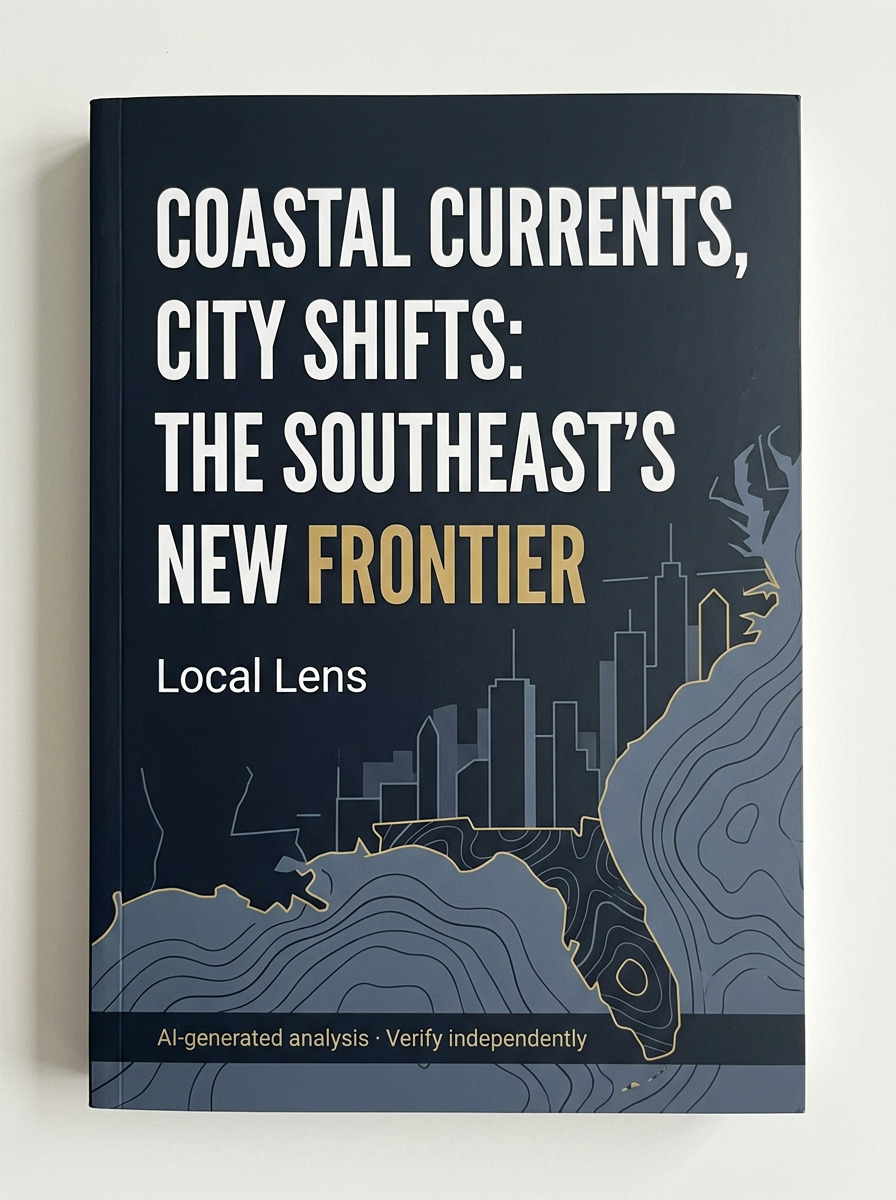
Coastal Currents, City Shifts: The Southeast's New Frontier

By Local Lens

Cover of Coastal Currents, City Shifts: The Southeast's New Frontier

Synopsis

From the quiet coastal towns swelling with new faces to the bustling city centers reinventing their skylines, the American Southeast is undergoing a profound transformation. This intimate narrative journeys through the lives touched by rapid growth, examining the choices made and the futures forged

Chapter 1: The Quiet Boom: Jasper County's Coastal Influx

**Disclaimer**

This book was generated using artificial intelligence. The content draws on real-world news sources and data, but may contain errors, omissions, or misinterpretations.

Readers are strongly advised to independently verify all facts, statistics, dates, and claims. Information that appears unusual or surprising should be cross-referenced with the original sources listed in the references section at the end of each chapter.

Librida and the AI systems used do not guarantee the accuracy, completeness, or timeliness of the information contained herein. This material should not be used as a sole source for academic, professional, or policy decisions.

---

The morning mist still clung to the gnarled live oaks of Jasper County, their Spanish moss dripping with the last vestiges of night. It was a familiar scene, one that Ms. Eleanor Vance had witnessed for all of her seventy-two years. She sat on her porch swing, a cup of lukewarm tea in her hands, and watched as the first rays of sunlight pierced the canopy, dappling her neatly kept garden. But even the timeless beauty of the Lowcountry couldn’t mask the subtle hum beneath the surface – a new sound, distinct from the cicadas and the distant cry of gulls. It was the rumble of construction vehicles, the insistent beep of reversing trucks, and the rhythmic thump of hammers that now punctuated her quiet mornings.

Jasper County, South Carolina, a place long cherished for its slow pace and pristine marshlands, was no longer merely “sleepy.” Recent U.S. Census Bureau estimates, released just last week on March 27, showed a seismic shift: Jasper had led the nation in population growth from mid-2024 to mid-2025, surging by a remarkable 6%. This wasn't merely local chatter; it was a national trend finding its clearest expression right here, in the unassuming coastal stretch between Savannah and Hilton Head. The “quiet revolution,” as some were calling it, was undeniably underway [1].

Eleanor remembered a time when the biggest news was the occasional sighting of a bald eagle or the opening of a new bait shop. Now, it was talk of subdivisions and traffic studies. "They're coming by the droves," she'd remarked to her neighbor, Martha, just yesterday over a shared pecan pie. And indeed, they were. The Census Bureau had noted that this growth wasn’t organic; it was driven overwhelmingly by migration from larger metropolitan areas, people seeking something different, something Jasper County, for generations, had in abundance: relative peace and affordability [1]. Brunswick County, North Carolina, just north of Wilmington, was experiencing a similar phenomenon, gaining nearly 5% of its population from similar inflows [1].

Take the Millers, for example, who had moved into the new development just two miles down Eleanor’s road. Sarah Miller, a former marketing executive from Atlanta, often walked her golden retriever past Eleanor’s house, always offering a friendly wave. "We just couldn't take the rat race anymore," Sarah had confided during one of their brief sidewalk conversations. "And the cost of living... it was getting impossible to raise our kids there without feeling like we were constantly drowning." She spoke of decent schools, the allure of the nearby beaches, and the sense of community she hoped to find. The Millers weren’t retirees, a demographic Eleanor also saw arriving in increasing numbers, but a young family, seeking a new foundation. Their story was a microcosm of what analysts were observing nationally: the Southeast was drawing in an unprecedented influx of out-of-market buyers, with Charleston, SC, a larger neighbor, seeing a substantial 75.8% of its real estate search traffic coming from outside the region in Q4 2025 [2].

The building boom was impossible to ignore. Where once stood pine forests and palmetto thickets, now rose the skeletons of new homes, their frames stark against the vivid blue sky. Tracts of land that had been in families for generations were changing hands, often for sums that Eleanor’s father could never have imagined. The influx of new residents created a tangible demand for housing, not just here, but across the entire Southeast [2]. Construction wasn't limited to residential; nearby, in Macon-Bibb, Georgia, ground was broken on an 801,000 square-foot Bob's Discount Furniture distribution center, a testament to the surging logistical needs of a growing region [5]. The landscape of the Southeast was literally being reshaped to accommodate its burgeoning population.

Across the county, in the nascent communities that were springing up like wildfire, new roots were being tentatively put down. The old Jasper County, with its interconnectedness forged over decades, was slowly but surely making space for the new. The local grocery store, once a quiet haunt, now boasted a diverse array of accents and an ever-expanding selection of organic produce, catering to tastes that were as varied as the newcomers themselves. New "neighborhood watch" groups formed, potlucks were organized, and tentative friendships were struck. "It's like a grand experiment," Martha had mused one afternoon, "watching how two different worlds try to become one."

The motivations behind this migration were deeply personal, yet echoed a collective national sentiment. The analyst quoted in a recent report succinctly captured it: "Small counties in the coastal Southeast had some of the largest population gains... mostly because of people moving from larger areas" [1]. These individuals and families weren't just fleeing high costs; they were seeking a different quality of life, a perceived slower pace, and often, a greater connection to nature that larger cities struggled to provide. They often arrived with some capital salvaged from home sales in more expensive markets, eager to invest in their new surroundings.

For Eleanor, the changes were a double-edged sword. She mourned the loss of some of the wilder, undeveloped stretches of land she remembered from childhood. The traffic, once a non-issue, was now a daily consideration. Her favorite quiet fishing spot was now often occupied. Yet, she also saw the positive. The county's tax base was growing, leading to improvements in schools and infrastructure. New businesses were opening, bringing new job opportunities – not just in construction, but in healthcare, retail, and services. Her grandson, who had reluctantly moved off to Florida for work after college, was even considering moving back, seeing the new opportunities emerging in his home county.

The challenge now was integration. How did the quiet boom mature into a sustainable, cohesive community? How did Jasper County, and other similar coastal enclaves, maintain their character while embracing this profound transformation? The answers were still being written, in the daily interactions between old-timers and newcomers, in the choices made by local leadership, and in the gradual weaving of countless individual stories into the larger tapestry of a region redefined. Eleanor, sitting on her porch, watched a small car, probably belonging to a new neighbor, turn onto her street. The hum was still there, a constant reminder of the changes, but beneath it, she could still hear the crickets, and the whispers of the wind through the live oaks – sounds that, she hoped, would never truly fade.

--- **References**

1. https://www.governing.com/urban/small-southeast-counties-lead-u-s-population-growth

2. https://www.churchillmortgage.com/articles/march-2026-real-estate-market-update

3. https://capitalanalyticsassociates.com/charlotte-tests-office-to-residential-conversions-amid-rising-vacancy/

4. https://www.click2houston.com/news/politics/2026/03/27/a-build-america-buy-america-law-is-causing-construction-delays-amid-the-us-housing-crisis/

5. https://www.maconbibb.us/bobsdiscountgroundbreaking/

6. https://www.granthammond.com/nashville-real-estate/3-biggest-nashville-real-estate-stories-march-22-2026/

Chapter 2: Concrete Canvas: Charlotte's Urban Reinvention

The Charlotte skyline, even in its quiet moments, hums with an unspoken ambition. It’s a city that builds, constantly evolving its steel-and-glass profile. But beneath the familiar glint of progress, a new kind of transformation is taking root, one that speaks less of aspiration and more of grounded necessity. Charlotte, like many urban centers, has found itself grappling with a paradox: soaring demand for housing juxtaposed with silently emptying office towers. This isn't just about constructing new buildings; it's about reimagining the very bones of the city itself.

I’m standing in Ballantyne, a part of Charlotte once synonymous with corporate campuses and sprawling office parks. The air still holds that manicured, business-district feel, but a shift is palpable. Signs of construction are everywhere, not just for new developments, but for something else entirely. Here, at the 16-acre Rushmore One site, Northwood Ravin has filed plans for 411 multifamily units – a mix of apartments and townhomes. This isn't groundbreaking in itself; Charlotte has been building residential for years. What makes this project, and others like it, significant is its origin. These units aren't going up on a vacant lot; they're set to rise, in part, from the shells of commercial buildings that once buzzed with cubicle life.

“It’s an adaptive reuse story, pure and simple,” explains Elaine Davies, a project manager for Northwood Ravin, as she gestures towards a low-slung, nondescript office building currently shrouded in scaffolding. Her voice, though pragmatic, holds a hint of excitement. “We’re taking structures that were designed for one purpose and giving them a completely different life. It’s a challenge, but it’s immensely rewarding.”

The challenge, as Elaine describes it, isn't just structural. It’s about envisioning homes where once there were boardrooms, about bringing natural light into spaces designed for fluorescent glow, and about creating community in an environment built for individual workstations. “Think about the plumbing,” she laughs. “An office building has a few central restrooms. An apartment building needs a kitchen and bathroom in every single unit. That’s a massive undertaking right there.” But it’s a necessary one. With Charlotte experiencing a surge in population, mirroring the dramatic growth seen in coastal areas like Jasper County and Brunswick County, the pressure for housing is immense [1].

The city’s commitment to this urban reinvention isn’t an accident. It’s a deliberate strategy woven into the fabric of the Charlotte Future 2040 plan. This ambitious blueprint isn't just about growth; it's about *smart* growth, encouraging mixed-use density and creating a more integrated urban experience. The 2023 Unified Development Ordinance, in particular, has eased the path for residential rezoning, making projects like Rushmore One more feasible. The goal, as city planners frequently stress, is to foster density where it makes sense, transforming areas that were monocultures of commerce into vibrant, liveable neighborhoods where work and life can truly converge.

Driving through the city, the evidence of this strategy is subtle but pervasive. You might notice an office tower downtown, its lower floors already converted into retail or dining, while upper floors are undergoing residential makeovers. Or a suburban office park, once a commuter-only destination, now surrounded by newly built townhomes and apartments, creating a sense of a nascent, self-contained community. This isn't merely about filling empty spaces; it’s about a deeply personal reinvention of how Charlotteans will live their daily lives.

I meet Sarah, a young professional who recently moved to Charlotte from out of state, drawn by job opportunities and the city’s reputation for vibrancy. She’s currently renting an apartment in a converted factory building in South End, one of the city's older adaptive reuse success stories. “I love the character of it,” she tells me over coffee at a bustling cafe next to her building. “You can see the history in the exposed brick, the high ceilings. It’s not just another new-build box.” Sarah is one of the many prospective residents looking at places like Rushmore One. Her desire isn't just for an apartment; it's for a walkable lifestyle, proximity to amenities, and a sense of belonging in a city that’s still new to her.

“The office market has undergone a fundamental shift,” observes Michael Chen, an urban planner with the city, his voice measured but firm. “Hybrid work, remote work – these aren’t just temporary trends. They’ve fundamentally altered the demand for traditional office space.” He points to data showing a noticeable increase in office vacancies across Charlotte, making these conversions not just an urban planning ideal, but an economic imperative. “Instead of letting these buildings sit empty, becoming urban ghosts, we’re breathing new life into them. We’re turning a liability into an asset.”

The scale of these conversions is impressive. While Rushmore One's 411 units are significant, they represent just one piece of a larger puzzle. The city is actively encouraging and exploring similar projects, understanding that addressing the housing shortage requires a multi-pronged approach. It’s a delicate dance, balancing the needs of developers, the desires of prospective residents, and the long-term vision of the city’s future.

For developers like Northwood Ravin, these projects offer a unique set of challenges and rewards. “It’s often more complex and potentially more expensive than building from scratch,” Elaine admits. “But the sustainability aspect is huge. We’re reusing existing infrastructure, reducing waste, and minimizing our environmental footprint. And there’s a real satisfaction in giving a building a second, equally important, purpose.” The idea of taking an existing, sometimes even iconic, structure and transforming it into something new resonates with a growing public consciousness around sustainability and smart growth.

Charlotte’s journey from a city of ambition to a city of concrete reinvention is a compelling narrative. It speaks to a pragmatism born of necessity, but also to a creative vision for urban living. Through the lens of projects like Rushmore One, we see not just buildings changing, but the very definition of a neighborhood evolving. It’s a future where the line between where you work and where you live becomes increasingly blurred, where old foundations are given new purpose, and where the beating heart of the city pulses with renewed, residential vigor. As Charlotte continues to grapple with the influx of new residents – part of the larger Southeastern migration that saw counties like Jasper and Brunswick boom – its commitment to adaptive reuse stands as a testament to its innovative spirit, ensuring that the city’s skyline, and its streets, continue to tell a dynamic, evolving story [1].

--- **References**

1. https://www.governing.com/urban/small-southeast-counties-lead-u-s-population-growth

2. https://capitalanalyticsassociates.com/charlotte-tests-office-to-residential-conversions-amid-rising-vacancy/

3. https://www.churchillmortgage.com/articles/march-2026-real-estate-market-update

4. https://www.click2houston.com/news/politics/2026/03/27/a-build-america-buy-america-law-is-causing-construction-delays-amid-the-us-housing-crisis/

Read on Librida