City of Many Tongues
By Mikael Löwgren
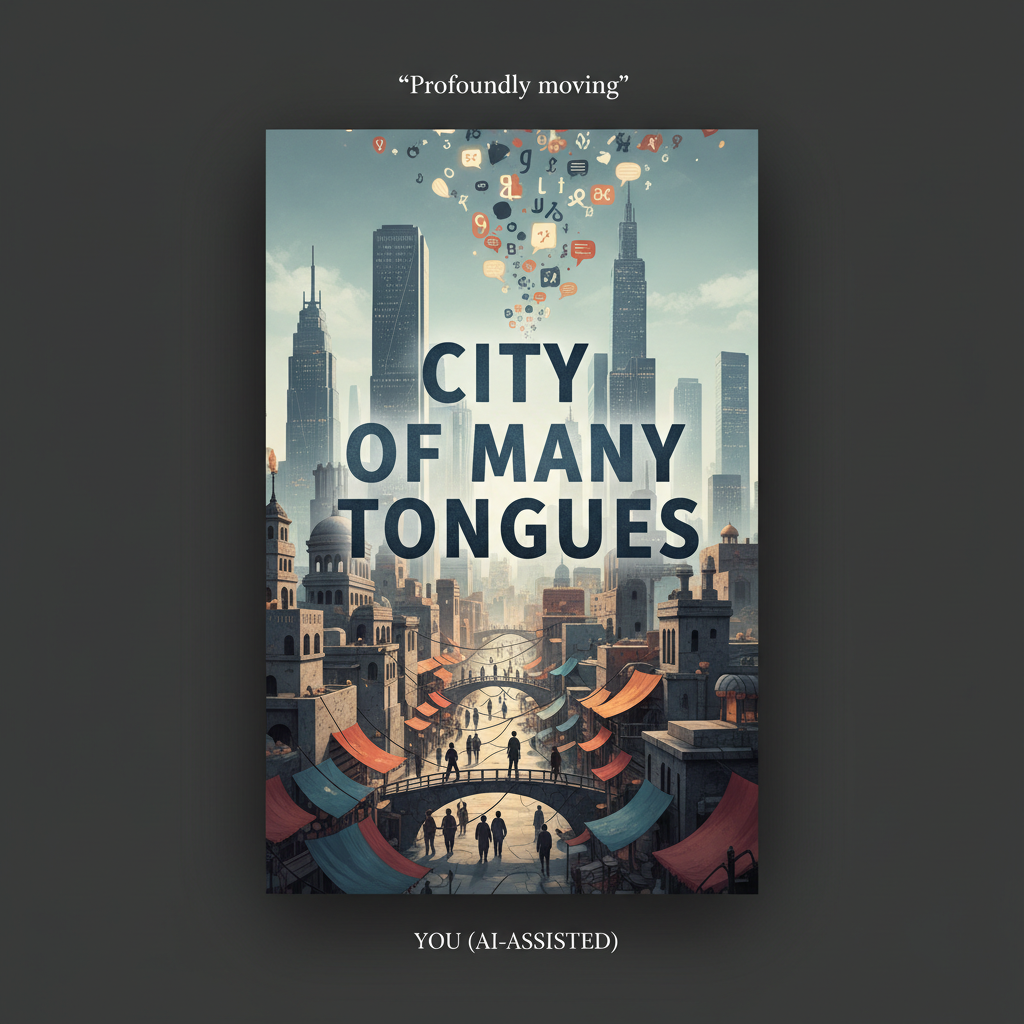
Synopsis
In a sprawling metropolis, the seemingly disparate lives of a young aspiring chef, an aging émigré, and a disillusioned architect intertwine, revealing the vibrant, cacophonous symphony of a city that constantly redefines itself.
Chapter 1: The Scent of Memory and Mop Water
The scent hit Amina first, long before she saw the stall: a heady, swirling current of cinnamon and star anise, cut through with the sharp, almost medicinal tang of fresh ginger. It was a familiar greeting, one that pulled at the edges of her memory like a half-forgotten song. She navigated the crowded aisle of Shepherd's Bush Market with the practiced ease of a salmon swimming upstream, her shoulders instinctively tucking in against the tidal pull of shoppers, pram-pushers, and the occasional lost-looking tourist. Each breath was a new ingredient – cumin from the spice vendor, the sweet rot of overripe mangoes, the metallic tang of fish from the neighbouring stall, all culminating in that intoxicating, almost edible perfume of her destination.
Her grandmother, Fathiya, lived a life circumscribed by such smells. Not the exhilarating, free-wheeting mix of market chaos, but the carefully curated, deeply comforting aromas of a kitchen where every spice held a lineage, every dish a story. Amina, however, was trying to write her own stories, ones that began not in the familiar warmth of her grandmother’s kitchen but in the gleaming, stainless-steel anonymity of a professional one. Today, though, she was on a sourcing mission, disguised as a dutiful granddaughter assisting with the weekend shop.
The stall, a riot of colour and carefully stacked plastic-wrapped packages, belonged to a wiry man with a perpetually flour-dusted apron and a smile that seemed perpetually on the verge of blooming into a full laugh. “Amina, habibti!” he boomed, spotting her over a mountain of turmeric root. He spoke in a rich, guttural Arabic that was music to her ears, a language reserved for family and the market. “Your grandmother sent you, yes? She needs her special za’atar.”
Amina nodded, already reaching for the familiar green-and-white striped bag. The za’atar was indeed special; mixed by hand by the stall owner’s wife, it bore little resemblance to the mass-produced stuff in supermarkets. It hummed with the bright citrus notes of sumac, the peppery warmth of thyme, and the earthy nuttiness of sesame seeds. This was the za’atar that coated the brittle flatbread Fathiya made every Friday, the one that tasted of home, of childhood, of a place Amina had only ever seen in faded photographs.
“She wants a kilo,” Amina said, switching seamlessly to English, a language that felt sharper, more utilitarian, even here. The stall owner's eyes twinkled. “A kilo! Such a feast she must be planning. Tell her I send my best regards. And tell her…” he paused, leaning in conspiratorially, the scent of cinnamon enveloping her, “this batch, I put in extra thyme. Just for her.”
Amina smiled, a genuine, unforced curve of her lips. This was the other side of the market, the one that made sense of its glorious, sprawling disarray. It wasn’t just about transactions; it was about connections, about the quiet weave of community threads that held the city’s disparate parts together. But sometimes, when she was staring at a blank whiteboard in culinary school, trying to conceptualise a dish that would impress Chef Dubois with its ‘fusion and innovation’ – a word that frequently felt like a straitjacket – she wondered if these threads weren’t also a leash.
Her phone buzzed, momentarily pulling her from her thoughts. It was a text from Yasmin, her best friend and fellow culinary student. *Kitchen at 7? Chef Dubois is dropping hints about the final project. Terrified.* Amina typed back, *Be there. You worry too much. It’ll be fine.* But even as she sent it, a familiar knot of unease tightened in her stomach. ‘Fine’ was not good enough. ‘Fine’ was what her family expected: to graduate, get a sensible job, maybe open a small, respectable cafe. But Amina dreamed of Michelin stars, of a culinary landscape where her heritage wasn’t just a flavour to be gently folded in, but the vibrant, unapologetic heart of the dish itself.
She hefted the heavy bag of za’atar, the scent of it clinging to her clothes, and began the trek back through the market, past the overflowing pyramids of scarlet chillies, the glistening trays of baklava, the stalls selling impossibly bright saris and cheap electronics. It was a symphony of sounds, too: the rhythmic chopping of a butcher’s cleaver, the shouted greetings of vendors, the babble of a dozen languages woven into an incomprehensible, yet strangely comforting, tapestry. London, in its chaotic grandeur, was like this market: a thousand distinct voices, all clamouring for space, all contributing to the whole.
***
Fathiya, in her modest flat above a corner shop in Acton, wasn't thinking of haute cuisine or fusion innovation. Her world, for the moment, was contained within the familiar, worn walls of her kitchen. The afternoon light, filtered through the net curtains, cast a soft, forgiving glow on the chipped Formica countertop and the perpetually steaming kettle. She sat at the small, round table, a cup of strong, dark tea cradled in her hands, her gaze fixed on the plastic bag Amina had just placed before her. The aroma of the za’atar wafted up, a fragrant whisper that transported her not just to Shepherd’s Bush, but to a distant childhood, to the harsh, sun-baked earth of her homeland.
For Fathiya, exiled decades ago by a war that ripped through her life like a hungry beast, the scent of cardamom and thyme, of sumac and dried mint, was more potent than any photograph, more vivid than any recounting. It was the taste of memory, a direct conduit to a life that no longer existed, except within the fragile architecture of her mind.
“Did you tell him about the thyme?” Fathiya asked, her voice a low purr, still imbued with the musical cadences of her native tongue, even after fifty years in London. She hadn’t needed to ask for extra; Farid, the stall owner, whose family had been neighbours back home, knew her preferences instinctively. It was this unspoken understanding, this deep-rooted kinship, that tethered her to a past she sometimes felt slipping away like sand through her fingers.
Amina nodded, already rummaging through the fridge for the ingredients for dinner. “He said he put in extra, just for you.”
Fathiya smiled, a small, private gesture. She closed her eyes for a moment, inhaling deeply. It was not just the spice itself, but the journey it represented. From the sun-drenched fields of her memory, across continents, to this small, terraced house in West London. Each grain was a tiny victory against the erasure of time, the indifference of a new land.
She often watched Amina in the kitchen, a whirlwind of motion and ambition. Her granddaughter moved with a fierce, almost impatient energy, her mind constantly whirring, devising, experimenting. Fathiya understood the ambition, in a way. She herself had been a whirlwind once, a young woman brimming with dreams of a different kind: of a large family, a bustling household, a safe and predictable life. The war had splintered those dreams, leaving her to piece together a new existence in a city that, for many years, had felt utterly alien.
She remembered her first days in London, the biting cold, the relentless grey skies, the bewildering array of languages that sounded like static compared to the melodies of her own. The food had been the hardest, bland and insipid, lacking the vibrant complexity she craved. It had been like trying to eat memories, and finding them tasteless. It was then that the grocery store, a small Turkish shop in those early days, had become her sanctuary. The familiar shapes of certain vegetables, the rich aroma of roasted coffee, the particular texture of flatbread – these were the lifelines she clung to, the anchors that prevented her from drifting entirely.
“The lamb needs more marinating,” Fathiya remarked, her eyes still closed, her nose twitching almost imperceptibly. Amina paused, a garlic clove poised in her hand. “I just put the spices in, Sito. It’ll be fine for an hour.”
“An hour is not enough,” Fathiya countered, opening her eyes. “It needs to sleep in the spices, to be caressed by them. Overnight, at least.” She tapped a gnarled finger on the table. “Flavour, Amina, is not something you rush. It travels slowly, soaking into the very fibre of the meat. Like peace. It cannot be forced.”
Amina sighed, a barely audible puff of air, and then nodded. She knew this dance. Fathiya’s wisdom was often delivered in riddles and metaphors, each lesson embedded in a culinary instruction. And Amina, despite her modern ambitions, knew her grandmother was usually right. There was a depth of flavour in Fathiya’s cooking that she, with all her modern techniques and advanced culinary theory, still struggled to replicate. It wasn’t about the ingredients alone; it was about the intention, the patience, the years of accumulated knowledge.
That evening, as the scent of slow-cooked lamb and rice permeated the small flat, Fathiya sat by the window, watching the streetlights flicker on. The sounds of London, muffled by the double-glazing, were a constant, low thrum. Sirens wailed in the distance, a bus rumbled past, and somewhere below, a child cried. This city, this colossal, indifferent entity, had taken so much from her, but it had also, in its own strange way, given her a new life, a new family. And it had preserved, in its labyrinthine corners, the echoes of her past, in the vibrant colours of a spice stall, the scent of familiar herbs carried on the wind.
Amina, meanwhile, was meticulously plating the lamb, a small frown of concentration on her face. Tonight’s dinner, with all its traditional flavours, felt both comforting and constraining. She loved her grandmother, revered her culinary wisdom, but sometimes the weight of expectation, the pull of the past, felt like a culinary handbrake. How could she honour the legacy without being confined by it? How could she innovate while still carrying the heart of her heritage? The questions swirled in her mind, a delicious, confusing mess, much like the city itself.
Later, as they ate, Fathiya chewed slowly, savouring each mouthful. “The meat is good, Amina. Very tender. But next time, the marinating. Remember what I said.”
Amina smiled, a small, private victory. She had secretly added a tiny touch of smoked paprika to the marinade, a subtle, almost imperceptible note that lifted the traditional flavour profile without overtly altering it. It was her own little act of quiet rebellion, her way of testing the boundaries, of beginning to write her own stories within the ancient texts of her grandmother’s kitchen. She wondered if Fathiya had noticed, if her discerning palate had detected the subtle shift. Her grandmother’s eyes, ancient and wise, met hers across the table. A flicker of something passed between them – a silent acknowledgement, a shared understanding that went beyond words. The city outside continued its restless hum, a symphony of many tongues, and in this small kitchen, new melodies were beginning to take shape.
Chapter 2: Blueprint Blues and Brick Dust
The hum of the city, a low, constant thrum beneath his feet and in his bones, no longer sang of possibility for Julian. It was a dirge now, discordant and insistent, a soundtrack to the slow, methodical dismantling of everything he’d once held sacred. From his twenty-third-floor office, a temple of polished concrete and smoked glass, he could chart the city’s relentless expansion like an illness spreading across a healthy organism. Cranes, skeletal giants reaching for an indifferent sky, dotted the horizon; each new tower a monument to profitability, each older edifice a sacrificial lamb to the god of progress. He’d designed some of them, of course. His fingerprints were on the blueprints, his precise lines etched into the foundations, but the soul – that elusive, vital spark he believed every building should possess – was perpetually missing.
Today, the vista felt particularly bleak, a washed-out grey mirroring the colour of his mood. Coffee, tepid and bitter, did little to cut through the thick film of ennui that coated his tongue. He traced the outline of a projected rendering on his screen, a shimmering glass behemoth destined to replace a row of charming, if slightly dilapidated, Victorian terraces in a district known for its independent bookshops and eccentric cafes. "The Sovereign Suites," the marketing team had christened it, with a flourish, as if to bestow upon it an instant, unearned heritage. Julian leaned back, the expensive leather of his chair squeaking a protest. Sovereign by name, soul-crushing by nature, he thought, a familiar cynicism curling at the edges of his mouth.
He remembered sketching dreamscapes in university, fuelled by cheap instant ramen and an unshakeable belief that architecture could shape lives, inspire communities, even heal. He’d envisioned buildings that breathed, that integrated into the urban fabric like a perfectly mended quilt, each stitch telling a story. Now, the stories were all the same: maximise footprint, minimise character, sell for profit. His grand visions had become blueprints for profit margins, his careful detailing reduced to cost-saving measures. The city, his muse, had become his professional tormentor.
A ping from his inbox announced the next disaster: an agenda for the evening’s community consultation on the “Riverbend Redevelopment Project.” He scrolled through the bullet points: ‘Economic Revitalisation,’ ‘Enhanced Urban Connectivity,’ ‘Modern Living Solutions.’ All the antiseptic buzzwords designed to obscure the undeniable truth – another vibrant, messy corner of the city was about to be gentrified into bland uniformity. He was slated to present. His role, as always, was to be the polished frontman, the professional artist whose designs, once imbued with ideals, now served to legitimise corporate avarice.
He stared at the photograph embedded in the document – the target of their development. It was an old public bathhouse, built in the early 20th century, a magnificent structure of red brick, intricate mosaic work, and soaring arched windows that now stood boarded up and scarred with graffiti. It had ceased operating as a bathhouse decades ago, after the advent of indoor plumbing had rendered it ‘obsolete,’ but it had become a de facto community hub over the years – a makeshift food bank, an informal art space, a gathering point for local activists and struggling artists. He’d always admired its stubborn refusal to completely disappear, its faded grandeur a testament to a different era. Now, even that was to be razed. For another Sovereign Suite, no doubt, but with a river view.
The meeting was held in the drafty community hall of a nearby church, a space that smelled faintly of damp wool and old hymn books. The air buzzed with a different kind of energy than the usual corporate sterility Julian inhabited – a raw, almost volatile energy. Rows of plastic chairs faced a raised dais where Julian and his two senior partners, smirkingly detached, sat alongside a smattering of local council members. The mood was palpably hostile.
“Good evening,” his senior partner, a man named Henderson whose tailored suits always seemed to fit too snugly, began, his voice oozing practiced charm. “Thank you for coming out tonight to discuss the exciting future of the Riverbend area.”
A murmur rippled through the room, punctuated by a few audible snorts. Julian recognised some of the faces from the local news, outspoken community leaders, their expressions set in lines of weary determination. He felt a familiar knot tighten in his stomach. His job was to present the glossy blueprints, to speak of ‘vision’ and ‘opportunity,’ to politely dismiss the inevitable accusations of displacement and cultural erasure. He was good at it, too good, perhaps. He could deliver the company line with a convincing simulacrum of enthusiasm, a professional veneer that ensured minimal pushback.
As Henderson droned on about ‘economic upliftment’ and ‘synergistic partnerships,’ Julian found his gaze drifting to the front row. A woman sat there, perched on the edge of her seat, her dark hair pulled back in a no-nonsense bun, a hand clenching a worn notebook. She had a sharp, intelligent face, framed by well-defined cheekbones, and eyes that missed nothing. Her expression was less angry than intensely focused, a quiet storm brewing behind a deceptively calm exterior. When Henderson finally ceded the floor, her hand shot up, a single, resolute spear in a sea of hesitant waves.
“Yes, madam?” Henderson said, his tone a little too condescending.
“My name is Aisha Rahman,” she stated, her voice clear and resonant, cutting through the church hall's poor acoustics. “And I’d like to know, specifically, how tearing down a historical landmark, a building that has served this community in countless ways for over a century, constitutes ‘economic upliftment’ for the people who actually live here, not just the shareholders of your development company.”
Julian saw a flicker of annoyance cross Henderson’s face. This was not the polite, deferential question he’d expected. “Ms. Rahman, we’ve conducted extensive feasibility studies,” he began, launching into a well-rehearsed spiel about structural integrity and the prohibitive costs of renovation.
Aisha interjected, not rudely, but with a laser-like precision that disarmed Henderson’s practiced deflection. “Feasibility studies that conveniently ignore the social and cultural capital of the building, I presume? The community garden that feeds dozens of families, for instance? The art collective that uses its abandoned wing as a studio? The fact that it’s simply *there*, a touchstone in a constantly shifting landscape?” She gestured around the room, her gaze sweeping over the faces of her neighbours. “These are not merely ‘costs’ to be absorbed or dismissed. These are lives. These are connections.”
Henderson, visibly flustered, turned to Julian. “Perhaps our lead architect, Mr. Davies, can elaborate on the architectural rationale, and the opportunities this new development presents.” It was a transparent attempt to shift the heat, to put the creative face on the frontline.
Julian stood, feeling the weight of their expectations, and her gaze, upon him. He clicked through to the first slide of his presentation, a slick CGI rendering of “The Riverbend Spire.” He’d poured hours into its design, trying to inject some vestige of his old ideals – a rooftop garden, public access to the riverfront, even a small, dedicated space for local artisans. But as he looked at the gleaming structure on the screen, and then at Aisha’s unimpressed face, it felt hollow.
He launched into his spiel, the familiar words flowing from his mouth. “The Spire aims to be a beacon of modernity, integrating sustainable materials and intelligent design to create a dynamic living environment…” His voice, usually confident and authoritative, sounded tinny in his own ears, like a recording played back from a great distance. He spoke of ‘regenerative urbanism’ and ‘mixed-use spaces,’ of a vision that would ‘reinvigorate the urban fabric.’ Each phrase felt like a betrayal, a lie of omission.
Aisha listened, her expression unreadable, her pen poised over her notebook. He tried to meet her eye, to find some flicker of understanding, but she offered nothing. When he finished, the room was silent for a beat, a heavy quiet before the inevitable storm.
“So, Mr. Davies,” Aisha’s voice cut through the silence, sharper now, more pointed. “You speak of ‘reinvigorating the urban fabric.’ But what about the fabric that already exists? The threads that have been carefully woven over decades, centuries even? Does your ‘modernity’ only extend to glass and steel? Does it not encompass history, memory, community identity?”
Julian felt a flush creep up his neck. Her words were not an attack; they were an accusation, one that resonated with the gnawing dissatisfaction he’d carried for years. He looked at the shimmering rendering of The Spire, and then back at the photograph of the old bathhouse, solid and steadfast in its decay. His design, however well-intentioned, was another act of erasure.
“We understand the historical significance of the site, Ms. Rahman,” he managed, his voice a little hoarse. “And we’ve made efforts to integrate elements of the area’s heritage into the new design – for example, the use of local stone in the lower façade, and the public art installations…”
She scoffed, a short, sharp sound that cut him off. “Public art installations of what, exactly? Souvenir plaques commemorating what you’ve destroyed? That’s not integration, Mr. Davies. That’s tokenism. That’s a corporate apology disguised as culture.” Her gaze was unflinching, demanding, and for the first time in a long time, Julian found himself speechless. She wasn’t merely disagreeing with his design; she was challenging the very foundation of his professional life. She was questioning the architect whose name was etched on these soulless developments, the architect who had once dreamed of shaping cities for the better.
Henderson interjected, his irritation finally boiling over. “Ms. Rahman, I think we have heard enough of your… rhetorical questions. Mr. Davies has presented a meticulously researched and brilliantly conceived design. Perhaps you could allow others to ask their questions.”
“Oh, I have plenty more questions, Mr. Henderson,” Aisha said, her voice dropping to a dangerous calm, “but they are not rhetorical. They are practical, ethical, and profoundly human. And they deserve real answers, not corporate jargon.” She fixed her gaze back on Julian, and a flicker of something, not anger, but a profound disappointment, crossed her features. “You’re an architect, Mr. Davies. You have the power to create, to preserve. What happened to that?”
The question hung in the air, a physical weight. What happened to that? Julian felt the heat of a hundred eyes on him, but it was Aisha’s direct, unwavering gaze that truly pinned him. He looked at his partners, their faces a mixture of exasperation and thinly veiled amusement at his predicament. He looked at the glossy image of his towering creation, a monument to everything he had come to resent. And then he looked at Aisha, her hand still resting on her battered notebook, her eyes burning with an idealism that he had all but forgotten.
He swallowed. The air in the church hall, thick with unspoken grievances, suddenly felt very thin. The city, his city, was screaming, demanding to be heard, and for the first time in what felt like an eternity, Julian was truly listening.
Chapter 3: The Unspoken Language of Hands
The pristine steel of the kitchen at 'Veridian' hummed with a tension Amina could almost taste, a metallic tang beneath the delicate aroma of truffle oil and simmering reductions. It wasn't just the warmth of a hundred infrared lamps or the steam rising from industrial dishwashers; it was the concentrated energy of bodies moving with a singular purpose, each gesture precise, economical. Her hands, usually so confident kneading dough or chopping herbs with rhythmic grace, felt suddenly cumbersome, alien. They were red, a little raw from the sudden increase in precision knife-work, and a faint tremor ran through them as she gripped the handle of a paring knife.
Chef Dubois' eyes were everywhere, dark and sharp, missing nothing. He moved like a dancer, a heavy-set man with surprising lightness, his white chef's jacket a beacon of authority. When he spoke, it was a low growl, never loud, but cutting through the clatter and sizzle like a laser. "Amina. Those shallots. You call that a brunoise?"
Her stomach clenched. She looked down at the tiny, almost perfect cubes, arranged on a pristine white board. "Yes, Chef."
He didn’t touch them. He simply looked, then back at her. "They are... asymmetrical. Each one is a testament to the fact that you are not *seeing* them." He paused, and the silence stretched, thick and uncomfortable. "You are guessing. We do not guess here. We *know*."
The words, though delivered without overt malice, stung. She had spent countless hours practicing, her grandmother’s quiet instructions echoing in the small kitchen at home. *Each cut tells a story, habibti. Make it a good one.* But this was different. This wasn't about love or memory; it was about absolute perfection, about an almost inhuman consistency that felt both exhilarating and terrifying.
Amina nodded, unable to speak. Dubois moved on, a ghost in white, leaving the faint scent of garlic and his unspoken disappointment in his wake. She took a deep breath, the air in her lungs feeling thin. Her station, tucked between a brusque sous chef who communicated primarily through grunts and an impossibly calm pastry assistant who moved like a surgeon, suddenly felt impossibly small. This was the pinnacle, the promised land of culinary ambition, yet every day felt like being pushed to the edge of a cliff, told to fly, and then admonished for the slightest wobble.
The lunch service began its relentless crescendo. Pans hissed, flames leapt, and the clatter of plates became a frenetic rhythm. Amina’s task was deceptively simple: prep the amuse-bouche. Tiny, intricate creations designed to awaken the palate, each one a miniature work of art. Today, it was smoked salmon tartare with pickled cucumber and a dill crème fraîche, served on a delicate rye crisp. The salmon had to be diced to an exact millimeter, the cucumber slices translucent, the dill sprigs uniform. One slip, one slightly larger piece, and the entire batch was rejected.
Her hands moved, faster now, a quiet fury fueling their precision. This wasn't about art, not yet. This was about survival. About proving she belonged, that her presence wasn't an act of charity or a box ticked. It was about earning her stripes, one perfectly diced shallot, one uniformly picked sprig of dill, at a time. The pressure was a constant, almost physical weight, but beneath it, a strange thrill began to build. She was here, in the engine room of a culinary marvel. And something in her, a stubborn spark, refused to be extinguished.
***
Fathiya sorted the lentils, a quiet, almost meditative ritual. Her fingers, gnarled with age, moved with a practiced ease, separating the tiny, dark discs from stray fragments of grit or unwanted husks. The afternoon sun, weak and watery through the kitchen window, cast long shadows across the worn wooden table. The radio in the corner hummed a low, tuneless classical station – something for the silence, not for listening.
She had been coming to the community center for this, for the small, shared tasks, for the unspoken communion of quiet hands, for several months now. It had started with the weekly English classes, a well-meaning but ultimately frustrating endeavor. The words felt slippery, uncooperative, refusing to align with the stories in her head. But then, a kindly volunteer, a young woman with bright, understanding eyes, had asked if she liked to cook. And suddenly, Fathiya found her purpose again.
Today, it was lentil sorting for the weekly communal meal. Tomorrow, perhaps breaking a hundred heads of lettuce for a salad. Next week, peeling mountains of potatoes. There was always something. And around the large, utilitarian kitchen, other women, and a few men, engaged in similar quiet acts of preparation.
There was Mrs. Sharma, her sari a splash of vibrant colour against the drab walls, carefully grinding spices in a large stone mortar, the air filling with the pungent, comforting scent of turmeric and cumin. Her movements were slow, deliberate, each turn of the pestle a lifetime of culinary knowledge. Fathiya watched her sometimes, a silent dialogue unfolding between their hands. Mrs. Sharma would glance up, a faint smile creasing her lips, and Fathiya would return it, a shared understanding passing between them without a single spoken word.
And there was Jerzy, a wiry man with a perpetual stoop, meticulously cleaning wild mushrooms, his calloused fingers delicate as he brushed away the earth. Poland, Fathiya thought, though she had never heard him speak. His eyes held the same kind of weariness and quiet resilience she recognized in herself. He would sometimes offer her a small piece of dark rye bread, homemade, pressed into her palm with a slight bow of his head. She would take it, her own offering a gesture of gratitude and kinship.
Languages formed a jumble here, a soft, murmurous babble that was less about communication and more about presence. Urdu, Punjabi, Polish, Somali, Arabic, Mandarin – snatches of conversation would drift across the kitchen, rising and falling like exotic bird calls. But none of it truly mattered. The real communication happened in the gestures. The offer of a chair, the sharing of a particularly fragrant piece of fruit, the careful placement of a heavy bag of flour closer to one person, a knowing glance when a new, unfamiliar volunteer struggled with a tricky vegetable.
Fathiya found a small, sharp stone amidst the lentils. She picked it out, her thumbnail scraping against its rough surface, and tossed it into a small discard bowl. This was her life now, sifting through the unwanted, finding the good, preparing for nourishment. It wasn't the bustling marketplace of her youth, nor the rich, complex meals of family gatherings. But it was something. It was utility, woven into the fabric of human connection.
She thought of Amina, her bright, ambitious granddaughter, chasing Michelin stars and culinary perfection. Fathiya understood the drive, the yearning for recognition. But she also wondered if Amina, in her pursuit of the exquisite, sometimes missed the simple, profound beauty of feeding someone with hands that simply *knew*. There was an elegance in a perfectly peeled onion, a poetry in the rhythmic chopping of herbs, that came not from a recipe, but from a lifetime of careful attention.
A young woman, one of the more energetic volunteers, approached Fathiya’s station. "Everything alright, Fathiya? Need help with those?" She gestured to the bowl of lentils. Her English was clear, well-intentioned, but loud.
Fathiya smiled, a slow, gentle stretching of her lips. She held up a small handful of the cleaned lentils, letting them cascade back into the bowl. "Good," she said, her voice a little gravelly, quiet. "Almost."
The young woman nodded, a slightly bewildered expression on her face. "Okay, great. Just let me know if you need anything." She moved off, her attention already pulled by another task.
Fathiya watched her go, then returned to her lentils. The young woman meant well, but she didn’t understand the unspoken language. She didn’t understand that the work itself was the connection, the gentle rhythm a form of conversation. It wasn’t about finishing quickly, it was about the act of doing, together, separately, united by the shared endeavour of feeding a corner of this vast, sprawling city.
Later, as the sun began its slow descent, painting the sky in hues of bruised purple and fiery orange, Fathiya walked home through the familiar streets. Her shoulders ached a little, and her fingers felt tired, but a quiet contentment settled within her. The city, with its jarring cacophony of sirens and distant traffic, felt a little less alien tonight. She had spent the afternoon sorting, not just lentils, but the disparate threads of her experience, weaving them into a tapestry of shared humanity. And as she fumbled with her keys at the door of her flat, she thought she smelled, faintly, inexplicably, the scent of fresh cardamom.
Chapter 4: Ghost Structures and Growing Roots
The rust-pocked gate groaned a protest as Julian pushed it open, the sound echoing a familiar lament in the narrow alley. Sunlight, usually a scarce commodity in this part of town, sliced through a gap in the buildings, illuminating motes of dust dancing in the stale air. This was the fifth such ‘ghost structure’ he’d visited with Lena, the activist whose unwavering tenacity had, against all odds, managed to chip away at Julian’s carefully constructed apathy. He’d initially seen himself as a reluctant participant, an architect lending his professional eye to a lost cause, but each creaking floorboard and peeling fresco had begun to rewrite that narrative.
The building in front of them was a Victorian-era public bathhouse, now a derelict cavern of crumbling tiles and broken windows, its grand intentions long since swallowed by ivy and neglect. Lena, ever the pragmatist with a poet's heart, pointed to a faded mosaic, barely discernible beneath layers of grime. "See? Mermaids. Swimming in something not quite water, not quite sky. Public art. For everyone. A place of cleansing, and gossip, and escape." She ran a gloved finger over the intricate pattern, her voice holding a quiet reverence that Julian found himself increasingly susceptible to.
He saw the mermaids, of course. He also saw the structural instability, the water damage, the impossibility of restoration given the council's budget—or lack thereof, specifically for anything that didn't promise a twenty-percent return on investment. His architect's brain was a relentless algorithm of cost-benefit analysis, a program he’d been running for so long he hadn’t stopped to consider if the inputs were even adequate. Lena, with her insistence on 'social capital' and 'community memory', was steadily introducing new variables.
"Imagine it," she said, pulling a tattered blueprint from her worn canvas bag, "not as it is, but as it was. Or, even better, as it could be. A community hub. A co-working space. A gallery. A theatre. Something that breathes life back into this dead space."
Julian knelt, studying the blueprint. His own grand designs, the gleaming steel and glass towers he’d drafted for corporate clients, suddenly felt sterile, unburdened by the weight of time and human stories. This bathhouse, this forgotten hulk, possessed a palpable history. He traced a finger along the faded lines of the original changing rooms, envisioning the laughter, the steamy air, the whispered intimacies. He felt a pang, not of nostalgia (he’d never known this place in its prime), but of a yearning for something he couldn't quite name. Authenticity, perhaps. Or simply the human touch.
"The brickwork's sound in parts," he conceded, pushing a loose brick back into place. "Good enough for a temporary bracing, at least. But the roof… that's a whole other story."
Lena smiled, a flicker of triumph in her eyes. "Temporary bracing. That's a start, Julian. You used to just say 'demolish.'"
He bristled slightly, but the protest died on his lips. She wasn't wrong. His profession, in its relentless pursuit of the new, had conditioned him to view anything old as an obstacle, a hurdle to be cleared, a site to be cleared. Gentrification, he realized with a jolt that felt like a punch to the gut, wasn’t just about rich people moving in and pushing poor people out. It was about erasing history, flattening complexity, sanitizing the grittiness that gave a city its soul. And he, with his slick designs and his comfortable salary, had been an unwitting accomplice, a foot soldier in this aesthetic cleansing.
The next few weeks were a blur of dusty site visits and even dustier council archives. Lena was a force of nature, charming information from reluctant civil servants, coaxing donations from local businesses, and rallying volunteers with a fervent optimism that bordered on miraculous. Julian, surprisingly, found himself caught in her wake, his analytical skills proving invaluable in navigating the labyrinthine world of building codes and heritage listings. He spent evenings poring over old maps, tracing the veins of the city’s forgotten infrastructure, seeing how each street, each building, was a chapter in a sprawling, multi-voiced narrative.
One drizzly Tuesday, they were examining a row of disused almshouses, their red-brick facades crumbling but still possessing a stoic dignity. Lena pointed to a small, almost invisible plaque above a doorway. "Built in 1892 for indigent widows. Imagine the lives lived within these walls. The stories. The quiet acts of survival."
Julian, usually impervious to such sentimental musings, felt a shift within him. He saw beyond the peeling paint and broken windows. He saw Fathiya, packing her meager belongings, her face etched with a lifetime of experience. He saw Amina, her hands stained with flour, pushing against the constraints of her own inherited traditions. They were all woven into the fabric of this city, living histories walking its streets, and these ghost structures were their silent witnesses.
"The council wants to sell them off to a developer," Lena said, her voice tight with suppressed anger. "Luxury apartments, naturally. Small balconies, big price tags. Called 'historic conversions' to justify the mark-up. It's a joke, Julian."
He didn't laugh. He felt a cold knot of dread in his stomach. This was his world. This was the machine he was a cog in. He had designed those kind of 'historic conversions' himself. Bright, airy spaces, minimalist interiors, deliberately sterile to appeal to a certain demographic, scrubbed clean of the inconvenient truths of the past. He had, in his own way, been complicit in the erasure.
"What if," he began slowly, the words feeling heavy in his mouth, "what if we propose something… radical?"
Lena turned, her expression a mix of curiosity and weary expectation. "Radical how?"
"Affordable housing. Community-led. With shared spaces – a garden, a workshop. Something that honors the original intention. Not just ‘preservation’ as an aesthetic, but as a living, breathing concept." He looked at the row of almshouses, at the resilient brick, the fading grandeur. "It’s not just about preserving the buildings, is it? It’s about preserving the idea of them. The *spirit* of them."
Lena’s eyes widened, a slow smile spreading across her face. "You're finally getting it, Julian. It's not about monuments. It's about roots. And how if you keep tearing them up, eventually, nothing will grow."
That evening, Julian sat at his meticulously tidy drawing board, not sketching the sleek lines of a new commercial development, but roughing out floor plans for the almshouses. He was thinking about light, and communal tables, and how to create dignity out of decrepitude. He found himself sketching a small, wild garden in the central courtyard, a space where residents could grow things – herbs, vegetables, stories.
He thought of the mermaids in the bathhouse, still swimming in their silent, beautiful narrative. He thought of the scent of cardamom, of the quiet strength of Fathiya’s hands, of Amina’s fierce, culinary ambition. These weren't just disparate lives, he realized. They were all threads in the same vibrant, tangled tapestry of the city. He, the disillusioned architect, had spent years observing the city's surface, its ever-changing skin. Now, thanks to Lena, he was finally starting to look beneath, to feel the pulse of its deeper, hidden heart. He was beginning to see not just ghost structures, but growing roots. And for the first time in a long time, the blueprint for his own life felt a little less rigid, a little more alive. The quiet hum of the city outside his window no longer sounded like a cacophony, but like a symphony, still unfinished, still evolving, and perhaps, finally, he had found his own part to play in its creation.
Chapter 5: A Taste of Home, A Hint of Here
The aroma of toasted cumin and something sharp, almost like a whisper of lemon, clung to Amina’s apron. She swiped a bead of sweat from her brow with the back of her hand, leaving a faint streak of flour. The kitchen, with its stainless steel gleam and industrial hum, felt both alien and intensely familiar. Here, amidst the precise chaos of a professional culinary space, she was attempting alchemy. Not the kind that turned lead into gold, but the far more intricate magic of taking a century of family recipes, imbued with the ghosts of forgotten dinner tables and the unspoken hopes of generations, and coaxing them into a new form.
Today’s experiment: *M’hanncha à la Pistache*, a serpentine pastry traditionally stuffed with almond paste, now reimagined with a delicate pistachio cream, a touch of orange blossom water, and a thin, crispy shell of phyllo dough brushed with clarified butter and a hint of smoked paprika. The paprika was her rebellion, a quiet assertion of her own palate against the comforting tyranny of tradition. Chef Alain, with his hawk-like gaze and even sharper tongue, hadn't quite scoffed at the idea, which, for him, was akin to effusive praise. He’d merely grunted, a sound Amina had learned to interpret as grudging acceptance.
She meticulously rolled the thin layers of phyllo, each turn a precise dance of fingers and parchment. On the scarred wooden cutting board beside her, a bowl of the vibrant green pistachio cream shimmered invitingly. Her grandmother, Fathiya, would have used a clay tagine, her movements slower, more deliberate, infused with the rhythm of countless meals prepared over an open fire. No digital scales, no precise temperature controls. Just instinct, honed by a lifetime of cooking. Amina sometimes wondered if the old ways, for all their perceived imprecision, held a deeper truth, a more profound understanding of the ingredients.
“It needs… something,” she muttered to herself, nudging a stray bit of dough back into line. The classic *m’hanncha* was sweet, purely sweet. Her version, she hoped, would offer a counterpoint, a subtle tension between the sugary pistachios and some earthy, almost savoury note. The smoked paprika was a gamble. Too much, and it would taste like a barbecue. Too little, and it would be lost, another pretty pastry in an overcrowded landscape. This was the tightrope walk of creation, the constant push and pull between homage and innovation.
Later that evening, after a relentless shift where the kitchen became a blur of frantic plating and shouted orders, Amina found herself back in Fathiya’s cozy flat. The smell of frying onions and simmering tomatoes from her grandmother’s kitchen was a balm, a warm embrace after the sterile intensity of the restaurant. Fathiya, her hands flour-dusted from preparing *batbout*, little Moroccan flatbreads, hummed a tuneless melody as she worked.
“How was your day, *habibti*?” Fathiya asked, not looking up, her arthritic fingers deftly kneading the dough. Her voice was raspy, laced with years of stories untold.
Amina sighed, leaning against the doorframe, watching her grandmother. “Tiring. And challenging. I’m trying to make a *m’hanncha*, but… different. Chef Alain called it ‘intriguing’. Which is practically a rave review from him.”
Fathiya chuckled, a dry rustle of air. “Intriguing. He likes your ambition. But he will test it.” She finally looked at Amina, her eyes, though clouded with age, still held a sharp intelligence. “What makes it different? A different spice?”
“Pistachio cream instead of almond,” Amina explained. “And a touch of smoked paprika.”
Fathiya paused, her hands still in the dough, a surprised expression on her face. “Smoked paprika? In a *m’hanncha*? That is… bold, Amina.” A twinkle appeared in her eye. “Your grandfather, may he rest in peace, he would have called it heresy. Then he would have eaten the whole plate.”
Amina smiled. She knew that feeling. The inherent tension between the ancestral wisdom and the desire to break new ground. “I want it to taste like… home, but also here. You know?”
Fathiya nodded slowly, her gaze drifting towards the window, where the city lights twinkled in the gathering dusk. “I know, child. I know that feeling very well.” She wiped her hands on a towel and motioned for Amina to sit at the small, worn kitchen table. “Come, tell me more about your ‘intriguing’ pastry. And I will tell you about the spices in my mother's kitchen, the ones your grandfather said tasted of ‘heresy’.”
And so, as the scent of the evening meal began to fill the small flat, Fathiya began to speak of her mother’s kitchen in Fez, a place Amina had only ever seen in faded photographs. She described the deep terracotta tagines, the earthenware bowls, the slow dance of pestle in mortar releasing the pungent secrets of cardamom and coriander. She spoke of her mother's special blend of *ras el hanout*, a secret only she knew, a tapestry of twenty-seven spices meant to evoke the warmth of the Sahara winds and the coolness of river mint.
“My mother,” Fathiya began, her voice softer now, tinged with a delicate melancholy, “she was a magician with spices. Not just in the cooking, you understand, but in the remedies. For every ailment, she had a tea, a poultice, a dish. I remember once, when your uncle – a little boy then, always causing mischief – scraped his knee badly. The wound was deep, and he cried inconsolably. My mother, she didn't just clean it. She made a paste of turmeric and honey, warm, viscous. She applied it with such tender care, humming a lullaby. The pain, it seemed to lessen almost immediately. The wound healed quickly, and without a scar. It wasn't just medicine; it was love, mixed with ancient knowledge.”
Amina listened intently, captivated. This was a Fathiya she rarely saw, a Fathiya unfettered by the daily routines of her London life, transported back to a vibrant past. The stories, previously fragmented, now flowed with a surprising clarity, each detail painted with the vibrancy of a forgotten memory rediscovered.
Fathiya continued, her gaze fixed on some point in the distant past. “And the stories that were told over those meals! My grandmother, your great-grandmother, she would sit with us, her eyes like polished stones, and tell tales of the Jinn, of desert tribes, of courageous women who rode camels as fiercely as any man. We would eat *harira*, steaming hot, and the spices in it, the ginger and the saffron, they tasted of those very tales, of the land, of our people.”
Amina pictured it, a tableau vivant of generations gathered, the firelight flickering, the air thick with perfume of spices and storytelling. It made her own culinary experiments seem almost trivial, a pale imitation.
“My father,” Fathiya reminisced, a slow smile gracing her lips, “he had a very particular taste for mint. He would only drink his tea with mint plucked fresh from the garden, still glistening with dew. And if it wasn’t perfect, if it was even slightly bruised, he would send it back, with a twinkle in his eye, saying it lacked ‘the spirit of green’. He taught me to appreciate the nuances, Amina. Not just the big flavours, but the subtle undertones, the way a pinch of cumin can transform a dish, not by overwhelming it, but by awakening something deeper within the other ingredients.”
Amina’s mind raced with connections. The ‘spirit of green’ – wasn’t that what she was trying to capture? The essence of a dish, beyond just its flavour profile. She thought of the smoked paprika in her *m’hanncha*, its faint, woody whisper against the sweet pistachio. It wasn't just about taste; it was about memory, about connection, about bridging a cultural divide.
“Did you ever… change your mother’s recipes?” Amina ventured, carefully.
Fathiya paused, her smile softening further. “Oh, yes, *habibti*. Not drastically. Not like your paprika in the *m’hanncha*,” she teased gently. “But a little. Sometimes, an ingredient was hard to find. Sometimes, I would add a little more of this, a little less of that, depending on our mood, or the season. Once, after I met your grandfather, and he brought back a small jar of a new spice from a market in Tunis – a very fragrant coriander, different from ours – I added it to a tagine of lamb. My mother tasted it, and she looked at me, a long look. Then she smiled. ‘This tastes of Tunis,’ she said. ‘And of you.’”
Amina felt a warmth spread through her. “She understood.”
“She understood everything,” Fathiya confirmed, her eyes now moist, but bright. “She understood that traditions are living things, Amina. They breathe, they adapt. They carry the past, yes, but they also embrace the present. They grow with us. That is their strength, their longevity.”
The stories continued, punctuated by the rhythmic thud of dough on wood as Fathiya returned to her *batbout*, the flatbreads now puffing beautifully in the hot pan. She spoke of the family's migration, the wrenching departure from Morocco, the fear of the unknown, the struggle to find familiar ingredients in a new land. She described the first time she had tried to make *couscous* in London, with unfamiliar semolina and water that tasted different, and how it hadn't felt right, hadn't tasted of home.
"It was like trying to speak a language without knowing the grammar," she explained, stirring a bubbling pot of lentils. "The words were there, but the melody was missing. It took time. It took patience. And it took understanding that 'home' was not just a place, but a feeling, one that I had to learn to carry within myself, no matter where I cooked."
Amina realized, with a jolt, that Fathiya wasn't just sharing memories; she was offering a subtle, profound culinary lesson. The struggle to translate a flavour, a dish, a memory, across continents and cultures. The quiet resilience required to adapt, to innovate, while still holding fiercely to the essence of what was truly meaningful.
"So, your *m’hanncha*," Fathiya said, a knowing gleam in her eyes, "your bold paprika. It is not just about taste, is it? It is about telling a new story, with ancient words. It is about *you*, Amina. Your home, and here.”
The kitchen, usually a place of quiet ritual for Fathiya, now vibrated with the echoes of generations. Amina understood, with a sudden clarity, that her grandmother’s kitchen was more than just a place where meals were made. It was a crucible of identity, a repository of history, a stage for stories that had been waiting patiently to be told. And in sharing them, Fathiya wasn't just reliving her past; she was handing Amina the keys to her own future, a future where the flavours of home could truly find their voice, and their place, in the vibrant, cacophonous symphony of the city. The aroma of simmering lentils and freshly baked flatbread mingled with the ghost of orange blossom and smoked paprika, a testament to a journey not just within a kitchen, but across time and tradition. The silence that followed was not empty, but full, pregnant with possibilities, with the scent of memory and the promise of new creations.
Chapter 6: The Fault Lines of Progress
The scaffolding, a skeletal predator, gnawed at the edges of the community centre. Its spindly metal arms scraped against the faded brickwork, a visible manifestation of the impending demolition. Dust motes danced in the anemic morning light, swirling around the handful of protestors gathered beneath, their hand-painted banners swaying like nervous flags in the weak breeze. Julian, standing a little apart from the main cluster, felt the familiar itch beneath his collar – an almost visceral discomfort with public displays, yet a growing conviction that these displays were, perhaps, a necessary evil.
The air thrummed with a nervous energy, a prelude to the inevitable clash. Cameras with their long, probing lenses were already positioned, their operators a study in practiced nonchalance. A journalist, sharp-suited and sharper-tongued, thrust a microphone towards a woman Julian dimly recognized from the last community meeting, her face a map of weary defiance. “Ms. Anya Sharma, co-organizer of the ‘Save Our Centre’ campaign, what are your feelings as the demolition crew prepares to move in?”
Anya, her voice surprisingly steady, considering the circumstances, replied, “Feelings? My feelings are that this is a betrayal. A betrayal of history, of community, of the very soul of this neighbourhood. This isn’t just a building; it’s where children learned to read, where elders found companionship, where countless lives were shaped. To tear it down for another soulless residential block? It’s an insult to everything we stand for.”
Julian watched the exchange, a knot tightening in his stomach. He’d helped Anya and her team craft their press releases, advised them on angles, even drawn up alternative design proposals that miraculously preserved the existing structure while accommodating the developer’s desired footprint. Proposals that, predictably, had been summarily dismissed. His former boss, Mark, had practically snorted down the phone: “Julian, are you really wasting our time with these… *boutique* solutions? We have deadlines, a contract. This isn’t a charity, you know.”
He remembered the dismissive tone, the way Mark had always been able to reduce everything to profit margins and square footage, stripping buildings of their histories, their narratives, until they were just numbers on a balance sheet. Julian had once admired that ruthlessness, that laser focus. Now, it tasted like ash in his mouth.
A shout erupted from the edge of the crowd. A burly foreman, crimson-faced and bristling, was attempting to shepherd a group of construction workers through the protestors. “Clear the way, please! This is private property! You’re obstructing progress!”
“Progress?” a man’s voice, raw with indignation, shot back. “Whose progress, mate? Yours, with your fat bonus? Not ours!”
The first shoves began. Not violent, not yet, but enough to set teeth on edge. Julian felt a surge of adrenaline, a primal urge to step in, to mediate, to somehow halt the inevitable. But his training, his years of observing, of intellectualizing, held him back. He was an architect, not a bouncer.
Then he saw her. Marina. Her camera slung casually over her shoulder, she moved with an almost predatory grace through the jostling crowd, her lens fixed on the unfolding drama. She caught his eye, a flicker of something unreadable in her gaze – recognition, perhaps, or a silent challenge. Marina, the journalist who had initially sensationalized his “rebellion” against his firm. The one who had, paradoxically, also given Anya’s campaign its first real traction.
“Julian Thorne,” she called out, her voice cutting through the rising din. “A word, if you please?”
He hesitated, then made his way towards her, feeling the gazes of both protestors and camera crews on him. He was no longer just an architect; he was a defector, an anomaly, a story.
“Still fighting the good fight, I see,” Marina said, a hint of steel beneath her composed exterior. She didn’t bother with pleasantries. “Your old firm, ‘Metropolis Designs,’ released a statement this morning. They’re calling your involvement with the ‘Save Our Centre’ campaign ‘misguided’ and ‘unprofessional,’ and insinuating your ideas are ‘financially unviable’.”
Julian felt a sharp jab of anger, quickly suppressed. “They’re entitled to their opinion. My ideas are viable, Marina. They just require a little more… imagination, and a little less greed.”
She noted that down, her pen scratching efficiently on her pad. “And your colleagues? Any specific comments from Mr. Davies, perhaps?” Davies was Mark’s right-hand man, a man whose ambition was only outstripped by his sycophancy.
“I haven’t spoken to Mark or Mr. Davies since I tendered my resignation,” Julian said, keeping his voice level. “My allegiance is to ethical design, to communities, not to corporate profit margins.”
A scoff, surprisingly close, made him turn. It was Gareth, a former colleague from Metropolis Designs, his hands stuffed into the pockets of his expensive coat. Gareth, who had always been quick with a joke, quicker with an opinion, and utterly devoid of ethical qualms when it came to a large commission.
“Ethical design, Julian?” Gareth chided, a smirk playing on his lips. “Funny how ‘ethical’ always seems to mean ‘unprofitable’ in your new lexicon. What happened to our ‘futuristic visions,’ eh? All that talk about shaping the city, pushing boundaries? Now you’re pushing… dust motes.” He waved a dismissive hand towards the protestors.
Julian felt a flush rise to his neck. “Some boundaries shouldn’t be pushed, Gareth. Some parts of the city are worth preserving, not simply bulldozing for the next high-rise monstrosity.”
“Monstrosity?” Gareth laughed, a brittle, humourless sound. “Those ‘monstrosities’ are providing homes, Julian. Jobs. Growth. You know, things this city actually *needs*. Not some crumbling old relic where old ladies play bingo.”
“It’s more than bingo, Gareth,” Julian retorted, his voice gaining strength. “It’s history. It’s identity. It’s the last vestiges of a community that’s being systematically eradicated, block by block, in the name of your so-called ‘progress’.”
Gareth’s smirk vanished, replaced by a cold, hard stare. “You’ve gone soft, Thorne. You used to understand the game. You used to be cutthroat. What happened? Did some bleeding heart whisper sweet nothings in your ear?” His eyes flickered towards Anya, who was still engaged in a heated debate with the foreman.
The implication hung in the air, a barbed insult. Julian clenched his fists, fighting the urge to respond with something equally cutting. He knew what Gareth was trying to do – reduce his convictions to mere sentimentality, to a weakness.
“I’ve opened my eyes, Gareth,” Julian said, his voice low but firm. “I’ve seen what we, what *you*, are building. And it’s not a city for everyone. It’s a city for the highest bidder, a homogenous landscape devoid of character, of soul.”
“Spare me the poetry, Julian,” Gareth sneered. “You’re just bitter because you couldn’t hack it. Because you jumped ship before the next big project landed. Don’t pretend it’s about some grand moral awakening.”
Before Julian could respond, Marina stepped in, her journalist’s instincts honed. “Mr. Thorne, Mr. Thorne,” she interjected smoothly, diverting the conversation. “What about the legal avenues? The injunction the campaign tried to secure?”
Julian took a deep breath, forcing himself to refocus. “The injunction was denied. The developer has all the necessary permissions. All legal recourse has been exhausted, for now.” He didn’t mention the desperation he’d felt sifting through outdated bylaws, searching for a loophole that simply wasn’t there. The law, he was learning, was often a weapon of the powerful.
As he spoke, a tremor ran through the crowd. A large yellow excavator, a monstrous metal beast, rumbled into view. Its enormous bucket, like a prehistoric jaw, swung menacingly, glinting in the morning sun. A gasp rippled through the protestors.
“They’re going to do it,” a woman whispered, her voice choked with tears.
The foreman, emboldened by the arrival of the machinery, began shouting through a megaphone: “Last warning! Clear the immediate vicinity! We are commencing demolition! Any individuals remaining will be removed by force!”
The air crackled with tension. The protestors exchanged fearful glances, but no one moved. They stood their ground, a fragile human barricade against the steel jaws of progress.
Julian felt a profound sense of helplessness. He had designed buildings that soared, that touched the sky. He had re-imagined cityscapes. Yet, here he was, powerless against the simple act of destruction. All his newfound knowledge, his moral compass, felt like a feather in the face of this juggernaut.
A young man, barely out of his teens, suddenly darted forward, placing himself directly in the path of the excavator, his arms flung wide in a gesture of desperate defiance. The machine, surprisingly, halted, its engine idling with a frustrated rumble.
Anya rushed forward, grabbing the young man by the arm, pulling him back. “Leo, no! That’s reckless!”
“What else are we supposed to do, Anya? Just stand here and watch?” Leo cried, his voice raw with despair.
The scene descended into controlled chaos. Police officers, who had been observing from a distance, now moved in, forming a line, their faces impassive. Marina and the other journalists pressed forward, sensing the climax, their cameras flashing like hungry eyes.
Julian found himself on the fringes, watching, his hands clammy. He should be doing something, he thought. But what? His architectural skills, his intellectual arguments, were useless here. This wasn't about blueprints or city plans anymore. This was about brute force against human will, about the cold efficiency of profit against the messy, illogical warmth of community.
He saw Gareth watching him, a look of grim satisfaction on his face. *This is what happens when you dabble in sentiment, Thorne. This is the reality you’re too soft to face.*
But Julian didn't feel soft. He felt a searing anger, a burning conviction that this was wrong, profoundly, unequivocally wrong. He was no longer just observing; he was internalizing. The grit in the air, the desperate cries, the rumble of the machine – it all coalesced into a single, undeniable truth: the city wasn’t just redefining itself; it was dissecting itself, tearing open old wounds, creating new ones, along the fault lines of wealth and power, progress and forgetting.
He saw the excavator’s bucket slowly, deliberately, begin to descend, its metal teeth poised. The crowd gasped. Anya clutched Leo, her eyes wide with dread. Julian, without conscious thought, took a step forward, then another, his gaze fixed on the menacing machine. His professional obligations, his former allegiances, felt like distant echoes, fading into the roar of the machine, replaced by something fiercer, something he was just beginning to understand. The battle for the community centre might be lost, but the war, he realized, had only just begun.
Chapter 7: Collision at the Crossroads
The air itself hummed, thick with the syncopated rhythms of distant drums and the high, bright trill of flutes. It was the City of Tongues cultural festival, a sprawling, joyous explosion of sound and aroma that had swallowed whole sections of the city. Amina, behind a makeshift counter adorned with string lights and woven fabrics, felt a nervous flutter in her stomach. Her station, nestled between a stall peddling vibrant Ghanaian fabrics and another offering intricate Peruvian silverwork, was a canvas of carefully arranged small plates. Today was the day; the final round of the Young Chef Showcase, held right here, amidst the glorious cacophony.
She smoothed the front of her crisp white chef’s jacket, the embroidered logo of her culinary school a small, defiant badge against the pressure building inside her. Her signature dish, ‘Saffron Sunset with Harissa Dewdrops and Pistachio Dust’, sat cooling on a silver platter. It was a deconstructed Palestinian *maqluba*, reimagined for a modern palate, a testament to her heritage and her ambition. She’d spent weeks perfecting the delicate balance of spices, the subtle crunch of the fried almonds, the silken texture of the spiced rice dome. It was a risk, challenging the palates nurtured on more conventional festival fare – kebabs and curries readily understandable. This, she hoped, was something different. Something that spoke of both tradition and innovation, a bridge between the familiar and the fantastically new.
The crowd swelled and parted around her stall, a kaleidoscope of faces and languages. A young couple, their arms laden with artisanal crafts, paused, their eyes assessing her offering. Amina offered a faint, practiced smile, a quiet invitation. “Would you like to try a sample?” Her voice was steady, betraying none of the internal turmoil. Each plate handed out was a tiny performance, a moment of judgment. The judges, they’d said, would be circulating anonymously, tasting covertly, their scores influencing the final decision more than any formal presentation. This was about the food, stripped bare, speaking for itself.
Across the sprawling festival grounds, past the boisterous drumming circles and the makeshift stages showcasing traditional dance, Fathiya moved with quiet dignity. Julian walked beside her, his shoulders, usually hunched in professional contemplation, now relaxed, almost jaunty. He’d insisted on taking her to the festival, sensing her unspoken longing for a connection to the vibrant tapestry of cultures that now defined *this* city, her adopted one. His grand project at the heart of the community, a co-operative workshop space salvaged from the jaws of a corporate demolition, was now fully funded, its blueprints framed and displayed, a tangible victory. He’d even managed to secure a small kiosk here, distributing flyers about the upcoming opening, explaining his vision to anyone who would listen.
“It’s good, isn’t it?” Julian said, his voice a low rumble above the din. He gestured with an expansive hand at the throngs of people. “All of it. So much… life.”
Fathiya smiled, a rare, genuine smile that crinkled the corners of her eyes. Her silver hair, usually pulled back in a severe bun, was softened by a loose scarf, its vibrant colours complementing her simple, elegant dress. The scent of roasted lamb and sweet pastries mingled with the sharper, cleaner aroma of burning frankincense from a nearby stall. It reminded her, faintly, of home – not the chaotic, war-torn home she had left behind, but the home of her childhood, before the shadows lengthened.
“It is a beautiful chaos,” she agreed, her English still carrying the soft lilt of her native tongue. Her gaze drifted across a group of dancers in brilliant, flowing robes, their movements fluid and mesmerising. She felt a lightness in her step, an unfamiliar sense of buoyancy. Julian had been a surprise, a gruff, thoughtful young man who, despite his profession, possessed a deep, almost instinctual understanding of the city’s undercurrents, its hidden heartbeats. He hadn’t just saved a building; he’d helped rekindle a spark in the community, a shared sense of purpose.
As they walked, Julian paused to speak with a colleague from the community activist group, gesturing excitedly at a scaled model of the workshop space. Fathiya continued to stroll, drawn by the vibrant display of a tea vendor who was gracefully pouring amber liquid from a silver pot into delicate glass cups. She took a sample, the warmth spreading through her, the cardamom and mint a comforting embrace.
A few stalls down, she saw a familiar young woman, her face intent, carefully arranging small, jewel-toned dishes. It was Amina, Fathiya’s granddaughter, though the girl, absorbed in her task, hadn’t noticed her yet. A wave of mingled pride and trepidation washed over Fathiya. Amina’s journey was her own, and Fathiya understood the tightrope walk between tradition and ambition. She had seen her granddaughter’s experimental dishes, tasted her daring reinterpretations of family recipes. Some were startlingly good, others… ambitious. Fathiya knew the weight of expectation Amina carried, the silent plea for approval in her eager eyes.
Just then, a sudden surge in the crowd, a momentary bottleneck caused by a street performer’s sudden, dramatic flourish, pushed Fathiya gently forward. Her balance, not as robust as it once was, faltered. A small, involuntary gasp escaped her lips as her hand, laden with the delicate teacup, lurched. The tea, hot and fragrant, splashed over the side, narrowly missing a passing child, but instead colliding with something else.
It was Amina’s table. More specifically, it was the corner of a pristine, white tablecloth, directly beneath her beautifully plated ‘Saffron Sunset with Harissa Dewdrops and Pistachio Dust’. A dark, spreading stain bloomed instantly, marring the immaculate presentation.
Amina’s head snapped up, her eyes wide with dismay. “Oh, no!” she breathed, a small, barely audible cry. The carefully constructed elegance of her display had been, in an instant, irrevocably compromised. She saw the stain, dark and conspicuous against the white, then followed its origin to the trembling hand of an elderly woman, her face etched with apology.
“I am so sorry, my dear,” Fathiya said, her voice filled with genuine distress. She fumbled for a tissue, but it was useless. The moment, carefully crafted, was gone.
Amina looked from the stain to the woman’s face, then back to her dish, a small sigh escaping her. The competition. The judges. The meticulous preparation. All of it felt suddenly fragile, perched precariously on the edge of this unexpected mishap. She felt a familiar burn of frustration, a quick, hot flash. Everything had to be perfect. Everything.
Just as Amina was about to speak, her well-practiced, professional composure threatening to crack, Julian arrived, his conversation with his colleague abruptly cut short by the small commotion. He took in the scene – the stained tablecloth, Fathiya’s distressed expression, Amina’s stiff posture, her gaze fixed on the marred display.
“Fathiya, are you alright?” he asked, his hand gently steadying her arm. His eyes then shifted to Amina, and a flicker of recognition crossed his face. He remembered her, vaguely, from her grandmother's snippets of conversation. This was the ambitious granddaughter, the chef-in-training.
“I… I am sorry, my dear,” Fathiya repeated, her voice thick with genuine regret. “I did not mean to…”
Amina, catching Julian’s eye, felt a curious shift. The fleeting moment of anger dissipated, replaced by a sudden, stark awareness of the three of them, awkwardly huddled around her small, temporarily ruined display. The city, roaring around them, suddenly seemed to focus its gaze on this singular, intimate moment.
“It’s… it’s fine,” Amina said, her voice softer than she'd intended. The damage was done. No amount of lamentation would un-spill the tea. She reached for a clean napkin, carefully dabbing at the stain, knowing it was a futile gesture. The dark patch remained, an unwelcome guest.
Julian, ever the problem solver, quickly assessed the situation. “Is there anything I can do, Amina?” he asked, seeing the quiet desperation in her eyes. The name, he realised, had just organically presented itself to him. “A fresh cloth, perhaps?”
Amina shook her head, a small, weary smile touching her lips. “It’s alright. Truly. What’s done is done.” She looked at Fathiya, whose eyes were still clouded with remorse. “It’s just a cloth, Savti. Nothing important.” The endearment, unbidden, slipped out, a familiar echo from her childhood.
Fathiya looked up, her expression softening then, almost imperceptibly, brightening. “Savti,” she whispered, the sound a comfort. It had been a long time since Amina had addressed her by the familiar, loving term. It felt like an old, warm blanket on a cold night.
At that precise moment, a woman in a crisp suit, her expression neutral, her hands clasped behind her back, paused by Amina’s stall. She wore a small, almost invisible badge that Amina recognised instantly: the emblem of the festival’s culinary judging panel. The woman’s gaze swept over the pristine dishes, then lingered, just for a breath, on the dark, spreading stain on the tablecloth. Her eyes then lifted to Amina’s face, then to Fathiya and Julian, standing awkwardly by.
Amina’s heart gave a sudden lurch. This was it. The moment of truth, and it arrived with a stain and an awkward family reunion. She felt a sudden, profound sense of exposure. She was not just a chef presenting her craft; she was a woman, standing with her apologetic grandmother and a sympathetic stranger, amidst the glorious, chaotic mess of her life.
The judge’s gaze was discerning, unreadable. Amina opened her mouth to apologise, to explain, but Fathiya, taking a deeper breath, spoke first.
“My granddaughter,” Fathiya said, her voice clear and resonant, a sudden strength blossoming in her. She gestured proudly towards Amina and the dish. “She makes beautiful food. From our home, but new. You must try.” She then looked directly at the judge, a small, knowing smile playing on her lips. “Sometimes, life is messy. But the beauty… the taste… it can still be there, yes?”
Julian, a quiet observer, watched the scene unfold. Fathiya’s unexpected intervention, her gentle, yet firm assertion, had injected a new element into the potentially disastrous situation. He saw Amina’s initial discomfort give way to a flicker of surprise, then something akin to gratitude. The rigid culinary composure, for a fleeting moment, softened.
The judge, her expression still neutral, finally spoke. “Indeed,” she said, her voice carefully modulated. “Presentation is important, but taste, of course, is paramount.” She picked up one of Amina’s ‘Saffron Sunset with Harissa Dewdrops and Pistachio Dust’ dishes. The delicate saffron rice, the vibrant orange of the harissa, the almost ethereal dusting of pistachio – the elements, despite the small imperfection of the backdrop, were undeniably exquisite. She took a small forkful.
Amina held her breath. The silence of the tasting was deafening, the festival’s vibrant hum fading into a distant murmur.
The judge chewed slowly, her eyes closed for a moment in concentration. Then, she opened them, and a faint, almost imperceptible smile touched her lips. “Intriguing,” she said, her gaze returning to Amina. “A bold reimagining. There’s a story here.” She took another bite, then nodded, a definite affirmation. “Thank you.”
With that, she placed the empty dish back on the counter, her gaze sweeping over the three of them one last time before she turned and melted back into the crowd.
Amina let out a long, slow breath she hadn’t realised she was holding. She looked at Fathiya, then at Julian, a genuine, unburdened smile finally breaking through. “Thank you, Savti,” she said, her voice thick with emotion. “Thank you, Julian.”
Julian simply nodded, a quiet satisfaction in his eyes. He had seen a small collision at a crossroads of lives, a momentary disruption that, instead of causing damage, had, in its own peculiar way, forged a deeper connection. Fathiya, emboldened by the moment, reached out and gently squeezed Amina’s hand. “Your food, it speaks,” she said, her eyes shining. “It has heart.”
And in the heart of the city, amidst the bustling festival, the shared laughter, the clatter of pots and pans, a small, unexpected understanding had blossomed. The stained tablecloth, a symbol of unwelcome imperfection, had instead become a canvas for something more profound: the messy, beautiful interconnectedness of lives, woven into the intricate, vibrant tapestry of a city that constantly redefined itself, stitch by fragile, resilient stitch. The aroma of saffron and harissa, mingling with the scent of blooming humanity, promised a future, rich with both comfort and daring.
Chapter 8: Echoes in the Edifice
The email arrived with the brutal efficiency of a guillotine. Not even a sigh, just the sharp, unblinking finality of it. Julian stared at the subject line, “RE: Proposed Development – Community Centre,” and then at the single attached document. It was a demolition order, dated last Tuesday, tucked neatly into the municipal archives without so much as a whisper to the local residents or the tireless, increasingly hoarse anti-demolition campaigners. Concrete plans now, not just proposals. The city had moved, silently, decisively, while they were busy drafting petitions that would now, apparently, serve as glorified kindling.
His office, usually a sanctuary of muted grays and the comforting hum of his high-spec workstation, felt suddenly predatory. The angled sunlight, usually so carefully calibrated to avoid screen glare, seemed to mock him, highlighting the innocuous dust motes dancing in the sterile air. He could almost hear the wrecking ball swinging, a low, metallic groan, even though the building was miles away, still stubbornly standing.
He felt a familiar, sickening lurch in his stomach, the kind that had been a recurring visitor since he’d first stumbled into one of those impassioned, disorganized community meetings. A lurch that spoke of impotence, of wheels already in motion, of a grander design indifferent to the lives crushed beneath its turning. But this time, it was different. This time, the impotence felt like complicity, like a stain spreading from his fingertips, up his arm, settling deep in his bones. He knew how these games were played, the subtle nudges, the well-placed donations, the conveniently timed "safety assessments" that magically deemed a sound structure unsound. He’d seen the plans morph, the compromises erode, until what was left bore no resemblance to the initial, idealistic sketches. He had even, in years past, been the hand guiding the pen, rationalizing the necessary evils of progress.
Julian clicked open a new email, the cursor blinking a silent challenge. He could forward the demolition order to Maya, the indefatigable community organizer, watch her unleash a storm of urgent calls and social media posts, and then retreat. Let her fight this losing battle, let her rage against the machine. He had done his part, hadn't he? He'd lent his expertise, his professional cred. He could walk away, tell himself he’d seen the process through.
But then he remembered the smell of old wood and lukewarm tea in the community centre’s main hall, the echo of children’s laughter from the dilapidated playroom. He remembered Fathiya’s quiet dignity, her hands, gnarled with age, carefully arranging delicate pastries at a potluck. He remembered Amina, barely more than a girl, explaining with fervent conviction why this space, this slightly dusty, wholly unglamorous building, was the crucible for her culinary dreams. He’d initially dismissed her as idealistic, a bit naive, but her earnest belief had chipped away at his cynicism, revealing, to his own surprise, a flicker of something he’d thought long extinguished. Hope? Or perhaps just a fierce, protective irritation.
He thought of the plans he’d reviewed, the developer’s slick renders of chrome and glass, the sterile, interchangeable luxury flats that would rise from the rubble. No mention of communal gardens, no affordable units, just "premium living experiences" and "unparalleled investment opportunities." The figures, he knew, were inflated, the projected profits obscene. And the kickbacks, though never explicitly stated, were implicit in the timing, in the sudden acceleration of a project that had been stalled for months.
His conscience, a long-dormant beast, began to stretch and yawn. It felt like a physical ache behind his eyes. He exhaled slowly, the sound a soft hiss in the otherwise silent room. He picked up his phone, his thumb hovering over Maya’s contact. Then he stopped. Not yet.
He opened a secure server, a back channel he’d used in his youth for less savory, though equally idealistic, endeavors. He navigated through encrypted folders, accessed client files he should never have been privy to, cross-referenced land deeds, shell companies, and the shadowy network of investors he’d always suspected lay beneath the city’s shimmering surface. The digital breadcrumbs led him down a rabbit hole of offshore accounts, untraceable transfers, and names that resonated with power, individuals whose faces adorned society pages but whose hands were deep in the city’s coffers.
The picture that emerged was uglier, more intricate, and far more pervasive than even his jaded expectations had allowed for. It wasn’t just a developer; it was a syndicate, a hydra-headed beast with tentacles reaching into every corner of the city’s bureaucracy. The community centre wasn't just in the way of a development; it was specifically targeted, its land undervalued, its historical significance conveniently overlooked, precisely because its demolition would trigger a cascade of related land purchases. A ripple effect designed to make a few very powerful men unimaginably wealthy.
The air conditioning unit whirred, a monotonous drone that was usually a comfort, now merely an added layer of white noise to the storm brewing in his mind. Julian felt the heat rising in his face, a slow burn of outrage that started in his gut and climbed to his temples. He was looking at a blueprint of systemic corruption, not just brick and mortar. And he knew, with a certainty that both terrified and galvanized him, that he couldn't walk away from this. Not now. Not when he had the evidence, the undeniable proof, sitting there, glowing on his screen.
He remembered a conversation with his mentor, years ago, on the ethical responsibilities of an architect. "You don't just design buildings, Julian," the old man had said, his voice raspy with age and a lifetime of principled battles. "You design futures. And sometimes, you have to choose whose future you're building."
Julian closed the secure server. His next move was clear, if terrifying. He had to go to the press. Not just Maya, who would passionately disseminate the information, but a wider, more influential platform. A public exposure. For that, he needed unassailable proof, a narrative that couldn’t be spun away, sources that couldn't be discredited. He spent the next few hours meticulously collating, cross-referencing, building a fortress of facts. He wouldn't just leak the demolition order; he would expose the whole rotten edifice.
He knew what this meant. It meant burning bridges, professional suicide. His career, the one he had painstakingly built, brick by meticulous brick, would likely crumble faster than the community centre. He would be blacklisted, ostracized. His name would pass into the hushed whispers of the industry, forever tainted. His colleagues, the ones who had laughed at his cynicism, then raised eyebrows at his activism, would now see him as a pariah. A traitor.
He stood up, stretched his stiff limbs. The office was quiet, the day winding down. He looked out his window at the sprawling, indifferent city below, a tapestry of light and shadow, life and decay. He thought of Amina struggling to perfect a new dish, of Fathiya’s quiet defiance, of Maya’s unrelenting spirit. They were just small cogs in this vast machine, but their struggles, their small victories, had a weight that the gleaming towers of finance could never muster.
He pressed send. The email, a carefully curated digital dossier, went out to a prominent investigative journalist he’d discreetly contacted months ago, never quite believing he’d actually need to pull the trigger. The journalist, known for her tenacity and fearlessness, had responded with a cryptic but encouraging "Intriguing. Keep me in the loop." Now, she had the whole dark story spread out before her.
For a moment, Julian felt a profound emptiness, a void where his future used to hum with predictable ambition. Then, slowly, a different feeling began to bloom. A quiet, resonant sense of peace. He had chosen. He had finally chosen. He felt lighter, as if a great weight had been lifted, only to be replaced by another, a heavier and more dangerous one. The fight wasn't over; it had just begun. And he, the architect of forgotten dreams, was now poised to tear down the very foundations of a corrupt system, even if it meant demolishing his own life in the process. The city, vast and indifferent, would now bear witness to his own, personal, irreversible transformation. And perhaps, just perhaps, it wouldn't be so indifferent after all.
Chapter 9: A New Recipe, A Different Skyline
The kitchen, a stark stage of stainless steel and sharp intentions, had always felt like a battleground to Amina. But tonight, it hummed with a different kind of energy, a softer thrumming born not of fear, but of anticipation. The air, usually thick with the scent of ambition and searing fat, now carried the heady promise of saffron and something indefinably older, more rooted. She stood before a gleaming prep station, not with the hurried, precise movements of a seasoned line cook, but with a deliberate grace, each motion a choreography born of memory and invention.
Fathiya’s stories, whispered truths over endless cups of mint tea, had become the bedrock of Amina’s new culinary edifice. They were more than recipes; they were narratives, imbued with the dust of distant markets, the clatter of ancient souks, the laughter of women gathered around makeshift fires. Fathiya had spoken of a spiced lamb tagine, not just as a dish, but as a balm for homesickness, a celebration of resilience. And in those recollections, Amina had found her anchor, the forgotten flavour she’d been seeking.
Tonight’s dish was her reinterpretation of that tagine. It wasn’t a slavish reproduction, but a dialogue between past and present, between Fathiya’s sun-drenched village and central London’s concrete labyrinth. She had started with the lamb, not the lean, butchered cuts her restaurant usually favored, but shoulder, slow-braised until it yielded with the sigh of surrender. To this, she’d added not just the traditional apricots and almonds, but also quince, its tartness a counterpoint to the lamb’s richness, a nod to the fruit trees in Fathiya’s childhood garden. For the spices, she’d bypassed the pre-ground powders, opting instead for whole cumin, coriander, and cardamom, toasted lightly in a dry pan until their volatile oils blossomed, then finely crushed. This, she knew, was how Fathiya would have done it, drawing out the very soul of the spice.
The aroma alone was a symphony. It swirled through the sterile kitchen, a warm, inviting current against the typically sharp edges of the evening’s service. Heads turned, surreptitiously at first, then more openly. Even Chef Dubois, a man whose palate was as unyielding as his gaze, paused at the pass, his nostrils flaring slightly. Amina caught his eye, a flicker of something she couldn’t quite decipher – curiosity? grudging acknowledgment? – before he moved on, though a subtle shift in his usually rigid posture remained.
The real innovation, however, lay in the plating. This wasn’t a rustic, generous stew. This was art on a plate. She’d painstakingly rendered sheets of phyllo dough, brushed with spiced butter, into delicate, edible baskets, a contemporary reinterpretation of the ubiquitous tagine pot. Inside, the lamb, shredded and perfectly sauced, nestled alongside jewel-toned slivers of quince and apricot. A sprinkle of fresh pistachios and a delicate drizzle of orange blossom honey-infused reduction completed the picture. It was visually stunning, a testament to her technical prowess, but more importantly, it whispered stories. It was Fathiya’s resilience, Amina’s ambition, and the vibrant, complex tapestry of their shared heritage, all distilled into a single, exquisite bite.
The restaurant was already buzzing with its usual Friday night cacophony, a symphony of clinking glasses, hushed conversations, and the distant rumble of the city. But when the first plates of “Fathiya’s Legacy” – as she’d daringly named it on the menu – began to leave the pass, a different kind of murmuring started. It wasn’t just the visual appeal; it was the scent, a subtle, evocative perfume that navigated the room, stirring memories in those who had them, sparking curiosity in those who didn’t.
Reviews, when they came, were rapturous. The food critic from the *Evening Standard*, notoriously difficult to impress, dedicated three breathless paragraphs to it, calling it a “masterpiece of culinary fusion,” a dish that “sang of heritage while simultaneously pushing the boundaries of modern gastronomy.” He praised its “emotional resonance” and Amina’s “courageous vision.” Other publications followed suit. The recognition poured in, not just for the restaurant, but for Amina herself. She started receiving invitations to culinary events, interviews, even a tentative offer to develop her own pop-up concept.
It was a heady, dizzying time. Yet, amidst the accolades and the rising star status, Amina found a quiet, profound fulfillment. It wasn't just about the praise; it was about finally, truly, owning her narrative. She had found her voice, not by shedding her past, but by embracing it, by weaving its threads into something utterly new. And whenever she felt a flicker of doubt, she thought of Fathiya, of her grandmother’s weathered hands, of the resilience etched into her stories, and drew strength.
***
The skeletal remains of the landmark, now a hollowed-out husk surrounded by the gnawing machinery of demolition, cast a long, mournful shadow across the construction site. Julian stood observing it, not with the familiar pang of regret, but with a curious, almost detached sense of observation. The struggle, though lost, had not been in vain. The building itself was gone, its brick and mortar slowly being reduced to dust, but something else had been forged in its place. A conviction.
His career-altering choice had been met with predictable outrage from his former colleagues and a flurry of legal threats from the developers. He’d walked away from the sterile glass towers and the stratospheric salaries, from the gleaming models of projects that promised everything and delivered nothing but more soulless conformity. The cost, as predicted, had been significant. His name, once synonymous with cutting-edge design for a certain elite clientele, was now either whispered with a mixture of pity and contempt, or, more surprisingly, a quiet, almost reverent respect from a different kind of architectural circles.
He was currently at the site of a new project, a different kind of endeavor entirely. This wasn’t a sleek corporate headquarters or a luxury residential complex. This was a community hub, planned for a forgotten corner of East London, a patchwork of diverse cultures, struggling enterprises, and surprising pockets of green space fighting for survival. The brief was simple, yet profoundly complex: create a sustainable, adaptable space that truly served the needs of the people who lived there.
He was working alongside a small, dedicated collective of architects, urban planners, and, crucially, local residents. The days were long, the budgets tight, and the debates fierce, but there was an exhilarating sense of shared purpose, a palpable energy that had been utterly absent from his previous work.
“Julian, what do you think of integrating the rainwater harvesting system more visibly?” asked Sarah, a young architect with bright, inquisitive eyes and a passion for vernacular design, pointing to a sketch on a crumpled blueprint. “Perhaps as a vertical garden feature on that south-facing wall? A living façade rather than just hidden pipes.”
Julian leaned over the table, tracing a finger along the proposed elevation. “It’s a strong idea, Sarah. Visually striking, yes, but also a constant reminder of sustainability in action. It’s about more than just function; it’s about education, setting an example. And it ties into the community’s desire for more green space.”
Their discussions weren’t about abstract concepts of aesthetics anymore; they were about the practicalities of natural light in a shared workshop, the optimal layout for a multi-faith prayer room, the best materials for insulation that were both eco-friendly and affordable. He felt a different kind of fulfillment now, not the detached satisfaction of a grand design executed flawlessly, but the messy, collaborative joy of co-creation.
He’d found a new mentor in Dr. Anya Sharma, a veteran urban geographer known for her radical, community-led approaches to urban planning. She had a knack for cutting through bureaucracy and empowering local voices. “Julian,” she’d said during their first meeting, her eyes sparkling with fierce intelligence, “the city isn’t built on blueprints alone. It’s built on needs, on dreams, on the very fabric of human connection. Your role isn’t to dictate; it’s to listen, to translate, to facilitate.”
And listen he did. He spent hours in community meetings, not presenting grand visions, but drawing crude sketches on whiteboards, taking notes, absorbing the anxieties and aspirations of the residents. They talked about a need for affordable childcare, for spaces where teenagers could gather safely, for accessible workshops where local craftspeople could share their skills, for a vibrant market square that harkened back to the human-scaled intimacy of simpler times.
The new building would reflect all of this. It wasn’t going to be a monolithic statement, but a series of interconnected, modular structures, designed to adapt and expand as the community grew. Reclaimed timber, locally sourced bricks, and abundant natural light were key. There would be a central atrium, a light-filled heart, that could transform from a community theatre to a farmers’ market to a quiet reading space. Rooftop gardens for urban farming, solar panels silently harnessing the city’s indifferent sun, and permeable paving to manage rainwater runoff – every element was being considered through a lens of sustainability and social impact.
Later that evening, after the last of the construction crew had packed up and the late afternoon sun cast long shadows across the nascent foundations, Julian stood on the half-constructed ground floor. The air, still carrying the faint scent of freshly cut timber and damp earth, was crisper here, less polluted than the city centre. Above him, the half-formed skeleton of the building rose against the bruised evening sky.
It wasn't a landmark in the traditional sense, not a towering edifice that demanded attention. It was something quieter, more humble, but pregnant with potential. He envisioned the laughter of children echoing through its halls, the murmur of conversations over cups of tea, the focused hum of creative work. This wasn’t about leaving his indelible mark on the skyline; it was about helping a community build its own.
The city, though constantly redefining itself, was not just about the tearing down and rebuilding of structures. It was about the reinvention of purpose, the quiet shifting of perspectives, the forging of new connections. The landmark might be gone, but from its ashes, from the lessons learned, a different kind of architecture was rising, one built on collaboration, sustainability, and the profound, enduring power of human spirit. As the first stars began to prick holes in the darkening canvas above, Julian looked up, not at the glinting glass towers in the distance, but at the nascent curves of his own project, a different kind of skyline, imbued with a different kind of hope.
Chapter 10: The Continuous Narrative
The city, a colossal exhaling beast, continued its relentless, grimy breath. Months had folded into each other like so many damp, forgotten laundry items, each leaving its own particular stain of memory on the urban fabric. The relentless hum of traffic, the distant wail of sirens, the polyglot chatter spilling from open doors – it was all still there, an omnipresent score to lives that had, by imperceptible degrees, shifted their key.
Amina’s hands, once accustomed to the exacting precision of Michelin-starred kitchens, now moved with a different kind of authority. Her establishment, simply called ‘Spice Route,’ was a riot of colour and aroma tucked away on a leafy side street, a little culinary rebellion in a sea of beige chain restaurants. The walls were painted a deep, earthy ochre, punctuated by framed textiles Fathiya had unearthed from her surprisingly extensive collection of vibrant silks and hand-stitched tapestries. Copper pots gleamed on rough-hewn shelves, reflecting the golden glow of the pendant lights. The air, heavy with the promise of cumin, coriander, and something brighter, more citrusy, clung to patrons’ clothes long after they’d left, a fragrant testament to a meal more memory than mere sustenance.
She ran her thumb over the chipped rim of a ceramic bowl, a small, involuntary gesture of affection. This bowl, like so many others, had been sourced from a local artisan, not some faceless warehouse. Every detail, from the rough grain of the wooden tables to the hand-written menu on recycled paper, spoke of intention, of a return to something authentic. The restaurant was a physical manifestation of that acclaimed dish she had created months ago, the one that had finally fused her grandmother’s stories with her own ambition. Here, in this sun-dappled space, she was not just cooking; she was narrating, each plate a chapter in a continuous, flavourful story.
Her staff, a motley crew of aspiring chefs, art students supplementing their income, and a delightful retired baker who kneaded dough with the ferocity of a much younger man, moved with a shared sense of purpose. There was no shouting here, no theatrical tantrums. Amina had cultivated an atmosphere of quiet respect, a belief that good food, like good art, sprang from a place of peace.
“Chef,” a young woman named Maya called from the pass, her face flushed with the heat of the kitchen, “Table four wants to know if the lamb tagine is vegetarian.”
Amina suppressed a smile. “Tell them it’s lamb, Maya. Perhaps they’d prefer the lentil dahl.” She watched Maya, barely out of her teens, relay the message with a patient explanation of ingredients. Amina remembered the frantic pace of grander kitchens, the constant pressure to perform for an unseen, unappreciative critic. Here, the critics were the smiling faces across the tables, the lingering looks of satisfaction, the quiet request for another serving. It was a different kind of pressure, a heavier, more fulfilling one.
One evening, Fathiya, perched on a stool near the open kitchen, watched her granddaughter orchestrate the dinner service as if conducting a silent symphony. The old woman’s eyes, usually steeped in the deep well of memory, glimmered with something lighter, a fragile but persistent joy. She no longer spent her days lost in the echoing aisles of the grocery store, though she still visited, of course, for the familiar smells, for the comforting ritual. No, Fathiya now had a purpose beyond the quiet dignity of her own existence.
The Community Centre, the very one Julian had fought to save, though ultimately unsuccessfully against the wrecking ball, had risen from its ashes in a new form. Not a grand, imposing edifice, but a smaller, more intimate space carved out of a disused library building. It had become a hub, a vibrant, if slightly ramshackle, gathering point for the neighbourhood’s elderly residents. Fathiya, initially a reluctant attendee, had found herself drawn in by the sheer force of collective energy. She taught embroidery, her nimble fingers weaving intricate patterns that were passed down generations. She shared recipes, not just exotic spice blends, but the quiet wisdom of making a meal out of very little. And, most importantly, she told stories.
Her voice, usually a soft murmur for Amina’s ears alone, now resonated in the small hall, filled with the warmth of shared experience. She spoke of her village, of the sun-baked earth, of the traditions that bound communities together. Her listeners, a diverse collection of faces etched with their own histories – Jamaican, Irish, Polish, Ghanaian – nodded in silent understanding. They too had left something vital behind, something they yearned to rekindle. In those shared moments, a new narrative was being woven, not of pain and loss, but of resilience and the quiet triumph of simply being.
“They asked me to lead the storytelling circle again next week,” Fathiya announced to Amina one Tuesday, her voice laced with a shy pride.
Amina, wiping down a counter, turned to her grandmother, a genuine smile lighting her face. “That’s wonderful, Mama. What will you tell them?”
Fathiya considered this, her gaze distant for a moment. “Perhaps about the flood. The year the river rose higher than anyone remembered. How the whole village worked to save the goats.” She paused, then added, almost to herself, "It always comes back to the animals, doesn't it?"
Julian, meanwhile, was far from the polished glass towers and the sterile boardrooms that had once defined his professional life. His office, if one could call it that, was a shared, open-plan space in a former textile factory, a hub of architects and urban planners dedicated to what they called ‘ethical rebuilding.’ The exposed brick walls, still smelling faintly of old machinery, were covered in blueprints, sketches, and photographs of neglected council estates and community gardens. His hair, once meticulously combed, was often ruffled, his shirts perpetually a bit rumpled. But his eyes, though still carrying the shadow of the battle lost, held a new, fierce light.
The landmark, the old community hall, had indeed fallen. The gleaming, soulless development had risen in its place, a testament to the city’s unyielding march of ‘progress.’ The loss had been a deep, personal wound, a scar on his conscience. Yet, from its rubble, something new had emerged within him. The public exposure he’d orchestrated, the career-altering choices he’d made, had cost him his reputation among the established firms, but it had earned him something far more valuable: freedom.
He now worked on projects that aimed not to impose, but to empower. He designed community kitchens in food deserts, libraries in forgotten corners, and sustainable housing solutions that centred the needs of the residents, not the profits of developers. He spent less time behind a desk and more time on site, talking to people, listening to their problems, their desires, their visions for their own spaces.
One breezy afternoon, he stood in a muddy patch of earth, a hard hat perched on his head, talking to a group of elderly residents from a nearby estate. They were discussing the layout of a shared garden, a project Julian’s firm was helping them design.
“Mr. Davies,” he said, gesturing to a sketch, “You mentioned wanting a bench in a spot that catches the morning sun, yes?”
An old man with a face like a crumpled map nodded emphatically. “Aye, and a bit of shelter from the wind. My old joints don’t take to the draughts like they used to.”
Julian sketched a small arbour, adding it to the plan. This was the work. This was the slow, painstaking, often frustrating work of rebuilding not just structures, but trust. The sleek, impossible visions of his youth had given way to something more granular, more human. He measured success not in height or grandeur, but in the number of smiling faces, in the quiet ownership people took of the spaces they helped create.
He knew that the city would continue its cycle of destruction and creation, its relentless reinvention. It would chew up old stories and spit out new ones, indifferent to the lives caught in its churning maw. But within that monumental indifference, there were small acts of resistance, of reclamation. Amina’s restaurant, a vibrant culinary embassy of heritage. Fathiya’s storytelling, weaving shared narratives into a new cultural tapestry. Julian’s quiet, ethical designs, attempting to mend the city’s torn spirit, one brick at a time.
Their lives, once so disparate, were now threads, subtly but inextricably woven into the city’s vast, ever-evolving fabric. They were not grand heroes, not revolutionaries in the traditional sense. They were simply people, living, working, and creating in the continuous narrative of a metropolis that constantly redefined itself, and in doing so, redefined them. The city hummed on, a magnificent cacophony, and within its endless story, theirs played on, a quiet, insistent melody. Tomorrow, the sun would rise again, painting the urban sprawl in shades of pink and grey, and the city, like its inhabitants, would begin again, forever incomplete, forever being written.