Borderless Skies
By Mikael Löwgren
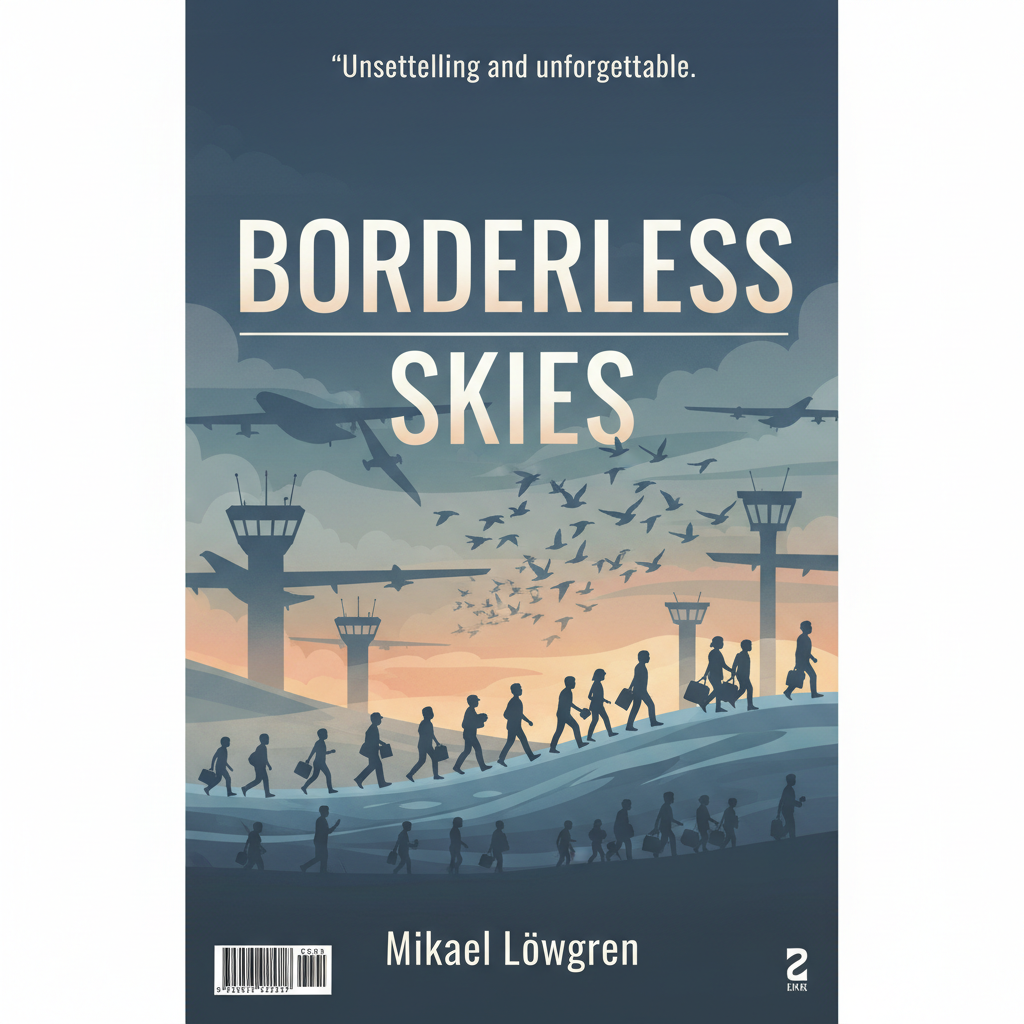
Synopsis
At a bustling European airport transformed into a transient sanctuary, the lives of a disillusioned flight controller, a compassionate aid worker, and a resilient displaced teenager intertwine amidst an unfolding humanitarian crisis.
Chapter 1: The Infinite Holding Pattern
The fluorescent hum of the radar room was Arthur’s daily symphony, a familiar, mind-numbing drone that had become as much a part of him as the faint ache in his lower back. Twenty-five years. A quarter of a century spent staring at green blips on a black screen, guiding metal birds through an invisible lattice in the sky. He used to find a strange beauty in it, the intricate dance, the unspoken trust. Now, it was just… noise.
Today, however, the noise was amplified, a cacophony of overlapping requests, delayed departures, and unscheduled arrivals. The airspace over Schiphol was a beehive, agitated and overpopulated. Not with holidaymakers or business executives, not anymore. These were different birds, their cargo heavier than luggage.
Arthur traced a lingering blip, an Airbus A330 from Istanbul. Its predicted landing time was already past. He pressed the comms button, the plastic cool against his thumb. “Schiphol Tower to Speedbird Four-Niner-Eight, you’re cleared for final approach, Runway Six. Expedite, please.”
A crackle, then a weary voice, thick with an accent Arthur couldn't quite place. “Speedbird Four-Niner-Eight, copy. Final approach, Runway Six. Thank you, Schiphol.” The pilot’s relief was almost palpable, even through the static. Arthur could picture him, knuckles white on the yoke, eyes bloodshot, having shepherded hundreds through hours of turbulence, real and metaphorical.
He watched the blip crawl toward the runway icon, a green insect finally finding its way home. But this wasn’t home for anyone on board. It was a holding pattern, a temporary suspension of unbelonging. He’d seen a dozen such landings in the last twelve hours, and the shift wasn’t even half over.
The screen shimmered with an unsettling saturation of green. Each blip, Arthur knew, represented a story, a severed life, a desperate hope. He no longer saw individual planes; he saw waves, an endless tide washing onto the sterile shores of his airport. Schiphol, once the gateway to the world, had become the world’s unwilling funnel.
He remembered the early days, not so long ago. The crisp announcements over the PA system, the rhythmic clatter of luggage wheels, the perfume of duty-free shops mingling with the faint aroma of freshly brewed coffee. Now, the coffee was still there, but it was often overshadowed by a different scent – the faint, lingering smell of antiseptic, of too many bodies in too small a space, of a desperation held just beneath the surface.
Arthur adjusted his headset. A newbie controller, barely out of training, stammered into his microphone, requesting clearance for an unscheduled medical transport. Arthur took over, his voice calm, decisive, a testament to years of suppressing instinctual panic. “Medical transport Oscar-Seven-Delta, cleared for immediate landing, Runway Zero-Three. Ground crew prepared. Do you concur?”
“Affirmative, Schiphol. Thank you.” Relief again. So much relief, hanging in the air like a thick fog.
He swiveled his chair, the worn leather groaning softly. Through the panoramic windows of the tower, the airport stretched out, a vast, flat expanse of concrete and glass, momentarily bathed in the watery afternoon sun. It was an alien landscape now. The usual orderly rows of parked aircraft were gone, replaced by a chaotic scattering of humanitarian aid planes, military transports, and commercial jets repurposed for emergency use. Tents, translucent white against the grey tarmac, had sprouted near the cargo bays, resembling grotesque mushrooms. They were intake centers, processing stations, temporary shelters. The efficiency he’d always prided himself on, the meticulous scheduling, the seamless flow – it was all a distant memory, replaced by a kind of organized chaos, a desperate improvisation.
He caught a glimpse of movement near one of the temporary structures. Figures in fluorescent vests bustled about, guiding lines of people. So many people. Tiny specks from this height, but Arthur knew their reality. He’d seen their faces on the news. Heard their stories, whether he wanted to or not, leaching into the periphery of his consciousness from the communal TV in the break room, from the hushed conversations of his colleagues. The faces of the tired, the afraid, the utterly bewildered.
He felt a familiar, cold detachment settle over him. It was a necessary shield, he told himself. To see them as individuals, to feel the weight of each individual tragedy, would be to crumble. His job was to manage the air traffic, to ensure the planes landed safely. The human cargo was someone else’s problem. A harsh thought, perhaps, but a survival mechanism. Too many years of this job, too much proximity to the invisible boundaries of life and death, had taught him that.
The hum of the instruments, the crackle of voices, the flickering green. It was all a pattern, an infinite holding pattern, and Arthur was merely a cog in its relentless turning. He reached for his thermos of lukewarm tea, the ritual a small comfort in the overwhelming tide. He took a sip, the bitter liquid burning a path down his throat.
Another blip appeared on the horizon, an unannounced arrival. His gut tightened. Here we go again. He knew, without checking the flight plan, that this wasn’t just another plane. This was another wave, another surge against the fragile dam that was this airport. He sighed, a tired, almost inaudible sound that was lost in the endless hum. He clicked his microphone on. “Unidentified aircraft, approaching Schiphol airspace. State your call sign and intentions.” The question hung in the air, weighted with the unspoken knowledge that intentions, in these skies, were rarely simple anymore.
Chapter 2: Grounding Zero
The scent of over-brewed instant coffee, acrid and persistent, clung to Élise’s clothes like a second skin. It mingled with the faint but omnipresent whiff of antiseptic wipes and something else, something indefinable that was part human desperation, part institutional weariness. She ran a hand through her already tangled hair, pushing stray strands back from her temples where a dull ache throbbed in rhythm with the fluorescent hum above. Another twelve-hour stretch had bled into another, the demarcation lines blurring into an unbroken continuum of controlled chaos.
She moved through Terminal 3, a skeletal shadow of its former self. Once, it had bustled with excited chatter, the rhythmic rumble of luggage carts, and the insistent chirping of departure announcements. Now, rows of cots replaced check-in desks, their thin mattresses covered in grey blankets, a sea of muted humanity. The duty-free shops, stripped bare, served as makeshift consultation rooms, their mirrored walls reflecting a distorted, urgent reality. A child’s drawing, a crayon sun blazing over a stick-figure family, was taped precariously to the polished glass of a former perfume counter. A splash of defiant color against the beige and grey.
Her clipboard, a battered testament to countless hours and countless names, weighed heavy in her hand. Each sheet represented a life uprooted, a story truncated. She was looking for Maria, an elderly woman with acute arthritis and a cough that grew more alarming by the day. Maria had been in designated ‘Zone C’ – the old baggage claim area, now repurposed – but the shuffling and reorganizing, a constant, low-grade tremor beneath the surface of the camp, meant people often vanished, only to reappear under a different designation hours later.
“Have you seen Maria Petrova?” Élise asked a volunteer, a young man with earnest eyes and a perpetually worried frown, who was distributing bottled water near what used to be a currency exchange. His name, she dimly recalled, was Thomas, or maybe Tom. They were all Thomas or Tom or Sarah or Anna, helpful but overwhelmed, their initial idealism slowly eroding under the relentless tide of need.
He shook his head, his brow furrowed deeper. “Not since this morning, Élise. They moved some of the elderly to the quieter section of Zone B, near the old executive lounge. Might be worth checking there.”
“Right,” she muttered, already turning, the dull ache in her head intensifying. The executive lounge. A cruel irony, she thought, to house the most vulnerable in a space once reserved for the privileged. But then, every inch of this airport was a cruel irony.
As she navigated the labyrinthine corridors, past the temporary segregation screens erected from repurposed cargo netting and plastic sheeting, she heard the low murmur of voices, a polyphony of languages, each carrying its own timbre of loss and hope. The air was thick with it – the smell of disinfectant, unwashed bodies, stale bread, and that other, unnamed scent she couldn’t categorize but recognized as the smell of prolonged transit.
She spotted him near a large, frosted window that overlooked a disused runway, its tarmac streaked with faded yellow lines. He was slight, barely more than a skeleton under a too-large hooded sweatshirt, the fabric worn thin at the elbows. He sat on a plastic crate, knees drawn up to his chest, arms wrapped around them. His gaze, fixed on the empty expanse of concrete and the distant, silver glint of idle planes, held an unyielding despair that resonated with an almost physical intensity.
He was just a boy, perhaps fourteen or fifteen, his face a canvas of sharp angles and hollows. His hair was dark and unruly, falling over eyes that seemed to have witnessed too much, eyes that were too old for his young face. Élise had seen that look before, countless times. It was the look of someone whose inner landscape had been scorched, leaving only desolate plains.
She hesitated, her professional instinct to move on, to prioritize the immediate, clashing with a deeper, more human impulse. Maria could wait a few more minutes. This boy, whoever he was, needed something. A connection. A moment of recognition.
She moved closer, her steps hushed by the worn linoleum. He didn’t flinch, didn’t acknowledge her presence. He remained perfectly still, a statue carved from sorrow.
“Hello,” she said softly, her voice pitched low, not wanting to startle him. He didn’t respond. His eyes remained fixed on the outside world, a world he was apparently no longer part of.
She knelt down beside him, mindful of not invading his already diminished personal space. The squat put a familiar strain on her knees, remnants of an old injury from a fieldwork mission in Yemen. Her own aches and pains felt insignificant, almost indulgent, in the face of what this boy was enduring.
“My name is Élise,” she tried again, slower this time, enunciating clearly. “I work with the aid organization here.” She gestured vaguely to the faded logo on her ID lanyard, a small, blue and white shield.
Still nothing. A tremor of frustration, quickly suppressed, rippled through her. She was tired. She had too many boxes to tick, too many forms to fill, too many people to locate. But the despair emanating from him was a gravitational pull she couldn’t ignore.
“Are you alright?” she asked, knowing it was a foolish question, a pointless platitude. Of course he wasn’t alright. No one here was alright.
He finally stirred, a slow, almost imperceptible shift of his head. His eyes, the color of rich, dark earth, met hers. There was no flicker of recognition, no curiosity, only that deep, bottomless exhaustion.
“Where are you from?” she prompted gently, trying a different tack. “Do you have family here?”
His lips parted, a dry, cracked line. A sound emerged, a raspy whisper, barely audible above the distant rumble of a service vehicle. “My family… gone.”
The words, simple and stark, hung in the air between them, laden with an unbearable weight. Élise felt a familiar stab in her chest, a physical ache that accompanied such declarations. *Gone*. The word that haunted the hallways of every refugee camp, every war-torn village she had ever worked in. It meant so many things, all of them terrible. Dead. Separated. Lost. Disappeared. Unlocatable.
“I’m so sorry,” she breathed, the inadequacy of the phrase a bitter taste in her mouth. What good was an apology in the face of such devastation?
He turned his gaze back to the window, to the empty runway. Outside, the sky was the color of bruised plums, promising rain. “We were on the boat,” he said, his voice flat, devoid of inflection. A recitation, not a confession. “Waves. Many waves. They took… my mother. My father. My sister.” He gestured vaguely, his hand a limp, dismissive flick. “Took them.”
Élise felt a chill snake up her spine, despite the stuffy warmth of the terminal. The Mediterranean. The endless stories of flimsy boats, overcrowded, capsizing under the indifferent gaze of the unforgiving sea. The human cargo swallowed whole.
“And you?” she asked, her voice tight. “How did you…?”
“Another boat,” he interrupted, his eyes still fixed on the horizon, as if searching for something there. “Another boat found me. They put me here.” He tapped his chest lightly, a hollow sound. “Alone.”
His name, she learned after a long, strained silence, was Omar. He was seventeen, though he looked younger, his small frame and youthful features belying the antiquity in his eyes. He had been alone for three days, since being transferred from the coastal reception center. Three days without family, without connection, adrift in a sea of anonymous faces.
“Have you eaten, Omar?” she asked, attempting to ground the conversation in the immediate, the tangible.
He nodded once, a brief, jerky motion. “Bread. Water.”
“Do you need anything right now? A change of clothes? Medical attention?” She ran her knowledgeable gaze over him – no overt injuries, but the pallor of his skin, the sunken eyes, spoke of deeper wounds.
He shook his head slowly. “No. Just… quiet.”
Quiet. A commodity as rare and precious as gold in this cacophonous ecosystem.
Élise felt a knot of frustration coil in her gut. She was an aid worker, a fixer, a problem-solver. She was trained to triage, to assess, to mitigate. But what could she fix for Omar? How did you mend a family that had been swallowed by the sea? How did you mend a heart that had been broken into a million pieces?
“We will try to find if any of your family made it,” she said, knowing it was likely a lie, a hollow promise. The chances were infinitesimally small. But she had to say it. It was part of the ritual, part of the desperate hope they clung to, both the aid workers and the displaced.
Omar looked at her then, a direct, unwavering gaze that held no hope, no expectation, only a bleak understanding. “They are gone,” he repeated, his voice barely a whisper. “The waves keep what they take.”
She felt a wave of coldness wash over her. His certainty was absolute. He wasn’t grieving in the frantic, desperate way she usually witnessed; his grief was a quiet, internal erosion. He wasn’t asking for rescue, for a miracle. He was simply stating a fact, a truth he had already accepted.
“We can find you a different place, if you want,” she offered, grasping at straws. “A quieter zone. Maybe away from the windows.” Sometimes, the constant sight of the outside world, so close yet so unreachable, was a torment.
He shook his head. “No. I like to see. I like to remember.” His gaze drifted back to the runway, to the limitless expanse of the sky above it. He watched it as if it held secrets only he could discern.
Élise rose slowly, her legs stiff. The ache in her head had sharpened into a piercing throb. She looked at her clipboard, at the endless tasks awaiting her. Maria. The distribution lists. The medication schedules. The reports. All of it suddenly seemed profoundly insignificant next to the quiet, profound tragedy embodied by the boy before her.
“I’ll come back later, Omar,” she said, her voice softer than she intended. “I’ll check on you.”
He didn’t respond, didn’t acknowledge her departure. He remained a solitary figure, a silent sentinel, his eyes fixed on the horizon, watching the fading light, an embodiment of grounded sorrow in an airport built for flight.
As Élise walked away, the fluorescent lights reflecting off the polished floor, she felt a familiar numbness creeping in, a necessary defense mechanism. She had to; otherwise, the relentless tide of individual nightmares would engulf her too. But Omar’s quiet despair, his absolute acceptance of loss, lingered, a sharp and poignant counterpoint to the insistent hum of the terminal, to the chaotic rhythm of life that stubbornly persisted within its walls. She had to locate Maria. She had to keep moving. But Omar’s image, his unyielding gaze, was now etched into the landscape of her own weariness, a permanent resident in the crowded archives of her fractured, compassionate heart. The sky outside darkened, mirroring the gathering gloom within the makeshift sanctuary, promising another night of restless, haunted hours.
Chapter 3: Echoes in the Terminal
The silence was a weight, heavier than the roar of jet engines Arthur orchestrated in his tower, more oppressive than the rhythmic clatter of Élise’s makeshift clinic. It was the silence inside Omar, a vast, echoing chamber where once a symphony of laughter, street vendors’ cries, and his mother’s humming had resided. Here, in the hollowed-out belly of Terminal 4, the constant low thrum of distant aircraft merely underscored its presence, a dull vibration against the bones of his chest. It was a backdrop, a stage sound for the theatre of his new existence.
His fingers, still slender despite the sudden hardening of his life, traced the edges of the photograph. It was a small thing, folded and refolded so many times its creases were white scars on the glossy surface, the emulsion worn thin in places. Dust, fine and ubiquitous, clung to its corners. His mother, her head tilted, a smile playing on lips he remembered tasting of strong tea and honey. His father, a hand on her shoulder, his eyes crinkling at the corners with an inner mirth that had always found its way to Omar. And him, smaller then, perhaps ten, wedged between them, his own grin wide, a gap where a missing front tooth used to be. The sun, hot and benevolent, bathed the brick wall behind them, the jasmine overflowing its pot in the corner. Home. The word was a husk in his mind, devoid of its former sweetness.
He sat on an upturned luggage trolley, its wheels locked, its empty cage a metaphor for the hollowness within him. The air was cool, conditioned to a uniform coolness that felt alien on his skin. A faint scent of disinfectant mingled with the lingering ghost of duty-free perfume and the sharper, more immediate smell of unwashed bodies. A human tapestry unfolded before him, an ever-shifting mosaic of faces. Hope, a fragile, almost translucent thing, shimmered in the eyes of a young woman clutching a child, whispering assurances into its ear. Despair, thick and dark, coated the shoulders of an old man, his gaze fixed on a distant, invisible point, his hands clasped over a bundle wrapped in faded fabric. Weariness, universal and profound, etched itself onto every contour, sculpted every slump of posture.
He watched them without judgment, without curiosity, almost as a camera might, recording the data without processing the emotion. He had no energy for emotion, not anymore. Each morning, Élise, with her kind but tired eyes, would check on him, a hand briefly on his arm. She would speak softly, asking if he needed anything, if he remembered anything more from the journey. He would shake his head, a silent affirmation of his blankness, and she would nod, her lips pressed into a thin line, a flicker of something in her gaze that he couldn’t quite decipher – pity? Frustration? Perhaps both.
He remembered only fragments. The dusty road, the sun beating down, the taste of grit in his mouth. The hurried whispers, the dark hull of a boat in the moonlight, the smell of diesel and fear. The crushing press of bodies, the rhythmic slap of water against the wood. The cold. Always the cold, even when the sun was high. Then the confusion, the shouting, the sudden emptiness beside him where his mother had been. A hand, strong and unfamiliar, pulling him up, out, away. A new cold, the absence of their warmth.
A small child, no older than four, broke free from his mother’s grasp and wobbled towards Omar. His eyes, wide and brown, fixed on the worn photograph. The child reached out a tentative finger, an innocent curiosity that was almost painful in its purity. Omar flinched, pulling the photograph closer to his chest. The child’s mother, a tired woman with a scarf wrapped around her head, quickly scooped him up, murmuring apologies in a language Omar vaguely recognized as his own. He watched them walk away, the child’s head resting on his mother’s shoulder, a picture of comfort. The pang, sharp and unexpected, twisted in his gut. A memory of his own head on his mother’s shoulder, the rhythmic sway of her walk… He squeezed his eyes shut, trying to hold onto it, but it was already dissolving, a wisp of smoke caught in the wind.
The loudspeaker crackled, an announcement in three languages, its words indistinguishable from the background hum. A group of people, recognizable by their matching, brightly colored vests, moved through the terminal, distributing bottles of water and foil-wrapped sandwiches. One of them, a young woman with a kind smile, paused near Omar.
“Water?” she asked, her voice soft, English with a slight accent he couldn’t place. She held out a frosty bottle.
Omar swallowed, his throat suddenly dry. He shook his head. He wasn’t thirsty, not in the physical sense. The thirst was deeper, an unquenchable yearning for what was lost.
She nodded, her smile not faltering. “Okay. If you change your mind.” She moved on, her brightly colored vest a beacon in the muted landscape of worn clothes and anxious faces.
He opened his eyes and looked at the photograph again. The light from an overhead fluorescent panel caught the worn surface, making the figures shimmer, almost alive. He focused on his mother’s smile, trying to conjure the sound of it, the way her eyes would crinkle at the corners when she laughed. But the sound was lost, swallowed by the silence. The memory was muted, like an old film reel, the colors faded, the dialogue inaudible.
He thought of the airport, this vast, echoing space. It was a place of departure, of arrival, of transition. For him, it was a stasis. A holding pattern, like the planes Arthur watched on his screen, circling, waiting for clearance to land. He was circling, waiting for something, though he didn’t know what. A sign? An answer? A direction?
A small group of teenagers, a few years older than him, sat against a wall opposite, their heads bent over a shared smartphone, their laughter, hushed and sporadic, a jarring intrusion into the prevailing quiet. They spoke in rapid bursts of a language he didn’t understand, but their gestures, their shared glances, were universal. They had each other. A small community formed out of shared displacement. He watched their fingers dance across the screen, the blue glow illuminating their faces. What were they seeing? What was so captivating? He felt a faint flicker of something akin to envy. He had no phone, no connection to the digital world, no portal to distract him from the insistent press of his own thoughts.
He folded the photograph carefully, tucking it into the inner pocket of his worn jacket. It was a fragile shield, a talisman against the encroaching emptiness. He stood up, his limbs stiff, the chill of the metal trolley still seeping into his clothes. He walked, slowly at first, then with more purpose, through the labyrinthine corridors of Terminal 4. The floor was clean, polished to a dull sheen, reflecting the fluorescent lights in long, wavy streaks. There were signs, in multiple languages, pointing to gates, to baggage claim, to restrooms. He didn’t need any of them. He was simply moving, putting one foot in front of the other, a small act of defiance against the inertia that threatened to consume him.
He passed a row of empty check-in counters, their screens dark, their conveyor belts still. A relic of a time when this terminal served a different purpose, when people arrived here with tickets and passports and the expectation of a destination. Now, it was the destination.
He saw Élise then, her back to him, speaking animatedly with a man in a crisp uniform, his shoulders stiff with authority. She gestured with her hands, a familiar intensity in her posture even from a distance. The man, a ground staff supervisor by the look of his badge, seemed to be listening with a mixture of patience and irritation. Her empathy radiated even across the expanse of the terminal, a warm current against the prevailing chill. He almost called out to her, a faint impulse – perhaps she would have an answer, a kindness that might fill a small part of the void. But the words caught in his throat, a whisper that never formed. He simply watched, a silent observer in this sprawling, temporary world.
He found himself near a window, a vast expanse of glass looking out onto the tarmac. The sun, a pale, anemic orb, was beginning its descent, staining the sky with muted shades of orange and purple. A scattering of aircraft stood parked, their silver bodies glinting in the fading light. A maintenance crew moved beneath the wing of a colossal freighter, their figures dwarfed by its scale. The distant sound of a jet engine spooling up, a rising crescendo, announced a departure. The plane, a white dart against the bruised sky, began its slow, deliberate taxi towards the runway.
Omar watched it, his face pressed against the cool glass. He watched as it picked up speed, a roaring beast finding its momentum, lifting off the ground with a powerful, seamless grace. It soared, a testament to human ingenuity, to the boundless aspiration to transcend gravity, to escape the confines of the earth. He watched until it was a mere speck, then a phantom, absorbed by the vastness of the darkening sky. A longing, sharp and exquisite, tightened his chest. To be on that plane. To be going somewhere. Anywhere. To be free of the ground.
The longing was almost too much to bear. It amplified the silence within him, turning it into a roar. He felt the weight of his own stillness, his own entrapment. The plane, carrying its nameless passengers to their unseen destination, left behind only lingering echoes in the terminal air. And in Omar, it stirred a flicker, a nascent pulse of a desire he hadn’t known he still possessed: the desire to simply not be here, a yearning for movement, for flight, for anything that would take him away from the deafening stillness of this life.
Chapter 4: Points of Intersection
The red phone, usually a silent sentinel on Arthur’s console, chose that precise moment to shriek. Not the anodyne buzz of an incoming flight plan amendment, nor the clipped urgency of a pilot reporting a technical snag. This was the raw, unadorned sound of an emergency, a direct line to Ground Operations, cutting through the rhythmic murmur of air traffic control like a razor. Arthur, mid-instruction to a Lufthansa pilot about a revised take-off slot, felt his gut tighten. He had seen enough incidents, enough blips vanish from screens, enough distant plumes of smoke reported by startled eyes, to know that this sound rarely heralded anything good.
He snatched the receiver, pressing it hard against his ear, the static-laced voice on the other end confirming his premonition. “Alpha-Six, Ground Incident. Family. Unaccompanied child. Gate B-17, just off Lufthansa 403. Medical team en route. Advise caution around the stand.”
*Unaccompanied child.* The words hung in the air, a disruption not just to his immediate schedule, but to the carefully constructed emotional barrier he maintained around his work. His world was vectors, altitudes, speeds – everything quantifiable, predictable, controllable. Human chaos was meant to be contained within the sterile confines of the terminal below, a problem for others.
He glanced at the panoramic window, the expanse of tarmac a familiar canvas of moving metal and flashing lights. Gate B-17. He could almost pinpoint the exact jet bridge, a metallic arm extending towards the fuselage of a behemoth, still disgorging its human cargo. A faint ripple of commotion was visible even from his vantage point: a cluster of yellow-vested ground staff, their usual brisk movements replaced by a hesitant, almost frantic milling. An ambulance, lights muted but urgent, was already weaving its way through the service lanes, its siren a distant, mournful cry just beginning to register even in the soundproofed chamber. This was not a blip. This was tangible.
“Roger that, Ground Ops,” he replied, his voice betraying none of the internal tremor. “Maintaining traffic flow. Keep us updated.” He hung up, the red phone a symbol of the thin, fraying thread connecting his abstract world to the messy reality unfolding beneath. For a moment, his usual efficient cadence faltered. The airspace, a delicate ballet of converging and diverging metal birds, continued its relentless demand for his attention, but his focus had fractured. He saw the world from above, a silent, orderly grid. But down there, on the ground, something was breaking the pattern.
It was rare for an incident to spill directly onto the tarmac, rare for it to interrupt the seamless transition from plane to terminal. This meant something had gone undeniably, viscerally wrong. He found himself replaying the conversation, searching for details, for a way to categorize it, to file it away. *Family. Unaccompanied child.* The terminology, so clinical, failed to capture the raw vulnerability it implied. His mind, trained to see patterns, to anticipate consequences, found itself contemplating a scenario beyond charts and flight plans: the sudden, terrifying jolt of human displacement, given form and voice on the sterile concrete.
He adjusted his headset, the familiar weight a small comfort. “Air France 218, cleared for take-off, runway three-left. Wind 270 at 10. Report airborne.” The words were automatic, a muscle memory, a desperate reaffirmation of order. But even as he spoke, his gaze drifted back to B-17. The ambulance had arrived, doors flung open, its white form a stark contrast against the grey aircraft skin. Figures moved with a renewed urgency now, a visible knot forming at the foot of the jet bridge.
Downstairs, Élise felt the familiar prickle of adrenaline, a sensation that had become as routine as her morning coffee. The crackle on her walkie-talkie was sharp, the voice of a fellow aid worker breathless with urgency. “Élise, Gate B-17. Lufthansa 403. Medical emergency. Family just disembarked, looks like a child collapsed, possibly exhaustion, dehydration. And… it’s a difficult situation. They don’t speak any of the European languages we have cover for yet.”
She was already moving before the voice finished, her sensible sneakers pounding a steady rhythm on the polished floor. B-17 was towards the perimeter of their current operational zone, a good five-minute sprint. Around her, the usual airport symphony – the rolling thunder of luggage, the tinny announcements, the babble of a thousand converging languages – faded to a dull hum. Her mind was already cataloging, categorizing the potential needs: immediate medical, language interpretation, psychological first aid, shelter, registration. The invisible checklist deployed with practiced speed.
The scene at B-17 was unfolding as described, but with a visceral intensity the walkie-talkie could never convey. A woman, her face etched with a fear that transcended language, was kneeling beside a small, still form on the floor, cradling its head. Two more children, their eyes wide and disoriented, clung to her, their small bodies trembling. A man, his clothes dust-stained and too thin for the European autumn, stood nearby, his hands clenched, a broken helplessness radiating from him. The ground staff, usually accustomed to calmly directing disembarking passengers towards customs, milled awkwardly, their trained politeness giving way to flustered concern. A medical team was already assessing the child, a rapid exchange of urgent whispers and the rustle of sterile packaging.
Élise pushed through the small crowd, her blue NGO vest a beacon, her voice calm despite the racing beat of her own heart. “I’m with the NGO. Can anyone translate?” she asked, her gaze sweeping over the faces, searching for a sign of comprehension. A young flight attendant, her complexion pale, shook her head mutely.
She knelt then, beside the mother, a gesture of shared humanity preceding any practical assistance. The child was very young, perhaps five or six, its face pale, its breathing shallow. Élise reached out, gently touching the mother’s shoulder. The woman looked up, her eyes, dark and ancient, locking onto Élise’s. There was no understanding in them, only raw, unadulterated terror. Yet, in that brief, shared moment, a current passed between them – a recognition of suffering, a silent pact of witness.
“Water,” Élise murmured to one of the medical staff, a young paramedic whose face was grim. “And a blanket. And has anyone tried Arabic? Farsi? Tigrinya?”
The paramedic nodded, already moving to retrieve the items. Another aid worker, a young man named Stefan who spoke rudimentary Arabic, arrived, his face creased with worry. He knelt and began to speak softly to the distressed parents, his words a gentle balm on the open wound of their fear. Élise watched him, a flash of relief warming her. Language barriers were their constant adversary.
As the paramedics carefully lifted the child onto a stretcher, its small body alarmingly limp, Élise rose, her eyes scanning the immediate vicinity. Passengers, delayed by the unfolding drama, were beginning to form a bottleneck in the jet bridge, their whispers a low thrum of curiosity and concern. An airport official, brisk and officious, was attempting to divert them, his voice sharp with irritation.
It was then, as she cast her gaze upwards, that she saw him. Not truly saw him, not with clarity, but sensed him. A figure, framed in the large control tower window, a distant dark silhouette against the relentless blue of the sky and the expanse of grey tarmac. For a split second, she felt an unseen gaze upon them, a perception that someone from a different realm, a different sphere of activity, was witnessing this small, catastrophic event.
Arthur, from his elevated perch, saw Élise. He didn’t know her name, but he recognized the blue vest, the swift, purposeful movements. He’d seen them before, these aid workers, weaving through the terminals, always a picture of controlled urgency. He watched her kneel, the small gesture of comfort she offered, and then her rise, her gaze, for a fleeting moment, seeming to pierce the glass and land directly on him. He wasn't sure if it was a trick of the light, or a momentary, impossible alignment of focus. But in that instant, a flicker of something passed between them. A shared exhaustion, perhaps. A mutual understanding of the weight of human fragility. He, from his world of abstract patterns, she, from hers of raw human need. Both working at the edges of chaos, trying to impose some semblance of order.
He broke the gaze first, his attention pulled back by the insistent green lights of an approaching cargo plane, its enormous bulk a distant, precise dot on his radar. The red phone had fallen silent, its immediate crisis abated, but the aftershocks continued, rippling outwards. Below, Élise was already coordinating with the medical team, directing Stefan, her voice a low, steady murmur. The family was being moved, a careful, orchestrated effort to shepherd them through the labyrinthine airport and towards what refuge could be offered.
The cargo plane touched down with a distant thud, its powerful engines roaring in reverse thrust. Arthur watched it, another piece of the intricate puzzle slotting into place. The planes kept coming, a relentless metallic tide. The children kept arriving, a human tide, sometimes breaking on the shore of the tarmac. The two worlds, distinct yet intertwined, continued their uneasy dance, the blips and the bodies, the sterile efficiency and the raw, vulnerable humanity, forever finding points of intersection in the vast, transient sanctuary of the airport.
Chapter 5: The Weight of the Airwaves
The weather pattern, a low-pressure system sprawling eastward from the Atlantic, had been a smudge on the long-range forecasts for days. Now, it solidified into a menacing presence, a thick grey thumbprint pressing down on the meteorological maps Arthur stared at. Every pixel pulsed with an impending threat. His screens, usually a symphony of neat flight paths and altitude readouts, began to stutter, the fine lines of projected wind shears wavering like nerves.
He felt it first in the air itself, the subtle shift in pressure against his eardrums, a precursor to the true disruption. The atmosphere outside the control tower’s reinforced glass walls, usually a clear, crisp blue at this hour, was now a uniform, oppressive grey, the kind that promised not just rain, but a relentless, drumming assault.
“Arthur, you seeing this?” came the clipped voice of Pavel from the next console, his fingers flying across a keyboard, toggling through weather models.
Arthur didn’t need to confirm. He felt it in his gut, a familiar tightening. “It’s coming in fast. Faster than predicted.”
The wind speeds on the active runways, relayed to him in a continuous stream of data, began to climb, tentative gusts morphing into sustained pushes. The first few commercial arrivals bounced hard on their final approaches, their pilots' voices roughened with strain over the comms. He pictured them, enormous aluminium birds, buffeted and slapped by an invisible hand, their delicate landings now precarious dances.
Then came the red alerts. Not just localized wind shear warnings, but icing potential above five thousand feet, widespread turbulence advisories, and a rapidly dropping visibility ceiling. The airport, one of the busiest hubs on the continent, was about to be choked.
His console, already a kaleidoscope of blinking data, lit up with new urgency. Divert. Delay. Hold. The directives cascaded down, each a potential catastrophe averted, or merely postponed. He worked the frequencies, his voice a steady counterpoint to the growing static, his mind a finely tuned instrument charting the invisible paths of hundreds of lives.
“Lufthansa 342, descend to eight thousand, hold at point X-ray-Whiskey-Tango. Expect further delays.”
“Air France 701, squawk three-two-seven-five, vector zero-niner-zero, maintain present speed.”
Each instruction was a thread in a vast, intricate tapestry, a continuous, live calculation of fuel reserves, passenger patience, and the ever-shrinking windows of opportunity the weather presented.
Then, the specific call. A humanitarian flight, designated “HOPE ONE,” out of Istanbul, carrying essential medical supplies and a team of doctors, was requesting priority landing. Its planned arrival, already shifted due to earlier technical issues, now coincided precisely with the weather’s intensifying fury.
Arthur’s eyes flicked to the flight plan, then to the swirling mass of red and orange on the weather radar. The conditions were rapidly deteriorating. Landing HOPE ONE right now would be a risk. A significant risk.
“HOPE ONE, this is tower. Be advised, current conditions are marginal for landing. Visibility dropping to minimums, wind shear active.” His voice, despite the internal dissonance, remained neutral, professional.
The reply was immediate, tinged with a weariness that seeped through the crackle. “Tower, HOPE ONE understands. We have critical cargo, urgent medical personnel. Requesting a window, however brief.”
He leaned back in his ergonomic chair, the faux leather creaking beneath him. His hand hovered over the transmit button. The ethical dilemma wasn’t a concept in a textbook; it was a physical weight, pressing down on his chest. On one screen, a dozen commercial flights orbited in holding patterns, each one a metal cannister filled with vacationers, business travelers, families eager to reconnect. Delayed, inconvenienced, perhaps. Annoyed, certainly. On another, the single, designated icon for HOPE ONE, a lifeline in miniature, carrying the promise of relief to an overwhelmed, under-resourced camp. A camp he knew, abstractly, existed within the very perimeter of the airport he controlled.
He saw Élise then, briefly, in his mind's eye. Her tired but determined face, the way her eyes, even in that fleeting encounter during the ground incident, had held a kind of fierce empathy. He imagined her, down there, beneath the deluge that was surely about to hit, waiting for these supplies. Waiting for these doctors.
“Tower, HOPE ONE. Fuel situation becoming a factor if we continue to hold.” The pilot’s voice was sharper now, the professionalism beginning to fray at the edges.
Arthur closed his eyes for a split second, a silent calculation unfolding in the dark. Granting HOPE ONE priority meant diverting at least two, possibly three, commercial flights to alternate airports. That meant hours of delay, thousands of euros in additional costs, furious passengers, and a bureaucratic nightmare of rescheduling and logistics. It also meant a higher risk of an incident – a close call, an aborted landing – for HOPE ONE itself in these conditions. But not granting priority… it meant delaying critical aid. It meant, potentially, lives. The simple, stark equation, unburdened by commercial profit margins or shareholder expectations, bore down on him.
“Pavel, what’s our window for a landing?” Arthur asked, his voice low, his eyes fixed on the weather radar.
Pavel, understanding the unspoken implication, clicked furiously. “Tight, Arthur. Maybe fifteen minutes before we hit Category Two conditions, sustained. Visibility will be almost nil. Runway conditions will be critical. It’s a gamble.”
A gamble. All of it was a gamble. Life, death, the flight of a plane, the trajectory of a human destiny. He thought of the detached, almost clinical way he’d viewed the influx of people until not so long ago. Blips on a screen. Numbers for a report. Now, the human element was seeping into the sterile air of his control tower, infiltrating his calculations.
He picked up the mic. “HOPE ONE, this is tower. Prepare for an expedited approach on Runway Zero-Six-Left. You are cleared for immediate descent, maintain current airspeed, vector three-five-zero. Be advised, you will be flying into severe turbulence. Acknowledge instructions.”
A beat of silence. Then, a voice, laced with relief, but still taut with precision. “HOPE ONE acknowledges. Cleared for immediate descent on Zero-Six-Left, vector three-five-zero. Thank you, tower.”
Arthur felt a microscopic tremor pass through him. It was done. The decision made. Now came the execution. He began rerouting the commercial traffic, his voice firm, unwavering as he issued diversion commands, explaining the unavoidable circumstances with practiced neutrality. He heard the grumbles, the exasperated sighs over the airwaves, the rapid-fire questions about connecting flights and hotel accommodations. He absorbed it all, letting it wash over him without penetration, his focus riveted on the single, determined blip that was HOPE ONE.
He watched it descend, fighting against the unseen forces of the wind, the icon on his screen wobbling like a tiny ship in a tempest. The visibility outside the tower windows was already degrading, the distant city lights blurring into watery smears. Rain began to lash against the glass, a furious staccato drumbeat that mirrored the frantic pounding in his own chest.
He monitored their altitude, their speed, their glide slope, every second an eternity. The pilot’s voice was tighter now, grunting through turbulence updates, the sound of the plane groaning under stress audible in the background.
“Tower, HOPE ONE, heavy crosswind correction confirmed.”
“Understood, HOPE ONE. You are five hundred feet. Maintain visual on the approach lights as best you can.”
He could see nothing from his vantage point but a grey, rain-streaked void. He relied entirely on the instruments, on the pilot's skill, on the thin thread of communication connecting them.
Then, through the static, a crackle of triumph, laced with exhaustion: “Tower, HOPE ONE, runway acquired. We are down. Thank you.”
A collective exhalation in the control tower. Pavel, usually stoic, let out a low whistle. Arthur felt the physical weight lift, replaced by a dull ache behind his eyes. He watched the blip of HOPE ONE taxi slowly towards its designated humanitarian aid gate, a small victory against the elements, against the logistical nightmares, against the crushing pressure of conflicting needs.
The commercial flights, diverted or still holding, would be a problem for hours, maybe days. The phone calls, the complaints, the official inquiries – they would come. But as he watched the rain intensify, turning the entire landscape into a blurred water painting, he felt a strange sense of quiet satisfaction. He had made a choice. He had given a lifeline. And in that moment, the sterile air of the control tower felt a little less cold, a little more human. Even as the next blips on his radar began to demand his attention, each one a new story, a new decision, he carried the weight of the one he had just made, a weight that paradoxically, made him feel momentarily lighter.
Chapter 6: Unseen Scars
The fluorescent hum of the repurposed baggage claim area usually grated on Élise, a constant, low-frequency thrum against her skull. But today, it was merely an accompaniment to the rhythmic whisper of charcoal on paper. She’d found Omar tucked away beneath one of the conveyor belts, a space he’d claimed as his own, a pocket of semi-privacy in the sprawling, public grief of the terminal. His back was to her, shoulders hunched, completely engrossed.
She hadn't meant to intrude, just to check on the quiet boy who seemed to shrink ever further into himself with each passing day. He’d been given a packet of instant noodles, lukewarm tea, and a worn-out copy of a children’s book in French, none of which he’d touched. It was the movement of his hand, quick and precise, that had arrested her.
He was drawing on the back of a discarded manifest, the faint blue lines of the original document barely visible beneath his fierce strokes. The subject, as she moved closer, was a human figure, curled in on itself, limbs impossibly contorted. The lines were jagged, almost violent in their intensity, yet there was a stark beauty to the form, a raw vulnerability that resonated with something deep inside Élise. It was a person, yes, but more, it was a feeling given shape – fear, entrapment, perhaps pain.
“Omar?” Her voice, usually soft, cracked the relative silence, and he flinched, his hand freezing mid-stroke. He tucked the paper hastily beneath his arm, his eyes, dark and wide, already scanning for an escape route.
“It’s okay, it’s just me,” she said, lowering herself to one knee, trying to appear less imposing. The metallic tang of antiseptic hung in the air, a constant reminder of the airport’s dual function. “What are you drawing?”
He shook his head, a quick, jerky motion, his gaze fixed on some point beyond her shoulder. His silence was a familiar wall, one she’d repeatedly tried to scale. Most of the children, even the traumatized ones, eventually found their voice, if only to ask for another biscuit or to complain about the cold. Omar remained an enigma, a repository of unspoken horrors.
“May I see?” she persisted gently, extending her hand, palm open in a gesture of reassurance. “I promise I won’t touch it, unless you want me to.”
He hesitated, his fingers still clutching the paper. Then, slowly, as if against his will, he unfolded his arm and pushed the crumpled sheet towards her.
Élise took it, careful not to even brush his hand. The drawing was even more profound up close. Beyond the twisted figure, there was a boat, minuscule and frail, tossing on an angry sea. Waves rose like monstrous, clawed hands, threatening to engulf the tiny vessel. And in the background, almost an afterthought, a faded, ghostly outline of a city, its buildings melting into the horizon.
She traced the charcoal lines with her gaze, a chill crawling up her spine. This wasn’t just a child’s doodle. This was a scream, rendered in graphite and paper. The details were stark, almost brutal: the desperate faces peering over the gunwales, the slick, dark surface of the water, the sheer, indifferent expanse of the sky.
“This… this is incredible, Omar,” she murmured, her voice thick with genuine admiration and a burgeoning sense of sorrow. “Did you see this?”
He nodded, a barely perceptible dip of his head. His eyes, though still distant, held a flicker of something she hadn’t seen before – not hope, not even recognition, but something akin to an ember, still glowing in the ashes.
“This boat… it reminds me of… of the sea,” she offered, knowing she was grasping, but needing to connect, to acknowledge the weight of his imagery.
He pointed a slender finger at a tiny figure in the boat, almost lost in the chaos. His finger trembled slightly. “Mama.” The word was a whisper, barely audible above the drone of the air conditioning.
Élise felt a sharp intake of breath. Mama. The last she knew, Omar’s family was presumed lost at sea, or rather, had simply vanished after their boat was intercepted. He had been found clinging to a piece of debris, near unconscious. This drawing wasn’t just a memory; it was a testament, a final, heartbreaking glimpse.
She felt a surge of protectiveness, of profound sadness, and a dawning realization. This was his language. This was how Omar spoke.
“You have a gift, Omar,” she said, her voice steadier now. She looked at the smudges on his fingers, the improvised charcoal that she now recognized as a burnt twig from a discarded branch someone had used for kindling. This wasn’t sustainable. This wasn’t enough.
The idea formed quickly, blooming in her mind like a sudden, unexpected flower. “Do you… do you like drawing, Omar?”
He looked at her then, directly, and for the first time, she saw a hint of something other than fear or emptiness. It was a question, a flicker of curiosity.
“I think you could draw so much more, Omar,” she pressed on, leaning forward slightly. “With better materials. Don’t you think?”
He tilted his head. He didn't speak, but it wasn't the usual blankness. It was an openness, a flicker of something new.
She returned the drawing to him, careful to smooth the crumpled edges. “Keep it safe. It’s important.”
Later that day, after her shift concluded, Élise found herself in a small art supply shop on the edge of the city. The sterile fluorescent lighting of the airport was replaced by the warm glow of incandescent bulbs, casting long shadows over shelves laden with tubes of paint, stacks of paper, and an overwhelming array of pencils. The smell of turpentine mingled with something sweet, like linseed oil. It was a world away from the makeshift clinic and ration queues.
She moved slowly, deliberately, her fingers tracing the fine edges of charcoal sticks, the smooth grain of cartridge paper. She’d always been drawn to art, sketching rudimentary landscapes in her college years, finding solace in the quiet focus. But she hadn’t drawn in years, not since the relentless demands of her work had swallowed every spare moment.
She chose a set of artist-grade charcoal pencils, soft and expressive, along with a thick pad of heavy-gauge drawing paper. Then, almost as an afterthought, a small box of colored pencils, primary hues, bright and unyielding. Perhaps, she thought, the sheer vibrancy might coax something else out of him, something beyond the monochrome of his grief.
“Working on a new project?” The shop owner, a woman with paint-stained fingers and a kind smile, asked her.
Élise offered a small, tired smile in return. “Something like that. For a boy I know. He has… a story to tell.”
The owner nodded, her eyes understanding. “Art is a good way to tell stories. Some stories, you can’t use words for.”
Élise paid for her purchases, the small bag feeling heavy with significance. The cost was negligible compared to the usual bureaucratic expenditure of medicine and food, but the potential yield, she felt, was immeasurable.
Back at the airport, the cacophony of voices and the restless movement of displaced humanity continued unabated. She spotted Omar easily, still in his chosen spot, hunched over, scratching away on another piece of scrap paper. It was a different image this time, one she couldn’t quite make out from a distance.
She approached him slowly, the crinkle of the paper bag announcing her presence. He froze, poised for flight.
“Omar,” she said, her voice soft. She held out the bag. “These are for you.”
He looked at the bag, then at her face. Suspicion warred with a cautious curiosity. He didn't reach for it.
Élise knelt down again, placing the bag on the floor between them. She reached in and pulled out a charcoal pencil, its tip finely sharpened, and then the pad of paper, pristine and white.
“These are special,” she explained, holding up the pencil. “Much better than twigs. And this paper,” she ran her palm over the smooth surface, “is for your drawings. To help you make them beautiful.”
She gently pushed the pencil and paper towards him. He still didn’t touch them, but his gaze was fixed on the objects, a quiet intensity in his dark eyes. It was a small aperture, a tiny crack in the wall he’d built around himself, but it was there.
“You can draw your boat again,” she suggested, her voice barely above a whisper. “Or your Mama. Or anything you want to. No one will take them, Omar. They’re yours.”
She could see him wrestling with it, the urge to touch the smooth paper, to feel the new pencil in his hand, conflicting with the ingrained fear, the caution that had become his second skin. He seemed to hold his breath, a tiny, internal battle playing out before her.
Then, slowly, his hand extended, tentative at first, then more assured. His fingers wrapped around the charcoal pencil, his thumb brushing over the carefully sharpened tip. He picked up the pad of paper, turning it over in his hands, admiring its blankness.
Élise simply watched, a small, fragile hope unfurling in her chest. She had offered him a voice, a means to translate the unseen scars of his journey into something tangible. Whether he would take it, whether he would allow himself to sketch the trauma that haunted him, remained to be seen. But in that moment, as his fingers tightened around the pencil, she felt a profound certainty that she had offered him more than just art supplies. She had offered him permission.
The low hum of the terminal continued, the distant echo of a flight announcement reverberating through the vast space. But in their small corner, beneath the conveyor belt, a new sound was about to begin – the soft, almost inaudible scrape of charcoal on paper, a nascent narrative waiting to be born. And as she watched him, she knew this wasn't just about Omar. It was about all of them, finding their own ways to make sense of the borderless skies they now collectively inhabited.
Chapter 7: A Glimmer of Connection
The airport’s hum, usually a dull, omnipresent thrum, seemed to narrow to a pinpoint whenever Élise sat across from Omar. It was in one of the quieter corners of the makeshift aid station, a few folding chairs pulled together near a perpetually buzzing fluorescent light. She’d brought him a new sketchbook, its cover a rich, unblemished cerulean that reminded her of a clear, boundless sky, a stark contrast to the faded, dog-eared one he clutched. He hadn’t opened it yet. It lay between them, a silent, weighty offering.
“It’s a nice color, isn’t it?” she’d said, her voice soft, designed to ripple the air, not fracture it.
He’d only nodded, his eyes, dark and often downcast, flicking briefly to the pristine paper.
Weeks had passed since their first encounter, a slow, arduous chipping away at the wall Omar had built around himself. Élise had seen it before, this retreat into an internal landscape, a fortress against further pain. Her approach was always the same: consistent presence, gentle prodding, and an unwavering patience that felt, at times, like a physical weight she carried.
Today, the air felt different. Perhaps it was the quality of the light filtering through the grimy terminal windows, lending a faded gold to the usually drab surroundings. Perhaps it was the quiet hum of a distant loudspeaker announcing a delayed flight, a voice with an unexpected lilt. Or perhaps it was Omar himself.
He picked at a loose thread on his worn jeans, his gaze fixed on the movement of his fingers. Élise waited. The silence stretched, not quite uncomfortable, yet taut.
Then, “My mother… she used to make me draw everything.” The words were a whisper, barely audible above the ambient noise, as if spoken to himself, not to her.
Élise felt a small, almost imperceptible surge of triumph, quickly suppressed. This was not a victory, but a delicate unwrapping. “What kind of things?” she encouraged gently, her voice a calm eddy in the current.
He finally lifted his head, his eyes meeting hers for a fleeting second, then darting to the untouched sketchbook. “The flowers in our garden. The patterns on the clay pots. Sometimes, the way the light fell on the mosque in the evenings.” He spoke in staccato bursts, each phrase a small, carefully placed stone. “She said if I didn’t draw them, I might forget how beautiful they were.”
A delicate tremor ran through Élise. This was a crack, a fissure in the rock. “She wanted you to remember,” she mused aloud, allowing the thought to hang in the air, open-ended.
He picked up the cerulean sketchbook, his fingers tracing the smooth cover. His touch was almost reverent. “Yes. Always remember.” His thumb brushed the corner, and then, with a slow, deliberate motion, he opened it to the first blank page. It lay there, vast and white, a world waiting to be filled.
“Have you ever drawn the airport?” Élise ventured, surprised by her own question. It felt almost sacrilegious to suggest rendering this sterile, transient space.
He turned his head, surveying their immediate surroundings: the rows of identical chairs, the distant bustle of people queuing, the omnipresent security camera in the corner. A faint, almost imperceptible smile touched his lips. “No. It’s… too much metal.”
Élise smiled back, a genuine, unforced expression. “Too much metal,” she repeated, savoring the simple truth of the observation. “What do you wish you could draw right now?”
His gaze drifted past her, to the towering windows facing the tarmac. Planes sat like dormant beasts, their wings catching the muted afternoon light. Beyond them, a thin, hazy line of distant mountains shimmered. “A bird,” he said, his voice stronger now, a faint echo of longing in its timbre. “Soaring. Not grounded.”
He paused, then added, his voice barely a breath, “Like me.”
The confession hung in the air, raw and vulnerable. Élise didn’t rush to fill the silence. There was no platitude that could soothe the ache of that comparison. Instead, she rose, walked a few steps to a supply cabinet, and returned with a small box of colored pencils, new and sharp. “Well,” she said, placing them gently beside the sketchbook, “a bird needs some good colors to soar, doesn’t it?”
He looked at the pencils, then at the blank page, then back at the distant sky, a quiet thoughtfulness settling on his face. He picked up a deep sapphire pencil, its lead still perfectly conical.
***
High above, in the sterile bubble of the control tower, Arthur watched. Not Omar specifically, not yet, but the steady flow of life in the terminal below. He had developed a new habit, a small ritual of detachment. During brief lulls between flight clearances, he would telescope his vision down, down through the layered glass of his tower, scanning the faces in the cavernous halls. He saw weariness, resignation, occasional moments of despair, but rarely hope.
Today though, something had snagged his attention. It wasn’t a blip on his radar, nor an unauthorized movement on the tarmac. It was a still point in the swirling chaos. Élise, the aid worker with the perpetually tired but determined eyes, was sitting with the quiet boy, the one Faysal had mentioned, the one who drew landscapes of grief. Arthur had glimpsed him before, a shadow flitting between groups, always alone.
He watched as the boy, Omar, opened a new sketchbook. A cerulean cover. Arthur found himself remembering the sky, the true, unfiltered blue of a summer morning, before the exhaust fumes and vapor trails smudged it. He saw Élise speak, her posture attentive, her head tilted just so. And then, he saw the boy’s head lift, his gaze panning towards the windows, towards the planes. And then, Omar’s hand reached out, selecting a pencil. A blue one, Arthur noted, almost involuntarily.
It was such a small, insignificant gesture in the grand scheme of the airport’s relentless operation. Pilots were waiting for clearance, fuel trucks were on a tight schedule, air traffic controllers in neighboring sectors were demanding updates. Yet, for a moment, Arthur felt a strange pull. He observed the almost delicate way Omar held the pencil, poised over the blank page. There was a fragile concentration in his posture, a momentary stillness that defied the clamor of his surroundings.
Arthur, a man whose life was dictated by precision, by vectors and altitudes and meticulously timed sequences, found himself, for the first time in what felt like years, focusing on something utterly unquantifiable. He wondered what the boy would draw. A plane? A distant mountain? A bird? The thought presented itself unbidden, a flicker of curiosity in the clinical landscape of his mind.
He knew nothing of this boy’s story, beyond the vague, generalized reports he sometimes overheard about new arrivals. Displaced. Trauma. Unaccompanied minors. These were categories, statistics, not people. But watching Omar, poised on the edge of creation in this unlikely, transient sanctuary, Arthur felt a subtle shift within him. It was not pity, not exactly. It was more akin to recognition. A silent acknowledgment of another human being attempting to find order, to impose meaning, however small, onto a world that had offered nothing but disorder.
He thought of his own meticulously drawn diagrams, his flight path projections, the elegant arcs of aircraft across a digital map. Omar’s blue pencil, suspended over a blank page, seemed to hold a similar, yet vastly more personal, promise of creation.
A sharp beep from his console jolted him back to reality. “Tower, this is flight BA211 ready for pushback, gate 34,” a crisp voice crackled through his headset.
“BA211, hold for traffic for two minutes,” Arthur responded, his professional tone snapping back into place, the impersonal authority he wielded every day.
But even as he issued the instruction, his gaze drifted once more to the lower terminal. Omar had lowered his hand. The blue pencil now rested on the paper. The blankness was no longer quite so absolute. A faint, tentative line, a curve, was barely visible. A wing, perhaps. Or the beginning of a cloud. A glimmer of something, nascent and fragile, had taken root.
Arthur turned back to his screens, his fingers flying over the keyboard, but the image lingered: a boy, a blue pencil, and the quiet courage of a beginning. The resilience, he realized, was not just in surviving. It was in daring to imagine, to create, even in the most barren of landscapes. He felt an inexplicable urge to see what the boy would eventually sketch, driven by an uncharacteristic, almost childlike curiosity. It was a feeling entirely new to him in this tower, a place where he was typically only concerned with what had happened, or what would happen, never what *could* happen. And that, he realised, was perhaps the greatest curiosity of all.
Chapter 8: Turbulence and Resolve
The drone of aircraft engines, usually a rhythmic pulse that underscored Arthur’s existence, intensified into a discordant roar. The screens before him, a tapestry of green and yellow lines weaving across a black expanse, flickered with an unprecedented density. It was as if every displaced person in the hemisphere had decided, at precisely this moment, to converge on his airspace. The radio crackled, a cacophony of urgent voices blurring into an unintelligible clamor. “Victor Tango Niner-Four, requesting emergency clearance… Mike Oscar Hotel Three-One, fuel critical… Delta Charlie Seven-Zero, medical aboard, priority landing required.” Each transmission tugged at a different nerve ending. He felt the familiar tightening in his chest, a sensation he usually attributed to too much coffee and too little sleep, but today it was something more, a constricting band of dread.
Down below, the terminals, already stretched thin, groaned under the new burden. Élise moved through the makeshift corridors, her strides purposeful but her every muscle screaming for respite. The air, thick with the scent of unwashed bodies and antiseptic, felt heavy in her lungs. Rows of cots, unfolded in every available space – abandoned duty-free zones, former VIP lounges, even sections of the baggage claim carousel – were now filled to overflowing. Faces, etched with exhaustion and a nascent panic, turned towards her as she passed, their eyes silently pleading. A small child, no older than five, clung to the tattered hem of his mother’s dress, his cough a ragged sound in the muted hum of voices. Élise knelt, her hand instinctively reaching for the child’s forehead. It was burning. She cursed under her breath. The medical tent, always a bottleneck, would be a war zone now.
The surge had been sudden, a trickle becoming a flood overnight. Reports from various borders, once sporadic, had fused into a single, alarming bulletin: a new wave, larger than any before, was approaching or had already arrived. The airport, this transient sanctuary, was about to be pushed to its breaking point.
Arthur watched the radar, his jaw clenched so tightly his teeth ached. Commercial flights, their carefully planned routes now snarled, circled endlessly in holding patterns. He had a queue of two dozen, all inbound, all demanding immediate attention. And then, there was the humanitarian cargo. Two C-130s, loaded with medical supplies and emergency food rations, were still holding at 10,000 feet, their pilots growing increasingly agitated. The protocol was clear: commercial traffic took precedence. Always. The airport was a business, after all, a massive gears-and-cogs machine designed for efficiency, for profit. But what profit was there in watching people starve, or sicken and die?
He stared at the blips, a single knot of logic untangling itself in his mind. The commercial flights could wait. They had enough fuel to circle for another hour, perhaps two. The cargo planes, however, carried life itself. He flicked a switch, his voice, usually calm and measured, now carrying an edge of definitive authority. “Tango Foxtrot Zero-Seven, you are cleared for immediate approach, runway three-zero. Repeat, immediate approach.” He heard the surprised confirmation from the pilot, followed by a slight hesitation. “Uh, Tower, we believe there are several commercial liners ahead of us in the sequence.”
Arthur took a deep breath. “Negative, Tango Foxtrot. Your payload has been prioritized. Execute approach sequence immediately.” He could almost feel the collective gasp from the commercial pilots now relegated to a holding pattern. He knew the reprimand would come. A formal investigation, perhaps even a suspension. He pictured the incident report, the coldly worded regulations he had just violated, spread out on a desk in front of his supervisor. But as he watched the green blip representing the C-130 begin its descent, a strange sense of clarity, almost a quiet satisfaction, settled over him. For the first time in a long time, the air felt a little lighter around him.
Élise had found Omar near the far end of Terminal B, huddled in a corner, sketching furiously. The makeshift art supplies she’d given him – a battered sketchbook, a handful of charcoal pencils – were scattered around him. His face, usually a mask of quiet contemplation, was contorted with a silent anguish. The page was covered in frenzied lines, a chaotic swirl of figures – stick thin, desperate, their hands outstretched. It was a depiction of the fear and overwhelming numbers she felt all around her.
“Omar,” she said, her voice soft, trying not to startle him. He looked up, his eyes wide, a flicker of the raw terror in his drawings still clinging to them. “Are you alright?”
He merely shook his head, holding up the sketchbook. There was a raw honesty in its pages, a truth that she, despite her decade of humanitarian work, sometimes struggled to articulate. He was showing her what she already knew: they were drowning.
“I need your help,” she said, her tone shifting. It was a gamble, asking for assistance from a boy who had every right to simply shut down. But there was a surprising strength in Omar, a quiet resilience she had come to trust. “Look around, Omar. We don’t have enough people. Too many new arrivals. The medical tent is overflowing. We need interpreters, people to help distribute water, blankets. We need someone to… to organize.”
His gaze flickered around the teeming terminal, taking in the huddled families, the weeping children, the overwhelmed volunteers. His eyes, though still reflecting a deep-seated sadness, began to lose some of their bewildered fog. He seemed to be cataloging, assessing, just as he did when sketching.
“Can you help me?” she pressed, offering him an open, questioning look. “Even just to show people where to find things? To translate for those who don’t speak English or French? You speak… how many languages did you say?”
He paused, then slowly, almost imperceptibly, nodded. “Three. And some Farsi.”
A small, hopeful spark ignited within Élise. “Good,” she said, her voice firm. “That’s very good, Omar. We need you. All of us.” She squeezed his shoulder, a silent acknowledgment of the burden she was placing on him. “I need to go to the main office, see if I can wrangle more resources. Can you start by helping the families over there?” She pointed to a cluster of distressed individuals near a hastily erected water station. “See if you can get them some water and tell them about the medical services if they need them.”
Omar, still clutching his sketchbook, rose slowly. He looked small, fragile, swallowed by the sheer scale of the despair around them. But as he began to walk towards the group, his pace steady, a strange determination seemed to emanate from him.
Élise watched him for a moment longer, a flicker of admiration in her weary eyes. She turned, threading her way through the throng, the cries and murmurs of hundreds of displaced souls washing over her. She knew the main office would be a battlefield of bureaucracy and desperation, a place where ‘no’ was the most frequently uttered word. But as she pushed open the heavy glass doors, she felt a rekindled resolve. She would not take no for an answer. Not today. Not with a thousand new faces staring back at her, their hopes and fears held precariously in the balance. The airport, this crucible of human experience, was about to truly test their limits, and she, for one, was ready to meet the challenge head-on.
Chapter 9: The Unfolding Canvas
A small crowd had gathered around the makeshift gallery wall, a section of an unused check-in counter near the perpetually humming baggage claim. Someone had taped up a sheet of corrugated cardboard, and on it, a half-dozen sketches by Omar were displayed. They were simple at first glance, line drawings, mostly, but they hummed with a quiet intensity that drew people in, holding them there with an invisible gravity.
There was the one of the woman clutching a child, their faces etched with a weariness that went beyond physical exhaustion, a deep-seated ache of the soul. Her eyes, two swift strokes of charcoal, held a boundless sorrow, yet a fierce protective instinct radiated from her hunched shoulders. Another depicted a pair of worn boots, muddy and scuffed, standing on what looked like a rocky shoreline, the vastness of an imagined sea stretching out behind them. It wasn't the detail that captivated, but the essence of the journey it implied, the silent testament to miles walked, obstacles overcome. Then there was the airplane, not the sleek, commercial jets that constantly landed and took off, but a smaller, older model, its propeller a blur of suggested motion, carrying what looked like bundled figures. It was a plane of memory, a ghost of arrival, carrying the weight of dreams and desperation.
People murmured, some pointing, others simply staring, their own histories reflected in the smudged charcoal. A young woman, no older than Omar himself, reached out hesitantly, her finger hovering inches from the drawing of the boots. Her own shoes, though clean, carried the same tired curve from prolonged standing. An older man, his face a roadmap of arid landscapes, nodded slowly, a knowing glint in his eye. He didn't speak, but his presence, like a silent chorus, resonated with the artwork.
Élise watched from a distance, a sense of quiet triumph swelling in her chest. She hadn’t expected this, not really. She’d given Omar the sketch pad and charcoal, a tentative offering, a whisper of a suggestion. But he had taken it, not with enthusiasm, but with a solemn focus, as if the act of creation was a necessary translation, a way to make sense of the sensory overload that was his new reality. He worked in fits and starts, often disappearing for hours, only to reappear with a new drawing, placed carefully on the counter for Élise to find. Slowly, organically, a narrative had begun to unfold.
It had been one of the aid workers, a cheerful woman named Anya who managed the distribution of blankets, who had first suggested displaying them. “People need to see this, Élise,” she’d said, her voice softer than usual. “It speaks to something in them.” And she was right. The drawings had become a focal point, a silent language understood by all, bridging the chasms of differing origins and shared uncertainty. They were not art as decoration, but art as witness, art as testament.
The recognition was subtle, not overt praise or applause. It was in the lingering gazes, the soft sighs, the occasional tear wiped away surreptitiously. Omar, when he was near, pretended not to notice, his eyes fixed on some distant point, a flicker of something close to pride, quickly masked, in their depths. He was still the quiet, withdrawn boy, but something had shifted. A small, almost imperceptible space had opened within him, occupied now by the act of creation, by the silent dialogue with his audience.
Across the sprawling complex, in a corner of Cargo Bay 4, Arthur felt the grit of sawdust under his worn loafers. The air was thick with the smell of freshly cut timber and the metallic tang of unrolled fencing. He wasn’t used to this, to the tangible nature of physical creation. His world was invisible signals, precise calculations, the ethereal ballet of aircraft across a digital sky. Here, it was about angles, stresses, and the dull thud of a hammer striking wood.
“Another few lengths here,” Élise instructed, her voice calm and authoritative despite the sheen of sweat on her brow. She pointed to a gap in the hastily erected partition they were constructing. It was designed to separate the arriving aid supplies from the temporary sleeping arrangements. The initial overflow had pushed the boundaries of every designated zone, and now, the raw materials of survival were mingling with the human tide. This partitioning, crude as it was, was a vital step towards reclaiming some order.
Arthur grunted in agreement, the sound less a protest and more an acknowledgement of the sheer inefficiency of the current system. The original plan had been simple: deliveries offload, supplies move to storage, people move to temporary camps. But the sheer volume had rendered "plan" an almost meaningless term. Supplies were piling up faster than they could be processed, creating bottlenecks, tripping hazards, and a general sense of barely controlled mayhem.
Élise had approached him that morning, not with a request, but with a direct question, devoid of preamble. “You understand logistics, don’t you? Flow, movement, efficiency.” He had looked at her, his usual wall of professional detachment already chipped away by the events of recent days. “I manage air traffic,” he’d responded, his voice flat. “It’s about preventing collisions, not building walls.”
“It’s about managing a system under duress,” she’d countered, her gaze unwavering. “And right now, this system is failing. We can’t get the medical supplies to the triage points because they’re blocked by food shipments that can’t be sorted. People are tripping over crates in the dark. We need a way to streamline the flow, to separate functions.”
Her logic was irrefutable. And in Arthur’s world, logic held sway above all else. He found himself sketching diagrams on a discarded manifest, lines and arrows showing simplified pathways, designated zones. He hadn’t realized how much he’d missed the tangible application of his skills, the satisfaction of solving a concrete problem. Up in the Tower, the problems were abstractions, signals on a screen. Here, the problems had faces, had immediate, often painful, consequences.
So now, here he was, in a cavernous cargo bay, wielding a measuring tape and offering suggestions on structural integrity. His hands, usually reserved for illuminated buttons and smooth joystick controls, were begrudgingly adapting to the rough textures of lumber and steel mesh.
“We need another gate here,” Arthur said, wiping sawdust from his glasses. “For outbound medical supplies. Otherwise, the flow will get congested when the next delivery arrives.” He sounded more like himself, less the reluctant volunteer and more the methodical strategist.
Élise nodded, making a note on her clipboard. Her ability to absorb information, synthesize it, and implement solutions, even in this chaotic environment, impressed him. She moved with purpose, her energy seeming to replenish itself from some unseen source. She called out instructions to a small crew of other volunteers, a mix of airport staff on loan and locals who had answered the call for help.
“Remember, the goal is clear pathways,” Élise announced to the group, her voice carrying over the din of activity. “We’re creating arteries here. Blood needs to flow freely.” Her analogy was strikingly apt, and Arthur, despite himself, felt a surge of appreciation.
He watched her for a moment, her brow furrowed in concentration as she examined a newly constructed section. She wasn't delicate, not in the way he typically associated with women. There was a strength in her movements, a practical competence that was entirely her own. She lifted a heavy coil of wire fencing with ease, her muscles rippling beneath her short-sleeved shirt. This was a different kind of strength than he observed in the abstracted world of his control tower, a resilience forged in direct human need.
Their collaboration was born of necessity, stripped of pretense. There was no time for small talk or personal revelations. It was a shared objective, a task uniting two individuals from vastly different professional realms, both pushing against the tide of an overwhelming crisis. He saw her as an extension of the problem, a vital component in its resolution. And she, he suspected, saw him as another tool, another resource to be deployed. It was efficient, effective, and strangely, for Arthur, a welcome reprieve from the isolating pressure of his usual duties.
The sun, a pale disc behind the vast, grimy windows of the cargo bay, began its slow descent. The noise of hammers and voices hadn’t diminished, but the quality of the light had softened, casting long, distorted shadows across the concrete floor. The partition was taking shape, rudimentary but functional, a physical manifestation of their combined efforts.
“We need to secure this top section before we call it a night,” Arthur said, pointing upwards. “Otherwise, it’s just a temporary wall, not a solution.”
Élise looked up, her gaze following his finger. “Agreed. We can probably scavenge some more ties from the electrical spares in Storage Annex B. I saw a pallet of them this morning.”
Their individual skills complemented each other, like interlocking gears. Arthur’s analytical mind, his precision in planning and structural assessment, meshed with Élise’s pragmatic resourcefulness and her deep understanding of the immediate human needs. He could see the system; she could feel the pulse of the people within it.
As the last ties were secured and the final lengths of wood hammered into place, a sense of completion, however temporary, settled over them. It wasn't perfect, not by any stretch of the imagination, but it was *better*. It was a step towards mitigating the chaos, a small victory carved out of overwhelming odds.
Arthur leaned against the newly erected barrier, his shoulders aching, his palms scratched. He breathed in the smell of pine and dust, a scent entirely alien to his sterile workspace. “So,” he said, the word emerging unbidden, a flicker of something akin to curiosity in his voice. “What’s the next bottleneck?”
Élise turned to him, a faint smile touching her lips, a rare sight that softened the usual intensity of her expression. “Always the next bottleneck, Arthur,” she replied, a hint of wry amusement in her tone. “Always.” She looked around the cargo bay, at the newly defined spaces, the promise of order emerging from disorder. “Tomorrow, we tackle the registration queue. It’s backing up past the main concourse.” Her expression shifted, mirroring the endless cycle of the crisis. New problems, new solutions, an unending canvas of human need. The work, it seemed, was never truly done.
Chapter 10: Navigating the New Horizon
The fluorescent hum of the main terminal, once a frantic thrum, had settled into a steadier drone. The initial surge, a chaotic wave that threatened to drown the airport in humanity, had receded, leaving behind a new, quieter rhythm. Tables had been erected, not for duty-free perfumes, but for registration forms. Cots, once stacked in emergency reserves, now lined corridors, their thin mattresses a testament to temporary relief. The air still carried the metallic tang of disinfectant, mixed with the faint, persistent scent of too many bodies in too small a space, but beneath it, a precarious order had been established.
Omar sat on a folding chair by a makeshift window, a pane of reinforced glass overlooking a tarmac that now felt less like an exit and more like a permanent fixture. He traced the contours of an airplane wing with his gaze, not with the longing of a passenger, but with the detached interest of an observer. The acute anxiety that had coiled in his stomach for weeks had begun to loosen its grip, replaced by a dull ache of uncertainty. The future, a word that had once conjured images of bustling souks and the faces of his family, now felt like an empty canvas. He still sketched, though the frantic energy of those early days had mellowed. His pencil moved with a deliberate, almost meditative pace, capturing the tired lines around a woman’s eyes, the quiet despair in a man’s slumped shoulders, the transient beauty of a child’s outstretched hand reaching for a piece of bread. These were not the vivid, searing memories of flight from home, but the more subtle, enduring textures of this new, suspended life. The artwork, now displayed on a large corkboard by the reception desk, had become a silent chronicle of their collective passing, a language spoken without words. People paused before it, their faces softening with recognition, a shared affirmation of experience.
Up in the tower, Arthur watched the digital representations of aircraft crisscrossing his screen. The blips, once abstract symbols of tonnage and speed, now carried a different weight. He saw the faint, almost imperceptible tremor of the humanitarian aid flights, bristling with an urgency not found in the commercial jets ferrying weary holidaymakers. He saw the slow, deliberate ascent of a plane repatriating a handful of elderly refugees, their journey home a fragile victory. The sterile language of air traffic control – “cleared for takeoff,” “maintain altitude,” “vector twenty-five degrees” – had been infused with a human component, a narrative he hadn't known how to access before. The memory of the humanitarian flight, the one he’d subtly prioritized in the tempest of that evening, still resonated. It wasn’t a grand heroic gesture, not in the way films depicted it, but a small, deliberate tilt of the scales. A quiet defiance of procedure. He still felt the tremor of adrenaline, not from the risk of reprimand, but from a nascent feeling of purpose. He hadn’t joined air traffic control to save lives, certainly not in this direct, tangible way. It had been about precision, order, the satisfying logic of controlled chaos. But something had shifted. The sterile concrete and steel of his world had been permeated by the raw, undeniable force of human need. He barked instructions into his headset, his voice clear and concise, but now, a flicker of something beyond just procedure animated his tone. He no longer just guided planes; he guided stories, trajectories laden with hopes and fears, destination points that held either solace or continued struggle. The blips on his screen, no longer just impersonal vectors, had become threads in a vast, sprawling tapestry, and he, in his glass-encased perch, had become one of its quiet, meticulous weavers.
Downstairs, amidst the organized chaos, Élise moved with renewed energy. The desperate scramble to keep people fed and sheltered had evolved into a more structured effort towards long-term solutions. Interviews, assessments, paperwork – mountainous piles of it – replaced the frantic distribution of bandages and blankets. Her worn vest, a permanent fixture, was slightly less stained, her eyes less shadowed, although the deep lines of compassion around them remained. She spoke to families, her voice a steady balm, explaining the labyrinthine process of asylum applications, the slow grind of bureaucracy. Some faces registered hope, others, a practiced resignation. She felt the pull of her next deployment, a new crisis brewing in a distant continent, a familiar ache of anticipation and dread. Her bag, already packed with essentials, lay by her cot in the administrative office that had become her temporary home.
She found Omar by the corkboard, meticulously arranging new drawings. He held a small, beautifully rendered sketch of an elderly woman, her face a roadmap of sorrow and resilience. He looked up as Élise approached, a faint smile touching his lips. It was a fleeting thing, but unmistakable. He gestured to the sketch, a silent offering.
“This one,” he said, his voice soft, “She reminds me of my grandmother.”
Élise took the drawing, her fingers tracing the delicate pencil lines. “It’s beautiful, Omar. She would be proud.”
He nodded, a distant look in his eyes. “They say we might be moved next week. To a different center.”
The words hung in the air, a familiar echo of a future perpetually deferred. Élise knew the drills, the promises, the inevitable delays. “Yes,” she confirmed gently. “They’re trying to find more permanent solutions. It won’t be easy, but it’s a step.” She didn’t offer platitudes. She offered truth, tempered with a quiet resolve.
He lowered his gaze, his fingers fiddling with the edge of another drawing. “I don’t know what I’ll do there.”
“You’ll find your way, Omar,” Élise said, her voice firm. “You always do.” She paused, then, on an impulse, she added, “Could I keep this one?” She held up the sketch of the old woman. “For luck? Or just as a reminder.”
He looked at her, his dark eyes searching hers, then he nodded slowly. “Yes. You can keep it.” A tremor passed through him, a barely perceptible shift. He had given her not just a drawing, but a piece of his perspective, a fragment of his story.
Later that evening, as the airport settled into its nocturnal hum – less frantic, more resigned – Élise packed the sketch carefully into a designated pocket in her travel bag, alongside her passport and a worn photograph of her own family. It was a small, tangible link to the lives she encountered, a silent promise. She remembered the early days when Omar had been a phantom, a whisper of despair in a sea of suffering. Now, he was a testament to the fragile resilience that existed even in the most broken of circumstances. His art had not only given him a voice but had, in its quiet revolution, transformed the very space around them.
The airport, though still a hub of arrivals and departures, had evolved. It was no longer just a place of transit; it was a crucible, forging new connections, new understandings. Arthur, up in his tower, saw the world in flight vectors and blips, but now, he also saw the faint, almost luminous trails of human stories. Élise, preparing for her next mission, carried not just supplies, but the weight of those stories, etched into her memory, and pressed into a drawing. And Omar, watching the twilight deepen over the tarmac, knew that wherever he went, his pencil and his art would follow, a silent cartographer of the human spirit, charting new, uncertain horizons. The stillness of the vast terminal held a quiet anticipation. For some, the journey was ending. For others, like Omar, it was just beginning, and the borderless skies, though immense and terrifying, now held a sliver of uncharted possibility.