Bleeding Cypress
By @smayer
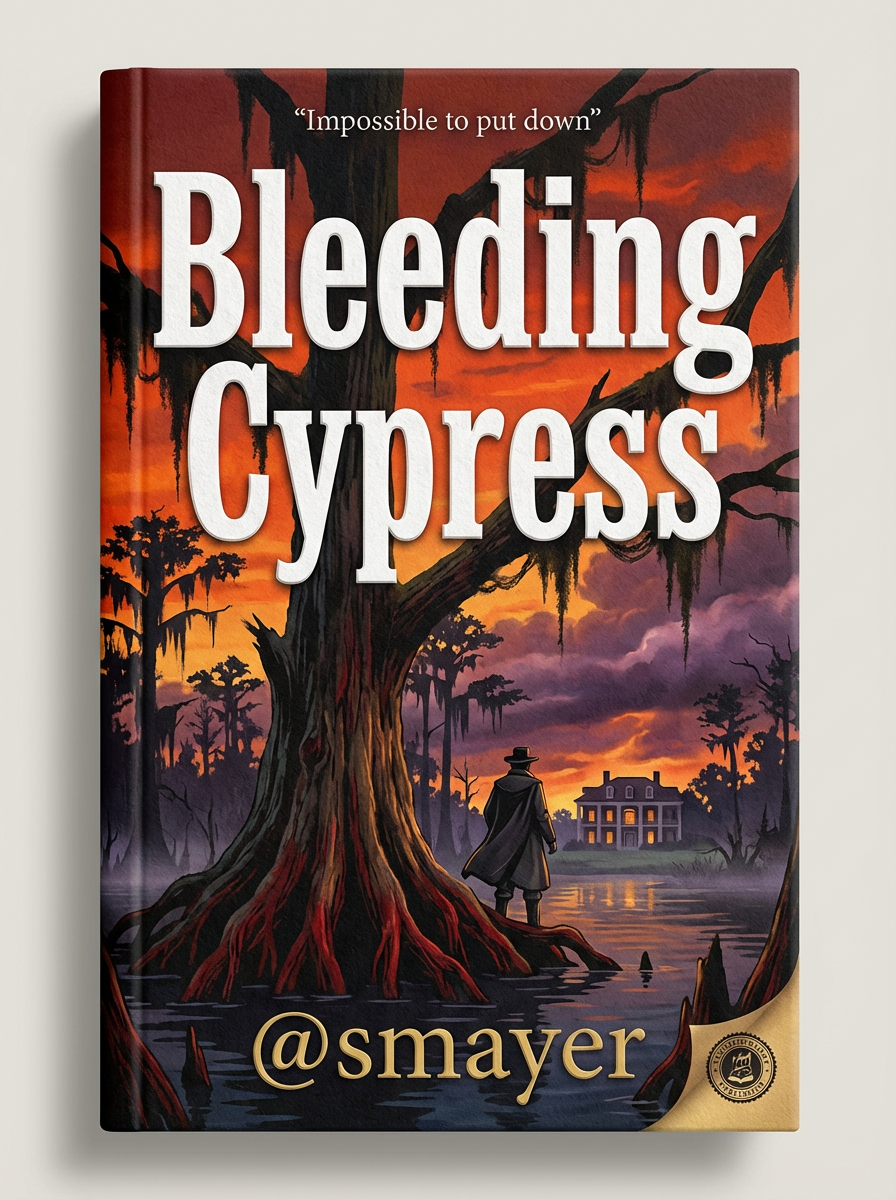
Synopsis
In the sweltering low country of South Carolina, the Caldwell family, pillars of the fading Southern aristocracy, cling to their ancestral plantation as the Civil War tears their world apart. As their sons march off to fight and the shadow of destruction looms, their conviction and humanity are test
Chapter 1: The Last Harvest
The scent of jasmine, heavy and sweet, clung to the air, an opiate over the hard reality of the Crows Creek plantation. Spring, 1860. The earth was fat with it, green things pushing up in silent, urgent growth. The cypress trees, ancient sentinels, dripped Spanish moss like old men’s beards, their roots a tangled mess in the dark water. The sun, already high, beat down with a promise of the brutal summer heat to come.
Elias Caldwell stood on the porch of the main house, a man carved from the same stubborn wood as the live oaks surrounding him. His gaze swept over the fields, a vast quilt of burgeoning cotton, stretching to the distant tree line. Here was his empire, built on sweat and sun, on the tireless labor of others. It was a good view, though he saw less of the land and more of the balance sheets in his mind. The drought of '58 had been a lean year. '59, better. This year, the signs were good. He felt it in his bones, the deep certainty of a seasoned planter.
His hand, gnarled and strong, absently touched the cold metal of his pocket watch. Half past seven. Thomas would be down soon. Thomas, his eldest, his heir. Thomas, who would inherit this land, this burden, this life. Elias had taught him the land, the crops, the careful dance of accounts. He had taught him how to ride, how to shoot, how to command. Now, there was a different lesson to be learned, a harder one.
A soft rustle and a faint clatter of china came from within the house. Mary. His wife. She would be arranging the breakfast, a quiet ritual of order and grace. Mary, with her pale hands and her sometimes-troubled eyes. She understood the workings of the house, the intricate web of domestic duties, but the brutal mechanics of the land, the calculations of bodies and profit, these were his province.
He turned as Thomas emerged from the shadowy hall, a tall young man, twenty-two, with his father’s solid build but his mother’s lighter hair and more thoughtful eyes. He carried himself with a quiet dignity, a blend of inherent authority and a certain youthful restraint.
“Morning, Father,” Thomas said, his voice even, already a man’s voice.
“Morning, Thomas. Good day for the fields.” Elias nodded towards the rising sun. “Cotton’s looking strong. We’ll have a good harvest, God willing.” There was always that caveat, the unspoken plea to forces larger than themselves.
“It does look promising,” Thomas agreed, stepping to the edge of the porch, his gaze following his father’s, but perhaps seeing more of the men and women bent over the rows than just the plants themselves.
They stood in silence for a moment, the natural quiet of early morning broken only by the distant calls of field hands and the chirping of cicadas. This shared silence was a common language between them, a comfort born of long association.
“Breakfast will be ready,” Thomas said, indicating the hall.
Inside, the dining room was cool and dim, heavy oak furniture gleaming in the filtered light. Mary, her silver hair pulled back in a neat bun, sat at the head of the polished table, her hands folded. Her morning gown was a simple cambric, her face serene, yet a faint tightness around her mouth suggested an underlying tension. She had the delicate beauty of a magnolia bloom, but one that had weathered more than a few storms.
“Good morning, my dear,” Elias said, taking his seat. Thomas pulled out a chair for his mother before seating himself.
“Good morning, Elias, Thomas,” Mary replied, her voice soft, a counterpoint to the masculine directness of her husband and son. “Penelope, bring the coffee.”
A young housemaid, light-skinned and swift, moved silently from the kitchen with a steaming silver pot. The scent of chicory and roasted beans filled the air. Mary poured, her movements precise.
The meal was served, a substantial spread: grits, ham, eggs, and freshly baked biscuits. They ate mostly in silence, the clink of silverware against china the loudest sound. Elias liked his mornings orderly, his meals efficient.
Patience, Thomas’s younger sister, came down later, a whirlwind of youthful energy. Her laughter, a bright sound, cut through the somber quiet of the room. She was fifteen, all vibrant spirit, untouched by the shadows that sometimes fell across her parents’ faces. She spoke of the new spring fashions, of a letter from a cousin in Charleston, of a horse that needed breaking. Elias listened, occasionally grunting, but his mind remained on the land, and on the gathering storm beyond it.
After the meal, Elias motioned for Thomas to follow him to his study. The room was lined with books, leather-bound volumes on law, history, and agriculture. A large globe stood in one corner, its continents a faded pastel. A map of the Confederacy, though not yet formally declared, hung prominently on one wall, crude lines delineating what they all knew to be their future.
Elias settled into his leather armchair, the scent of pipe tobacco lingering faintly in the air. He gestured for Thomas to take the chair opposite.
“War is coming, Thomas,” Elias said without preamble, his voice flat, definitive. “There’s no turning from it now. The North will not let us go in peace. Not with their factories and their hunger for our cotton. They say it’s about slavery. And in part, it is. But it’s also about power, about the very structure of this republic.”
Thomas nodded, his expression serious. “I believe you are right, Father. The papers are full of it. Sumter, the talk of secession.”
“Talk has turned to action. South Carolina will go. And others will follow. We must be prepared.” Elias leaned forward, his hands clasped. “You are my eldest. You will lead when I am gone. And before that, you will fight for what is yours. For this land. For our way of life.”
“I understand,” Thomas said, his voice firm. He had been raised with this understanding, this expectation. It was in his blood, this unquestioning loyalty to family and land.
“Good.” Elias studied his son’s face. “You’ll need to polish your shooting. Your drill. And you must learn to lead men in battle, not just in the fields. It’s a different sort of command entirely.”
“I’ve ridden with the militia, Father,” Thomas reminded him gently.
“Militia drills are one thing. War is another. Men break under fire. Men die. You must learn to make decisions when blood is on the ground, and doubt in the heart.” Elias paused, his gaze hardening. “Never show fear, Thomas. Never. Even if it eats at you from the inside.”
“I will remember that.”
Elias stood and walked to the window, looking out again towards the fields. “This land… it is more than just fields and timber. It is our legacy. It is the blood and sweat of generations. It is what makes us Caldwells. And we will defend it, with every fiber of our being.”
The weight of his words hung in the air. Thomas felt it, a profound and undeniable force. He knew the cost of this land, the lives it demanded, the lives it held in thrall. He had seen the scars on the backs of the field hands, the resignation in their eyes. He had heard the distant cries from the quarters at night. These things, he knew, were woven into the fabric of their existence, unspoken, undeniable.
Later that morning, as the sun climbed higher, Thomas walked the fields, his boots sinking into the rich, dark earth. He spoke to the overseer, Josiah, a grizzled man with a stern face and an intimate knowledge of cotton. He spoke to the hands, his voice quiet, steady, enquiring about the plants, about their health. He knew them, not just as a mass of labor, but as individuals, some with families, some with stories of their own.
He found Old Bessie, stooped over a row, her hands deft as she tended the young plants. She had been on Crows Creek since before his birth, since before his father’s birth even. Her face was a map of lines, her eyes milky with age.
“Morning, Bessie,” Thomas said, his voice respectful.
She straightened slowly, her back protesting. “Mornin’, Marse Thomas. Fine day for the cotton.” Her voice was a dry rasp.
“It is.” He watched her for a moment. “How are your hands? Not too sore?”
“They seen worse days, chile. They seen worse.” She offered a small, knowing smile. “This here harvest, she gon’ be a good one. The land feel it.”
He trusted her instinct. Bessie knew the land better than any of them. He continued his walk, the sun warm on his back. The air hummed with the endless work of the plantation. This was the world he knew, the world he was expected to protect.
Meanwhile, inside the cool confines of the main house, Mary supervised a new batch of linens being brought in from the wash house. The air in the laundry room was thick with steam and the clean scent of lye soap. She moved with an economy of motion, her gaze missing nothing.
“Mind those corners, Tilly,” she instructed a young girl, barely twelve, who struggled with a large sheet. “Careful now. Don’t let it drag.”
Tilly nodded, her brow furrowed in concentration.
Mary felt the familiar ache in her heart, a blend of duty and discomfort. These girls, these women, their lives were intertwined with hers, yet separated by an unbridgeable chasm. She saw their faces in her dreams, sometimes, their quiet suffering a persistent hum beneath the veneer of gentility.
She had tried, in her quieter moments, to speak with Elias about it, about the moral weight of their existence. He would listen, his face impassive, then shake his head. “It is the way of things, Mary. The way it always has been. The economy of the South hinges on it. Our survival hinges on it.” His conviction was absolute, impenetrable.
She remembered a time, long ago, when she had ventured into the slave quarters with medicines for a sick child. The stares, the silence, the profound sense of otherness had chilled her to the bone. She had wanted to help, truly. But she had felt a barrier, thick and invisible, preventing true connection. They were her people, her responsibility, yet not her people at all.
She walked into the parlor, the formal room usually reserved for visitors. She ran a gloved hand over the polished surface of the piano. Its keys, white and glinting, rarely felt the touch of her fingers anymore. Music, art, poetry – these things, once her solace, seemed frivolous now, in the face of what was coming.
She thought of her sons. Thomas, so earnest, so dedicated to his father’s vision. And Henry, younger, still at boarding school in Georgia, full of fire and romantic notions of chivalry. They would both go to war, she knew it. It was the South’s claim on her sons, a debt to be paid in blood.
A sense of dread, cold and sharp, pierced through her. How many mothers in the South would feel this same dread? How many would lose their sons, their husbands, their brothers? This harvest, this green abundant spring, felt like a cruel irony, a flourishing world poised on the brink of destruction.
Elias, in his study, returned to his papers, his calculations. He believed in the righteousness of their cause. He believed in the strength of their convictions. He believed in the divine order of their society. And he believed, with a fierce, unyielding certainty, that they would prevail. This would be a short war, he reasoned, a swift demonstration of Southern resolve. The North would see reason. The North would yield.
He leaned back, a faint smile playing on his lips. The scent of jasmine wafted through the open window, a sweet perfume over the sound of distant labor. The Caldwell plantation, his Crows Creek, stood firm, a monument to his will, and a testament to the life he had built. He did not see the cracks, the fissures that were forming, invisible beneath the verdant surface, ready to rupture and bleed across the land. The last harvest, for now, promised to be a good one.
Chapter 2: The Road to Sumter
The air in Charleston was thick with something new, something sharper than the usual salt and humidity. It was the scent of conviction, or perhaps, delusion. Flags snapped from every balcony, not the Stars and Stripes, but the new banner, a circle of white stars on a field of blue, then the bars and cross. Independence. Or a fever dream. Elias watched it all from his carriage, his jaw tight. The city pulsed with men. Young men mostly, their faces flushed, their eyes bright with a fire he understood, though he no longer felt its heat.
“They’re flocking,” Thomas said, his voice flat with admiration. “Like a river to the sea.” He sat opposite his father, the brim of his hat low over his eyes.
William, sixteen and gangly, leaned forward, his face pressed to the window. “Look, Father! Another company forming up. They march so straight.” His voice held the tremor of a boy desperate to prove himself a man.
Elias said nothing. He saw the pride, the raw, undiluted belief in a cause these boys had been fed since birth. He saw the uniforms, ill-fitting on some, crisp on others. Farmers, blacksmiths, clerks, planters’ sons. They were all there, drawn by the urgent drumbeat of secession. South Carolina had seceded in December, like a crack in a dam. Now the water was rushing.
His original plan had been different. To shelter Thomas, send him north if it came to that, to Europe even. To preserve a piece of his line, the family’s future. But the tide had turned too quickly. The state had voted to leave the Union. The Fort Sumter standoff, then the bombardment, had made all talk of neutrality, of avoidance, seem cowardly. Sumter had been hit only days ago. The newspapers crowed of victory, of a glorious dawn. Elias saw only the coming storm.
He watched Thomas as the carriage wound through the narrow streets. His eldest son, strong, steady, born for the land. Thomas had spoken of duty, of honor. Of defending their home. Elias knew where such words led. He had seen it in Mexico, too many years ago. The clean-cut promises, the blood-soaked earth.
“We’ll go to the recruiting office,” Elias said, his voice rough. He had chosen. He had postponed for as long as he could. But the questions, the glances, the implied accusations of cowardice from neighbors and even relatives had grown too heavy to bear. A Caldwell could not stand aside. Not now.
Thomas nodded, a flicker of satisfaction in his eyes.
William let out a small, suppressed cheer.
The recruiting office was a warehouse near the docks, hastily converted. The air inside was thick with cigar smoke and the scent of young male sweat. A long line snaked towards two tables where weary-looking men in haphazard uniforms took down names. Another line formed for a doctor, a burly man with a permanent scowl, who made swift, brusque examinations.
Elias stood with his sons. He watched the process. The questions were few. Can you hold a rifle? Are you a man? Do you believe? The crowd answered yes, yes, and with booming conviction, always yes.
When it was Thomas’s turn, he stood tall, his shoulders back. He gave his name, his age, his occupation. Planter. He signed with a steady hand. He looked back at his father, his eyes clear.
Then William stepped forward. His voice cracked as he gave his age – sixteen. The recruiting officer looked up, a shadow of a smile touching his lips. He saw the eagerness in the boy's face.
“Sixteen, eh? You’re a bit young, son.”
William’s face fell. “But I’m strong, sir! And I can shoot. Father taught me.” He gestured to Elias.
Elias stepped forward. “He is,” he stated. “Can handle a shotgun. Has a good eye.” He hated the words, each one a betrayal to the part of him that wanted to shield his youngest. But the other part, the part that was a Caldwell, that had lived on that land for generations, knew this was necessary. A calculated loss.
The officer looked at Elias, then back at William. “Alright, then, boy. Welcome to the army of the Confederate States.” He handed William a crumpled paper.
William’s face lit up, a pure, unadulterated joy that made Elias’s stomach clench. He had signed his son’s death warrant.
They walked out into the streets, the afternoon sun brilliant but cold. Thomas and William walked with an added spring in their step, their heads held high.
“We’ll be assigned to different companies, most likely,” Thomas said, a hint of regret in his voice. “Unless I can pull some strings to keep William with me.”
“No,” Elias said, his voice curt. “He will learn on his own. You will learn on your own. You will not protect him. Do not think you can.” The words were harsh, meant to brace Thomas for a brutal truth. He watched Thomas flinch, then steady himself.
“When do we report, Father?” William asked, his voice still brimming with excitement.
“Tomorrow morning. Battery Park. Six o’clock.” Elias pulled out his watch, a heavy gold disc. “We’ll get you supplies. Boots that fit. A good coat. A heavier blanket.”
They spent the rest of the afternoon moving between crowded shops, purchasing the essentials of soldiering. The stores were chaotic, stripped bare of many goods already. Prices were rising. Elias paid in gold, grimacing at the cost. He saw other families, doing the same. Mothers with red-rimmed eyes, fathers with grim sets to their mouths.
Back at the Caldwell townhouse in Charleston, a silent, tense dinner awaited. Mary sat at the head of the table, her face pale, her eyes distant. She had known this day would come. The air was thick with unspoken words, with the heavy weight of impending separation.
“Thomas and William signed up today,” Elias announced, his voice flat. He looked at Mary, daring her to argue, to break. She met his gaze, her lips pressed into a thin line. She did not break.
“I expected no less,” she said, her voice soft but steady. “Since Sumter, there has been no other path.”
William launched into a breathless account of the recruiting office, of the drills he’d seen, of the conviction of the men. Thomas added details, speaking of strategy and deployment, of the inevitability of the war. Elias listened, sipping his wine. Mary sat in silence, her gaze drifting between her sons, her hands clasped tightly in her lap.
Later, after the boys had gone to bed, Mary faced Elias in the drawing room. The curtains were drawn, hiding the festive lights that still glowed in some windows down the street. The mood in the Caldwell house was anything but festive.
“You couldn't stop them,” she stated, not a question.
Elias ran a hand over his tired face. “No. I couldn’t. The tide was too strong. And to be a Caldwell, a man of this land, and not… it would have been a stain.”
Mary walked to the fireplace, poked at the dying embers. “A stain. Is that what you call it? To preserve one’s children?” Her voice was low, dangerous.
“To preserve them from what? From the very air they breathe? From the words whispered in their ears since they learned to speak? This is not some passing fancy, Mary. This is our home. Our way of life. They believe they are defending it.”
“And you, Elias? Do you believe it?” She turned, her eyes accusing.
He met her gaze. “I believe the die has been cast. And it will be a bloody game.” He paused, then continued, his voice heavy. “I saw their faces today. The fervor. The conviction. They would have gone even if I had forbidden it. Run off, joined up under a false name. Better to go with my blessing, with proper supplies. With what grace we can offer.” He didn’t add that William, being so young, might have been lost in the anonymity of the war. Thomas, at least, had the sense of responsibility to keep an eye on him. Such as it was.
Mary said nothing for a long moment. She walked to him, her hand going to his arm. “Keep them safe, Elias. Promise me you will do what you can.”
He looked down at her, at the raw vulnerability in her eyes. It was an impossible promise. “I will try, Mary. I will try.”
The next morning was cold, despite the promise of spring. A chill wind blew in from the harbor, carrying the scent of salt and imminent rain. Elias and Mary stood on the sidewalk outside the townhouse as Thomas and William emerged, dressed in their new, ill-fitting uniforms. They looked like boys playing at soldiers, their gear bulky, their faces a mixture of nerves and exhilaration.
William, seeing his mother, rushed forward and embraced her tightly. Mary held him close, her face buried in his shoulder. Elias watched, a lump forming in his throat.
Then Thomas stepped forward. He embraced Mary briefly, a quick, almost formal gesture. He turned to Elias. “We’ll make you proud, Father.”
Elias clapped a hand on his son’s shoulder, a firm, heavy grip. “Come back, Thomas. Both of you. That is all I ask.” He did not say ‘win’. He did not say ‘fight bravely’. Just ‘come back’.
The boys began their walk to Battery Park, their boots clattering on the cobblestones. Elias and Mary watched until they were mere specks in the distance, swallowed by the growing stream of men heading towards the rendezvous point.
Mary began to tremble. Elias put an arm around her, drawing her close. She leaned against him, her body shaking. “It has begun,” she whispered, her voice raw. “God help us all.”
Back at the plantation, the air felt different. Still, yes, but heavy, like a storm brewing. Sarah, one of the house servants, had brought Mary her morning tea. Her face was clouded, her eyes lowered. The news of the men leaving had reached the quarters. It always did.
Mary sat at her dressing table, staring at her reflection. She saw the lines of worry etched around her eyes, the faint tremor in her hand as she lifted the teacup. Her sons were gone. Off to war. The words felt alien, unreal. This was not the world she had been born into. This was chaos.
She looked out the window, across the vast fields of cotton and rice. The land, so vibrant a year ago, now seemed to wear a shroud. The work continued, of course. The enslaved people toiled as always, their lives dictated by the rising and setting of the sun, by the rhythm of the tasks. But Mary felt a shift, a subtle, almost imperceptible change in the dynamic. A quiet tension. A watchful silence.
She remembered the swift departure of the men from the city. Not just Thomas and William, but others. The blacksmith’s son, the stable master’s boy, the miller’s apprentice. All gone, leaving gaping holes in the fabric of daily life.
On the plantation, the men who could be spared from the harvest, from the essential work of maintaining the estate, had also been called. Elias had sent twenty of the youngest, strongest men. Not to fight, but to dig fortifications, to build roads, to serve as laborers for the Confederate cause. He had chosen them carefully, knowing that each one taken was a drain on the plantation’s ability to function.
Mary walked the grounds, her steps heavier than usual. She saw the empty spaces, the absence of familiar faces. The fields seemed larger now, the work more arduous with fewer hands. The overseer, Mr. Abernathy, a gruff, practical man, complained endlessly about the loss.
“We’re stretched thin, Mrs. Caldwell,” he had grumbled. “The crops won’t pick themselves. And with the boys gone…” He shook his head grimly.
Mary understood. The war was not just cannons and cavalry. It was the slow, insidious draining of resources, of manpower, of hope. It was the relentless stripping away of the things that kept a household, a plantation, afloat.
She went to the kitchen. Cook, a formidable woman named Bessie, usually sang as she worked. Today, the kitchen was silent, save for the crackling of the fire and the clatter of pots.
“Bessie?” Mary asked.
Bessie turned, her face unusually somber. “Mornin’, Miz Mary.”
“You seem quiet today.”
Bessie wiped her hands on her apron. “My nephew, Jonah. He was one of them Mister Elias sent off. Strong boy, Jonah. Good with his hands.” Her voice was devoid of emotion, yet Mary sensed a deep, quiet grief beneath the surface.
Mary felt a pang. She knew Jonah. A quiet, diligent young man. He would be digging trenches somewhere, near Charleston. Exposed. “I’m sorry, Bessie. It was unavoidable.” The words sounded hollow, empty even to her own ears.
Bessie merely nodded, turning back to her work. But the silence in the kitchen remained. It was a silence that spoke of fear, of uncertainty, of a future unfolding beyond their control.
That evening, as the sun dipped below the horizon, painting the sky in fiery hues, Mary stood on the veranda, watching the last of the field hands trudge back to the quarters. The air was cool, carrying the scent of damp earth. She felt a profound loneliness, a sense of isolation.
Elias joined her, a glass of brandy in his hand. He looked out at the darkening fields, his face grim. “Abernathy says the harvest will be short this year. Not enough hands, too much rain early on, then this dry spell.”
Mary wrapped her arms around herself. “And what then, Elias? When the crops fail? When the men are gone?”
He took a long sip of his brandy. “We endure. We always have.” His voice was laced with a weary resolve. “We cut back. We make do. We find a way.”
But Mary knew, with a certainty that chilled her to the bone, that this was different. This was not a bad season, a dip in prices, a brief setback. This was a tearing, a rending of the very fabric of their world. The war had come, and with it, the erosion of everything they knew. She thought of Thomas and William, mere boys marching into a conflict that would demand everything of them. She thought of Jonah, digging in the unforgiving earth. She thought of the silence in Bessie’s kitchen.
The implications were vast and terrifying. The South, their proud, defiant South, was rushing headlong into a darkness from which she feared they might never emerge whole. The cost, she realized with a shudder, would be immeasurable. And it was only just beginning.
Chapter 3: Letters from the Front
The sun, a relentless fist, beat down on Bleeding Cypress. It was 1862. The spring had been wet, promising a good harvest, but the men were gone. Elias, too old for muskets, was off in Charleston, arguing with other gentlemen about supplies and strategy, leaving Mary to wrestle with the land and the increasing emptiness of the house. The fields, once tended with a brutal efficiency, now showed the scars of neglect. Weeds, thick and persistent, choked the dwindling cotton plants.
The women, black and white alike, moved with a slower cadence. The joyous songs that had once marked the rhythm of labor were muted, replaced by a low hum of worry, a sigh in the humid air. Supplies, once plentiful, were now rationed. The sugar barrel was low. The coffee, a luxury before, was a memory. Hominy and salt pork became the staples, day in and day out.
Sarah, the head cook, a woman whose hands knew the secrets of every herb and root, now stretched a chicken for a week. Her eyes, usually bright with a quiet humor, held a deep weariness. “Mistress Mary,” she’d say, her voice soft as a field mouse, “the children, they grow thin.” Mary knew it. She saw it in the hollows beneath the eyes of the young ones, in the way their clothes, once snug, now hung loosely.
She tried. She organized the women, planting extra rows of beans and corn in the kitchen garden, turning every inch of available land into a desperate attempt to feed them all. But the land, without the strong backs and knowing hands of the men, resisted. The sun withered the sprouts, insects devoured the tender leaves. The desperation was a palpable thing, a weight in the air, heavier than the humidity.
The enslaved people, their numbers dwindled by the war and disease, moved with a sullen resignation. Their eyes, when they met hers, held a question Mary could not answer. A quiet defiance simmered beneath the surface, a low murmur of discontent that grew louder by the week. They spoke of freedom, now, not in whispers, but in low, grave tones, almost a demand. Mary heard it. She felt it. The foundation of their world, built on generations of forced labor, was cracking.
Then came the letters. Not often, not regularly, but they arrived, carried by weary riders or passed from hand to hand along the fragile lines of communication. They were always addressed to Mary. Elias, when he was home, would read them with a grim set to his jaw, but it was Mary who absorbed their true weight.
The first was from Thomas. Dated late ‘62. He wrote of mud. Always mud. And hunger. And the constant whine of mosquitoes. He spoke of engagements, of skirmishes, but with a detached brevity that chilled her. “We held the line at Antietam,” he wrote, “a nasty business. William is well.” That was all. No tales of glory. No passionate declarations of Southern honor. Just mud and a terse confirmation of his brother's health.
Mary read it until the paper grew soft and translucent from her fingers. She kept it in the pocket of her dress, a small, crinkled shard of her son, a tangible link to a world she could not comprehend.
William’s letters were different. Shorter. More direct. His hand, usually so elegant and flowing, was jagged, the words often smudged. His first, also from late ‘62, spoke of thirst. “The creek was red, Mother. We drank from it anyway.” He didn’t elaborate. He didn’t need to. Mary could picture it, taste the iron in her mouth. He asked if the camellias were blooming. A small, tender touch in a landscape of horror.
She wrote back with a fierce dedication, filling pages with news of the plantation, of home, of the small, familiar details she hoped would tether them to her. She never spoke of the struggles, of the dwindling supplies, of the growing unrest in the quarters. She painted a picture of stability, a fortress of normalcy, a lie she needed them to believe.
As 1863 dawned, the news grew grimmer. Vicksburg, Gettysburg. Names that echoed through the newspapers Elias brought from Charleston, names that brought a fresh wave of dread to Mary. The letters from her sons grew less frequent, their content more spare, more brutal.
Thomas, in a letter dated July, wrote, “The air here smells of death. We are less men, more specters. William, he saw something… something that changed him.” The words hung in the air, heavy and unsaid. What could change her William, her gentle, bookish boy? The thought was a thorn in her heart.
William’s next letter arrived shortly after. It was barely a paragraph. “Mother, the boys are gone. Most of them. I am tired. I cannot think.” It was unsigned. Only his initial, smudged and faint, marked the bottom of the page.
Mary sat on the porch, the letter in her hand, the sun baking the wood around her. The children from the quarters played nearby, their laughter thin and reedy. The scent of jasmine, usually a comfort, now felt cloying, a false promise of peace. She saw her sons, not as the young men who had left her, but as the specters Thomas described, their faces etched with horror, their eyes holding the unspeakable.
That night, she couldn’t sleep. She walked the silent halls of Bleeding Cypress, the floorboards creaking a lonely chorus. The portraits of her ancestors, stern-faced men and women who had built this empire on the backs of others, seemed to watch her with an unseeing gaze. She stopped before the painting of her own mother, a woman of stern beauty and formidable will. Had she ever faced such a reckoning? Had she ever watched her world crumble, piece by agonizing piece?
The war, Mary realized, was not just fought on battlefields. It was fought in the silence of these halls, in the fear that gnawed at her stomach, in the desperate attempts to keep a semblance of order in a world gone mad. It was fought in the hungry eyes of the children, in the weary faces of the women, in the simmering resentment of the enslaved.
One sweltering August afternoon, a young rider, barely a boy himself, arrived at Bleeding Cypress. His uniform was ragged, his horse lathered. He carried a dispatch for Elias, and a sealed envelope for Mary. Her heart seized.
It was from a field hospital chaplain. It spoke of Thomas. A wound. Not fatal, yet. But grave. The leg. Amputation. Mary read the words, but they didn’t register as language. They were just shapes, black marks on a page. She felt a cold dread spread through her, a numbing certainty of loss.
She walked to the quarters, her customary poise unraveling. She found Sarah by the wash house, scrubbing clothes with a fierce energy. Mary pressed the letter into her hands. Sarah, her face impassive, read it. Her eyes, when they met Mary’s, held a deep, shared sorrow.
“Lord have mercy,” Sarah murmured, a whisper of a prayer.
Mary felt no mercy. Only a vast, aching emptiness. Her sons. Her boys. One wounded, perhaps maimed forever. The other, broken in spirit. The war was taking them, piece by piece, just as it was taking everything else.
The next few months blurred into a haze of worry and work. Elias returned from Charleston, his face drawn, his usual bluster replaced by a quiet despair. He received the news of Thomas with a stoicism that Mary knew was a mask for his own agony. He spoke of the war’s shifting tides, of the Union advance, of the growing scarcity of everything.
The Union soldiers were closer now. Their patrols were reported in neighboring parishes. The distant rumble of cannons, once a novelty, now a familiar, terrifying soundtrack to their lives. The whispers of freedom in the quarters grew louder, bolder. Some of the enslaved people simply disappeared, melting into the swamps, seeking the protection of the Union lines. Mary knew she couldn't stop them. The very idea of holding them captive, now, felt like a grotesque mockery.
In late autumn, another letter from William arrived. It was short, disjointed, almost a fever dream. “Mother, the fight is for nothing. We are ghosts fighting ghosts. I see their faces. I hear their screams. It does not stop.” He did not ask about camellias. He did not mention home. He spoke of the faces of the dead, of screams that echoed even in his sleep.
Mary sat by the fire, the letter clutched in her hand, the words a burning brand against her skin. The flames danced, casting long, grotesque shadows on the walls of the parlor. She stared into the fire, seeing not the warmth, but the inferno that consumed their lives.
She thought of the young man who had left her—William, with his bright eyes and his love of poetry. Now, he was a wraith, haunted by the atrocities he had witnessed, carrying the weight of a war that had devoured his innocence. Thomas, strong and stoic, now lying in a hospital bed, a part of him irrevocably lost to the surgeon’s blade.
The world was changing. She felt it, tasted it in the thin broth she ate, saw it in the wary eyes of the people who still remained on the plantation. The grand illusions of their past, of a genteel, ordered society, were crumbling around them. The letters, sparse and grim, were not just reports from the front. They were prophecies. Prophecies of an irreversible loss, of a world irrevocably altered, of a South that would bleed and burn and rise again, but never be the same. And Mary, standing amidst the ruins of her old convictions, knew she would have to face it, whatever it brought.
Chapter 4: The Shadow of Sherman
The wind carried whispers. Not the gentle rustle of cypress leaves or the murmur of the river, but a colder, harsher sound. It was the sound of distant guns, carried on the anabasis of the wind, and the stories that rode with them. Elias felt it, heard it, even before his dust-caked boots crunched on the drive up to Caldwell Manor.
He had been gone two weeks, a desperate foray into the backcountry, bargaining for salt and flour. He’d found little enough to show for it. But he’d found more than provisions. He’d found fear. It clung to the air, thick as Spanish moss, in every scattered hamlet and every hushed conversation. Sherman. The name was a blight, a burning shadow stretching across the land.
The oaks lining the drive seemed to droop lower, their ancient branches heavy with foreboding. The house, usually a bastion of stately pride, seemed diminished, its white columns grayer, its windows like vacant eyes. The silence was the first thing that struck him. Not the peaceful quiet of a working plantation at twilight, but a deeper, more unsettling stillness. The usual hum of voices, the distant clang of the smithy, the shouts of children – all gone.
He dismounted, his joints stiff, and handed the reins of his weary horse to a boy whose face was leaner than Elias remembered. The boy’s eyes were wide, darting, like a trapped bird. Elias clapped him on the shoulder, a gesture meant to convey reassurance, but it felt hollow even to him.
Inside, the house was cool, almost cold. A faint scent of wood smoke and something else, something indefinable, something like waiting. Mary met him in the hallway. Her face, always finely etched, seemed sharper now, drawn by a constant tension. Her hair, usually coiled neatly, had strayed in places, betraying the weariness beneath her composure.
“Elias,” she breathed, her voice a fragile thing. She embraced him, a brief, tight clasp that spoke of longing and relief, and something else, something akin to shared dread.
“Mary.” He held her a moment longer than he usually did. He could feel the tremor in her body. He could feel his own.
He looked around. The house felt stripped, even though nothing was overtly missing. It was the absence of life, of easy warmth, that spoke volumes. The grand hall, once echoing with laughter and conversation, seemed to swallow sound.
They sat in the parlor, the room unlit save for the last fading light of the afternoon filtering through the heavy curtains. She poured him a glass of water, her hands steady.
“What news?” she asked, her voice low. She didn’t need to specify. They both knew.
He stared into the glass, seeing not the water but the images from his journey: blackened fields, gutted homesteads, people with hollow eyes and haunted faces. “He’s coming, Mary. He moves like a pestilence. Through Georgia, leaving nothing but ash.”
She nodded, a slow, deliberate movement. Her eyes fixed on a distant point, beyond the walls of the house, beyond the fields, beyond their world. “We’ve heard the rumors. The tales. They grow wilder every day. Like locusts, they say. Devouring everything.”
“It’s not rumor, Mary. Not all of it. I saw it. The smoke on the horizon, not from a friendly hearth. The sheer, overwhelming numbers. They mean to break us. Not just the army, but the spirit of the land itself.” Elias’s voice was rough, edged with a bitterness that had been growing within him for months, for years.
He told her of his journey, of the empty stores, the fear in the eyes of everyone he met. He spoke of refugees, white and black, all moving north or south, fleeing the unstoppable blue tide. He described the utter, cold intent in the Federal army’s actions, not just to defeat, but to destroy.
Mary listened without interruption, her hands clasped tightly in her lap. When he finished, the silence in the room was profound, punctuated only by the distant caw of a crow.
“What do we do, Elias?” she asked, her voice barely a whisper.
He had no easy answer. He had wrestled with that question for two weeks, riding through the ravaged landscape. “We prepare,” he said, the words feeling inadequate, almost meaningless in the face of what was coming. “We secure what we can. We try to provide for those who depend on us.”
“They are already leaving,” Mary said, her eyes meeting his. “The field hands. They slip away in the night. More and more each week.”
Elias sighed. He had seen that too, out on his journey. The promise of freedom, the chaos, the desperate search for something better, or at least different. He couldn’t fault them, not truly. What was left to hold them here? A dying dream.
“Can we blame them?” he asked, the question rhetorical. “What have we left to offer them beyond what we ourselves possess? Scraps. Danger. Uncertainty.”
“And what of us, Elias?” Mary pressed. “What of the children? Eleanor? Sarah? They are terrified.”
Eleanor, his eldest daughter, was a woman grown, though still unmarried. Sarah, younger, still clung to the remnants of childhood. He thought of them, and a fresh wave of fear, cold and sharp, cut through him. His sons, Thomas and William, were already in the maw of the war. Now the war was coming to their doorstep, a hungry beast with no quarter.
“We will protect them,” Elias said, though he knew the words were thin armor against the coming storm. “We will send what we can away. The silver. The family papers. Anything that will not burn.”
He rose and walked to the window, pulling aside the heavy drape. The last vestiges of sunset painted the western sky in hues of blood orange and bruised purple. It felt like a prophecy. Beyond the manicured lawn, the orderly rows of cotton, the cypress swamp loomed, dark and secretive. It had always been a sanctuary, a provider. Now, it felt like a potential place of hiding, or escape. Or ruin.
He turned back to Mary. “We have fought for this land, Mary. Our family has bled for it for generations. We will not abandon it easily.”
Her gaze was steady. “No. Not easily. But there is a line, Elias. A line where stubbornness becomes suicide.”
He knew she was right. He recognized the practical truth in her words, but his blood, his very bones, rebelled against it. Caldwell Manor was more than just land and timber. It was history, identity. It was their name, etched into the very soil.
Over the next few days, a grim energy descended upon the plantation. It was not the bustling activity of harvest, but the desperate, hurried movements of people preparing for an invasion. Elias directed the hiding of valuables. The enslaved people, a dwindling number but still present, worked with a somber efficiency, their movements punctuated by whispers and fearful glances. Some helped, their faces unreadable. Others watched, their eyes calculating, waiting for their moment.
They buried the family silver, wrapped in burlap and oilcloth, under the roots of the oldest oak, a tree that had stood sentinel for centuries. Elias handled each piece, a chalice, a snuff box, a locket, feeling the weight of generations in his hands. It felt like burying a part of himself. Mary joined him, her face grim, as they interred the physical embodiment of their heritage.
“It will be safe there,” Elias muttered, wiping the sweat from his brow.
Mary said nothing, but her hand settled on his arm, a gesture of shared understanding. Hope was a fragile thing these days.
Eleanor helped pack clothes, plain dresses and sturdy boots. Sarah, her eyes wide, watched the house being stripped, a silent understanding settling on her young features. The parlor was dismantled, the curtains taken down, the furniture pushed against walls, covered with white sheets like ghosts. The grand piano, too heavy to move, stood mute, its polished surface reflecting the dim light, a symbol of a forgotten elegance.
Elias walked the fields, the rows of cotton standing high now, ready for harvest. But there would be no harvest. Not this year. Or perhaps, not ever. The air was thick with the scent of pine and rich earth, but beneath it, the smell of fear persisted.
He spoke to Old Man Fitzwilliam, the overseer, his face lined and weary, his body bent by years of sun and toil. Fitzwilliam had seen four score years, and had never known a world without Caldwell Manor standing proud.
“What will become of us, Master Caldwell?” Fitzwilliam asked, his voice raspy.
Elias looked out at the fields, the work of generations. “We will endure, Fitzwilliam. We always have.” But the words tasted like ash.
Mary, ever the pragmatic one, made sure they had enough stores to last, if not an army, then at least their diminished household for a good long while. The smokehouse was stocked. The root cellar filled. But the constant fear was that it would all be for naught, that the approaching army would simply take it all, or burn it.
He thought of Thomas and William, out there, somewhere, fighting a losing war. His heart ached, a deep, raw pain. Were they even alive? The letters, sparse as they were, had stopped coming weeks ago. The silence was louder than any cannon fire.
One evening, as the sun dipped below the horizon, casting long, stark shadows across the estate, Elias found Mary on the veranda, staring out at the fading light. Her posture was stiff, her hands clasped in front of her.
He sat beside her, the rickety swing creaking softly under their combined weight.
“It feels like the end,” she said, her voice devoid of emotion, a flat statement of fact.
“No, Mary,” Elias contradicted, though he felt the chill of that same thought in his own bones. “It is an end. An end to a way of life. But not the end of us. Not yet.”
“What will be left?” she asked, turning her head to look at him, her eyes searching, desperate for an answer he didn’t possess.
He didn't answer directly. Instead, he spoke of their sons, of their courage, of the fight they were waging. He spoke of Eleanor and Sarah, of their strength, of the future they still had, however uncertain. He spoke of their ancestors, of the trials they had faced and overcome. He spoke of resilience, a word that felt heavy and ancient on his tongue.
They sat in silence then, as the last light faded and the stars began to prick through the deepening blue of the sky. The air grew cooler. The sounds of the swamp drifted up, the croak of a frog, the buzz of insects.
Elias felt the weight of his land, his family, his people, heavy on his shoulders. He was a man of the earth, and the earth was trembling. He had built this life, nurtured it, even if its foundations were built on something rotten. Now it was all coming apart, piece by piece.
He remembered a line from a sermon he’d heard once, long ago, about the proud cedars of Lebanon being brought low. Now, he felt like one of those cedars, standing tall against a hurricane, knowing that soon, he would either break or be uprooted entirely.
The sound of hoofbeats, distant at first, then closer, broke the stillness. Elias tensed. Mary’s hand flew to her throat. Every sound now was freighted with meaning, with dread.
A rider, moving fast, burst into view on the main road, kicking up a plume of dust. He was a young boy from a neighboring farm, his face streaked with dirt and fear.
“Master Caldwell!” he yelled, his voice hoarse, breathless. “They’re coming! Sherman’s men! They’re just over the river! Burning everything!”
Elias stood, his blood turning cold. This was it then. No more whispers. No more rumors. The shadow was here. The final act had begun.
He turned to Mary. Her face was pale, but her eyes held a spark, not of resignation, but of fierce, protective resolve.
“Get the girls,” Elias said, his voice low, steady, cutting through the rising panic. “Be ready. We will face what comes, together.”
He walked to the stable, feeling the ground tremble beneath his feet, not from cavalry, but from the shattering of his world. He would stand, for his family, for his land, even if it meant standing alone, against the fire. The cypress around them, ancient and enduring, would bear witness to it all.
Chapter 5: Ashes on the Wind
The wind howled a different song that winter. Not the familiar mournful Atlantic sigh, but a dry, rasping gasp carrying the scent of distant fires. The days shortened, bled of light, and the nights deepened into a black so profound it seemed to swallow the stars. Elias stood on the porch, the biting air a physical presence against his weathered face. He watched the horizon, a perpetually smudged line of smoke staining the low country sky.
They had heard the stories, of course. Whispers, then shouts, then the screaming certainty carried by refugees. Sherman was coming. A plague of locusts, a consuming fire, a beast uncaged. Elias had dismissed much of it as fear-mongering, the usual embellishment of war. Now, the embellishment was the reality.
The first plumes of thick, black smoke appeared in early December. Not isolated fires, but a rolling storm front of destruction, moving with an unnatural speed. It was the Copley’s place, ten miles west. Then the Abernathy’s, just beyond the cypress swamp. Each new column of smoke was a fresh wound opened in the familiar landscape.
Mary watched it too, her face etched with a fear that went beyond the ordinary. She no longer spoke of hope, only of endurance. Her hands, once soft, were chapped and calloused from the endless toil. They had butchered the last pig in November, salted the meat. The corncrib was low. They were living on borrowed time, on the thin thread of what little they had managed to hoard.
The enslaved people on the plantation were a different kind of barometer. Their faces, usually stoic, now held a flickering light, a dangerous anticipation. The Union soldiers, they said, brought liberation. Elias saw it differently. He saw upheaval, chaos, the dismantling of everything they had known. He had always believed in order, in the natural hierarchy. This was disorder, pure and unadulterated.
One morning, just before Christmas, the distant rumble became a tremor underfoot. Elias felt it first, a deep vibration through the old pine floorboards. Then the baying of the hounds in the distant quarters. Mary came out, wrapping a shawl tighter around her. "What is it, Elias?" Her voice was flat, devoid of its usual lilt.
"They are close," he said. He didn’t need to elaborate. The sound on the wind was no longer distant. It was the cacophony of a marching army, a thousand men and horses on the move.
He stood on the bluff overlooking the main road for an hour, watching. The first soldiers appeared like specters through the mist, their blue uniforms a stark contrast to the bleached winter trees. They were not an orderly procession. They were a surge, a torrent. Foot soldiers, cavalry, wagons laden with plunder. They moved with a predatory intent, their eyes scanning, assessing, consuming.
He watched them approach the Caldwell gates, the wrought iron that had stood for a century. A small detail of men detached themselves, moving with a practiced swiftness. One swung a heavy ax, the strike echoing like a cannon shot. The gate splintered, then fell.
Elias walked back to the house. His steps were heavy, each one an affirmation of his loss. He entered the parlor, where Mary stood, perfectly still, her hands clasped. Eleanor, their youngest daughter, barely sixteen, huddled behind her mother, her face pale.
"They are here," he said.
The first soldiers entered the yard like a burst dam. They were a mixed lot: battle-hardened veterans, young boys with too much bravado, and a smattering of bummers, the scavengers of the army, their faces hard and hungry. Their blue coats were stained, their boots caked with mud. Rifles glinted.
A young officer, no older than Thomas, rode up to the porch. He dismounted with an easy grace, his uniform cleaner than the rest, his face un-lined by the raw brutality Elias had seen in the eyes of the others.
"This is Caldwell Plantation?" he asked. His voice was surprisingly soft, almost polite.
Elias nodded. "It is." His voice was hoarse.
"I am Captain Davies, 15th Iowa Infantry. General Sherman's orders. We are to seize all supplies, dismantle Rebel infrastructure, and ensure no aid continues to the Southern cause." His eyes swept over Elias, then Mary, then the grand old house. Elias saw the evaluation, the silent contempt for what they represented.
"We have nothing left to give," Mary said, her voice trembling slightly.
The captain’s lips curved into a half-smile that held no humor. "I imagine you do, madam. We always find something."
The world inside the house became a whirlwind of blue uniforms. They moved with a disturbing efficiency. They stripped the pantry, emptying bags of cornmeal, barrels of salted meat, jugs of molasses. They took the few remaining chickens from the coop. They led away the mules, the remaining horse that Elias had hidden in the deep woods. They found it, of course. They always did.
Elias stood in the parlor, watching them pillage the memories of his family. An old soldier, his face scarred, ran his hand over the polished mahogany of his grandmother's sideboard, then took an ax from his belt and swung. The wood splintered with a sickening crack. Elias felt a physical blow. He stood unmoving, his fists clenched, a hot, bitter taste in his mouth.
Mary stared, her eyes wide with a quiet horror. Eleanor whimpered. Elias put a hand on her shoulder, a small, futile gesture of protection.
Outside, the air filled with the shouts of soldiers, the whinnying of horses, the distant barks of their own dogs, now excited by the chaos. Then came the sound Elias had dreaded, the sound that tore at the very fabric of his being. The slaves were leaving.
He saw them, a stream of figures moving towards the main road, their few possessions bundled tightly. Old Man Moses, who had worked in the fields since Elias was a boy, his face a mask of bewildered hope. Young Clara, carrying her infant on her hip, her gaze fixed on something beyond the horizon. They were not running from the soldiers. They were running to them.
These were the people whose lives had been interwoven with his family, whose labor had built this land. He watched them go, a hollow ache spreading through his chest. He felt no anger, only a profound sense of loss, a recognition that the world he had known, the foundation of his existence, was crumbling before his eyes.
A young slave, a boy named Samuel who had always played with Eleanor, looked back. Their eyes met. There was no defiance in Samuel’s gaze, no accusation, only a simple, raw curiosity. Then he turned and walked away, disappearing into the stream of humanity.
Elias felt a cold dread settle in his stomach. It was not just the property they were losing. It was the future. It was everything.
The soldiers were methodical. They broke what they couldn't carry. Chairs were thrown into the yard, portraits slashed, books ripped apart. A soldier, whistling a tune, took an ornate gold frame from the mantel and smashed it against the hearth, then kicked the canvas repeatedly. It was a portrait of Elias’s great-grandfather, a stern, proud man. Now just a torn canvas.
Captain Davies returned to the porch, wiping his hands on a cloth. "We are leaving a detachment to secure the property for the night, Mr. Caldwell. And to ensure no aid falls into Rebel hands. Your residence will be spared the torch tonight, as per General Sherman’s directive regarding non-military structures, if occupied by women and children. Be grateful for that."
Elias looked at him, his eyes burning. "Grateful?" he said, his voice flat. "You have taken everything."
"You built your kingdom on the backs of others, old man," the captain said, his voice hardening. "You reap what you sow. This is the harvest of your peculiar institution."
He turned and strode away, mounting his horse. The column of soldiers began to move, leaving behind a smaller group, perhaps twenty men. They set up makeshift campfires near the main house, their rifles stacked.
The sun began to set, painting the ravaged landscape in hues of blood and fire. The air grew colder, biting. Elias, Mary, and Eleanor sat in the stripped parlor, the wind whistling through a broken windowpane. The silence was heavy, broken only by the distant murmur of the Union soldiers and the occasional crackle of their fires.
Mary rose, her movements stiff. She found a tattered blanket, all that remained, and wrapped it around Eleanor. Her gaze met Elias's. There was a raw, naked despair in her eyes that he rarely saw.
"We have nothing left," she whispered.
"We have each other," he said, the words feeling thin and insufficient in the vast hollowness of their loss.
That night was a long, cold vigil. Elias slept fitfully, if at all. His mind replayed the day's events, a grim panorama of destruction. He thought of Thomas and William, out there somewhere in the vast, bleeding landscape of war. Did they know? Would they ever return to this desolation?
The next morning, the air was sharp with the scent of woodsmoke and damp earth. Elias went out to the kitchen, hoping to find something, anything. The hearth was cold. The cupboards bare. The soldiers had even taken the iron pots and pans. He found a single, forgotten apple, shriveled and bruised, on the floor beneath a broken shelf. He gave it to Eleanor. She ate it slowly, her eyes wide.
The Union detachment remained for two more days. They were a constant, unsettling presence. They slept in the parlor, their boots scuffing the polished floors, their laughter echoing through the once-sacred spaces of the house. They pilfered the last few items of value: a silver locket from Mary’s dressing table, an embroidered tablecloth. It was a slow, agonizing bleed.
On the third morning, a rider arrived, a gaunt corporal with a message for the detachment’s sergeant. Soon after, the sergeant barked orders. The remaining soldiers packed up their meager camp.
"We're moving out, old man," the sergeant said, his voice devoid of emotion. "Keep your heads down. There's more coming."
They rode off, a small cloud of dust marking their departure. The silence that descended after they left was absolute, deafening. It was a silence born of emptiness, of absence, of profound scar tissue.
Elias walked through the house. It was a carcass. Glass shattered everywhere, furniture overturned, mattresses slashed, books scattered like autumn leaves, their pages torn and stained. The air hung thick with the smell of spilled liquor and something else, something metallic and acrid, like the residue of violence.
He stepped outside. The stables were empty, the chicken coop a ruin. The fields, once meticulously tilled, were churned mud, trampled by thousands of boots. A dead hog lay by the fence, its throat cut, left to rot.
He walked past the quarters, now silent and deserted. The doors hung open, revealing empty rooms. The sound of their leaving, the quiet exodus of a community, was the sound that haunted him most.
Mary found him there, standing amidst the desolation, his gaze fixed on the endless, broken fields. She came to him, her hand touching his arm.
"We must live, Elias," she said, her voice a low murmur against the wind. "We must find a way."
He looked at her, his wife, her face lined with grief, her spirit unbent. He saw the strength in her, the resilience that had always been there, beneath the gentle surface. He knew then what they were facing. It was not just the loss of property, or status, or even tradition. It was a fight for their very existence.
They began the grim work of salvage. Mary found a broken bucket and tried to sweep the glass from the parlor floor. Elias gathered wood from the broken fences to make a fire that night. There was no dignity in it. No grand gestures, only the instinct to survive.
The winter wore on, a relentless assault. News of Sherman's continued march flowed like a poisoned river. Savannah had fallen. Columbia was burning. Each new report was another nail in the coffin of their hope.
Food became a constant, gnawing worry. Elias hunted squirrels and rabbits, their gaunt bodies a testament to the scarcity of the season. Mary gardened, turning over the trampled earth with a broken hoe, hoping for a spring that felt impossibly far away.
Occasionally, other refugees passed by, gaunt figures with haunted eyes, their stories mirroring their own. They spoke of burning homes, of fields left fallow, of families broken apart. The war had not just shattered their world; it had scattered it, reduced it to ash on the wind.
One frigid afternoon, Elias was mending a fence, the cold biting at his exposed hands. He saw a rider approach in the distance, a lone figure on a bony horse. His heart leaped. Thomas? William?
But as the figure drew closer, he saw it was not. It was a young woman, her clothes ragged, her face smudged with dirt. She pulled her horse to a halt.
"Mr. Caldwell?" she asked, her voice thin.
He nodded.
"I need to tell you something," she said, her eyes wide and fearful. "They’re coming back. The Federals. They’re burning everything. Taking what’s left. My home… it’s gone." She started to weep, silent, wracking sobs.
Elias felt a cold dread settle in his bones. He knew what she meant. The first wave was the pillaging. The second wave, the final, consuming fire.
He went to Mary. Her face was grim as he told her. "We cannot stay here," she said, her voice firm. "We must go."
"Go where, Mary?" he asked, a bitter laugh escaping him. "There is nowhere left to go."
"There is the swamp," she said, her eyes fixed on the distant line of cypress trees. "We can hide there. We've done it before. We must save what little we have left. This house… it is just wood now. We are more."
He looked at her, at Eleanor, huddled by the dying embers of the fire. He thought of the generations of Caldwells who had lived and died in this house. The gravestones in the family plot, now undoubtedly defiled. The memories that clung to every broken piece of furniture. It was not just wood. It was their history.
But Mary was right. Their history was in them now, not in the broken remnants of a home.
They gathered what they could. A few blankets. The last of the dried meat. A small bag of Elias’s hunting shot. It was a meager harvest, a stark contrast to the abundant leaving of the first wave of fire.
As the sun began to set, painting the sky with a fierce, angry red, they walked away from the Caldwell plantation. Elias led, Mary followed, her arm around Eleanor. They did not look back.
The first flames licked the sky an hour later. Elias saw it from the relative safety of the swamp, the towering plumes of smoke, the orange glow against the black winter night. It was a funeral pyre, a final, brutal ending to a way of life. The heat of it, even from a distance, seemed to warm the chill night air.
Mary gripped his arm. Her face was streaked with tears, but her jaw was set. Eleanor whimpered, burying her face in her mother's shoulder.
Elias watched the flames consume his world, his ancestral home. The scent of burning wood, of smoke and ash, carried on the wind. It was the smell of extinction. He felt the cold swamp water seeping into his boots, the damp air clinging to his clothes. He was no longer a planter, no longer a master. He was simply a man, stripped bare, watching his civilization burn.
He did not cry. There was no room for tears. Only a grim, absolute determination to survive. For Mary. For Eleanor. For the phantom sons who might, one day, return. Even if they returned to nothing but ashes on the wind.
Chapter 6: A Bitter Earth
The spring of ’65 brought no relief. Only a silence, heavy and unnatural, hung over the land where the roar of cannons had once echoed. The war was done. But the earth, scorched and broken, showed no signs of healing.
Elara Caldwell, Elias’s daughter, moved through the skeletal remains of what was once their grand home. The columns still stood, blacked by fire, like ancient sentinels guarding nothing. The roof was gone, the floorboards charred, a gaping maw to the sky. She felt the grit of ash under her boots with every step. It clung to everything, a permanent shroud.
Her father, Elias, was a different man. The war had stripped him not just of his wealth, but of his very essence. His hair, once a distinguished iron-grey, was now a stark white, thin and brittle. His shoulders, once broad and commanding, sagged. He sat on an upturned barrel in the middle of the ruined parlor, his eyes fixed on the empty space where the grand fireplace had been. He hadn’t spoken a full sentence in days. Only grunts, or a bitter shake of his head.
Elara found her mother, Mary, in the remains of the kitchen garden. Mary, surprisingly, was planting. Not the vast row crops of before, but small, determined patches of corn and beans, pushing seeds into the scarred earth with a trowel she’d salvaged. Her hands, once so soft and used to fine embroidery, were calloused and cracked.
“Mother.” Elara’s voice felt hoarse, unused.
Mary looked up, her face gaunt but her eyes, though weary, held a stubborn light. “We need to eat, Elara.”
It was a simple truth, brutal in its clarity. They needed to eat. They needed to survive. The grand pronouncements of honour and states’ rights, the pronouncements that had sent Thomas and William marching, seemed like a cruel jest now. All that remained was the raw instinct to live.
The news had come piecemeal, rumors carried on the wind by passing soldiers, some Confederate, some Federal, all equally exhausted and broken. Lee had surrendered. Lincoln was dead. The Confederacy was no more. Elias had listened to the reports with the same vacant stare he held now. He had placed so much faith in the cause, invested so much of his very being into the idea of it. Its collapse had taken him with it.
The field hands, the enslaved people who had worked Caldwell land for generations, were gone. They had scattered when Sherman’s army swept through, following the promise of freedom, or simply fleeing the chaos. A few, the older ones, had nowhere to go, or perhaps, out of habit, had stayed close. They were still here, living in what remained of the cabins, just as lost as the Caldwells, but with a different kind of freedom. A freedom that brought with it hunger and uncertainty.
One of them was Patience, a woman who had worked in the Caldwell house since Elara was a child. Patience was a silhouette against the setting sun, carrying a bucket of water from the creek, her steps slow and deliberate. She passed where Elias sat, but he did not acknowledge her. There was no master and no slave now, only people made equal by devastation.
“Patience,” Elara called out, her voice soft.
Patience turned. Her face, etched with decades of hard labour, held an unreadable expression. “Miss Elara.” The 'Miss' felt strange, a relic of a time gone.
“Any luck with the traps?” Elara asked. They were all reliant on whatever small game could be caught, whatever wild greens could be scrounged.
Patience shook her head. “Too much noise, too many folks movin’ about. Animals stayin’ hid.”
Elara nodded. It was true. The woods, normally teeming with life, felt empty, hushed.
The first tangible blow of the new reality came with the arrival of the Freedmen’s Bureau. A young, earnest man, barely out of uniform, rode up on a scrawny horse, carrying official papers. He introduced himself as Lieutenant Miller.
“Mr. Caldwell?” he asked Elias, who remained on his barrel, unmoving.
Elara stepped forward. “My father is unwell, Lieutenant. I am Elara Caldwell.”
Miller surveyed the ruins around them, his gaze lingering on Elias. “I understand. We’re here to establish order, assess damages, and facilitate the transition of the freedmen.”
Order. Elara almost laughed. What order could there be in this wasteland?
He laid out the terms. The land, though ruined, was still legally Caldwell land, for now. But the labor was free. Any who wished to stay and work for wages were free to do so. Any who wished to leave were free to leave. And schools would be established, for all.
Elias barely registered the words. But Elara heard them, and understood the seismic shift they represented. The foundation of their world, built on chattel slavery, was gone. There was no turning back.
“Wages?” Elara asked, her voice incredulous. “Lieutenant, we have no money. No crops. No means.”
Miller nodded grimly. “I understand, Miss Caldwell. Many are in the same predicament. The government will be providing some aid, but it will be limited. You’ll have to find a way to rebuild. Perhaps sharecropping arrangements, once the land is productive again.”
Sharecropping. It sounded like another form of bondage, but with a veneer of legality. It was not the bounty and effortless command Elias had known. It was desperate, meager.
That night, Elias spoke, his voice raspy, broken. "We lost everything, Elara. Everything we built. Everything we believed in."
Elara sat beside him, the chill night air biting. "We still have the land, Father. What's left of it."
He scoffed, a bitter sound. "Land without labor is just dirt, girl. Just dirt."
The days bled into weeks. The Caldwells, along with the few remaining former slaves, began the slow, agonizing process of clearing debris. It was backbreaking work. Elara saw Patience and others working alongside her, their faces grim, their movements precise. They were building something new, together, even if none of them knew what it would be.
One afternoon, a rider approached the plantation. A young man, face smeared with dirt, clothes ragged. He dismounted, and Elara’s breath caught in her throat.
“Thomas?” It was a whisper.
He had grown thin, his face hollowed, but it was him. Thomas, home from the war. Her eldest brother.
He walked with a slight limp, favouring his right leg. His eyes, though weary, held a glint of the old Caldwell fire. He looked at the ruins of his home, and his face hardened.
“My God,” he muttered. “What have they done?”
Elara ran to him, embracing him fiercely. He was bone and sinew, but he was alive.
“William?” she asked, pulling back, a knot of dread forming in her stomach.
Thomas’s gaze flickered away. He swallowed hard. “William… he didn’t make it, Elara.” His voice was flat, devoid of emotion. “Chickamauga. Last year.”
The words struck her like a physical blow. William. Her younger brother, so full of laughter and boyish enthusiasm. Gone. Another casualty, another piece of the Caldwell family torn away.
Mary, hearing the commotion, emerged from the garden. Her initial joy at seeing Thomas quickly turned to grief as she read the truth in his eyes. A cry, sharp and animalistic, escaped her lips. Patience, standing nearby, lowered her head in silent respect. Elias, roused from his stupor by the sound, looked at Thomas, then at Mary, and finally, a single tear tracked a path through the grime on his cheek.
The return of Thomas brought a flicker of renewed purpose, though it was tinged with sorrow. He was different, harder, scarred. He rarely spoke of the war, but the haunted look in his eyes told tales. He moved with a new urgency, a fierce, desperate need to rebuild.
“We can’t just sit here,” he told Elias one evening, his voice sharp, almost disrespectful. “We have to work. We have to make something of this.”
Elias merely grunted, the fire that had once fuelled him seemingly extinguished.
Thomas took charge. He began to organize the clearing of the fields, overseeing the repairs of what few buildings could be saved. He spoke to the former slaves, offering them shares of future crops for their labor. Many were hesitant, suspicious. The promise of freedom was one thing, the reality of survival another. But some, the ones who had nowhere else to go, or who had known the Caldwells for generations, agreed. Necessity, Thomas knew, was a powerful persuader.
Elara found herself working alongside Thomas, clearing rubble, planting, learning the harsh realities of manual labor. Her hands, too, became calloused. She missed the gentle rhythm of her former life, the books and music that now seemed impossibly distant. But there was a grim satisfaction in the work, a sense of creating something from nothing.
The moral reckoning, however, gnawed at them all. The years of privilege, built on the backs of others, now felt like a curse. The very earth they tilled felt heavy with the weight of unpaid debts, unspoken abuses.
One sweltering afternoon, as Thomas and Elara were struggling to haul a charred beam, Patience approached them.
“Got a fever,” she said, her voice low. “Moses’ boy. He’s bad.”
Moses was one of the older men, a taciturn fellow who had stayed. His grandson, a child of perhaps five, was a lively boy who had once chased chickens around the yard.
Elara felt a familiar dread. Sickness was a constant threat, and now, with no resources, no proper medicines, it was a death sentence.
Thomas dropped his end of the beam. “Where is he?”
They went to the row of cabins. The air inside Moses’s cabin was thick with heat and the smell of sickness. The boy lay on a straw pallet, his breath shallow, his skin burning.
Mary, despite her own grief, had always had a practical nature when it came to tending the sick. She was there, attempting to cool the boy’s forehead with a damp cloth. But her face was etched with helplessness.
“He needs quinine,” Mary said, her voice tight with desperation. “Or something to break the fever.”
Quinine. It was a luxury now, more precious than gold. Everything was.
Thomas looked at the boy, then at Moses, whose face was a mask of stoic despair. He remembered the boy, playing in the fields, a small dark blur of energy.
“I’ll go,” Thomas said, his voice decisive. “I’ll go to Charleston. See if I can find something.”
Elara looked at him, surprised. Charleston was a ruin, a ghost of its former self. And the journey was dangerous, bandits and rogue soldiers still roaming the roads.
“Thomas, it’s too risky,” she said.
He met her gaze, his eyes hardened by the war. “He’s a child, Elara. And he’s our responsibility. We owe them that much.”
The words hung in the air, weighted with the unspoken history between them. It was a clear acknowledgement of the past, a silent vow to try and atone.
He left at dawn, on one of the few horses that had survived the war, a gaunt, skittish mare. Elara watched him go, a prayer on her lips.
Days passed, agonizingly slow. The boy grew worse. Moses sat by him, unmoving, a monument to sorrow. Elara and Mary did what they could, applying cool compresses, offering sips of water. But it was not enough.
On the fifth day, just as they were beginning to despair, a rider approached. It was Thomas, his face drawn with fatigue, his clothes more ragged than before. In his hand, he clutched a small, carefully wrapped package.
“I got it,” he said, his voice hoarse, dismounting slowly, his limp more pronounced. “Traded my father’s pocket watch for it. All they had.”
The relief that washed over Elara was profound. It was a tiny vial of powder, but it held the promise of life.
Mary immediately prepared a dose, mixing it with water, and gently coaxed the struggling boy to swallow. They waited, hours stretched out, tense and silent. Slowly, miraculously, the boy’s fever began to recede. His breathing eased. The rigid tension in his little body relaxed.
Moses, who had kept vigil, finally looked up. A raw, choked sound escaped him. He looked at Thomas, then at Mary, a profound gratitude in his eyes. No words were exchanged, but the message was clear.
That night, as the sun dipped below the horizon, painting the scarred sky in hues of blood and ash, Elara sat beside Thomas, who was finally resting.
“You saved him, Thomas,” she said, her voice barely a whisper.
He was silent for a long moment, staring at the ruins of their home. “We have to do better, Elara,” he said, his voice rough. “All of us. We have to learn from this bitter earth. We have to build something new, something that won’t break so easily.”
Elara looked at her brother, at the weary lines etched on his face, at the determined glint in his eyes. The world they had known was gone, obliterated by fire and war. The future was uncertain, a landscape as desolate and challenging as their physical surroundings. But in that moment, as the last light faded, she felt a flicker of hope. A hope born from the ashes of their past, forged in the crucible of their suffering, and rooted in the harsh, undeniable truth of their shared humanity. The lessons of sacrifice and survival were etched deeply into their very being. They would rebuild, not what was, but what could be. They had to.