Being Busy Doesn't Have to Be a Curse
By @katbow
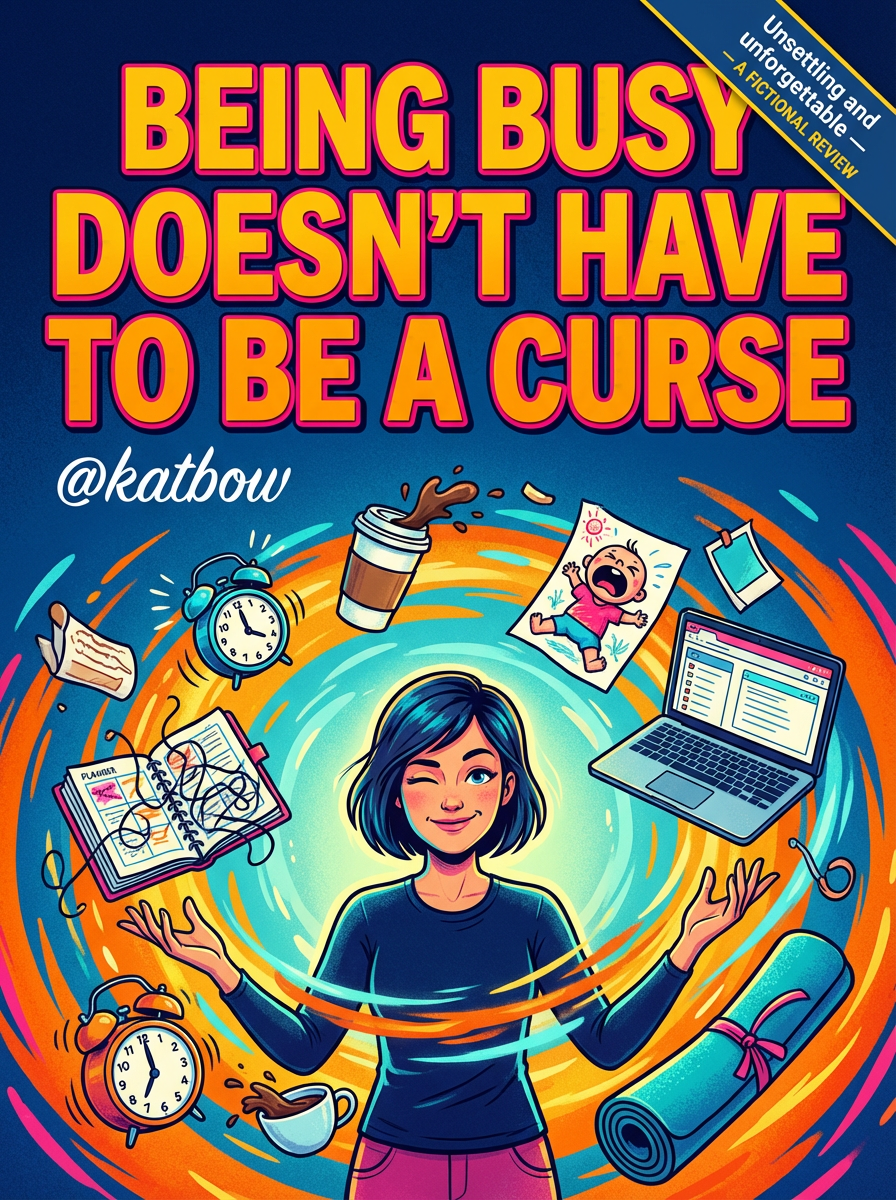
Synopsis
This humorous and brutally honest guide tackles the overwhelming reality of modern busyness, offering practical, no-nonsense strategies to not just survive but thrive amidst the chaos. From taming the digital beast to mastering the art of the 'elegant decline,' it teaches you how to juggle work, fam
Chapter 1: Welcome to the Circus: Admitting You're a Busy Hot Mess (and That's Okay!)
Brenda Chang here, and let's get one thing straight: if you picked up this book, you’re probably juggling more metaphorical chainsaws than a circus clown on a unicycle made of flaming spaghetti. You’re not alone. I see you, clutching your lukewarm coffee, staring blankly at your overflowing inbox, and wondering if "sleep" is just a mythical creature from a children's story. Welcome to the club. The "Busy Hot Mess" club. Our membership benefits include chronic eye bags, a deep understanding of what constitutes "dry shampoo," and the profound ability to hold a coherent conversation while simultaneously planning a toddler’s birthday party, drafting an urgent work email, and mentally cataloging the increasingly urgent home repairs.
For a long time, I thought I was the only one. I’d scroll through my social media feed, seeing perfectly curated lives, color-coded calendars, and people effortlessly “nailing it” at everything from artisanal bread baking to multi-national corporate takeovers. How did they do it? Were they just built differently? Did they possess some secret algorithm for time management that I, Brenda Chang, with my perpetually smudged glasses and a snack drawer that looked like a crime scene, was simply not privy to?
Then I met Dr. Dr. Eleanor Vance. Not in person, thankfully. She exists solely in the pristine, sun-drenched offices of my nightmares, or rather, in the glossy pages of "The 10 Habits of Highly Productive Unicorns." Dr. Dr. Vance, with her perfectly coiffed hair and a smile that suggested she hadn’t experienced a moment of genuine stress since the invention of the Post-it note, preached the gospel of "synergistic time-blocking" and "leveraging your morning power hours." My morning power hours, Dr. Dr. Vance, usually involve wrestling a cat off the counter and trying to remember if I brushed my teeth.
The truth is, we’re all performing a high-wire act of varying degrees of grace and impending doom. And it’s exhausting. We’re constantly bombarded with the message that busyness equates to importance, that a packed schedule is a badge of honor. "Oh, you're so busy!" people exclaim, often with a hint of admiration, as if you’ve just scaled Everest while simultaneously performing open-heart surgery on a hamster. The unspoken agreement is that to *not* be busy is to be, well, a slacker. A consumer of Netflix and breaker of societal norms.
But here’s the thing: being busy has become less about genuine engagement and more about a frantic, unthinking scramble. We’re running on a hamster wheel that seems to be operating on a rocket-fueled hamster protein shake. And for what? To answer emails at 2 AM? To miss the school play because of a "critical" meeting about the new office stapler?
Let me give you a quick "Brenda Chang Busyness Assessment." Answer honestly, to yourself, no judgment. 1. Have you ever eaten breakfast in the shower? (Bonus points if it was a cold pop tart.) 2. Is your phone perpetually below 20% battery, despite owning at least three different charging cables? 3. Do you communicate primarily in vague, non-committal grunts when asked about future plans? 4. Is your "to-do" list less a list and more a hieroglyphic scroll of impending doom? 5. Have you ever accidentally replied to a work email as if it were a text to your significant other? (I once told my boss, "LOL, totally! My butt hurts though." – it was an autocorrect fail for "but it hurts," related to a software issue, I swear.) 6. Do you regularly forget what day of the week it is? 7. Is "stressed" your default answer to "How are you?" 8. Have you ever considered a career as a professional napper? 9. Do you refer to your calendar as "The Black Hole of My Existence"? 10. Do you feel a perverse sense of accomplishment when you finally remember to move the laundry from the washer to the dryer?
If you answered yes to even three of those, congratulations, you're a Card-Carrying Member of the Busy Hot Mess Club. Take a bow. And maybe a nap.
So, why are we all so darn busy? It’s not just a personal failing, I promise. It’s a multi-headed hydra of modern life. First, there’s the glorification of "the grind." Remember Gary Peterson? My colleague? Bless his cotton socks. Gary is the king of "can-do." Need someone to organize the company picnic, lead the new project, *and* volunteer for the charity bake sale? Gary's your man! His calendar looks like a Jackson Pollock painting, and his eyes perpetually dart around like a squirrel trying to cross six lanes of traffic. He’s always the first to arrive and the last to leave, proudly proclaiming, "Sleep is for the weak, Brenda!" Gary means well, truly. He just hasn’t learned the elegant art of the "No." Or even the "Hell no, are you kidding me?" He’s a well-meaning cog in the machine of perpetual busyness, constantly adding more spokes to his already overloaded wheel. We’ve been conditioned to believe that saying no is a sign of weakness, rather than a crucial act of self-preservation.
Then there’s the digital beast. Oh, the digital beast. It promised to make our lives easier, more connected, more efficient. Instead, it’s tethered us to a constant stream of notifications, emails, and the ever-present siren song of social media. Remember when you could leave the office and be truly *done*? Now, your boss can ping you at 9 PM about a "quick question," or Aunt Milly can send you a cryptic Facebook message about a family gathering you *must* attend, completely obliterating any semblance of evening peace.
Aunt Milly. My nemesis. She’s delightful, really. Always baking cookies, always has a kind word. Until she discovers a sudden, pressing need for me to drive her across town to pick up artisanal cat sweaters *tonight*. "Oh, darling, I know you’re busy, but it’s just a *little* favor!" she’ll coo. And the guilt trip begins. Because family. Because tradition. Because who wants to be the monster who denies Aunt Milly her feline fashion fix? Our personal lives are no longer sacred, shielded from the demands of the outside world. The lines between work, family, social, and personal time have blurred into an indistinguishable, stress-inducing mess.
And let’s not forget the "myth of having it all together." This, my friends, is the most insidious beast of them all. We see others appearing to effortlessly juggle careers, perfect families, immaculate homes, and a thriving social life, all while looking like they just stepped off the set of a shampoo commercial. We compare our perpetually chipped nail polish and half-empty fridge to their Instagram-perfect existences and feel like abject failures.
I once spent an entire Saturday trying to replicate a Pinterest-worthy bento box for my niece's school lunch because I saw a picture of Dr. Dr. Eleanor Vance’s "mindful midday nourishment" on a blog. It involved individually carved cucumber flowers and ethically sourced organic edamame. Mine ended up looking like a toddler had attacked a garden. My niece, bless her heart, ate the goldfish crackers and left the rest. That day, I learned a valuable lesson: stop trying to be Dr. Dr. Vance. Just be Brenda. And Brenda's bento boxes sometimes consist of a questionable sandwich and a handful of whatever was at the back of the pantry.
The "Instagram life" is often just a carefully constructed façade. What you don't see are the frantic last-minute grocery runs, the mountain of unfolded laundry just out of frame, the arguments with spouses about who forgot to pay the electricity bill, or the exhaustion that seeps into every pore after a full day of "having it all together." Real life is messy. It’s chaotic. It’s about burnt dinners and missed deadlines and occasionally forgetting your child’s name for a split second (okay, maybe that last one is just me).
So, what’s the point of this glorious, comedic deep dive into our collective overwhelmed state? Simple. It's permission. Permission to acknowledge that you are, indeed, a busy hot mess. And that, unequivocally, is okay. More than okay, in fact. It’s *normal*.
This isn't a book about transforming you into a cyborg of efficiency, meticulously scheduling every heartbeat. I leave that to Dr. Dr. Eleanor Vance and her "Zen Productivity Retreats in the Himalayas." This is a book about navigating the actual, messy, glorious, frustrating reality of your life. It's about finding humor in the chaos, recognizing your limits, and learning to say "no" without a side order of guilt. It's about figuring out how to juggle those chainsaws without losing a limb (and occasionally dropping one, because hey, you’re human).
We’re going to laugh at the absurdity of it all. We’re going to acknowledge that the drive-thru is sometimes a perfectly acceptable dinner option. We’re going to understand that "self-care" doesn't always have to involve an hour-long yoga session and kale smoothie; sometimes, it’s just five minutes of staring blankly at a wall, unbothered.
Embrace your inner chaotic juggler. Raise a lukewarm coffee mug with me and declare, "Yes, I am a busy hot mess! And I'm doing my best!" Because your best, no matter how imperfect or frantic it feels, is enough. This book isn't about eradicating busyness; it's about making it work for *you*, instead of the other way around. It's about finding pockets of peace, setting sustainable boundaries, and remembering your own value beyond your to-do list.
In the upcoming chapters, we'll delve into the practicalities of taming the digital beast that's constantly buzzing in your pocket. We'll explore the art of the "elegant decline," a refined way to say "no" without alienating your Aunt Milly or incurring the wrath of Gary Peterson. We'll talk about ditching the guilt, finding your rhythm, and building systems that actually *support* your life, messy as it may be.
So, buckle up, fellow busy hot mess. You've bravely admitted your truth. Now, let’s figure out how to thrive in this beautiful, chaotic circus we call life, without completely losing our marbles. Because a packed schedule doesn't have to be a one-way ticket to burnout. It can, believe it or not, be a journey towards a more intentional, joyful, and slightly less frantic existence. I'm Brenda Chang, and I'm right here with you, probably forgetting where I put my keys, but still smiling. Mostly.
Chapter 2: The Digital Demigod Dilemma: Conquering Screens Before They Conquer You
Ah, the digital demigods. We invited them into our lives with open arms, didn’t we? “Oh, a tiny computer in my pocket? How quaint!” we cooed, completely oblivious to the fact that we were essentially adopting a high-tech gremlin that would, given half a chance, eat our free time after midnight and multiply. Now, instead of cute fluff, we have a constant, buzzing, vibrating, dinging, flashing, glowing sentinel of distraction clinging to us like a limpet – a limpet that knows our deepest anxieties *and* the exact moment our colleague Brenda (no, not *me*, the other one) posts another cat video.
Let’s be brutally honest: your phone isn’t just a phone anymore. It’s a digital dictator, a pixelated potentate, a pocket-sized overlord that demands your attention with the relentless persistence of a toddler who’s just discovered glitter. You pick it up to check the weather, and 45 minutes later, you’re knee-deep in a Reddit thread about the geological implications of miniature donkeys. Sound familiar? Welcome to the club. Membership dues are paid in lost productivity, frayed nerves, and the haunting suspicion that you’ve just scrolled past the prime of your life.
Remember Dr. Dr. Eleanor Vance’s latest webinar series, “Optimizing Your Digital Ecosystem for Peak Performance”? I swear, she probably has a self-cleaning robotic butler that answers her emails while she meditates in a sensory deprivation tank. She’ll tell you to schedule “digital detox hours” and “mindful scrolling sessions.” And bless her perfectly coiffed, productivity-guru heart, I’m sure it works for *her*. For the rest of us mere mortals, those “detox hours” usually translate to staring blankly at a wall, wondering if we missed anything important, and then frantically checking our phones “just in case.” It’s like trying to quit sugar when you live directly above a candy factory.
The problem isn't the devices themselves, of course. They’re tools, brilliant ones. It’s their insidious ability to become masters, not servants. It’s the constant stream of notifications, like tiny digital breadcrumbs leading us deeper and deeper into the forest of distraction. “Ding! Gary Peterson mentioned you in the project Slack channel!” *Panic.* “Buzz! Aunt Milly just shared another one of those slightly blurry photos of her prize-winning petunias!” *Mild existential dread.* “Vibrate! Someone you barely remember from high school liked your photo from 2017!” *What even is my life?*
This, my friends, is the Digital Demigod Dilemma. We created these gods, and now they’re demanding burnt offerings of our attention, our focus, and frankly, our sanity. But fear not, fellow sufferers of the perpetually dinging pocket! We can – and we will – reclaim our digital sovereignty. We’re not talking about throwing your phone into a volcano (though some days, the thought is tempting). We’re talking about training these unruly electronic beasts to be the helpful tools they were always meant to be, not the attention-sucking black holes they’ve become.
**Step 1: The Great Notification Purge (Prepare for Bloodshed)**
This is where we go from being digital serfs to digital overlords. The first step in taming your digital beast is to muzzle it. Think of every push notification as a tiny, digital interruption. Now, multiply that by… oh, let's say 300 a day. That’s 300 tiny mental context switches, 300 mini-heart attacks of “What now?!” It’s exhausting, and it ensures you’re living in a constant state of low-level anxiety, perpetually anticipating the next digital demand.
Go into your phone’s settings. Navigate to “Notifications” (yes, that little icon that looks suspiciously like a bell, because it’s perpetually ringing). Now, look at the list of apps. Scroll. Keep scrolling. Is it longer than your grocery list? We have a problem.
Here’s the rule: If an app isn’t actively helping you do your job, connect with genuinely important people, or provide truly essential information *at that very moment*, turn off its push notifications. I mean, ruthlessly. Does your weather app *really* need to tell you it’s sunny outside? Can you not look out a window? Does that game you played once in 2019 need to remind you that your digital carrots are wilting? Let them wilt! It builds character. For the virtual carrots.
“But Brenda,” I hear you plead, “what about important work messages? What if Gary Peterson needs me for an urgent brainstorm about ergonomic staplers?”
Okay, fine. For work-related communication apps, you can be slightly more discerning. But even then, consider batching. Does Slack need to notify you every time someone types a single word? Or can it wait until there are a few messages, or even better, until you decide to check it at designated times? Most platforms have settings for this. Explore them. Unleash your inner digital Marie Kondo: if it doesn't spark joy (or critical information), silence it.
My own journey through the Great Notification Purge was a revelation. For years, I had allowed various apps to send me promotional emails masquerading as urgent updates, news alerts telling me about things I didn't care about, and social media pings announcing vaguely interesting happenings in the lives of people I hadn't spoken to since Y2K. The silence that followed was… unnerving at first. Like going deaf in a noisy city. But then, it was glorious. It was the sound of my own thoughts, unmolested. It was the ability to finish a paragraph without instinctively reaching for my phone. It was like emerging from a digital fog machine into clear air.
**Step 2: The Art of the Digital Time Block (Because Your Brain Isn’t a Multitasking Marvel)**
Our brains, wonderful as they are, are spectacularly awful at true multitasking. What we do when we “multitask” is actually rapid task-switching. Every time you jump from an email to a spreadsheet to a text message to a cat video on Instagram, your brain has to reorient itself, load new context, and lose precious milliseconds (which add up to minutes, then hours, then weeks) getting back on track. It’s like trying to juggle flaming chainsaws while reciting Shakespeare – impressive, but ultimately messy and prone to causing irreparable damage.
This is where the Digital Time Block comes in. Instead of reacting to every ding and buzz, you proactively decide when you will engage with your digital world.
Here’s how it works:
* **Designated Email Safari:** Pick specific times of the day to check and respond to emails. Maybe it’s 9 AM, 1 PM, and 4 PM. During those times, you’re fully immersed in email. Outside of those times? Email is a non-starter. This means turning off desktop notifications, closing the tab, or even minimizing the email client. Tell your colleagues (especially Gary Peterson, who emails like he’s trying to win a Pulitzer) that you’re doing this. A simple out-of-office autoreply that says, “I check emails at 9, 1, and 4 to maximize focus. For urgent matters, please call [insert actual urgent contact method here],” works wonders. They’ll either respect it or realize their “urgent” need isn’t quite as urgent as they thought.
* **Social Media Slots (or “doomscrolling dungeons,” as I affectionately call them):** This is the hardest for many. Social media platforms are engineered by literal geniuses to be addictive. They tap into our primal need for connection, validation, and cute animal videos. So, don’t try to fight them all day. Give them a specific time slot, just like you would a meeting you actually want to attend. Maybe it’s 15 minutes after lunch, or 10 minutes before bed (though I’d argue the latter promotes insomnia, but hey, baby steps). Outside of those slots? The apps stay closed. Buried in a folder on your phone, perhaps, aptly named “Temporal Eddy.”
* **The “Deep Work” Digital Lockdown:** This is for when you *really* need to get stuff done. You have a big report due, a creative project calling, or simply need to sort out your life admin without your phone whispering sweet nothings about flash sales. During these periods, your phone goes into full “Do Not Disturb” mode. Better yet, it goes into another room. Or on a timed lockbox. Or maybe you just give it to a trusted friend who promises to only give it back if you recite the entire Gettysburg Address backward. Whatever it takes.
Brenda (the other one, not me) once complained she couldn’t even write a simple memo without checking her phone every five minutes. “It’s like it’s calling to me!” she wailed. I suggested she put it across the room. She looked at me like I’d suggested she perform open-heart surgery with a spork. But she tried it. The first day, she felt phantom vibrations. The second day, she still felt tempted. By the end of the week, she’d written two memos, a presentation, and a strongly worded email about the office coffee machine, all without a single digital interruption. Miracles do happen.
**Step 3: Train Your Phone, Not the Other Way Around (A.K.A. The Home Screen Makeover)**
Your phone’s home screen is prime real estate. What’s on it? A delightful spread of apps designed to distract you? Or a lean, mean, productivity machine? Let’s redecorate.
* **The “Core Four” Rule:** Limit your home screen to the absolute essentials. I’m talking phone, messages, camera, and one work-critical app. Everything else? Toss it into folders. No, not just any folders. Into folders labeled things like “Brain Drain,” “Time Vortex,” or “Future Me’s Problem.” The more steps it takes to get to that addictive app, the less likely you are to impulsively open it. This is friction, my friend, and friction is your digital diet’s best ally.
* **Grey Scale Gauntlet:** Turn your screen to grayscale. Seriously. Full color is designed to be appealing, vibrant, and engaging. It’s what makes those notifications pop. Take away the color, and suddenly your phone looks… boring. Like a sad, colorless world devoid of joy. It's surprisingly effective at reducing the siren call of the screen. (You can usually find this in accessibility settings.)
* **Delete the Digital Debtors:** Are there apps on your phone you haven't opened in months but still demand your attention with updates and notifications? Delete them. Free up that digital real estate. It's like decluttering your physical space, but for your mind. That old game you downloaded in a moment of weakness? Poof. That coupon app you used once? Gone. Be ruthless.
Aunt Milly once called me in a panic because she’d deleted her Facebook app. “Brenda! How will I know what Janice had for lunch?!” she exclaimed, as if the fate of the free world hinged on the gastronomic habits of distant cousins. I calmly explained she could still access Facebook through a web browser if she *really* needed to. The extra steps involved in opening a browser, typing in the URL, and logging in were enough to curb her impulsive checking. Turns out, Janice’s lunch choices weren't as life-altering as she’d initially feared.
**Step 4: The Device Divorce (Temporary Separation is Healthy)**
Sometimes, you just need a break. A proper, physical separation from your digital overlords.
* **Bedroom Banishment:** Do not, under any circumstances, bring your phone to bed. Your bedroom should be a sanctuary for sleep, intimacy, and quiet reflection, not a scrolling station. Get an actual alarm clock. Read a physical book. Stare at the ceiling and contemplate the universe. The blue light from screens messes with your sleep, and the temptation to check “just one more thing” can steal precious hours of rest.
* **Mealtime Mandates:** Family meals, solo meals, meals with friends – these are prime opportunities for genuine connection and presence. Declare meals a phone-free zone. Put them in a basket in the middle of the table, on silent. First person to touch their phone has to do the dishes (or sing an opera, depending on family tradition). You’ll be amazed at how much more you notice – your food, the conversation, the subtle nuances of human interaction that get drowned out by the glow of a screen.
* **The “Weekend Whisperer” Technique:** For one day a week, or even just a few hours, consider a full digital sabbatical. Turn off your phone. Put it in a drawer. Go for a walk. Read a book. Garden. Bake something. Reconnect with the tangible world. It’s surprisingly liberating to realize that the world *doesn’t* actually end when you’re not constantly plugged in.
Gary Peterson, poor soul, was a workaholic to the core. He'd even take his laptop to the beach on vacation. His wife eventually staged an intervention, hid his phone, and forced him to spend a weekend entirely unplugged. He came back looking disoriented, like a deep-sea diver suddenly thrust into daylight, but also surprisingly refreshed. He’d actually *talked* to his kids. He’d gone for a hike. He even started a new hobby: carving miniature wooden ducks. The digital quiet had allowed his own creativity to surface, unburdened by the constant demands of his inbox.
**The Digital Demigod Downfall: Your Reward**
By implementing these strategies, you’re not just reclaiming your time; you’re reclaiming your attention, your focus, and your sanity. You’re trading a life of constant reactivity for one of intentional action. You’re moving from being a digital puppet to a digital puppet master.
Will it be easy? Nope. These devices are designed to be addictive, and breaking habits takes effort. You’ll feel the phantom vibrations. You’ll catch yourself reaching for your phone out of habit. You’ll have moments where you think, “What if I *am* missing something vitally important?” But every time you resist, every time you choose to be present, you chip away at the demigod’s power.
Soon, you’ll find yourself with more time. Not just empty time, but *quality* time. Time to think, to create, to connect, to relax. Time to actually *be* busy with things that matter, rather than simply being busy reacting to the digital whims of others. Your phone will become a tool, a servant, ready to assist when *you* command, not a tyrannical ruler dictating your every waking moment. And when that happens, my friend, you’ll realize that being busy doesn't have to be a curse. It can be a choice, one made on your terms, not those dictated by a buzzing black rectangle. Now, if you’ll excuse me, my digital detox timer just went off, and I’m pretty sure my imaginary miniature donkeys are about to achieve geological significance.
Chapter 3: The Art of the Elegant Decline (and Other Boundary Badassery)
"No."
Say it with me. Louder. With conviction. "NO!"
Doesn't that feel… surprisingly good? Like a tiny, rebellious cheer erupting from your soul’s deepest, most overworked caverns? Welcome, my fellow busy hot messes, to Chapter 3: "The Art of the Elegant Decline (and Other Boundary Badassery)." If Chapter 1 was about admitting you’re drowning and Chapter 2 was about wrestling your digital overlords, this chapter is about building the ark, stocking it with snacks, and putting up a "Do Not Disturb" sign so big it can be seen from space.
Because let’s be honest, the biggest reason we’re all so busy isn’t always external forces. Sometimes, it’s us. It’s our inability to say no. It’s our deeply ingrained, societal-pressure-fueled need to be agreeable, helpful, and perpetually available. It’s the fear of being seen as "un-team-player," "un-friend," "un-family," or, God forbid, "un-nice."
Well, I’m here to tell you that "nice" is often the enemy of "sane." And being a "team player" doesn’t mean you have to be the team’s designated martyr. This chapter is your crash course in boundary badassery – learning to say "no" without feeling like a villain, declining commitments with the grace of a gazelle (or at least a slightly tipsy but well-meaning sloth), and prioritizing your own well-being without a single pang of guilt.
**The "Yes" Trap: A Comedy of Errors**
Think back to the last time you said yes when every fiber of your being was screaming "NOOOOOOOO!" Was it…
* …volunteering to organize the office holiday party, despite despising glitter and small talk? * …agreeing to babysit your sister’s triplets, even though you just wanted to curl up with Netflix and a family-sized bag of chips? * …taking on that extra project at work, knowing full well your current plate was already overflowing like a leaky dam in monsoon season? * …promising to bake 30 cupcakes for the school bake sale, despite your baking skills extending only to "opening a box of Pop-Tarts"?
(Confession: I once agreed to host a potluck with a theme I *clearly* didn’t understand, resulting in a table laden with various shades of beige and one very confused guest who brought a live chicken. The "yes" trap is real, folks.)
Why do we do it? A complex cocktail of reasons, really:
1. **The Fear of Missing Out (FOMO):** What if this *is* the one chance to network with that important person? What if I miss out on a truly epic karaoke night? (Spoiler: Most karaoke nights are only epic for the person singing.) 2. **The Desire to Be Liked:** We crave acceptance, and saying yes feels like a golden ticket to popularity. (Newsflash: True friends don’t require you to sacrifice your sanity for their convenience.) 3. **The Guilt Trip Express:** "Oh, but they *really* need me." "No one else can do it." "It’s just for a little while." (Translation: They’re good at emotional manipulation, and you’re a soft touch.) 4. **The "I Can Do It All!" Delusion:** We genuinely believe we can defy the laws of physics and time, squeezing 36 hours of activity into a 24-hour day. (Spoiler: You can’t. You’ll just end up tired, cranky, and possibly wearing mismatched socks.) 5. **The Lack of a Script:** We simply don’t know *how* to say no politely. We stutter, we stammer, we awkwardly fumble, and then before we know it, we’re committed to painting a mural on the side of the local library.
This chapter is your antidote to the "yes" trap. It’s your boundary-building toolkit, complete with witty comebacks and practical strategies.
**The Pillars of Boundary Badassery: Your "No" Manifesto**
Before we dive into specific scripts, let’s internalize some core principles:
1. **Your Time is Finite and Precious (Like a Unicorn’s Tear):** You wouldn't let someone just walk into your bank account and take money, would you? Your time and energy are even more valuable. Guard them fiercely. 2. **"No" is a Complete Sentence (Seriously):** You don't always need a grand explanation, a medical emergency, or a meticulously crafted PowerPoint presentation to justify your refusal. "No, I can't" is often perfectly sufficient. 3. **Prioritize Your Oxygen Mask First:** Remember the airline safety spiel? Put on your own mask before assisting others. If you’re burnt out, exhausted, and resentful, you’re no good to anyone. Self-care isn't selfish; it’s essential. 4. **The World Will Not End (Probably):** The project will still get done. The party will still happen. Your friend will find another ride. The universe does not revolve around your singular ability to overcommit. 5. **Boundaries Are About Respect (Yours and Theirs):** Setting boundaries isn't about being mean; it's about respecting your own needs and teaching others how to respect them too.
**The Art of the Elegant Decline: Your Script Book for Saying "No"**
Now for the fun part: the actual words. Here are some tried-and-true techniques, ranging from the subtly evasive to the unapologetically firm, complete with comedic examples.
**1. The "Pre-emptive Strike" (aka, Don’t Even Let Them Ask)**
This is for those people or situations where you *know* a request is coming. Get ahead of it.
* **Scenario:** Your colleague, Brenda, always "delegates" her least favorite tasks to you. You see her approaching with that glint in her eye. * **Your Move:** "Hey Brenda! Just wanted to let you know I’m swamped this week with the [insert actual project here] and then I’m dedicating Friday to finally tackling that [insert personal task here, e.g., 'mountain of laundry' or 'existential dread']. So, my plate is officially overflowing!" * **Why it works:** You’ve set the expectation *before* she can even open her mouth. You’ve framed it as a statement of fact, not a negotiable option.
**2. The "Honest But Gentle" Decline (The Classic)**
When you need to say no, but you still want to maintain a good relationship.
* **Scenario:** Your friend asks you to help them move furniture on your only free Saturday. * **Your Move:** "Oh, that sounds like a tough job! Unfortunately, I'm already committed that day/I really need that time to recharge. I hope you find someone awesome to help!" * **Why it works:** You're direct but kind. You don't over-explain, but you acknowledge their need. "I'm already committed" is vague enough to be true without divulging your plans to binge-watch reality TV.
**3. The "It’s Not a Good Fit For Me Right Now" (The Professional Polish)**
Perfect for work requests, committees, or volunteer opportunities.
* **Scenario:** Your boss asks you to take on an additional, non-essential project. * **Your Move:** "Thanks so much for thinking of me for that, I appreciate it. However, given my current workload with [Project A] and [Project B], I don't believe I can give that new project the attention it deserves right now without compromising my existing commitments. My priority is to deliver excellent results on what I currently have." * **Why it works:** You frame it as a professional decision, not a personal failing. You're showing dedication to your *current* responsibilities, which is hard to argue with.
**4. The "Alternative Suggestion" (The Helpful Boundary)**
When you can't do it, but you genuinely want to help find a solution (without becoming the solution).
* **Scenario:** Your sister needs a ride to the airport, but you legitimately can't. * **Your Move:** "Oh no, I wish I could! I'm completely tied up then. Have you tried [Uber/Lyft/asking your cousin Gary who owes you a favor]? Or maybe there's a shuttle service?" * **Why it works:** You're not leaving them completely stranded, but you're firmly holding your boundary. You're offering *options*, not *yourself*.
**5. The "Let Me Check My Calendar… Oh, What a Shame!" (The Strategic Delay)**
For those times you need a moment to think or want to avoid an immediate "yes."
* **Scenario:** Someone asks you to do something on the spot, and you feel pressured. * **Your Move:** "That sounds interesting/challenging/like it involves heavy lifting. Let me just check my calendar and get back to you." (Then, if you decide to decline: "Thanks for the offer, but after looking at my schedule, I just don't have the bandwidth right now.") * **Why it works:** It buys you time. It allows you to remove yourself from the immediate pressure of the request and make a decision based on your actual capacity, not just your knee-jerk people-pleasing reflex.
**6. The "I Appreciate the Offer, But No" (The Blunt & Beautiful)**
Sometimes, less is more. Especially when you’ve already tried the gentler approaches.
* **Scenario:** Your neighbor, who always "forgets" their wallet, asks to borrow money *again*. * **Your Move:** "I appreciate you thinking of me, but no." (Silence. Hold eye contact. Maybe add a slight head tilt for dramatic effect.) * **Why it works:** It’s unambiguous. It sets a firm boundary. You don't owe anyone an explanation for why you're not doing something.
**7. The "Delegation Dynamo" (The Turn-Around)**
When someone asks you to do something that is clearly *their* responsibility.
* **Scenario:** A colleague asks you to proofread their entire 50-page report, which is due in an hour. * **Your Move:** "I'm happy to give it a quick once-over for major typos if you point out the sections you're most concerned about, but I don't have time for a full proofread. Perhaps you could use [Grammarly/ask someone from your own team]?" * **Why it works:** You offer a *limited* amount of help if you choose, but you immediately redirect the primary responsibility back to them.
**8. The "Broken Record" (The Persistent Boundary Setter)**
For those who just don't seem to get the hint.
* **Scenario:** Your aunt keeps pestering you to join her pyramid scheme. * **Your Move:** "Aunt Carol, I've told you before, I'm not interested." (She asks again.) "As I said, I'm not interested." (She tries to convince you with statistics.) "I appreciate your enthusiasm, but my answer remains the same. I'm not interested in that." * **Why it works:** You repeat your boundary calmly and consistently. You don't engage in debate or justification. Eventually, most people will give up.
**The Guilt Trip Gauntlet: How to Dodge the Emotional Bombs**
Even with the perfect script, you might encounter resistance. Some people are masters of the guilt trip. Here's how to disarm them:
* **"But I *really* need you!"** * **Your Response:** "I understand this is important to you, and I wish I could help, but I simply can't right now." (Empathy without capitulation.) * **"You *always* say no!"** (Even if you almost never do.) * **Your Response:** "I'm sorry you feel that way. I have to prioritize my commitments, and right now, I need to focus on X, Y, Z." (Don't defend your past choices; focus on your current reality.) * **"It'll only take a minute!"** (The most insidious lie of all.) * **Your Response:** "Even a minute can throw off my schedule today. I need to stay focused on what I'm doing." (Or, if appropriate: "My 'minute' often turns into an hour, and I'm not prepared for that right now.") * **"I thought you were my friend/family!"** * **Your Response:** "Our friendship/relationship is very important to me, which is why I need to take care of myself so I can be a good friend/family member in the long run. Right now, that means saying no to this." (Flip the script – self-care is *good* for your relationships.)
**The Aftermath: No Regrets, Only Resilience**
After you deliver your elegant decline, you might feel a pang of guilt. That’s normal. It’s years of conditioning. Acknowledge it, and then let it go. Remind yourself of the "Pillars of Boundary Badassery."
* **They might be annoyed.** That’s *their* emotion to manage, not yours. * **They might find someone else.** Excellent! That means the task gets done, and you didn't have to sacrifice your well-being. * **They might respect you more.** People often respect those who clearly articulate their boundaries, even if they initially grumble. It shows strength and self-awareness.
**Your Homework for Boundary Badassery:**
1. **Identify Your "Yes" Triggers:** Who or what situations make it hardest for you to say no? Be specific. 2. **Pre-script Your Declines:** For your top 3 "yes" triggers, write out a few elegant decline scripts using the techniques above. Practice them in the mirror. Seriously, it helps! 3. **Start Small:** Don't try to say no to everything at once. Pick one low-stakes request this week and practice your new skills. 4. **Embrace the Awkward:** The first few times you set a firm boundary, it might feel awkward. That's okay! Awkwardness is the price of admission to the VIP lounge of sanity. 5. **Celebrate Your "Nos":** Did you successfully decline something that would have drained you? High five yourself! You just reclaimed a piece of your precious time and energy.
Remember, dear reader, being busy doesn’t have to be a curse. But being busy because you can’t say no *is* a curse. You are not a human "yes" machine. You are a complex, deserving individual with limited time and energy. It's time to wield the power of the elegant decline, to set boundaries like a boss, and to reclaim your right to a life that feels less like a circus and more like a well-orchestrated symphony where *you* get to conduct.
Now go forth, and practice your "no." The world (and your sanity) will thank you for it.
Chapter 4: Calendar Chaos & To-Do List Turmoil: Befriending Your Schedule (or At Least Calling a Truce)
Alright, gather ‘round, my fellow productivity pilgrims, because if Chapter 3 taught us anything, it’s that saying “no” is a superpower. But what happens when you’ve said “yes” to the things you *do* want to do, and now your calendar looks like a Jackson Pollock painting after a particularly energetic caffeine binge? Welcome to the glorious, terrifying, and often hilarious world of Calendar Chaos and To-Do List Turmoil.
You know the feeling, don’t you? That insidious little thrill when you buy a brand new notebook, pristine and full of promise, ready to receive the meticulously organized list of all the things you are absolutely, definitely going to accomplish. You crack open your planner, perhaps a Moleskine, perhaps a bullet journal so intricate it requires an engineering degree to decipher, and you begin. “Monday: Q3 Report, email Brenda, therapy, Pilates (finally!), call insurance.” “Tuesday: Dentist (yay!), client meeting, grocery shopping, meditate for 20 minutes (hah!).”
By Wednesday, your ambitious plans have usually collided with the cold, hard reality of life. Brenda didn’t email back, the Q3 report unearthed a financial black hole, Pilates was replaced by a desperate search for your car keys, and meditation turned into 20 minutes of staring blankly at the wall, wondering if you’d remembered to unplug the iron. Your beautiful to-do list, once a beacon of hope, now mocks you with its uncrossed items, a testament to your unfulfilled potential.
This, my friends, is the seductive siren song of “productivity porn.” We scroll through Instagram, admiring aesthetically pleasing bullet journals filled with perfectly color-coded tasks and tiny, adorable illustrations. We read articles titled “5 AM Club: How to Conquer Your Day Before Sunrise!” and “Batch Your Tasks for Maximum Efficiency!” We buy apps that promise to optimize our every waking moment, turning us into lean, mean, task-completing machines. And for a glorious five minutes, we believe it. We *can* be that person! We *can* achieve peak performance!
Then, reality slaps us across the face with a wet fish. That perfectly color-coded task of "Respond to 47 emails" takes three hours, not thirty minutes. The "batch cooking" session turns into a charred culinary disaster. And the 5 AM club? Well, let's just say my alarm clock and I have a very intimate, adversarial relationship involving multiple snoozes and a profound sense of betrayal.
The truth is, while intention is a lovely thing, the sheer volume of modern life often renders our best-laid plans utterly useless. We're not just busy; we're *overwhelmed*. Our brains are like a browser with 3,000 tabs open, each one screaming for attention, playing a different, equally annoying song. And our calendars? They’re less a helpful guide and more a sadistic game of Tetris where the blocks are constantly falling, and you just know you’re about to lose.
So, how do we tame this beast? How do we look at our overflowing schedule and our never-ending to-do list without immediately wanting to curl into a fetal position and hum show tunes until the feeling passes? We befriend it. Or, failing that, we call a very firm truce.
**The Great Calendar Confrontation: It's Not You, It's Me (and Also, It's Definitely You)**
First, let’s talk about your calendar. Is it a digital masterpiece, synced across all devices, sending helpful (read: nagging) reminders? Or is it a physical relic, smudged with coffee stains and indecipherable scribbles? Whatever its form, it’s time for an honest conversation.
**Step 1: The Full Reveal. No Holds Barred.**
Open your calendar. All of it. Digital, analog, the sticky note on your fridge, the vague promise you made to your aunt three months ago. Write *everything* down. Every meeting, every appointment, every commitment, every vague intention. Don’t filter. Don't judge. Just get it all out there. This is like turning on all the lights in a very messy room. It’s horrifying, but necessary.
You might find things you completely forgot about. You might find two conflicting appointments. You might find a recurring Tuesday evening commitment that you swore you canceled last year (spoiler: you didn’t). This is the moment you realize your calendar is less a tool and more a wild beast that has been silently breeding in the corners of your life.
**Step 2: The Ruthless Cull (Channel Your Inner Marie Kondo, But With More Swearing)**
Now, with your calendar laid bare, it’s time to ask the hard questions. For each item:
* **"Does this spark joy?"** (Okay, maybe not *joy*, but "Is this genuinely important, necessary, or something I truly want to do?") If the answer is a resounding "meh," or "my boss made me," or "I promised my cousin's second-tier acquaintance I'd attend their cat's birthday party," then it's a prime candidate for the chopping block. Revisit Chapter 3. Practice your elegant decline. * **"Can this be delegated?"** Is there someone else who can do this? Your partner? A colleague? A very responsible teenager you can bribe with pizza? If so, offload it. The goal here is not to be a martyr; it's to survive. * **"Is this realistic?"** Look at your Tuesday. If it has "9 AM Client Meeting," "11 AM Deep Work Session," "1 PM Lunch with Important Person," "2 PM Brainstorming Session," and "4 PM Pick Up Kids," and you also need to, you know, *breathe*, then something's gotta give. Be honest with yourself about how long things *actually* take. Add buffer time. Always add buffer time. Assume everything will take 20% longer than you think. You'll thank me later.
**Step 3: Color-Coding for the Chronically Confused (or the Visually Motivated)**
Once you've culled the herd, it's time to bring some order to the remaining chaos. This is where color-coding comes in. But forget the intricate systems that require a legend and a PhD. Keep it simple.
* **Red: Non-Negotiables.** These are the things you absolutely, positively cannot reschedule or ditch. Work meetings, doctor's appointments, your kid's school play (unless you want to be *that* parent). * **Green: Self-Care/Joy.** This is your gym time, your reading hour, your coffee with a friend, your designated staring-at-the-wall-and-contemplating-the-meaning-of-life time. These are just as important as the red items. Actually, arguably more so, because if you burn out, nothing else gets done anyway. * **Blue: Flexible/Deep Work.** These are tasks that need to get done but can be moved if absolutely necessary. Writing reports, answering emails, doing laundry.
Seeing your calendar visually broken down like this can be incredibly illuminating. If it's 90% red and zero percent green, you have a problem, my friend. A big, burn-out-inducing problem. Adjust accordingly.
**The To-Do List Tangle: From Mountain to Molehill (Preferably a Cute, Manageable Molehill)**
Now, let's tackle the to-do list. That ever-growing, guilt-inducing scroll of unfinished business. We all have one. Mine currently includes "figure out why the cat keeps meowing at the ceiling" and "learn to juggle (metaphorically and literally)."
The problem with most to-do lists is they are simply brain dumps. We write down everything that comes to mind, regardless of urgency, importance, or whether it's even humanly possible to achieve in a single day. This creates a psychological burden that's heavier than a sumo wrestler in a lead suit.
**Technique 1: The "Eat That Frog" Method (But Maybe With a Side of Bacon)**
Coined by Brian Tracy, "Eat That Frog!" basically means: do your biggest, most unpleasant task first thing in the morning. Get it over with. Don't procrastinate. Don't check emails. Don't scroll Instagram. Just tackle the frog.
Why? Because if the first thing you do is conquer your biggest challenge, the rest of the day feels like a downhill stroll with a gentle breeze at your back. If you leave the frog simmering on the back burner, it will haunt you, drain your energy, and make every other task feel heavier.
My personal modification: "Eat That Frog (But Maybe With a Side of Bacon)." The "bacon" is a small reward you promise yourself *after* the frog is devoured. A fancy coffee. Ten minutes of mindless scrolling. A quick dance party in your kitchen. Whatever motivates you to get that slimy amphibian down the hatch.
**Technique 2: The "Rule of 3" (Because Our Brains Can't Handle More Than That Anyway)**
This is gloriously simple. At the beginning of each day (or the night before), identify the **three most important things** you need to accomplish. Just three. These are your non-negotiables for the day. Everything else is gravy.
Why three? Because our working memory is notoriously limited. Trying to juggle 10 "top priorities" is a recipe for paralysis. Focusing on three gives you clarity, direction, and a much higher chance of actually feeling accomplished.
Write these three things down prominently. Put them on a sticky note on your monitor. Tattoo them on your forehead (maybe not that last one). The goal is to have them staring you in the face, reminding you what truly matters for that day.
**Technique 3: The "Time Boxing" Tango (Because Tasks Expand to Fill Available Time, Like My Waistline After Holidays)**
Ever notice how a task that *should* take 30 minutes magically expands to fill an hour if you let it? That's Parkinson's Law in action, and it's a productivity killer. Time boxing is your secret weapon.
For each task on your list (especially the blue, flexible ones), assign a specific amount of time. And here's the crucial part: **stick to it.**
* "Respond to emails": 30 minutes (then close your email tab, regardless of whether you're finished). * "Draft project proposal": 90 minutes (then take a break, even if you're mid-sentence). * "Load dishwasher, fold laundry, stare blankly at the wall": 45 minutes (because multi-tasking is a myth, but staring blankly at the wall is essential).
The beauty of time boxing is twofold: it forces you to focus intently during that allocated time, and it prevents tasks from bleeding endlessly into your day. If you don't finish, you either re-time box it for later or accept that you've done enough for now. Progress, not perfection, is the mantra here.
**Technique 4: The "Batching Bonanza" (For When You're Feeling Particularly Ambitious)**
While multi-tasking is generally bad, *batching* similar tasks together can be a game-changer. Our brains hate context switching. Every time you jump from emails to a report to social media to a phone call, your brain has to reboot, wasting precious mental energy.
Instead, group similar tasks:
* **Email Block:** Designate specific times for checking and responding to emails. Don't let your inbox dictate your day. * **Call Block:** Make all your phone calls back-to-back. * **Errand Block:** If you have multiple errands, try to do them all in one go, geographically organized (my inner control freak loves this). * **Creative Block:** If you have writing, brainstorming, or other creative tasks, dedicate a solid chunk of uninterrupted time to them.
This minimizes the mental overhead of switching gears, allowing you to get into a flow state and be more efficient.
**The Weekly Review: Your Sanity Check-In (and Chance to Reschedule That Pilates Class… Again)**
Finally, to truly befriend your schedule, you need a regular check-in. I recommend a "Weekly Review." This isn't some corporate jargon-filled performance review; it's a personal sanity check.
At the end of each week (Friday afternoon is ideal, or Sunday evening if you're a glutton for punishment), take 30-60 minutes to:
1. **Review your calendar for the past week:** What went well? What didn't? Where did you overcommit? Where did you waste time? 2. **Review your to-do list:** What got done? What didn't? Why? Migrate unfinished but important tasks to the *next* week. Ditch the irrelevant ones. 3. **Plan the upcoming week:** Based on your reflections, populate your calendar with your non-negotiables, self-care items, and time-boxed tasks. Apply the Rule of 3. 4. **Celebrate the wins:** Even small ones! You emptied the dishwasher! You responded to *one* email! You didn't spontaneously combust from stress! Acknowledge your efforts. 5. **Adjust and adapt:** This is not about being perfect. It's about learning. Every week is an experiment. What strategies worked? What didn't? Tweak your approach for the next week.
The goal of this weekly review isn't to beat yourself up; it's to gain clarity and make incremental improvements. It's about recognizing that your schedule is a living document, not a rigid prison sentence.
**The Grand Finale: A Truce, Not a Total Takeover**
Let's be brutally honest: you will never have a perfectly organized calendar and a consistently cleared to-do list. Life happens. Unexpected fires will erupt. Your cat will continue to meow at the ceiling for reasons unknown. That's okay.
The aim here isn't to achieve some mythical state of "perfect productivity." It's to reduce the anxiety, the overwhelm, and the constant feeling of being behind. It's about moving from a state of chaos to a state of controlled chaos. It's about calling a truce with your schedule, acknowledging its demands, but also asserting your own need for breathing room, sanity, and maybe an occasional spontaneous dance party.
So, go forth, my friends. Confront your calendar. Tame your to-do list. Eat those frogs (with bacon). And remember, being busy doesn't have to be a curse. With a little humor, a lot of honesty, and some strategic planning, it can just be… well, busy. But a much more manageable, less soul-crushing kind of busy. Now, if you'll excuse me, I have to go figure out why my cat is staring at the ceiling again. Probably a ghost. Or a really interesting dust bunny.
Chapter 5: Mindful Mayhem: Finding Zen in the Eye of the Storm (Even If It's Just for 5 Minutes)
Let’s be honest. If you’re reading this book, you probably haven’t seen true tranquility since that one time you accidentally took a double dose of allergy medication and spent three hours staring intently at a dust bunny. The idea of meditating for 30 minutes, doing a full yoga flow, or even just sitting silently with your thoughts sounds less like a path to enlightenment and more like a cruel, elaborate prank. “Mindfulness,” you scoff, as you simultaneously answer an email, stir a boiling pot, and try to stop your toddler from eating a crayon. “Yeah, right.”
And you’re absolutely correct. For us, the perpetually busy, the notion of serene, uninterrupted contemplation is as elusive as a unicorn riding a unicycle while juggling flaming chainsaws. It’s a lovely thought, a beautiful aspiration, but let’s get real – our lives are more akin to a perpetual game of Whack-A-Mole, where every mole is an urgent task and the mallet is our dwindling sanity.
But here’s the good news: you don’t need to achieve full-blown nirvana to reap some of the benefits of mindfulness. You don’t need to shave your head, wear flowing robes, or even own a meditation cushion (unless it’s disguised as a particularly fluffy throw pillow you occasionally weep into). What we’re aiming for here are *micro-moments* of mindfulness. Think of them as tiny, bite-sized sanity snacks. Little pockets of peace you can snatch from the jaws of chaos, even if it’s just for five glorious, unadulterated seconds.
Because even a microscopic pause can be a game-changer. It’s the difference between perpetually running on fumes until you spontaneously combust, and just *almost* spontaneously combusting, but managing to pull yourself back from the brink with a strategically timed deep breath and a muttered expletive.
So, let’s ditch the lofty expectations and embrace the gloriously messy reality of mindful mayhem. Here are a few highly unscientific, yet surprisingly effective, strategies for finding your zen in the eye of the storm.
**The Power Pout: Harnessing the Therapeutic Grump**
Forget gentle smiles and inner peace. Sometimes, the most mindful thing you can do is acknowledge the absolute, unadulterated rage bubbling beneath the surface. And what better way to do that than with a good, old-fashioned power pout?
This isn’t your average sulk. This is a *deliberate*, *focused* grimace. Find a private spot – the bathroom stall, behind a large plant, under your desk (no judgment here). Now, really *feel* that frustration. Let your jaw clench. Scrunch your eyebrows. Push your lower lip out so far it could catch rainwater. Hold it. Feel the tension. Acknowledge it. You are a magnificent, furious gargoyle, and that’s perfectly okay.
The beauty of the power pout is twofold: 1. **Validation:** It tells your inner stressed-out toddler, “Yes, I see you. You are *very* upset, and that’s valid.” 2. **Release:** Holding that physical tension, then consciously releasing it, can be surprisingly cathartic. It’s like a mini, non-destructive tantrum.
After about 10-15 seconds of intense pouting, slowly relax your face. Take a deep breath. You might not be beaming, but you’ve acknowledged the storm within, and now you can move forward, slightly less likely to snap at the next person who asks if you’ve "tried delegating."
**The Strategic Stress Snack: Mindful Munching, Not Mindless Gulping**
We’ve all been there: the stress snack. It usually involves a large bag of something crunchy, consumed standing over the kitchen sink, with absolutely no memory of the first half of the bag. This isn't mindfulness; it's emotional eating on autopilot.
The Strategic Stress Snack, however, is different. This is a *pre-planned*, *deliberate* moment of culinary comfort. The key is intention and presence.
1. **Choose Wisely (or at least deliberately):** Don't just grab whatever's closest. What *actually* sounds good right now? A square of dark chocolate? A handful of nuts? A single, perfectly ripe berry? (Okay, maybe not the berry if you’re truly stressed, let's aim for something with a bit more *oomph*.) 2. **The Ritual:** Don’t eat it while simultaneously scrolling through Instagram or yelling at your kids. Find a quiet corner. Sit down. Look at your chosen snack. Really *look* at it. Notice its texture, its color, its scent. 3. **The Slow Chew:** Take a bite. Don’t just swallow. Let it linger. What are the flavors? How does it feel in your mouth? Chew slowly. Savor it. Notice each sensation. 4. **The Post-Snack Pause:** Once it's gone, take a moment. How do you feel? A little less frantic? A tiny bit more grounded?
This isn't about avoiding "bad" foods; it's about making your food choices conscious, even if that choice is a handful of cheesy puffs. By bringing awareness to the act of eating, you interrupt the stress cycle and give your brain a much-needed sensory break. Plus, you actually *enjoy* the food, rather than just inhaling it.
**The "Five Senses Scramble": Your Emergency Grounding Kit**
When your brain feels like a hamster on a caffeine-fueled wheel, and your thoughts are ricocheting off the walls of your skull, the Five Senses Scramble is your go-to. It’s a rapid-fire grounding technique that pulls you back into the present moment by engaging your senses.
Here’s how it works: Stop what you’re doing (or at least pause the internal monologue of impending doom). Now, quickly identify:
* **5 things you can SEE:** Don’t just glance. *Really* look. The dust motes dancing in the sunlight, the specific shade of blue on your pen, the pattern on your colleague's hideous tie. * **4 things you can FEEL:** The texture of your clothing, the warmth of your coffee mug, the pressure of your feet on the floor, the slight breeze from the air conditioning. * **3 things you can HEAR:** The hum of the computer, distant traffic, your own breathing, the faint *thump-thump* of your heart trying to escape your chest. * **2 things you can SMELL:** Your coffee, your hand sanitizer, that faint scent of yesterday's lunch, the unique aroma of "office." * **1 thing you can TASTE:** Your lingering coffee taste, your toothpaste, a dry mouth, or maybe that strategic stress snack you just had.
This exercise forces your brain to switch gears from abstract worries to concrete, immediate reality. It’s like hitting the reset button on your internal panic alarm. You might not solve world hunger in those 30 seconds, but you'll definitely feel more present and less like you're about to spontaneously combust from sheer overwhelm.
**The "Power Pause" (aka The Bathroom Break Brilliance)**
Let’s be real. For many of us, the only guaranteed moment of relative solitude is a trip to the restroom. Don't waste it! Transform your humble bathroom break into a Power Pause.
Instead of rushing in, doing your business, and rushing out while checking your phone, try this:
1. **The Walk:** As you walk to the restroom, consciously notice your steps. Feel your feet on the floor. Pay attention to your breath. 2. **The Sacred Stall:** Once inside the stall, close your eyes (assuming you’re done with the functional part). Take three *deep, slow* breaths. Inhale through your nose, feeling your belly expand. Exhale slowly through your mouth, imagining tension leaving your body. 3. **The Micro-Meditation:** For a glorious 30-60 seconds, just *be*. Listen to the ambient sounds (try not to focus too much on *those* particular ambient sounds). Notice the feeling of the air on your skin. Just exist. 4. **The Re-Entry:** Open your eyes. Take one more deep breath. You are now refreshed, slightly less stressed, and ready to face the world again (or at least the next hour of it).
This is a tiny, clandestine act of self-care. No one needs to know you just had a moment of profound introspection next to the hand dryer. It’s your secret weapon against the relentless march of the workday.
**The "One-Minute Wonder": Focusing on a Single, Mundane Task**
Mindfulness doesn't have to be exotic. It can be found in the most mundane of tasks. The trick is to bring your *full attention* to that task, and only that task, for one glorious minute.
Think about something you do regularly, almost unconsciously:
* **Washing your hands:** Really feel the water, the soap lathering, the scent, the friction. * **Stirring your coffee/tea:** Watch the liquid swirl, listen to the clinking of the spoon, feel the warmth of the mug. * **Opening a door:** Notice the weight of the handle, the sound of the latch, the movement of the door on its hinges. * **Drinking a glass of water:** Feel the coolness, the sensation of it going down your throat, the taste.
For that one minute, block out everything else. No planning your next meeting, no worrying about the laundry, no replaying that awkward conversation. Just the task. The glorious, simple, utterly present task. It’s like a mini mental vacation, a tiny reset button for your overstimulated brain.
**The "Gratitude Glimpse": Finding the Tiny Bright Spots**
When you’re in the thick of busyness, it’s easy to focus on everything that’s going wrong, everything you *haven’t* done, and everything that’s still piling up. The Gratitude Glimpse is about deliberately shifting your focus, even for a moment, to something positive.
This isn’t about forcing yourself to feel overwhelmingly joyous when you’re feeling like a deflated balloon. It’s about acknowledging the *tiny*, often overlooked, good things.
Take 30 seconds to mentally (or even verbally, if you're alone) acknowledge:
* One good thing that happened today (even if it was just successfully opening a stubborn jar). * One thing you’re looking forward to (like that strategic stress snack). * One thing you appreciate about your current surroundings (the comfy chair, the sunlight, the fact that the coffee machine is actually working). * One person you’re grateful for (even if they’re currently annoying you, you can still appreciate their existence).
This isn't about ignoring the bad; it's about giving your brain a break from the negativity feedback loop. Even a fleeting acknowledgment of something positive can shift your perspective and infuse a little bit of light into your day.
**The "No-Guilt Gap": Embracing the Blank Space**
Perhaps the most radical act of mindfulness for the perpetually busy is to simply… do nothing. And then, here’s the kicker: *don’t feel guilty about it.*
This is not easy. Every fiber of your busy being will scream, "You should be doing something! You're wasting time! Productivity is calling!" Tell that inner critic to take a hike.
Find a moment – five minutes, if you dare. Sit. Lie down. Stare out a window. Do not pick up your phone. Do not open your laptop. Do not make a mental to-do list. Just exist in the gap.
It might feel uncomfortable at first. Your brain might try to fill the silence with a thousand thoughts. That’s okay. Just notice them, and gently let them go. You don’t have to solve the world’s problems right now. You don’t have to be productive. You just have to *be*.
This "no-guilt gap" is an act of rebellion against the cult of constant busyness. It’s a radical statement that your worth isn't tied to your output. It’s a moment to simply recharge, to let your brain defragment, and to remember what it feels like to just… breathe.
**The Takeaway: Small Steps, Big Impact**
True tranquility might remain a distant, shimmering mirage for those of us navigating the daily maelstrom. But that doesn't mean we have to sacrifice our sanity entirely. By incorporating these funny, achievable, and utterly practical micro-moments of mindfulness, you can inject little pockets of peace into your chaotic existence.
Think of it less as a spiritual journey and more like a series of strategic pit stops in the race of life. Each power pout, strategic stress snack, or one-minute wonder is a chance to refuel, re-center, and remind yourself that even in the eye of the storm, you can find a moment of calm. You might not achieve enlightenment, but you’ll definitely be less likely to scream into a pillow by 3 PM. And frankly, that's a pretty good win in our busy world. Now, if you’ll excuse me, I think I hear a power pout calling my name.
Chapter 6: The Glorious Mess: Embracing Imperfection and Living Your Best (Busy) Life
The glorious mess. Sounds like a rejected title for a reality TV show about a particularly unhinged commune, doesn't it? But here we are, at the grand finale of our journey through the beautiful, baffling, and often bladder-testing world of busyness. You’ve survived the circus, wrestled with digital demigods, mastered the elegant decline (hopefully without causing too many international incidents), tamed your calendar, and even managed a mindful minute or two without spontaneously combusting. Give yourselves a pat on the back. Or, if your arms are too tired from all that juggling, just mentally acknowledge your own magnificent efforts.
Now, after all that strategizing, prioritizing, and occasional stress-snacking, we arrive at the most crucial, and perhaps most liberating, revelation of all: it’s okay for things to be a bit… well, messy. In fact, it’s not just okay, it’s *glorious*.
For too long, we’ve been fed a diet of perfectly curated Instagram feeds, productivity gurus with suspiciously clean desks, and the insidious notion that if you’re not ‘crushing it’ 24/7, you’re somehow failing. This, my friends, is a steaming pile of artisanal, organic, gluten-free nonsense. Life isn't a pristine spreadsheet; it's a Jackson Pollock painting after a particularly vigorous cat fight. And that, I propose, is its charm.
Let’s be honest. The pursuit of perfection is exhausting. It’s like trying to herd squirrels while simultaneously solving a Rubik’s Cube and reciting the periodic table backwards. You might get one or two things right, but the whole endeavor will leave you twitching and questioning your life choices. The perfectly organized home? A myth perpetuated by people who don’t have toddlers or pets that shed enough to knit a small horse. The flawlessly executed project? Often a mirage created by a team of exhausted individuals who haven’t slept in days and are fueled solely by caffeine and existential dread.
Embracing the glorious mess isn't about throwing in the towel and living in a permanent state of chaos (though, let’s be real, some days it feels like we’re auditioning for that role). It’s about recognizing that perfection is an unrealistic, soul-sucking goal, and that a life lived with passion, purpose, and a healthy dose of reality is inherently, wonderfully, messily imperfect.
Think of it this way: a perfectly clean kitchen is a sign of a kitchen unused. A pristine journal? It means you haven’t been pouring your brilliant, albeit sometimes nonsensical, thoughts onto its pages. A life without a few glorious messes is a life unlived, or at least, a life lived to the tune of a very strict, very boring metronome.
**The Guilt Trip: Your Uninvited Travel Companion**
One of the biggest obstacles to embracing our glorious mess is the relentless, nagging voice of guilt. It’s that little gremlin perched on your shoulder, whispering insidious things like, “You *should* have done more,” “You *should* be further along,” “Why can’t you be more like [insert perfectly polished acquaintance here]?”
This guilt gremlin is a master manipulator. It thrives on comparison and feeds on your self-doubt. It wants you to believe that every unread email, every forgotten appointment, every crumb under the dining table is a personal failing of monumental proportions.
My advice? Evict the gremlin. Don’t just ask it to leave; serve it with a very firm, very final eviction notice. Tell it that its services are no longer required, and that you’re perfectly capable of feeling adequately stressed without its unsolicited commentary.
How do you do this? By practicing self-compassion, my busy, beautiful friend. Self-compassion isn't about letting yourself off the hook for everything; it's about treating yourself with the same kindness and understanding you'd offer a good friend. Would you berate your bestie for forgetting to reply to an email when they’re juggling a new job, a sick kid, and a leaky roof? No, you’d probably bring them wine and tell them they’re doing great. So why do we treat ourselves like we’re auditioning for a role in a particularly harsh reality TV show called "Perfection or Perish"?
Give yourself grace. Acknowledge that you’re doing your best with the resources you have, which often include limited time, even more limited energy, and a brain that occasionally decides to store important information in the same place it keeps lyrics to 90s pop songs.
**Celebrating the Small Victories (Even If They Involve Not Crying in Public)**
When you’re constantly busy, it’s easy to focus on the never-ending to-do list, the looming deadlines, and the sheer volume of things that still need to be done. This is a recipe for overwhelm and a one-way ticket to ‘Why did I even bother?’ville.
Instead, let’s shift our perspective to celebrating the small victories. And I mean *small*. We’re not talking Nobel Prizes here, folks. We’re talking about the truly magnificent, unsung achievements of daily busy life.
Did you manage to get out of bed this morning without hitting snooze five times? Victory! Did you remember to pack your lunch *before* you left the house, thus avoiding a sad, expensive takeout meal? Huzzah! Did you successfully navigate a grocery store trip without having a full-blown existential crisis in the cereal aisle? Pop the champagne (or at least, open that bottle of sparkling water you’ve been saving).
These aren't trivial. These are the building blocks of sanity. These are the tiny triumphs that keep us going. We’ve become so accustomed to only celebrating grand achievements that we forget to acknowledge the Herculean efforts involved in simply existing and functioning in a busy world.
My personal favorite small victory? Successfully locating both earbuds on the first try. It’s a rare and glorious moment, often followed by a brief, celebratory dance that usually involves tripping over something.
So, make a mental note, or even a physical one, of these small wins. Did you finally unsubscribe from that relentless marketing email list? Did you successfully parallel park on the first try? Did you manage to have a conversation with another human being without checking your phone? These are all worthy of acknowledgment. They’re proof that you’re not just surviving; you’re actively, imperfectly, brilliantly *doing*.
**The Art of Letting Go (of the Illusion of Control)**
Another hallmark of the glorious mess is the willingness to let go. And I don’t mean letting go of your grip on reality (though some days, that feels like a tempting option). I mean letting go of the illusion of absolute control.
We live in a world that constantly tells us we *can* control everything. We can control our schedules, our diets, our children’s behavior, the trajectory of our careers, and even the weather (okay, maybe not the weather, but you get my drift). This is, quite frankly, a lie. A beautiful, tempting, utterly exhausting lie.
Life is inherently unpredictable. The universe, in its infinite wisdom, often has a wicked sense of humor. Just when you think you’ve got it all figured out, BAM! Your washing machine breaks, your child decides to express their artistic flair on the living room wall with a permanent marker, or your perfectly planned day gets derailed by an unexpected client request.
Trying to control every variable is like trying to catch smoke with a strainer. It’s futile, frustrating, and will leave you feeling utterly depleted. The secret, then, is to learn to surf the waves of unpredictability rather than trying to stop them.
This means accepting that sometimes, things will go wrong. Sometimes, you’ll drop the ball. Sometimes, your meticulously planned dinner will end up being cereal for everyone. And sometimes, your perfectly organized inbox will spontaneously combust into a fiery inferno of unread messages.
And that’s okay. It really is.
The ability to shrug, laugh (or at least manage a wry smile), and adapt is a superpower in the busy world. It’s the difference between a minor setback and a full-blown meltdown. It’s the understanding that while you can plan and prepare, life will always throw curveballs. And your job isn’t to catch every single one, but to occasionally dodge, duck, dip, dive, and… well, you get the picture.
**The Power of ‘Good Enough’**
In a society obsessed with ‘best,’ ‘optimal,’ and ‘peak performance,’ the concept of ‘good enough’ feels almost rebellious. But it’s a concept that holds immense power for the perpetually busy.
‘Good enough’ is not about lowering your standards to rock bottom. It's about recognizing that sometimes, 80% is perfectly acceptable, and striving for 100% will only lead to burnout, missed deadlines, and a general sense of existential dread.
Is that report ‘good enough’ to be submitted, even if it doesn’t have that one extra graph you *really* wanted to include? Probably. Is that dinner ‘good enough’ to feed your family, even if it’s not a five-star culinary masterpiece? Absolutely. Is your house ‘good enough’ for guests, even if there’s a dust bunny the size of a small rodent under the sofa? Unless your guests are professional dust bunny inspectors, then yes, it’s good enough.
The pursuit of perfection often leads to procrastination. We delay starting tasks because we're afraid we can't do them perfectly, or we spend an inordinate amount of time on the last 20% of a task that yields minimal additional benefit.
Embrace ‘good enough.’ It’s a liberator. It frees up your time, reduces your stress, and allows you to actually *finish* things instead of perpetually chasing an unattainable ideal. It's the difference between getting things done and getting things *perfectly* done, often at the expense of everything else.
**Your Best (Busy) Life: A Choose Your Own Adventure**
So, what does it mean to live your best (busy) life? It certainly doesn't mean having a life free of busyness. That, we’ve established, is about as realistic as finding a unicorn that also does your laundry.
Living your best busy life means recognizing that busyness is often a byproduct of a life filled with things you care about: work that challenges you, relationships that nourish you, passions that ignite you, and responsibilities that keep you grounded (even if they occasionally make you want to scream into a pillow).
It means accepting that the chaos is part of the tapestry, not a flaw in the design. It means understanding that sometimes, your schedule will be packed, your brain will feel fried, and your patience will be thinner than a supermodel’s patience for carbs. And in those moments, you’ll remember to breathe, to laugh at the absurdity of it all, and to give yourself a break.
It means ditching the guilt, celebrating every tiny victory, letting go of the illusion of absolute control, and embracing the power of ‘good enough.’ It means finding humor in the everyday absurdities, whether it’s your cat attempting to ‘help’ you with your important video call or your child explaining, in excruciating detail, why they *must* wear their superhero cape to the grocery store.
It means creating a life that feels authentic to *you*, not to some idealized version of what a busy life *should* look like. Maybe your version of a "balanced" life involves working 60 hours a week because you love your job, and your "self-care" is binge-watching bad reality TV. Or maybe it involves meticulously planning every hour, but with built-in buffers for spontaneous dance parties. There’s no one-size-fits-all answer, because you, my dear reader, are wonderfully, uniquely, gloriously you.
**The Final Flourish (and a Gentle Kick in the Pants)**
We’ve reached the end of our little journey. You’ve got the tools, the strategies, and hopefully, a renewed sense of humor about the whole glorious mess of it all. But here’s the kicker: knowing is one thing; *doing* is another.
Don't just read these words and nod sagely. Go forth and apply them. Start small. Pick one thing from this book that resonated with you and try it out. Set a boundary. Delegate a task. Celebrate a micro-victory (like successfully reheating leftovers without burning them).
Your busy life isn't a problem to be solved; it's an adventure to be lived. And like any good adventure, it will have its ups and downs, its moments of triumph, and its moments where you just want to curl up in a ball and pretend the world doesn’t exist.
But here’s the good news: you’re not alone. We’re all in this glorious, messy, busy boat together, occasionally bailing water, sometimes singing off-key, but always, always moving forward.
So, embrace the imperfection. Revel in the chaos. Laugh at yourself. Give yourself a break. And remember that being busy doesn't have to be a curse. It can be a vibrant, fulfilling, and yes, sometimes utterly ridiculous, testament to a life fully lived.
Now go forth, you magnificent, busy, gloriously messy human, and live your best life. And if you happen to find a unicorn that does laundry, please send me its contact information. I'm busy.