Balkan Bus Lines
By Mikael Löwgren
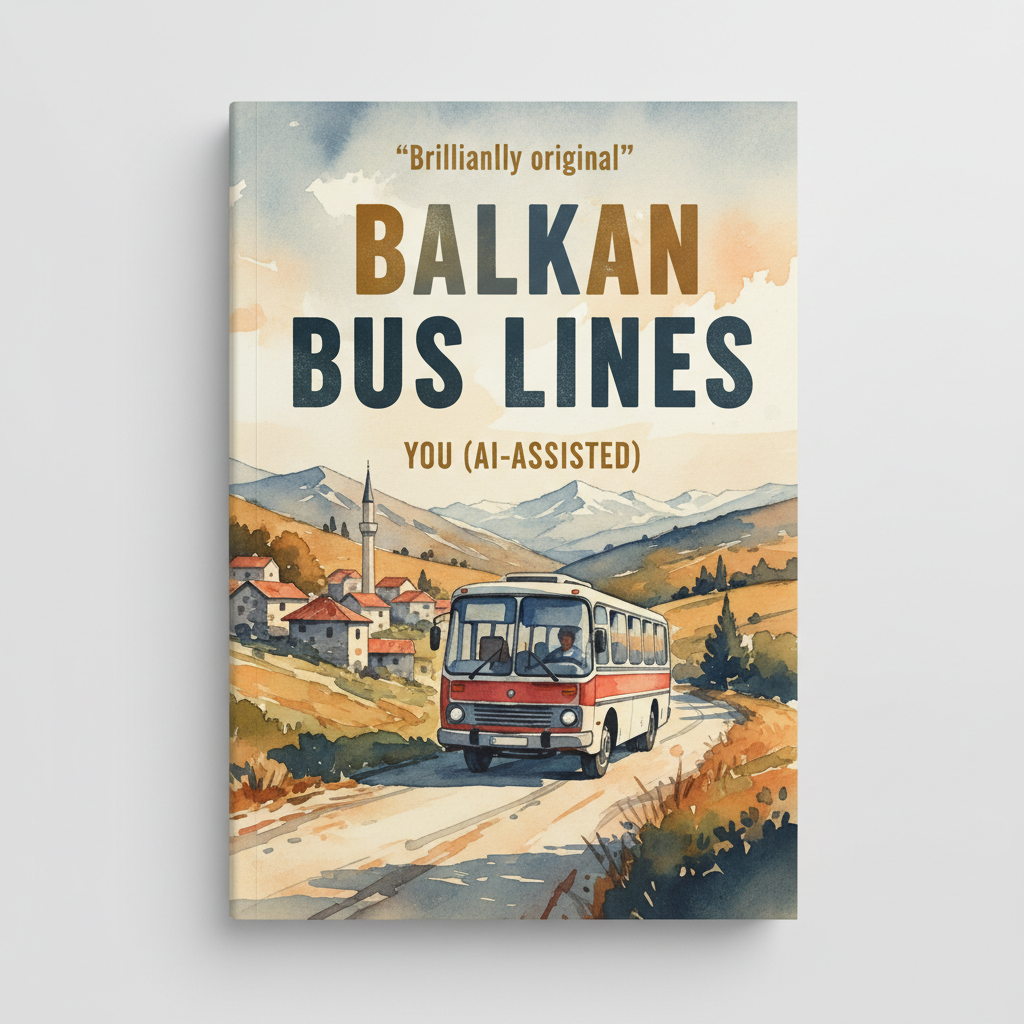
Synopsis
An American traveler navigates the complex history and vibrant cultures of the Balkans solely by local bus, discovering a region rich with untold stories that challenge conventional perceptions of Europe.
Chapter 1: Departure from Zagreb: The First Rumble
The hum of the bus’s engine was a low growl beneath Alex’s worn rucksack, a melody that promised movement, escape, and the delicious uncertainty of the unknown. Outside the dusty window, Zagreb’s morning sprawl dissolved into a mosaic of faded Socialist-era apartment blocks and the occasional glint of sunlight off a distant, more ornate spire – a last, lingering glimpse of Central Europe before the true Balkan wild began. He’d arrived yesterday, tumbled off a plane, and, true to his self-imposed dictum, immediately navigated the local public transport from the airport, refusing the lure of taxis or ride-shares. It was, he reasoned, a baptism by fire, a commitment to the spirit of the journey. Local buses only. No exceptions.
His seat, a rather unyielding blue fabric, was too close to the aisle for comfort but afforded an unobstructed view of the emerging drama of the bus station. It wasn’t the pristine, glass-and-steel edifice he was accustomed to in Western Europe. This was a place of functional grit, a symphony of shuffling feet, shouted goodbyes, and the persistent smell of diesel. Vendors hawked lukewarm coffee from chipped thermoses and plastic bags overflowing with *bureg* – savory pastries that smelled of cheese and hot oil. Alex bought one, the warmth seeping into his fingers through the thin paper napkin. The crust crackled at first bite, revealing a creamy, slightly salty filling. This was the taste of the journey.
A woman with a formidable amount of luggage, secured with twine and what looked suspiciously like an old bedsheet, barked orders in swift Croatian at a hapless young man attempting to heave a particularly bulbous suitcase into the undercarriage. Her voice, though sharp, carried a certain good-natured resignation. He watched, amused, as she finally took matters into her own hands, demonstrating a surprising strength that sent the suitcase rattling into place. Her triumph was met with a chorus of approving clucks from a cluster of older women already settled in the bus, their heads wrapped in colorful scarves.
Alex checked his digital ticket for the tenth time. “Zagreb to Sarajevo,” it read. A direct route, or as direct as anything could be when dealing with border crossings and mountain roads. The journey was estimated at eight hours, optimistically. He’d intentionally left his itinerary fluid, a bare-bones skeleton of cities he wanted to touch, allowing the bus schedules and chance encounters to fill in the gaps. It was a philosophy he was still gently nurturing, a conscious push against the hyper-planned, Instagram-perfect travel blogs he so often scrolled through. He wanted messy, imperfect, real.
The bus, a stately beast of faded red and white, vibrated with a newfound energy as the engine settled into a deeper thrum. The doors hissed shut, a pneumatic sigh that sealed off the station’s immediate chaos. A collective shifting, a rustle of coats and bags, ran through the cabin. Heads turned towards the front, towards the driver, a man whose face, Alex noted, seemed carved from hard-won experience. He wore a crisp, white shirt despite the early warmth, and his movements were precise, economical.
A jolt, a lurch, and then they were moving. Slowly at first, navigating the tight confines of the bus station, dodging a smaller local bus that seemed intent on cutting them off. The sounds of Zagreb pressed in, a cacophony of car horns, distant sirens, and the insistent clang of a tram. Then, as they cleared the station and merged onto a broader avenue, the sounds began to recede, replaced by the internal symphony of the bus itself: the constant drone of the engine, the low murmur of conversations, the rhythmic squeak of a loose panel somewhere near the rear.
Alex leaned his head against the window, the glass cool against his cheek. The city unfolded. Grand Austro-Hungarian architecture, stately and somewhat imposing, gave way to more modern, if less aesthetically pleasing, blocks. Graffiti, splashes of vibrant color and rebellious messages, adorned walls he might have otherwise found mundane. He spotted a mural of a stylized bear, its eyes glowing yellow, a poignant contrast to the dull concrete canvas. Art, he thought, finds a way.
The road gradually widened, and the buildings began to thin. Outskirts. Supermarkets with sprawling parking lots, car repair shops with tires stacked like ancient monuments, then small, unassuming houses with gardens bursting with roses and grapevines. The air seemed to lighten, lose its city grit.
He pulled out his small notebook, its pages filled with hasty scrawls, half-formed thoughts, bus schedules he’d scribbled down from various online forums. He wasn't journaling in the traditional sense, more gathering observations, details. A mental snapshot. The Croatian countryside unspooled. Broad, fertile plains, dotted with neat rows of cornstalks already standing tall, swaying gently in the morning breeze. He saw small, meticulously tilled plots of land, scarecrows in various states of disrepair, their patched clothing flapping like distressed flags.
His fellow passengers were a quiet, unobtrusive lot, at least for now. Across the aisle, a young woman was engrossed in her phone, her thumb a blur across the screen. Behind him, a couple engaged in a hushed conversation, their Croatian a melodic, soft stream of sound he couldn’t decipher. A few rows ahead, a man in a tweed jacket stared fixedly out the window, a small, beat-up briefcase resting on his lap. Each seemed to carry their own world, portable and self-contained, yet all bound together by the rumble of the bus.
The landscape began to change, a subtle shift at first. The plains started to ripple, then swell into gentle hills. Forests, dark and coniferous, began to appear on the horizon, hinting at the mountains that lay ahead. The sky, a brilliant, unblemished blue, promised good weather for the entire journey. Alex felt a tingling sensation, a quiet excitement that hummed just beneath his skin. This wasn’t a vacation, not in the traditional sense of resort hotels and curated experiences. This was an immersion.
A sudden, sharp braking sent a ripple of murmurs through the bus. Alex instinctively braced himself, his hand flying to the back of the seat in front of him. The bus shuddered to a halt, nose-to-tail with a line of other vehicles. A groan rose from the passengers. Construction. Of course. It was an unavoidable truth of travel in this part of the world. Roads, bridges, tunnels – always being worked on, always creating bottlenecks.
He peered out. A single lane of traffic was being funneled past a stretch of torn-up asphalt. Men in orange vests moved with a languid efficiency, their faces grimed with dust. The air filled with the distant thud of heavy machinery. The bus driver let out a soft sigh, barely audible, and leaned back, his hands resting lightly on the wheel. He seemed to accept this delay with a stoicism born of long experience.
Minutes stretched into what felt like an hour. Conversation picked up, hushed and polite at first, then growing in volume as the boredom set in. The woman with the formidable luggage, who had settled in two rows ahead of Alex, now pulled out a small, intricately embroidered cloth and began meticulously peeling an orange, the sweet, citrusy scent wafting through the bus. She offered a segment to her neighbor, who accepted it with a nod of thanks. It was a small, domestic gesture that felt utterly out of place, yet perfectly natural, within the confines of the halted bus.
Alex watched the world outside, the forced pause allowing him to focus on details he might otherwise have missed. A small, roadside shrine, almost hidden by overgrown bushes, adorned with plastic flowers and a faded photograph. A dog, lean and watchful, trotting purposefully along the shoulder of the road. The way the sunlight caught the individual leaves of a silver birch tree, making them shimmer like a thousand tiny mirrors.
Finally, with another lurch and a burst of diesel fumes, the bus eased forward. The collective sigh of relief was palpable. As they passed the construction site, Alex saw a weathered sign, its paint peeling. It was in Cyrillic, a language he couldn’t read, a tantalizing hint of the borders they would soon cross, the cultural shifts they would soon encounter.
The road began to climb, winding its way through ever-thicker forests. Pines gave way to deciduous trees, their leaves a riot of greens, punctuated by the occasional flash of scarlet or gold from an early-changing sapling. The air grew cooler, crisper. The views that opened up were breathtaking: sweeping vistas of valleys below, a patchwork of fields and tiny villages, all dwarfed by the sheer scale of the mountains.
He ate his *bureg*, now cold but no less satisfying, and washed it down with a lukewarm bottle of water from his bag. The simple act of sustenance felt profound, part of the ritual of travel. He was shedding the layers of his previous life, inch by inch, embracing this new, mobile existence.
The bus began to rock with the rhythm of the winding road, a gentle sway that was almost hypnotic. He closed his eyes for a moment, letting the sounds and sensations wash over him. The distant hum of tires on asphalt, the muffled voices, the persistent, comforting thrum of the engine. He wasn’t sure where they were, precisely, or how much longer it would take. But that was the point, wasn't it? To let go of the need for absolute certainty, to simply be present.
The first rumble wasn’t seismic, not a shaking of the ground. It was an internal tremor, a slow-building awareness that this journey was going to be more than just a passage from one city to another. It was a journey into a different kind of time, a different way of being. This was the Balkans, announcing itself, not with a shout, but with the subtle turning of a wheel, the low growl of a bus, and the quiet, insistent unfolding of a tapestry of landscapes and lives. And Alex, leaning his head against the window, felt a thrilling sense of beginning. The border, he knew, was still some hours away, a line on a map that would soon become a physical reality. He wondered what stories waited on the other side.
Chapter 2: Bosnian Horizons: Echoes in the Landscape
The Croatian customs officer, young and stiff in his uniform, barely glanced at Alex’s passport. A quick stamp, a perfunctory nod, and the bus was lurching forward, leaving the neat, ordered fields of Croatia behind. The asphalt, once smooth and well-maintained, began to fray at the edges, patchwork repairs appearing with increasing frequency. It was a subtle shift at first, like the gradual toning down of a vibrant painting, but within minutes, the change was undeniable.
The trees grew denser, their branches interlocking overhead, casting dappled shadows that danced across the bus windows. The open plains gave way to rolling hills, then to mountains that rose abruptly from the valley floor, their peaks shrouded in a perpetual soft haze. The air, though still warm, carried a different scent—earthier, with the faint, metallic tang of distant rainfall. Green was the dominant colour here, an almost overwhelming verdancy that swallowed everything else, broken only by the occasional cluster of terracotta roofs clinging precariously to a hillside.
The bus, an ancient beast of a vehicle with springs that groaned in protest at every turn, began its ascent. The road narrowed, twisting and turning like a forgotten ribbon, hugging the contours of the mountains. On one side, a sheer rock face scraped against the sky; on the other, a vertiginous drop into a valley so deep its floor was lost in shadow. Alex pressed his face against the grimy window, watching the landscape unfold. It wasn’t picturesque in the manicured, postcard sense. It was wild, untamed, deeply scarred, yet undeniably beautiful in its raw untamed power.
He wasn’t the only one gazing out. Across the aisle, an elderly woman sat upright, her hands clasped in her lap. Her face was a canvas of fine wrinkles, etched deep around eyes that held a surprising luminosity. A dark headscarf covered her silver hair, and a worn, dark coat was buttoned to her throat despite the warmth inside the bus. She had boarded at the last Croatian stop, a silent, almost invisible presence, carrying only a small, canvas bag that seemed to weigh nothing at all. Her gaze was fixed on the passing scenery, not with curiosity, but with an air of profound familiarity, as if she were reading a long-forgotten story in the folds of the land.
After a particularly sharp bend, the bus grunted up a steep incline, its engine straining. A sudden jolt sent loose items rattling, and the old woman’s hand went instinctively to the small bag by her feet. Her eyes met Alex’s for a fleeting moment, a spark of shared experience passing between them. He offered a small, tentative smile. She returned it, a slow, gentle unfolding that softened the lines around her mouth.
“First time in Bosnia?” she asked, her voice a soft murmur, surprisingly clear despite the engine's roar. Her English was accented, but fluent, every syllable precisely placed.
Alex nodded. “Yes. From America.”
“Ah, America.” She paused, her gaze drifting back to the window. “A long way. What brings you to this old place?”
“Travel. To see something different. Learn a little about the region.” He gestured vaguely at the rugged mountains. “It’s… striking.”
She chuckled, a dry, rustling sound. “Striking, yes. But it has seen much. Too much, perhaps, for its own good.” A sigh escaped her, barely audible above the bus’s rumble. “These mountains, they hide many secrets. And many reminders.”
As if on cue, the bus rounded another bend, and in the distance, a cluster of buildings came into view. Most were intact, their roofs a familiar red, but among them stood gaunt, skeletal structures, their walls riddled with gaping holes, their windows like vacant eyes staring out at nothing. Some were roofless, their interiors exposed to the elements, silent monuments to a past that wasn't past at all.
Alex felt a chill despite the warmth. “Those… those are from the war?” he asked, his voice hushed.
The old woman’s expression hardened almost imperceptibly. “From the war, yes. And from the peace that came after, which sometimes felt like another kind of war. They are everywhere, you will see. Like scars on the land, on the people.” She traced a pattern on her worn coat with a gnarled finger. “My village, not far from here, was like that. Not one house left standing.”
He didn't know what to say. His pre-trip research had covered the broad strokes of the Bosnian War, the ethnic cleansing, the siege of Sarajevo, but seeing the physical remnants, raw and unvarnished, was a different kind of lesson.
“Did you… did you live through it?” he ventured, then immediately regretted the question. It felt invasive, clumsy.
She turned to him fully now, her luminous eyes fixing on his. “Live through it? We all lived through it, those of us who did not die. It was not a choice. It was life. Survival.” She paused, a far-off look entering her gaze, as if she were sifting through memories, choosing which ones to share.
“I was a young woman then,” she began, her voice taking on a narrative rhythm. “Not as young as you perhaps, but young enough to believe the world was a certain way. My husband, Marko, he was a farmer. Strong hands, a good laugh. We had two children, a boy and a girl. We lived in a small house, just beyond that distant peak, where the river widens. A peaceful life, you understand. Simple.”
Her gaze drifted back to the window, watching the blur of green. “Then, suddenly, it was not peaceful. The news came first, whispers on the radio, then shouts in the marketplace. Friends became strangers overnight. Neighbours, those you had known your whole life, looked at you with suspicion, with fear, sometimes with hatred.”
The bus hit a particularly large pothole, jolting them both. The old woman barely registered it. Her story was unfolding, a delicate paper flower opening in the damp air.
“We heard the sounds of fighting, first far away, then closer. The men of the village, they tried to protect us. But what can you do, against so much?” She shrugged, a small, weary gesture. “One night, the shelling started. Not just one or two, but many, like thunder tearing the sky apart. We hid in the cellar, my children clinging to me, Marko trying to be brave, though I could see the fear in his eyes.”
Alex found himself leaning forward, completely absorbed. The bus rattled on, oblivious to the quiet drama unfolding within its walls. The vibrant green landscape outside now seemed to hold a darker hue, a silent witness to countless such stories.
“When the shelling stopped, the silence was worse,” she continued, her voice dropping to a near whisper. “We waited. And then, the shouting. Boots on the mud. They came with guns. They took the men. All of them. Including Marko.” Her hand went to her throat, a faint tremor running through her fingers. “I never saw him again.”
A heavy silence descended, broken only by the rhythmic hum of the bus engine. Alex felt a knot tighten in his stomach. He wanted to offer comfort, but words felt inadequate, hollow.
“The women and children, they made us leave,” she said, finally breaking the silence, her voice now a little stronger, steadier. “Walk. Just walk. We carried what we could. My daughter, she was only five, my son, eight. They cried, of course. For their father. For their toys. For their home, which was now just smoke and ash.”
She pointed a gnarled finger towards a distant, mist-shrouded peak. “We walked for days, through those mountains. Sometimes at night. Sometimes hiding in the ditches when the patrols came. We ate roots, leaves. Drank from streams. But we kept moving. Because what else was there to do?”
What else indeed? Alex imagined the sheer terror, the relentless exhaustion, the agony of loss, compounded by the constant threat of violence. He looked out at the peaceful, green hills, trying to superimpose images of desperate refugees fleeing through this very landscape. It was almost impossible.
“We found safety, eventually,” she said quietly. “In another country. Germany. They gave us shelter. Food. But it was not home. My children grew up there. They speak German better than they speak Bosnian now. They are good people. But they do not remember the smell of the plum jam my mother used to make. Or the way the river sounded at dawn.”
She paused again, her gaze distant, fixed on something only she could see. “I came back, when the fighting stopped. There was nothing left, of course. Just rubble. But it was my rubble. And the river still flowed. So I stayed. I built a new life, a small house with my own hands, with the help of neighbours who had also returned.”
Her eyes finally returned to Alex, a gentle, sad smile playing on her lips. “So, you see. These mountains. They hold stories. They bear witness. They are beautiful, yes. But they are also full of ghosts.”
The bus lumbered on, the sun now beginning its slow descent, painting the western sky in streaks of orange and purple. The air through his open window carried a cooler bite, a promise of evening. Alex looked at the old woman, her face illuminated by the setting sun, transformed into a mosaic of light and shadow. Her story, delivered with such quiet dignity, had pierced through his tourist’s detachment, revealing the profound human cost beneath the stunning scenery.
“Thank you,” he said, his voice a little hoarse. “For telling me.”
She nodded, a slight inclination of her head. “It is good to tell. Good to be heard. So that people remember. So that it does not happen again.”
The bus began its descent now, the engine whine changing from a straining growl to a steady hum. The road, though still winding, seemed to straighten slightly, and the outlines of a town began to emerge in the valley below. Red roofs, a slender mosque minaret, the glint of a river. Alex knew this was his stop.
He gathered his backpack, a sudden urgency in his movements. The conversation had left him feeling both heavy and strangely enlightened. The Balkan experience, he realized, was not just about picturesque villages and ancient ruins. It was about raw, living history, etched into the landscape and carried in the hearts of its people.
“My stop is coming up,” he said, gesturing towards the approaching town.
The old woman gave him another gentle smile. “Go well, young man. And listen. The stones here, they speak. If you know how to listen.”
As the bus slowed, rumbling into a small, dusty bus station, Alex turned for one last look at her. She was already gazing out the window again, her silhouette framed against the fading evening light, a sentinel watching the Bosnian horizons, full of echoes. He stepped off the bus, the cool evening air washing over him, carrying with it the scent of woodsmoke and damp earth. The ground beneath his feet felt heavier here, imbued with a history he was only just beginning to understand.
Chapter 3: Sarajevo's Embrace: A City of Scars and Smiles
The bus coughed its last breath at the Sarajevo bus station, a concrete behemoth that felt like a relic from another era. Stepping onto the dry pavement, the air immediately felt different – heavier, perhaps, or simply laden with an unfamiliar scent. It wasn't unpleasant, just… distinct. A mix of grilled meats, exhaust fumes, and something else, something metallic and faintly sweet, like old rain on stone.
Alex adjusted the strap of his backpack, the weight suddenly more noticeable after hours of sitting. The station itself was a hive of activity, a constant ebb and flow of passengers, hawkers calling out their wares, and the rumbling growl of engines. He bought a small, sticky pastry from a woman whose hands moved with practiced efficiency behind a glass case. She smiled, her eyes crinkling at the corners, and offered a soft "dobar dan." Her warmth was a welcome contrast to the utilitarian surroundings.
Emerging from the station, the city proper unfolded. It wasn't the pristine, polished European capital Alex had imagined, but something far more compelling. Buildings wore their history openly, like badges of honor, or perhaps, scars. Pockmarks from bullets stitched across facades, some patched imperfectly with newer bricks, others left raw, a stark reminder. Yet, beneath the visible wounds, life pulsed with an undeniable vigor. Cafes spilled onto sidewalks, their metal chairs facing outward, inviting passersby to witness the city's unfolding drama. The aroma of strong coffee mingled with tobacco and the sharp spice of grilled cevapi.
He found his guesthouse after a pleasant, meandering walk through streets that twisted and turned with a charming unpredictability. It was tucked away on a cobbled lane, a bright yellow building with window boxes overflowing with geraniums. The owner, a barrel-chested man with a booming laugh named Damir, greeted him like a long-lost cousin, pressing a lukewarm apricot rakija into his hand before he’d even set down his bags.
"Welcome to Sarajevo!" Damir declared, his voice echoing in the small, tile-floored entryway. "You will see, this city, it has a soul. A very old soul, a very strong soul." He clapped Alex on the shoulder, the gesture firm and friendly. "You are hungry, yes? We will eat later. For now, drink. And tell me, why Sarajevo?"
Alex fumbled for words, the rakija already warm in his stomach. "I just… wanted to see it. Hear its stories."
Damir nodded slowly, his smile fading slightly, then returning with a renewed intensity. "Stories, we have many. Too many, some would say. But you will see, we still live. We still laugh. We still make the best coffee in the Balkans."
The next morning, armed with a strong Bosnian coffee and Damir’s hastily scrawled map, Alex ventured out. He spent hours in the Baščaršija, the old Turkish Bazaar, a labyrinth of narrow streets where coppersmiths hammered out intricate designs, jewelers polished silver, and aromatic spices mingled in the air. The call to prayer drifted from minarets, a hauntingly beautiful sound that settled over the market, momentarily quieting the chatter of commerce. Here, the bullet holes faded into the background, replaced by the vibrant tapestry of centuries-old tradition.
Later, he found himself boarding a local bus, the number 31e, a clattering contraption that seemed to have seen better days. He wanted to see beyond the picturesque heart of the city, to understand its breadth. The bus was nearly full, a microcosm of Sarajevo life. An elderly woman with a floral headscarf clutched a string bag overflowing with groceries. A group of teenagers, their laughter bright and careless, scrolled through their phones. A man in a crisp suit read a newspaper, his brow furrowed.
As the bus pulled away from the bustling center, the architecture began to shift. The Ottoman-era buildings gave way to Austro-Hungarian grandeur, then abruptly to the stark, functional blocks of the socialist era. The journey was a visual history lesson, each neighborhood a new chapter. The bullet holes, less frequent in some areas, were still there, like errant stitches in a patchwork quilt. Some buildings were mere skeletal remains, hollowed out shells that pierced the skyline, silent testaments to a conflict that felt both distant and terribly close.
He found himself seated next to a young woman, perhaps in her late twenties, with striking green eyes. She wore a simple scarf, patterned with small blue flowers, loosely around her neck. She caught him staring at a particularly damaged building and offered a small, sad smile.
"It's everywhere, isn't it?" she said, her English precise, with a soft, musical cadence.
Alex nodded, feeling a little self-conscious. "Yes. It's… impossible to ignore."
"Good," she replied, her gaze fixed on the passing street. "We don't want it to be ignored. But we also don't want it to define us." She turned to him, her expression a mix of defiance and gentle pride. "My name is Amina. You are American?"
Alex introduced himself. "Yes. Alex. And you live here?"
"My whole life," Amina said. "Born during the war. My parents told me stories of living in the basement. Of waiting for the water truck. Of the silence when the shelling stopped, and then the fear when it started again." She paused, her eyes clouding slightly. "My father was a baker. He would sneak out in the night sometimes, with flour, trying to make bread for our neighbors."
The bus rattled over a set of tracks, the conversation momentarily drowned out by the noise. When it subsided, Amina continued. "This part of the city," she gestured out the window, "it's changing now. More international businesses. People from all over. But still, you see the scars." She pointed to a playground where children shrieked with joy, their bright clothes a splash of color against the faded concrete. "And you see the life. We repair, we rebuild. We don't forget, but we move forward."
Their conversation flowed easily, Amina a knowledgeable and poignant guide. She pointed out places of significance – a library that had been deliberately targeted and burned, now rebuilt with painstaking care; a bridge where a sniper’s nest had once terrorized the inhabitants; a small, vibrant park that had once been a cemetery. She spoke with a disarming honesty, her voice devoid of bitterness, but rich with the emotional weight of her city’s history.
Alex felt a deep connection to her words, a raw understanding that surpassed any textbook or documentary. The divisions she spoke of weren't just architectural, but social. The bus, he realized, was moving through invisible lines, not just physical neighborhoods, but psychological territories. He noticed the changing styles of mosques and churches, the subtle shifts in the advertisements on billboards, the different types of shops.
"It can be hard," Amina admitted, her voice lower now. "To live so close to… the memory. Sometimes it feels like we are on two different paths, even in the same city. But then," her green eyes twinkled, "you sit down for coffee with a neighbor, and you talk, and you remember that we are all just people trying to make a life."
As the bus approached his stop, Alex felt a pang of regret. He wanted to hear more, to absorb every detail of Amina's perspective. He thanked her, and she gave him a small, warm smile.
"I hope you enjoy your time here, Alex," she said. "See everything. And listen. Sarajevo has many things to say."
Stepping off the bus, the evening air was cool and crisp. The mountains surrounding Sarajevo, still capped with patches of snow, cast long shadows over the city. He walked slowly back to the guesthouse, the images and stories of the day swirling in his mind. The bullet-scarred buildings, the rich aroma of Turkish coffee, the vibrant chaos of the bazaar, and Amina’s gentle, resolute voice.
Sarajevo was not a city of easy answers. It was a complex weave of beauty and tragedy, division and resilience. It was a place that had endured unimaginable pain, yet still offered a smile, a cup of rakija, a story. And as the streetlights began to flicker on, casting a golden glow on the old stone, Alex realized that he was just beginning to understand the depth of its embrace. The city, with all its visible scars and vibrant life, was slowly, quietly, revealing its soul. And he knew, with a certainty that settled deep in his bones, that he would carry a piece of it with him long after his bus departed.
Chapter 4: Montenegrin Coastline: A Glimpse of Paradise
The engine grumbled, a familiar lullaby now, as the bus pulled away from the Sarajevo station. Sunlight, already a stranger in the winding streets of the city, poured through the grimy windows, painting the dust motes in the air with a transient, golden glow. Alex leaned back, the worn fabric of the seat molding to his frame, a ghost of the thousands of journeys it had witnessed. He watched Sarajevo shrink in the rearview mirror, its hills slowly receding into a blue-grey haze, the minarets and church spires blurring into an indistinguishable skyline. He felt a familiar pang of something akin to melancholy, a sensation that had become intertwined with each departure. Each city, a fleeting friend.
The road out of Bosnia was less dramatic than the one in, the landscape softening from rugged mountains to rolling hills dotted with sheep and small, whitewashed houses. The bus was fuller than usual, the luggage racks overflowing with bundles wrapped in faded cloth, cardboard boxes tied with string, and an assortment of plastic bags bulging with unknown treasures. The air, thick with the scent of human proximity and a faint, sweet aroma of something baked, hummed with a low murmur of conversation in a language Alex was beginning to recognize, even if he couldn’t understand.
Beside him, a woman with a kind face and silver hair meticulously peeled an orange, her movements precise and unhurried. Across the aisle, a young couple whispered secrets, their heads close, a shared smile flickering between them. Children, a scattering of them throughout the bus, squirmed in their seats, their impatient energy a counterpoint to the adult resignation. This was a different kind of crowded, not the stifling press of a city bus, but a shared journey, a temporary community bound by the rumble of the engine and the ribbon of asphalt ahead.
Around noon, a collective sigh rippled through the bus as the terrain began to change. The hills grew steeper, rockier, their flanks shedding the last vestiges of green for a stark, pale grey. Then, suddenly, a brilliant flash of azure sliced through the landscape. The sea.
It appeared without warning, a vast, shimmering expanse that stretched to the horizon, a deeper, more saturated blue than any Alex had ever witnessed. Gasps punctuated the low hum of conversation, and heads swiveled, pressing against the glass. The bus, as if in deference to the sudden majesty, slowed its pace, winding along a road carved directly into the cliff face. Below, the Adriatic sparkled, a million tiny diamonds dancing on its surface.
The air shifted, a subtle but distinct tang of salt replacing the earthy smell of the interior. Windows, previously kept shut, were now wrestled open, letting in a rush of cool, fresh air that whipped through the cabin, rustling hair and clothes. Alex inhaled deeply, the briny scent a welcome tonic after days of exhaust fumes and city air.
He found himself leaning closer to the window, captivated. The coastline unfurled like a painted scroll, each turn revealing a new vista more stunning than the last. Steep cliffs, their faces weathered by centuries of wind and sea, plunged directly into the cobalt depths. Tiny coves, barely visible from the road, beckoned with secluded stretches of white pebbles. Every now and then, a cluster of terracotta roofs would appear, clinging precariously to the hillsides, their windows gazing out at the endless expanse.
The woman beside him, seeing his mesmerized gaze, offered him a segment of her orange. “Crna Gora,” she said, her voice soft, a hint of pride in her tone. “Beautiful, yes?”
Alex nodded, accepting the sweet, juicy fruit. “Yes. Very beautiful.” He managed, and a genuine smile, the first truly unrestrained one in days, spread across his face. The orange tasted like sunshine and sea spray.
He soon found himself in an unexpected conversation. The woman, whose name was Lena, spoke halting English, enough to bridge the gap between them. She was traveling to visit her sister in Bar, a coastal town further south. Her husband, she explained with a sigh and a gentle shrug, was a fisherman. “Hard life,” she said, her eyes gazing out at the vast sea. “Always the sea.”
Lena’s stories, pieced together through broken English and expressive gestures, painted a picture of a life intertwined with the rhythm of the waves. She spoke of her children, grown now, scattered across Europe for work, and of her grandchildren, whom she saw only a few times a year. Her voice, though tinged with a quiet longing, held a remarkable resilience. She offered Alex stories of local customs, of special fish dishes, and of the harsh beauty of winter storms.
Soon, the man across the aisle, the younger half of the whispering couple, leaned over. “You are American?” he asked, his English surprisingly good, though heavily accented. His name was Marko, and his girlfriend, Ana, smiled shyly from beside him. They were students, heading to Kotor for a long weekend before exams.
The bus became a mobile common room. Snacks were exchanged – Lena’s oranges, Marko and Ana’s homemade cheese pastries, and Alex’s store-bought biscuits, which were received with polite but clear disinterest. Laughter, easy and unforced, filled the air. Marko, emboldened by a shared laugh over a particularly bumpy stretch of road, began to tell Alex about the Bay of Kotor, his words a cascade of adjectives.
“It is not really a bay,” Marko explained, his hands gesturing expansively, encompassing the world outside the window. “It is a *fjörd*. Like in Norway, but… warmer. More Mediterranean.” He spoke of ancient towns clinging to the water’s edge, of fortified walls and Venetian palaces, of islands with churches that seemed to float on the water. “You will see Perast. It is… magical. And Our Lady of the Rocks.” His eyes gleamed with anticipation.
The road descended, the bus clinging to the mountainside like a beetle. The incline grew steeper, the curves sharper, and the views became even more spectacular. The sea, once a distant shimmer, now pulsed closer, its surface ruffled by a gentle breeze. Small islands, emerald jewels in the blue, began to appear, each with a smattering of trees and miniature churches.
And then, the bay.
It wasn't a bay in the conventional sense, but a series of interconnected waterways, deep fingers of water reaching inland, surrounded by impossibly steep mountains that rose directly from the sea, their peaks dusted with the last vestiges of winter snow. The bus snaked its way along the perimeter of the Bay of Kotor, the water a mirror reflecting the dramatic sky and the towering cliffs. It was a landscape of theatrical scale, a stage set by nature for grand narratives.
Ancient stone buildings, their red-tiled roofs contrasting sharply with the grey stone, lined the shore. Fishing boats, small and colorful, bobbed gently in tiny harbors. The air was thick with the scent of salt and pines. Time seemed to slow, the world outside the bus windows unfolding in a panoramic dream.
“Kotor is coming soon,” Lena announced, pointing to a cluster of buildings nestled at the foot of one particularly imposing mountain. “The old city, inside the walls. Very old.”
Alex pressed his forehead against the cool glass, his mind struggling to reconcile the beauty before him with the stories he’d heard of this region’s tumultuous past. How could such a place, so tranquil and majestic, have witnessed so much conflict? It was a question that had recurred throughout his journey, a persistent whisper beneath the surface of each new discovery.
As the bus veered left, rounding a final bend, the full grandeur of Kotor unfurled. A medieval walled city, perfectly preserved, sat nestled beneath the formidable bulk of Mount Lovćen. The ancient stone ramparts, centuries old, snaked up the steep mountainside, a dizzying ascent of switchbacks that disappeared into the distant clouds. Beyond the walls, a maze of narrow streets and venerable buildings, their facades softened by time, promised untold stories.
Lena gestured towards the bus door. “My stop is next. Bar. Farther south.” She gave him a warm, motherly smile. “Be safe, young man. Enjoy Crna Gora.”
Marko and Ana exchanged phone numbers with Alex, promising to meet up in Kotor for a drink. “The best rakija is here,” Marko declared, his eyes twinkling. “You must try.”
As the bus slowed to pull into the Kotor station, a feeling of exhilaration mixed with a familiar anticipation washed over Alex. The camaraderie of the journey, the stories shared, the unexpected kindness of strangers – these moments were becoming as much a part of his travelogue as the landscapes themselves. The bus, a mere conveyance, had transformed into a vessel of shared humanity, carrying him not just across borders, but into the heart of a vibrant, resilient culture.
He stepped off the bus, the air thick with the scent of oleander and old stone. The sun, lower now, cast long shadows across the ancient walls of Kotor, bathing them in a soft, golden light. Above, the fortress climbed, sentinel-like, into the deepening twilight. He looked up, a thrill running down his spine. The path beckoned, ancient and steep, promising a vista that would surely etch itself into his memory forever. His new temporary home awaited, a labyrinth of history and beauty, ready to reveal its secrets.
Chapter 5: Albanian Crossroads: Navigating the Unknown
The border crossing into Albania was less a formal checkpoint and more a suggestion of demarcation. A faded, hand-painted sign, barely legible beneath a tangle of wild vines, announced ‘Mirë se vini në Shqipëri – Welcome to Albania.’ The gravel road, already uneven for miles, intensified its assault on the bus’s suspension. Each jolt sent a fresh tremor through Alex’s spine, a rhythmic percussion accompanying the rumbling engine. Even before the bus sputtered to a final halt, a chaos of sound and motion erupted outside.
It wasn't a sudden explosion, but a gradual crescendo. The air, thick with the scent of damp earth and something vaguely metallic, began to thrum with a thousand interwoven noises. Honking horns, sharp and insistent, cut through the general din of human voices. Hawkers, their faces leathery and etched with purpose, swarmed the bus, thrusting plastic-wrapped goods through open windows. Their cries mingled with the bleating of a tethered goat somewhere nearby and the insistent chatter of chickens.
Alex peered out, a knot tightening in their stomach. The tidy order of Montenegro, even its bustling coast, felt a world away. Here, the road was not just a thoroughfare but a marketplace, a social hub, a livestock thoroughfare. Weather-beaten stalls, patched with mismatched tarpaulins, spilled their wares onto the dirt: pyramids of bright green peppers, glistening piles of silver fish, bolts of rough-spun fabric in riotous colors. Children, their faces grimy but their eyes startlingly bright, wove through the throng, dodging donkeys laden with enormous bundles of firewood and ancient Mercedes sedans that seemed held together by sheer willpower.
The bus door finally hissed open, releasing a fresh surge of passengers and a cloud of dust. Alex watched, mesmerized, as an old woman with a formidable mustache and a headscarf the color of dried blood wrestled a live turkey onto the bus, its indignant gobble adding another layer to the cacophony. No one batted an eye. This was simply the way of things.
Stepping off the bus felt like diving into a cold, rushing river. The current of humanity pulled Alex along, a thousand individual stories swirling around them. They clutched their背包 tighter, their senses overwhelmed. The sun, a pale, indifferent orb in the hazy sky, seemed to struggle to penetrate the dust-laden air. The air itself tasted raw, elemental, unlike anything Alex had encountered before.
Eventually, they found the next bus. If the previous one had been charitably described as 'local,' this was 'hyper-local.' It wasn’t a sleek coach, the type that traversed national borders, but a battered minivan, its paintwork scarred with a thousand skirmishes. The destination, scrawled on a piece of cardboard and taped to the windshield, was Fier, a name Alex had circled vaguely on their map.
The driver, a burly man with a permanent five o’clock shadow and a gold tooth that flashed when he smiled, greeted Alex with a wide, incomprehensible grin and a gesture towards the rear. The minivan was already nearly full, passengers packed in like sardines, luggage piled precariously on laps and over heads. Alex squeezed into a tiny space next to a woman nursing a baby, the warmth of their bodies pressing against them immediately. There was no personal bubble here, no polite distance. Only shared space, shared breath.
The journey began with a lurch and a roar, the engine protesting loudly as the driver expertly navigated the vehicle through the market maze. The driving style, Alex quickly realized, followed a philosophy entirely foreign to their Western sensibilities. It was less about adhering to lines and signs, and more about a fluid, almost organic dance with other vehicles, pedestrians, and livestock. A horn was not an expression of anger, but simply a notification: *I am here. I am coming. Make way.*
The road out of the border town quickly devolved into a rough track, winding through a landscape that shifted from scrubby hills to vast, parched plains. Dilapidated concrete bunkers, remnants of a bygone era's paranoia, dotted the fields like strange, forgotten mushrooms. Their grey, ominous forms stood in stark contrast to the vivid green of new growth that pushed through the cracks, a testament to nature's relentless reclamation.
Hours bled into one another. The rhythm of the bus became a hypnotic drone. The scenery, while stark, pulled at Alex with its raw beauty. Small villages, clinging to hillsides, appeared and vanished, their houses a patchwork of stone and unpainted brick, Laundry, bright splashes of color, fluttered from lines strung between homes. Farmers, their faces weathered and hands calloused, toiled in fields, guiding ancient plows pulled by oxen, or herding flocks of sheep down dusty trails. It was a landscape that felt untouched by time, stubbornly refusing to conform to any modern ideal.
Conversation within the bus was a low murmur of Albanian, punctuated by the occasional cry of the baby or a burst of laughter. Though Alex understood none of the words, the tone was warm, familial. They exchanged glances and smiles with their neighbors. The woman next to them, after much struggling with a plastic bag, offered Alex a tangerine, its citrusy scent a welcome reprieve from the dust. Alex, touched by the gesture, accepted with a grateful nod, peeling the fruit slowly, savoring its sweetness.
The further they ventured into the interior, the more the road seemed to disappear, replaced by a series of interconnected dirt paths. At one point, the minivan had to pull over to allow a herd of cows, tended by a young boy no older than ten, to cross. The boy, with a stick twice his height, skillfully guided his charges, his serious gaze meeting Alex’s through the dusty window. It was a scene straight out of a pastoral painting, yet it was simply daily life.
The sun began its slow descent, painting the sky in hues of orange and purple. Shadows lengthened, stretching across the undulating fields. Alex, lulled by the constant motion and the low hum of voices, found themselves drifting between wakefulness and sleep. The initial shock had receded, replaced by a deep sense of immersion. This wasn't just a place to observe; it was a place to be absorbed into, to experience on a visceral level.
As dusk deepened, the minivan finally pulled into what resembled a small town square. Fier. It was less a destination and more a continuation of the journey, another eddy in the river of Albanian life. The bus sputtered to a halt amidst a similar flurry of activity, though on a smaller scale than the border. Boys kicked a deflated soccer ball in a dirt patch. Women chatted on benches, their voices carrying easily in the twilight. The air, cooler now, carried the scent of woodsmoke and roasting meat.
Stepping out, Alex felt a new kind of tiredness, but also a strange exhilaration. The journey had been arduous, a test of patience and comfort. But it had also been a revelation. The assumptions they’d carried, the preconceptions of what a country ‘should be,’ had been stripped away, layer by layer, replaced by a raw, unvarnished appreciation for the resilience, the warmth, and the sheer, magnificent chaos of Albania.
The unfamiliar sounds of the Albanian night began to wash over them: the distant barking of dogs, the murmur of distant radios, the rhythmic clang of a blacksmith working late. Alex looked up at the vast, star-peppered sky, feeling utterly small yet profoundly connected. They had not just travelled across a border; they had crossed into a new understanding, a different way of seeing. Fier awaited, and with it, the unknown possibilities of the Albanian night.
Chapter 6: Macedonian Melodies: Of Lakes and Legends
The bus lurched and groaned, the familiar rumble a comforting rhythm under Alex’s feet. Albania had been a beautiful, bewildering dream, a kaleidoscope of concrete bunkers and mountain passes. Now, the terrain outside the window was subtly shifting, the rugged peaks softening into rolling hills, a tapestry of greens and browns unfurling under a pale, undecided sky. A sign, weathered and faded, announced: “North Macedonia.” The air, even through the sealed window, felt different – cooler, perhaps, carrying a whisper of something ancient and unhurried.
The stop in Bitola was brief, just long enough for a scattering of passengers to disembark and a few new faces to squeeze aboard, their bulky bags rustling with the scent of roasted peppers and something sweet. The journey quickly resumed, the bus angling southeast, tracing the contours of a land that felt steeped in history, every rise and fall of the road hinting at layers beneath. Olive groves gave way to vineyards, then to fields of tobacco plants, their broad leaves catching the muted sunlight like offerings.
The destination was Ohrid, a name that had always conjured images of tranquil waters and medieval monasteries in Alex's mind. The internet had painted a picture, of course, but the bus was revealing the brushstrokes of the journey itself – the slow unveiling of a landscape.
As the afternoon wore on, a shimmering expanse appeared on the horizon, a deep, almost indigo blue. Lake Ohrid. It stretched out, vast and still, reflecting the distant mountains like a polished mirror. The bus began its descent, winding down through small villages where old men sat on wooden benches, watching the world go by, their faces etched with stories. Children, released from school, chased each other down cobbled lanes, their laughter tinkling like tiny bells.
The bus station in Ohrid was a modest affair, a single-story building facing a dusty parking lot. The air was calm here, a gentle breeze stirring the leaves of Lombardy poplars. Alex shouldered the backpack, the familiar weight a steadying presence. The lake was just a short walk away, a promise of serenity after days of constant motion.
The guesthouse, a small, whitewashed building with terracotta roof tiles, was nestled just above the old town. From the narrow balcony, the view was breathtaking: the lake, impossibly blue, cradled by mountains, and the ancient churches of Ohrid, their domes and bell towers reaching for the deepening sky. The soundscape was dominated by the gentle lapping of water, punctuated by the distant calls of gulls.
The first evening was a blur of exploration – narrow, winding streets paved with smooth, worn stones, leading to hidden courtyards and sudden panoramic views. The town thrummed with a quiet energy, a comfortable blend of local life and a handful of intrepid tourists. Dinner was *tavče gravče*, baked beans in an earthenware pot, accompanied by sharp Macedonian cheese. The waiter, a man with a booming laugh and a surprisingly delicate touch with a raki glass, recommended a local white wine that tasted of sunshine and stone.
The next morning, determined to delve deeper into the local culture, Alex booked a bus trip to a nearby village, known for its traditional music. The bus was smaller than the intercity coaches, an older model with vinyl seats and faded curtains. It rattled and swayed, a living contraption, as it climbed into the hills above the lake.
The journey was a sensory immersion. The windows, thankfully, could be opened, allowing the breeze to carry the scent of pine and damp earth. A couple of rows ahead, an elderly woman hummed a low, melancholy tune, her fingers working deftly on a piece of embroidery. Across the aisle, a young man with kind eyes and a neatly trimmed beard watched the passing landscape, occasionally offering a quiet comment to the woman beside him, her head resting on his shoulder.
The landscape grew wilder with each turn, the neatly cultivated fields replaced by dense forests that climbed the steep slopes. After about an hour, the bus pulled into a small, dusty square in what appeared to be the village of Brajčino. It was smaller than Alex had imagined, a collection of stone houses clustered around a venerable plane tree, its branches spreading like ancient arms.
The music was not hard to find. It drifted from a low-slung, whitewashed building near the center of the square, a lively, insistent melody that pulled at the air. As Alex approached, the sound grew clearer – the reedy wail of a *gaida*, a Macedonian bagpipe, intertwined with the plucked strings of a *tambura*, creating a tapestry of sound that was both joyful and a little raw.
Inside, the room was dimly lit, a scattering of wooden tables and chairs. In a corner, four musicians sat, lost in their music. A man with a weathered face and a broad smile played the *gaida*, his cheeks puffed, his whole body swaying with the rhythm. Beside him, a younger man, his fingers a blur, coaxed intricate melodies from the long-necked *tambura*. A third man kept a steady beat on a small drum, and a fourth, his voice surprisingly robust for his age, sang in a language Alex didn't understand, but the emotion was palpable – a story being told, a land being celebrated.
There were only a handful of other people in the room, mostly locals, sipping coffee or small glasses of *rakija*. They nodded their heads, tapped their feet, occasionally breaking into quiet conversation, their voices a soft counterpoint to the music. Alex found an empty table in the corner, ordered a coffee, and simply listened.
The music was hypnotic, transporting. It spoke of mountains and valleys, of harvests and celebrations, of love and loss. It was music that had grown from the earth, shaped by centuries of tradition. The tempo shifted, from slow, soaring laments to fast, energetic dances that made the feet itch to move. The *gaida* player seemed to channel the soul of the instrument, its notes bending and twisting, sometimes mournful, sometimes triumphant. The *tambura* danced around it, a sparkling counterpoint, like sunlight on water.
Between pieces, the musicians took a short break. The *gaida* player, a man named Blagoja, noticed Alex. His smile crinkled the corners of his eyes. "You like our music, yes?" he asked, his English surprisingly good, though heavily accented.
"It's beautiful," Alex replied, genuinely. "I've never heard anything quite like it."
Blagoja nodded, pleased. "This is old music. From our grandfathers. Their grandfathers." He gestured around the small room. "It is the heart of Macedonia."
He picked up a small, wooden flute, a *kaval*, and played a short, haunting melody. "The *kaval*," he explained, "it speaks of the mountains. Of the shepherds and the wind."
Alex found himself asking questions, curious about the instruments, the origins of the songs. Blagoja and his bandmates, encouraged by the genuine interest, launched into stories. They spoke of village festivals, of weddings and baptisms where the music would play late into the night. They talked about learning from their elders, about the importance of keeping the traditions alive in a world that often sought faster, louder rhythms.
"The young ones," Blagoja admitted with a sigh, "they like the new music, the computers. But some," he brightened, gesturing to the young *tambura* player, "they still come to us. They want to learn. It is in their blood."
The *tambura* player, whose name was Stefan, offered a shy smile. "My grandfather taught me. He said the *tambura* has a conversation with the world."
Their warmth was infectious. Alex spent the rest of the afternoon there, listening, learning, feeling a deep connection to this seemingly lost corner of the world. The music was not just entertainment; it was a living history, a direct line to generations past. It was proof that while the world rushed forward, some things, truly valuable things, endured.
As the light began to fade, casting long shadows across the square, the bus for Ohrid arrived. Alex thanked the musicians, promising to remember their sounds. Blagoja clapped Alex on the shoulder. "Come back, friend," he said. "The music will always be here."
The bus journey back was quieter. Other passengers dozed, tired from their day. Alex watched the setting sun paint the sky in fiery hues, turning the lake into a canvas of oranges and purples. The melodies of the *gaida* and *tambura* still hummed in the ears, a gentle echo.
Back in Ohrid, the evening air was cool and still. The old town, lit by soft streetlights, seemed to glow with an ethereal beauty. Below the guesthouse balcony, on the ancient cobbled streets, a different kind of music was beginning to stir. A solo guitarist, his instrument amplified just enough to carry, played a familiar folk tune. A group of friends gathered around a table in a small restaurant, their voices rising and falling with laughter.
North Macedonia. It wasn’t just a country on a map. It was a symphony of sounds, a landscape of stories, a place where the past was not just remembered, but lived. And as Alex leaned on the balcony railing, looking out at the timeless lake, a new curiosity stirred. If the melodies of the mountains held so much history, what secrets did the waters hold? The lake, so vast and deep, seemed to beckon, promising another layer of discovery. Tomorrow, perhaps, a boat.
Chapter 7: Kosovo's Pulse: A Young Nation's Energy
The bus shuddered its way across the border, a barely perceptible shift in the asphalt the only indication of leaving North Macedonia behind. A young man in a worn uniform, his face impassive, collected Alex’s passport, scrutinizing its pages before stamping it with a force that seemed almost personal. On the other side, the roadside billboards were different, the script now a curious mix of Latin alphabet and something entirely new, the K of Kosovo looming large in promotional material for mobile networks and soft drinks.
The landscape, initially, remained much the same: rolling hills dotted with sheep, occasional clusters of modest homes, their red-tiled roofs a splash of colour against the dull green of early spring. But gradually, a subtle energy began to seep into the air. More cars appeared, newer models alongside battered Ladas. The towns grew denser, their buildings a patchwork of hastily constructed concrete and older, Ottoman-era stone. This wasn’t the ancient, weathered beauty of Ohrid, nor the rugged grandeur of the Montenegrin coast. This was a place in motion, a nation still finding its footing.
Pristina arrived in a rush of noise and movement. The bus discharged its passengers at a sprawling, chaotic station, a symphony of honking horns, shouted greetings, and the urgent rumble of departing vehicles. Unlike the more structured stations of Croatia or even the surprisingly orderly one in Skopje, this felt more like a grand, unplanned gathering. Alex navigated the throngs, a sensory overload after the comparative quiet of the border crossing. The air thrummed with a nervous excitement, a palpable sense of a thousand individual stories playing out simultaneously.
A young man, perhaps no older than twenty, met Alex’s gaze. He held a small, laminated sign that simply read "HOSTEL." His eyes, dark and intelligent, held a flicker of curiosity as Alex approached. "You are Alex?" His English was accented but clear.
"That's me."
"Welcome to Pristina. We take the smaller bus, yes? Is faster." He gestured towards a white minibus, its windows tinted so dark they looked like endless night. The driver, a stout man with a booming laugh, was already loading bags onto the roof rack.
The minibus wove through the city’s arteries, a relentless current of traffic. Pristina unfolded outside the window, a fascinating jumble of old and new. Gleaming modern buildings, all glass and steel, stood cheek-by-jowl with Soviet-era apartment blocks, their concrete facades scarred and stained. Minarets pierced the skyline alongside towering contemporary sculptures. The streets teemed with people – young people, mostly, their energy almost radiating through the glass. Students spilled out of cafes, their animated conversations carried on the breeze. Young professionals, sleek in modern clothes, hurried past. This was a city of youth, a nation eager to shed the shadow of its past, even as that past was inextricably woven into its very fabric.
"Is busy today," the young man from the hostel, whose name was Arben, offered. "Always busy. People here, they don't stop. We have to work hard, yes?" He flashed a quick, almost apologetic smile. "To build, to make better."
His words hung in the air, a quiet manifesto. Alex nodded, absorbing the urban kaleidoscope outside. A group of teenagers, some with bright, colourful headscarves, others with spiky hair and piercings, laughed uproariously as they navigated a crowded pavement. Their laughter, free and unrestrained, felt like a powerful assertion of life, a defiant ripple against the historical currents that had so often sought to silence this region.
The hostel itself was a haven of calm, tucked away on a side street. A converted old house, its interior was surprisingly modern and tastefully decorated, a testament to the burgeoning design scene in Pristina. Alex dropped the backpack, the weight suddenly lifting from shoulders that hadn’t realized how much they were carrying.
In the common room, a small group of travelers gathered, their hushed conversations punctuated by the clinking of glasses. Alex poured a glass of water, the cool liquid a welcome relief. A girl with fiery red hair and a distinct Irish accent looked up. "First time in Kosovo?" she asked, her voice friendly.
"Yeah. Just got in."
"It's mad, isn't it? In the best way possible. So much… life. So much *energy*." She took a sip of her beer. "I was a bit nervous coming here, you know, with everything… but it's just amazing. The people are incredible."
Her assessment resonated deeply with Alex’s initial impressions. The perceived dangers, the often-sensationalized news reports, faded into obscurity when confronted with the vibrant reality.
Later that afternoon, Alex ventured out alone, determined to explore. The central boulevard, Nënë Tereza, pulsed with activity. Hawkers sold roasted chestnuts, their smoky aroma mingling with the sweet scent of pastries from nearby bakeries. Music spilled from outdoor cafes, an eclectic mix of local pop and international hits. Children chased pigeons in front of the National Theatre, their squeals of delight echoing off the neoclassical facade.
Alex found a small, unassuming eatery tucked away in a side alley, the kind that promised authentic local fare. A man with a thick moustache, his white apron dusted with flour, greeted Alex with a warm smile and gestured towards a free table. The menu, surprisingly, had English translations, another small sign of the nation’s outward-looking spirit. Alex ordered *qebapa* – grilled minced meat served with fresh bread and chopped onions – and a local beer.
The food was simple, hearty, and utterly delicious. As Alex ate, a group of elderly men sat at a nearby table, engrossed in a game of dominoes. Their laughter, deep and resonant, filled the small space. One of them, noticing Alex’s watchful gaze, offered a toothless smile and a nod. There was a quiet dignity in their presence, a sense of deep roots in a place eager to grow new branches.
In the evening, Arben, the hostel attendant, offered to take a small group of guests on a spontaneous walking tour. Alex readily agreed. As the sun began to dip below the horizon, painting the sky in fiery hues of orange and purple, Arben led them through narrow streets, pointing out landmarks, sharing snippets of history and personal anecdotes.
"This here," he said, gesturing to a particularly stark, concrete building, "this was a symbol of the old time. The library. It was meant to be, I don't know, *modern*. But people, they say it looks like a prison. Or like a brain, if you look close, with the little domes." He chuckled, a wry humour in his voice. "Now, is like us. We take the old, we make new. We learn from everything."
He spoke of the 1999 conflict with a subdued gravity, but never with bitterness. He spoke of the displacement, the struggle, the slow rebuilding, but always, always, he returned to the future. "We are young," he said, pausing in front of the "Newborn" monument, a giant, brightly painted sculpture whose letters were rearranged annually to reflect current events. "This monument, it shows who we are. Every year, new. Every year, different. But always… new. Always strong."
One of the letters was a vibrant mosaic made of bottle caps, another a collection of carefully arranged old license plates. It was eclectic, a little messy, and entirely captivating. It perfectly embodied the spirit Alex had observed – a nation piecing itself together, making something beautiful and resilient out of disparate parts.
Later, sitting on a bench overlooking a tree-lined square, Alex watched the city lights twinkle on. A young couple, hand in hand, walked past, their easy conversation a low murmur. A group of friends huddled around a phone, sharing a laugh at something displayed on the screen. The air was cool, smelling faintly of woodsmoke and damp earth.
Kosovo felt different. It wasn’t the picture-postcard perfection of some European capitals. It didn't possess the ancient, almost melancholic beauty of other Balkan nations. This was a place raw with ambition, electric with the energy of youth, a nation unapologetically forging its own path. The weight of history was present, certainly, but it didn't feel like a burden. Instead, it felt like a foundation upon which something entirely new was being built. From the bus windows, from the bustling streets, from the genuine smiles of its people, Alex felt a powerful current of hope, a nation’s pulse beating strong and fast, ready for whatever lay ahead. The next leg of the journey, south towards Prizren, promised to reveal more layers of this complex and captivating country, a country that seemed determined to define itself on its own terms.
Chapter 8: Serbian Roads: Connecting Histories
The landscape blurred into streaks of muted greens and browns outside the bus window. Kosovo had been a vibrant jolt, a youthful pulse echoing against ancient stones, but now the bus was rumbling north, towards the Serbian border. The shift in atmosphere was subtle at first, a slight tightening in the air, perhaps, or merely a projection of Alex's own awareness of the line being crossed. The faces on the bus seemed less animated, caught in a quiet contemplation that mirrored the gathering dusk.
As the border post approached, the bus slowed, then idled. The chatter, already subdued, died completely. Everyone reached for passports, a practiced, almost ritualistic movement. Alex watched a young woman in the seat across the aisle, meticulously smoothing the edges of her document before handing it to the uniform. There was a faint tremor in her hands, or perhaps it was just the vibration of the idling engine. The border official, a man whose face seemed carved from granite, boarded, his eyes sweeping over each passenger with a detached efficiency. He collected the passports, a thick stack growing in his hand, and disappeared into the small, nondescript building.
The wait stretched. Ten minutes. Twenty. The hum of the engine was the only sound for a long time, then a baby in the back began to whimper, a tiny, insistent cry that seemed to underline the unspoken tension. Eventually, the official reappeared, distributing the passports with the same practiced detachment. No smiles, no unnecessary words. Just the rustle of paper and the soft thud of documents being returned. As Alex’s passport was handed back, the glance from the official was quick, assessing, then dismissive. The bus lurched forward, leaving the border post behind, and the collective exhale felt almost audible.
The transition felt less like crossing a line on a map and more like stepping into a different current of the same river. The histories here, Alex mused, were not merely parallel tracks but intricately braided threads, tangled and re-tangled over centuries. Each country visited, each conversation, had offered a different facet of the same complex jewel. In Bosnia, the scars were raw, visible on the very buildings. In Montenegro, the past felt ancient, a deep foundation beneath stunning natural beauty. Albania had been a plunge into a world refreshingly, sometimes bewilderingly, different. Kosovo, a testament to resilience and an arduous new beginning. And now, Serbia. The stories collected, the fragmented narratives, all pointed to a deeper historical tapestry, one interwoven with pride, grievance, and a persistent, undeniable interconnectedness.
The bus continued its journey under a sky now dusted with stars. The landscape outside softened, the edges of distant hills blurring into the inky blackness. The air grew cooler, carrying the faint scent of pine and something else, something metallic and industrial, hinting at the approach to larger settlements.
The passenger next to Alex shifted, finally breaking the prolonged silence that had settled post-border. It was a young woman, perhaps in her early twenties, with intelligent eyes framed by dark, wispy bangs. She carried a well-loved backpack that looked as if it had seen many journeys.
“Long trip?” she asked, her English surprisingly fluent, though with a distinct, melodic accent.
“From Zagreb, actually,” Alex replied, a smile feeling a little rusty after the quiet journey. “Started there. Through Croatia, Bosnia, Montenegro, Albania, North Macedonia, Kosovo, and now here.”
Her eyebrows rose slightly. “Wow. The full tour. You must have many stories.”
“A few,” Alex admitted. “And each place has its own. So different, yet…” Alex paused, searching for the right word. “Connected. Like pieces of a very intricate puzzle.”
She nodded, a thoughtful expression on her face. “Yes, exactly. We all share so much, even when we try to pretend we don’t. Our histories are… sticky. They cling to each other.” She extended a hand. “I’m Jelena. I’m a student. Heading back to Belgrade for a few days before exams.”
“Alex,” Alex returned, shaking her hand. Her grip was firm, confident. “What are you studying?”
“History, actually,” she chuckled, as if the irony delighted her. “Ancient history, mostly. But it’s hard to study the ancient world here without constantly bumping into the very recent past. It’s like living archaeology.”
“I’ve noticed that,” Alex said, recalling the bullet-scarred buildings in Sarajevo and the monuments in Pristina. “Every corner holds a story.”
“And sometimes those stories weigh heavily,” Jelena added, gazing out the window at the passing darkness. “Especially for our generation. We carry the weight of what happened, even if we were too young to remember it ourselves. It’s in our parents’ eyes, in the silences at family dinners.”
“But also a lot of hope, I’ve seen,” Alex offered. “Especially in the younger people I’ve met. A desire to look forward, to build something new.”
Jelena smiled faintly, a flicker of something wistful in her eyes. “There is hope. We want to travel, to study, to build careers, to just… live. Live without the constant shadow. But it’s not easy. The economy, the politics, the past that keeps asserting itself.”
She turned back to Alex, a more animated glint in her eyes. “It’s funny, you coming all this way, by local bus. Most people, if they come at all, fly to Belgrade, maybe see a few sights, then leave. You’ve seen the real paths between everything.”
“That was the idea,” Alex confessed. “To see the in-between, the connections. To learn firsthand, not just from headlines.”
“And what have you learned about us?” Jelena asked, her voice light but with an underlying curiosity.
Alex considered. “That it’s far more complex than any news report could ever convey. That hospitality is a huge part of the culture, everywhere I’ve been. That the food is incredible. And that despite the deep divisions, there’s a shared resilience, a shared sense of humor, a shared love of coffee, it seems.”
Jelena laughed, a bright, clear sound. “Ah, coffee! Essential. And it’s true, we drink a lot of it. It’s how we process everything, I suppose.” She paused, then added, more seriously, “What do you think is the biggest misconception about the Balkans?”
“That it’s all one thing,” Alex replied without hesitation. “That it’s just ‘the Balkans,’ a monolithic entity defined by conflict. It’s so much more. So many distinct cultures, languages, beliefs, all coexisting, sometimes uneasily, but still there. And that the people are universally hostile or stuck in the past. I’ve found ordinary people wanting nothing more than to live their lives, raise their families, and be understood.”
Jelena nodded slowly. “That’s what we try to tell people, but it’s hard. The stories that make headlines are rarely the quiet stories of everyday life.” She leaned forward slightly, her voice dropping to a more intimate tone. “My parents, they still talk about the 90s like it was yesterday. My grandparents, about the war before that. My great-grandparents, about the Ottomans. It’s a very long memory in Serbia. And sometimes, that long memory can feel like a burden.”
The bus hit a rough patch of road, jarring them slightly. Outside, the headlights occasionally illuminated a lone farmhouse, or the skeletal branches of winter trees against the black sky.
“Do you think your generation will be able to break that cycle?” Alex asked, genuinely curious.
A long silence followed, punctuated only by the rumble of the bus. Jelena stared at her hands clasped in her lap. “I don’t know,” she finally admitted, her voice soft. “I hope so. We definitely want to. We want to be seen for who we are now, not just as a continuation of old grievances. We want to connect with Europe, with the world, on equal terms, not as a collection of problems to be solved.”
She looked up, a glimmer of defiance in her eyes. “We are proud of our heritage, of our culture, our history. But we also want to build something new. A Serbia that is modern, open, and forward-looking. It’s a tension, always. Between the past that shaped us and the future we want to create.”
The conversation continued late into the night, weaving through topics of history, personal dreams, the challenges of finding work as a young graduate, and the universal desire for stability and peace. Jelena spoke of Belgrade with a quiet affection, describing its vibrant nightlife, its ancient fortress, its dynamic art scene, and the constant hum of life along the Sava and Danube rivers. Her words painted a picture of a city striving to reconcile its weighty past with its aspirations for a new future.
As the bus neared Belgrade, the distant glow of city lights began to appear on the horizon, a faint smolder against the indigo sky. The vehicle slowed, signaling its approach to civilization, its rhythm changing from the steady drone of the open road to the intermittent braking and accelerating of urban travel. Buildings began to emerge from the darkness, first scattered, then closer, forming a dense tapestry of concrete and glass.
Jelena pointed out landmarks in the dim light: a bridge arching gracefully over unseen water, a distant spire, the faint outline of a massive, illuminated cross on a hilltop. “That’s St. Sava Temple,” she explained, her voice tinged with pride. “One of the largest Orthodox churches in the world.”
The bus pulled into the main station, a bustling hub even at this late hour. The air was thick with the smell of exhaust fumes and the murmur of dozens of conversations. People greeted waiting family members, embraced, shared hurried goodbyes. The chaotic energy was a stark contrast to the quiet intimacy of the journey.
“Well, this is my stop,” Jelena said, gathering her backpack. “Thank you for the conversation, Alex. It was… good. Sometimes we forget to talk about these things with people who haven’t lived it.”
“Thank you, Jelena,” Alex replied, feeling a genuine connection. “It was insightful. Good luck with your exams.”
She smiled, a warmth in her eyes. “Hvala! And enjoy Belgrade. It’s a city with a lot to say, if you listen closely.”
With a final nod, she disappeared into the tide of people, swallowed by the late-night throng. Alex watched her go, then retrieved her own backpack. The bus, despite its long journey, felt strangely empty now. Belgrade lay ahead, a gateway to the next chapter, a city waiting to share its own intricate stories, its own answers to the persistent questions of history and hope. The bus lines, Alex realized, weren't just routes from one place to another; they were conduits, connecting not just cities, but narratives, generations, and an entire, complex history. And there was still so much more to hear.
Chapter 9: Belgrade Buzz: The Journey's Culmination
The final hum of the engine, a deep, satisfied thrum, vibrated through the worn seat as the bus eased to a stop. Belgrade. The name itself felt like a culmination, a brassy chord following a delicate, meandering melody. Unlike the hushed intimacy of a mountain pass, or the sprawling quiet of a lakeside town, Belgrade assaulted the senses with an immediate, overwhelming embrace. The air, thick with exhaust fumes and the distant scent of roasting nuts, pressed in. Sounds layered one over the other: the insistent blare of horns, the rhythmic clatter of trams, the rise and fall of countless conversations in a language that, after weeks of partial comprehension, still remained a beautiful, infuriating puzzle.
No gentle introduction here. The bus disgorged its passengers onto a pavement that pulsed with life. Vendors hawked newspapers and dubious charging cables from makeshift kiosks. Children, released from school, darted between pedestrians, their laughter sharp and bright. A woman in an impossibly high pair of heels navigated the uneven flagstones with practiced ease, her phone pressed to her ear, her voice a rapid-fire staccato. This was a city that demanded attention, a metropolis that had no time for gradual awakenings.
Alex hoisted a backpack that felt surprisingly light now, its weight having become a familiar extension of the self. The terminal itself was a monument to transit, a sprawling concrete beast where bus lines crisscrossed a dusty expanse, disgorging and swallowing travelers in an endless cycle. The logic of Balkan bus travel, once a source of constant low-level anxiety, had morphed into a strange comfort. The ritual of finding the right platform, deciphering unfamiliar timetables, the small negotiations over luggage, the collective exhale when the engine finally rumbled to life – it had all become part of the journey’s peculiar rhythm.
Stepping out of the immediate chaos of the terminal, the city began to unfold with a different kind of intensity. Buildings, a curious mix of Austro-Hungarian grandeur, socialist-era brutalism, and glass-fronted modernity, jostled for space. Graffiti, elaborate and often politically charged, splashed across faded facades, a vibrant counterpoint to the city’s stern architecture. The Danube, a glittering ribbon in the late afternoon sun, revealed itself in glimpses between towering structures, a constant, ancient presence.
Alex found a small park bench, worn smooth by countless occupants, and watched the city’s pulse. A young couple, their heads close, shared a pastry. An elderly man, his face a roadmap of wrinkles, meticulously folded a newspaper. The sheer diversity, the frantic energy, the feeling of something perpetually in motion – it was a stark contrast to the quiet, introspective moments spent in the smaller, more rural corners of the Balkans. Here, history wasn’t whispered; it roared from monuments, echoed in the names of streets, and simmered beneath the surface of everyday life.
Later, as dusk began to paint the sky in hues of orange and bruised purple, Alex boarded a local city bus, the destination largely irrelevant. It was simply another bus, another means of absorption. The interior was packed, a symphony of shuffling feet, whispered conversations, and the persistent, tinny music leaking from someone’s headphones. Hands gripped overhead straps, bodies swayed in unison with the bus’s lurches. The scent of damp wool and cheap perfume mingled in the air.
Through the streaked windows, the city transformed. Neon signs flickered to life, casting a garish glow over bustling pedestrian streets. Cafes spilled onto pavements, their patrons nursing small cups of coffee or glasses of rakija, their voices a low murmur against the backdrop of the city. The Kališ—the Belgrade Fortress—loomed in the distance, its ancient walls silhouetted against the deepening twilight, a timeless sentinel watching over the confluence of the Sava and Danube rivers.
This final bus ride, through the very heart of the capital, felt different. It wasn’t a journey from one place to another, but a journey *through* a place, an immersion into its essence. The bus moved with a confident swagger, navigating narrow streets, stopping and starting with the brusque efficiency of a seasoned city dweller. Each turn revealed new details: a grand theater adorned with intricate carvings, a forgotten alleyway draped in shadow, a brightly lit bakery exhaling the sweet aroma of fresh bread.
Alex found a precarious perch near the back, leaning against the window, the vibrations of the engine a familiar lullaby. The faces of the passengers, illuminated by the passing streetlights, told their own stories. A young woman, her eyes fixed on her phone, a worried frown etched on her forehead. An older couple, their hands clasped, gazing out at the blur of the city with a quiet contentment. A group of students, their laughter bubbling over, animated by some shared joke.
There was a profound sense of accomplishment brewing within. Weeks ago, the thought of navigating this sprawling, intricate region solely by bus felt audacious, almost foolhardy. Now, after countless hours spent gazing out of bus windows, after navigating language barriers and unexpected detours, after sharing snippets of life with strangers who became temporary companions, it felt like an earned mastery. The anxieties had faded, replaced by a deep appreciation for the ingenuity of local transport, the resilience of the people, and the sheer, unbridled beauty of the journey itself.
The bus veered sharply around a corner, jostling Alex forward. A spontaneous "uff!" escaped someone’s lips, followed by a ripple of small chuckles. These small moments, these shared experiences, were the true currency of the journey. They were the threads that wove together the tapestry of Alex’s understanding.
The idea of the "Balkans" as a monolithic entity, a single, undifferentiated bloc, had been thoroughly dismantled, replaced by a mosaic of distinct cultures, histories, and landscapes. Each country, each town, each bus ride, had revealed another facet, another layer. From the quiet melancholy of Bosnia to the vibrant energy of Kosovo, from the majestic mountains of Montenegro to the ancient shores of North Macedonia, the region had unveiled itself in a kaleidoscope of experiences.
And now, Belgrade. A cacophony of sound, a riot of color, a city unapologetically itself. It was the natural endpoint, the grand finale. The bus, with a final, shuddering sigh, pulled into a brightly lit square. The doors hissed open, and the stream of passengers began to flow out, merging with the river of people already flowing through the square.
Alex stepped off, feeling the solid ground beneath worn boots. The air was cool, carrying the scent of damp earth and distant woodsmoke. The square was alive with activity—street performers, musicians, couples strolling hand in hand. The dome of a grand building glowed softly in the artificial light.
Turning, Alex looked back at the bus, now a brightly lit rectangle gliding away into the night, its red taillights shrinking to pinpricks. It was more than just a vehicle; it was a companion, a mobile vantage point, a rolling confessional, a silent witness to a journey that had reshaped both perspective and self. The journey might have culminated in this magnificent, bustling city, but the subtle hum of the bus, the rhythm of its movement, would linger—a quiet, insistent reminder of the roads traveled, the stories gathered, and the complex, beautiful heart of the Balkans.
Chapter 10: Reflections from the Rearview Mirror: A New Perspective
The final Belgrade morning dawned with a pale, undecided light, mirroring Alex’s own introspection. The air, crisp with the lingering chill of autumn, carried the distant hum of city traffic – a sound that had slowly, imperceptibly, shifted from a cacophony to a comforting backdrop over these past weeks. This was it. The last lingering hours before the grand departure, not by bus this time, but by something far swifter, far less intimate: a flight out of Nikola Tesla Airport.
Alex sat by the window of the small guesthouse room, the ceramic mug of lukewarm coffee steaming gently in hand. Below, a local woman swept the pavement in front of her modest shop with rhythmic, unhurried strokes. Her movements, so ingrained, so devoid of haste, felt like a silent farewell. From this perch, the city stretched out, a patchwork of communist-era blocks and Ottoman-era arches, all woven together by the relentless flow of daily life. It was a scene Alex had come to recognize, to understand, not as a tourist, but as someone who had breathed its air, eaten its food, and, most importantly, travelled its roads.
The backpack, now a familiar extension of the body, lay open on the narrow bed, its contents mostly packed, a haphazard collection of acquired trinkets and well-worn clothes. A faded postcard of Mostar’s Stari Most peeked out from a side pocket. A small, handcrafted wooden figure of a rooster, bought in a dusty Albanian market, nestled amongst a stack of laundered shirts. Each item a tactile anchor to a memory, a conversation, a moment of unexpected grace.
The journey had been, in every conceivable way, an unspooling. An unspooling of assumptions, of preconceived notions, of the neatly packaged narratives often consumed from afar. Europe, as painted by glossy magazines and mainstream media, had been a mosaic of predictable Western European capitals, quaint cobblestone streets, and a history neatly framed within the last century. But the Balkans… the Balkans had ripped that canvas apart and re-stitched it with threads of resilience, trauma, humor, and an enduring, almost defiant, spirit.
The bus, that humble, often rattling, sometimes overcrowded vessel, had been the key. It wasn't just transportation; it was a classroom on wheels, a moving stage for human drama. From the first hesitant lumber out of Zagreb, with its crisp, business-like efficiency giving way to the wilder, greener landscapes of Croatia, to the dizzying ascents and descents through Bosnian mountains, each curve of the road had brought a new lesson.
Alex remembered the old man on the bus to Mostar, his voice a gravelly whisper as he recounted the war, not with bitterness but with a profound, almost weary sadness. His hand, gnarled and scarred, had gestured vaguely towards the passing fields, “Here, young one, many stories. Too many to tell in one journey.” Alex had listened, captivated, a knot tightening in the stomach. History wasn't just in textbooks here; it was in the furrows of an old man’s face, in the still-standing ruins, in the hushed tones of stories exchanged between strangers.
Sarajevo. The name itself felt like a poem, a lament. The city had been a stark embodiment of contradiction: bullet holes pockmarking elegant Austro-Hungarian facades, vibrant cafes flourishing directly across from memorials to unspeakable cruelty. The bus rides through its diverse neighbourhoods had exposed the invisible lines that still ran through communities, yet also the shared spaces, the everyday interactions that transcended them. A woman sharing her homemade burek, a group of teenagers laughing raucously in the back row, their music bleeding from tinny headphones – these were the small, profound acts of defiance against division.
Then the sudden, breathtaking plunge into Montenegro, the Adriatic stretching out like an impossible dream. The bus clung to cliffs, the sea a sapphire expanse far below. Here, the conversations were lighter, peppered with vacation plans and local gossip. The shared awe at the sheer beauty of the Bay of Kotor fostered an easy camaraderie, strangers becoming companions for a few sun-drenched hours. It was a reminder that even amidst the weight of history, joy and breathtaking natural beauty persisted, offered as balm and respite.
Albania had been a jolt, a delightful, exhilarating chaos. The sheer bravado of the local drivers, the kaleidoscope of colour in the markets, the pervasive scent of strong coffee and roasting meat. The bus ride through the Accursed Mountains, a journey of bone-rattling proportions, had been a physical endurance test, but one rewarded by unparalleled vistas and the unexpected kindness of a shepherd who offered a swig of homemade rakia. It was a place that demanded full immersion, where assumptions crumbled under the weight of vivid, sensory reality.
North Macedonia, with its ancient lakes and Orthodox monasteries, offered a different kind of solace. The rhythmic strumming of a *šargija* on a bus to Ohrid, the voice of the old musician weaving tales of forgotten kings and enduring legends, had been a mesmerizing experience. It was here that Alex truly began to understand the depth of cultural heritage that permeated every corner of this region, a tapestry far richer and more intricate than any simplified map could suggest.
Kosovo. A young nation, pulsating with a raw, undeniable energy. Pristina, a city in flux, still bearing the scars of conflict but pulsating with the aspirations of a new generation. The youth, especially, had been a revelation. Their eagerness to engage, their fluency in English, their fierce pride in their nascent state – all shared during bumpy bus rides and hurried transfers – offered a powerful counter-narrative to the often-singular headlines.
And then Serbia, a land of rolling plains and a different cadence of history. The conversation with the student on the night bus to Belgrade, a bright, articulate young woman who spoke of ambition and the desire for a future free from the shadow of the past, yet acknowledged its inescapable presence. She had articulated a common thread Alex had observed across all borders: the yearning for progress, for peace, without forgetting the lessons learned, however painful.
Belgrade, finally, had served as the culmination, a grand finale. Its grit and grandeur, its confluence of rivers, its blend of brutalist architecture and elegant boulevards, reflected the complexity of the entire region. The city buses, with their dense crowds and distinct routes, were like arteries, pumping the lifeblood of a resilient, evolving metropolis.
Now, as the departure loomed, the rearview mirror effect was potent. The journey hadn't just been a physical traversing of landscapes; it had been a mental and emotional recalibration. The notion of “Europe” had expanded dramatically, shedding its tidy, Western-centric casing to reveal a vast, intricate, and deeply human heart beating in its southeastern corner.
Alex realized, with a sudden clarity, that the Balkans were not a footnote in European history; they were an integral chapter, often tragic, always vital. The conflicts, the divisions, the unresolved tensions that still simmered beneath the surface, were undeniable. But so was the warmth of the people, the fierce pride in their heritage, the enduring humor in the face of adversity, the stunning natural beauty that seemed to defy human strife.
The bus, with its constant, democratic movement, had been the perfect lens. Stripped of the insulated bubble of a rental car or the sterile distance of an airplane, Alex had been forced into direct, unfiltered contact. The shared space, the casual conversations, the quiet observations – these were the bedrock of understanding. It was in the cramped legroom, the shared snacks, the collective sighs of relief after a particularly bumpy stretch, that the true character of the region revealed itself.
The woman sweeping downstairs finished her work, gave a slight nod to an unseen neighbor, and disappeared inside. The city’s hum grew louder, the promise of a new day gathering momentum. Alex took a last sip of coffee, now entirely cold, and exhaled slowly.
The flight would be swift, a blurring of borders and time zones. Soon, the familiar comforts and predictable rhythms of home would reassert themselves. But something fundamental had shifted. The world, and particularly Europe, would never look the same. The Balkans, once a vague, often-misunderstood region on the periphery, now occupied a central, vibrant space in Alex’s internal map. Its stories, its people, its resilience – etched into memory, carried not just in the souvenirs in the backpack, but in a profound, enduring shift in perspective.
The bus, Alex thought, had not just taken me across borders, but across a chasm of ignorance. And in that crossing, it had left an indelible mark, a deeper understanding of what it means to be human, and what it means to belong to this complex, beautiful corner of the world. The journey back would feel very different… but for now, there was still the bus to the airport, one last local ride, one last chance to watch the world unspool.