Ashes and Echoes: A Family's Ordeal in the Civil War
By You (AI-assisted)
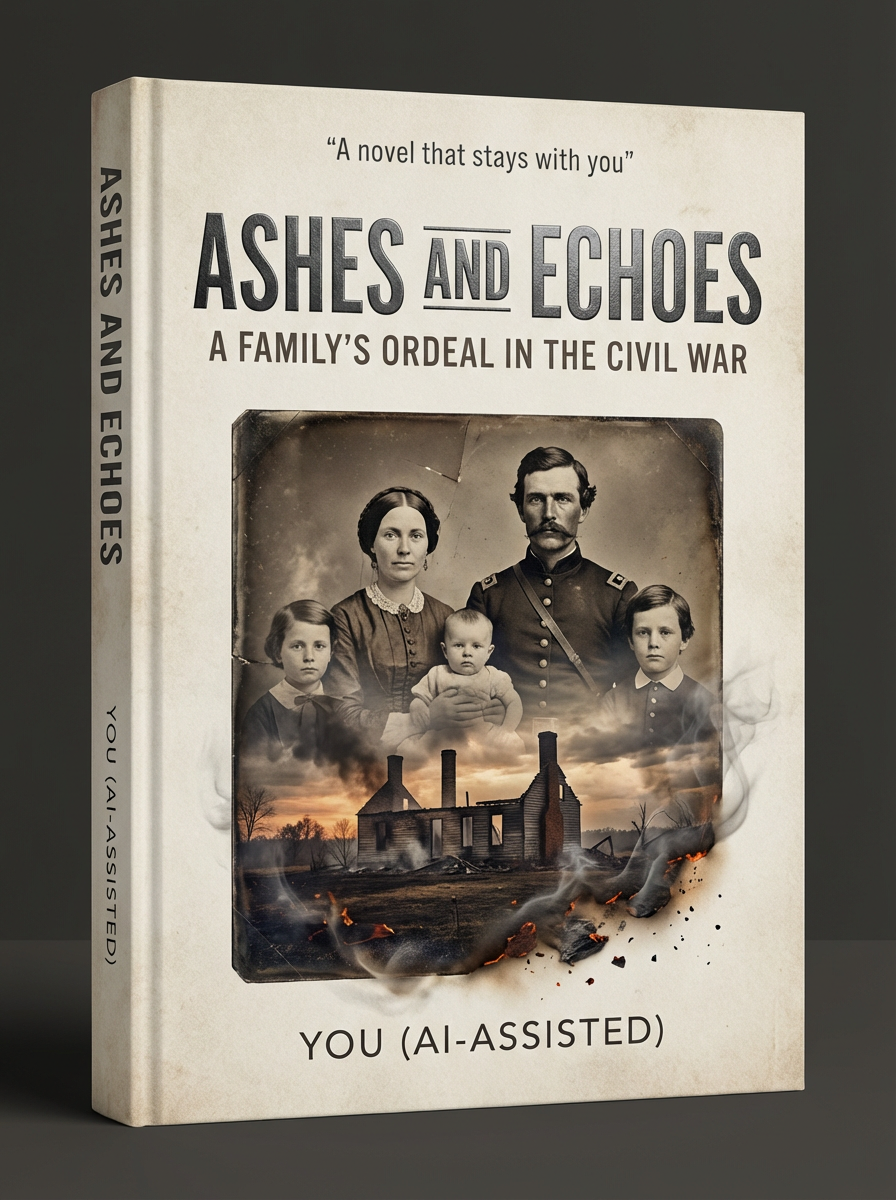
Synopsis
Through the eyes of the widowed matriarch Eleanor and her two sons, Thomas and William, this book meticulously chronicles the devastating impact of the American Civil War on a fictional farming family in rural Virginia. From the initial fervent patriotism and the harsh realities of wartime rationing
Chapter 1: The Looming Storm: A Fragile Peace
The scent of turned earth and apple blossoms, a fragrance synonymous with renewal, hung heavy in the Virginia air that spring of 1860. On the modest acreage of the Caldwell farm, a rhythm of life had been established generations ago, a cadence dictated by sun and season, by planting and harvest. Eleanor Caldwell, her hands calloused not just from work but from a lifetime of careful tending, watched her sons, Thomas and William, from the porch swing as they wrestled playfully with a young calf. The sight, so ingrained in her daily existence, brought a fleeting smile to her lips, a brief respite from the quiet anxieties that had begun to gather, like storm clouds on a distant horizon.
The Caldwells were not boastful people. Their wealth was measured in fertile soil, a sturdy farmhouse built by Eleanor’s late husband, Jeremiah, and the health of their livestock. Thomas, at nineteen, possessed the raw strength of a man who had known a plow handle since boyhood. His frame was broad, his movements deliberate, and his eyes, the same piercing blue as Jeremiah’s, held a straightforward honesty. William, two years his junior, was leaner, quicker, with an inquisitive glint in his hazel eyes that often led him beyond the confines of the farm, into the worn pages of books Eleanor carefully guarded. Their bond, forged in shared chores and childhood escapades, was a comforting constant in Eleanor’s life, a vibrant thread in the fabric of their small world.
This world, however, was beginning to feel less insulated than it once had. News, carried by travelers or the weekly newspaper from Richmond, arrived with increasing urgency, each dispatch adding another layer to the simmering unrest. Talk of secession, states’ rights, and the peculiar institution of slavery, once relegated to impassioned debates among politicians in distant cities, had begun to seep into the very bedrock of their rural community.
Eleanor remembered the hushed conversations among the menfolk at church gatherings, the way their voices would drop when the topic turned from crop yields to Charleston. Jeremiah, a man of quiet conviction and steady temperament, had always held that compromise was possible, that the Union, however strained, would endure. “Headstrong men talking themselves into a corner,” he’d rumbled once, after a contentious meeting in town, “but sense will prevail.” Yet, even Jeremiah had begun to frown more often in the months before his passing, his brow furrowed not by the usual worries of drought or blight, but by something more profound, more unsettling.
Now, without Jeremiah’s calming presence, Eleanor found herself listening more intently, her ears attuned to the subtle shifts in conversation, the unspoken fears lurking beneath pleasantries. She had seen the fervor in her neighbors’ eyes, a patriotism that, for some, was beginning to manifest as a fierce, almost zealous, loyalty to their Southern way of life. The abolitionist pamphlets, occasionally finding their way even to their remote corner of Virginia, were met with scorn and indignation, their words seen as an affront, an intrusion into affairs that were, by God-given right, their own.
For the Caldwells, slavery was not an immediate reality. They owned no enslaved people; their farm was worked by their own hands and occasional hired help from poorer families in the district. Jeremiah had never been comfortable with the institution, though he rarely spoke openly against it, understanding the deep-seated societal norms that upheld it. He had taught his sons to value honest labor and to treat all men with decency, a lesson Eleanor reinforced daily. Yet, the defense of slavery, she knew, was inextricably linked to the burgeoning sense of Southern identity, a cornerstone of the societal structure that underpinned their entire world.
One evening, as dusk painted the sky in streaks of orange and purple, Thomas returned from town with an air of agitation that unsettled Eleanor. He kicked a loose stone by the porch steps, his usual measured demeanor replaced by a restless energy.
“They’re talking of forming a ‘Sovereignty League’ in Chesterfield,” Thomas announced, his voice tight. “To uphold Virginia’s rights against Yankee aggression.” He glanced at William, who had abandoned his book and was now listening intently.
William, ever the questioner, piped up, “What ‘aggression,’ Thomas? Lincoln hasn’t even been elected yet.”
Thomas scoffed. “It’s coming, William. Can’t you feel it? They say he means to abolish slavery, to turn our whole way of life upside down.”
Eleanor, mending a tear in one of Jeremiah’s old shirts, paused, her needle suspended in the air. “Such talk is reckless, son. Much can change before November.”
“But Ma,” Thomas countered, his voice rising, “they say we have to be ready. That if Lincoln is elected, Virginia will have no choice but to stand with her Southern brethren.” He was echoing the words of older men, men whose opinions were held in high regard in their community. The seeds of patriotism, intertwined with a defensiveness that bordered on paranoia, were taking root.
William, however, remained skeptical. “But at what cost, Thomas? Secession? That means war, doesn’t it?” His voice, though quieter, held a directness that sometimes pricked Thomas’s more impulsive nature.
Thomas hesitated, running a hand through his thick brown hair. “Not necessarily, William. It’s a show of strength. To make clear where we stand. No one wants war.” But even as he said the words, a flicker of uncertainty crossed his face. The idea of war, though distant and abstract, was beginning to take on a terrifying shape in the collective consciousness.
Eleanor watched them, her heart a heavy stone in her chest. She saw the nascent fire in Thomas’s eyes, the yearning for purpose and belonging that came with his age. She saw William’s thoughtful frown, the intellect that sought reason in a world that seemed increasingly to be abandoning it. She knew, with a certainty that chilled her to the bone, that these abstract debates, these grand pronouncements, would soon touch their lives in a very real, very brutal way.
The spring gave way to a sweltering summer. The sun beat down on the fields, ripening the wheat and corn, demanding endless toil. The rhythm of farm life continued, a temporary shield against the relentless drumbeat of political upheaval. Yet, the news persisted, each week bringing reports of fiery speeches, growing militias in the Carolinas, and a deepening chasm between North and South.
The election of Abraham Lincoln in November was met in their community not with surprise, but with a grim, almost fatalistic resignation. It was seen as an affirmation of all their fears, a confirmation that the federal government was indeed intent on encroaching upon their sovereign rights. The talk of secession, once a murmur, now became an open declaration, echoed in town squares and church halls.
Eleanor remembered the day the news of South Carolina’s secession reached them. It was a cold December morning, the air crisp and biting. A rider, his horse lathered with foam, had galloped through the village, shouting the news, his voice hoarse with a mixture of excitement and fear. A ripple of profound change had gone through the community that day. For some, it was a moment of triumphant defiance; for others, a moment of profound dread.
Thomas, when he heard, clenched his fists. “It’s begun,” he said, his eyes alight with a strange mix of apprehension and exhilaration. He saw it as a call to arms, a defense of their way of life, an honorable stand against perceived tyranny.
William, however, secluded himself in his room, poring over maps and history books. He emerged hours later, his face pale. “This isn’t just South Carolina, Ma,” he murmured, pointing to a map of the United States, his finger tracing the Mason-Dixon line. “This is a fissure. It threatens to split the whole country apart.” His youthful optimism, once so resilient, was beginning to wane under the weight of unfolding events.
Eleanor, ever practical, tried to maintain an outward calm. She continued her duties, tending to the hens, churning butter, planning the meals. But in the quiet hours of the night, when the house was silent save for the creak of the floorboards and the distant hoot of an owl, she would lie awake, staring at the ceiling, her mind racing. Jeremiah’s steady presence, his grounded wisdom, was sorely missed. She felt a profound sense of isolation, a woman navigating a rising tide of male-driven rhetoric and burgeoning conflict.
She knew what such a conflict would demand. It would demand the strength of young men, the very strength her sons now possessed. And that knowledge filled her with a terror that a lifetime of hardships had not prepared her for. She had buried her husband; the thought of burying her sons was a torment she could barely contemplate.
As the winter deepened, the world outside the farm seemed to shrink, yet the tensions within it grew vast. Families were divided, not by geography, but by ideology. Loyalties were tested, and friendships strained. Those who spoke of compromise were often branded as cowards or traitors. The moderation that Jeremiah had so valued evaporated in the heat of passionate debate.
The Caldwells, like many farming families, lived on the precipice of survival. A good harvest meant sustenance; a bad one, hardship. The prospect of war threatened to disrupt this delicate balance to its very core. Food would become scarce, prices would soar, and the labor force, already strained, would be decimated as men answered the call to arms. Eleanor, with her deep understanding of agrarian life, saw the practical devastations of conflict far clearer than the grand pronouncements of politicians. She saw empty fields, hungry bellies, and cold hearths.
Spring returned in 1861, but it felt different. The air did not carry the same promise of renewal. Instead, it was thick with apprehension. The apple blossoms seemed somehow paler, the scent less intoxicating. The playful wrestling between Thomas and William now carried an undercurrent of something more serious, a latent energy that felt like a coiled spring.
The news of the attack on Fort Sumter in April extinguished any lingering hope of a peaceful resolution. It was a flashpoint, igniting the tinderbox of fear and frustration. In Virginia, the decision to secede, so fiercely debated for months, was made. The Commonwealth, a bridge between North and South, would cast its lot with the Confederacy.
Thomas returned from town that day, his face flushed, his eyes burning with an almost frightening intensity. He didn’t kick stones this time; he strode onto the porch, his boots thudding with a new finality. “Ma,” he said, his voice husky, “Virginia has seceded. They’re raising regiments. Everyone is signing up.”
Eleanor stood, clutching the worn apron she always wore. Her breath caught in her throat. She looked at Thomas, then at William, who stood silently beside her, his face a mixture of dread and fascination. She saw in Thomas’s eyes not just the patriotism of a young man eager for adventure, but the earnest conviction of a son of Virginia, compelled to defend his home.
“Thomas,” she began, her voice barely a whisper, “what are you saying?”
He met her gaze, his chin set. “I’m saying I have to go, Ma. We all do. It’s our duty. To Virginia. To everything we believe in.”
William, still silent, watched his brother, a complex mix of admiration and fear playing across his face. He saw the allure of cause and comradeship, the call to heroism that stirred the blood of every young man. But he also saw the terrifying implications, the sheer enormity of what Thomas was proposing.
Eleanor felt the world tilt on its axis. The fragile peace that had held their lives together, the delicate balance of farm labor and quiet routine, shattered around them. She looked from one son to the other, seeing in them the continuation of Jeremiah, the future of their name, the very essence of her existence. And now, this swirling tempest threatened to tear them away.
The scent of apple blossoms still lingered, a poignant reminder of springs past, of a world that was no more. The looming storm had broken. The year 1861, barely begun, promised to be a turning point, not just for the Caldwell family, but for an entire nation. The echoes of peaceful agrarian life would soon be replaced by the harsh clang of war, and the ashes of their former world would begin to accumulate, silently, inevitably, at their feet. Eleanor Caldwell, a widow without a husband, now stood on the threshold of a new, terrifying reality, a mother on the brink of profound loss, her family’s fate inextricably bound to the unfolding tragedy of a divided America.
Chapter 2: The Call to Arms: Divided Loyalties
The spring of 1861 brought with it a renewed vibrancy to the Virginia earth, a lush green that belied the growing malignancy beneath the surface of everyday life. Yet, for Eleanor Caldwell and her sons, Thomas and William, the usual rhythms of planting and tending felt discordant, overshadowed by the increasingly strident clamor of political rhetoric and the terrifying drumbeat of impending conflict. The fragile peace, so painstakingly maintained in the previous year, had shattered with the news from Fort Sumter.
The attack, reported through the terse telegrams and shouted headlines of traveling newspapers, ripped through the quiet fabric of their community like a cannonball. For many, it was the final, undeniable proof that an irreconcilable chasm now divided the nation. The air around the Caldwell farm, usually filled with the scent of freshly tilled soil and the drone of bees, became thick with the weight of unspoken anxieties and deeply held convictions suddenly thrust into the harsh light of judgment.
Thomas, with his pragmatic nature and a mind that favored order and efficiency, had always held a deep respect for the Union. He believed in the principles upon which the republic was founded, seeing secession as a betrayal of those very ideals. His childhood had been filled with stories of Washington and Jefferson, of a grand experiment in self-governance that, despite its imperfections, represented the highest aspirations of mankind. The notion of tearing such a creation apart, of inviting chaos and bloodshed, filled him with a profound sense of foreboding. He saw the institution of slavery as a moral stain, a festering wound that had long undermined the nation’s promise, but he believed it could be resolved within the existing framework of law and compromise, however difficult. His heart ached for swift resolution, for the restoration of the Union, and for the preservation of the ideals he held so dear.
William, two years younger, was a different sort of man entirely. More impetuous, with a fiery spirit and an unyielding loyalty to his home, he saw the conflict through the lens of states' rights and self-determination. The narratives of "Northern aggression" and "Yankee tyranny" resonated deeply within him, fueled by the impassioned speeches of local politicians and the fervent belief that Virginia's sovereignty, and indeed the Southern way of life, was under direct assault. He had grown up with enslaved people working the fields alongside his family, a reality ingrained into the economic and social fabric of their existence. While he didn't actively champion the cruelty of the system, he accepted it as a part of their world, a world he was now being told was threatened with extinction by an outside power. To him, the call to arms was a sacred duty, a defense of hearth and home against an invading force.
Their differing perspectives, once merely topics of polite, if sometimes heated, dinner table debate, now became a gaping chasm between them. The easy camaraderie of brothers working the land together, sharing jokes and burdens, began to erode. Eleanor, caught in the terrifying vortex of their diverging loyalties, found herself walking on eggshells, each conversation a potential minefield. Her widowed heart, still bearing the silent ache for her late husband, now braced itself for an even crueler torment: the prospect of her sons, her only remaining family, choosing paths that would not only separate them but potentially pit them against each other.
The recruitment posters began to appear in the nearby town of Culpeper, transforming whitewashed walls into pronouncements of war. Bold, black letters exhorted young men to defend their state, their honor, their families. Illustrations depicted fierce-eyed soldiers, flags unfurled, charging into glorious battle. The air thrummed with a nervous energy, a blend of fear and fervent patriotism. Neighbors, once united by common crops and shared droughts, now openly declared their allegiances, their voices sharpened by conviction.
One sweltering afternoon in late April, William returned from town, his face flushed, his eyes alight with a fierce resolve that Eleanor had only seen on the brink of a storm. He found Thomas inspecting a stubborn plowshare in the barn, his brow furrowed in concentration.
"They're forming a company, Thomas," William announced, his voice barely containing his excitement. "The Culpeper Rifles. Everyone's signing up. Mr. Henderson, young Caleb Miller, even old Man Johnson's boy."
Thomas straightened, his gaze sweeping over his younger brother, notes of apprehension and resignation already forming in his mind. "And what does that mean for us, William?" he asked, his voice even, betraying little of the tumult within.
"It means," William declared, puffing out his chest, "that we have to do our part. Virginia needs us. Our home needs us. I’m going to enlist."
The words hung heavy in the dust-filled air of the barn. Thomas slowly leaned the plowshare against the wall, his hands, calloused from years of labor, now clenched into fists. "William, have you truly considered what you're saying? This isn't some tavern brawl. This is war. People will die. And for what? To break up the very nation our father fought for?"
William’s excitement curdled into anger. "Our father fought for liberty, Thomas! He fought against tyranny, and that's precisely what we face now. The North seeks to dictate our lives, to destroy our way of life. They want to free our slaves, ruin our economy, and tell us how to live. This isn't about breaking up a nation; it's about defending ourselves!"
"Defending ourselves from what?" Thomas retorted, his voice rising. "From a lawfully elected government? Are we to plunge ourselves into certain destruction just to cling to an institution that history will surely condemn? Think of Mother, William. Think of this farm. Who will tend it if we both go off to fight?"
"Mother will manage," William said, though a flicker of doubt crossed his face. "And we are defending this farm, Thomas! If the Yankees come, who will stop them? Are you just going to stand by while they march through Virginia, burning and pillaging?"
"I will not stand by," Thomas said, his voice now dangerously low. "But I will not fight for the destruction of the Union. I believe in its ideals, William. I believe in its promise, even with its grievous flaws. This rebellion, this secession, it is a folly, a tragic miscalculation that will only bring ruin."
"Then you would stand with the invaders?" William scoffed, his eyes narrowing. "You would fight against your own people, your own state?"
The accusation hung in the air, a poisonous dart. Thomas closed his eyes for a moment, the weight of their divergent paths pressing down on him. When he opened them, the weariness in them was profound. "William, you make this sound so simple. There is no easy choice here. But I cannot in good conscience lift a hand against the Union, against the very government I swore an oath to uphold, however informally, by being a citizen. If I must fight, it will be to preserve it, not to tear it asunder."
The chasm between them yawned wider still. Eleanor, drawn by the rising voices, now stood silently in the barn doorway, a hand pressed to her mouth, her eyes wide with dread as she listened to the raw exchange.
"You mean to join the Federal army?" William breathed, his voice laced with disbelief and a deep, cutting betrayal.
"If it comes to that, yes," Thomas affirmed, his resolve hardening even in the face of his brother's stunned horror. "I will not betray my convictions, William. And I will not betray the memory of our father, who believed in a united nation."
William stared at him, his face a mask of hurt and incomprehension. The thought of Thomas fighting for the "enemy" was an unimaginable blow, a betrayal that cut deeper than any political argument. "Then you are no brother of mine," he said, the words sharp and bitter, before he turned on his heel and stormed out of the barn, leaving Eleanor to face her eldest son in the suffocating silence.
Eleanor stepped forward, her footsteps heavy. "Thomas," she whispered, her voice trembling. "What has this come to? My sons, on opposing sides?"
Thomas turned to her, his own face etched with pain. "Mother, I know this is hard. But I cannot join a rebellion that I believe is misguided and ultimately self-destructive. I cannot fight against the principles I hold dear. If I must fight, I will fight for what I believe is right, for the Union." He took her hands, his grip firm. "I will try to make sure I am not stationed here, not against Virginians, if I can help it. But I must go."
Eleanor’s gaze swept over the familiar landscape of their farm, the fields they had tilled together, the home they had built. The thought of her sons, her own flesh and blood, being caught in the machinery of war, fighting for different ideals, was a nightmare she had never conceived. She saw the unwavering conviction in Thomas’s eyes, the quiet strength that mirrored his father’s. She knew reasoned argument would not sway him. Her heart, already fractured, felt as if it were being torn anew.
The next few days were a blur of hushed preparations and strained silence. William, true to his word, rode to Culpeper and formally enlisted in the Culpeper Rifles, a unit destined to become part of the Confederate Army of Northern Virginia. He returned home wearing a rough-spun uniform of grey, an ill-fitting cap on his head, and a defiant pride in his bearing. He avoided Thomas, communicating with his mother in terse, clipped sentences, his gaze often drifting to the familiar fields with an intensity that spoke of both longing and resolve.
Eleanor, with the stoic courage that had seen her through the loss of her husband and the relentless demands of farm life, helped him pack his meager belongings. She pressed a small, worn Bible into his hands, its pages soft with age. "Read this, William," she urged, her voice thick with emotion. "And remember your mother's prayers." He nodded, unable to meet her gaze, the weight of his decision and the unspoken chasm between them heavy in the air. The morning he left, the sun was barely over the horizon, casting long, mournful shadows across the dew-kissed fields. He embraced Eleanor tightly, a rare show of open affection, before mounting his horse. He glanced towards the house one last time, a flicker of something unreadable in his eyes, before riding off down the dusty lane, his figure shrinking until it was swallowed by the morning mist.
Thomas waited until a week after William's departure, a week filled with an oppressive quiet that settled over the farm like a shroud. He used that time to settle affairs, to explain his intentions to their aging farmhand, Silas, who promised to help Eleanor as best he could. He rode to Alexandria, a journey fraught with internal turmoil and the mounting uncertainty of the road. There, away from the immediate scrutiny of his community, he made his own agonizing decision. He enlisted in a newly formed infantry regiment of the Union Army, a choice that solidified the familial schism begun in the barn.
He wrote a letter to Eleanor, painstakingly composing each word, knowing it would be weeks, perhaps months, before she would receive it. In it, he tried to explain his convictions, to reassure her of his love, and to express his profound regret for the pain his choice would inevitably inflict. "Mother," he wrote, his hand trembling slightly, "I go not to fight against Virginia, but to fight for the Union that I believe holds the true path to our future. I pray for William's safety, and for yours, every day. Remember that my heart remains with you, no matter where this war takes me."
Eleanor received the letter almost two months later, stained and creased from its long journey. She sat at the kitchen table, the familiar script blurring through her unshed tears. With both her sons gone, swallowed by the maw of war, the farm felt impossibly large, impossibly empty. The sun still rose and set, the crops still needed tending, but the vibrant tapestry of their lives had unraveled, replaced by a stark, monochromatic landscape of fear and loneliness.
The initial fervent patriotism that had swept through the South, convincing many young men like William of the righteousness of their cause, began to give way to the first grim realities of conflict. Early victories, such as the First Battle of Manassas (or Bull Run, as the Federals called it), brought euphoria but also casualty lists, sobering reminders of the true cost of glory. The Caldwells’ neighbors, those whose sons or husbands had marched off with similar enthusiasm, now spoke in hushed tones of lives lost, of limbs shattered, of brave young men returning home in flag-draped coffins or with minds haunted by unspeakable horrors.
For Eleanor, the absence of her sons was a constant ache. Every rustle of leaves, every distant dog bark, every rider on the road sent a jolt of hope and dread through her. She was now solely responsible for the farm, a burden that pressed down on her with relentless weight. Silas, though loyal and hardworking, was aging, and the labor shortages intensified with each passing month as more men were called to arms. The land, which had once been a source of sustenance and stability, now felt like a lonely sentinel, bearing witness to her solitary struggle.
Rationing began almost immediately. Coffee, sugar, even basic staples became luxuries. Eleanor learned to do without, to make do, to stretch what little they had. Her ingenuity, refined over years of managing a household on limited means, was now tested to its limits. Candles were sparingly lit, meals were simple and repetitive, and every patch of fabric, every worn tool, was cherished and mended with careful hands. The world shrank from the grand narratives of nationhood to the immediate, visceral need for survival.
Conscription, though not yet directly affecting their community in its harshest forms, was a constant threat. The newspapers reported on its implementation in other states, a grim harbinger of what was to come. The initial romanticism of war, the belief that it would be a swift and glorious affair, evaporated with each passing month, replaced by a grim recognition of its enduring brutality.
Eleanor learned to read the newspapers with a practiced eye, searching for any mention of the Culpeper Rifles or, in the Union dispatches, of Thomas’s regiment, though she knew the latter was a futile hope, their names rarely published in enemy papers. Each battle, each movement of troops, filled her with renewed dread. Was William there? Was Thomas? Were they facing each other, unknowingly, across a blood-soaked field? The questions spiraled in her mind, constant, tormenting.
The first letter from William arrived nearly six months after his departure, its envelope smudged and worn, carrying the scent of wood smoke and damp earth. Eleanor tore it open with trembling fingers. He wrote of the camaraderie among his fellow soldiers, of harsh marches and meager rations, but mostly of the unwavering conviction in their cause. He spoke of picket duty, of skirmishes, of the terrifying whistle of minie balls. He did not describe the horrors of battle, not fully, but the underlying tension in his words, the grim reality filtering through his youthful enthusiasm, was palpable. He asked for news of home, of the farm, and offered a veiled hope that perhaps, one day, Thomas would see the truth and join their righteous cause.
Eleanor clutched the letter to her chest, a conflicting mix of relief and renewed despair washing over her. He was alive. For now. But the war, relentless and insatiable, claimed bodies and souls with equal indifference.
The Caldwell farm, once a quiet sanctuary, was now a microcosm of the divided nation itself. The echoes of political fervor, of deeply held beliefs, had led two brothers down irrevocably separate paths. Their choices, born of conviction and circumstance, had cleaved their family in two, leaving Eleanor alone to tend the fields of a land now bathed in the shadow of war, her heart a battleground of longing and fear, her nights filled with the silent, haunting cries for her lost sons. The call to arms had been answered, and the tragic legacy of a family, like a nation, torn asunder, had truly begun.