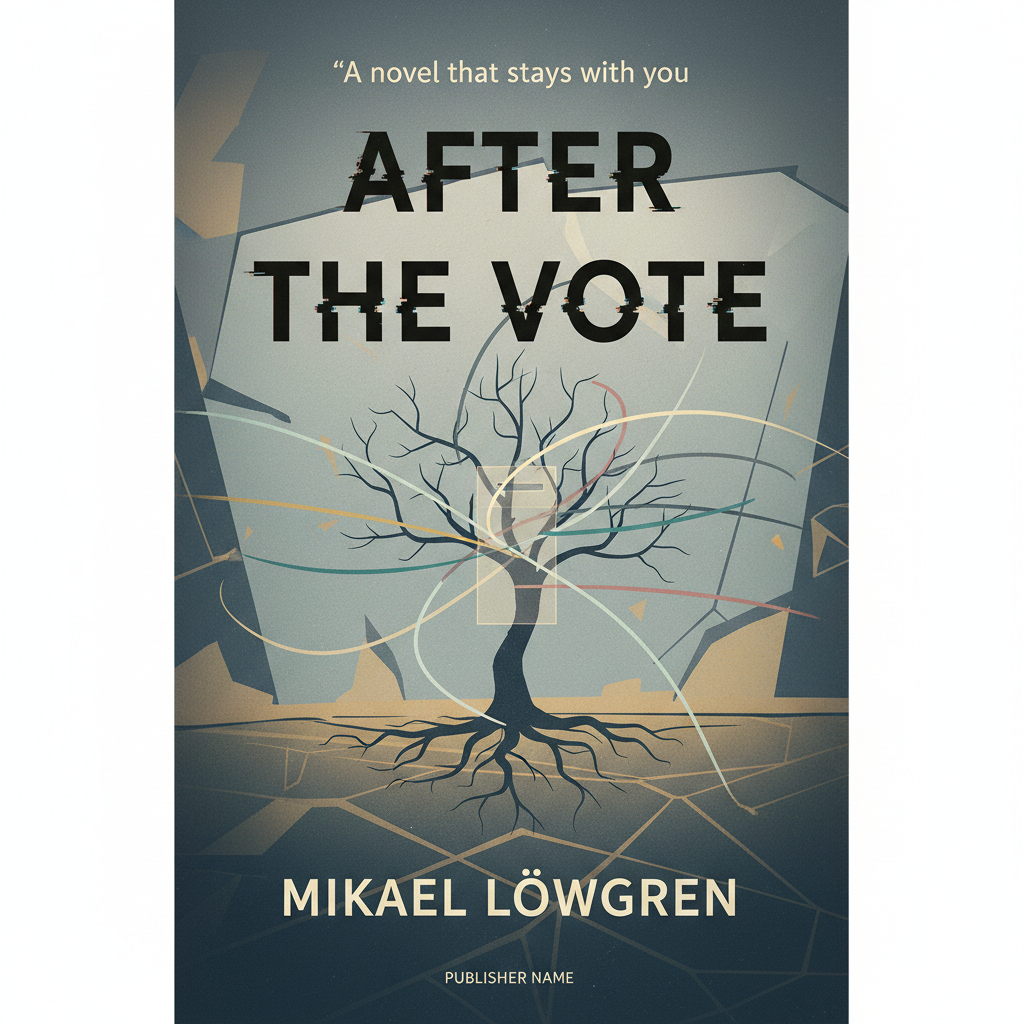
After the Vote
By Mikael Löwgren
Synopsis
In a fractured nation reeling from a divisive election, five disparate lives intertwine, revealing the quiet resilience and pervasive unease of a democracy grappling with its own reflection.
Chapter 1: The Dawn of Uncertainty
The new day arrived not with a declaration, but with a whisper, like a secret passed between conspirators. It bled through the inadequate blinds of Eleanor’s apartment, a reluctant grey, too anemic to offer any real consolation. She lay still, suspended in the space between waking and the full, crushing weight of consciousness, her body a frail vessel anchored by the rhythmic throb behind her eyes. The silence, typically a comforting blanket in her seventh-floor perch, was now a brittle shell, amplifying the distant, mournful wail of a siren – not urgent, but a drawn-out lament, echoing the ache within her.
She had dreamt not of fire or flood, but of an endless, featureless plain under a sky the colour of unwashed linen, where all the familiar landmarks had vanished. There were no trees, no houses, no roads, only the ground stretching out, an indifferent canvas. And she, a tiny, solitary figure, walking, walking, compelled forward by an unseen force, never reaching anything. It was the kind of dream that seeped into the waking hours, leaving a residue of profound unease.
The digital clock on her bedside table glowed a malevolent red: 6:02 AM. Too early for the full onslaught of the news, too late to pretend yesterday never happened. Her hand, liver-spotted and slightly tremulous, reached for the rimless glasses on the nightstand. The world snapped into sharper focus, a clarity she almost resented. Dust motes danced in the nascent light, microscopic, innocuous, yet somehow mirroring the countless, tiny anxieties that now populated the air.
She pushed herself up, a groan escaping her throat – a sound of old joints, yes, but also of a soul bruised and weary. The floorboards, cool beneath her bare feet, offered no comfort. Her reflection in the polished surface of the antique dresser showed a woman who had aged a decade overnight. The lines etched around her eyes were deeper, the pallor more pronounced. The once-vibrant blue of her eyes seemed faded, like an old tapestry left too long in the sun. This was the face of anticipation, of apprehension, of a deep and settled foreboding that burrowed into the marrow of her bones.
A slow, creeping dread tightened its grip with each passing minute. The air, usually crisp and breathable, felt thick, heavy, laden with unspoken questions. She moved to the window, pulling back the curtain. The city, usually a vibrant tapestry of noise and movement by this hour, now seemed muted, hesitant. The street below was quiet, almost unnaturally so. A single car, a dark sedan, drove slowly past, its tires barely whispering on the asphalt. No joggers, no early dog walkers, no harried commuters clutching coffee cups. It was as if the city itself was holding its breath, waiting for a signal, a cue, that had not yet arrived.
Eleanor remembered mornings after other elections. The jubilant shouts, the mournful sighs, yes, but always a definite rhythm, a sense of having arrived at a new, albeit perhaps undesirable, destination. This morning felt different. It felt like being adrift in an interregnum, a pause before an unknown sentence was delivered. The result, inconclusive well past midnight, had been broadcast in stark, disembodied numbers, a digital recitation of a nation’s divided soul. She had listened, perched on the edge of her sofa, a half-empty mug of cooling tea clutched in her hand, until the anchor’s voice had blurred into a monotonous hum, until her eyelids had grown too heavy to keep open.
Now, the silence pressed in. She walked into the kitchen, the linoleum cool against her feet. The familiar rituals of morning offered little solace. The kettle hissed, a sound both mundane and alien. She measured the coffee, her movements precise, almost ritualistic, yet her mind churned. What would they say on the radio? What permutation of numbers, what carefully chosen platitudes, would try to stitch together the gaping chasms that had been revealed?
The coffee brewed, a dark, aromatic comfort, but even its familiar scent seemed diminished, its promise of restoration hollow. She poured a mug, the ceramic warm against her hand, and carried it back to the window. The sky had lightened a fraction, revealing a thin, almost invisible haze over the distant skyscrapers. The city was waking, but not with its usual robust energy. It was a waking punctuated by a collective held breath.
She traced a finger along the condensation on the windowpane. What had she contributed? Decades spent teaching, explaining, dissecting the intricate dance of history, the fragile scaffolding of democracy. Had any of it mattered? Had the carefully reasoned arguments, the historical parallels, the fervent appeals to civic responsibility, truly sunk into the fertile ground she had envisioned? Or had they simply evaporated, lost in the din of partisan rhetoric, the relentless drumbeat of division?
A profound sense of futility, cold and sharp, pierced through her. It wasn’t just the outcome of *this* election; it was the chasm itself, wider, deeper, more entrenched than she had ever dared to imagine. It was the feeling that something fundamental had shifted, irrevocably, within the very fabric of society. A knot tightened in her stomach. This wasn't merely a political loss; it was a societal arrhythmia, a heart skipping beats, threatening to cease its rhythm altogether.
***
Miles away, in a cramped, sun-starved apartment above a perpetually fragrant bakery, Mateo stirred. The air was thick with the scent of stale yeast and something vaguely burnt, a comforting aroma that usually signaled the day's beginnings but now felt like a suffocating shroud. He was sprawled across a futon, a thin blanket tangled around his legs. His phone, lying face down on the rickety nightstand, pulsed with a silent, insistent vibration, a digital heartbeat of the world outside.
He ignored it. The sleep he’d managed to snatch had been shallow, fragmented by images of impassioned faces, placards held high, the metallic taste of adrenaline that had become his constant companion for weeks. He had worked until his voice was raw, his feet swollen, his very being a conduit for the fervent belief in a better path. And now…
He pushed himself up, his muscles stiff, protesting. The faint light filtering through the grimy window painted the peeling wallpaper in stripes of sickly yellow. The apartment was strewn with the detritus of frenzied activity: crumpled flyers, half-empty coffee cups, the laptop open on a chair, its screen a dark, accusing mirror.
He swung his legs over the edge of the futon, his bare feet meeting the cold linoleum floor. A faint tremor ran through him, not of cold, but of something deeper, a vibration in his very bones. His heart hammered, not with anger, but with a dull, persistent ache. It was a despair that was muted, almost academic in its expression, but no less potent. It was the despair of investment, of belief, of the raw, exposed nerves that come with pouring every ounce of oneself into a cause, only to watch it falter.
He picked up his phone, his thumb hovering over the screen. The notifications piled up: news alerts, messages from the campaign group chat, calls he’d missed from Sarah. He pushed them all away, not quite ready to face the deluge. He knew what they would say. He had seen the numbers inching towards their grim conclusion throughout the night, the hopes of a narrow victory eroding with each precinct report.
He went to the small, grimy kitchenette, running water into the kettle with a practiced ease. The clattering of the enamel kettle against the ancient stovetop seemed a jarringly loud intrusion into the morning's fragile quiet. He stared at his reflection in the dark glass of the microwave, a young man with haunted eyes, the shadows beneath them like smudges of fear. His usually vibrant dark hair was disheveled, standing up in rebellious tufts. He looked, he thought, like a soldier after a crushing defeat, unsure of where to go next, or even *if* there was a next.
He made himself instant coffee, a bitter brew that did little to cut through the heavy fog in his mind. The baker downstairs was already at work, the muffled thud of dough being kneaded a sorrowful rhythm accompanying his thoughts. Mateo leaned against the counter, sipping the scalding liquid, his gaze fixed on nothing in particular.
The despair wasn't a sudden explosion, but a slow, insidious seep. It was the feeling of having poured water into a sieve, watching it drain away, knowing the effort was futile, but having been compelled to try anyway. He had believed, truly, fiercely, in the possibility of change, of a shift in the prevailing narrative. He had rallied, debated, organized, convinced, pouring every ounce of his youthful energy into the machine of progress.
And now, the machine had stalled. Or worse, it had veered off course, into a direction he found increasingly unfathomable.
He remembered the faces, the hopeful eyes, the hands he had shaken, the arguments he had won, the ones he had lost. He remembered the feeling of solidarity, a powerful, intoxicating force. Where were those people now? Scattered, he imagined, like dandelion seeds in a harsh wind, each carrying a fragment of the shared dream, but with no fertile ground to land on.
His phone buzzed again, relentlessly. This time, he picked it up, his finger tracing the edges of the screen. Sarah. Her name, a small comfort, a reminder of the personal amidst the political. He debated calling her, but what would he say? His voice would betray him. He wasn't angry, not immediately. He was just…empty. A profound, aching void.
He closed his eyes, taking a deep, shuddering breath. The scent of burnt sugar from the bakery downstairs seemed to fill his lungs, an unwelcome sweetness. This wasn't the end, he knew that intellectually. Battles were fought and lost, and then fought again. But this felt like something more. It felt like a fracture, not just within the political sphere, but within the very idea of common ground, of shared humanity.
He walked over to the laptop, his fingers hovering over the trackpad. The news sites would be ablaze. The pundits would be dissecting, analyzing, offering their glib pronouncements. He wasn't ready for their words, for the attempt to rationalize the irrational, to sanitize the mess.
He sat down, the chair creaking under his weight. He looked at the dim, unmade room, at the haphazard piles of books and clothes. This was his sanctuary, his crucible of ideas, his small stage for big dreams. And now, it felt like a cage, holding the remnants of a defeated hope.
What did one do after such a night? What was the first step on a path that had splintered into a million confusing directions? The question hung in the air, heavy and unanswered, mingling with the scent of stale bread and burnt sugar, as the city slowly, unwillingly, began to stir from its uncertain sleep.
Chapter 2: Echoes in the Streets
The rumble began subtly, a low thrum beneath the city’s usual clamor, like distant thunder promising a storm yet unwilling to commit. Sarah, perched on a stool behind the counter of ‘The Woven Word,’ her small bookstore and cafe, felt it in the soles of her worn sneakers first, then migrating up into the delicate architecture of her spine. It was a vibration distinct from the subway’s subterranean groan or the incessant churn of traffic; this was alive, diffuse, spreading.
Her gaze, already troubled since the news anchors had finally, irrevocably, declared the outcome, drifted towards the street. The oversized plate glass window, usually a cheerful portal displaying stacks of new arrivals and a handwritten sign advertising artisanal coffee, now served as a reluctant screen for a drama she wished she were merely observing, not living.
It was mid-morning, past the initial rush of commuters craving caffeine and headlines. The usual rhythm of her day, the quiet hum of pages turning, the clink of ceramic on saucers, had been fractured by the pervasive, static hum of the radio she kept tuned to the local news. Every ten minutes, a breathless reporter would reiterate the same facts, repackaging them with increasingly dire adjectives. Divisive. Historic. Unprecedented.
Then came the cheers. Or perhaps, jeers. From this distance, filtered through the thick glass, it was hard to tell. A group of perhaps fifty people, still sparsely populated against the wider canvas of the street, marched past her window. They carried hand-painted signs aloft, their messages crude but unmistakable: bold block letters declaring victory, triumph, the dawning of a new era. A few waved flags, their colors snapping crisply in the autumn wind. Their faces were flushed, their voices raw with a mixture of exhilaration and something more primal, something sharp and almost gleeful. One man, his face a ruddy picture of uncontained joy, glanced into her shop, his eyes lingering for a beat, a challenging, almost confrontational glint in them. Sarah felt a prickle of unease, pulling back instinctively, as if her own reflection in the window might somehow betray her neutrality.
Neutrality. What a quaint concept, she thought bitterly. Like a forgotten dialect from a time when one could simply be an observer, not a participant, not a consequence.
She watched them recede, their celebratory shouts fading into the general din. But the silence they left in their wake was heavier, not lighter. It was the quiet before the next wave, the breath held before plunging into cold water.
A lone bell above the door chimed, announcing a customer. It was Arthur, a retired history teacher with a perpetually stoic expression and a penchant for obscure biographies. He shuffled in, his usual briskness absent, and made his way to the ‘New Releases’ table without a glance at the coffee machine.
“Morning, Sarah,” he mumbled, his voice gravelly. He didn’t meet her eyes.
“Morning, Arthur,” she replied, her own voice feeling thin and reedy. “Can I get you your usual?”
He shook his head, his gaze fixed on a memoir about a dissident poet. “No, thank you. Too much noise in my head already.” He picked up the book, flipping through the pages mechanically. “Seems like the whole damn city is unraveling.”
Sarah gripped the edge of the counter. “It’s starting early, isn’t it?”
“Earliest I’ve ever seen,” Arthur affirmed, his voice laced with an old man’s weary wisdom. “The kind of unrest that usually takes a few days to ferment. This… this is instant.” He paused, then looked up, his eyes finally meeting hers. They were rimmed with red, betraying a sleepless night. “What do you make of it, Sarah?”
She smoothed a stray strand of hair behind her ear, a familiar gesture when she felt cornered. “I don’t know, Arthur. I just… I hope it doesn’t get worse.” The words felt hollow as they left her mouth, a desperate attempt at optimism that even she didn't believe.
Arthur grunted, a skeptical sound. “Hope is a luxury, my dear. Not a strategy.” He placed the book back on the table. “I’ll just… browse. Might be some solace in the past, after all.”
Solace in the past. Sarah wished she could find it there, but her gaze kept returning to the window, to the present unfolding on the street. Slowly, tentatively, she began to see more movement. Figures emerging from subway stations, spillways of people converging from side streets. Not yet a throng, but a gathering.
The air itself seemed to thicken, charged with an invisible current. She busied herself with rearranging a display of literary fiction, her fingers tracing the spines of books, seeking the familiar comfort of their promised narratives. But the words on the pages swam before her eyes, refusing to settle.
Then came the next wave. This one was different. Their numbers were greater, their signs starkly contrasting with the earlier celebratory parade. These were handwritten on cardboard, edges ragged, scrawled with anger, fear, and defiance. NO. NOT OUR PRESIDENT. WE WILL NOT COMPLY. Their faces, visible through the gaps between signs, were grim, set, their jaws tight. They walked with a purpose that felt less like marching and more like bracing for impact.
A young woman, no older than her early twenties, her face pale but determined, caught Sarah’s eye. She was shouting something, her voice hoarse, but the words were lost to the glass and the growing crescendo of the crowd. Still, the anguish on her face was palpable, a raw wound exposed to the cold autumn air.
Sarah felt a knot tighten in her own stomach. This had been her neighborhood, a sanctuary built on the quiet dignity of books and brewing coffee. Now, the public square outside her window, once a space for dog walkers and street musicians, was becoming a stage for a division that felt both deeply personal and overwhelmingly collective.
She’d always prided herself on ‘The Woven Word’ being a neutral space, a haven for all readers, regardless of their political leanings. Now, she felt that neutrality actively threatened, not by any direct attack, but by the very atmosphere of contention seeping in, tainting the air.
A delivery truck, stalled at the corner by the sheer volume of pedestrians, blared its horn in frustration. A ripple of irritation went through the marching crowd, some turning to shout back at the driver, further escalating the tension. The city, usually a symphony of controlled chaos, was descending into something less orchestrated, more volatile.
A sudden, sharp burst of sound made her jump. It was a whistle, piercing and urgent, followed by a chant, rhythmic and insistent. “Whose streets? Our streets!” The words, repeated over and over, resonated with a tribal energy that sent a shiver down her spine.
Arthur had stopped pretending to browse. He stood by the window, his arms crossed, his expression grave. “Look at them,” he murmured, not to Sarah specifically, but to the abstract air of the shop. “Such conviction. On both sides.” He sighed, a sound heavy with the weight of historical precedent. “And so little listening.”
Sarah nodded, unable to articulate the churning dread she felt. The demonstrations were growing denser, a river of humanity flowing past her shop, sometimes two distinct currents, one flowing one way, the other the opposite, occasionally merging, momentarily jostling, then separating again. The air outside thrummed with a nervous energy, a palpable anticipation of collision.
She thought of her inventory, the carefully curated shelves of stories, of differing perspectives bound within paper and ink. Would people still want to read, to understand, when the world outside was screaming? Would the quiet act of turning a page stand a chance against the roar of the crowd?
A teenager, too young to vote perhaps, but old enough to have absorbed the rhetoric, strode past, holding a sign that depicted a very recognizable caricature framed by a cross-out symbol. His face was a mask of righteous indignation. Behind him, an older woman with a grimly determined expression held a sign that simply read, in stark black letters, ‘I Voted.’ It was a statement, a protest, and an almost despairing plea all at once.
The light began to fade, not from the setting sun, but from the mass of bodies obstructing the sky. The shouts grew louder, punctuated by the occasional blast of a megaphone or a rhythmic clap. Sarah felt the shop’s serene bubble beginning to thin, the roar from outside pressing in, threatening to pop it.
Just as she was about to suggest to Arthur that perhaps they should lock the door, a sudden surge in the crowd pushed a man directly into her window. He wasn’t looking in, but rather trying to avoid being swept away by the current. His hands splayed against the glass, leaving faint, oily prints. For a split second, his face was inches from hers, a fleeting glimpse of fear and confusion, before the crowd pulled him onward.
The impact vibrated through the glass, rattling a small ceramic mug on the display shelf. It was a visceral reminder of the physical reality of the unfolding scene, the tangible pressure of public emotion spilling into the very fabric of her community.
Arthur let out a soft sound, a sigh of resignation. “This is just the beginning,” he said, his voice barely a whisper. “The echoes will reverberate for a long, long time.”
Sarah looked at the smudged handprints on her window, a silent testament to the blurring line between the outside and the in. The rumble in the street had graduated from a distant thunder to a full-blown storm, and she, a small business owner with a bookstore full of stories, could do nothing but watch it rage. The quiet resilience she’d hoped her community possessed felt, in that moment, painfully fragile. And the pervasive unease that had settled over the city the morning after the vote, now had a thousand protesting voices.
Chapter 3: Beneath the Surface
The television in the breakroom blared on, a relentless, well-modulated voice dissecting the pixelated map of the nation into triumphant hues of red and retreating shades of blue. Thomas stared at it over the rim of his cooling coffee mug, the steam a thin, curling question mark against the harsh fluorescent light. “They keep saying ‘mandate,’” Lena from accounting piped up, her voice a reedy counterpoint to the anchor’s baritone. “Like everyone just magically changed their minds overnight.”
Thomas grunted, not bothering to look at her. Lena was a good sort, usually. Practical. But lately, her practicality had curdled into a kind of weary cynicism that made him uncomfortable. The air in the breakroom, usually thick with the smell of stale coffee and the clatter of cutlery, now held a strange tension, a thin film of unspoken resentments that coated every surface.
He picked at a loose thread on the cuff of his worn overalls. The numbers on the screen fluctuated, decimal points shifting with a maddening precision, each fraction of a percentage point a tiny chisel chipping away at the presumed bedrock of their shared understanding. The pundits, with their slick hair and tailored suits, spoke of demographics and voting blocs, of the rural-urban divide, of resurgent populism. They spoke of everything Thomas knew, without ever speaking *to* it, or *for* it.
“You’d think they’d have better things to talk about,” Dave, a burly forklift operator, grumbled, his voice low and rumbling like the machinery he commanded. He swiped a crumb from his chin. “Like how much the electric bill is going up next month. Or the price of milk.”
Lena sighed, a delicate, almost theatrical sound. “It’s all connected, Dave. They always say it is. Supply chains, global markets, consumer confidence. It all links back to… this.” She gestured vaguely at the television screen, her hand a pale wavering shadow in the harsh light.
Thomas felt a familiar knot tightening in his stomach. He didn’t want to talk about it. He didn’t want to talk about any of it. He wanted to go back to the rhythmic clang of the presses, the comforting scent of lubricants and metal shavings, the familiar ache in his shoulders that was a testament to a day’s honest work. He wanted the world to be a machine, predictable and ordered, where inputs led to outputs with a clear, unambiguous logic.
Instead, the world outside the factory walls, and increasingly, even within them, felt like a broken gear. Each rotation was off-kilter, grinding against another, producing only friction and heat, never the smooth, purposeful hum he remembered.
When the break ended, Thomas walked the familiar path back to his station on the assembly line, the drone of the machinery a welcome balm. Here, at least, there was order. Raw materials flowed in, components were fitted, products emerged. A tangible purpose. But even this solace was fleeting. He found himself glancing across the line, catching the eyes of his co-workers. He’d known most of them for years. Shared Christmases, complained about supervisors, celebrated birthdays with lukewarm cake in the breakroom. Now, there was a certain guardedness in their gazes, a subtle recalculation, as if each interaction was being weighed against an invisible ledger.
He remembered last week, before the vote. He’d overheard a conversation between two younger guys on the night shift, their voices hushed, almost conspiratorial. One of them, a fresh-faced recruit named Kyle who still had the hopeful sheen of youth on him, had been talking about ideals, about a future where things would be… better. The other, Mark, who’d been on the line nearly as long as Thomas, had just snorted. “Better for who, exactly? You think they’re gonna suddenly remember us down here in the dirt? They don’t even see us, Kyle.”
Thomas hadn’t intervened. He’d just kept his head down, feeding sheet metal into the press, the rhythmic thump-thump-thump a dull accompaniment to the unspoken chasm opening between them. But he’d felt a chill regardless. A recognition of something he’d been trying to ignore.
That evening, the usual Tuesday poker game at Frankie’s Bar felt different. The air was thicker, not just with cigarette smoke, but with something else—an unspoken challenge, a barely contained exasperation that simmered beneath the surface of every casual remark. Thomas sat hunched over his cards, trying to focus on the fading patterns on the backs of the kings and queens, but his mind kept drifting to the empty seat where old Mr. Henderson usually sat.
Frankie, whose perpetually stained apron seemed to absorb the sorrows of the neighbourhood, wiped down the counter with a sluggish cloth. “Henderson ain’t coming tonight,” he announced, not looking at anyone in particular. “Says he’s got a headache. Or maybe he just can’t bear the sight of us anymore.” He let out a humourless laugh.
A ripple of uneasy silence spread through the small gathering. Mr. Henderson, a retired butcher with a penchant for telling long, winding stories about the old days, was one of the fixtures of their small, insular community. He was the kind of man who’d always had a kind word, a shared joke, regardless of background or stripe. His absence was a heavy weight.
“He said something about needing to ‘separate himself from the noise’,” Joe, a plumber with a perpetually grease-stained baseball cap, offered, his voice unusually subdued. He picked at a loose thread on his sleeve. “Said he heard too many things lately that made his stomach turn.”
Thomas knew what Joe was talking about. He’d heard them too. The offhand comments about “those people,” the thinly veiled accusations disguised as rhetorical questions, the way conversations would suddenly drop into a brittle silence when certain topics arose.
“Heard his boy moved back in,” someone else chimed in, a carpenter named Paul who usually had a booming laugh. His laugh was conspicuously absent tonight. “Said his grandson got some job up in the city. Big fancy tech gig. Henderson was really proud of him last time.”
“Well, you know what these young folks are like these days,” Joe said, his tone darkening slightly. “Filled with all sorts of crazy notions. Think they know everything.” He pushed a small pile of chips into the pot, his hand trembling slightly.
Thomas watched the pot, a small circle of plastic disks, its value accumulating, shrinking, then growing again. A tangible thing, unlike the invisible resentments that swirled around them like unseen dust motes. He folded his hand, not because he had a bad draw, but because the effort of concentrating felt too much. The game, once a simple diversion, now felt laden with unspoken meaning, each bet a silent declaration of something far more profound than the strength of one’s hand.
Later, walking home under the indifferent glow of the streetlights, Thomas felt the unfamiliar sting of alienation. It wasn’t a dramatic, sudden break. It was more insidious, a slow erosion, like water carving away at a riverbank. He used to know who his neighbours were. Their politics were a vague, collective hum, a background noise that didn’t interfere with the shared rhythm of their lives – the summer barbecues, the neighbourhood watch meetings, the complaints about the leaky municipal pipes. Now, the hum had become discordant, a jarring cacophony that left him feeling adrift.
He passed Mrs. Peterson’s house. Her hydrangeas, usually a vibrant display of pinks and blues, seemed to droop under the moonlight, their colours muted to a bruised purple. He remembered just a few months ago, she’d brought over a plate of her famous lemon bars after he’d helped her fix her gutter. They’d stood on her porch, talking for nearly an hour about the weather, her grandchildren, and the best way to keep squirrels out of bird feeders. Now, when he saw her at the grocery store, her eyes would dart away, or she’d offer a strained smile, her words clipped and polite, nothing more.
He knew why. He’d heard the whispers. He’d seen the yard signs, those bright flags of allegiance that had sprung up like weeds on a barren landscape, marking territory where there was once only common ground. His own small patch of lawn remained defiantly bare, a neutral territory in a landscape increasingly defined by battle lines.
He thought of the factory. The comforting monotony of the work was becoming less of a solace and more of a cage. The rhythmic clang of the presses, once a lullaby, now felt like a hammer striking an anvil, each beat driving home the growing chasm. The faces across the line, once familiar and unburdened by hidden meanings, now seemed to wear a subtle mask, a slight shift in the eyes, a tightening of the jaw. He felt the threads that connected him to them, to his community, fraying, one by one.
He unlocked his front door, the click echoing in the sudden silence of his small home. The air inside smelled faintly of dust and old coffee. He switched on the lamp in the living room. The news was still on, a low hum from the television speakers. The faces of the pundits had changed, but their message remained the same: analysis, speculation, dissection. They were carving up the nation into understandable pieces, but in doing so, they seemed to be carving up something else too – the fragile, unspoken bonds that held people together.
Thomas stood in the center of his living room, the quiet pressing in on him. He felt an intense weariness, a bone-deep exhaustion that had nothing to do with the physical demands of his work. He wanted to understand, to make sense of the shifting sands beneath his feet, but all he found was a swirling confusion, a sense of loss that he couldn’t quite name.
He looked around the room, at the worn armchair, the stack of unread magazines on the coffee table, the faded photograph of his parents on the mantelpiece, their smiles fixed and eternal. He felt a profound sense of isolation, a solitary island in a sea of rising tides. The routine, once his refuge, now felt like a barren shore. He needed something more, something beyond the predictability of the factory, beyond the strained silences of the poker game, beyond the endless dissection of the news. He just didn’t know what. And the not knowing, that was the coldest part of all.
Chapter 4: The Weight of Victory
The fluorescent hum of the government building’s fourth floor was a constant, low thrum against David’s temples. It had been there, a white noise backdrop to his life, for the better part of fifteen years. Today, though, it felt different. Sharper. Like a high-frequency whine only dogs could normally hear, setting their teeth on edge.
He’d arrived early, as always, before the true avalanche of emails and directives descended. His office, a cubicle with a perpetually smudged faux-wood laminate desk, offered a sliver of refuge. A half-empty Styrofoam cup of instant coffee, its surface skimmed with a thin film of something unidentifiable, sat beside his keyboard. He hadn’t touched it. The aroma, usually a comforting signal of routine, now brought a faint metallic taste to his mouth.
Victory. The word felt clumsy in his mind, like a foreign object stuffed into an already overflowing pocket. It was everywhere. On the news ticker that crawled across the bottom of his computer screen, alongside the headlines detailing national unity and a new mandate. In the hushed, almost reverent tones of his colleagues who filtered in, eyes bright with a mixture of relief and something akin to disbelief. Even the usually stoic Mr. Henderson from Accounting had offered a surprisingly jovial “Morning, David! A good day for the nation, wouldn’t you say?” as he passed the breakroom.
David had merely nodded, a noncommittal gesture that tasted of ash.
He opened the daily briefing, the screen’s stark white light illuminating the faint lines etched around his eyes. Page after page of policy initiatives, strategic realignments, and forward-looking statements. It was all there, the blueprint for the coming years, drafted by the very minds who now held the levers of power. His side. Their side. The winners.
And yet, the feeling in his gut was not elation. It was a dense, leaden weight, pressing against his diaphragm. A responsibility so vast it felt physically crushing.
He remembered the night of the count, hunched over his laptop in the dim glow of his living room, a half-eaten bowl of cold cereal forgotten beside him. Each reported percentage point, each swing in the electoral map, felt like a personal blow, or a dizzying surge. When the final projections had solidified, a strange silence had descended upon his small apartment. His wife, Sarah, had let out a breath she seemed to have been holding for hours, a soft, almost imperceptible sigh. She had then looked at him, her eyes wide, a flicker of something unreadable – relief? fear? – in their depths.
“We won,” she’d whispered. It hadn’t sounded like a celebration. It had sounded like a question.
Now, in the sterile glow of his office, that question echoed. *We won.* But at what cost? And what exactly had they won?
He scrolled through the document, his gaze snagging on a line item for 'National Re-education Programs.' The phrasing sent a shiver up his spine. He understood the intent – to bridge the ideological chasm, to foster a shared understanding of national values. But the words themselves, stark and bureaucratic, carried the faint, chilling echo of something far less benign. He envisioned carefully curated content, history rewritten, dissenting voices subtly muted. A quiet, insidious shaping of public thought.
David sighed, a gust of air escaping his lungs that felt unexpectedly heavy. He was a cog, a worker bee in the vast, intricate machinery of government. His job was to implement policies, to ensure the smooth functioning of the myriad regulations that governed daily life. He wasn’t a policy maker, not a strategist. He was a translator of directives, a facilitator of procedure. He had always taken a quiet pride in his neutrality, his analytical approach. Facts, figures, protocol. These were his anchors.
But the election had shifted the very seafloor beneath those anchors.
He closed the document, opting instead for the endless stream of emails. Most were boilerplate, internal communications that required little thought. But one caught his eye, an urgent memo from the Department of Civic Engagement, marked ‘CONFIDENTIAL – FOR IMMEDIATE ATTENTION.’
His fingers hovered over the mouse. He knew what it would say, or at least the gist of it. Directives on how to address public dissent, strategies for managing ‘misinformation campaigns,’ guidelines for promoting ‘national cohesion.’ Clean, clinical language designed to mask the underlying currents of control.
He remembered a conversation with his father, years ago, when David was still in university, idealistic and full of righteous indignation. His father, a retired civil servant himself, had listened patiently, his hands clasped over a worn leather-bound book.
“David,” he’d said, his voice soft but firm, “You can only ever truly see things from where you stand. And if you stand inside the machine, you are stained by its oil, no matter how pure your intentions.”
At the time, David had dismissed it as cynicism. Now, the words resonated with an unnerving clarity. The oil felt thick on his fingers, even if he hadn’t directly applied it.
A rapid series of taps on his cubicle wall jolted him. It was Margaret, his section head, a woman composed primarily of sharply tailored blazers and an unshakeable belief in procedure. Her smile, usually a tight, practised affair, was today almost beatific.
“Good morning, David,” she chirped, and the word ‘good’ hung in the air with a weight it didn’t usually possess. “Are you all set for the morning briefing? Dr. Albright is particularly keen to discuss the implementation timelines for the new civic outreach initiatives.”
David forced a smile, a grimace that felt like it was tearing at the corners of his mouth. “Almost, Margaret. Just reviewing a few last-minute details.”
She nodded, her gaze sweeping over his desk, lingering for a fraction of a second on the still-closed confidentiality memo. Her expression didn’t change, but David felt a prickle between his shoulder blades. An unspoken expectation, a subtle pressure to align himself, to show his allegiance to the new order.
“Excellent,” she said, her voice bright. “We need all hands on deck, David. This is our moment. To reshape. To rebuild.”
She glided away, leaving behind a faint scent of lavender and certainty.
David opened the confidential memo. It was exactly as he’d predicted. A detailed strategy for monitoring online discourse, for identifying ‘inflammatory rhetoric,’ and for developing counter-narratives. It wasn't surveillance, not explicitly. It was ‘proactive engagement.’ It was ‘community safeguarding.’ It was a gentle, almost benevolent tightening of the reins.
He scrolled to the end, the list of proposed digital tools and data analytics platforms stretching into an alarming length. This was not the work of a single department. This was a coordinated, systemic effort, vast and meticulously planned. It had been brewing for months, perhaps years, waiting for this moment, this ‘victory,’ to be unleashed.
He thought of Mateo, the young activist he’d seen on the evening news, his face painted with defiance, his voice hoarse from shouting slogans into the indifferent wind. He thought of Eleanor, the retired professor, whose op-eds in the national papers often critiqued the erosion of civil liberties, her words eloquent and increasingly ignored. He thought of Sarah, whose small business now teetered on the brink, threatened by new regulations promised by the election winners.
And then David thought of Thomas, the factory worker, whose quiet alienation he’d sometimes glimpsed in the hurried exchanges at the local market. Thomas, who had always voted the other way, whose silent disapproval was a palpable presence in the community. What would this victory mean for him? For millions like him? Would they be ‘re-educated’? Would their dissent be labelled ‘misinformation’?
The weight in his stomach intensified, a cold knot of dread. This wasn't a clean victory. It was a fracturing, a deepening of the lines already etched into the nation's psyche. It was a mandate, yes, but for whom, and at whose expense?
He pushed back from his desk, the squeak of his chair a surprisingly loud transgression in the quiet office. He needed a moment, a gulp of actual air that wasn’t recycled and filtered by the building’s sterile ventilation system.
He walked to the window, overlooking the bustling street below. Cars streamed by, their roofs gleaming under the pale winter sun. Pedestrians hurried along, wrapped in coats and scarves, their faces obscured by the pace of their lives. A bus rumbled past, its side emblazoned with a smiling political slogan, a relic from the campaign that still clung to the city’s surfaces.
It all looked normal. Utterly, disturbingly normal.
Yet, David knew, with a certainty that chilled him to the core, that beneath the placid surface, something fundamental had shifted. The air itself felt thinner, charged with an unheard vibration. The victory was not a resolution; it was merely a new beginning, a fresh start for a battle that had only just truly begun. And he, a quiet bureaucrat, was standing squarely in the path of its advance.
He looked down at his hands, calloused faintly from years of pushing pencils and typing keyboards. He wondered whether they were clean enough to make a difference, or if they were, as his father had warned, already stained by the oil of the machine. The responsibility of ‘their’ triumph, the burden of governance, settled over him like a shroud. He felt a tremor of something he couldn't quite name – fear, perhaps, or a nascent defiance. The coming days, he knew, would demand more than just passive implementation. They would demand a choice. And the possibility of choice, in the sterile confines of this victory, felt like the heaviest weight of all.
Chapter 5: Lines in the Sand
The immediate tremor had subsided, leaving behind a new topography. The ground, once seemingly solid, was now riddled with fault lines, some subtle as a spider’s silk, others gaping chasms visible from a great distance. Eleanor, with her scholar’s discerning eye, watched these transformations from her perch in the city, her gaze sharpened by decades of observing the intricate dance of human sociology. She saw not just the overt demonstrations, the flags unfurled in defiant clusters, but the myriad tiny shifts, the almost imperceptible repositioning of individuals within their communal orbits.
The neighborhood, for instance, had acquired a new vernacular of signaling. Porch lights, once merely functional, now glowed in specific hues, announcing allegiances. Bumper stickers, always present, had proliferated, their messages coarser, less nuanced. It was as if the invisible ink of collective sentiment had been exposed to a powerful UV light, revealing what had always been there, perhaps, but never quite so starkly defined.
Her walks, once a balm of anonymous observation, now felt different. The casual nods exchanged with strangers had diminished. People averted their gaze more readily, or, conversely, held it too long, searching for something, a sign, a confirmation, an affiliation. The air itself felt denser, charged with unspoken questions. Eleanor found herself, against her will, categorizing, sifting through these micro-expressions. The woman with the perpetually worried brow at the corner market, whose shopping basket now contained an explicit brand of coffee known to be favored by a particular faction; the young man with the elaborate tattoos who used to offer a jaunty "morning" but now hurried past, his shoulders hunched. Everyone was, consciously or unconsciously, donning their colors, drawing their lines.
The bookstore, her usual sanctuary, had become a micro-climate of this broader societal shift. Mrs. Henderson, the owner, a woman of unshakeable equanimity who always smelled faintly of old paper and Earl Grey, now presided over a sharply divided landscape. Books on political theory and social commentary, once relegated to dusty back shelves, were now prominently displayed, selling rapidly. But there was a curious polarization even within their sales. One type of book flew off the shelves, devoured by those seeking validation and ammunition. The other, those offering dissenting views or historical critiques, might sit for weeks, handled hesitantly, sometimes put back with a visible sigh.
Eleanor herself had almost been drawn into an argument there just last week. She had reached for a slim volume of essays on the fragility of democratic institutions, a French philosopher she admired. A man, portly and red-faced, in a cap emblazoned with a slogan, had materialized beside her, his breath smelling of stale coffee.
“You readin’ that?” he’d grunted, his eyes narrowed.
Eleanor had turned slowly, meeting his gaze. “I find it illuminating,” she’d demurred, her voice calm, even.
“Illuminating what, exactly?” he challenged, moving closer. His shadow fell over her, surprisingly large. “More of their liberal claptrap, I suppose. Trying to tell us how to feel.”
Eleanor had held the book tighter. “It’s a historical perspective, primarily. A study of patterns.”
“Patterns!” he scoffed, a short, sharp bark. “I see patterns alright. Patterns of betrayal. Patterns of elitism.” He gestured vaguely around the store, as if indicting every volume not deemed righteous in his eyes.
Mrs. Henderson, sensing the disturbance, had appeared from behind a towering shelf of fiction, her movements deceptively swift. A quiet, knowing glance passed between her and Eleanor. Eleanor almost imperceptibly shook her head. Mrs. Henderson stepped in, a polite smile plastered on her face, her hands clasped.
“Can I help you find something, sir?” she’d asked, her voice a gentle interruption.
The man had huffed, his confrontational energy deflating slightly under Mrs. Henderson’s mild but firm presence. “No. Just… looking.” He’d cast one last, scathing look at the book in Eleanor’s hand, then stalked off towards the current affairs section, where the more incendiary titles were displayed like trophies.
Eleanor had met Mrs. Henderson’s eyes. “Thank you,” she’d murmured.
“It’s becoming… tiresome, isn’t it?” Mrs. Henderson replied, a flicker of weariness crossing her usually composed features. “Every conversation feels like walking on eggshells. Or landmines.”
“Indeed,” Eleanor agreed, replacing the book. The impulse to engage, to explain, to bridge, was slowly being eroded by the sheer fatigue of constant vigilance.
The shift was palpable in her online forums too, those digital salons where academics and thinkers once debated ideas with a certain detached intellectual rigor. Now, even those sanctuaries were fractured. Discussion threads devolved into accusations, thinly veiled insults, and the swift, brutal application of the “unfollow” button. Colleagues she had respected for decades, whose intellectual integrity she had never questioned, now posted comments that left a sour taste at the back of her throat, betraying a tribal loyalty she hadn't known they possessed. The nuanced argument, the careful dissection of evidence, was being replaced by the blunt force of assertion.
Even her infrequent phone calls with her grand-niece, Clara, felt strained. Clara, vivacious and idealistic, had always been engaged in various causes, but now her voice carried an edge of anger, a raw frustration that Eleanor found both familiar and alarming.
“Aunt Eleanor, you wouldn’t believe what they’re saying on campus now,” Clara had said, her voice crackling with indignation over the phone. “They’re trying to shut down the student newspaper because it published an opinion piece critical of the new policies. They’re calling it ‘divisive’ and ‘unpatriotic’.”
Eleanor had listened, her fingers tracing the worn pattern on her armchair. “These are old tactics, Clara,” she’d said, her voice a low thrum of experience. “When fear escalates, so does the desire for conformity. Dissent becomes a threat.”
“But it’s different now, somehow,” Clara insisted, her voice tight. “It feels… institutionalized. Like they’re building walls where there used to be gates.”
Eleanor understood. It was the shift from individual prejudice to systemic reinforcement. The subtle cues that regulated daily life were now being codified, etched into policy, spoken from pulpits and podiums.
She saw it most clearly in what was *not* being said. The uncomfortable silences that fell when certain topics were broached. The swift change of subject. The avoidance of certain names in conversation. It was a conscious pruning of public discourse, a narrowing of the acceptable. Coffee shop conversations were quieter now, less boisterous. People seemed to choose their words with greater care, or, conversely, spoke only to those already known to share their convictions, creating echo chambers both digital and physical.
The parks, once melting pots of humanity, now seemed to possess invisible boundaries. Families picnicked in distinct clusters, their blankets spread just a little further apart from others. Children, however, were oblivious. They chased each other across the grass, their laughter a pure, untainted sound, their games free of the invisible ideological walls their parents tacitly acknowledged. Eleanor sometimes sat on a bench, watching them, finding a sliver of hope in their unburdened play. They represented the unwritten future, the possibility of a different design, a world where the lines might finally fade.
But for now, the lines were hardening. They were not just marks in the sand, easily erased by the tide. These lines were being carved into stone, defining new territories of thought and feeling, remapping the social landscape with an unnerving precision. Eleanor felt a chill, a deep, ancestral disquiet. She had seen this pattern before, not in her own lived experience, but in the brittle pages of history, in the academic texts that lined her study. The settling of emotional storms into sharper, more defined lines, she knew, was not the end of the tempest. It was merely the eye of the storm, before the wind changed direction, and turned truly violent.
She picked up the local newspaper, its headlines screaming discord, its opinion pages a battleground. An article detailed a new zoning ordinance, seemingly innocuous, but Eleanor, with her long memory for municipal politics, could almost taste the subtle power grab hidden within its bureaucratic language. Every seemingly minor event, every new regulation, every public utterance, now carried the heavy weight of an underlying agenda. It was a language she was fluent in, a grammar of power and control.
The evening news confirmed her fears. A report on a proposed change to educational curricula, focusing on a revised interpretation of national history. It wasn't just about facts, she knew. It was about narrative. Controlling the past was always the first step to controlling the future. The broadcast showed parents debating heatedly at a school board meeting, their faces contorted with conviction, their voices overlapping in an unintelligible din. It struck Eleanor that they were no longer debating ideas, but identities. Their very being felt threatened, and in that fear, they drew their lines ever more fiercely.
Eleanor turned off the television, the silence of her apartment settling around her like a shroud. The world outside hummed with unspoken tensions, a constant, low-frequency vibration that resonated deep within her bones. The initial shock, the confusion, had given way to a chilling clarity. The boundaries were no longer fluid. They were solidifying, hardening, changing the very architecture of their shared existence. The stage was set, not for reconciliation, but for a prolonged standoff. And the quiet resilience she observed in some, she knew, would be tested against the pervasive unease that now permeated every corner of the nation. It was a battle not of armies, but of wills, of beliefs, fought in the hushed tones of everyday interactions, and the roaring cacophony of public discourse. And Eleanor, the careful observer, knew this was only the beginning of a much longer, much more arduous journey.
Chapter 6: Small Acts of Defiance
The scent of stale coffee and desperation clung to Mateo’s small apartment, a constant reminder of the nights he’d spent hunched over his laptop, fingers flying across the keys like startled birds. The initial paralysis had lifted, replaced by a restless current that ran just beneath his skin, urging him to move, to *do*. He couldn't shake the image of the faces from the rallies, etched with a mixture of hope and fear, an unsustainable alchemy he recognized in himself. Grand gestures, the kind that blazed across news feeds and filled public squares, felt distant, almost frivolous, in the face of such entrenched division. What was needed, he intuited, was something smaller, more intimate. Something that could knit fragments back together, stitch by careful stitch.
His first attempt was a community garden. An absurdly hopeful notion, perhaps, for a cityscape scarred by neglect and suspicion. He’d found a patch of forgotten earth behind the old textile mill, a desolate rectangle choked with weeds and broken glass. It was hardly Eden, but the sunlight, when it broke through the perpetual urban haze, managed to fall there, offering a sliver of promise.
He posted flyers – simple, hand-drawn things in a deliberate nod to a time before sleek, digital pronouncements. "Community Garden Project. All Welcome. Saturday, 9 AM. Tools provided (some)." He taped them to lampposts, to the grimy windows of laundromats, to the weathered bark of the few trees that clung to existence on the cracked pavements. He half-expected no one. He more than half-expected ridicule.
The first Saturday, a brisk wind whipped through the vacant lot, tugging at the stray strands of his hair. The sun was a pale disc, offering little warmth. He stood alone, a shovel propped against a crumbling brick wall, its metal edge glinting with a morbid reflection. Just as a familiar knot of despair began to tighten in his chest, a figure emerged from the alleyway onto Elm Street. A woman, her hair a wild tangle of grey, pushed a rusty shopping cart laden with what looked suspiciously like an assortment of gardening implements gleaned from various curbsides. She wore a patched denim jacket and an expression that could peel paint.
"You the one puttin' up those flyers?" she asked, her voice gravelly, like stones shifting in a dry riverbed.
"That's me," Mateo managed, a thread of unexpected hope weaving its way through the gloom.
"Hmph. You planning to grow sunflowers in a junkyard?" She gestured with a dirt-stained hand at the desolate plot.
"Thought we could try," he said, a tentative smile touching his lips.
She grunted, a sound of ambivalent approval, and began to unload her cart, revealing a collection of spades, trowels, and even a small, tarnished watering can. "Name's Agnes," she offered, not looking at him, already assessing the terrain. "Used to have a prize-winning petunia patch back on Sycamore before they tore down the block."
Slowly, haltingly, others arrived. A young couple, timid and uncertain, carrying two small, potted tomato plants as if they were fragile treasures. An elderly man with a stoop and a pair of secateurs, his eyes keen and surprisingly vital. A single mother with two boisterous children who immediately began excavating the dirt with their bare hands, shrieking with delight at every unearthed worm.
It wasn't a throng, not a revolution. It was a handful of strangers, united by a flicker of shared intention. They worked for hours, breaking up soil that had been compressed by decades of indifference, pulling out stubborn weeds, their breathing growing heavier, their initial reserve slowly eroding with each shovelful of dirt. The children’s laughter cut through the mechanical drone of distant traffic, a surprisingly resilient sound.
Mateo found himself talking to Agnes, learning about Sycamore Street, about the resilience of petunias, about the quiet dignity of a well-tilled plot. He told her about his own vague unease, his desire to build something new from the wreckage of the old. She listened, occasionally offering a sharp nod or a dismissive wave of a hand.
"Politics, eh," Agnes said, wiping sweat from her brow with the back of her hand. "Always dividing. Dirt, now, dirt just is. You put a seed in it, it grows. Or it doesn't. Simple. No arguments there."
Her words, simple as they were, resonated. It wasn’t about ideologies here, not about red or blue. It was about turning over the earth, about the tangible act of creation, about the hope intrinsic in a seed.
The garden began to take shape. Not quickly, not easily, but it grew. Patches of rich, dark earth appeared where only hardened clay had been. Heavier rocks were pried loose, then formed into rudimentary borders. Every Saturday, rain or shine, they gathered. The work was physical, demanding, a welcome antidote to the abstract anxieties that still buzzed around them like unseen flies.
Beyond the garden, Mateo began to explore other avenues of quiet defiance. He started an online forum, not for political rhetoric, but for skill-sharing. "The Exchange," he called it. The premise was simple: offer what you know, ask for what you need. A woman needed help fixing her leaky faucet; a retired plumber offered his services. A student struggled with calculus; a former math teacher offered evening tutoring sessions. Mateo himself, armed with a surprisingly useful knowledge of basic coding, helped a local non-profit build a more efficient website.
The online space, usually a crucible of vitriol, became, under this specific directive, a place of surprising generosity. The currency here wasn't money or influence, but mutual aid. It was slow-growing, this new ecosystem. There were false starts, misunderstandings, the occasional flicker of the old divisions. But mostly, there was a steady hum of quiet cooperation.
He remembered Eleanor’s words from a chance encounter at the co-op a few weeks prior, after that first tumultuous week. She'd observed him, her gaze piercing, even as she selected organic kale. "The edifice crumbles slowly, Mateo," she had mused, her voice low, almost a whisper. "But so too does the new structure rise. One brick at a time, often unseen." He hadn’t fully understood her then, still mired in the spectacle of national despair. Now, as his hands grew calloused from the shovel and his mind buzzed with ideas for the Exchange, her words took on a profound clarity.
One evening, after a particularly productive session at the garden where a hardy crop of lettuce was finally showing visible growth, Mateo walked home feeling a weary satisfaction. The air itself seemed lighter, less oppressive. He passed Sarah’s shop, its window dark. He wondered how she was faring, still remembered the worried lines around her eyes from the protests. He hadn't seen her on the streets among the gardeners, or chiming in on The Exchange. Her world, he suspected, was still under siege by a different kind of quiet war.
He opened his apartment door, the stale coffee smell still present, but now overlaid with the faint, earthy scent of soil that clung to his clothes. He switched on his laptop, the glow illuminating the small, cluttered room. A notification blinked on the Exchange forum. A new post.
"ISO: alguien para enseñar español. Ofreceré clases de costura a cambio. Mi hija extraña a su abuela y creo que esto le ayudaría."
Mateo read the words, the Spanish a gentle, melodic counterpoint to the day's exertions. *Someone to teach Spanish. I will offer sewing classes in return. My daughter misses her grandmother and I think this would help her.*
He felt a warmth spread through him, a small, quiet flame igniting in the hollow of his chest. It wasn't about changing the world in one grand stroke, he realized. It was about creating pockets of light, spaces where human connection, stripped of ideology and prejudice, could still flourish. It was about the individual acts of defiance, the refusal to let the darkness consume all, the persistent, almost stubborn insistence on building something new, one small, vital offering at a time. The fragile shoots in the garden, the tentative exchanges online – these were not insignificant. They were, perhaps, the very bedrock upon which a future, however distant and uncertain, might one day be built. And in that moment, he felt a flicker of energy return, propelling him toward the keyboard, ready to answer.
Chapter 7: The Personal Economy
The bell above the door of ‘Sarah’s Stitches’ used to ring with a cheerful regularity, a metallic pronouncement of a customer’s arrival, followed by the soft murmur of fabric or the rhythmic snip of scissors. Now, it was mostly silent. The dust motes, caught in the anaemic afternoon sun seeping through the front windows, danced a lonely ballet in the stillness. A week, then two, since the last proper alteration order. Sarah traced the worn pattern on the countertop with a finger, the varnished wood already smooth in places from decades of hands, her own and those before her.
The hum of the industrial sewing machine, usually a comforting backdrop to her thoughts, sat inert, its foot pedal gathering a fine film of neglect. It was more than just a quiet spell, she knew it in her bones. The slow bleed had begun weeks ago, a subtle constricting of the customer flow, a quiet decision in a thousand households to patch rather than replace, to make do with crooked hems and frayed cuffs.
“Morning, Sarah,” came the voice of Mrs. Henderson, her hair a startling blue against her faded floral dress, stepping cautiously over the threshold. The bell made a faint, hesitant tinkle, as if surprised to be used.
“Morning, Mrs. Henderson,” Sarah replied, attempting a smile that felt brittle even to herself. “What can I do for you today?”
Mrs. Henderson held up a meticulously folded, yellowed bedsheet. “Just needs a patch, dear. Small tear, mind you. Don’t want to waste a perfectly good sheet.” Her tone was apologetic, a common inflection these days. People felt the need to justify their thrift.
Sarah took the sheet, running her fingers over the thin, almost transparent cotton. “Of course. I can do that. Be ready by Friday.”
“Perfect. And if you have any scraps of that nice, strong denim, I’ll take a few. For mending the boy’s trousers.”
Sarah nodded, a knot tightening in her stomach. Denim scraps, once a nuisance, now a commodity. The small additions, the ‘just a few’ items, were becoming the bulk of her transactions. The ‘small tear’ economy.
After Mrs. Henderson left, the silence in the shop felt heavier, imbued with the unspoken anxieties of her customers. Sarah pulled out her ledger, its pages already filled with more red ink than black. Fabric costs were up, not dramatically, but enough to eat into the already thin margins. The electricity bill, a constant, unyielding presence, felt like a silent judgment. She ran her finger down a column of numbers, each one a tiny stab.
She remembered her grandmother, Clara, a woman of unshakeable practicality, who had founded this shop in the lean years after the war. Clara had spoken of resilience, of “making do and mending” not just as a skill, but as a philosophy. Sarah felt the ghost of Clara’s industriousness, her unwavering belief in the value of honest work, now mocked by the empty racks and silent machines.
The news from the city, glimpsed on the small, grainy television in the corner during lunch, offered little comfort. More reports of retail closures, of ‘downsizing’ and ‘restructuring.’ The talking heads used sterile terms, but Sarah translated them into empty shop fronts and despondent faces. It wasn’t a slump; it was a slow, deliberate shrinking. A retraction.
She thought of Thomas, the factory worker she’d known vaguely since childhood. His factory, a hulking edifice on the edge of town, had been a constant for generations. Now, whispers of reduced shifts, of outsourced production, filtered through the community. If the factory, the town’s very backbone, was faltering, what hope was there for Sarah’s Stitches?
The afternoon wore on, marked only by the gentle tick of the antique clock above the cash register. Sarah started sorting through her button jar, a kaleidoscope of plastic and mother-of-pearl, an act of almost meditative futility. Each button held the memory of a garment, a customer, a time when such small details felt important. But who needed new buttons when nothing fit anymore, when everything felt frayed at the edges?
Later, as the shadows lengthened and the streetlights flickered on, cutting weak circles of illumination through the gathering gloom, a young woman, perhaps in her late twenties, paused outside the shop window. Sarah watched her, a hopeful flutter in her chest. The woman wore a practical, if slightly worn, coat, and carried a canvas tote bag. She peered at the display of patterned cottons and delicate silks, then at the ‘Alterations’ sign. A potential new customer, perhaps.
The woman hesitated, then stepped inside. The bell gave a faint, almost apologetic chime.
“Good evening,” Sarah said, her voice a little rusty from disuse.
“Evening,” the woman replied, her eyes scanning the shop, taking in the bolts of fabric, the neat stacks of thread, the silent machines. She seemed to be assessing, not just the products, but the atmosphere. “I was just… looking.”
Sarah nodded, feeling a familiar script begin to unfold. “Can I help you find anything in particular?”
The woman’s gaze landed on a display of hand-embroidered tea towels, delicate floral patterns on crisp white linen. “Those are beautiful,” she said, her voice soft, almost wistful. “My grandmother used to make things like that.”
“They’re from a local artisan,” Sarah offered, a small spark of warmth rekindling within her. A connection.
“They remind me of… better times,” the woman said, a faint shadow passing over her face. She picked up a tea towel, her fingers tracing the intricate stitching. “How are things going for you these days? With the shop, I mean?”
The question hung in the air, blunt and unexpected. Sarah paused, weighing her words. The polite fiction, the pretense of normalcy, felt too heavy to maintain. “It’s… quiet,” she admitted, her gaze drifting to the empty corner where her grandmother’s old rocking chair sat vacant. “People are tightening their belts. You feel it, don’t you?”
The woman nodded slowly, putting the tea towel back down. “We all feel it. I’ve just been laid off, actually. From the library. Funding cuts, they said.” A wry, humorless smile touched her lips. “Apparently, books are a luxury now.”
Sarah felt a pang of recognition, a shared understanding that transcended words. “I’m so sorry,” she said, genuinely.
“It’s alright. I suppose I saw it coming. The signs were all there. The late fees going unpaid, the empty chairs in the reading room. People are too stressed to read, I think. Or too worried about where their next meal is coming from.” She sighed, a deep, weary sound. “It’s just… you work your whole life for something, you believe in it, and then it just… dissolves.”
“That’s how it feels,” Sarah agreed, her voice barely above a whisper. The personal economy, she thought. The invisible threads that connected all their struggles, woven into this tapestry of unease.
The woman lingered a moment longer, her fingers lightly touching a bolt of deep navy velvet. “You know,” she said, turning back to Sarah, a flicker of something in her eyes that wasn’t despair, but something akin to quiet resolve. “I read an article about how people are starting to learn old skills again. Mending. Growing their own food. Small acts of… self-sufficiency.”
Sarah looked at her, truly seeing her now. Not just a potential customer, but a kindred spirit in the shifting landscape. “Survival,” Sarah corrected softly.
“Maybe,” the woman conceded. “Or maybe… resilience. What are your busiest times for alterations normally?”
“Before the holidays,” Sarah replied, thinking of the flurry of Christmas dresses and party suits. “Weddings, proms in the spring.”
“And people aren’t getting married or going to dances anymore?” the woman asked, a hint of irony in her voice.
“They are,” Sarah said, “but less grandly. Or they’re making do with what they have.”
The woman nodded, her eyes thoughtful. “So, you’re still getting *some* business.”
“Just enough to keep the lights on, if I’m lucky,” Sarah said, the honesty feeling like a relief.
The woman reached into her canvas bag, pulling out a faded, but well-cared-for, pair of trousers. “These are my good ones,” she said, holding them out. “They’re a bit threadbare at the knees. Do you think you could patch them up for me? Make them last a bit longer?”
Sarah took the trousers, feeling the soft, worn denim. Not another grand gown, not a bespoke suit. Just a simple repair, a pragmatic request. But in that moment, it felt like more. It felt like a small act of hope, a defiant refusal to let things fall apart completely.
“Yes,” Sarah said, a genuine smile finally touching her lips. “I can do that. I can definitely do that.” She looked at the woman, a stranger, yet inextricably linked by the threads of their current circumstances. “My name’s Sarah, by the way.”
“Eleanor,” the woman replied, returning the smile. “And it’s nice to meet you, Sarah.”
As Eleanor left, the bell chimed, a little clearer this time, a tiny ripple in the quiet of the street. Sarah looked down at the trousers in her hands, a simple mend. But it was a thread, a single, strong thread, weaving its way through the uncertainty. The personal economy, she thought again. It was not just about money, but about ingenuity, about connection, about finding worth in the small, essential acts of creation and repair. And perhaps, just perhaps, those threads could still hold things together.
Chapter 8: A Confluence of Cracks
The afternoon sun, usually a benign presence, seemed to press down with unusual weight, glinting off the polished chrome of the police cruiser. It was a Tuesday, a Tuesday like any other, until it became distinctly not. A small gathering, no more than twenty, had convened outside the new municipal building. Their grievance, a proposed rezoning ordinance that threatened to displace a community garden, was specific, local, and contained within the customary bounds of civic displeasure. They carried signs, hand-painted, mostly inoffensive. “Save Our Soil,” one read. Another, less poetic but equally earnest, proclaimed, “Hands Off Our Cabbage.”
The incident began, as these things often do, with something trivial. A dropped sign, perhaps, or a misplaced foot. A young man, barely out of his teens, stumbled into the path of an approaching bicycle courier. Neither was injured, but a terse word was exchanged, then another, louder. The courier, burdened by a precarious stack of pizza boxes, gestured sharply with his chin. The young man, already primed for confrontation by the mere act of standing in protest, took offense. A half-eaten slice of pepperoni, liberated from its carton, arced through the air, landing with a greasy splat on the polished boot of a uniformed officer who had been observing the scene with practiced disinterest.
It was this splash of red, this unexpected stain on the sterile backdrop of municipal order, that seemed to act as a trigger. The officer, until then a human statue of impartiality, snapped to attention. His hand went to his belt, to the radio, then to the young man’s shoulder. The conversation that followed was brisk, urgent, and amplified by the sudden silence that had fallen over the small protest. The young man, startled, instinctively pulled back. His friends, until then mere onlookers, surged forward.
From her shop window, Sarah saw it unfold, a pixelated tragedy played out in slow motion. The storefront opposite, a dry cleaner’s, offered a distorted reflection, making the figures appear elongated, grotesque. Her antique cash register, usually a comforting sentinel, hummed with a low, anxious thrum. Just yesterday, she had taken down the small, hand-drawn sign that had declared, in faint, hopeful script, "Democracy Blooms Here." It felt naive, now. She watched the uniformed figures multiply, materializing from side streets and corners, their presence a sudden, oppressive weight. The small group of protesters, outnumbered, surrounded, began to shrink, their voices, once spirited, becoming thin, reedy things. A woman, her face contorted in a silent scream, raised her gardening trowel in a gesture that was either defiance or despair. A flash of silver, then a dull thud. It was a sound that didn't belong in a Tuesday afternoon.
Eleanor, miles away in her book-lined study, did not see the incident directly. But she saw its immediate consequence, unfolding across the digital retina of her tablet. The news alert, terse and red-lettered, spoke of “minor disturbances” and “swift containment.” But the accompanying image, a blurry screenshot from a live feed, told a different story. A mass of bodies, clad in riot gear, pressing against a smaller, more vulnerable cluster. The glint of a shield, the flailing arm of a citizen. She felt a familiar chill, the cold dread that she had hoped, prayed, might recede. It was the chill of history repeating, a pattern of suppression she had witnessed in grainy black-and-white footage from other eras, other nations.
She remembered the way the city had felt after the election, a barely contained tremor beneath the surface, like a geological fault line shifting. Now, it seemed, the crack had appeared. This wasn't about a garden, not really. It was about the thin membrane of agreement that had always held them, as a society, within acceptable parameters. That membrane, she thought, had just torn. She closed her eyes, and still, she saw the blurred image, the asymmetrical power, the swift, almost surgical precision of the clampdown. The silence that followed, she knew, would be an illusion. It would merely be the quiet of something forced underground, where it would fester.
Mateo was closer, though still physically safe within the crowded confines of his shared apartment, the aroma of stale coffee and unwashed laundry clinging to the air. The notification, a frantic jumble of crying emojis and exclamation marks from his encrypted group chat, snatched him from his half-formed plans for an upcoming solidarity rally. "They took Rosa," one message read. "For a *trowel*," another followed, incredulous. Rosa, a gentle woman who knitted intricate scarves for new babies and whose hands were usually covered in potting soil, not accusations of violence.
He watched the raw, shaky footage posted to the chat, his stomach tightening with each jolt of the camera. The young man who had tossed the pizza slice, a face Mateo recognized from community meetings, was being dragged away, his protests muffled by a gloved hand. The thud. That was Rosa, then. He saw the glint of the trowel, a harmless tool, suddenly rendered a weapon in the flickering light of a cell phone camera. The anger that had been simmering within him since election night, a low, persistent flame, flared into a roaring inferno. This wasn't just containment; this was a message. A clear, unequivocal warning. And the message was received. The plans for the solidarity rally suddenly seemed inadequate, toothless. He found himself thinking, not of placards and chanting, but of what lay buried beneath the garden that Rosa had tended with such care. What other seeds, he wondered, would germinate there now?
Thomas, oblivious to the digital frenzy, was winding down his shift at the foundry. The rhythmic clang of metal on metal was a comforting, familiar sound, blocking out the static of the outside world. He had seen the police cruisers earlier, a flash of blue and white as he drove in, but had dismissed them as a routine traffic stop. It was only when he walked out into the fading light, the sweat cooling on his skin, that he became aware of the change. The bus stop, usually bustling with a mix of shift workers and late-day shoppers, was eerily quiet. A tension hung in the air, a scent of ozone and unspoken anxiety.
He saw the crumpled newspaper first, discarded on a bench, a lurid headline screaming across the front page: "Civic Unrest Quelled: Law and Order Prevails." Below it, a photograph, grainy and unflattering, of a woman being subdued. He recognized the slight figure, the familiar flowered scarf. It was the old lady from the community garden, the one who always offered him fresh tomatoes in the summer, her hands calloused but gentle. He felt a jolt, a sudden, cold intrusion into his carefully constructed cocoon of routine. He hadn't seen her name, but he didn't need to. He knew. This wasn't some distant incident. This was his neighborhood. His tomatoes. The chill that ran through him was not from the evening air, but from the sudden, stark realization that the line between order and chaos, between the distant news and his quiet life, was far thinner than he had ever allowed himself to believe.
David, sitting in his sterile government office, bathed in the cool glow of his monitor, received the reports with a detached professionalism that felt, even to him, somewhat practiced. The official brief, delivered via encrypted internal channels, characterized the incident as "a minor, isolated altercation instigated by a few disruptive elements." The attached incident report detailed the charge: "assault with a deadly weapon," followed by the specific mention of a "gardening trowel." He read the words, then reread them, a slight flicker of something – amusement, perhaps, or a dry irony – passing through him. A gardening trowel.
He knew, intellectually, that optics were everything. The administration, having just secured a contentious victory, needed to project an image of stability, of firm control. Any sign of dissent, however minor, had to be met with an unequivocal response. It was strategy. It was necessary. Yet, as he scrolled through the appended images, official and sanitized, he saw a woman's face, her mouth open in a soundless cry – Rosa's face. He knew her, peripherally, from the neighborhood association meetings, a staunch advocate for the community green spaces. She was not a violent woman.
He felt the familiar fissure within himself, the one that sometimes opened between the meticulous logic of his professional life and the quieter, more inconvenient stirrings of his conscience. The incident report was a neat, tightly packaged narrative. But the real narrative, the one that unfolded in the blurred images and whispered reports, felt messier, more complex. He thought of the delicate ecosystem of public trust, how easily it could be bruised, how quickly it could fracture. He thought of the countless subtle cracks that spiderwebbed beneath the surface of their society, cracks that seemed to be widening with each passing day. The incident, ostensibly minor, was a tremor, a small, significant shudder on one of those expanding fault lines. And he, sitting at the epicenter of officialdom, felt the reverberations all the same. He leaned back in his ergonomic chair, the hum of the air conditioning a constant, low drone. He looked at the neatly typed report again. "Law and Order Prevails." But at what cost, he wondered, did such prevailing come? And for how long, truly, could such a fragile peace be maintained? He found himself tracing the outline of a crack on his polished desk, a phantom fissure that seemed to emanate directly from the page.
Chapter 9: Finding Acknowledgment
The air, thin and cold even in the weak afternoon sun, seemed to vibrate with a perpetual hum of unease. It had settled into the very grit of the sidewalks, embedded itself in the brittle leaves skittering across the plaza, and found purchase in the strained smiles exchanged between strangers. Eleanor, ever observant, noted the slight stiffening of shoulders, the quick diversion of eyes, the way even a casual offer of assistance at the overflowing municipal recycling bins could be met with a wary glance. The public incident, a flurry of shouted words and a hastily overturned vendor's cart, had served only to peel back another layer of pretense, exposing the raw, tender flesh beneath.
She had come to the main library, not for books – her shelves at home groaned under the weight of accumulated knowledge – but for the solace of its quiet architecture, the faint scent of old paper and dust that promised an enduring, if silent, conversation. Today, however, even the library felt different. The usual hushed murmur was punctuated by sharper coughs, rustling pages that seemed to signal impatience, and the clack of keyboards that sounded less like industry and more like a nervous tic.
Eleanor settled into her usual worn armchair by the large arched window, a copy of an anthology of postmodern poetry unread in her lap. Her gaze drifted out to the street below, where passersby walked with an almost deliberate lack of engagement, their individual bubbles of self-preservation inflated to bursting. It was there she saw him, through the smudged glass: a young man, perhaps Mateo’s age, fumbling with a bulky protest sign that refused to fold neatly into his backpack. He wore a faded, paint-splattered hoodie, and his face, even from this distance, conveyed a familiar tautness around the jaw.
She watched him struggle, the cardboard sign snagging on the zipper, its message, partially obscured, hinting at some plea for justice or recognition. A sudden gust of wind, sharp and biting, caught the sign and whipped it from his grasp, sending it tumbling into the path of an approaching pedestrian. The pedestrian in question was a woman in a sensible tweed coat, her walk brisk and purposeful, her expression one of mild annoyance. Eleanor braced herself for the inevitable, the sharp retort, the averted gaze, the widening of the invisible chasm.
Instead, the woman paused. A flicker of something, perhaps surprise, perhaps a fleeting recollection of a shared humanity, softened her features. She bent, slowly, deliberately, and retrieved the errant sign. It was a simple act, devoid of fanfare, yet in the context of recent weeks, it felt monumental. She handed it back to the young man, whose own face, initially contorted in frustration, now registered a flicker of bewildered gratitude. He muttered something Eleanor couldn't hear, but the woman offered a small, almost imperceptible nod. Then, she continued on her way, her sensible tweed coat disappearing around the corner.
The young man, holding the sign as if it were a fragile artifact, stood for a moment, simply staring after her. He then, with a renewed, albeit gentler, determination, managed to fold the cardboard and tuck it away. He looked up, directly at Eleanor’s window, though she knew he couldn't possibly see her through the grime and the distortion of the old glass. He simply stood there, a solitary figure against the backdrop of an indifferent city, a subtle shift in his posture, as if an almost imperceptible weight had been momentarily lifted.
Eleanor felt an unfamiliar lightness in her own chest. She hadn't seen a full exchange of words, no grand gesture, but the silent acknowledgment of one human to another, untainted by the prevailing narratives of division, felt like a small, unexpected thaw. It was a testament to the enduring presence of something softer, something more pliable, beneath the hardened shell of collective discord.
Later that afternoon, as the library began to empty, a woman approached Eleanor’s armchair. She was older, with intricately braided grey hair and eyes that held the quiet wisdom of someone who had seen much. Eleanor recognized her as the circulation desk librarian, though they had never formally spoken beyond the transactional politeness of checking out books.
“Excuse me,” the librarian said, her voice soft, carrying the faintest lilt of an accent Eleanor couldn’t quite place. “I apologize for disturbing you, Professor Caldwell, but I couldn’t help but notice you often sit here.”
Eleanor, a little surprised to be recognized beyond her usual check-out number, offered a small, polite smile. “Indeed. It’s a good vantage point. And the light is agreeable.”
The librarian nodded, her gaze following Eleanor’s to the window. “A good vantage point, yes. To watch the world, and to think.” She paused, then continued, a gentle earnestness entering her tone. “I’m Amara. And I – I’ve been feeling it, too. This… heaviness. This sense of things coming apart.”
Eleanor closed her book, giving Amara her full attention. It wasn’t an accusation, not a complaint, but an observation, shared with an almost hesitant vulnerability. “It is pervasive,” Eleanor conceded. “Like a low-grade fever that leaves everyone feeling off-kilter.”
Amara nodded slowly. “Yes, exactly. And the silence… among people who used to speak so freely. It’s the worst part, sometimes. The fear of saying the wrong thing, of being misunderstood.”
Eleanor found herself considering this. The fear of misunderstanding. It was a potent, insidious thing, capable of erecting invisible walls more formidable than any physical barrier. “Indeed,” she agreed, her voice softening. “Politeness is often a symptom of deeper anxieties, rather than genuine concord.”
Amara offered a small, wistful smile. “That’s beautifully put. I often think that. My parents, they spoke of similar times, in their country. When words became weapons, and trust, a scarce commodity.” She glanced around the now almost empty library, as if ensuring no one else was listening in on their quiet exchange. “My son, he’s like that young man out there, with his signs and his causes. So passionate. And so… frustrated.”
Eleanor felt a surprising swell of connection. It was a rare thing, these days, to speak openly about such matters without the conversation immediately devolving into entrenched positions. “It’s a difficult age for passion,” Eleanor observed. “To see the world’s flaws so clearly, and to feel so powerless to mend them.”
“And for us, Professor,” Amara replied, her eyes meeting Eleanor’s, “to see the same flaws, perhaps, but to remember how many times we’ve seen them before. The circle.”
“The eternal return,” Eleanor murmured, a faint, melancholic smile touching her lips. “Yes. One begins to wonder if humanity is doomed to repeat the same errors, just with different technologies at its disposal.”
“Perhaps,” Amara said, her gaze returning to the window, to the last vestiges of daylight fading into violet and grey. “Or perhaps, each time, a small crack appears. A new way to see, if only for a moment. Like that young man out there, and the woman with the tweed coat.” She turned back to Eleanor, a faint, intriguing light in her eyes. “Did you see that? From your vantage point?”
Eleanor felt a quiet warmth spread through her. To have her silent observation acknowledged, understood. “I did,” she said, meeting Amara’s steady gaze. “It was a small thing. But it felt… significant.”
“Everything is made of small things,” Amara said, her smile gentle. “Even the chasm. And even the bridge.” She lingered for another moment, then, with a slight dip of her head, said, “Thank you for the conversation, Professor. It’s rare, these days, to find acknowledgment.” She then turned and walked back to her desk, the faint swish of her sensible uniform a quiet counterpoint to the city’s restless murmur.
Eleanor watched her go, a fresh perspective settling over her. Amara’s words lingered, echoing the small, silent act she had witnessed. *Everything is made of small things.* It was true, of course. The great tectonic plates of society shifted not always in cataclysmic ruptures, but in a thousand tiny frictions, a million imperceptible acknowledgments, or their lack.
**
Miles away, in the clamor of the factory floor, Thomas felt the familiar rhythmic shudder of the machinery beneath his steel-toed boots. The air was thick with the scent of oil and metal, a familiar comfort, a predictable reality in a world that had become anything but. The noise, a chaotic symphony of presses and conveyor belts, usually served as a shield, allowing him to retreat into the reliable landscape of his own thoughts.
Today, however, even the din seemed to carry an edge, a sharper resonance that spoke of frayed nerves. The shift supervisors walked with a quicker pace, their expressions tight. Production quotas, already under pressure due to fluctuating supply chains and a generally uncertain order book, were being pushed harder than ever. The whisper of layoffs, initially dismissed as mere rumor, had begun to coalesce into something more concrete, discussed now in hushed tones over lunch breaks, punctuated by the clatter of cutlery against plastic plates.
Thomas focused on the precise movements required for his station, feeding raw metal sheets into the stamping press with a practiced, almost meditative rhythm. He watched the massive die descend, heard the satisfying *thunk* as it cut and shaped, and then guided the newly formed part onto the conveyor. Repeat. Repeat. Repeat. There was a certain honesty in the steel, an unyielding truth. It either fit, or it didn’t. There was no room for interpretation, no political posturing.
His work partner, a younger man named Kevin, with a perpetually worried frown etched between his brows, usually kept to himself. Kevin was notoriously quiet, often listening to music through worn earbuds, his world contained within the rhythmic thrum of his own playlist. They worked side-by-side yet in separate universes, each bound by the demands of their shared task but otherwise disengaged.
Today, however, Kevin’s earbuds were conspicuously absent. He was working with a strained intensity, his movements a fraction too jerky, his brow furrowed with something beyond the usual concentration. Thomas, usually content to let the silence reign, felt a flicker of concern. Even on the factory floor, there were unspoken rules, a subtle etiquette. And Kevin’s discomfort was palpable.
During their mandated ten-minute break, Thomas headed for the water cooler, the lukewarm liquid a small comfort. Kevin, instead of reaching for his customary tattered paperback, stood staring out one of the grimy windows, his hands shoved deep into his pockets. Beyond the glass, the grey concrete of the factory yard stretched out under a sky that promised more rain.
Thomas, for perhaps the first time in their years of working together, broke the silence. “Rough one today, huh?” It was a simple, innocuous observation, but the sound of his own voice, cutting through the ambient drone of the factory, felt surprisingly loud.
Kevin jumped slightly, as if startled, then turned. His eyes, usually downcast, met Thomas’s. They held a weary resignation. “Yeah,” he mumbled, his voice hoarse. “Just… everything. My wife, she got her hours cut at the diner. And the landlord, he’s talking about raising the rent again.” He sighed, a heavy, rattling sound. “It’s like they just don’t care, you know? The people making the decisions. They don’t see us.”
Thomas felt a familiar knot of anger tighten in his own gut. He had heard these complaints, lived them himself, but rarely did he hear them articulated with such raw, unfiltered honesty. He usually just nodded, grunted, and kept his thoughts to himself. His side of the divide, his people, they too felt unseen, unheard. It was a core tenet of their bitterness, their rage.
But looking at Kevin, at the genuine distress etched on his young face, Thomas saw not an opponent, not a member of the ‘other side,’ but a person. A person struggling, trying to keep his head above water, just like he was. The lines that usually defined their separate spheres, the political banners, the ingrained tribalism, blurred into insignificance before the universal fear of not being able to provide.
“They never do,” Thomas said, his voice surprisingly soft. He leaned against the cool metal of the water cooler. “Not really. Not ‘til it’s too late.” He thought of his own home, the quiet worry in his wife’s eyes, the carefully managed budget. “It’s always the same, ain’t it? The little guy gets squeezed.”
Kevin looked at him, a flicker of surprise in his eyes, quickly followed by a hesitant hope. “Yeah,” he said, a little louder this time. “They talk about the economy, the big numbers. But they don’t talk about how it feels when you’re looking at that grocery bill and wondering if you can even make it to next Friday.” His voice trembled slightly. “Or when your kid asks why they can’t have the new video game, and you don’t know what to tell ‘em.”
Thomas felt the words resonate within him, a silent echo of his own experience. His son, not quite so young anymore, but the memory of those pleas, those explanations, was still sharp. He knew what it was like to feel that particular brand of uselessness.
“They never will,” Thomas agreed, his gaze fixed on some point beyond the grimy window. “Not unless we make ‘em.” He didn’t elaborate, didn’t offer solutions, didn’t wade into the familiar political arguments. He simply offered the shared understanding, the quiet acknowledgment that, at a fundamental level, their experiences of struggle were not dissimilar, despite their perceived differences.
Kevin remained silent for a moment, simply absorbing the unexpected empathy. Then, he let out a long, slow breath, a subtle relaxing of his shoulders. “Yeah,” he said again, almost a whisper. “Yeah, I guess not.” He even offered a small, tentative smile, a momentary lifting of the ever-present worry. “Thanks, Thomas.”
The break whistle cut through the air then, sharp and insistent, pulling them back to their stations. As they returned to the relentless rhythm of the presses, Thomas noticed a subtle change. The silence between them wasn’t as heavy now. It had a different quality, a thinner membrane. When Kevin accidentally dropped a sheet of metal, causing a clatter that usually would have earned him a sharp look, Thomas merely offered a slight shrug, a silent gesture of camaraderie.
It was a small thing, a brief conversation over a water cooler, a shared lament about the unseen pressures of life at the bottom rung. But for Thomas, it felt like a momentary bridge, built not with grand pronouncements, but with the quiet acknowledgment of a fundamental, shared humanity. A bridge across a chasm he thought uncrossable, revealing a sliver of hope that perhaps, even in these fractured times, empathy was not entirely extinguished.
Chapter 10: The Ongoing Process
Months sloped by, not in a grand, sweeping arc, but in a series of sharp, uneven increments. The dust, contrary to earlier, more hopeful predictions, had not settled. It had merely shifted, a fine, insidious grit now residing in the pores of everything, changing its texture. What had once been a familiar landscape, if unsettling, now possessed an alien quality, like a cherished painting viewed behind a newly smeared pane of glass. The sky, though still blue on clear days, felt a shade heavier, as if burdened by the sheer weight of protracted disagreement. The air itself seemed to carry a faint hum of unresolved tension, a low-frequency oscillation that vibrated through bones and nerves, a constant, subliminal reminder.
Eleanor, seated on her usual bench in the park, noticed the subtle alteration in the way people walked. Not hurried, not necessarily fearful, but with a new kind of self-contained awareness. Headphone cords were more prevalent, eyes averted with a practiced ease. The open, easy glances of before, the casual nods of shared public space, had receded, replaced by an intricate dance of avoidance. She watched a young couple, their hands clasped, navigate a slow-moving cluster of dog walkers. Their connection felt less like a celebration and more like a fortification, a private redoubt against the ambient disquiet. She understood it, this turning inward, this desperate clutch at the familiar. She herself had cultivated a new rhythm, a series of deliberate actions that formed a protective shell. Her mornings began with news analysis, not for information as much as for pattern recognition, for the subtle shifts in rhetoric that hinted at the prevailing current. Her afternoons were spent in the quiet communion of her books, or in carefully chosen conversations with those few friends who still possessed the courage for genuine discourse.
Mateo, however, found solace not in retreat, but in the amplified clamor of shared purpose. The initial despair, a thick, suffocating blanket, had thinned, revealing the sharp, animating edge of necessity. The small acts of resistance he’d cultivated had grown into a fragile but persistent network. He now spent his evenings in a disused community hall, its fluorescent lights buzzing a persistent, anemic tune, surrounded by a rotating cast of faces, all etched with an identical blend of weariness and fervent hope. They organized now, not just demonstrations, but information drives, food banks operating discreetly within neighborhoods where the official ones had faltered, legal aid clinics for those caught in the widening net of minor infractions that seemed to disproportionately affect certain demographics.
“Another one down,” a voice announced, sliding a newspaper across the table to Mateo. The headline was stark: an environmental protection agency, further stripped of its already meager powers. Mateo’s jaw tightened. The erosion was relentless, a slow-motion collapse of institutional girders. But now, it was met not with surrender, but with a grim resolve. “Alright,” he said, pushing his glasses up his nose, “who knows a good lawyer? And where’s that list of local waterways? We need to rally the watershed groups. They’ll listen.” The air in the hall, stale and smelling faintly of disinfectant and stale coffee, was thick with determined energy. Each setback, a new reason to push harder, to bridge another gap, to forge another link in the chain that, they hoped, would hold.
Sarah’s shop, “Ephemeral Delights,” once a cheerful beacon of handcrafted trinkets and artisanal coffees, had adopted a grittier facade. The whimsical chalkboards now listed practical items: bulk lentils, locally sourced eggs, hand-knitted scarves rather than decorative baubles. The scent of roasted beans still lingered, a comforting ghost, but it was often mingled now with the earthy aroma of root vegetables and the clean, sharp tang of soap. The dwindling customers of months past had stabilized, replaced by a different kind of clientele – those seeking necessities, those valuing the direct connection to a local source, those simply seeking a moment of quiet normalcy in the face of mounting absurdity.
She had learned to be resourceful, to barter, to wheel and deal with suppliers who, like her, were navigating the shrinking margins of a fractured economy. The elegant display cases now held jars of homemade preserves, their labels handwritten, their contents a testament to resilience. “Still going, then, Sarah?” Mrs. Henderson asked one afternoon, her voice a low rumble, as she placed a careful order for a dozen eggs and a loaf of sourdough. “Still going,” Sarah replied, a faint smile playing on her lips. She didn’t elaborate, didn’t need to. Mrs. Henderson, a woman who’d seen several recessions come and go, understood the unspoken narrative. The shop wasn’t just a shop anymore; it was a small harbor in a stormy sea, a place where transactions extended beyond currency, touching upon trust and shared struggle. The little bell above the door still tinkled, a cheerful lie in a world of muted tones, but Sarah had grown accustomed to its incongruity.
Thomas, in the steady thrum of the factory floor, found himself less alienated, oddly enough. The initial awkwardness with his neighbors had solidified into something quieter, a mutual respect born of shared hardship. The factory itself hadn’t changed, its machinery a constant, grumbling presence, but the dynamics among the workers had. The small kindnesses, the shared lunches, the tacit understanding when someone was struggling – these had taken on a greater significance. Political differences, while not eradicated, had been subsumed beneath the more immediate concerns of job security, rising costs, and the sheer effort of keeping a household afloat. A common enemy, it seemed, was more unifying than any common ground.
He’d taken to learning new skills, hands-on, tangible ones. In the evenings, after the grease and grime of the factory had been scrubbed from his skin, he would pore over old manuals, learning about plumbing, basic electrical work, the intricacies of small engine repair. The knowledge felt less like an interest and more like a necessity, a hedge against an uncertain future. He’d helped Mrs. Petrov with a leaky faucet last week, refusing payment, accepting only a plate of her surprisingly spicy pierogies. The simple exchange felt more meaningful than any pay-check. It was a reversion, almost, to an older way of life, a pre-industrial understanding of community. And in that, in the turning of screws and the tightening of pipes, Thomas found a quiet, almost meditative peace. The sound of his own hammer, striking true, was a small, resonant victory.
David, in the gilded cage of government service, felt the weight of victory turn to something more akin to slow, inexorable subsidence. The initial elation, already tempered, had evaporated entirely, replaced by a pervasive sense of bureaucratic quicksand. His work, once framed by clear directives and predictable processes, was now a constant exercise in damage control, in translating convoluted policy into something resembling actionable implementation, in navigating a labyrinth of shifting mandates and opaque agendas. The air conditioning in the building still hummed, the coffee still flowed in endless streams, but the efficiency had bled out, replaced by a frantic, often pointless, churn.
He’d learned to move with a new kind of caution, to speak in measured tones, to edit his words before they left his throat. His colleagues, equally beleaguered, had formed their own silent pact, a network of eye-rolls and shared sighs that communicated volumes without uttering a single treasonous syllable. He found himself, late in the evenings, poring over budget reports, not for their official numbers, but for the subtle, often hidden, indicators of resource redirection, of priorities quietly, stealthily, shifted. He saw the cracks forming, the slow, almost imperceptible fission of agencies, of departments, of the very foundational structures he had once believed immutable. The building held, for now, its stately facade intact, but David could feel the tremors in the floor, the subtle, unsettling groan of stresses accumulating, of supports being quietly, systematically, undermined. He was less an actor now, and more an observer, a diligent chronicler of the ongoing process of unraveling.
The public incident from months ago, the one that had sent ripples through the city, had faded from the front pages, but its echoes lingered. It had been a stark illustration of the thinness of the membrane separating order from chaos, civility from raw emotion. It had also served as an unexpected catalyst. The small acts of understanding, the fleeting bridges that had emerged in its wake, had not vanished. They had, like roots, begun to spread, tentatively, beneath the cracked pavement. Eleanor had found herself, one Tuesday afternoon, sharing a cup of tea with the woman who had once vehemently disagreed with her on every conceivable political topic. Their conversation, carefully skirted of the usual flashpoints, had focused instead on their shared love of horticulture, on the stubborn resilience of roses in less-than-ideal soil. It was fragile, a conversation held together by mutual, unspoken agreement to omit the contentious, but it was a connection nonetheless.
Thomas, too, had witnessed the persistence of these unexpected bonds. A new initiative at the factory, born of necessity rather than design, encouraged workers from different departments, formerly siloed by function, to collaborate on problem-solving. He found himself working alongside a younger man, politically diametrically opposed to him, on modifying a temperamental piece of machinery. The conversation had, at first, been purely mechanical, focused on torque and calibration. But as the frustration mounted, as the grease stained their hands, a different kind of dialogue had slowly emerged, about shared frustrations, about the difficulty of making ends meet, about the strange comfort of working with one's hands. The machine, stubborn and cantankerous, had become an unlikely arbiter, demanding collaboration, demanding a turning away from the larger, more abstract divisions.
Life, it turned out, continued. Not as it had before, not with the easy assumptions of a stable ground. It was an ongoing process, a continuous negotiation with reality. The divisions remained, deep and unforgiving, like canyons carved into the earth. But within those canyons, new pathways were being forged, new footholds discovered. It was a slow, arduous journey, punctuated by setbacks and small triumphs. Democracy, they were all learning, was not a destination, a point of arrival. It was the journey itself, endless and often exhausting, a perpetual state of becoming, of adapting, of finding the next step, even when the path ahead was obscured by the unrelenting, ever-shifting dust. And as Eleanor watched the day fade, the city lights beginning to prickle through the deepening dusk, she wondered: how long could these fragile new pathways hold, before the canyon walls gave way entirely?