Across the Atlas by Shared Taxi
By Mikael Löwgren
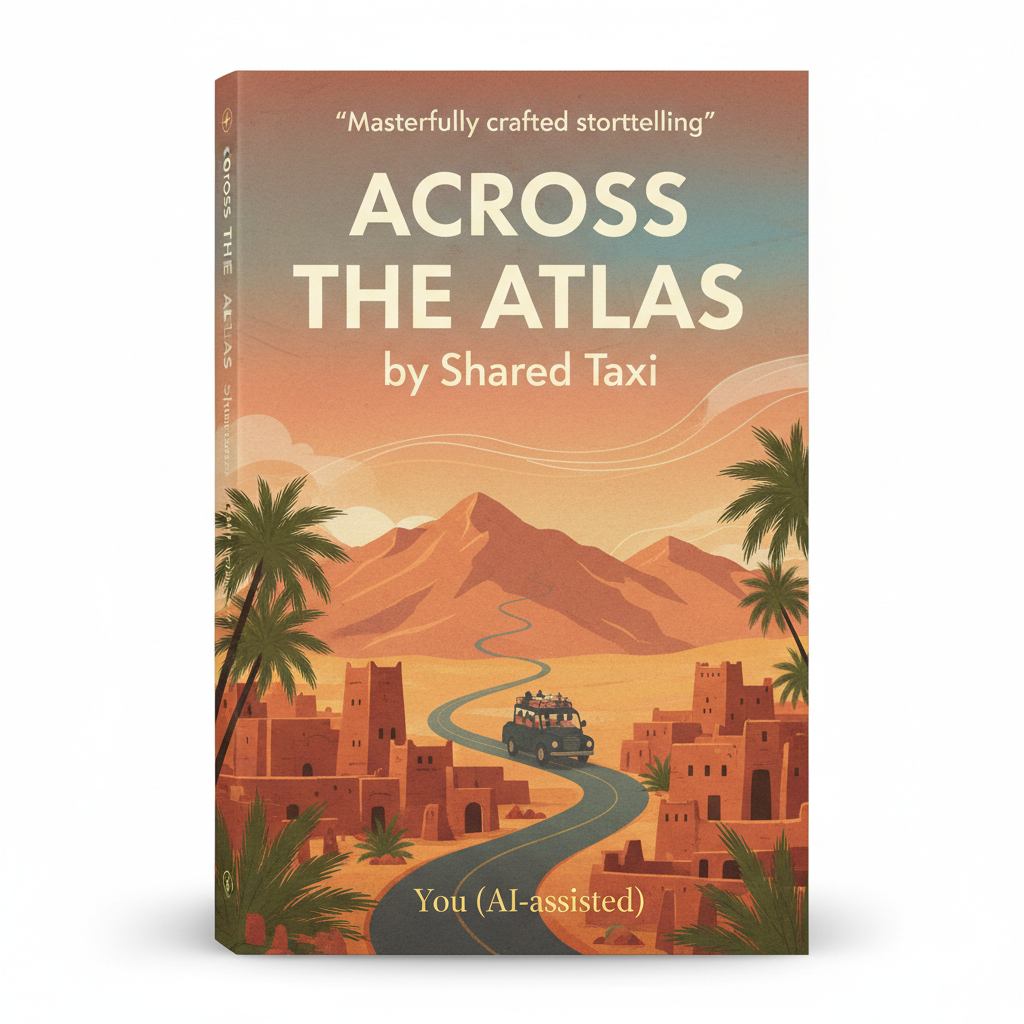
Synopsis
An intrepid traveler navigates the vibrant chaos of Morocco entirely by shared taxi, discovering profound connections and unexpected truths in every conversation and mile marker.
Chapter 1: The First Ride: Casablanca's Embrace
The air, thick and humid, clung to me the moment I stepped from the air-conditioned cocoon of Mohammed V International. It tasted of dust and something vaguely metallic, a scent utterly alien to the sterile recycled air of the Boeing. A cacophony assaulted my ears: rapid-fire Arabic, the rumble of unseen engines, and a distant, insistent honking that seemed to be the city’s heart. My backpack, an absurdly heavy appendage strapped to my back, shifted, reminding me that this was real. Casablanca.
Terminal 1 was a blur of fluorescent lights and hurried figures. I navigated the labyrinthine corridors, a growing sensation of mild panic prickling my skin. Every sign was in Arabic and French, the latter a language I could fumble through, but the former an impenetrable script that felt designed to mock my singular English-speaking brain. My mission: a shared taxi to the city center. A simple enough concept on paper. In practice, it felt like deciphering ancient runes while blindfolded.
Outside, the sun, a fierce, unapologetic orb, beat down on the taxi queue. A wave of exhaustion, the kind that only comes after twelve hours crammed into an economy seat, threatened to buckle my knees. The queue itself was less a line and more a restless amoeba, constantly shifting, dissolving, and re-forming. Men in long, flowing djellabas stood shoulder to shoulder with women in vibrant headscarves, children clinging to their hands, their eyes wide with the same bewildered awe that must have been etched across my own face.
My eyes scanned for the tell-tale white of a shared taxi, or ‘grand taxi,’ as I’d learned from my pre-trip research. These would be older Mercedes Benzes, beat-up and overflowing. I spotted one, its paintwork faded to a creamy off-white, a dent blossoming like a grotesque floral arrangement on its rear fender. A man, his face a roadmap of sun-baked lines, leaned against its hood, chewing on a toothpick, his gaze sweeping over the crowd. He looked like a man who knew things.
Taking a deep breath, I pushed through the eddying mass, my backpack a clumsy battering ram. “Grand taxi?” I asked, my voice a reedy whisper in the din, pointing vaguely in the direction of the city.
The man’s eyes, dark and intelligent, crinkled at the corners. He removed the toothpick. “*Oui, Madame. Casablanca Centre*.” His French was surprisingly clear, devoid of the rapid-fire slurring I’d overheard.
“How much?” I managed, clutching my well-worn phrasebook in my clammy hand, though the words tumbled out before I could find the right page.
He held up five fingers. Fifty dirhams. That was what the guidebook had said, about five US dollars. A fair price. I nodded, a flicker of relief uncurling in my chest. He gestured to the front passenger seat. “*Avant, s’il vous plaît*.” Front, please.
My stomach did a little flip. The front passenger seat in a shared taxi meant two passengers, not one. I’d read about it. A common practice here. It was part of the experience, I reminded myself, forcing a tight smile.
The car’s interior smelled of stale cigarette smoke, old upholstery, and something vaguely like spices. The dashboard was a landscape of cracks and missing knobs. The seat itself was a patchwork of frayed fabric, its stuffing threatening to erupt from several seams. I squeezed myself in, my backpack having been unceremoniously tossed into the tiny boot by the driver.
Within moments, a man with a neatly trimmed beard and a pristine white shirt slid in beside me. He smelled faintly of musk and cologne, a stark contrast to the car’s general aroma. He grunted a polite acknowledgment, his gaze fixed straight ahead. The driver, meanwhile, had rounded the car and settled himself behind the wheel. He looked into the rearview mirror, his eyes scanning the road behind, then shouted something guttural out the window. Another moment, and a third passenger, a woman swathed in a *hijab* of brilliant turquoise, clambered into the back, followed by a younger man with headphones clamped over his ears. The car, meant for four passengers, now held six. The driver, two in the front, and three in the back. Welcome to Morocco.
The Mercedes rumbled to life with a cough and a wheeze. The driver, without so much as a backward glance, yanked the gear stick into first. We lurched forward, joining the chaotic ballet of traffic. It was a dance I hadn’t learned the steps to. Cars swerved and honked with a relentless urgency. Mopeds, laden with impossible towers of bread or entire families, wove through the narrow gaps between vehicles like daring insects. Pedestrians, seemingly possessed of an innate invulnerability, stepped into the flow of traffic with a confident stride that made my breath catch in my throat.
I pressed myself against the door, the flimsy fabric of my shirt doing little to absorb the heat radiating from the window. My fellow front-seat passenger remained stoic, his composure baffling. He seemed utterly unfazed by the hair's-breadth misses and the constant blare of horns. The noise level in the car was surprisingly low, the road noise and the murmuring of the back-seat passengers forming a low thrum beneath the driver’s occasional bursts of conversation, mostly directed at the road itself.
My eyes darted around, trying to absorb everything. The airport road quickly gave way to a landscape of low-slung, whitewashed buildings, their facades often adorned with intricate geometric patterns or splashes of vibrant color. Laundry, strung across balconies, fluttered like defiant flags. Satellite dishes, gleaming silver, sprouted from rooftops like strange metallic fungi. The air was now thick with the scent of exhaust fumes mixed with something sweet and smoky, perhaps charcoal or grilling meat.
We passed bustling marketplaces, where piles of oranges and crimson pomegranates glowed under makeshift awnings. Donkey carts, laden with impossible weights, mingled with sleek European cars. Men pushed handcarts piled high with what looked like recycled cardboard. Women, their faces veiled or uncovered, haggled animatedly over produce. The sheer human density was astonishing. Every street seemed to pulse with life, every corner teeming with activity.
A sudden, sharp honk startled me. Our driver, with a casual flick of the wrist, narrowly avoided colliding with a moped that had daringly cut across three lanes. My heart hammered against my ribs. I risked a glance at the man beside me. He merely blinked, his expression unreadable. He clearly had a much higher threshold for vehicular mayhem.
The conversation in the back began to pick up, a melodic stream of Arabic, punctuated by bursts of laughter. I wished I understood. I felt like an alien observing a fascinating, intricate ritual without knowing its meaning. My phrasebook, still clutched in my hand, felt utterly useless. How could I even begin to ask a simple question in this swirling vortex of sound and motion?
The driver, a man approaching fifty with a receding hairline and a perpetually stern expression, began to hum along to the tinny Moroccan music emanating from the radio. His fingers beat a gentle rhythm on the steering wheel, an incongruous gesture of peace amidst the chaos he so expertly navigated. He seemed to possess an almost telepathic connection with the other drivers, predicting their movements, anticipating their turns, and always, always, finding a way through.
My muscles, tensed from the moment I entered the car, slowly began to relax. I realized I was breathing in shallow, anxious gasps. I consciously tried to deepen my breaths, to inhale the foreign air, to let the sensory overload wash over me. This was it. This was the adventure. This was the immersion I craved.
The city began to change. Buildings grew taller, their architecture more modern, interspersed with imposing structures that looked centuries old. The grand boulevard, lined with palm trees, gave way to narrower streets, some barely wide enough for two cars to pass. The honking, if anything, intensified. It was no longer an angry sound but a form of communication, a constant dialogue between drivers, a warning, an invitation, a playful challenge.
We stopped at a traffic light beside a vibrant kiosk, its shelves overflowing with cigarettes, newspapers, and brightly colored candies. A young boy, no older than ten, darted between cars, hawking bundles of fresh mint. The intoxicating scent of it wafted into the open window. It was crisp, invigorating, a welcome counterpoint to the exhaust fumes.
The man beside me, for the first time, shifted his gaze. His eyes met mine, a fleeting moment of connection. He offered a small, polite smile. “*Bienvenue à Casablanca, Madame*.” His voice was low, reassuring.
“Thank you,” I managed, the words a little choked.
He gestured vaguely out the window. “*C’est grand, n’est-ce pas?*” It's big, isn't it?
I nodded vigorously. “*Très grand. Et… très animé*.” Very big. And very lively.
His smile widened slightly. He seemed pleased by my attempt at French. “*Oui. Toujours. Mais… belle*.” Yes. Always. But… beautiful.
I looked out at the kaleidoscope of colors, the swirling motion, the undeniable energy pulsating through the city. Despite the grime, the noise, the sheer unadulterated chaos, there was something undeniably beautiful about it. A raw, untamed beauty that hummed with life.
The shared taxi, a conduit for myriad lives and journeys, rumbled on. Somewhere, deep in the city’s heart, my destination awaited. But for now, I was content to be a passive observer, a silent participant in this vibrant, bewildering tableau. The first ride. It had been challenging, overwhelming, even a little terrifying. But it had also been exhilarating. And I knew, with a certainty that settled deep in my bones, this was just the beginning. The road, stretching out before us, promised so many more such journeys, so many more glimpses into the soul of this incredible country. And I, battered backpack and racing heart, was ready for every single one.
Chapter 2: Fez: Labyrinth of Voices
The dust of the shared taxi, a fine, ochre powder, coated my clothes and throat, mingling with the lingering scent of stale cigarette smoke and mint tea. Our driver, a man whose face was a roadmap of sun-baked wrinkles, finally killed the engine with a shuddering cough. We had arrived. Not, as I had naively imagined, at some grand gateway to Fez, but rather at a bustling, nondescript road junction choked with vendors, donkey carts, and a cacophony of human voices.
“Fez,” he announced, his voice raspy, a dismissive flick of his wrist indicating a direction I couldn't discern amidst the swirling chaos. My fellow passengers, a young couple draped in vibrant textiles and an elderly man with a perpetually amused glint in his eye, began to gather their belongings with practiced haste. They moved like currents through the thick human tide, leaving me stranded on the curb, my backpack feeling suddenly enormous, a beacon for every eager tout within earshot.
“Medina? Madame? Hotel? Good price!” A chorus of insistent voices enveloped me. I clutched my shoulder straps, a deer in the headlights, the map I’d painstakingly downloaded onto my phone suddenly an absurd, useless artifact. This wasn't just a city; it was a living, breathing organism, a labyrinth designed by centuries of bustling humanity.
The elderly man, noticing my bewildered expression, returned to my side. He radiated a calm, knowing energy. “First time in Fez?” he asked, his English surprisingly good, albeit accented with the rolling 'r’s of the Maghreb.
I nodded, feeling a flush creep up my neck. “It’s… quite something.”
He chuckled, a dry rustle like autumn leaves. “Fez is not for the faint of heart. Come, I show you where to go. The taxi cannot enter the old city.” He gestured with a gnarled hand towards a narrow, shadowed alleyway that seemed to swallowed the bustling street whole. It looked less like an entrance to a city and more like a crack in the fabric of reality.
I hesitated. Instinct warred with the knowledge that blind trust was often the currency of travel here. But there was something in his eyes, a kind of paternal warmth, that eased my apprehension. He was the man who had shared his dates with me during the long ride, who had pointed out the distant peaks of the Atlas Mountains as we’d driven through the plains.
“Thank you,” I managed, hoisting my backpack higher.
“My name is Hassan,” he offered, already leading the way. “You are going to a riad in the medina?”
“Yes, Riad Anass,” I replied, fumbling for the address he couldn't possibly read.
He waved away my efforts. “Anass? Yes, I know it. Near Bab Bou Jeloud.”
Bab Bou Jeloud. The Blue Gate. The iconic entrance I’d seen in countless photographs, rendered entirely unrecognizable by the swirling reality before me.
Hassan navigated the throng with effortless grace, his small frame weaving through the donkey carts laden with leather goods, past the overflowing fruit stalls, and around the bustling tea vendors. I scrambled to keep up, my senses barrassed by unfamiliar sights and sounds. The air thickened with the scent of spices – cumin, coriander, saffron – mixed with the sharp tang of curing leather, the sweet aroma of pastries, and the undeniable, earthy smell of donkeys. It was a perfume unique to Fez, intoxicating and overwhelming.
The alleyways narrowed further, becoming twisting passages flanked by high walls that seemed to lean in, whispering secrets. Sunlight, once brilliant, now struggled to penetrate, dappling the ancient stones in shifting patterns of gold and shadow. The sounds of the modern city faded, replaced by the rhythmic clatter of hammers from a coppersmith’s workshop, the distant wail of the call to prayer, and the constant, vibrant murmur of human voices. This was not a city, I realized, but a living, breathing palimpsest, each layer of history carved into its very stones.
“Here,” Hassan announced, stopping abruptly before an unassuming wooden door, studded with intricate metalwork. “Bab Bou Jeloud.”
And there it was, an archway shimmering with vibrant blue and green tiles, a testament to intricate craftsmanship. Yet, it was different from the postcards. Here, it was less a monument and more a bustling portal, alive with people flowing in and out like a human tide. Donkeys, laden with goods, pushed through, their hooves clattering on the ancient cobblestones. Street vendors hawked their wares, their cries blending into a melodic, incessant hum.
Hassan pointed into the heart of the medina. “Your riad is this way. We will go together.”
His continued generosity surprised me. Most people, I had learned, would have expected payment by now. He seemed genuinely intent on helping.
We entered the labyrinth. It was utter sensory overload. Everything was compressed, intensified. Shops spilled out onto the narrow lanes, their vibrant wares – leather bags, ceramic tagines, shimmering silks – a kaleidoscope of colour. The air throbbed with the constant murmur of voices, a thousand conversations weaving in and out, in Arabic, in French, in a smattering of other languages. Children chased pigeons, their laughter echoing off the ancient walls. A blind man, guided by a young boy, navigated the uneven cobblestones with surprising agility, his stick tapping a rhythmic beat.
I felt like an intruder, an alien observer in a world that had existed, largely unchanged, for centuries. My carefully planned itinerary, my carefully chosen phrases, all felt utterly inadequate. This was a place to be experienced, not merely observed.
Hassan moved with an internalized map, turning with seemingly arbitrary precision down alleys that looked identical to my untrained eye. Twice, we encountered dead ends, but he merely chuckled, a mischievous glint in his eye, and backtracked without a hint of frustration.
“The medina, she keeps her secrets well,” he said, noticing my wide-eyed confusion. “But once you know her, she welcomes you.”
The young couple from the taxi, who had somehow reappeared at our side, added their own insights. The woman, whose name I learned was Aicha, spoke in rapid, lilting French. “It’s like a living organism, the medina. The streets breathe, they shift. You must learn to listen to them.” Her husband, Karim, nodded in agreement, a warm, reassuring smile on his face. He spoke less, but his presence was a comforting anchor.
Aicha pointed to a vendor selling trays of glistening dates. “Here, try these. They are from our village, near Tafilalt. Sweetest in all Morocco.” She peeled back a sticky skin, offering me a date that practically melted on my tongue, releasing a burst of honeyed sweetness.
We walked on, a small, accidental caravan. They pointed out hidden fountains, artisans hunched over their intricate work, and the faint, sweet scent of cedar wood from a carpenter’s shop. They became my guides, not just to the physical labyrinth, but to its unspoken rules, its rhythms. They told me about the history of Fez, about the university of Al-Attarine, about the tannery’s ancient methods. Their words, delivered in fragments of English and French, painted a vivid picture of a deeply traditional city, fiercely proud of its heritage.
Finally, after what felt like an endless journey through a shifting, dreaming city, Hassan stopped before another unassuming doorway, set into a seamless stone wall. “This is it. Riad Anass.”
It was so perfectly integrated into the streetscape that I would have walked past it a dozen times without noticing. No grand entrance, no glittering sign. Just the heavy wooden door, intricately carved.
“Thank you, Hassan. And Aicha, Karim,” I stammered, feeling a profound sense of gratitude. “I don’t know how I would have found this without you.”
Hassan waved away my thanks with a dismissive hand. “No, no. It is nothing. Travelers help travelers. This is our way.”
Aicha smiled, her bright eyes crinkling. “If you need anything while you are in Fez, ask for Aicha in the souk of the dyers. Everyone knows me. Or Karim, by the leather tanneries.” She gestured vaguely into the heart of the medina. “We are like family here.”
Karim gave a shy nod. “Fez is a friend. You will like it.”
With a final wave, they melted back into the bustling street, leaving me once again alone, but this time with a different feeling. Not lost, but ready. I pushed open the heavy wooden door, and stepped into a cool, calm courtyard, a world away from the chaotic beauty of the medina. The air here was scented with orange blossom and jasmine. A small fountain murmured in the center, its gentle splash a soothing counterpoint to the insistent hum of the city outside. Sun slanted through the open roof, illuminating intricate tilework and potted plants.
I had arrived. And I had learned that the true map of Fez was not on a screen, but woven into the generous hearts of its people. The labyrinth was not something to be conquered, but to be embraced, its secrets revealed not by guidebooks, but by the kindness of strangers. And as I checked in, the murmur of the medina, now a distant, soothing hum, hinted at countless other stories waiting just beyond the threshold, whispered by the winding alleys and the echoing walls, in a language I was just beginning to understand. Tomorrow, I would step back out into that vibrant chaos, and this time, I wouldn't be quite so lost.
Chapter 3: Mountain Passes and Shared Meals
The diesel engine groaned, a familiar, rhythmic complaint as we began our ascent. Outside the window, the flat, ochre landscape of central Morocco dissolved into a patchwork of olive groves, then gave way to the craggy foothills of the High Atlas. The *Grand Taxi*, a beige Mercedes from a bygone era, felt like a ship setting sail on a sea of rock, its suspension groaning with each curve and dip. The air, which had clung heavy and warm in the plains, now carried a crisp, almost alpine scent – a mix of pine, dry earth, and something indefinably wild.
My fellow passengers, a kaleidoscope of faces I now recognised from the crowded taxi stands of Fez, settled back into their routine. The older woman beside me, her headscarf a vibrant blue against her weathered skin, pulled a small, embroidered pouch from her voluminous bag and began to finger a string of amber beads. Across from us, two young men, brothers perhaps, spoke in hushed tones, their eyes, dark and quick, scanning the passing landscape. In the front, next to the driver, a stout man with a neatly trimmed beard was already asleep, his head lolling against the window, the sunlight glinting off his silver-rimmed glasses. He’d introduced himself as Youssef, a merchant on his way to a market in Azrou.
The flat ribbons of road we'd traversed so far now tightened into a series of hairpin bends. The Mercedes, despite its age, handled them with a surprising, almost defiant, grace. Each turn offered a new vista, a panorama of plunging valleys and dramatic, sun-baked peaks that seemed to ripple towards the sky. The colours of the mountains were a revelation: not just brown, but a spectrum of burnt umber, deep ochre, and the occasional flash of verdant green where a hidden spring nourished a cluster of trees. I pressed my forehead against the cool glass, trying to imprint every detail onto my memory, the enormity of the landscape dwarfing our small, struggling vehicle.
The driver, a man whose permanent five o’clock shadow suggested a life lived largely in haste, navigated these treacherous passes with an unnerving confidence. His hand, calloused and strong, rarely left the top of the steering wheel, his eyes darting between the road ahead and the small, cracked rearview mirror. He spoke in a rapid-fire dialect of Darija, interspersing his narratives with loud bursts of Arabic pop music that vibrated through the worn upholstery. Sometimes, he’d turn to address the entire car, a monologue punctuated by laughter, and the passengers, whether they understood his specific words or not, would nod in agreement, a shared understanding of the journey itself.
Hours bled into one another, marked only by the shifting angle of the sun and the increasing chill in the air. The small talk in the taxi, initially hesitant, had grown into a comfortable hum. We were linked, not just by the confined space, but by the shared experience of the road. Youssef, awakened now and refreshed, began to share anecdotes about his trading ventures, his voice a low, melodious rumble. The brothers, emboldened perhaps by the shared laughter, chimed in with stories of their village life, painting a picture of sheep grazing on impossibly steep slopes and nights spent beneath a canopy of stars. Even the older woman, initially reserved, offered me a piece of dried fig from her pouch, a wordless gesture of welcome that transcended any language barrier.
My own attempts at conversation, a hesitant mix of broken French and the handful of Arabic phrases I’d gleaned from my travel guide, were met with patience and encouragement. They corrected my pronunciation gently, their smiles warm and genuine. It was in these small interactions, these shared smiles across the worn seats, that the true magic of shared travel began to reveal itself. We were temporary companions in a metal box hurtling through one of the most stunning landscapes I had ever seen, and in that shared vulnerability, a nascent camaraderie was blossoming.
Suddenly, with no warning other than a slight decrease in speed, the driver veered sharply off the main road onto a rough track of gravel and loose stones. The Mercedes lurched, throwing us forward slightly before settling onto the uneven terrain. The conversation died, replaced by questioning glances. Was this a shortcut? A bathroom break?
The driver brought the car to a halt in a small, sheltered hollow. Below us, a slender river snaked through the valley, its water a startling silver under the afternoon sun. On the opposite bank, a handful of Berber tents, their dark, woven fabric almost invisible against the mountain, clustered near a stand of gnarled juniper trees. The air, here, was thin and clean, carrying the scents of wild herbs and damp earth.
“*Ach-ghada*,” the driver announced, turning in his seat, a wide grin breaking across his face. “Lunch.”
A ripple of murmurs, a mix of expectation and relief, went through the car. Youssef, with a surprising agility for a man of his size, was already reaching for a large, woven basket he’d had tucked under his seat. The brothers exchanged a knowing glance, their faces alight with anticipation.
We spilled out of the taxi, stretching cramped limbs and breathing in the cool mountain air. The driver, meanwhile, had produced a worn prayer mat and, after surveying the rocky ground, laid it out carefully in a patch of shade offered by a scraggly tree. It was then I noticed that almost every passenger had brought something.
From Youssef’s basket emerged a steaming tagine, its terracotta lid still warm to the touch. The aroma of tender lamb, preserved lemons, and a complex blend of spices wafted through the air, instantly making my stomach rumble. The older woman, with surprising grace, unveiled a cellophane-wrapped parcel of *khobz* – flat, round discs of homemade bread, still warm from the oven. The brothers, meanwhile, produced a cluster of dates and a small, earthenware pot of olives cured in brine and herbs.
I, the unprepared traveler, felt a pang of embarrassment. My contribution to this impromptu feast consisted solely of a half-eaten packet of biscuits and a bottle of lukewarm water. But before I could dwell on my inadequacy, Youssef gestured for me to sit beside him on the prayer mat.
“*Kul! Kul!*” he urged, using the Arabic word for “eat,” his smile encompassing the entire group.
And so, we ate. The tagine was exquisite, the lamb meltingly tender, its rich sauce a perfect counterpoint to the sweetness of the preserved lemons. We broke off pieces of *khobz* to scoop up the delicious stew, our fingers dipping and sharing from the communal dish. The dates were plump and sweet, the olives salty and tangy. Each bite was an explosion of flavour, enhanced by the crisp mountain air and the shared experience.
Conversation flowed easily, punctuated by satisfied sighs and the clinking of shared utensils. The driver, usually so focused on the road, now sat amongst us, his usual stern expression softened by the shared bounty. He spoke of his family, of the challenges of driving these mountain roads, of his dreams of one day owning a newer, more comfortable car. The older woman, her eyes sparkling, told a story of a pilgrimage she had made to a distant shrine, her voice a soft cadence that held us captive.
It wasn't just the food; it was the way it was offered, the way it was shared. There was no formality, no hesitation. This was simply how things were done amongst temporary companions, a silent agreement to pool resources and break bread together, a ritual as old as the mountains themselves. I felt a warmth spread through me, different from the initial flush of embarrassment. It was a sense of belonging, a quiet understanding that I was no longer just an observer, but a participant.
As the last scraps of tagine were scooped up and the bread crumbs brushed away, the driver rose, stretching languidly. “*Yallah*, let’s go,” he announced, his voice gruff but tinged with a familial warmth. We packed our empty dishes, leaving no trace of our feast, the mountains a silent witness to our camaraderie.
Back in the taxi, the atmosphere was palpably different. The initial distance between us had evaporated, replaced by a comfortable intimacy. The conversations continued, but now with a deeper resonance, a shared history woven into the fabric of the journey. Youssef even offered me a small, perfectly ripe orange, peeled and segmented, a final gesture of hospitality. I accepted it with a genuine smile, the sweetness of the fruit mirroring the warmth in my heart.
As the sun began its descent, painting the western peaks in fiery hues of orange and purple, the road narrowed once more, winding its way through a deep gorge. The Mercedes, its engine purring a contented tune, continued its odyssey. The shadows lengthened, stretching across the rugged landscape, and the air grew noticeably colder. I pulled my jacket tighter, watching the world outside transform as day surrendered to dusk.
The rhythm of the road became a lullaby. The driver, no longer talking, focused intently on the fast-fading light. The other passengers, their faces softened by the shadows, had grown quiet, lost in their own thoughts or perhaps simply enjoying the profound stillness of the mountains. I, too, fell into a meditative state, the day's experiences swirling in my mind.
The shared meal hadn't just filled my stomach; it had filled a space within me I hadn't known was empty. It had shown me the unspoken language of generosity, the effortless grace of connection that thrives in the unexpected spaces between strangers. I had begun this journey expecting to simply get from one place to another, a lone traveler observing a foreign land. But here, in the heart of the Atlas, I was learning that the journey itself was the destination, and the people along the way—they were the true landscape.
The air grew sharply colder, hinting at the altitude we had reached. The distant lights of a town, a faint scattering of yellow pinpricks against the inky blackness of the mountains, appeared on the horizon, promising comfort and a place to rest. But as we snaked around the final bend, the town was not our destination. Instead, the driver pulled over abruptly, not in a bustling square or by a bus stop, but at the mouth of a narrow, unlit track, where a lone figure stood, shrouded in the deepening twilight, a small, worn suitcase at his feet. The car, packed to the brim, now had to make room for one more.
Chapter 4: Marrakech: The Jemaa el-Fna's Pulse
The Peugeot screeched to a halt, a final defiant wheeze from its overworked engine. Dust, a fine red layer from the Atlas passes, billowed around its tires like a phantom cloud. The driver, a man whose face was etched with the geographic history of every road he’d ever traversed, gestured vaguely with a calloused hand. “Jemaa el-Fna.” His voice, hoarse from a thousand previous declarations, was barely audible above the sudden, engulfing roar of Marrakech.
I unfolded myself from the back seat, joints protesting after the journey, and blinked. The world, previously a mosaic of mountain vistas and quiet villages, had fractured into a kaleidoscope of sound and fury. It wasn’t just noise; it was an orchestra of humanity, a symphony of commerce and celebration, each instrument playing at full volume. My backpack, a familiar weight on my shoulders, suddenly felt like a flimsy shield against the onslaught.
Before me yawned a vast expanse, bathed in the soft, fading light of late afternoon. The air, thick with the scent of spices and exhaust fumes, felt electric, humming with an energy that vibrated in my chest. Horse-drawn carriages, their drivers in traditional djellabas, clip-clopped past, their bells a tinny counterpoint to the din. Hawkers, their voices honed by years of practice, chanted their wares, a rhythmic incantation that blended into the general cacophony.
My eyes struggled to focus, overwhelmed by the sheer volume of sensory information. Women, their faces framed by vibrant headscarves, moved with a fluid grace through the crowds, baskets balanced impossibly on their heads. Men in conical straw hats led donkeys laden with goods, their cries of “Balak! Balak!” (Watch out!) cutting through the din. The square, even at this relatively early hour, was a river of humanity, swirling and eddying around an unseen gravitational pull.
I took a tentative step forward, then another, the asphalt beneath my worn boots vibrating with the collective pulse of the city. My shared taxi, a faithful if somewhat battered conduit, had delivered me to the very heart of the beast. This wasn't just a square; it was a living, breathing entity, its heart beating to the rhythm of a thousand distinct lives.
Suddenly, a whiff of something sweet and cloyingly fragrant hit me. Mint tea, I realized, steaming from countless tiny glasses offered from brass trays. Then came the pungent, earthy aroma of grilled meats, mingled with the sharper scent of oranges, piled high on vendor stalls, their citrusy perfume cutting through the heavier smells. My stomach, long accustomed to the irregular timings of shared taxi snacks, rumbled in protest.
I navigated the first wave of people, a polite nod here, a slight sidestep there, trying to project an air of calm I certainly didn't feel. A man, his face a roadmap of sun-darkened wrinkles, extended a hand, a small, intricate leather-bound book dangling from his fingertips. “Souvenir, madame? Good price.” His voice was smooth, almost hypnotic. I smiled, shook my head gently, and moved on, the rhythm of his sales pitch fading behind me.
Further into the square, the scene intensified. Storytellers, their voices rising and falling in dramatic cadences, gathered mesmerized circles around them. Their faces were animated, their hands weaving tales in the air as their words painted vivid images. I couldn't understand much of the Arabic, but the energy was palpable, the laughter and gasps from the audience universal. It was theatre played out under the vast, Moroccan sky, an ancient tradition echoing down through generations.
Then came the snake charmers. Their flutes, a thin, reedy sound, cut through the general hubbub, drawing my gaze. Coiled serpents, their scales shimmering under the faint light, swayed hypnotically in woven baskets, their heads rising and falling in time with the music. Their handlers, often with a mischievous glint in their eyes, seemed to possess a primal connection to the creatures. It was both unsettling and captivating, a dance on the edge of danger.
I kept moving, drawn deeper into the heart of the square. The stalls, initially a blurred mess, began to coalesce into distinct entities. Piles of dates, glistening like amber jewels, were stacked alongside arrays of intricate silver jewelry. Spices in every conceivable shade, from rusty ochre to vibrant saffron, scented the air from open sacks. The vibrancy of the colours was dizzying, a riot of reds, blues, and golds clashing and harmonizing.
As the sun dipped lower, painting the sky in fiery streaks of orange and purple, the square transformed again. Hundreds of food stalls, previously mere frameworks, now burst into life. Lanterns, casting a warm, golden glow, illuminated bustling kitchens. Clouds of steam rose from bubbling tagines, their fragrant odors promising untold culinary delights. The air grew thick with a new layer of smells: roasted lamb, sizzling merguez, and the sweet, comforting scent of harira, the traditional Moroccan soup.
I found myself pausing, mesmerized by a group of Gnaoua musicians. Their deep, resonant chanting, accompanied by the hypnotic thrum of their *guembris* and the clatter of *qarqaqs* (metal castanets), created a trance-like atmosphere. Their movements were fluid, almost ritualistic, their brightly coloured costumes swaying to the primal beat. Their music resonated deep within me, bypassing language and culture, speaking directly to something ancient and rhythmic in my own soul. It was raw, unadulterated passion, born from centuries of storytelling and spiritual devotion.
A sudden gust of wind, carrying with it the elusive scent of night-blooming jasmine, rustled through the square. The temperature began to drop, a welcome respite from the day's heat. The crowds, far from thinning, seemed to swell, as if every inhabitant of Marrakech and its surrounding villages had gravitated to this single, pulsating heart.
I found a relatively quiet corner near a date seller, whose calloused hands efficiently scooped handfuls into paper cones. I took a deep breath, trying to process the sheer magnitude of the experience. It wasn’t just the sights and sounds; it was the feeling of being utterly, completely immersed in something so ancient, so vibrant, so unapologetically alive.
A small child, no older than five, darted past my legs, kicking up a tiny cloud of dust. She giggled, her high-pitched laughter cutting through the din like a bell. Her mother, her face a serene mask, followed close behind, her gaze sweeping over the endless bazaar. There was a sense of utter belonging here, of generations having lived and breathed in this very space, their stories woven into the very fabric of the square.
I pulled out my small notebook, the pen feeling alien in my hand. How to capture this? How to translate the roar in my ears, the scent in my nostrils, the electric hum beneath my feet onto a blank page? It felt impossible. My previous understanding of "city life" felt laughably quaint compared to the raw, untamed energy of Jemaa el-Fna. This wasn't a city; it was an organism, its every cell thrumming with an independent, yet interconnected, life.
My eyes scanned the perimeter, searching for a sign, any indication of where to go next. The shared taxi, my trusty vessel of transition, had deposited me and vanished, leaving me adrift in this magnificent, chaotic sea. I felt a familiar pang of apprehension, the brief flicker of doubt that often accompanies the arrival in a truly overwhelming place.
But then, the aroma of grilled lamb, spicy and tantalizing, hit me again, overriding the apprehension with an entirely more primal urge. My eyes landed on a bustling food stall, its cook expertly flipping skewers over glowing coals. The steam rose in fragrant clouds, carrying promises of sustenance and warmth.
For a moment, I stood there, simply watching the ballet of commerce and connection unfold before me. This wasn't just a place to eat, or to shop, or to be entertained. It was a place to belong, if only for a fleeting moment. It was a testament to the enduring human spirit, a place where stories unfolded, meals were shared, and connections, however fleeting, were forged amidst the vibrant chaos.
My gaze settled on a man in a worn, traditional cap, patiently stirring a large pot, its contents bubbling invitingly. He caught my eye, a small smile crinkling the corners of his eyes, and gestured towards an empty stool at his counter. The gesture, simple and unspoken, was an invitation, a thread of connection in the dizzying tapestry of the square. And in that moment, amidst the roar of Marrakech, I felt a magnetic pull, a deep and undeniable urge to step fully into its embrace.
Chapter 5: Desert-Bound: Silence and Stars
The air, thick and sweet with the jasmine and exhaust fumes of Marrakech, thinned as our shared taxi peeled away from its western gate. The cacophony of the Djemaa el-Fna, a symphony of snake charmer flutes, hawkers' cries, and the syncopated rhythm of Berber drums, shrunk in the rearview mirror until it was merely a memory, a faint hum against the steadily growing whine of the engine.
Our vehicle, a battered Mercedes sedan of indeterminate vintage, felt different this time. Older, perhaps, or simply more worn from countless journeys across the Atlas. The seats, usually a patchwork quilt of humanity, held only four of us: the driver, a taciturn man whose face was a roadmap of sun-baked lines, a young couple, hushed and entwined in the back, and me, perched in the front passenger seat. There was no boisterous banter, no shared snacks, no attempts at fragmented conversations in a dozen languages. A quiet understanding settled like dust motes in the afternoon sun. We were heading deeper south, toward the desert, and the landscape had already begun its slow, deliberate transformation.
The rich ochre and terracotta hues of the city gave way to a palette of muted browns, greys, and the occasional stubborn splash of green where an oasis clung to life. The asphalt ribbon, smooth at first, gradually deteriorated into a pitted, uneven path that made the Mercedes shudder and groan in protest. Villages, once frequent and bustling, became sparse, mere clusters of mud-brick dwellings baking under an unfiltered sun. Their inhabitants, when we saw them, moved with the unhurried grace of those accustomed to vast spaces and the slow turning of seasons. Children, brown and luminous, waved from dusty doorways, their smiles bright against the somber backdrop.
The conversations inside the taxi, what little there had been, dwindled to silence. The young couple in the back occasionally exchanged whispers, punctuated by the soft brush of their hands. The driver, whose name I learned was Abdel, communicated primarily through grunts and the occasional pointing gesture, his eyes fixed on the horizon that shimmered with heat. I, too, found myself falling into a sort of meditative quiet. The relentless assault on the senses that had characterized my previous days in Morocco had finally receded. Here, in the vastness beyond the Atlas, there was only the hum of the engine, the whisper of wind through the open window, and the ceaseless, hypnotic rhythm of the road.
The mountains, which had been a formidable presence, towering and majestic, now seemed to recede, their peaks blurring into the distant haze. They were no longer a challenge to be crossed, but a memory, a testament to the journey already undertaken. The sky, a brilliant, impossibly blue expanse, seemed to stretch further here, an endless dome arching over a flat, ancient land. It was a landscape that commanded respect, not with drama, but with its sheer scale and raw, untamed beauty.
We stopped once, in what Abdel described with a wave of his hand as a "village," though it was little more than a roadside shack selling bottled water and stale bread. The air outside was dry and hot, smelling faintly of dust and something else – something ancient, like sun-baked earth and forgotten histories. I stretched my legs, feeling the grit of the desert under my worn boots. A lone camel, tethered to a gnarled tree, regarded me with impassive, black eyes. Its stillness was profound, a reflection of the land itself.
Back in the taxi, the silence felt different. It was no longer an awkward absence of conversation but a comfortable companion. It allowed for reflection, for the unfurling of thoughts that had been compressed by the constant stimulation of city life. I thought of the faces I had encountered, the hands I had shaken, the stories I had imperfectly pieced together. The shared taxis had not just been a mode of transport; they had been vessels of connection, each one a microcosm of Morocco's vibrant tapestry. But here, in this growing emptiness, the connections were internal.
Abdel, in the late afternoon, finally broke his long silence. His voice, gravelly and low, emerged as we passed a particularly desolate stretch where the road seemed to vanish into the horizon. "Desert," he grunted, gesturing with his chin. "Different."
I nodded, not needing elaboration. The very air was different, thinner, sharper, carrying with it the tang of anticipation. The sand, which had been lurking at the edges of the fields, now began to assert itself, creeping closer to the asphalt, forming small, wind-sculpted dunes. The sparse vegetation grew even sparser, giving way to hardy, tenacious shrubs that clung defiantly to life.
As dusk began to paint the sky, the landscape transformed again, cloaked in hues of orange, purple, and deep indigo. The shadows lengthened, stretching like weary travelers across the vast expanse. The silence deepened, broken only by the rhythmic hum of the engine and the occasional soft sigh from the back seat. The young couple, their heads now resting against each other, seemed to have drifted into a shared dream.
The sun dipped below the horizon in a spectacular blaze of glory, bleeding crimson and gold across the western sky. It was a swift, dramatic descent, unlike the lingering twilight of more temperate climes. In its wake, an inky blackness began to seep across the world, star by star.
And then, the stars.
I had seen stars before, of course, but never like this. Here, in the absence of any light pollution, they blazed with an intensity that stole the breath from my lungs. The sky was not merely sprinkled with points of light; it was a vast, glittering tapestry, a cosmic ocean swirling with diamonds. The Milky Way was a milky river, a visible pathway across the heavens, its ethereal glow casting a faint sheen on the distant dunes.
Abdel, perhaps noticing my awestruck gaze, pulled the Mercedes to the side of the road. The engine coughed once, then died, plunging us into an absolute, breathtaking silence. Even the wind seemed to hold its breath.
"Look," he said, his voice surprisingly soft.
We sat there, the four of us, in the heart of the desert, under a canopy of a million, billion stars. The air was cool now, crisp against my skin, carrying the scent of dry earth and something wild, ancient. The vastness was humbling, a profound reminder of my own minuscule place in the grand scheme. The shared taxi, which had jolted and rumbled its way across the Atlas, felt like a small, safe haven adrift in an ocean of cosmic wonder.
It was more than just beauty; it was a feeling of profound peace. The worries, the anxieties, the constant mental chatter of daily life, all seemed to dissolve under the weight of that immense, silent sky. There was a sense of coming home, not to a place, but to a feeling of deep belonging, of being connected to something unimaginably larger than myself. It was the feeling of truth, stark and unadorned, revealed in the quietude of the desert night.
Abdel restarted the engine after a long, silent moment. The sudden roar was a jolt, but even then, the spell wasn't entirely broken. As we resumed our journey, the headlights cut a narrow path through the encroaching darkness, but above us, the stars continued their silent, eternal dance. The destination, a small desert outpost called Merzouga, felt less like a physical place and more like an idea, a beckoning promise further out into the boundless expanse. The remaining miles stretched before us, not as an endurance test, but as a path into the heart of something profound, a journey not just across a country, but within myself. The desert had called, and I was answering, one silent, star-dusted mile at a time.
Chapter 6: The Sahara's Edge: A Bedouin Encounter
The final shared taxi, a battered Mercedes with more miles on its chassis than stars in the desert sky, lurched to a halt in Merzouga, a scattering of ochre buildings swallowed by the encroaching dunes. Dust, fine as confectioners’ sugar, puffed up around the tires, momentarily obscuring the last sliver of fading daylight. The air, thin and dry, carried the faint, sweet scent of burning wood and something musky, distinctly animal. My legs, cramped from hours of being folded like a pretzel, unbent with a grateful groan. The driver, a man whose face was etched with a thousand sun-baked lines, gestured vaguely towards a cluster of tents barely visible against the deepening indigo.
“Your guide,” he grunted, already pulling away, leaving me standing alone with my backpack, the drone of the Mercedes fading into the vast silence.
The silence was absolute, a heavy counterpoint to the raucous symphony of cities I’d left behind. It pressed in, vast and ancient, punctuated only by the whisper of the wind sifting through the sand. A figure emerged from the shadowy cluster of tents, tall and lean, draped in flowing dark robes that seemed to melt into the twilight. His head was wrapped in a cobalt blue turban, its fabric catching the last vestiges of light. He moved with an unhurried grace, like a desert animal perfectly attuned to its environment.
“*Salam alaikum*,” he said, his voice a low rumble, surprisingly gentle. “Welcome, traveler. I am Hassan.”
His eyes, dark and intelligent, crinkled at the corners as he offered a hand. His grip was firm, calloused. He didn’t ask my name, or where I’d come from, or why I was here. He simply took my backpack, slinging it over his shoulder as if it weighed nothing, and began to walk. I followed, my boots crunching softly on the sand that stretched, unbroken, to the horizon. The ground beneath my feet felt yielding, alive.
The tents, far from being a mere cluster, were a small encampment, tucked into a gentle hollow between two nascent dunes. Three camels, their ungainly figures silhouetted against the deepening sky, chewed placidly beside a rough-hewn wooden trough. A wisp of smoke curled from a small fire, where a woman, her face mostly obscured by a dark veil, stirred a pot. The smell of cumin and coriander, rich and inviting, immediately pulled me in.
Hassan led me to a low, open-sided tent, its floor covered with intricately woven rugs. Poufs, soft and inviting, were scattered around a low, round table. He gestured for me to sit, and without a word, vanished. I sank onto a pouf, the soft wool cushion a welcome relief. The last sliver of twilight bled out of the sky, giving way to an astonishing display of stars. They were not merely scattered, but poured across the heavens like spilled diamonds, a brilliant river of light I’d only ever dreamed of seeing. The Milky Way was a tangible, luminous cloud above me.
Hassan returned with a small, battered metal teapot and three glasses, each adorned with a simple silver pattern. He poured mint tea, its aroma instantly clearing the dust from my throat. It was piping hot, sweet, and unbelievably refreshing. Another figure joined us, an older man, his face a web of wrinkles that spoke of countless desert sunrises and sunsets. His eyes, though, held a youthful twinkle.
“My father, Ahmed,” Hassan introduced, and the old man offered a warm, toothless smile. He sat beside us, cross-legged, a presence both serene and powerful.
The sound of rustling fabric announced the woman’s return. She carried a large, shallow wooden bowl, heaped high with steaming couscous, studded with vegetables and chunks of tender lamb. The scents were intoxicating. She also brought rough-hewn wooden spoons. We ate in comfortable silence at first, the only sounds the soft clinking of spoons against the bowl and the occasional sigh of the wind. The food was simple, yet bursting with flavor, each bite a journey of texture and taste.
Ahmed, the patriarch, was the first to speak, his voice a low, gravelly timbre. “You travel far, little bird.” He spoke in Arabic, and Hassan, sensing my blank look, translated. “He asks where you come from.”
“America,” I replied, the word feeling oddly foreign in this ancient landscape.
Ahmed nodded slowly, thoughtfully. “A land of tall buildings and rushing waters. Is it true your cities never sleep?”
I recounted fleeting images of New York, of its ceaseless hum and artificial glow, trying to convey a sense of its energy without making it sound alienating. Hassan’s translations were smooth and effortless, bridging the cultural chasm with grace.
“Here,” Ahmed said, sweeping a hand towards the boundless darkness, “the desert sleeps, and we sleep with it. But in the quiet, there is much to be seen, if one has the eyes for it.” He paused, looking intently at me. “Do you have the eyes, little bird?”
The question lingered in the air, a challenge and an invitation. I felt a surge of truth, a burgeoning awareness that indeed, my eyes were being opened in ways I hadn’t anticipated.
“I hope so,” I confessed, feeling strangely vulnerable.
The woman, who I learned was called Fatima, Hassan’s wife, sat down near the fire, her movements economical and strong. She listened, her presence a steady anchor. Soon, the meal finished, and Hassan refilled our tea glasses. Ahmed leaned back, his eyes fixed on the distant stars.
“My father once told me stories,” he began, his voice dropping to a near whisper, “of the dunes moving, shifting like living things. They remember all who have passed over them. The footsteps of shepherds, of traders, of armies, even of spirits.” He smiled faintly. “The desert holds many secrets, if you know how to listen.”
I found myself leaning forward, captivated. This wasn’t just conversation; it was oral history, passed down through generations, woven into the very fabric of their lives.
“Did he ever see the dunes move?” I asked, my voice hushed.
Ahmed chuckled, a dry rustle like leaves. “He said he felt them. Felt the earth breathe beneath his feet. And he told me of the *djinns* that ride the wind, whispering forgotten stories to those who wander too far.”
Fatima, though silent, nodded in affirmation, a subtle movement that spoke volumes. It was clear these weren't just tales but deeply held beliefs, part of their heritage as people of the desert.
Hassan then spoke, his tone more pragmatic, yet still tinged with a poetic resonance. “My family, our family, they have lived here for longer than the great kings of your history books. We know the rhythm of the sand, how to find water where there is none, how to read the stars like a map.” He gestured to the sprawling celestial canvas above us. “That is our ancient compass. And it never lies.”
He pointed out constellations, calling them by names I didn't recognize, names that evoked images of desert animals and nomadic journeys. The Great Bear became a grazing camel, Orion transformed into a mighty hunter. Each star, each pattern, was a story waiting to be told.
“What brought you to the desert, little bird?” Ahmed asked, his gaze gentle but penetrating. “Do you seek something?”
The question caught me off guard. I had thought I was merely seeking adventure, a new experience. But as I sat there, under that boundless sky, nourished by their food and their stories, I realized it was more profound than that. I was seeking a connection, a deeper understanding, something beyond the superficial.
“Yes,” I admitted, my voice barely above a whisper. “I think I am.”
Ahmed smiled, a slow, knowing expression. “The desert has a way of showing us what we seek, even when we do not know it ourselves. It strips away the unnecessary, clears the mind. Here, there are no distractions, only truth.”
The air grew chillier as the hours passed, but the warmth of their hospitality was a shield against the cold. We talked of shared taxis, of the chaos of the cities, of the ease and slowness of desert life. They spoke of the changing seasons, of the rare rains that transformed the arid landscape into a fragile, blooming tapestry. They described the challenges of their life, the relentless sun, the scarcity of resources, but always with an underlying resilience, a deep-seated pride in their heritage.
Fatima brought another pot of tea, and this time, small, intensely sweet dates, their skins glistening in the firelight. These dates, she explained through Hassan, were harvested from their own small grove, an oasis of green clinging defiantly to life at the edge of the dunes. Each date tasted like condensed sunshine and earth, a testament to their enduring connection to this harsh but beautiful land.
As the night deepened, a sense of profound peace settled over me. The rhythmic breathing of the camels, the soft crackle of the fire, the distant whisper of the wind through the dunes – it all merged into a lullaby that spoke of timelessness. I felt a sense of belonging, an unexpected intimacy with these people I had met only hours before. It was the hospitality of the desert, raw and unadorned, offered freely and without expectation.
Before finally getting ready to sleep, Hassan led me to a smaller, private tent, similar to the main one, but with a thicker rug and a neatly folded blanket. “Rest well,” he said, his eyes reflecting the starlight. “Tomorrow, the dunes await.”
I laid down on the soft rug, pulling the blanket up to my chin. The flap of the tent was open, offering a final, breathtaking view of the celestial tapestry above. The night was a deep, velvet black, studded with more stars than I had ever imagined possible. Each tiny point of light seemed to shimmer with an ancient story. The last sound I heard before drifting into a deep, dreamless sleep was the soft, rhythmic sigh of the desert wind, carrying with it echoes of ancient voices and the promise of new discoveries. I had come to the Sahara’s edge by a shared taxi, but I had arrived at the heart of something infinitely larger. Tomorrow, the dunes would reveal their secrets, and perhaps, more of my own.
Chapter 7: Conversations with the Drivers
The rumble of the engine became a familiar heartbeat, the scent of diesel and dust a curious perfume. Each driver, with their worn seat covers and faded dashboard photos, was a fresh chapter, a new voice in the unfolding narrative of Morocco. They weren't just chauffeurs; they were impromptu narrators, historians, and philosophers, their hands on the wheel guiding not just the car, but also my understanding of their world.
There was Abdul, whose battered Mercedes, a relic from the 80s, felt more like a trusted steed than a vehicle. We’d left Zagora just as the sun began to paint the sky in fiery oranges and purples, heading towards Ouarzazate. Abdul, a man with a booming laugh and eyes that crinkled at the corners, had been a nomad in his youth. “The desert, mademoiselle,” he’d said, one hand casually resting on the gear stick, the other gesturing broadly at the retreating dunes, “she speaks to you. A different language than the cities, no? Cities, they shout. The desert, she whispers secrets.” He spoke of watching his father herd goats across vast, empty expanses, of learning the constellations not from books, but from endless nights beneath an unfiltered sky. His transition to a taxi driver had been driven by a desire for a different future for his children, a future with schools and doctors. Yet, the longing for the open spaces remained in his voice, a wistful melody beneath the rhythmic hum of the engine. He spoke of politics in hushed tones, careful not to betray any definitive leaning, but the subtext was clear. The promises of progress, he implied, often arrived in the cities long before they reached the scattered villages clinging to the edge of the desert. He’d point to a distant, almost invisible dwelling. “Life is hard there. But the spirit, it is strong. Like the argan tree, it finds a way to survive, even thrive, in the most difficult places.”
Then there was Rachid, a younger man, perhaps in his late twenties, whose Peugeot Partner felt almost brand new. We were navigating the winding roads out of Ouarzazate, heading north towards Marrakech. Rachid was a man of ambition, dreaming of opening his own business, perhaps a small guesthouse. His smartphone was never far from his reach, a constant stream of messages and calls, even while expertly navigating hairpin turns. He spoke of the youth, their aspirations, their frustrations. “They say we are lazy,” he’d scoffed, gesturing impatiently at a slow-moving donkey cart. “But what opportunities are there? We study, we work hard, and still, the doors are closed. It is not enough to dream, mademoiselle. You must fight for it, every day.” He used the word ‘fight’ not with aggression, but with a fierce determination, a kind of hopeful resilience. His conversations swung between optimistic pronouncements about Morocco’s future and quiet laments about the brain drain, the young people he knew who had left for Europe, seeking what they couldn’t find at home. He confessed a fondness for Western pop music, which often blared softly from his stereo, a counterpoint to the traditional Moroccan tunes I’d grown accustomed to. He asked about my life, my country, eager to glean insights into a world beyond his immediate grasp, a world he saw as both a source of inspiration and a reminder of the chasm between their reality and ours.
Mustafa was a quiet man, his face etched with sun lines, his hands calloused from years of driving. He picked me up in Marrakech, a well-worn Dacia, for the long haul to Fez. He spoke little, but his silence was not empty. It was a comfortable, contemplative quiet, occasionally broken by a single, insightful observation. As we passed sprawling olive groves, he pointed with a nod, “This land, it gives us everything. We must treat it with respect.” His words, delivered in a low rumble, carried the weight of generations. He spoke of cyclical droughts, of the changing patterns of rain that worried the farmers, of how the land itself dictated the rhythm of life here. He carried a small, leather-bound prayer book on his dashboard, its pages softened with use. He’d occasionally clear his throat, an indication that he was about to share a particularly poignant thought. Once, he spoke of loyalty. "A good driver, he is like a good friend. He takes you where you need to go, safely, and he listens. He doesn't judge. He simply drives." It wasn’t a self-congratulatory statement, but rather a reflection on the unspoken contract between driver and passenger, a testament to the quiet dignity he brought to his work.
The drivers were more than just people ferrying me from one point to another. They were a continuous thread, weaving through the different landscapes, connecting the disparate experiences. They were the constant in a journey defined by change. In their shared taxis, I wasn’t just a passenger; I was a temporary confidante, an audience, a recipient of their unfiltered perspectives. Their lives, played out against the backdrop of their country’s complex tapestry, became a powerful and intimate lens through which to view Morocco.
These conversations, sometimes fragments, sometimes extended narratives, were never forced. They arose naturally from the shared intimacy of a confined space, from the long stretches of road where silence eventually yields to curiosity. We’d talk about the price of gas, the quality of the roads, the best places to buy dates, or the upcoming local festivals. But beneath these surface-level exchanges, deeper currents flowed. They spoke of the subtle shifts in Moroccan society, the push and pull between tradition and modernity. They spoke of the King with reverence, a unifying figure in a diverse nation. They spoke of their families, their hopes for their children, the weight of responsibility that rested on their shoulders.
One afternoon, heading towards Chefchaouen with a driver named Tarek, a man whose easy smile seemed permanently etched on his face, the conversation turned to tourism. Tarek, keen to practice his English, peppered me with questions about my opinions. “Do you like our country, mademoiselle? Do you feel safe?” He was genuinely interested, not just in my personal experience, but in a broader understanding of how Morocco was perceived by outsiders. When I spoke of the warmth of the people, the beauty of the landscapes, his chest seemed to swell with pride. “This is our home,” he said simply, his gaze sweeping across the rolling hills that shimmered in the afternoon heat. “We want to share it. We want you to see the real Morocco, not just the postcard.” He then launched into a passionate, albeit broken-English, explanation of the local economy, the reliance on tourism, the delicate balance between welcoming visitors and preserving their culture. It was clear that for many of these drivers, their livelihood was intrinsically linked to how well they presented not just themselves, but their entire nation. They were, in a very real sense, Morocco’s ambassadors on the road.
As the sun dipped below the horizon, painting the sky in a final, glorious flourish of oranges and purples, Tarek began to hum a gentle tune, a traditional Berber melody. The rhythmic sway of the car, the lingering scent of mint tea from a roadside stop, and the soft strains of the song lulled me into a peaceful state. The miles had melted away, not just in terms of distance, but in terms of understanding. Each driver, with their unique insights and personal histories, had chipped away at my preconceived notions, replacing them with something richer, more textured, and infinitely more human. The shared taxi, I realized, was more than just a mode of transport; it was a moving classroom, a confessional, a mobile stage for the everyday drama of Moroccan life. And as we edged closer to the luminous blue city of Chefchaouen, I knew the conversations, and the revelations, were far from over.
Chapter 8: Unexpected Detours and Delays
The rumble of the old Mercedes had become a comfort, a lullaby woven into the fabric of the journey. It was a sound that had accompanied me through the clamor of cities, the whisper of mountain passes, and the vast, sun-baked silence of the desert’s edge. But this morning, a different sound pierced the air – a violent, guttural cough, followed by an ominous silence.
Mohammed, our driver, a man whose weathered face usually held a permanent, easy smile, frowned, his eyes scanning the dashboard with a concentration that instantly tightened the atmosphere in the cramped cabin. The faint, sweet scent of mint tea, leftover from our hurried breakfast, evaporated, replaced by the metallic tang of something burning. We were stalled, not in a bustling souk, nor amidst the serene beauty of a mountain vista, but on a desolate stretch of road between the dusty, sun-bleached town of Rissani and the next speck on the map, Erfoud. Nothing but scrub brush, an endless expanse of ochre earth, and a sky so aggressively blue it hurt the eyes.
The five of us – a young couple returning to Meknes after visiting family, a solitary business traveler clutching a worn briefcase, a kindly older woman whose silent prayers seemed to shimmer around her, and myself – exchanged uneasy glances. The initial silence was broken by the sharp intake of breath from the young woman in the front seat, a sound of dawning apprehension.
Mohammed, with a practiced sigh that spoke volumes of similar incidents, announced, "Pneu crevé." A flat tire. Not the engine, then, but still a predicament. He wrestled his substantial frame out of the driver's seat, the door groaning in protest. The sun, already high and fierce, beat down without mercy.
I stepped out, stretching limbs that had grown stiff from hours of confinement. The air was thick with the scent of baked dust and something vaguely herbal – wild thyme, perhaps, crushed underfoot. The landscape spread out in every direction, an endless, undulating canvas of browns and yellows, dotted with the occasional, tenacious acacia tree. There was no sign of human habitation, not even the distant shimmer of a mirage.
Mohammed, his brow furrowed in concentration, was already assessing the damage to the rear passenger-side tire. It looked less like a puncture and more like a catastrophic explosion, shredded rubber flapping forlornly around the metal rim. Our spare, he discovered with a muttered string of Arabic that was clearly not a blessing, was little better – a deflated, cracked relic that looked as though it had last seen air several decades prior.
The initial frustration, a prickle of impatience, was quickly overridden by the sheer absurdity of the situation. Here we were, five strangers and a driver, marooned in the middle of nowhere, our grand plans momentarily suspended by a rogue pebble, or perhaps simply the sheer entropy of mechanical things.
The young couple pulled out their phones, but the universal symbol for no signal taunted them. The business traveler, ever practical, produced a thermos of strong coffee, offering small, plastic cups to everyone. Even in this minor crisis, Moroccan hospitality asserted itself. We drank the bitter, bracing liquid in silence, each of us processing the unexpected halt in our journey.
Mohammed, meanwhile, had begun his elaborate distress ritual. He climbed onto the roof of the taxi, perched precariously, and began to wave a bright red rag, a vibrant splash of color against the faded sky. It was a gesture both desperate and entirely theatrical, a silent plea cast into the vastness. For what felt like an eternity, nothing moved. The only sound was the distant buzzing of unseen insects and the rhythmic thump of my own heart against my ribs.
Then, a faint shimmer on the horizon. A tiny, almost imperceptible dust cloud. It grew, slowly, steadily, resolving itself into the shape of a battered, donkey-drawn cart. Relief, warm and unexpected, washed over me. The old woman beside me murmured a quiet “Alhamdulillah.”
The cart’s driver, a wizened man with eyes that seemed to have absorbed the endless horizons, pulled his slow-moving cargo alongside us. He spoke to Mohammed in animated bursts of local dialect, his hands sketching broad, expressive gestures. He had no spare, of course, but he offered to take Mohammed to the nearest village, a place he called "Tamtattoucht," a name that rolled off his tongue like a whispered secret.
And so, Mohammed, with a final, apologetic shrug, climbed onto the cart, vanishing back into the dust from which he had emerged. We were left to wait.
Hours stretched, marked by the sun’s slow, deliberate climb toward its zenith, and then its equally unhurried descent. The heat intensified, then began to mellow. We huddled in the meager shade of the taxi, sharing stories, exchanging snippets of our lives. The young couple, initially reserved, spoke of their dreams of opening a small guesthouse. The business traveler, usually consumed by calls and emails, revealed a surprising passion for classical Arabic poetry. The older woman, her hands perpetually busy with a string of amber beads, recounted tales of her youth, her voice a soft murmur against the vast backdrop of the desert.
I found myself marveling at the ease with which these strangers adapted, transforming a frustrating delay into an unexpected opportunity for connection. There was no outrage, no demanding of refunds, just a patient acceptance, a quiet understanding that some things were simply beyond control. It was a lesson in resilience, delivered not from a textbook, but from the very heart of the desert.
Just as the sun began to paint the western sky in hues of fiery orange and deep violet, the familiar rumble of a vehicle approached. Not our taxi, but an even older, more decrepit pick-up truck, crammed with what looked like an entire household’s worth of belongings, chickens clucking indignantly from a cage on the roof. And there, squeezed between a sack of dates and a wobbly stack of blankets, was Mohammed, beaming. He had not only secured a new tire, but also a ride back, along with an offer of a meal from the kind family in the pick-up.
The tire change was a communal effort, a choreography of grunts and strained muscles. With a final heave, the new rubber was in place. We piled back into the taxi, the air inside now significantly cooler, carrying the lingering scent of dust and shared humanity. The engine coughed to life, roaring with renewed vigor.
We reached Erfoud well after dark, the town lights a welcome twinkle in the inky blackness. Our planned onward journey was impossible, the remaining shared taxis long gone. Mohammed, however, was already making calls, orchestrating our accommodation for the night. He secured us rooms in a small, family-run auberge, promising a freshly prepared tagine and mint tea. What would have been a soulless overnight stop became a cozy, unexpected haven, complete with the rhythmic call to prayer echoing from a nearby minaret.
The next day, our departure was swift and efficient. The initial delay had not been eliminated, merely shifted. As we sped towards Zagora, the flat, baked earth gradually giving way to the imposing, jagged peaks of the Anti-Atlas Mountains, I reflected on the detour. It had been inconvenient, certainly, test of patience, undoubtedly. But it had also been a gift, a forced pause that had peeled back layers of cultural difference, revealing the common threads of human experience. It had shown me that true travel wasn't just about reaching a destination, but about how you navigated the unexpected currents along the way.
The shared taxi, I realized, was more than just a mode of transport. It was a microcosm of Morocco itself – vibrant, unpredictable, and always, in its own unique way, welcoming. And as the distant, shimmering outline of Zagora began to appear on the horizon, I knew that whatever other detours and delays awaited me, I was ready. I had learned to embrace the unexpected.
Chapter 9: Return Journey: A Changed Perspective
The familiar scent of diesel and mint tea wafted through the open window, a strangely comforting perfume. This wasn't the tentative, slightly nauseating aroma of my first shared taxi out of Casablanca, the one that had clung to my clothes like a nervous sweat. No, this was different. I leaned back against the slightly worn upholstery, the rhythm of the engine a soothing thrum beneath my spine. The landscape, once a blur of exotic novelty, now unfolded with the quiet dignity of a familiar friend. The ochre earth, the stoic argan trees dotting the hillsides, the occasional flash of a bright blue door on a mud-brick house – they were no longer just sights to be cataloged, but threads in a tapestry I now recognized.
My return journey had begun, not with a jolt of anxiety, but with a sigh of homecoming. The chaotic ballet of finding the right Grand Taxi stand, deciphering the shouted destinations, and negotiating the last available seat, once a daunting gauntlet of linguistic and cultural hurdles, had transformed into a practiced art. I no longer clutched my shoulder bag like a life raft, nor did I flinch at the close proximity of my fellow passengers. Instead, I settled in, my elbows brushing worn fabric, my knee occasionally knocking against a plastic bag of spices or perhaps a live chicken – the small intimacies of shared travel.
The conversations, too, had shifted. No longer a bewildered listener striving to catch snippets of Arabic or Darija, I found myself participating, albeit imperfectly. My fragmented phrases and clumsy conjugations, once a source of self-consciousness, were now met with patient smiles and encouraging corrections. This wasn't just about language; it was about connection. The women sharing their stories of children and markets, the men debating the price of olives or the state of the harvest – their narratives, once opaque, now resonated with a quiet familiarity. I understood the subtle nods, the shared glances, the unspoken agreements that wove through the spoken words.
Today, the driver, a craggy-faced man with eyes that crinkled at the corners when he smiled, was recounting a heated debate he’d had with his brother over a stray goat. He spoke in a rapid-fire burst of Darija, interspersing his narrative with dramatic gestures of his hands, briefly taking them off the steering wheel. A young woman beside me, swathed in a vibrant hijab, chuckled softly, then translated the gist for my benefit, her voice a low murmur. “He says his brother thinks the goat is possessed. He says it’s just hungry.” We all laughed, a ripple of shared amusement through the small confines of the taxi. This easy camaraderie, this willingness to bridge the communication gap, was a testament to the miles I’d traveled, not just across the Atlas, but within myself.
The landscape outside continued to unfurl, a moving panorama. Instead of staring fixedly at the horizon, trying to absorb every new detail, I found myself noticing the minutiae. The way the light caught the dust motes dancing in the air, transforming the mundane into something magical. The faint scent of oregano and wild thyme that drifted in through the window, a ghost of the mountains I had recently left. The distinct calligraphy of a roadside sign, its swirls and loops now recognizable as a town I’d passed through before, a landmark of my journey. The journey itself no longer felt like a series of distinct points—Casablanca, Fez, Marrakech, the Sahara—but a fluid continuum, each segment seamlessly connected by the hum of the engine and the presence of shared humanity.
We stopped, as always, at a dusty roadside cafe for a tea break. The initial trips had seen me hesitant, a foreigner unsure of the protocol. Now, I knew the drill. I followed the others, found a plastic stool, and watched as the ubiquitous tea boy poured amber liquid into chipped glasses, the stream arcing high from the pot, a practiced flourish. I savored the sweet, hot liquid, feeling the warmth spread through me, a comfort as familiar as my own heartbeat. I knew to offer a small coin for the collective bill, a gesture that was now accepted with a simple nod rather than a surprised smile.
Even the logistical intricacies, once a source of constant anxiety, now felt like a well-rehearsed dance. The timing of departures, the unspoken agreements about luggage, the subtle cues that signaled a taxi was almost full – it was all part of a rhythm I had learned to internalize. I could anticipate the ebb and flow, the moments of calm punctuated by bursts of activity. When we finally pulled into the teeming outskirts of Marrakesh, the familiar cacophony of horns and voices didn't overwhelm me. It felt more like a musical score, complex and layered, but with a discernible melody.
I remember my first arrival in Marrakech, the vibrant chaos of Jemaa el-Fna a dizzying assault. I had stood on the edge, a hesitant observer, trying to absorb it all without being swallowed whole. Now, as our taxi navigated the labyrinthine streets, I saw it with different eyes. I noticed the resilience in the faces of the vendors, the quiet grace of the storytellers, the intricate patterns of daily life that played out beneath the dramatic sky. The city still pulsed with an undeniable energy, but now I felt less like an outsider looking in, and more like a participant, a witness to its enduring spirit.
The conversations with the drivers, too, had deepened. On my outward journey, they had been a source of fleeting insights, glimpses into lives I barely understood. Now, with a shared history of miles and a growing trust, they offered more. One driver, a garrulous man with a penchant for philosophical musings, had spent an hour explaining the nuances of Berber hospitality, his words painting vivid pictures of open homes and shared meals. Another, a quieter man, had spoken of his children’s dreams, his worries for their future, a universality that transcended language barriers. These weren’t just drivers anymore; they were guides, confidantes, accidental teachers who had opened my eyes to the heart of their country.
The delays that had once filled me with frustration now seemed like merely part of the journey's texture. A flat tire, a detour around a washed-out road – these were no longer obstacles, but opportunities. An opportunity to observe, to chat with fellow passengers while the driver expertly changed a tire, to wander into a small village and discover an unexpected view. I had learned the unhurried rhythm of Moroccan time, a fluid concept that prioritized connection and presence over strict adherence to schedules. The stress that had once tightened my shoulders had long since dissolved, replaced by a quiet acceptance.
As we neared the bustling periphery of Casablanca, the city lights shimmering on the horizon like scattered jewels, a melancholic sweetness settled over me. This return wasn't an ending, but a continuation. The shared taxis had not merely transported me across a geographical expanse; they had carried me through a landscape of self-discovery. Each mile marker, each conversation, each unexpected twist in the road had chipped away at my preconceived notions, leaving behind a deeper understanding, a wider perspective.
The initial fear of the unknown, the trepidation of navigating a foreign land solely by the generosity of strangers, had melted away, replaced by a profound gratitude. I had witnessed resilience, experienced unparalleled hospitality, and tasted the vibrant tapestry of Moroccan life. The shared taxi, once a symbol of my discomfort, had become a metaphor for connection, a testament to the unexpected bonds forged in the close quarters of an old Mercedes.
When the taxi finally rumbled to a halt at the familiar Grand Taxi stand in Casablanca, the blare of horns and the shouts of vendors no longer sent a jolt of anxiety through me. Instead, a wave of affection washed over me. I stepped out, my legs stiff but my spirit buoyant, and took a deep breath. The scent of diesel and mint tea was still there, but now, it smelled like home. The journey might be ending, but the lessons I'd learned, the connections I'd made, had irrevocably altered the landscape of my inner world. I looked back at the taxi, its dented elegance reflecting the city lights, and smiled. The road ahead, for the first time in a very long time, felt wide open, filled with possibility, and strangely, quite familiar.
Chapter 10: Beyond the Road: Connections That Last
The scent of jasmine, carried on a breeze that had journeyed all the way from the Atlantic, snaked through the open window of the Casablanca hotel room. It mingled with the faint aroma of roasting coffee from the street below, a symphony of familiar scents that, just weeks ago, would have been exotic. Now, they simply *were*. My suitcase lay half-packed on the plush, if slightly dated, carpet, a stark contrast to the dust-stained backpack that had been my constant companion for so long. Tomorrow, the metallic hum of a jet engine would replace the guttural roar of a Mercedes diesel, and the world outside my window would shrink from a vibrant, bustling tapestry into a series of perfectly framed aerial photographs.
I ran a hand over the smooth, cool fabric of the hotel bedspread, a luxury I’d foregone in favor of more authentic, if scratchier, accommodations. The quiet of the room was almost jarring after weeks of constant chatter, the rhythmic clatter of engines, and the endlessly unfolding soundscapes of Moroccan streets. I missed it already, the cacophony, the living, breathing soundtrack of a country that had opened its arms and its heart, one shared taxi ride at a time.
It started with a nervous leap, a hopeful plunge into the unknown. Casablanca, a blur of white modernity, had felt like a gauntlet thrown, daring me to navigate its labyrinthine transport system. That first shared taxi, crammed shoulder-to-shoulder with strangers, the air thick with unfamiliar spices and hushed Arabic, had been a baptism by fire. I remembered the clammy palms, the racing heart, the frantic searches through phrases I barely understood. Now, the thought of cramming into a beat-up old Mercedes, the driver’s perpetually optimistic grin reflected in the cracked rearview mirror, brought a soft smile to my lips. It was no longer a challenge; it was a homecoming.
The journey wasn't just about getting from point A to point B. It was the space *between* the points, the conversations that unfolded, the silences that deepened, the connections that cemented themselves with every bump in the road. It was the knowing glance from the old woman in Fez, who, without a word, offered me a sliver of her sweet orange as we edged through the medina's bottleneck. Her eyes, crinkled with age and wisdom, held a silent understanding, a shared journey beyond the physical distance. It was the boisterous laughter of the young men heading to the mountains, their voices echoing off the majestic peaks as they regaled me with tales of their football prowess, pausing only to share their sticky, date-filled pastries. They insisted I take the last one, a gesture of generosity that transcended language barriers and disparate backgrounds.
I recalled the shared meal in the High Atlas, the driver pulling over unexpectedly by a gurgling stream, unfurling a checkered blanket, and producing a thermos of mint tea and loaves of fresh bread. We sat there, a motley crew of strangers – a businessman, a student, a farmer, and me – sharing slices of cheese and olives, the crisp mountain air sweet on our tongues. The sun, a drowsy sultan, dipped below the jagged peaks, painting the sky in hues of apricot and rose. In that moment, the world outside our small circle ceased to exist. We were simply people, breaking bread together, connected by the shared journey, by the humblest of meals.
Marrakech had been a sensory explosion, a whirlwind of snake charmers and storytellers, dye pits and exotic aromas. But it was the quiet conversation with the elderly silversmith on the outskirts of the Djemaa el-Fna, our shared taxi having skirted the main square, that truly stayed with me. He spoke of his ancestors, of the traditions passed down through generations, his hands, gnarled with age, gesturing eloquently as he described the intricate patterns of his craft. He offered me a tiny, intricately carved silver charm, a protection against the evils of the road, he’d winked. I still wore it, a cool weight against my skin, a tangible reminder of the invisible threads that bind us.
The Sahara. Even the memory of it brought a shiver, not of cold, but of awe. The endless stretches of sand, the silence that pressed in on all sides, the stars that burned with an intensity I had never witnessed. The shared taxi that took me to the edge of the desert had been a silent companion, the landscape speaking its own profound language. The Bedouin family, their faces weathered by sun and wind, had welcomed me into their tent with a warmth that glowed brighter than their flickering oil lamp. Their stories, translated haltingly by their youngest son, spoke of a life inextricably linked to the land, of resilience and deep respect for nature. We sat on colorful rugs, sipping sweet tea, the vastness of the desert stretching out beyond the tent flaps, a silent witness to a connection that felt as ancient as the dunes themselves. They weren’t just offering a meal; they were offering a piece of their world, an invitation into a way of life that humbled and inspired.
And the drivers. Ah, the drivers. They were the unsung heroes of this entire odyssey. Each one a character study, a window into a different facet of Moroccan life. There was the perpetually cheerful old man with the missing teeth and a penchant for singing along to scratchy Arabic pop songs, his joy infectious. There was the stoic young man, who, through broken English, explained the political landscape of his country with surprising candor, his eyes gleaming with hope for a better future. There was the philosophical grey-bearded veteran, who spoke of life’s journey in metaphors, comparing our shared taxi to a ship navigating the currents of fate. They were more than chauffeurs; they were guides, storytellers, confidantes, and, in many cases, temporary guardians. They maneuvered through chaotic city streets and desolate desert roads with equal aplomb, their hands steady on the wheel, their instincts finely tuned. They knew the shortcuts, the best places for a quick tagine, the exact spot to pull over for a breathtaking view. They were the constant, reliable thread that stitched together the disparate moments of my journey.
I remembered the unexpected detours, the breakdowns that initially sent a jolt of panic through me. The flat tire on a deserted stretch of highway, the engine trouble in a dusty village, the seemingly endless waits for more passengers. Each delay, each deviation from the planned itinerary, had initially felt like an obstacle, an unwelcome disruption. But with time, they transformed into opportunities. The flat tire led to an exchange of jokes and shared smokes with a group of local men, their camaraderie a balm against the frustration. The engine trouble meant an impromptu visit to a bustling village market, a chance to witness local life away from the tourist gaze, to haggle for fresh dates and marvel at the vibrant textiles. The waits gave rise to unexpected conversations, shared silences, and a deeper appreciation for the ebb and flow of life, for the rhythm of a country that operated on its own clock. Adaptability, I learned, was not just a survival skill; it was a gateway to richer experiences.
My return journey had been a revelation. The discomfort of the shared taxi, once a source of apprehension, had receded. Now, it felt like embracing an old friend. The familiar scent of diesel and cheap air freshener, the jostle of bodies, the babble of Arabic, all felt comfortable, even comforting. I no longer clung to my guidebook, instead relying on the snippets of conversation, the knowing looks, the unspoken cues that had become my new language. The landscapes, once simply beautiful backdrops, now held stories, echoes of past encounters, memories etched into the very fabric of the earth.
This journey, undertaken entirely by shared taxi, had been a deliberate choice, a self-imposed challenge to shed the protective layers of organized tours and private transport. I wanted to see Morocco not from the insulated bubble of a tour bus, but from its living, breathing heart, from the passenger seat of its most democratic form of transport. And in doing so, I found not just a country, but a reflection of humanity at its most raw and most beautiful.
It wasn’t just about visiting a place; it was about connecting with it, allowing it to seep into my skin, to reshape my understanding. I arrived with preconceived notions of a developing nation, a place to be observed from a respectful distance. I left with a profound sense of interconnectedness, of the universal threads that bind us all, regardless of language, culture, or economic standing. The people I met, fleeting companions on a shared road, had etched themselves into my memory, their smiles, their kindness, their resilience, a testament to the enduring spirit of Morocco.
The bonds formed on the open road are different. They are ephemeral, yet potent. There’s a certain intimacy that arises from being in close quarters, sharing a journey, even for just a few hours. The normal barriers of polite society crumble, replaced by a shared vulnerability, a mutual reliance on the uncertain whims of the road. You become, for a brief time, a small, nomadic family, bound by the destination and the journey itself. And when the journey ends, when you alight and exchange those final, knowing glances, there’s a quiet understanding: you’ve been a part of something, however temporary, that is truly special.
I closed my eyes, letting the faint jasmine scent wash over me. Tomorrow, I would board that plane, leaving behind the shared taxis, the bustling souks, the call to prayer echoing through ancient medinas. But I wouldn’t be leaving empty-handed. I would carry with me the warmth of shared laughter, the wisdom of quiet conversations, the resilience born of unexpected detours. I would carry the knowledge that true travel isn't about the destinations you tick off a list, but about the connections you forge, the humanity you discover, and the unexpected truths that reveal themselves, one shared taxi ride at a time. And as the sun began its final descent over the Atlantic, painting the Casablanca sky in fiery hues, I knew one thing with absolute certainty: this was just the beginning of a lifelong journey, a journey that had been irrevocably altered by the open road and the souls I’d found along the way.