A Nation Divided: The Unfolding and Unraveling of the American Civil War
By @smayer
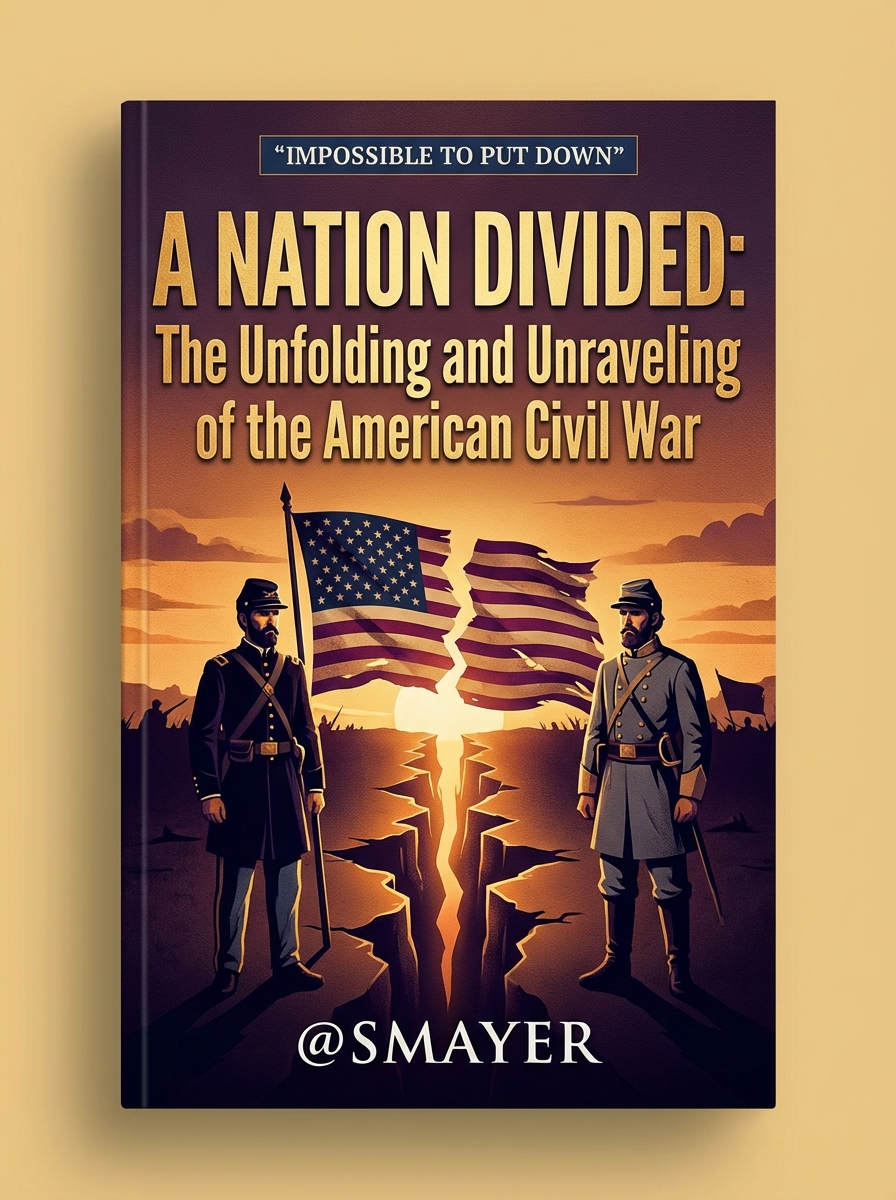
Synopsis
This meticulous historical account delves into the profound ideological, economic, and social fissures that precipitated the American Civil War, tracing its violent commencement, the arduous trials of its four-year span, and its tumultuous resolution, ultimately reshaping the political and moral lan
Chapter 1: Seeds of Discord: The Antebellum Landscape
The American experiment, conceived in liberty and forged in revolution, bore within its nascent structure the seeds of its own discord. For decades, these seeds lay dormant, occasionally sprouting into thorny debates, yet ultimately overshadowed by the promise of westward expansion and national unity. But by the middle of the 19th century, the fertile ground of American society, tilled by economic divergence and ideological intransigence, had begun to nurture these seeds into a formidable thicket, threatening to sunder the very fabric of the young nation. The defining conflict, the one that would ultimately rend the Union and redefine its purpose, was slavery.
From the earliest colonial days, the peculiar institution of chattel slavery had been an integral, albeit morally fraught, component of the American economy. While initially present in all thirteen colonies, its economic utility flowered most luxuriantly in the agrarian South. The invention of the cotton gin in 1793, by Eli Whitney, paradoxically cemented slavery's hold. Suddenly, short-staple cotton, previously unprofitable due to the labor-intensive process of seed removal, became the king crop of the South. Plantations expanded, and with them, the demand for enslaved labor skyrocketed. This economic engine, fueled by the relentless toil of millions, created a society fundamentally different from its Northern counterpart.
The Southern aristocracy, a planter class built upon the edifice of enslaved labor, developed a distinct cultural identity. Their wealth, power, and social standing were inextricably linked to their human property. They championed a hierarchical society, where paternalism and honor were paramount, and where the "natural order" placed white citizens above African Americans. This vision permeated their politics, their religion, and their social norms. For them, slavery was not merely an economic convenience; it was a cornerstone of their civilization, a divinely ordained institution, and a necessary evil for maintaining social stability. President Jefferson Davis, a Mississippi planter himself, would embody this resolute devotion to the Southern cause, viewing it not as a defense of injustice, but as the preservation of a way of life, a conviction that would later inform his leadership of the Confederacy.
Conversely, the North was evolving into an industrial and commercial powerhouse. While slavery had not been eradicated through high moral principle alone – it was never as economically viable in the North’s diversified economy – it had steadily withered, primarily replaced by immigrant wage labor. Cities like Boston, New York, and Philadelphia buzzed with manufacturing, trade, and burgeoning financial institutions. Labor was increasingly free, and though social inequalities persisted, the fundamental system of human bondage was absent. This divergence fostered a different set of values: an emphasis on individual liberty, free labor, and the pursuit of self-improvement. It was in this environment that abolitionist sentiments, though initially a fringe movement, found fertile ground. Figures like Frederick Douglass, himself a testament to the brutal realities of slavery and the power of human intellect, emerged as eloquent and passionate voices against the injustice. His electrifying oratory, honed through personal suffering and rigorous self-education, laid bare the hypocrisy of a nation that proclaimed liberty while upholding bondage. Harriet Tubman, a figure of extraordinary courage and resourcefulness, embodied the active resistance to this injustice, guiding hundreds of enslaved people to freedom through the perilous network of the Underground Railroad, her very existence a defiant challenge to the Southern system.
The economic disparities between North and South were not simply a matter of differing agricultural and industrial bases; they contributed to a widening chasm in political priorities. The South, reliant on agricultural exports, favored low tariffs to protect its trade with Europe and to keep the cost of imported goods down. The North, with its nascent industries, advocated for high tariffs to shield its domestic manufactures from foreign competition. These fundamental economic grievances, often masked by pronouncements of constitutional principle, became recurring points of contention in Congress, each debate further hardening regional identities.
Beneath these economic and social currents lay the bedrock of constitutional debate: states' rights versus federal authority. The very foundation of the United States was a delicate balance between a strong central government and the sovereignty of individual states. From the Alien and Sedition Acts to the Nullification Crisis, this tension had periodically erupted. The South, fiercely protective of its institution of slavery, increasingly invoked the doctrine of states' rights, arguing that the federal government had no power to interfere with or abolish slavery within their borders. They viewed any federal attempt to regulate or restrict slavery as an infringement on their constitutional autonomy, a dangerous usurpation of power by the central government.
The North, increasingly influenced by abolitionist sentiment, viewed slavery not as a matter of states' rights, but as a moral stain on the nation. They argued that the federal government had a role, if not a duty, to limit the expansion of slavery and eventually, to eradicate it. This ideological chasm was exacerbated by westward expansion. Each new territory acquired, from the Louisiana Purchase to the lands ceded by Mexico, became a battleground for the future of slavery. Would these new lands be free or slave? The answer held profound implications for the balance of power in Congress, and thus, for the very survival of the Southern way of life.
The Missouri Compromise of 1820 was an early, fragile attempt to defuse this powder keg, admitting Missouri as a slave state and Maine as a free state, and drawing a line across the Louisiana Purchase territory, prohibiting slavery north of 36°30′ parallel. For a time, it held. But the acquisition of vast new territories after the Mexican-American War in 1848 shattered this uneasy peace. The Compromise of 1850, a frantic effort to restore equilibrium, admitted California as a free state, abolished slave trade (but not slavery) in the District of Columbia, and enacted the Fugitive Slave Act. The latter, which mandated the return of escaped enslaved people to their owners, regardless of whether they were in a free state, proved to be an incendiary piece of legislation. It brought the institution of slavery directly into the lives of Northerners, often forcing them to participate in its enforcement, and galvanized abolitionist opposition.
Stephen A. Douglas, the ambitious Senator from Illinois, believed he had found a solution to the perennial debate over slavery in the territories with his concept of "popular sovereignty." His Kansas-Nebraska Act of 1854 effectively repealed the Missouri Compromise, allowing the residents of Kansas and Nebraska to decide for themselves whether to permit slavery. Douglas, a skilled debater and a pragmatist, probably envisioned this as a way to avoid a national crisis, but instead, it ignited one. The fertile plains of Kansas became a bloody crucible, a microcosm of the national conflict. Pro-slavery and anti-slavery settlers, often armed and organized, flooded into the territory, leading to widespread violence and ultimately, a small-scale civil war known as "Bleeding Kansas." Acts of terror, such as the Pottawatomie Massacre led by the zealous abolitionist John Brown, became chilling precursors to the larger conflict. Brown, unwavering in his anti-slavery beliefs and convinced of his divine mission, saw violence as a legitimate means to an end, a disturbing conviction shared by a small but potent segment of the abolitionist movement.
The political landscape, once dominated by national parties, began to fracture along sectional lines. The Whig Party, unable to reconcile its Northern and Southern factions, collapsed. Its demise paved the way for the rise of the Republican Party in the North, a new political force explicitly dedicated to preventing the expansion of slavery into the territories. Abraham Lincoln, a relatively unknown lawyer from Illinois, emerged from this maelstrom. Though not an abolitionist in the radical sense, he possessed an ethical resolve and a pragmatic understanding of the nation's predicament. His electrifying debates with Stephen A. Douglas in 1858, though he lost the Senate race, propelled him onto the national stage. Lincoln argued that "A house divided against itself cannot stand," recognizing that the nation could not long endure half slave and half free. He sought to contain slavery, believing that if prevented from expanding, it would eventually wither and die.
However, the South interpreted Lincoln’s position, and indeed the very existence of the Republican Party, as an existential threat. The Dred Scott v. Sandford Supreme Court decision in 1857 further inflamed tensions. The Court, dominated by Southern justices, ruled that African Americans, whether free or enslaved, could not be American citizens and therefore had no standing to sue in federal court. More critically, it declared the Missouri Compromise unconstitutional, asserting that Congress had no power to prohibit slavery in the territories. This decision was a triumph for the South and a catastrophic blow to the anti-slavery movement, effectively opening all federal territories to slavery.
The escalating rhetoric grew increasingly vitriolic. Southern politicians and newspapers denounced Northern abolitionists as fanatics and incendiaries, while Northern voices condemned the "Slave Power" for its aggressive expansionism and its assault on American ideals. The very language used to describe the "other" became increasingly dehumanizing, constructing an image of an irreconcilable enemy.
The final precipitating event, the spark that ignited the conflagration, was John Brown's raid on Harpers Ferry in October 1859. Brown, with a small band of followers, launched a daring assault on the federal arsenal, hoping to seize weapons and arm enslaved people for a massive uprising. The raid failed spectacularly, and Brown was captured, tried, and executed. For the South, Brown was a terrorist, a direct manifestation of Northern aggression and a chilling harbinger of race war. For many in the North, particularly abolitionists, he became an anti-slavery martyr, a figure willing to sacrifice his life for the cause of freedom. The starkly divergent reactions to Brown’s actions underscored the profound chasm that had opened between the sections.
The election of 1860 became the breaking point. With four major candidates – Lincoln for the Republicans, Douglas for the Northern Democrats, John C. Breckinridge for the Southern Democrats, and John Bell for the Constitutional Union Party – the national consensus had utterly collapsed. Lincoln, representing a party that vowed to prevent the expansion of slavery, won the presidency without a single electoral vote from the Deep South. The Southern states, interpreting his victory as an unequivocal threat to their institutions and their way of life, saw no alternative but secession.
Within weeks of Lincoln's election, South Carolina, a state long at the forefront of states' rights advocacy, voted to secede from the Union. Other Southern states quickly followed suit, driven by a fear that their peculiar institution, and indeed their entire social and economic system, was under imminent threat. They believed they were acting in the spirit of their revolutionary forefathers, defending their liberty and self-determination against an overreaching federal power. By February 1861, seven states had seceded and formally organized the Confederate States of America, electing Jefferson Davis, a man of resolute character and deep conviction, as their president. His unwavering devotion to the Southern cause meant he would guide the Confederacy with single-minded purpose, believing firmly in the righteousness of their rebellion.
Thus, as President Abraham Lincoln prepared to take the oath of office in March 1861, the nation he was sworn to protect was already irrevocably shattered. The "seeds of discord" sown by slavery, nurtured by economic divergence, and cultivated through constitutional disputes, had blossomed into an unyielding division. The question was no longer *if* the nation would face a trial by fire, but *when* and with what devastating consequences. The stage was set for a brutal, internecine conflict, a war that would redefine America and etch its name in blood into the annals of history.
Chapter 2: The Irrepressible Conflict: From Abolition to Secession
The uneasy truce that had tenuously bound the American states began to fray irrevocably in the mid-19th century. Chapter 1 chronicled the underlying currents of economic divergence, constitutional contention, and the moral stain of slavery that permeated the young nation. Now, as the 1850s dawned, these subtle fissures transformed into gaping chasms, threatening to swallow the Union whole. The concept of the “irrepressible conflict,” a term later popularized by William H. Seward, began to manifest not as a theoretical construct, but as a chilling reality.
Central to this escalating tension was the burgeoning abolitionist movement. What had once been a fringe cause, often relegated to religious societies and intellectual circles, gained considerable momentum. Figures like **Frederick Douglass**, an eloquent and courageous orator, transcended his past as an escaped slave to become a searing voice against human bondage. His powerful speeches and writings, detailing the brutal realities of slavery, pricked the national conscience, compelling many to confront the hypocrisy of a nation founded on liberty while upholding the institution of chattel slavery. **Harriet Tubman**, a beacon of bravery and resourcefulness, risked her life repeatedly to guide hundreds of enslaved people to freedom through the intricate network of the Underground Railroad. These acts of defiance, both intellectual and physical, served as a direct challenge to the Southern way of life and its economic bedrock.
The moral indignation articulated by abolitionists inevitably collided with the practicalities of westward expansion. As the nation pushed its boundaries, the question of whether new territories would allow or forbid slavery became a flashpoint. Each acquisition, from the Louisiana Purchase to the Mexican Cession, reignited the fundamental debate about the peculiar institution’s future. The carefully constructed compromises that had temporarily diffused tensions in earlier decades, such as the Missouri Compromise of 1820, now appeared increasingly fragile in the face of an expanding republic and an increasingly polarized populace.
The most significant legislative salvo in this escalating conflict was the **Kansas-Nebraska Act of 1854**, championed by Illinois Senator **Stephen A. Douglas**. Ambitious and a skilled debater, Douglas sought to facilitate a transcontinental railroad and to resolve the territorial slavery question by applying the principle of "popular sovereignty." This doctrine proposed that the residents of each territory, rather than Congress, should decide whether to allow slavery. While seemingly democratic, the Act carried a profound and devastating consequence: it explicitly repealed the Missouri Compromise, which had prohibited slavery north of the 36°30′ parallel. This move was a direct concession to Southern political power, opening vast new territories previously closed to slavery.
The immediate aftermath of the Kansas-Nebraska Act was chaos. The fertile plains of Kansas became a battleground, a grim preview of the larger conflict to come. Pro-slavery and anti-slavery settlers, many armed and ideologically fervent, poured into the territory, each side determined to sway the popular vote in their favor. The ensuing violence, aptly dubbed "Bleeding Kansas," saw brutal clashes, retaliatory murders, and widespread intimidation. **John Brown**, a zealous and fanatical abolitionist from Connecticut, emerged from this maelstrom, leading a small band of anti-slavery fighters in a brutal massacre of pro-slavery settlers at Pottawatomie Creek in 1856. Brown’s actions, while condemned by many, further radicalized both sides, transforming the abstract debate over slavery into a very real and bloody struggle for dominance. The events in Kansas demonstrated that compromise was no longer a viable path; direct confrontation, even violent confrontation, was becoming increasingly inevitable.
Compounding the legislative and territorial strife was the judicial intervention of the Supreme Court in the **Dred Scott v. Sandford decision of 1857**. Dred Scott, an enslaved man, sued for his freedom after having lived with his owner in free states and territories. The Supreme Court, led by Chief Justice Roger B. Taney, delivered a sweeping and catastrophic ruling. It held that Scott, as a Black man, whether enslaved or free, was not a citizen and therefore could not sue in federal court. More critically, the Court declared the Missouri Compromise unconstitutional, asserting that Congress had no power to prohibit slavery in the territories. This decision was a profound victory for the South, appearing to legitimize slavery everywhere and invalidate any federal efforts to restrict its expansion. For abolitionists and many in the North, it was an outrageous usurpation of justice and a blatant attempt to entrench slavery perpetually. The ruling eroded trust in the judiciary and further inflamed passions, solidifying the belief for many Northerners that a "Slave Power" conspiracy was at work to dominate the entire nation.
The political landscape continued to shift dramatically. The Whig Party, unable to reconcile its internal divisions over slavery, crumbled, giving rise to the Republican Party, founded in 1854 on an explicitly anti-slavery expansion platform. Its rapid ascent signaled a fundamental realignment of political power. The 1858 senatorial election in Illinois pitted **Abraham Lincoln**, a relatively unknown but profoundly ethical and eloquent lawyer, against **Stephen A. Douglas**. The ensuing debates, particularly those in Freeport, became legendary. Lincoln, with his pragmatic and determined logic, cornered Douglas on the implications of popular sovereignty in light of the Dred Scott decision. Douglas’s "Freeport Doctrine" stated that territories could effectively exclude slavery by refusing to pass laws protecting it, a position that alienated Southern Democrats and further fragmented the national party structure. Though Lincoln lost the election, the debates propelled him onto the national stage, showcasing his formidable intellect and unwavering moral stance against slavery’s expansion.
The year 1859 brought another pivotal and deeply shocking event: **John Brown's raid on Harpers Ferry**. Driven by his fanatical belief that he was God's instrument to end slavery, Brown led a small band of abolitionists, including several of his sons, in an audacious seizure of the federal arsenal at Harpers Ferry, Virginia. His objective was to arm enslaved people and incite a widespread slave rebellion across the South. The raid, however, was poorly planned and quickly suppressed by federal troops led by then-Colonel Robert E. Lee. Brown was captured, tried for treason, and subsequently hanged.
The aftermath of Harpers Ferry was electrifying and polarizing. To many in the North, particularly abolitionists, Brown became a martyr, a Christ-like figure who sacrificed himself for a righteous cause. **Frederick Douglass**, while not participating in the raid, understood Brown’s desperate conviction, even if he disagreed with the tactics. To the South, however, Brown was a terrorist, a direct embodiment of their worst fears: Northern aggression, incitement of slave revolts, and an existential threat to their very lives and property. His raid confirmed for many Southerners that a peaceful coexistence with the North was impossible. The gap in understanding and sympathy between the two regions became unbridgeable.
The political culmination of these mounting tensions arrived with the **Presidential Election of 1860**. The Democratic Party, hopelessly fractured over the issue of slavery and popular sovereignty, nominated two candidates: **Stephen A. Douglas** for the Northern Democrats and John C. Breckinridge for the Southern Democrats. The Constitutional Union Party, a hastily formed group attempting to avoid disunion, nominated John Bell. However, it was the Republican Party, now a dominant force in the North, that nominated **Abraham Lincoln**.
Lincoln’s platform was clear: no expansion of slavery into the new territories. He was not an abolitionist in the immediate sense, nor did he advocate for federal interference with slavery where it already existed. Yet, his commitment to preventing its spread was seen by the South as an ultimate threat to their institution and, by extension, their entire way of life. The election results shattered the Union. Lincoln famously won without a single Southern electoral vote, a stark demonstration of the deep regional divide. His victory, secured entirely by Northern votes, was interpreted by Southern states not as a democratic outcome, but as an act of aggression, a blatant disregard for their interests and rights. For them, it was proof that their voices were no longer heard, their institutions no longer safe within the Union.
The response from the South was immediate and decisive. South Carolina, long a bastion of states' rights and pro-slavery sentiment, led the way. On December 20, 1860, barely a month after Lincoln's election, South Carolina formally seceded from the United States. Its declaration cited the "increasing hostility on the part of the non-slaveholding States to the institution of slavery" and the election of a president "whose opinions and purposes are hostile to slavery."
Mississippi, Florida, Alabama, Georgia, Louisiana, and Texas quickly followed suit in early 1861, before Lincoln even took office. These seven states established the **Confederate States of America** in February 1861, adopting a constitution remarkably similar to that of the United States, but with explicit protections for slavery and an emphasis on states' rights. **Jefferson Davis**, a resolute and devoted former U.S. Senator from Mississippi, was elected as its provisional president. Davis, though hesitant to break from the Union initially, quickly became a staunch leader of the Southern cause, viewing secession as an honorable defense of Southern liberty and distinct civilization.
During this tumultuous interregnum, as the old Union dissolved and a new Confederacy formed, there was a desperate search for compromise. President James Buchanan, Lincoln’s predecessor, was a lame-duck president paralyzed by indecision, believing he lacked the constitutional authority to prevent secession. Various congressional efforts at compromise, such as the Crittenden Compromise, which proposed constitutional amendments to protect slavery permanently, failed to gain traction. **Abraham Lincoln**, despite not yet being inaugurated, firmly rejected any compromise that allowed for the expansion of slavery. His principled stand, though politically risky, reflected his belief that the nation could not long endure "half slave and half free."
When **Abraham Lincoln** finally took the oath of office on March 4, 1861, the nation was already fundamentally fractured. In his first inaugural address, Lincoln, pragmatic yet determined, pleaded for unity. He affirmed his commitment to preserving the Union and reiterated that he had "no purpose, directly or indirectly, to interfere with the institution of slavery in the States where it exists." Yet, he also declared that secession was "legally void" and that he would "hold, occupy, and possess the property and places belonging to the Government." His message was a delicate balance: conciliation without concession on the fundamental principle of Union.
The stage was now set for armed conflict. The symbolic fulcrum of this impending clash was Fort Sumter, a federal outpost in the harbor of Charleston, South Carolina, a city that had become the heartland of secession. The fort was cut off from Union supply lines and running low on provisions. Lincoln faced an impossible decision: reinforce the fort and risk war, or abandon it and legitimize secession. He chose a middle path, notifying South Carolina that he would send provisions, not reinforcements. Confederate forces, however, saw this as an act of aggression.
On April 12, 1861, Confederate batteries opened fire on Fort Sumter. Major Robert Anderson, the Union commander, was forced to surrender after a 34-hour bombardment. No lives were directly lost in the firing, but the psychological impact was immense. The attack on Fort Sumter ignited the powder keg that had been accumulating for decades. **President Jefferson Davis** had made the fateful decision to attack, convinced it was a necessary assertion of Confederate sovereignty. The shells that rained down on Fort Sumter shattered any lingering hopes of a peaceful resolution.
Lincoln immediately called for 75,000 volunteers to suppress the rebellion. This call sparked a second wave of secession, as four more Southern states – Virginia, Arkansas, North Carolina, and Tennessee – refused to fight against their sister states and joined the Confederacy. Among them was Virginia, a state of immense strategic importance and home to **Robert E. Lee**, then a colonel in the U.S. Army. Torn between his loyalty to the Union and his deep allegiance to his home state, Lee famously resigned his commission, choosing to cast his lot with Virginia and the Confederacy. His decision epitomized the agonizing choices faced by many individuals as the nation splintered.
The "irrepressible conflict," once a theoretical danger, had now erupted into open warfare. The profound ideological schisms, the legislative battles over land and liberty, the moral outrage of abolitionists like **Frederick Douglass** and **Harriet Tubman**, the violence sparked by **Stephen A. Douglas**'s popular sovereignty, the judicial overreach of the Dred Scott decision, the prophetic thunder of **John Brown**’s raid, and the epochal election of **Abraham Lincoln** had all converged. The Union was no more; in its place stood two separate, warring nations, each convinced of the righteousness of its cause, bracing for a conflict whose scale and brutality would forever scar the American landscape. The stage was indeed set for a war unlike any the nation had ever known.
Chapter 3: The Storm Breaks: Early Battles and Shifting Strategies
The reverberations of secession had scarcely settled when the first shots of the American Civil War rent the air, transforming ideological strife into bloody reality. For months, the nation had held its breath, a fragile peace maintained by a delicate balance of political maneuvering and thinly veiled threats. But as dawn broke on April 12, 1861, over Charleston Harbor, South Carolina, that balance shattered. The bombardment of Fort Sumter, a federal outpost garrisoned by Major Robert Anderson and his small contingent of Union soldiers, marked the undeniable commencement of hostilities.
The attack on Fort Sumter was not a spontaneous act but the culmination of escalating tensions. Following South Carolina’s secession, the state had demanded the surrender of all federal property within its borders. Anderson, strategically relocating his forces from the vulnerable Fort Moultrie to the more defensible Fort Sumter, refused. For weeks, the fort became a symbol, a testament to federal authority in a rebellious state. Confederate General P.G.T. Beauregard, a former student of Anderson’s at West Point, was tasked with its reduction. His ultimatum rejected, Beauregard’s batteries opened fire at 4:30 AM.
The barrage was relentless. For 34 hours, Confederate cannons pounded Fort Sumter, unleashing thousands of shells. Anderson’s men, outgunned and outmanned, returned fire with dwindling ammunition. The psychological impact of the bombardment far outweighed its physical toll; remarkably, no Union soldiers were killed during the attack itself, though one died later from an accidental cannon discharge during the evacuation. On April 13th, with the fort ablaze and its walls crumbling, Anderson surrendered. The Stars and Stripes were lowered, replaced by the newly unfurled Confederate banner.
The fall of Fort Sumter was a watershed moment. In the North, it ignited a furious wave of patriotism and indignation. The deliberate attack on federal property was seen as an act of treason, a direct assault on the Union itself. President Lincoln, who had thus far pursued a policy of cautious conciliation, now had no choice but to respond decisively. On April 15th, he issued a proclamation calling for 75,000 volunteers to suppress the rebellion, a move that irrevocably committed the nation to war. This call for troops, however, proved to be the final straw for several Upper South states. Virginia, North Carolina, Arkansas, and Tennessee, reluctant to participate in any military action against their Southern brethren, swiftly voted to secede and join the Confederacy. The lines of division were now starkly drawn, the two opposing nations fully formed.
With the initial shock of Fort Sumter subsiding, both sides began to articulate their military objectives and strategies. For the Union, the primary goal was the preservation of the United States. Lincoln’s administration viewed secession as illegal and the Confederate states as rebellious entities that needed to be brought back into the fold. The Union’s strategic advantages were formidable: a larger population (22 million to 9 million, including 3.5 million enslaved people in the South), a superior industrial base, a more extensive railroad network, and a dominant navy. General Winfield Scott, the aging but brilliant hero of the Mexican-American War and then General-in-Chief of the U.S. Army, proposed the "Anaconda Plan." This strategy, derided by some as too slow and cautious, envisioned a naval blockade of the Confederate coastline to strangle its economy, coupled with a thrust down the Mississippi River to split the Confederacy in two. The intent was to squeeze the life out of the rebellion rather than engaging in immediate, costly frontal assaults.
The Confederacy, conversely, fought for independence and the preservation of its peculiar institution. Its strategy was primarily defensive. Lacking the industrial capacity and manpower of the North, Confederate leaders hoped to leverage their vast geographical expanse, the passionate commitment of their populace, and the perceived military prowess of their officers. The objective was to inflict enough casualties and prolong the conflict sufficiently to exhaust the North’s will to fight, ideally prompting foreign intervention from European powers dependent on Southern cotton. Jefferson Davis, the Confederate President, envisioned a defensive-offensive strategy, using interior lines to concentrate forces and strike at vulnerable Union armies, while generally avoiding large-scale invasions of Union territory unless strategically advantageous. The Confederate capital was moved from Montgomery, Alabama, to Richmond, Virginia, placing it dangerously close to Washington D. D.C., but also signifying the pivotal importance of Virginia as the primary battleground.
The initial enthusiasm on both sides was palpable, yet profoundly naive. Soldiers, often clad in hastily assembled uniforms, marched off to war with banners flying and bands playing, convinced of a swift and glorious victory. Many believed the war would be over in a matter of months, a single decisive battle settling the dispute. This illusion was shattered just three months after Fort Sumter, on the rolling hills and plains near a small creek in northern Virginia: Bull Run, or Manassas, as the Confederates called it.
The First Battle of Bull Run, fought on July 21, 1861, was the first major land engagement of the war and a rude awakening for both North and South. Union General Irvin McDowell, under immense political pressure from Washington D.C. to deliver a quick victory, led an army of approximately 35,000 largely untrained and inexperienced troops towards Richmond. His plan was to flank Confederate forces under Beauregard near Manassas Junction, a crucial railroad hub.
The march itself was chaotic. Green Union soldiers, many still in civilian clothes, often broke ranks to forage for food or pick berries. Civilians, including congressmen and socialites, packed picnic baskets and rode out from Washington to witness what they expected to be a grand spectacle, a leisurely afternoon of martial entertainment. They would instead witness the brutal realities of modern warfare.
The battle began with a Union flanking maneuver that initially caught the Confederates off guard. For hours, the fighting was fierce and confused. Union forces pushed the Confederates back, threatening to break their lines. It was at this critical juncture that Confederate Brigadier General Barnard Bee, attempting to rally his wavering troops, pointed to General Thomas J. Jackson, holding his position “like a stone wall” against the Union assault. The moniker stuck, and "Stonewall" Jackson entered the annals of military legend. Jackson’s steadfastness, combined with the timely arrival of Confederate reinforcements by rail under General Joseph E. Johnston, turned the tide.
As the afternoon wore on, the Confederate counterattack gained momentum. The Union lines, already exhausted and disorganized by their earlier success, began to buckle. The retreat quickly devolved into a panicked rout. Union soldiers, dropping their rifles and equipment, fled back towards Washington, mingling with the terrified civilians who had come to watch. The roads became choked with fleeing soldiers, carriages, and onlookers, all desperate to escape the carnage. The retreat was a humiliating spectacle for the Union, a stark illustration of its army's lack of discipline and experience.
The casualties at First Bull Run, while modest by later Civil War standards (around 2,900 Union and 2,000 Confederate), were unprecedented for American warfare up to that point. The sight of so many dead and wounded, the deafening roar of artillery, and the sheer terror of the rout disabused both sides of their romantic notions of war. The picnic baskets were abandoned, the cheering stopped, and the grim reality of a protracted, bloody conflict began to dawn.
For the South, Bull Run was a morale-boosting victory, confirming their belief in the superiority of their fighting men and the righteousness of their cause. However, it also fostered a dangerous complacency, leading some to believe the war was effectively won. They failed to press their advantage, allowing the demoralized Union army to regroup relatively unmolested. For the North, the defeat was a shock to the system, a painful but necessary lesson. It exposed the inadequacy of their untrained volunteer army and the folly of underestimating their Southern adversaries. The call for a quick, decisive victory evaporated, replaced by a grim determination to build a professional fighting force.
In the aftermath of Bull Run, President Lincoln moved to reorganize the Union war effort. General George B. McClellan, a brilliant organizer and charismatic leader, was called upon to command the Army of the Potomac. McClellan, a meticulous planner, immediately set about transforming the demoralized rabble into a disciplined, well-trained army. His efforts in drilling, equipping, and organizing the nascent force were monumental, though his cautious nature would later become a source of frustration for Lincoln.
Beyond the major engagements, the early months of the war saw a flurry of smaller skirmishes and strategic maneuvering. In the border states – Maryland, Kentucky, Missouri, and Delaware – the struggle was particularly acute, often pitting neighbor against neighbor. These states, geographically and ideologically divided, were crucial to both sides. Lincoln skillfully navigated the complexities of keeping them in the Union, understanding that their loss would significantly strengthen the Confederacy and bring the war directly to the Union's doorstep.
The naval aspect of the war also began to take shape. The Union’s Anaconda Plan hinged on its naval superiority. Lincoln declared a blockade of the Confederate coastline, a move initially mocked by the South as a "paper blockade." However, the Union Navy, though small at the outset, rapidly expanded. By the end of 1861, it had seized key coastal positions and was beginning to effectively impede Confederate trade, including the vital export of cotton and import of manufactured goods. The Confederates, lacking a significant navy, resorted to commissioning privateers and developing innovative, though ultimately limited, naval technologies like ironclads and submarines.
The early months of the war also revealed profound miscalculations on both sides. The North initially underestimated the South’s resolve and military prowess, believing the rebellion could be swiftly crushed. The South, in turn, overestimated its own military strength relative to the North’s industrial might and capacity for sustained warfare. Both sides misjudged the nature of modern warfare, expecting a conflict reminiscent of European battles fought by professional armies, not the mass citizen armies and industrial-scale destruction that would define the Civil War.
Perhaps the most significant dawning realization was the immense scale and brutality of the conflict. The battles, even in their early stages, produced casualty figures that dwarfed previous American wars. The sheer number of men involved, the destructive power of improved weaponry (rifled muskets, more accurate artillery), and the lack of sophisticated medical care combined to create unprecedented levels of suffering and death. The war was not a glorious adventure; it was a grinding, horrifying struggle that would demand immense sacrifice from an entire generation.
As 1861 drew to a close, the initial euphoria and naivete had evaporated. The easy victories anticipated by both sides had proven illusory. The Union, stung by Bull Run, was settling in for a long, arduous fight, its massive war machine slowly grinding into gear. The Confederacy, buoyed by its early successes, remained confident but faced the daunting task of sustaining a war against a numerically and industrially superior foe. The storm had broken, and its full fury was yet to be unleashed. The early battles had not decided the war, but they had irrevocably defined its character: a brutal, protracted, and utterly transformative conflict that would reshape the very fabric of the American nation. The initial assumptions had been shattered, and a new, grim reality had taken hold, one that promised years of bloodshed and uncertainty.