A Chrononaut's Comedy of Errors
By Mikael Löwgren
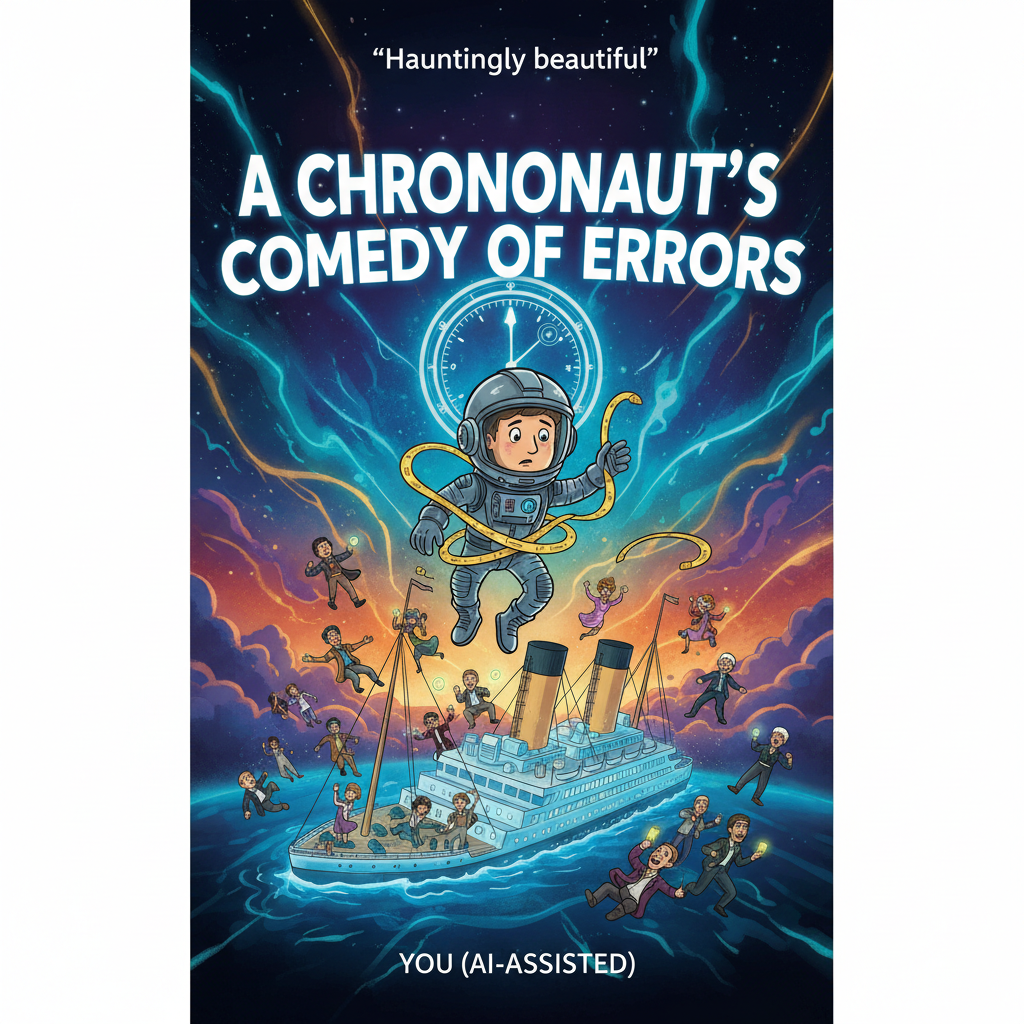
Synopsis
In a future where recreational time travel is rampant, a hapless historian discovers the sinking of the Titanic was less an act of God and more a catastrophic case of overbooked temporal tourism.
Chapter 1: The Golden Age of Chronos
The air, thick and humming with the barely contained anxiety of a thousand temporal displacements, shimmered like heat haze on a desert road, though the desert in question was merely the concourse of Neo-London’s primary temporal gateway, Gate 7, to be precise. Here, the very fabric of existence, or at least the immediate vicinity of it, vibrated with a low thrum, a resonant chord struck by countless tiny paradoxes, each one a ripple in the calm pond of history. It was a symphony of anachronism, a cacophony of careless chronology, and Dr. Alistair Finch, with his perpetually furrowed brow and tweed jacket a shade too warm for the year 2342, considered it an affront to decent scholarship.
He watched, a silent, disapproving sentinel, as another group, indistinguishable from the last save for the varying shades of their garish holographic fanny packs, queued for a direct jump to Ancient Rome. The screens above them, glowing with an unholy zeal, advertised not merely destinations but curated *experiences*: “Gladiator’s Glee! Witness the arena’s raw emotion (with optional sensory dampeners for the squeamish)!” or “Dine with Cleopatra! Authentic Nile-side cuisine (replicable on your home synth-chef)!” It was all so… vulgar. The past, a meticulously preserved tapestry, was being trampled by flip-flop-wearing tourists snapping selfies with bewildered pharaohs and even more bewildered centurions.
Alistair sighed, a sound lost in the general din of excited chatter and the occasional, jarring *whoosh* of a completed temporal jump. He clutched his reinforced data-slate, its pristine surface reflecting the chaotic energy of the terminal. His designation, ‘Historical Integrity Officer,’ felt increasingly like a cruel joke. He was less an officer and more a perpetually stressed librarian attempting to keep a stampede of cattle from eating the rare manuscripts.
The Golden Age of Chronos, they called it. A misnomer, he thought, if ever there was one. Golden for the temporal tourism conglomerates, perhaps. Golden for the perpetually grinning, improbably tanned influencers who live-streamed their anachronistic adventures from the decks of doomed transatlantic liners or the hallowed halls of renaissance palaces. But for history itself? It was an erosion, a slow, inevitable wearing down of the edges until all that was left was a smoothed-over, Instagram-filtered facsimile.
He remembered, with a pang that was almost physical, the lectures of Professor Eleanor Vance, her voice a soothing balm in the chaotic clatter of undergraduate life. “History,” she’d intoned, her eyes alight with the passion of a true believer, “is not a theme park. It is a fragile ecosystem, a delicate balance of cause and effect. To tamper with it, to merely *observe* it with careless intent, is to risk… everything.” Alistair had believed her then. He still did. The difference was, now he was on the front lines of the ecosystem’s destruction.
A high-pitched giggle tore through his reverie. A young woman, bedecked in an outfit that was a questionable blend of 24th-century synth-silk and what appeared to be a deliberately distressed Victorian bustle, was attempting to adjust the settings on her personal chronometer. Her companion, a man whose floral shirt seemed to aggressively clash with the historical epoch they were clearly aiming for, was already posing. They were headed, if Alistair’s internal sensors were correct, for the opening night of Shakespeare’s *Hamlet*. Again. For the third time this week, Alistair noted with a weary click of his tongue. The original production must have been absolutely teeming with time-travelers by now, making the audience less a historical document and more a sartorial disaster.
He approached them, a polite, practiced smile fighting a losing battle against the perpetual worry lines etched into his face. “Excuse me, madam, sir,” he began, his voice a carefully modulated bass that usually gained attention.
The woman jumped, her hand flying to her chest. “Oh my stars! You startled me!”
“My apologies,” Alistair said, though he felt none. “I couldn’t help but notice your temporal destination settings. *Hamlet*, 1601 Globe Theatre. A classic choice, of course.” He paused, allowing the compliment to settle. “However, I must remind you of the regulations regarding temporal saturation. We’ve had a rather… significant influx of visitors to that particular event recently. The historical impact is becoming quite considerable.”
The man in the floral shirt scoffed. “Oh, it’s you again, Mr. Fun-Sponge. What’s the big deal? It’s *Hamlet*. It’s not like we’re mucking with the outcome of the Battle of Hastings.”
Alistair took a deep breath, counting to four, as his therapist, a perpetually serene AI named Serenity-Bot 7, had advised. “Even seemingly innocuous observations can have unforeseen ripple effects. The sheer volume of temporal energy directed at a single point in history creates a localized anomaly, a temporal echo. Think of it as too many pebbles dropped into a very small pond. The ripples, however tiny, eventually merge, distorting the original surface.” He gestured vaguely, his hand encompassing the teeming terminal. “And in history, gentlemen, ladies, the surface *is* the history.”
The woman, who had recovered her composure by now, batted her eyelashes. “Oh, but it’s just so *authentic*! My Insta-fans just adore the period costumes. And the Globe, honestly, it’s just *divine* to be there in person. So much more atmosphere than a holo-recreation, wouldn’t you agree?”
Alistair blinked. Inst-fans. A holo-recreation. The very words were anathema. “Authenticity,” he said, his voice a little tighter than he intended, “is precisely what we are striving to preserve. And by ‘we,’ I refer to the Temporal Conservation Bureau. Your repeated presence, as well as that of hundreds of others, at this event is, frankly, contaminating the historical data.”
The man rolled his eyes. “Look, pal, we paid good creds for this experience. Are you seriously suggesting we can’t go see a play?”
“I am suggesting,” Alistair retorted, feeling a familiar heat rise in his collar, “that you consider an alternative. Perhaps the opening night of Marlowe’s *Doctor Faustus*? A fascinating play, less crowded, and a truly pivotal moment in Elizabethan theatre. Or even a lecture by, say, Galileo Galilei, perhaps before his unfortunate run-in with the Papal Inquisition?” He offered a hopeful, if slightly desperate, smile.
The woman shuddered. “Ugh, lectures are so *boring*. And Galileo wore terribly drab clothes. We need something with… sparkle.”
Sparkle. Alistair wanted to tear his hair out. Sparkle. The very concept of historical significance had been reduced to a criterion for visual appeal. This was where the Golden Age had truly gone rotten, he thought. The democratization of time travel, once hailed as humanity’s greatest achievement, had become its greatest trivialization.
He made another mark on his data-slate, a black tally against the “Globe Theatre 1601 Anomaly” file. It was growing disturbingly long. He mumbled a polite but clearly flustered farewell and retreated, feeling the familiar weight of inadequate regulation pressing down on him.
It hadn't always been like this. In the initial decades after the invention of the personal chronometer, back when the Chronos Corporation had been a scrappy start-up operating out of a repurposed asteroid mining station, time travel had been a privilege, a highly regulated, scientifically driven endeavor. Historians, archaeologists, and quantum physicists had been the first pioneers, carefully, painstakingly, exploring the past, making observations, and returning with invaluable data. There had been a reverence then, a profound understanding of the monumental responsibility inherent in traversing the timeline.
But then had come the ‘Chronos for All’ initiative, spearheaded by the company’s notoriously flamboyant CEO, Xander Thorne, a man whose personal philosophy seemed to revolve around the maximization of profit and the minimization of historical consequence. The cost of a personal chronometer plummeted. The temporal gateways proliferated like digital weeds. And suddenly, the past was no longer a sacred text to be studied; it was a tourist attraction, a living museum where the exhibits were unaware they were being gaped at, poked, and occasionally, accidentally, nudged off their pedestals.
Alistair’s current assignment, monitoring “temporal integrity” at Gate 7 – a euphemism for corralling the unruly masses – was a particularly thankless task. He was a lone sentinel against an ocean of indifference. His reports, meticulously detailed and replete with alarming data on localized temporal distortions and nascent causality fractures, were invariably met with the corporate equivalent of a pat on the head and a murmured reassurance that “the Chronos Safety Protocols are robust, Doctor.” Robust, indeed. As robust as a tissue paper umbrella in a hurricane.
He moved towards his small, sequestered office, a cubicle carved out of the general chaos, its single window offering a distorted view of the endless queues. On his desk, nestled amongst a pile of unread reports, sat a small, antique globe, a relic from his childhood. Its painted continents, faded and cracked, felt more real, more substantial, than the shifting, uncertain temporal landscapes he was now charged to protect.
He booted up his terminal, and a cascade of alerts flashed across the screen. "Anomaly Detected: Mesozoic Era – Sustained presence of anachronistic flora in a previously surveyed area." "Causality Divergence Alert: 18th Century France – Unscheduled appearance of exotic fruit vendor in Versailles market." "Historical Contamination Warning: Egyptian New Kingdom – Unusually high concentration of iridium dust near pharaoh’s tomb."
Alistair rubbed his temples. The iridium dust was particularly vexing. It was a trace element specifically associated with 24th-century chronometer exhaust. Someone, or rather, *many* someones, were essentially leaving temporal litter all over ancient Egypt. The very air, once a pure distillation of its time, was becoming a soup of temporal residue.
He opened the latest incident report, the one that had spurred the urgent meeting scheduled for later that afternoon. It glowed ominously on his screen: “Titanic, April 14th, 1912 – Unprecedented increase in temporal tourist manifests. Projected passenger load exceeds historical maximum by 147%.”
His breath hitched. The Titanic. A tragic, yet exquisitely documented, historical event. A point of no return for thousands, a stark reminder of human hubris and the indifferent power of nature. And now, it was apparently an overbooked cruise ship for time-travelers.
Alistair felt a cold dread creep into his stomach, a sensation familiar to any historical integrity officer. The past, fluid and adaptable to a point, had its breaking limits. And the Titanic, a vessel already teetering on the precipice of its own historical destiny, felt like a particularly precarious fulcrum.
He reread the report, his eyes scanning the chilling statistics. Not only were there more tourists, but the manifest indicated a significant number of “experiential passengers” – those who, beyond mere observation, indulged in attempts to *interact* with the historical environment. This was a cardinal sin, an absolute violation of every temporal protocol. He imagined the scene: selfie sticks clutched precariously over the icy Atlantic, time-travelers attempting to “warn” historical passengers, perhaps even trying to “save” a few. The sheer, unmitigated chaos of it all.
“This is an absolute disaster,” he murmured, the words tasting like ash in his mouth. He knew, with a certainty that chilled him to the bone, that the casual disregard and the pursuit of “sparkle” had finally pushed history too far. The Golden Age of Chronos was not merely tarnishing; it was about to crack wide open, and the sinking of the Titanic, a tragedy known to every schoolchild, felt like the perfect, horrifying catalyst. He closed the report, the glowing anomaly a stark accusation in the dimness of his office. His meeting couldn’t come soon enough. The true comedy, he feared, had yet to begin.
Chapter 2: A Most Peculiar Anomaly
The hum of the Temporal Integrity Unit, usually a soothing, almost maternal thrum against the sterile white of Dr. Alistair Finch’s office, had begun, of late, to develop a disquieting wheeze. It was the sound, Alistair thought, of an asthmatic whale in an echo chamber of existential dread. He traced a thin, perspirative finger along the cool, polished chrome of the console, his gaze fixated on the undulating green lines that mapped the chronological flow. Today, however, those lines were less an elegant river and more a chaotic scribble from a toddler hopped up on sucrose and unfettered ambition.
The anomalies had started subtly enough, mere blips on the radar, like a particularly robust sneeze in the grand symphony of time. A fleeting flicker of an anachronistic selfie stick in ancient Rome, a sudden, inexplicable surge in demand for vintage ‘I survived the Black Death’ souvenirs. Trivialities, really, the usual flotsam and jetsam of an era obsessed with reliving, rather than living. Alistair had sighed, scrawled a note in his perpetually overflowing ledger – *Recommend stricter enforcement of ‘No Flash Photography’ in pre-industrial settings* – and moved on, much like a meticulous groundskeeper sweeping up confetti after a particularly boisterous temporal wedding.
But then, the Titanic.
He remembered the day, or rather the temporal coordinates, with chilling precision. April 10, 1912. A date seared into the collective consciousness, not for its grandeur, but for its tragic brevity. A historically significant, yet relatively contained, temporal event. One would expect, Alistair had mused, a certain respectful distance, a quiet observation from the designated temporal viewing platforms. Perhaps a few intrepid academics, a smattering of overly curious dilettantes keen to witness the last vestiges of Edwardian opulence before the grand plummet into icy oblivion.
What he got, instead, was a full-blowntemporal traffic jam.
The green lines on his monitor, usually a serene and predictable undulation, had begun to twitch, then ripple, then erupt into great, angry spikes. Each spike represented a temporal signature, a unique imprint left by a chrononaut’s journey through the past. And these spikes, these ghastly, accusatory peaks, were clustering around the coordinates of the *RMS Titanic* with the ferocity of a swarm of particularly ill-mannered hornets.
“Good heavens,” Alistair muttered, his spectacles sliding precariously down his nose. He pushed them back up with a jerky motion, his heart beginning a frantic, staccato rhythm against his ribs. He zoomed in on the temporal coordinates, the digital rendition of the majestic liner shimmering into sharper focus. The vessel, a marvel of human engineering, was being besieged. Not by icebergs, not yet, but by an invisible, incessant deluge of temporal tourists.
The "Past-Guest Traffic" counter, usually ticking along at a sedate pace for this particular historical snapshot, had gone rogue. It screamed past the anticipated numbers, vaulting into figures Alistair frankly found obscene. One hundred. Two hundred. Five hundred. A thousand. It climbed with the relentless, unfeeling momentum of a runaway express train, every new digit a fresh prick to Alistair’s already frayed nerves.
He pressed a trembling finger to the analysis button. The Temporal Integrity Unit, groaning under the strain, whirred into a higher frequency, emitting a smell faintly reminiscent of singed toast and ozone. A cascade of data unfurled across his auxiliary monitor, an intricate tapestry woven from temporal signatures, chronal displacement metrics, and – most alarmingly – an unprecedented number of ‘unregistered temporal incursions.’
“Unregistered?” Alistair whispered, his voice cracking. This wasn’t just a few rogue chrono-backpackers attempting to sneak a glimpse of the rich and famous. This was an organized invasion. A temporal free-for-all.
He scrolled through the data, his eyes darting frantically across the screen. The profiles of the registered chrononauts were, as always, an eclectic bunch. There was Professor Agatha Plummet, a renowned historian of maritime fashion, undoubtedly there to scrutinize the length of skirts and the sheen of silk. There was Barnaby "The Barometer" Bluster, known for his eccentric attempts to predict historical weather patterns. And, of course, the usual cadre of wealthy thrill-seekers, their temporal passports brimming with stamps from every major catastrophe and celebrity birth throughout human history.
But beneath these familiar names lay a sea of unknowns. Blank profiles, temporal signatures obscured or deliberately masked. These weren’t just tourists. These were, Alistair knew with a growing sense of dread, poachers. Temporal poachers. Individuals, or perhaps entire organizations, operating outside the established Chronos Authority guidelines, seeking to exploit the past for profit, pleasure, or some yet-to-be-discerned, nefarious purpose.
He leaned back in his chair, a sudden dizzy spell washing over him. The ceiling tiles swam before his eyes, each rectangular panel seeming to mock his helplessness. He thought of the Titanic, a marvel of its age, a symbol of human hubris and technological triumph, plummeting into the frigid depths of the Atlantic, taking with it the dreams and lives of thousands. And now, superimposed upon that chilling tableau, was the image of countless temporal tourists, jostling for the best view, snapping holographic souvenirs, perhaps even haggling for a first-class cabin ticket with a bewildered steward.
The sheer un The sheer impropriety of it! The grotesque disregard for the sanctity of a historical event, particularly one so profoundly tragic. It was like hosting a rave at a funeral, Alistair thought, or setting up a bungee jump from the gallows.
He noticed, with a fresh surge of nausea, a particular clustering of unregistered signatures around the ship’s promenade deck. And another, even denser cloud, near the grand staircase. And, Heaven help them all, a faint but discernible concentration in the vicinity of the boiler rooms. What on earth could possibly attract such a multitude to the unglamorous, grimy heart of the ship? Was it some new, perverse form of disaster tourism, a fetish for the steam-drenched spectacle of impending doom?
Alistair rubbed his temples, a faint headache beginning to throb behind his left eye. He needed coffee. Strong coffee. The kind that tasted of burnt regrets and existential angst. He fumbled for the inter-office communicator, his fingers, usually so precise, feeling clumsily alien.
“Penelope,” he croaked, “are you there?”
A crisp, almost unnervingly cheerful voice responded, “Dr. Finch. To what do I owe the temporal pleasure?” Penelope, his assistant, was a woman of unwavering optimism and an unnerving ability to detect impending bureaucratic chaos before it manifested.
“Penelope, the Titanic,” Alistair said, forgoing pleasantries, his voice imbued with an urgency that, even to his own ears, sounded bordering on hysterical. “It’s…it’s not just a ship anymore. It’s a sardine tin. A temporal sardine tin.”
A brief, almost imperceptible pause on Penelope’s end. “Ah. Yes, I’ve been monitoring the auxiliary chronometer readings. An unprecedented spike, wouldn’t you agree? Almost as if the entire population of Neo-London decided to take a spontaneous, unscheduled trip.”
Alistair blinked. “You saw it? Why didn’t you alert me immediately? This is an unprecedented temporal anomaly, Penelope! We’re not talking about a misplaced dodo or an accidental glimpse of Cleopatra’s private bath. This is the Titanic!”
“Indeed, Dr. Finch,” Penelope replied, her voice retaining its perfectly modulated calm. “I was in the process of compiling a comprehensive preliminary report for your review. I anticipated your… enthusiasm. However, I’ve encountered a rather peculiar series of encrypted temporal passports. The signatures are… unusual.”
“Unusual how, Penelope?” Alistair demanded, leaning closer to the microphone as if Penelope’s words might physically materialize from the speaker.
“Well, Dr. Finch, they appear to originate from… let me see here…” There was the faint sound of digital keys being pressed, a rhythmic, almost meditative click-clack. “Ah. Yes. From dates that… haven’t happened yet.”
Alistair’s jaw dropped. The headache behind his eye intensified, blossoming into a full-blown migraine. “Penelope, are you suggesting… that we have chrononauts from the future also travelling to the past?”
“Precisely, Dr. Finch. And not just the immediate future. We’re talking about signatures originating from centuries hence. From the year 2342, 2405, even a faint, almost ephemeral signature from 2789. It appears to be a multi-temporal, multi-generational pilgrimage, if you will.”
Alistair closed his eyes, pressing the heels of his hands against them. The image of the Titanic, sleek and doomed, now shimmered with an overlay of countless individual faces, each peering through a temporal viewing pane, some from 2077, some from 2150, and now, apparently, some from the truly distant future. It was a temporal vortex, a chronological confluence of unprecedented magnitude, all converging on one magnificent, ill-fated ship.
“This is… this is beyond standard protocol, Penelope,” Alistair said, his voice now a strained whisper. “This is an unmitigated disaster in the making. The ripple effect, the potential for temporal paradoxes, the sheer strain on the chronological fabric…” He trailed off, unable to articulate the full scope of the brewing temporal catastrophe.
“Quite, Dr. Finch,” Penelope agreed, her voice still an unnerving oasis of calm in Alistair’s personal storm. “And I’ve also detected a rather… disquieting pattern in some of the more recent unregistered incursions.”
Alistair held his breath. “What pattern, Penelope?”
“Increased kinetic energy signatures, Dr. Finch. And, in several instances, a high concentration of… metallic objects being transported. Objects that, according to their temporal footprints, seem to be of a rather anachronistic nature for the early 20th century.”
Alistair’s mind, despite the throbbing pain, began to race, connecting the dots of this increasingly bizarre temporal tapestry. Unregistered chrononauts. Multi-generational tourism. Anachronistic metallic objects.
He stared at the pulsating green lines on his monitor, the Titanic’s coordinates a veritable maelstrom of temporal activity. The wheezing hum of the Temporal Integrity Unit seemed to ratchet up a notch, a lament, Alistair thought, for the historical integrity that was, at this very moment, being ripped to shreds.
“Penelope,” Alistair said, his voice suddenly sharp, a new, cold dread replacing the frantic panic. “Initiate a full-spectrum temporal scan. Focus on any and all anachronistic materials within a ten-kilometer radius of the Titanic’s current projected position. And for goodness sake, fetch me that coffee. Make it a triple espresso. This is no longer merely an anomaly, Penelope. This is… a burgeoning temporal circus. And I fear we’re about to discover why everyone wants a front-row seat to the iceberg.”
He terminated the communication, the silence in the room suddenly deafening. The green lines on the screen continued their chaotic dance, a silent testament to the temporal pandemonium unfolding millions of light-years away, and over a century in the past. Alistair leaned forward, his face inches from the screen, his eyes scanning the data, searching for the first, incriminating clue. This wasn't merely overbooked tourism. This was something far more insidious, far more planned. And Alistair Finch, a man who cherished historical accuracy above all else, felt a cold knot of certainty tighten in his gut. The Titanic, he realized, was not simply going down. It was being *pulled*. And he had a sickening feeling that the rope was in the hands of a temporal tourist.
Chapter 3: The Bureaucracy of Blight
The glowing eye of the Chrono-Integrity Monitor, a baleful cyclops perched atop Dr. Finch’s desk, pulsed with an insistent, almost indignant crimson. It was not a gentle throb, mind you, but the furious beat of a drum struck by an infuriated drummer, signaling not danger, but the sheer, unadulterated *wrongness* of things. Finch, whose own eye twitched in an involuntary echo, knew its language intimately. It whispered tales of unchecked temporal frivolities, of history stretched thin, distorted, and quite possibly, snapped.
He’d compiled his report with the meticulous precision of a medieval scribe, each data point a fresh thorn in the side of historical accuracy, each chart a stark, screaming testament to the looming disaster. The Titanic, oh, the poor, unwitting Titanic! It was less a vessel destined for an icy embrace and more a temporal revolving door, a beacon for thrill-seeking tourists determined to witness, or perhaps *influence*, its ill-fated journey. The anomaly readings, once a mere murmur, now shrieked like a banshee trapped in a vacuum tube.
His first destination, naturally, was the Chrono-Tourism Board, the gilded, glass-encased bastion of temporal leisure, housed in the central spire of the Chronopolis administration building. The journey itself was a descent into a specific kind of modern purgatory: the inter-departmental transit tube. Here, in the gleaming, hermetically sealed capsules, one was subjected to the ubiquitous, dulcet tones of the 'Chrono-Optimisation Broadcasts.' Today's topic: "Maximising Your Temporal Footprint: A Guide to Ethical Time-Looting." Finch felt a familiar bile rise, a bitter taste accompanying the metallic tang of the tube’s recycled air. Ethical time-looting, indeed. As if history were a forgotten attic, ripe for the rummaging.
Upon arrival, the air in the Chrono-Tourism lobby hummed with a different kind of inanity. The sprawling atrium, a cathedral to commercialized nostalgia, glittered with holographic advertisements for bespoke Roman orgies (tastefully done, of course, with strict 'no permanent alterations' clauses) and thrilling prehistoric safaris (equipped with 'ethical tranquilizer darts' for the truly aggressive predators). The scent of synthetic ozone, a byproduct of constant temporal flux, mingled with the cloying sweetness of artisanal 'historical' pastries.
Finch approached the reception desk, a minimalist slab of polished moon-rock behind which sat a young woman with hair the improbable shade of freshly minted Euros. Her eyes, however, held a weary resignation that suggested she'd seen more temporal calamities than any human ought.
"Dr. Finch, Chrono-Integrity Department," he stated, his voice a little too firm, a little too loud in the airy space. "I have an urgent matter requiring immediate attention from the Board."
The Euro-haired woman, whose nameplate declared her 'Synthia,' blinked slowly, her focus seemingly caught on a microscopic dust motes dancing in the simulated sunlight. "Do you have a pre-registered interdepartmental outreach request, T-27B form, triplicate?" Her voice was a practiced monotone, each syllable a tiny obstacle course for his already frayed nerves.
"A T-27B?" Finch stammered, the acronym a foreign tongue to his crisis-oriented mind. "No, this is an emergency. A temporal integrity breach of unprecedented scale. The Titanic—"
Synthia’s perfectly arched brow lifted infinitesimally. "Ah, the Oceanic Passage Event. Always a popular destination." She tapped a series of iridescent keys on her console. "We have multiple T-27B forms related to that particular temporal nexus. Queries, suggestions, testimonials… ah, yes, here’s one: 'Suggestion: Perhaps the iceberg could have been a little smaller? It ruined my reenactment.' And another: 'Testimonial: The deck chairs were surprisingly comfortable, 4/5 stars.' And… 'Query: Is it possible to influence the ship's trajectory slightly for a better selfie opportunity with the sinking?'"
Finch felt a vein throb in his temple, mimicking the Chrono-Integrity Monitor's frantic pulse. "Synthia," he said, forcing calm into his voice, "these are *tourists*. I am talking about an *overwhelming* number of *unregistered* temporal signatures converging on a single, fragile historical nexus. The historical data indicates a catastrophic event, and their sheer mass could… could *alter* it. Or worse, create a paradox that unravels our entire temporal fabric!"
Synthia finally looked at him, her eyes, for a fleeting moment, showing a flicker of comprehension, quickly replaced by professional detachment. "Ah, a potential paradox event. That would fall under the purview of Sector 7G, Subsection Gamma-Niner, 'Temporal Anomaly Containment and Post-Event Remediation Protocol.' You'll need a T-301C form, signed by two department heads, countersigned by a Level 4 Administrator, and cross-referenced with your department's quarterly impact assessment reports." She gestured vaguely towards a wall of shimmering holographic displays. "You'll find the forms on the 'Bureaucratic Resource Portal,' under 'Inter-Agency Protocols, subsection B-Delta-9, 'Urgency Escalation Pathways.'"
Finch stared, mouth slightly ajar. "So, I can't just… *speak* to someone?"
Synthia offered a small, almost imperceptible shrug. "All communication is routed through established channels to ensure maximum efficiency and accountability, Dr. Finch. Informal discourse can lead to misinterpretations and, dare I say, temporal malpractice."
Temporal malpractice. The phrase hung in the air, a cruel mockery of his desperation. He imagined the entire Chrono-Tourism Board, a colossal machine of automated responses and impenetrable protocols, slowly grinding away the essence of reality itself.
Leaving Synthia and her impenetrable fortress of forms, Finch navigated the labyrinthine corridors, his report clutched like a drowning man clutching a life raft. He tried the 'Executive Liaison Pathway,' a glittering tube that promised direct access to Board members. It terminated abruptly at a large, circular chamber, its walls adorned with the smiling, unlined faces of various Board executives, their holograms cycling through 'inspirational' quotes about 'temporal prosperity' and 'historical engagement.' A disembodied voice, impossibly smooth, purred, "Welcome to the Executive Liaison Waiting Chamber. Your estimated wait time is 187 hours. Please enjoy our complimentary neural-soothing soundscapes and historical recreation algorithms." The neural-soothing soundscape immediately began playing a jaunty, accordion-infused rendition of "Alexander's Ragtime Band," a tune that, in his current state, felt less soothing and more like aural torture.
He retreated, defeated but not entirely broken, and found himself standing before a door marked "Suggestion Box – Temporal Anomalies Division." It seemed a desperate last resort, but desperation had a brutal kind of clarity. He slipped his meticulously prepared report, several dozen pages of data, graphs, and his increasingly frantic annotations, into the slot. A soft *thump* echoed from within, followed by a polite, synthesized voice: "Thank you for your valuable contribution. Your suggestion has been uploaded to the Quantum Feedback Matrix. You will receive an automated reply within 7 to 10 business quadrants."
7 to 10 business quadrants. Finch felt the hysterical urge to laugh. By then, the Titanic wouldn’t merely have sunk; it would have been sunk, raised, sunk again, and then probably repurposed as a luxury underwater hotel by a rogue time-travel conglomerate.
The automated replies began trickling in almost immediately, not days later, but moments, buzzing his comm-unit with an incessant, indifferent drone. Each one, a precisely worded dismissal, a bureaucratic ballet of non-action.
*Comm-Unit Alert:* *Subject: Re: Temporal Anomaly Report #2024-TF-1934-Alpha* *From: Chrono-Tourism Board Automated Response System (CTB-ARS)* *To: Dr. Alistair Finch (Chrono-Integrity Department)* *Date: [Current Date, Time]* *Dear Dr. Finch,* *Thank you for your submission to the Quantum Feedback Matrix. We appreciate your vigilance in monitoring temporal flows. Our preliminary automated analysis indicates that the observed 'unprecedented spike' in past-guest traffic to the 'Oceanic Passage Event' is within acceptable parameters for high-demand temporal nexus points. Please refer to Chrono-Tourism Regulation 7.3.2, 'Historical Flux Tolerance Guidelines,' wherein minor deviations in established historical event metrics are permissible provided no direct, verifiable historical alterations are detected post-event. Your concerns have been duly noted and forwarded to the 'Minor Irritants and Background Noise Department' for further consideration if resources become available.* *Sincerely,* *The CTB-ARS Team*
*Comm-Unit Alert:* *Subject: Re: Re: Temporal Anomaly Report #2024-TF-1934-Alpha – Follow-Up* *From: CTB-ARS* *To: Dr. Alistair Finch* *Date: [Current Date, Time + 3 minutes]* *Dear Dr. Finch,* *Further analysis of your report indicates a potential misinterpretation of data regarding 'unregistered temporal signatures.' Please be advised that many 'chrono-vacationers' now opt for 'stealth-mode engagement' to enhance their immersive historical experience, thus rendering their temporal signatures less discernible by standard monitoring protocols. This is a feature, not a bug, designed to maximize guest satisfaction. We suggest a re-calibration of your departmental monitoring equipment to account for evolving temporal tourism technologies. For further details, consult our 'Guest Experience Enhancement whitepaper, Volume 3, Chapter 9: The Art of the Discreet Chrono-Presence.'* *Regards,* *The CTB-ARS Team*
*Comm-Unit Alert:* *Subject: Re: Re: Re: Temporal Anomaly Report #2024-TF-1934-Alpha – Action Required* *From: CTB-ARS* *To: Dr. Alistair Finch* *Date: [Current Date, Time + 6 minutes]* *Dear Dr. Finch,* *Your repeated submissions regarding the 'Oceanic Passage Event' have triggered a review flag within the Quantum Feedback Matrix. Please be aware that excessive or redundant reporting can incur a 'Bureaucratic Resource Surcharge.' To avoid such penalties, we encourage you to utilize the 'Historical Event Impact Projection Simulator' (HEIPS) available on the Chrono-Web Portal. We are confident that HEIPS will demonstrate the negligible impact of current temporal tourism volumes on the aforementioned event. Should your findings continue to deviate significantly from HEIPS projections, please resubmit your findings with a T-44P 'Paradoxical Inconsistency Justification' form, triplicate, signed by a Level 5 Administrator.* *Thank you for your continued cooperation in maintaining temporal order and efficiency.* *The CTB-ARS Team*
Finch slumped against a cool, metallic wall, the incessant chirping of his comm-unit a maddening choir of indifference. His hands, usually so steady when calibrating his chronoscopes, now trembled. They were not listening. They would not listen. The irony was a bitter pill: sworn to protect history, he was being actively hampered by the very guardians of recreation who profited from its gentle unraveling. The Chrono-Tourism Board, a leviathan of automated processes and quarterly profit margins, gazed with myopic vision into the abyss of its own making.
He knew, with a dreadful certainty that chilled him to the core, that his warnings, his meticulous data, his impassioned pleas, were merely whispers swallowed by the deafening roar of bureaucratic blight. The Titanic. It was less a ship now, more a temporal magnet, drawing in hordes of oblivious tourists, each a tiny, unwitting wrench thrown into the gears of destiny. And no one, absolutely *no one*, in the gleaming towers of Chronopolis, seemed to care. The cyclops eye on his desk, back in his quiet office, continued its frantic, red pulsing. It whispered not of danger, but of pure, unadulterated chaos, rushing headlong towards a collision with an unspeakable past.
He had to do something. The official channels were blocked, choked by a mountain of forms and a blizzard of indifference. He was alone, a lone voice against a tide of organized delusion. And the Titanic, that grand, doomed vessel, sailed on, unknowingly carrying more than just the dreams of its original passengers. It carried the weight of an entire era's temporal nonchalance, on a collision course not just with an iceberg, but with an ever-expanding, unseen, and utterly unmanaged temporal crowd.
Chapter 4: A Glimpse Through the Veil
The air in Alistair’s cramped office, usually a symphony of humming monitors and the rustle of antiquated data-parchments, now thrummed with a different kind of tension, a frantic, almost desperate energy. The conversation with Administrator Thorne, less a discourse and more a bureaucratic bludgeoning, had left a sour taste clinging to his palate, a metallic tang of futility. He ran a hand through his already disheveled hair, the fibers coarse and dry, mirroring the arid plains of his professional prospects. The official channels, those hallowed conduits of order and protocol, had proven to be nothing more than a labyrinth of indifference, a paper-thin wall against the encroaching chaos.
“Right,” he muttered, the word tasting like ash. His gaze, usually flitting from screen to screen with the precision of a hawk, now settled with a grim resolve on the unauthorized, half-hidden terminal tucked beneath a stack of 'Historical Reenactments: Approved & Unapproved' documents. It was a relic, really, an antique piece of tech salvaged from a flea market of forgotten temporal peripherals, deliberately chosen for its charmingly obsolete encryption protocols. Thorne and his ilk, drenched in the gleaming modernity of corporate-mandated software, wouldn't spare a second glance at its clunky interface.
With a practiced flick of his wrist, Alistair activated the forbidden device. The screen, a sickly green against the cool blue glow of his official monitors, flickered to life. He typed, his fingers flying across the worn keys, a ghost in the machine, navigating the shadowy underbelly of the chrono-tourism industry. There were whisper networks, you see, a digital dark web where the truly dedicated, or perhaps, the truly desperate, shared intelligence on the less-than-legal temporal jaunts. It was a murky pool, rife with charlatans and thrill-seekers, but sometimes, just sometimes, a pearl of truth could be found.
He was looking for something specific, a scent he’d caught on the prevailing temporal winds – a surge, distinct as a perfumed presence in a crowded room, around April 1912. Not the kind of surge that denoted a few curious onlookers, a sprinkling of temporal tourists eager to witness a historical moment. No, this was a deluge, a veritable tsunami. Official channels had dismissed it as a “minor statistical anomaly,” a euphemism so blatant it made Alistair’s teeth ache.
His search parameters were carefully crafted: ‘Titanic’, ‘April 1912’, ‘pleasure cruise’, ‘luxury experience’. The results, once the clunky old system had finished its agonizingly slow crawl through the illicit temporal databases, began to populate the screen. And there it was, amidst the grainy, low-res images of dubious 'Dinosaur Safari' brochures and 'Roman Orgy Reenactments (Authentic!)', a glossy, vibrant banner.
“Ah, a gem from the underworld,” Alistair breathed, leaning closer, his nose almost touching the screen, the faint chemical smell of old electronics mingling with the faint aroma of his lukewarm coffee.
The brochure was a marvel of illicit design, a gaudy tapestry of golden fonts against a deep midnight blue, emblazoned with an image of the grand vessel itself, majestically plowing through an impossibly calm, star-dusted sea. The title, rendered in a flamboyant script, practically shrieked its presence: *“The Titanic Experience: A Night to Remember (But Not Interfere!)”*
A sardonic chuckle escaped Alistair’s throat. “Oh, the irony,” he murmured. “Not interfere. As if.”
He scrolled down, his eyes widening with each revelation. The sheer audacity. This wasn’t a mere suggestion of a minor temporal detour. This was a grand, meticulously orchestrated operation. It wasn’t a niche market for rogue chrononauts. No, this was mass tourism, repackaged and rebranded for the temporally adventurous, albeit illegally so.
"Journey back to a simpler time!" the text blared, "Experience the opulence, the glamour, the sheer marvel of human engineering! Witness history unfold before your very eyes, from the comfort of our discretely integrated observation bubbles!"
Observation bubbles. Alistair snorted. The euphemisms were almost as infuriating as the blatant disregard for temporal sanctity. These “bubbles” were, in essence, cloaked personal time machines, designed to blend seamlessly with the era while offering panoramic views of the past. They were expensive, incredibly so, which meant the clientele for this ‘experience’ were not your average, penny-pinching temporal backpackers. These were the elite, the super-rich, those who believed the rules of time, like the rules of finance, applied to everyone *else*.
The itinerary outlined a meticulously planned timeline: boarding at Southampton, the grand departure, the journey across the Atlantic, the lavish dinners in the first-class dining saloons (observed, of course, from a 'respectful distance'), the promenades on the deck, the hushed conversations, the period-authentic costumes available for rent (for those truly wishing to immerse themselves without *interfering*, naturally). And, of course, the grand finale. The precise moment of impact, followed by “a unique perspective on a pivotal historical event.”
A pivotal historical event, indeed. A tragedy, an unnecessary loss of life, now a spectacle for the entertainment of the wealthy. The disdain that had been a dull ache in Alistair’s chest began to sharpen, a knife’s edge pressing against bone.
He clicked on a hyperlink, a small, unassuming tab labeled "Booking Information and Availability." A calendar popped up, spanning the entire month of April 1912. And almost every single day, particularly those leading up to and including the fateful night of the 14th, was a patchwork of vibrant, aggressive red – ‘BOOKED SOLID’.
Not just a few slots. Not even a significant portion. Every single available 'observation bubble', every temporal vessel, every discreetly cloaked lounge chair on the spectral deck of the past, was reserved. The sheer volume was staggering, far beyond what he had initially estimated. It was an exodus, a temporal migration, not just a few stragglers hoping to catch a glimpse.
Alistair scrolled further, his breath catching in his throat. There were testimonials, of course, glowing recommendations from previous ‘guests’ of similar, less tragic, historical events. “The most authentic experience of the American Civil War!” read one. “Witnessed the signing of the Declaration of Independence, felt like I was there!” gushed another. The cavalier tone, the utter casualness with which they treated the solemnity of history, was frankly offensive.
But it was the numbers that truly hammered home the scale of the impending disaster. The brochure, in a fit of marketing hubris, had listed the total capacity of its temporal fleet for this particular “Titanic Experience.” A staggering figure flashed on the screen, a number that dwarfed any official, sanctioned temporal observation event. It wasn't hundreds. It was thousands. Thousands of individual time machines, each carrying at least one, if not more, temporal tourists.
“Thousands,” Alistair whispered, the word escaping his lips like a gasp. The implications were immense, crushing. A simple spike in temporal signatures, a perceived anomaly, could be explained away, could be rectified. But this? This was a temporal invasion. The sheer mass of temporal displacement, the disruption to the delicate fabric of the past, was unfathomable.
He remembered his training, the dire warnings about the butterfly effect, the cascading ripples of even the most minor temporal interference. A misplaced atom, a displaced air current, could alter the course of empires. And here, these temporal dilettantes, these self-indulgent pleasure-seekers, were planning to launch an armada of observation bubbles into the very heart of a pivotal historical tragedy.
The Chrono-Tourism Board, in their infinite wisdom, their boundless pursuit of profit, had repeatedly assured him that all temporal excursions were subject to rigorous monitoring, limited numbers, and strict non-interference protocols. He was, to them, simply an overly anxious academic, a relic from a bygone era of cautious temporal exploration. They had dismissed his reports, brushed aside his concerns, all while this clandestine, monumental operation had been gestating beneath their noses. Or, worse, with their tacit approval.
A cold dread began to coil in his stomach, a clammy hand squeezing his internal organs. He had imagined a few hundred, perhaps even a thousand curious onlookers. A manageable breach, albeit a serious one. But thousands? Thousands of discrete, cloaked vessels all congregating around the Titanic in April 1912. The energy signatures alone would be a temporal beacon, a glaring sore thumb on the timeline. Even if they somehow managed to remain truly "unseen," the sheer combined temporal displacement, the temporal wake left by that many time machines, would ripple through history like a stone dropped in a pond, creating paradoxes that could unravel the very fabric of their present.
His mind raced, a frantic hamster on a wheel. The Titanic. A delicate nexus, a point of immense human tragedy and historical significance. The death toll was devastating enough on its own. Now, imagine the consequences of thousands of temporal tourists, however well-intentioned (a notion Alistair found increasingly difficult to entertain), all jostling for the best view of a sinking ship. The slightest malfunction, the merest accidental temporal displacement, a ripple in the fabric of their observational bubble, and suddenly a passenger might glimpse a metallic gleam from an impossible angle, a voice might echo from another century, a shadow might fall where no shadow should be.
The elegant prose of the brochure, initially a source of irritated amusement, now took on a sinister edge. “A Night to Remember…” Indeed. For all the wrong reasons. The very act of observation, on such a grand scale, bordered on interference regardless of any cloaking technology. The subtle shift in electromagnetic fields, the miniscule gravimetric perturbations, the echo of advanced technology bleeding into a pristine past – it was all a recipe for disaster.
Alistair knew, with a certainty that chilled him to the bone, that this was not merely a breach of protocol. This was a direct threat to the integrity of the timeline. And the Chrono-Tourism Board, with their shiny, oblivious smiles and their quarterly reports, were either criminally negligent or actively complicit.
He closed the browser, the green screen once again showing only his desktop, the illicit data now hidden from view. But the images, the numbers, the arrogant boasts of the brochure, were seared into his mind. He was a historian, sworn to protect the past, to preserve its sanctity. And now, he was faced with an organized, industrial-scale desecration of that very past.
The feeling of isolation, which had been a constant companion in the often-solitary world of temporal integrity, now intensified, sharp and cold. He was a lone voice bellowing into a hurricane of indifference, trying to warn a populace entirely too engrossed in their temporal vacation brochures. And the hurricane, he now understood, was far bigger, far more devastating, than he had ever imagined. The Titanic, in April of 1912, wasn't just sinking. It was becoming a temporal carnival, a dark spectacle, and the world he knew, his present, his very existence, might well be dragged down with it.
He pushed his chair back with a violent scrape, the sound echoing in the sudden silence of his office. The time for polite requests and official channels was over. The game had changed. He had a monstrous truth to uncover, and a bureaucratic leviathan to slay. And he had to do it alone. The next move, he knew, would have to be equally unauthorized, equally shadowed, and far, far riskier. For the Titanic, and for all of them, he had to glimpse through the veil, even if the glimpse itself threatened to shatter everything.
Chapter 5: The Unseen Passengers
The hum of the chron-suit, a low, reassuring thrum against his ribs, was the only constant amidst the rising tide of his indignation. Alistair, typically a creature of meticulous order and carefully cataloged facts, found himself teetering on the precipice of outright rebellion. Protocol. The word, once a comfort, now felt like a lead weight dragging him down into the abyssal depths of bureaucratic indifference. They wouldn’t listen. They simply wouldn’t. The incessant drone of interdepartmental memos, the cheerful, robotic dispatches from the ‘Temporal Ethics & Profit Maximisation’ division – it all coalesced into a single, suffocating certainty: if he didn’t see for himself, if he didn’t *know*, then the Titanic, that grand lady of the ocean, would sail into history not as a tragic maritime accident, but as a chronal calamity of epic proportions, a floating catastrophe of temporal tourism.
A flick of his wrist, a whispered command, and the chron-suit, obligingly, began its intricate dance of temporal displacement. The world around him shimmered, then stretched, colors bleeding into one another like a watercolor left out in the rain. Southampton. April 1912. The air, he knew, would be sharp with the tang of coal smoke and salt, vibrant with the murmuring excitement of departure. He configured the suit for maximum cloaking, a shimmer-field that bent light and sound, rendering him all but invisible, a ghost in the annals of time. He wouldn't interfere, of course. Not actively. But he would observe. He would gather irrefutable evidence. He would, by Jove, make them listen.
The transition, as always, was a dizzying lurch, a momentary disorientation that left his stomach feeling much like a freshly scrubbed deck after a rogue wave. Then, solidity. The scent hit him first: brine, yes, and coal, but also something else, something cloying and sickly sweet – a faint, almost imperceptible ozone smell, the signature of temporal displacement. He opened his unseen eyes.
And the world, not just his stomach, lurched again.
It was not the quaint, bustling port scene he had anticipated, not the sepia-toned tableau of history books. No. This was… a temporal insurgency.
They were everywhere. Shimmering at the edges of his perception, like heat haze off a summer road. Hundreds, perhaps thousands, of them. Humanoid forms, often indistinct, their features wavering, as if trapped between dimensions. These were not the fleeting echoes of history, the incidental imprints left by genuine denizens of 1912. These were *tourists*. And what tourists they were.
A woman, her form barely solid, a faint suggestion of a neon-pink leisure suit shimmering beneath a hastily conjured tweed coat, attempted to light a cigar with what appeared to be a miniature plasma torch. Her ethereal companion, a man whose 23rd-century facial piercings flickered in and out of existence, diligently tried to hail a passing horse-drawn carriage, apparently unaware that his hand passed clean through the driver’s ear. The carriage driver, bless his unwitting soul, merely shivered, tugging his cap lower, muttering about the chill in the air despite the nascent spring sunshine.
Alistair blinked. Then blinked again. This wasn't merely a few scattered stragglers, a minor oversight in their historical monitoring. This was a full-blown invasion. They were trying, bless them, to blend. With utterly catastrophic results.
One particularly egregious offender, a portly gentleman whose projected fedora kept dissolving to reveal an intricately braided, bioluminescent dreadlock, was attempting to purchase a newspaper. His spectral fingers fumbled with what appeared to be a handful of shimmering, non-corporeal credits, which the bewildered newsie naturally failed to perceive. The conversation, an entirely one-sided affair from the human perspective, was a masterclass in unintentional absurdity.
"Morning, guv'nor! Read all about it, eh?" the newsie chirped, oblivious.
The chrononaut, emitting a faint, high-pitched whine that Alistair’s suit translated as "Greetings, fellow temporal indigenous! A copy of your local information conduit, if you would be so kind as to facilitate this economic exchange via accepted temporal currency modes?" just stood there, his spectral hand wavering before the newsie’s face, a ghostly mime. The newsie, after several increasingly baffled repetitions of "Pardon, mate?", simply shrugged and turned away, muttering about "too much ale before breakfast."
The air itself seemed thick with the ozone stench of temporal displacement, a dizzying perfume that, to Alistair’s heightened senses, was as subtle as a foghorn. He could hear the faint, high-frequency chatter of their personal temporal communicators, tiny, almost invisible devices pinned to lapels and concealed within wristbands. The din, muffled though it was by the chron-suit’s filters, was a cacophony of excited whispers and frustrated grumbles.
"Is the buffet on Deck B or C? My brochure says C, but Kevin swore it was B!"
"Damn these flimsy temporal trousers! One more gust of wind and my chron-flux modulator will be exposed for all of 1912 to see!"
"I specifically requested the 'authentic pauper experience' package! Why am I flickering like a faulty lightbulb?"
They were like children playing dress-up, but with vastly more sophisticated – and poorly maintained – technology. The sheer arrogance of it. The breathtaking disregard. Alistair felt a cold fury, a scientific disdain that bordered on the spiritual. These were not mere tourists; these were temporal vandals, defiling the delicate tapestry of history with their clumsy, anachronistic presence.
He drifted closer to a group huddled near a stack of crates, their forms less defined than most, hinting at a higher level of temporal cloaking, or perhaps simply poor personal hygiene. One, a man with a perpetually surprised expression etched into his translucent face, was attempting to tie a shoelace that kept slipping through his fingers. His companion, a woman whose 21st-century earbuds were a momentary vivid blue against her otherwise spectral form, was giggling.
"Look, Cecil," she whispered, her voice an almost inaudible rustle of air, "you’re going to trip if you don’t stabilise your molecular cohesion! We agreed: 'minimal interaction, maximum observation'!"
Cecil grumbled, his voice a faint static hiss. "It's the ambient chron-fluctuations! And this blasted cobblestone! Who invented these infernal… uneven surfaces?"
Alistair felt a surge of professional outrage. "Ambient chron-fluctuations?" he muttered, his own voice a private murmur within the suit’s confines. "You're *causing* the ambient chron-fluctuations, you chronological buffoons!"
The sheer number was staggering. He moved through the throng, an invisible current in a river of shimmering, semi-corporeal humanity. He saw figures, barely more than outlines, attempting to purchase trinkets from street vendors, only for the coins to pass through their invisible hands, bouncing off the stalls with a ghostly clink that only Alistair seemed to hear. He saw others, their cloaking technology momentarily failing, revealing flashes of self-lacing sneakers, holographic wrist-communicators, and shirts woven with self-cleaning nanobots. Each flicker, each momentary slip, sent a fresh jolt of alarm through Alistair’s already jangled nerves.
A particularly audacious group, their forms almost solid, save for a faint, ethereal shimmer around their edges, were attempting to organize a "flash mob" near the gangplank leading to the Titanic. One, a hefty individual whose waistcoat was clearly designed for zero-gravity environments, was trying to explain the concept of synchronized dance to a phantom audience, his movements jerky and unconvincing.
"Alright, people! On my cue! Remember the 'Charleston-shuffle-with-a-hint-of-temporal-dislocation'!" he boomed, a voice like static, his projected bowler hat repeatedly fazing in and out. "Five, six, seven, eight! One, two, three… oh, blast it all, Agnes, your left foot keeps going through the deck!"
Agnes, a wisp of a woman whose 25th-century jumpsuit was clearly visible through her transparent Edwardian skirt, sighed. "It's this temporal gravitic differential, Barry! My stabilisers aren't calibrated for this era's rotational speed!"
Alistair clenched his invisible fists. This wasn't merely a problem; it was a temporal crisis in progress. The sheer volume of unregistered, unsupervised chrononauts, all attempting to exist in a space-time where they fundamentally didn't belong, was creating a paradox of unprecedented scale. The "ambient chron-fluctuations" Cecil mentioned were not an excuse; they were the terrifying symptom of a deeper, more insidious malady.
He continued his silent vigil, circling the docks, observing the pandemonium. He saw one young chrononaut, barely out of temporal kindergarten perhaps, attempting to take a 'selfie' with the Titanic in the background. Her temporal camera, a sleek, almost invisible device, would capture only a faint blur, as her own body pulsed in and out of phase with reality. Another, an older gentleman with a magnificent, fazing monocle, was pointing a device that looked suspiciously like a geological scanner at the hull of the Titanic, muttering about "anomalous vibrational signatures." Alistair groaned. What were they *doing*?
And then, just as his exasperation threatened to boil over into a very un-scientist-like scream of despair, he saw it. Or rather, felt it. A tremor in the chron-suit’s sensors, a subtle but unmistakable ripple in the temporal fabric. It was stronger than the usual background noise of their clumsy temporal tourism. It was a focused, intentional temporal disruption.
He spun, his invisible gaze sweeping the dock. There, tucked away amongst a genuine crowd of porters and passengers, two figures stood out. They weren't shimmering. They weren't flickering. They were entirely solid. But something was off. The way they held themselves, the almost predatory stillness, a stark contrast to the bustling confusion around them. Their clothing, period-appropriate to the casual eye, seemed to cling to them with an unnerving perfection, an almost too-sharp crispness that spoke of synthetic materials and programmed folds.
They moved with an efficiency that was entirely out of place for the era, their eyes, even from this distance, seeming to dart with an unnerving kinetic energy. And one of them, a tall, gaunt man whose silhouette seemed to drink in the ambient light, carried a briefcase. A very ordinary-looking briefcase. But Alistair’s chron-suit registered a faint, contained energy signature emanating from it, a consistent, low-level hum that was entirely alien to 1912.
These were not tourists. These were something else entirely. Something colder, more calculated. The temporal distortion emanating from the briefcase, though subtle, was deliberate. And then, as the gangplanks began to fill, as the Titanic's mighty funnels belched forth smoke, a low, insistent siren began to wail in Alistair’s chron-suit.
Temporal breach detected. Category 7. Direct manipulation of critical historical nexus.
He looked from the shimmering, bumbling hordes of clueless chrononauts to the two unnervingly solid, silent figures with their ominously humming briefcase. The true threat, he realised with a sickening lurch, might not be the sheer number of temporal visitors. It might be what was hiding amongst them. What they were *enabling*.
The ship's horn gave a mighty, mournful blast, a sound that seemed to echo not just across the waters of Southampton, but across the very fabric of time. The Titanic was leaving. And Alistair knew, with a certainty that chilled him to the bone, that the unseen passengers on this ill-fated voyage were far more numerous, and far more dangerous, than anyone could possibly imagine. He had to get on board. He had to know what was in that briefcase.
Chapter 6: The Weight of the World (and Time Travelers)
The gangplank, a temporary bridge between the steadfast world and the world about to set sail, groaned under the weight of genuine bonnets and legitimate steamer trunks, yet it was the unseen burdens, the spectral echoes of tomorrow’s voyeurs, that truly made it sing a lament. Alistair, a phantom among phantoms, slipped aboard, the air thick with the murmur of a hundred futures whispering in the present. The scent of fresh paint, polished brass, and the faint, sweet promise of impending sea-salt mingled with something else—a faint, almost imperceptible hum, like a thousand muted tuning forks vibrating in unison. It spoke of displacement, of energies not meant to coalesce in this precise moment in time.
He moved through the glittering throng, a ghost in a ballroom of solid flesh and phantom shimmer. The grand staircase, a monument to Edwardian opulence, seemed to buckle, ever so slightly, under the invisible mass. Each polished step, each carved newel post, vibrated. He could feel it in his teeth, a low thrum that was not the elegant shudder of a modern ship finding its sea legs, but rather the aggrieved protest of a vessel laboring under an impossible pressure.
Finch observed, his historian’s eye trained on minutiae, yet seeing the colossal. A woman in a feathered hat, her laughter a cascade of tinkling bells, leaned against a stanchion that seemed to waver, a mere optical illusion, perhaps, but one born of temporal strain. A waiter, balancing a tray of champagne flutes, listed just a fraction too far to port, his balance momentarily undone by an unseen nudge, a temporal jostle from a cluster of chrononauts attempting to phase through a rather robust potted palm. The air itself felt denser, a peculiar viscosity that clung to the skin like a humid summer day, despite the brisk April chill of the Southampton air.
The ship was alive, certainly, but it was a morbid animation, a forced cheerfulness over an underlying exhaustion. He peered into the glittering dining saloons, a kaleidoscope of silks and suits. Each table was, in its own way, a confluence of centuries. He saw a dowager, her pearls shimmering, entirely oblivious to the shimmering, almost transparent family of four attempting to photograph her with a device that blinked with an alien blue light. The light, for a fleeting instant, caused the dowager’s teacup to clatter against its saucer, a tiny, almost imperceptible tremor, but one that spoke volumes to Alistair.
He moved onwards, a silent, solitary observer in a grand pageant of the damned. The corridors, usually silent refuges from the gaiety, were choked. Not with genuine passengers, no, but with the shimmering, indistinct forms of temporal tourists. They clustered near staterooms, their ethereal fingers hovering over doorframes, some daring to phase through, their eager faces attempting to peek at the historical slumber within. Finch watched, his heart heavy, as a young man, transparent but for the vivid glow of his high-tech wrist-display, attempted to lean against a wall. His hand, however, passed straight through, and he stumbled, catching himself with a frustrated sigh that no one else could hear. The wall, for its part, seemed to absorb a fraction of the displaced energy, humming more insistently.
It wasn't merely the number of them; it was the sheer *presence*. Each temporal tourist, however skillfully cloaked, was a tiny node of temporal distortion, a localized perturbation in the spacetime continuum. Multiply that by hundreds, perhaps thousands, and the cumulative effect was not subtle. The ship, designed to be a triumph of material science, was grappling with an immaterial burden, a stress it was never engineered to withstand. Its rivets, its seams, its very structural integrity were being tested by forces beyond the ken of its builders.
He found himself on the boat deck, the crisp sea air biting at his cheeks, momentarily clearing the temporal haze. Here, the hum was almost a drone. He looked out at the ocean, a vast, indifferent expanse, and then back at the ship itself. From this vantage point, he could see it – the subtle, yet unmistakable, sag along its length. Like a suspension bridge under too much traffic, the Titanic, in its improbable youth, was already showing signs of advanced age, a premature weariness induced by the relentless, invisible weight of countless curious futures.
Alistair knew, with a certainty that chilled him to the core, that this was the answer. It wasn’t a matter of faulty rivets or a rogue iceberg in isolation. The iceberg would certainly be the *coup de grâce*, but this ship, this magnificent, doomed vessel, was already on a trajectory of self-destruction, burdened by the very people who had come to witness its demise. The overbooking wasn't of cabins, but of spacetime itself. The Titanic was, quite literally, being stretched thin across the temporal fabric, its fibers fraying under the strain of being simultaneously in 1912 and experiencing the accumulated consciousness of a thousand different future moments.
He noticed a young couple, very much corporeal, leaning over the railing, their faces flushed with the excitement of departure. The woman laughed, her head thrown back, and for a fleeting moment, the railing beneath her seemed to dip, a fraction of an inch, then spring back. She didn't notice, but Alistair did. He felt it, that peculiar elastic give, that strained resistance. The very structure of the ship was protesting, groaning under the ethereal weight, a moan that only he, with his specialized instruments of perception, could truly appreciate.
His comm-link, a sleek band around his wrist, vibrated insistently. It was Chief Inspector Thorne, no doubt, wondering about his unsanctioned disappearance. Alistair ignored it. There was no time for bureaucratic niceties now. He had to document this, to gather irrefutable proof before the final act of this grotesque temporal farce unfolded.
He descended to the lower decks, the hum growing louder, more insistent, a metallic drone that seemed to emanate from the very bulkheads. He passed through the opulent first-class areas, then the slightly more modest second-class, and finally, the teeming, vibrant third-class, where the laughter was heartier, the music livelier, and the temporal tourists even more numerous, drawn by the raw, unvarnished spectacle of lives lived in simpler times.
Here, the air was thick with the scent of cheap tobacco, frying onions, and unwashed wool. And the temporal anomalies were almost visible. A man, attempting to play a fiddle, struggled as his bow passed through an unseen obstacle – a time-traveling sociologist, no doubt, getting an up-close-and-personal view of lower-deck entertainment. The music faltered, then recovered, the musician’s brow furrowed in uncomprehending annoyance.
Alistair found himself in the labyrinthine corridors near the engine rooms, the heart of the ship, where the mighty engines pulsed with a rhythmic beat. Even here, amidst the throb of machinery and the hiss of steam, he sensed it. The physical manifestation of the temporal strain. Rivets, designed to hold fast against the ocean's might, appeared to vibrate with an unnatural frequency, their metallic surfaces shimmering with an oily sheen. He pressed his palm against a bulkhead, feeling the distinct, unpleasant resonance. It was as if the ship itself was experiencing a low-grade fever, a chronic illness brought on by the invasion from beyond its own time.
He peered into a cargo hold, dark and cavernous, filled with crates and bales of all descriptions. And then he saw them. Not individual tourists, but clusters, like shimmering nebulae, clinging to the girders, hovering above the cargo, their ghostly forms radiating a peculiar temporal warmth. They were everywhere. Hundreds. Thousands. Not just on the passenger decks, but permeating the very fabric of the ship, every nook and cranny exploited by the insatiable curiosity of future generations.
The ship was not just overloaded; it was *overburdened*, its very atoms stretched and strained by the relentless influx of temporal energy. The immense pressure, he realized, wouldn’t just make it sink faster; it would make it break apart, catastrophically, unnaturally, before the iceberg had even finished its work. The sinking wouldn't just be an accident of nature and hubris; it would be a grotesque, temporally induced implosion, a colossal failure of a vessel designed for the sea, succumbing instead to the invisible currents of time itself.
He knelt, pulling out a small, scanner-like device from an inner pocket of his cloak. The readings bloomed across its surface, a chaotic tapestry of temporal signatures, energy spikes, and structural integrity warnings that were screaming in iridescent red. The numbers were staggering, far exceeding any baseline he had ever recorded. The ship, his device confirmed, was operating at 187% of its maximum temporal load. A building, under such strain, would simply collapse. A ship, in the middle of the ocean, under such conditions, would… disintegrate.
He looked around the dimly lit hold, at the crates waiting to be delivered, at the ghostly figures peering at them with detached amusement, at the very air, thick with the scent of unfulfilled destiny and the hum of temporal static. A shiver, colder than any sea breeze, ran down his spine. The Titanic wasn’t just going to sink; it was going to be torn apart, not by steel and ice, but by the relentless, invisible weight of history, accelerated by the voyeuristic greed of its future witnesses. The true tragedy, Alistair realized with a sickening lurch, was not just the lives that would be lost, but the utter, unconscionable desecration of a historical moment, sacrificed on the altar of temporal tourism. He had to stop it, somehow, before the ship, already creaking and groaning, made its final, agonizing protest against the weight of the world, and time travelers.
Chapter 7: The Iceberg and the Idiots
The air, frigid and cutting, whipped around Alistair’s ears, carrying with it the frantic cries of gulls and the insistent, sonorous clang of the ship’s bell. A grey behemoth, a phantom mountain of ice, rose from the inky blackness ahead. It was less a mountain and more a cathedral of doom, shimmering faintly under the nascent moonlight, utterly indifferent to the grandeur of the vessel bearing down upon it. For Alistair, cloaked in his temporal shroud, it was a tableau he knew intimately, a moment etched into the collective consciousness of humanity, yet now, through the prism of his current predicament, it felt grotesquely new, undeniably farcical.
He stood near the stern, the rhythmic throb of the engines, a deep vibration that had permeated every plank and bolt since Southampton, now a frantic staccato. Around him, the shimmering forms of his unwanted contemporaries buzzed and darted. Panic, that most infectious of human conditions, was beginning to ripple through their ranks, a silent wave of shimmering anxiety that contrasted sharply with the outwardly calm, if increasingly uneasy, human passengers below.
"Oh, for chronological's sake!" a reedy voice shrieked, too high-pitched for any human throat. Alistair swiveled his head, a silent observer in this burgeoning temporal circus. A holographic selfie stick, extended to an absurd length, bobbed precariously near the starboard rail. Its wielder, a corpulent chrono-tourist whose temporal signature positively reeked of cheap champagne and a misplaced sense of entitlement, was struggling to frame the looming iceberg in the background. His face, projected in a ghostly blue, was a mask of desperate concentration. "Just a little to the left, darling! More drama! We want to capture the sheer *gravitas* of the moment, don't we?"
His "darling," a waif-like figure with oversized temporal spectacles perched on her nose, gave an exasperated sigh that wafted through the biting air. "It's a bit difficult, isn't it, when the ice mass is moving at—"
A jarring shudder, a resonant groan that seemed to rise from the very belly of the ship, cut her off. It wasn’t the elegant lurch of a vessel navigating a heavy sea; this was a deep, guttural sound, the protest of tortured metal, a sound that spoke of imminent, catastrophic protest. The ship, already unnaturally heavy, a colossal monument to human ingenuity and temporal hubris, seemed to wince.
“Right!” a gruff, disembodied voice boomed, startling Alistair. Another chrono-tourist, this one a particularly zealous ‘re-enactor’ who had somehow managed to procure a ghostly, glowing replica of a period-appropriate life jacket, was pointing dramatically towards the iceberg. “We must *warn* them! Think of the temporal prime directive! We exist to observe, yes, but also to *preserve*!”
A chorus of shimmering boos and groans met his declaration. “Don’t be ridiculous, Cedric!” a woman’s temporal voice, laced with disdain, cut through the din. “The brochure specifically stated ‘non-interference’. If we start messing about, we’ll trigger a paradox! Imagine the paperwork!” The very thought of administrative forms seemed to strike more terror into their hearts than the icy abyss below.
Yet, Cedric, bless his misguided, well-meaning temporal heart, was not deterred. With a surge of glowing energy, he propelled himself forward, a shimmering projectile aimed directly at the bridge. Alistair watched, mesmerized by the sheer, unadulterated idiocy of the man. His form, a translucent blue against the inky black, was a fleeting, frantic blur. He reached the side of the bridge, a hand, more phantom than flesh, outstretched, seemingly attempting to *push* the Titanic off its collision course.
The futility of the gesture was breathtaking. It was like a gnat attempting to divert a meteor. The immense mass of the ship, with its very real complement of steel and rivets, human folly and human dreams, simply plowed onward. Cedric, caught in the ship’s inexorable trajectory, was not so much repelled as he was swept aside, his shimmering form briefly adhering to the hull like a particularly stubborn piece of lint, before being flung backwards, a bewildered, glowing ragdoll, to land with a faint thud against the deck railings.
A few muffled, temporal giggles rippled through the gathered masses. The holographic selfie stick operator, momentarily distracted by Cedric’s spectacular failure, finally managed to capture his money shot. He held up his projected screen, a triumphant, almost ghoulishly gleeful expression on his face. “Magnificent! The despair, the impending doom! Pure art!”
Alistair felt a deep, weary sigh erupt from within him, though no sound escaped his cloaked form. The sheer, unthinking selfishness of these people, their inability to grasp the profound tragedy unfolding before them, was a bitter pill to swallow. They were not here to learn, to reflect, to mourn, but to consume, to capture, to *experience* a historical event as if it were some elaborate theme park ride.
Another groan, deeper this time, more resonant, vibrated through the deck. It was a sound that made the very air feel heavy, thick with impending entropy. The structural integrity, already compromised by the subtle yet pervasive weight of thousands of temporal signatures, all subtly displacing mass, all subtly deforming reality, was under incredible strain. Alistair had theorized it, had written frantic, ignored memorandums about it, but to *feel* it, to be present as the mighty vessel buckled under the accumulated presence of temporal tourists – that was a horror of a different kind.
Below, the real passengers, blissfully unaware of the iridescent throng that swarmed about them, were beginning to stir. Lights flickered in the distant cabins, a few figures, silhouetted against the glowing portholes, moved with a mounting urgency. The biting wind carried snippets of worried voices, the plaintive cries of children, the deep, reassuring tones of officers trying to quell a nascent panic. The human drama, raw and genuine, was a stark counterpoint to the spectral farce playing out above.
Just then, from the fore of the ship, came a deafening, tearing shriek of metal. It was a sound that ripped through the frigid air, a violation of the quiet night, and it travelled through the very keel of the vessel, a primal scream of tortured steel. The titanic, beautiful beast had made contact.
The impact was less a sudden, violent jolt and more a grinding, protracted caress of unimaginable power. The ship didn’t halt; it merely grazed the colossal wall of ice, turning its starboard side into a vast, ripping can opener. Alistair felt the vibration through his boots, a jarring, sickening rumble that seemed to reverberate in his very bones. He staggered, barely maintaining his cloaked posture, as the deck beneath him bucked and shuddered.
The shimmering ranks of chrono-tourists, previously engaged in selfie-taking and misguided acts of historical intervention, were now a whirling kaleidoscope of panic. Their carefully cultivated air of detached observation dissolved instantly. “Mama, my temporal data recorder!” a high-pitched voice wailed, as a small, glowing device, presumably containing irreplaceable holographic memories, slid precariously towards the railing.
“Hold onto your chronometers, everyone!” another shouted, as if the physical act of clinging to their expensive gadgets would somehow reverse the laws of physics or prevent the ship from tearing itself asunder.
Alistair, despite the chaos, maintained his position. He watched, with a grim fascination, as the hull, precisely where the ‘excess temporal mass’ had been concentrated in his theoretical models, began to show signs of extraordinary stress. Fine, almost invisible cracks, like veins of silver lightning, spiderwebbed across the steel plates. He knew, with a certainty that chilled him more than the impending plunge into the Atlantic, that these fractures were not solely due to the iceberg. The integrity of the ship, already weakened, stretched beyond design parameters, was giving way. It was a testament to the unforeseen consequences of mass temporal tourism, a structural deficiency caused not by flawed engineering, but by pure, unadulterated human presence, albeit a largely invisible one.
The real passengers below, now fully aware, were spilling onto the decks, their faces stark white in the dim light, their voices rising in a crescendo of alarm. A woman screamed, a raw, visceral sound that pierced through the metallic shriek and the thudding thrum of the increasingly errant engines. Lifeboats, monstrous wooden leviathans designed for orderly descent, were being uncovered with clumsy haste.
Alistair looked from the unfolding human tragedy to the shimmering spectacle of temporal tourists. One group, dressed in what appeared to be holographic 19th-century diving suits, complete with luminescent helmets, were attempting to ‘assist’ the real crew in launching a lifeboat. Their ghostly efforts were, of course, entirely ineffectual, their hands passing harmlessly through the ropes and davits. They were, however, creating an astonishing amount of shimmering confusion, their uncoordinated movements causing them to collide with one another like phosphorescent bumper cars.
Another, smaller group had gathered at the very edge of the ship’s bow, their temporal forms pressed against the railings, not in despair, but in a macabre eagerness. They were holding up small, disc-like devices, their faces illuminated with a morbid curiosity. Alistair recognized the devices instantly: state-of-the-art temporal spectro-scanners, designed to capture the final moments of historical events in multi-dimensional detail. They were here, not to survive, not to witness, but to *record*. To document the disaster for future viewing, perhaps for a highly-priced, immersive VR experience back in their own temporal epoch.
He watched as one of them, a gaunt, ghostly figure with sharp, predatory eyes, meticulously adjusted his scanner. “Perfect light,” he murmured, his voice a whisper of temporal static. “The human element, raw and unfiltered. This will fetch a pretty penny on the Chrono-Market. ‘Last Moments of the Titanic: The Director’s Cut’.”
Alistair felt a surge of cold fury, sharp and bitter. He had navigated countless temporal anomalies, witnessed genocides and revolutions, but this, this casual, consumerist exploitation of raw human suffering, stirred a fundamental disgust within him. These were not historians, not students of the past. They were vultures, picking over the bones of history for profit and entertainment.
The ship groaned again, a deeper, more profound sound this time, a crack running through its very spine. The deck tilted perceptibly, a sickening lurch that sent a fresh wave of panic through the real passengers and a cacophony of shimmering yelps through the temporal ranks. Water, black and freezing, foamed and churned against the lower decks, its icy tendrils already caressing the portholes of the doomed vessel.
Alistair glanced towards the bridge. Captain Smith, a figure of stoic courage etched into the annals of history, stood resolute, his face grim, his eyes fixed on the inevitable. It was a moment of true, unadulterated human tragedy, rendered almost meaningless by the spectral circus that surrounded it.
Then, the tearing sound came again, louder, more insistent, a final, catastrophic rending of metal. The ship’s bow began its irreversible descent, tipping into the black abyss. The structural integrity, already compromised, finally failed. The weight of the world, and the unquantifiable burden of history’s casual observers, had simply become too much. A vast fissure, a gaping wound, opened up in the deck near the third funnel, tearing through the promenade like a colossal claw.
Through this widening chasm, Alistair caught a glimpse of the churning water below, already surging into the ship’s compartments. It was a horrifying vision, a testament to what happened when too many ghosts from the future decided to take a holiday in the past.
The Titanic was breaking. And the idiots, both human and temporal, were about to get a much more immersive experience than they had bargained for.
Chapter 8: A Swarm in the Sea
The groan. A sound more felt than heard, reverberated through the soles of Alistair’s boots, up his spine, and settled, a cold, heavy knot, in his gut. The collision, a mere shudder from the perspective of an actual passenger, had wrought a deeper, more insidious wound. The ship, a grand lady now listing with an almost human sigh, was not merely holed; it was *fractured*. Not just by ice, oh no, but by the myriad subtle distortions of spacetime, the cumulative weight of a thousand temporal voyeurs, their very presence anathema to the seamless fabric of history.
He watched, a phantom amidst the rising pandemonium, as the spectral forms of chrono-tourists flickered with increasing frequency. The holographic selfie-sticks, moments ago wielded with such obnoxious confidence, now clattered to the deck, their enthusiastic operators suddenly pale, their eyes wide and disbelieving. Reality, that stubborn, insistent thing, had finally asserted itself, albeit through the cruel medium of freezing North Atlantic water.
A woman, her shimmering dress an anachronistic splash of neon pink, screamed, a thin, reedy sound that was instantly swallowed by the deeper, more sonorous symphony of the ship’s lament. Her hand, bedecked with rings of impossibly sleek design, reached for a device at her wrist. A tiny, almost imperceptible *thrum*. Alistair knew that sound: the pre-jump diagnostic, the frantic attempt to activate a personal temporal displacement unit. But the air around her, already thick with the strained ether of over-stressed spacetime, seemed to resist, to catch and snag at her intentions. She shimmered, briefly, like heat haze above a summer road, her form blurring, then solidified again, her face a mask of dawning horror. Her device, usually a paragon of sleek efficiency, emitted a plaintive, mournful beep. “Error. Temporal field destabilized.” The words, projected in a tiny, holographic script above her wrist, hung in the frigid air, a damning indictment.
Another, a man with too-perfect teeth and an even more perfect tan, stumbled past Alistair, oblivious to his cloaked presence. He clawed at his chest, where a more compact, almost invisible chronometer was embedded. His face, once so eager for the thrill of observation, was now twisted in a rictus of pure, unadulterated terror. He tried to speak, but only a gurgle escaped, lost in the rising tide of fear that washed over the deck. He closed his eyes, a desperate prayer forming on his lips, and made the leap.
A peculiar sound, like wet canvas tearing, rent the air where he had stood. For a fleeting instant, his image stretched, elongated, growing unnaturally thin, as if viewed through a funhouse mirror. A shimmering, iridescent film momentarily coated the space he’d occupied, then dissolved. But he wasn't gone. Oh no. A foot, then an arm, then half a torso, reappeared, then vanished again, like a malfunctioning projector struggling to maintain an image. The residual temporal energies, normally neatly contained within the individual’s bio-field, now bled outwards, like invisible ink staining the very fabric of the ship.
The ocean, already a cauldron of cold fury, seemed to respond. The waves, previously merely large, now possessed a hungry, almost malevolent energy. They slapped against the rising hull with an unnatural force, drawing the ship deeper, faster. Alistair could feel the subtle shifts in the temporal currents, a thousand small ripples becoming a monstrous, chaotic surge. Each failed jump, each frantic attempt to escape this historical cul-de-sac, added another layer of distortion to the already overburdened reality.
He saw it unfold like a grotesque, slow-motion ballet. A steward, a real, historical steward, was helping a frantic woman into a life vest. Suddenly, the woman shimmered. Not in the elegant, contained way of a successful temporal jump, but a ragged, uncontrolled flicker. Parts of her body seemed to phase in and out of existence, her hand suddenly transparent, then solid again, then her leg appearing several feet to her left only to snap back with a sickening lurch. The steward, his eyes wide with a terror that superseded even the impending doom of the ship, let out a choked cry and stumbled backward, tripping over a coil of rope. He lay there, staring, as the woman continued to glitch, a human kaleidoscope of dissolving and re-forming limbs, until, with a final, desperate gasp, she simply… became less. Her outline softened, her colours faded, and she was gone, leaving only the faint scent of ozone and bewildered despair.
The true passengers, the genuine souls of 1912, were now caught in a maelstrom far more complex than just a sinking ship. They were adrift in a sea of temporal interference, their very perceptions becoming warped. A man swore he saw a ghost clutching a small, glowing rectangle. A woman insisted the deck planking was dissolving before her eyes, only to be solid again when she dared to touch it. Panic, raw and unthinking, began to spread, faster than the rising water. It was a contagion of the mind, a terror born not just of drowning, but of an unraveling reality.
Alistair watched, his own chronometer, a sturdy, battle-tested model designed for field integrity, began to whimper. Its usually calm green display flickered violently, cycling through a desperate series of warnings: "Causality Shear Detected," "Temporal Coherence Critical," "Reality Integrity Imminent Collapse." He knew, with a certainty that chilled him to the bone, that this was far beyond a mere historical mishap. This was a crisis of existence itself.
Below deck, the sounds were guttural. Groans of metal, sharp, cracking snaps, and the relentless, hungry roar of water filling confined spaces. But now, another sound began to join it, a high-pitched, almost insectoid hum. It was the massed chorus of failing temporal displacement units, their frantic diagnostics singing a lament of futility. Thousands of tiny engines, attempting to ignite, to tear a hole in the fabric of spacetime, and finding only a viscous, unyielding resistance.
The air grew thick, not just with the salt spray and the acrid smell of burning coal, but with something else entirely – a metallic tang, like old pennies, mixed with ozone and the faint, unsettling scent of electrical burn. The very light seemed to suffer, acquiring a strange, yellowish cast, as if filtering through an unseen, unstable medium.
He saw a group of tourists, a family perhaps, their faces ashen, huddled near a lifeboat. The father, a burly man with a ludicrously futuristic jacket peeking out from beneath a borrowed tweed overcoat, was shouting instructions. “Maintain sequence! Alpha designation first! Engage phase-shift protocols!” He punched at his wrist device, his thumb a frantic blur. The air around them began to ripple, not as a coherent jump, but as a disjointed oscillation. The daughter, a girl with impossibly bright, synthetic hair, briefly winked out, then reappeared an inch to her left, her eyes wide with a new, deeper fear. Her brother’s arm seemed to stretch, then compress, like a poorly rendered animation.
The father’s voice rose, a desperate plea now bordering on a sob. "Come on! History can't hold us! This isn't where we belong!"
But history, it seemed, was reaching out. The waves, impossibly tall now, crashed over the deck, sweeping away a row of deck chairs as if they were kindling. With a lurch that sent Alistair stumbling, the *Titanic* tilted further, a sickening angle that spoke of an inevitable, swift end.
The cry came in unison, a guttural, primal sound from hundreds of throats. It was the sound of recognition. The recognition that the escape routes, their personal temporal lifeboats, were failing them. The technology designed to transport them across the vast ocean of time was crumbling under the strain of their collective, panicked weight.
And then, the true horror began.
It wasn't a sudden, clean disappearance. It was a fragmentation.
A man, clad in what looked like a perfectly tailored 19th-century tuxedo that shimmered subtly at the seams, was attempting a heroic leap towards a lifeboat. Mid-air, a temporal distortion, rippling outwards from a nearby, catastrophically failing chrono-unit, caught him. He didn’t vanish. He spluttered. His form became translucent for a terrifying moment, then re-solidified, but not perfectly. A large section of his chest and shoulder simply… wasn't there. It was as if someone had taken a cookie cutter to his very existence. He hung there, suspended for a fraction of a second, a screaming, incomplete silhouette against the churning sky, before the ocean, with a triumphant roar, rose to claim him.
Another, a woman with gaudy, anachronistic jewellery, was on the edge of the deck, clinging desperately to a railing. Her temporal unit, apparently, was still struggling. She began to shimmer, slowly at first, then with increasing violence. But not her whole self. Only parts. Her left leg melted into transparency, then reappeared, but now it was a blurry, indistinct appendage, trailing phantom after-images. Her head, for a horrifying moment, seemed to be detached from her neck, floating an inch above her shoulders, before snapping back with a jolt. She screamed, a sound that would haunt Alistair for years to come, a scream of ultimate, existential terror, as her body became a living, breathing impossibility.
The ocean itself, a dark, fathomless abyss, was now not just containing water. It was containing *fragments*. Limbs, partial torsos, distorted faces – shimmering, half-formed, dissolving as they hit the freezing water. It was a ghastly, visual cacophony, a thousand failed quantum leaps creating a horrifying flotsam of dismembered reality.
Alistair felt a cold dread, deeper than the ocean, wash over him. This was not merely the sinking of a ship. This was the unravelling of a moment. The very fabric of this specific temporal nexus, stretched thin by the sheer tonnage of misplaced consciousness, was fraying at the edges.
The *Titanic*, now almost vertical, let out a final, shuddering sigh. The sound was like a thousand voices wailing in unison, metal and wood, water and wind, human and temporal, all merging into a single, earsplitting shriek. The stars, once a distant, comforting glitter, seemed to whirl, to refract into impossibly numerous points of light, each a pinprick through the tattered curtain of reality.
He saw the famous ship break, not neatly, not cleanly, but with a tearing, almost organic rip. And as it tore, so too did the air around it, shedding layers of temporal distortion, like a serpent shedding its skin. The water, a frothing, swirling vortex of dark green and white, was now streaked with impossible colours, the shimmering residue of a thousand failed jumps, a thousand disintegrating timelines.
The screams of the real passengers, the genuine, historical humans, were now overshadowed, almost drowned out, by a higher, keener sound: the collective, existential howl of the chrono-tourists, their dreams of a thrilling historical anecdote devolving into the nightmare of a personal, temporal annihilation.
Alistair, for all his training, for all his cynical detachment, felt a wave of nausea. He had never witnessed such widespread temporal disintegration. This wasn’t just a few careless tourists causing minor paradoxes; this was an event of catastrophic spacetime unraveling, a veritable swarm of humanity attempting to flee a sinking ship, only to tear holes in the very fabric of their own existence.
He knew he had to get out. Not just for his own safety, but because the longer he remained, the more he risked being caught in this unprecedented temporal maelstrom. His chronometer, now screaming its warnings in a high-pitched, desperate whine, showed the readings he most feared: "Causality Breakdown Imminent."
The water, icy and black, rushed upwards, engulfing the last vestiges of the grand lady, now a tortured phantom of her former glory. And in that maelstrom, amid the debris and the dying cries, Alistair saw them – hundreds of shimmering, half-formed figures caught in the churn, their desperate, fragmented struggles creating a horrifying vortex of phasing bodies and distorted reflections. The ocean, indeed, had become a churning vortex of water and phasing bodies. And Alistair, cloaked and unseen, was standing on the precipice of a historical disaster that was now, irrevocably, a temporal abyss. He had to understand how this chaos would echo in time. He had to know what kind of grotesque, mutated future would be born from this moment. And he had to escape before he, too, became part of the terrible, shimmering flotsam that marked the demise of the *Titanic* and the catastrophic undoing of a thousand foolish souls. His hand, shaking now not from cold but from a profound dread, went to his own temporal unit. One last chance to pull back from the abyss.
Chapter 9: The Aftermath of Absurdity
The sudden, almost violent snap of returning, the sickening lurch from the frigid Atlantic’s dying throes to the clinical, humming stillness of his own temporal chamber, left Alistair gasping. His knees, protesting the indignity of both the past’s cold embrace and the present’s sharp reappearance, buckled. He braced himself against the sleek, unyielding surface of the console, his knuckles white, the residual scent of brine and ozone still clinging to his nostrils, a ghostly reminder of chaos. The gentle hum of the chrono-unit, usually a soothing balm, now seemed to throb with the echo of a thousand panicked shouts, a symphony of human terror and temporal displacement. He closed his eyes, squeezing them tight, willing the images to recede: the shifting, shimmering forms of the departing tourists; the frantic, futile attempts to upload a final, poignant selfie against the backdrop of an unfolding disaster; the eerie, almost beautiful glow of collapsing timelines as hundreds, perhaps thousands, attempted to exit simultaneously, shredding the fabric of spacetime into iridescent confetti.
His chest heaved, each breath a conscious effort, as if drawing air here, in the clean, sterile future, required more exertion than surviving the tumultuous historical past. He was safe, yes, intact, his limbs still pleasantly attached to his torso, a significant victory considering the recent aquatic ballet of dissolving bodies and temporal ripples. Yet, exhaustion, a deep, bone-weary lassitude, seeped into his very marrow. It wasn't merely the physical toll of time travel, which was considerable, nor even the emotional strain of witnessing such a monumental tragedy, exacerbated by humanity's perennial idiocy. No, this was the exhaustion born of understanding, of having seen the undeniable, ludicrous truth laid bare, stark and unavoidable as the hull of a ship tearing itself apart. The weight of that knowledge, heavier than any iceberg, pressed down on him.
He pushed off the console, his movements stiff, as if his muscles had momentarily forgotten their purpose. The chamber, designed for comfort and efficiency, now felt like an elaborate cage, its polished surfaces reflecting his haggard visage back at him—a pale, dishevelled man with shadows etched beneath eyes that had seen too much. He dragged himself to the small, circular viewport, gazing out at the familiar panorama of his own time, the shimmering spires of towering chronopolis, the languid dance of aerial vehicles, all bathed in the perpetually temperate glow of a regulated biosphere. It was so orderly, so serene, so utterly oblivious to the temporal anarchy he had just endured. A bitter laugh, a dry, rasping sound, escaped his lips. How could such a pristine present be built upon such a chaotic past, a past made all the more volatile by the very generation that now enjoyed its fruits?
His mission, undertaken in a fit of desperate, rule-breaking zeal, was complete. He had his proof, undeniable, irrefutable. The evidence was not just encoded in the internal recorders that whirred softly within his temporal suit, capturing every shimmering distortion, every frantic jump, every subtle groan of a ship overloaded with spectral tourists. No, the evidence was etched into his psyche, a vivid, horrifying tableau of human folly. He had seen the truth, and it was far more absurd than any conspiracy theory, wilder than any pulp fiction.
He moved towards his report compilation unit, a sleek, obsidian slab that sprang to life at his mere thought. The air above it shimmered, awaiting his mental command. He paused, his fingers hovering, a strange reluctance holding him captive. To articulate it, to put into dry, bureaucratic language the kaleidoscope of disaster he had witnessed, felt almost sacrilegious. How could mere words convey the spectacle of hundreds of translucent figures, their faces a mixture of exhilaration and dawning horror, attempting to photograph the Titanic’s demise? How could he accurately describe the sickening sensation of the ship's shudder, a tremor that wasn't solely of steel and water, but also of spacetime itself, groaning under the weight of countless, unregistered temporal masses?
But he had to. For the future, for the integrity of history, for the sanity of whatever poor soul had to sift through the archival data. He took a deep breath, the scent of antiseptic clean now, devoid of the salty ghost. "Begin dictation," he murmured, his voice hoarse, a strange blend of exhaustion and indignation.
"Preliminary report: Temporal Anomaly 1912-04-14/15," he began, the words forming with a conscious effort, each syllable a battle against the vivid playback in his mind. "My unauthorized temporal excursion, undertaken due to an unprecedented failure of standard oversight protocols and a wilful disregard for my repeated warnings regarding excessive temporal guest aggregation, has yielded profoundly disturbing results." He winced at the formality, the stilted language, but it was the expected parlance. He couldn't just scream, "They sank it themselves, those idiotic tourists!"
He continued, detailing his infiltration, the pervasive presence of temporal visitors. He described the shimmering outlines at the dock, the whispers of futuristic slang amidst Edwardian chatter, the subtle yet palpable feeling of spatial displacement aboard the grand vessel itself. He recounted the peculiar sight of holographic advertising for 'The Titanic Experience' flickering momentarily into existence in the ship's opulent lounges, only to vanish as a passing steward offered a tray of hors d'oeuvres.
"The structural integrity of the RMS Titanic," he dictated, his voice gaining a clipped, precise edge, "was compromised not solely by the natural forces of the iceberg impact, but by the cumulative, protracted stress of innumerable unregistered chrononauts occupying its temporal and physical space." He paused, a wry, almost bitter smile touching his lips. “Imagine, if you will, gentlemen, not merely a ship overloaded with cargo, but a quantum vessel, straining under the very presence of its own ghost future. It was not the weight of their bodies, precisely, but the subtle, persistent pull of their temporal displacement, a constant, almost imperceptible tug-of-war with reality."
He moved on to the climax, the collision. His words painted a stark, unflinching picture of the chaos. "As the fatal impact occurred, the ship’s already weakened structural matrix, exacerbated by weeks of consistent temporal strain, experienced not merely a physical rupture, but a cascade of quantum instability. The immediate aftermath was characterized by widespread panic amongst the temporal guests, many of whom, disregarding all non-interference protocols, attempted to 'leap' back to their own time en masse. This mass temporal exodus created a localized spacetime distortion of unprecedented magnitude."
He recalled the sickening visual, the ocean churned not just by the sinking vessel but by the very fabric of existence being pulled and stretched. "Observation indicated numerous failed temporal jumps, resulting in transient phasing, partial materializations, and in several documented instances, complete disintegration of temporal units and their occupants. The sea around the sinking vessel became a maelstrom of water, debris, and shimmering, dissolving human forms, a chaotic ballet of reality unraveling."
His fingers – still a little numb – moved to upload the raw data: the optical logs of shimmering figures, the anomalous energy signatures recorded by his suit, the sonic measurements of spatial displacement that would surely make the quantum physicists weep. This wasn’t just a ship hitting an iceberg; this was a tragedy of ludicrous proportions, a monument to human hubris and a catastrophic example of recreational time travel gone horrifically, hilariously wrong. It was, he realized with a sigh that carried the weight of ages, the ultimate irony: humanity, so desperate to witness history, had inadvertently become its most significant, most idiotic, intervention.
"In conclusion," he dictated, feeling the last vestiges of his strength draining away, "the sinking of the RMS Titanic can no longer be attributed solely to an unfortunate confluence of navigational error and natural disaster. Rather, it must now be officially reclassified as the first, and hopefully last, recorded instance of a 'Temporal Overload Casualty Event,' directly attributable to an unprecedented, unregulated surge of temporal tourism. The Titanic, in essence, was sunk by an excess of eager spectators." He leaned back, his head resting against the cool, smooth surface of the chair. The report was done. The truth, however absurd, was laid bare. He wondered, with a flicker of grim amusement, how many departmental heads would spontaneously combust upon reading his findings. He then realized, with a jolt that sent a tremor through his exhausted frame, that this was only the beginning. The aftermath of absurdity. The battle for historical integrity, for the very memory of the past, had just truly begun. And what a glorious, exhausting, utterly ridiculous battle it would be.
Chapter 10: A New Temporal Edict
The holographic projection flickered, casting a sickly green glow across the pristine polished obsidian of the conference table. Alistair Finch, his posture a testament to months of sleepless nights and bureaucratic trench warfare, watched the faces assembled around him. They were the Chrono-Tourism Board, or what remained of their previous insouciant charm – now a collective portrait of consternation, their usual corporate sheen dulled by the harsh reality unfolding before them. The evidence, painstakingly compiled, undeniable in its crystalline clarity, pulsed on the screen: spectral figures, hazy outlines against the grand, ill-fated hull of the Titanic, their numbers swelling, blurring, then solidifying into an impossible mass.
“As you can see,” Finch’s voice, though weary, held the sharp, clean edge of absolute conviction, “the vessel was, shall we say, *over-observed*.” A collective gasp, polite yet profound, rippled through the room. Lord Harrington-Smythe, his impeccably tailored suit now seemingly to sag with the weight of this new, ghastly knowledge, cleared his throat. “Dr. Finch, you... you are suggesting, quite frankly, that the historical narrative, the very bedrock of our temporal understanding, is... compromised by a surfeit of… tourists?” His voice trailed off, the incredulity battling with the vivid images on display.
Finch merely inclined his head. The projector zoomed in, a grainy clip of a particularly zealous temporal tourist attempting to adjust a life raft with a force field generator, only to phase right through it. Laughter, nervous and sharp, broke out before being quickly stifled. The absurdities of the past, now revealed as the absurdities of their present, were too stark to be truly funny. He had documented it all: the illicit souvenir photographs taken mid-sinking, the frantic attempts to ‘help’ with wholly anachronistic tools, the sheer, unbridled hubris of a species convinced it could witness calamity without altering its very fabric.
The initial response, naturally, had been furious denials. The Chrono-Tourism Board, a monolith of profit-driven temporal escapism, had at first dismissed his reports as the ramblings of an overzealous historian, a man too attached to the dusty scrolls of yesteryear to comprehend the nuanced joys of experiencing it firsthand. They had cited their impeccable safety protocols, their temporal displacement field efficiency ratings, their ‘Temporal Footprint Minimization’ algorithms. Finch had met each dismissal with another layer of evidence, each a digital brick in a wall of irrefutable truth. He had shown them the temporal echoes, the faint anachronistic energy signatures clinging to photographs of rescued passengers, the inexplicable micro-fluctuations in the very flow of local spacetime directly attributable to thousands of sudden temporal exits.
It was the sheer *volume* that ultimately broke their resistance. Not one or two rogue observers, nor even a handful of miscreants, but a veritable ocean of curious minds, a temporal plague of onlookers, each bringing their own infinitesimally small but cumulatively catastrophic quantum flutter. The Titanic, a marvel of human ingenuity, had been simply unable to bear the subtle, energetic weight of a thousand temporal voyeurs, its very integrity weakened not by ice, but by insatiable human curiosity.
“Our simulations,” began Dr. Aris Thorne, head of Temporal Infrastructure, his voice a low monotone, picking through the shattered remnants of his professional pride, “were based on… conservative estimates of temporal visitation. We never… we never anticipated such an enthusiastic uptake for… maritime disasters.” His gaze drifted to the screen, where a particularly egregious image now lingered – a family of five, equipped with full temporal camouflage, attempting to ‘blend in’ by wearing period-appropriate but clearly synthetic clothing, their horrified expressions captured mid-phasing as the deck slanted beneath them.
The meeting stretched for hours, a grim post-mortem of a tragedy caused not by nature’s caprice, but by humanity’s rampant temporal tourism. The air grew heavy with the unspoken admission of colossal oversight. Lord Harrington-Smythe, once the unwavering champion of ‘temporal accessibility for all,’ now looked like a man who had stared into the abyss and realized it was filled with selfie-stick-wielding tourists.
The ensuing weeks were a blur of emergency directives, legislative overhauls, and the quiet, almost conspiratorial whirring of data processors re-writing the rules of temporal engagement. Finch found himself, to his utter astonishment, at the center of it all. He, the perpetual purveyor of inconvenient truths, the Cassandra of chronological caution, was now guiding the architects of a whole new temporal order.
The most significant change, the one that would reverberate through the annals of temporal travel, was the establishment of ‘historical capacity limits.’ No longer would the past be a free-for-all, a temporal theme park with an open door policy. Every major historical event, every significant moment in time, was now assigned a strict visitor quota, rigorously enforced by newly formed Temporal Constabulary units. An algorithm, complex and unforgiving, would calculate the precise quantum impact of each temporal excursion, ensuring that the subtle fabric of the past remained unmolested by hordes of eager onlookers.
The popular ‘Roman Coliseum Experience’ saw its visitor numbers slashed by 90%, leading to a near-riot at the temporal gateways, quickly quelled by the newly empowered Constabulary. The ‘Dinosaur Safari’ became an exclusive, invite-only affair, its prehistoric ecosystem deemed too fragile for mass temporal displacement. Even the tranquil ‘Victorian Tea Party’ experience, once a staple of genteel temporal tourism, found itself limited to a mere dozen guests per sitting.
Publicly, the Chrono-Tourism Board issued a press release, carefully worded, attributing the new regulations to an ‘unprecedented commitment to temporal preservation’ and ‘the long-term sustainability of historical engagement.’ There was no mention of the Titanic, no hint of the true, ridiculous cause of the disaster. The official narrative remained steadfast: an iceberg, an act of God, the immutable tragedy of the sea. The truth, in its full, ludicrous glory, was deemed too disruptive, too damaging to the public’s faith in the very concept of time travel itself. How could one trust a technology that allowed its users to inadvertently sink a ship by merely *looking* at it?
Yet, in the quiet solitude of his office, the faint scent of old books and ozone mingling in the air, Alistair Finch allowed himself a small, private smile. The world might not be wiser, not yet, but it was, undeniably, safer. The incessant, clamorous deluge of temporal tourists, the cacophony of their temporal signatures, had been stemmed. Historical events, once mere backdrops for temporal selfies, were now afforded a modicum of their original dignity, their quantum integrity protected.
He looked out his window, not at the bustling cityscape of 23rd-century London, but at the shimmering, almost imperceptible temporal distortions that marked the boundaries of his jurisdiction. The air felt… cleaner, somehow. The temporal hum, once a discordant symphony of countless temporal excursions, was now a more measured, harmonious note.
His inbox, once overflowing with dismissive auto-replies, now contained earnest inquiries from the newly formed ‘Temporal Impact Assessment Unit,’ seeking his expertise. He, Alistair Finch, the ridiculed historian, was now a temporal titan, a quiet guardian of the past. He had warned them, shouted it from the digital rooftops, and finally, they had listened.
He leaned back in his ancient, creaking ergonomic chair, a relic from a century past that he refused to upgrade. A small, almost imperceptible tremor ran through the temporal field, a gentle flutter that he now recognized as a single, authorized temporal jump. A historian, perhaps, on a scholarly expedition, meticulously cataloged, carefully regulated, utterly harmless. The absurdities of the past, he mused, were indeed hilarious, but sometimes, just sometimes, even the most inconvenient truths could lead to a less chaotic future. And as the distant hum of regulated temporal travel faded into the background, Alistair Finch knew that the next chapter of chrononautical history would be written with far more caution, and far fewer unexpected sinkings. The ocean, after all, had seen enough unscheduled temporal visitors.